
InspectAPedia® FREE Encyclopedia of Building & Environmental Construction, Diagnosis, Maintenance & Repair |
Question? Just ask us! InspectAPedia
|
 Find & Test for, Remove & Prevent Mold in Bathrooms
- POST a QUESTION or COMMENT about the diagnosis, cleanup & prevention of mold growth in bathrooms
Bathroom mold causes, cures, prevention:
This article gives advice on how to find, test for, remove & prevent mold in bathrooms, including mold found on bath tiles, moldy tile grout, moldy caulk, and hidden bathroom mold.
Brown mold, and sometimes darker black mold commonly found on bath tile grout may be harmless, a cosmetic clean-up job handled with bathroom cleaners.
On occasion mold in bathrooms may indicate a more serious hidden leak behind a cabinet, vanity, wall, or floor. In such cases there may be hidden rot, insect damage, or a larger mold reservoir that needs attention. Here we explain how to decide what to do about bathroom mold, how to remove it, how to prevent new bath mold growth, and when to dig deeper into building cavities.
InspectAPedia tolerates no conflicts of interest. We have no relationship with advertisers, products, or services discussed at this website.
Is Bathroom Mold a Health Risk or Indoor Air Quality Problem?
This bathroom mold diagnostic procedure helps identify the presence of or locate the probable sources of mold reservoirs in bathrooms, and helps decide if there is a need more invasive, exhaustive inspection and testing such as cutting openings to inspect wall, ceiling or floor cavities.
Obviously such destructive steps should be avoided if at all possible, so first let's look at which kinds of bathroom mold indicate cosmetic versus more serious trouble.
Allergenic bathroom mold:
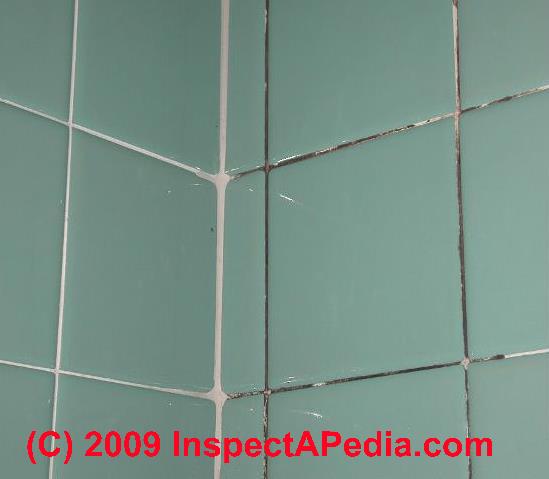
Our photo above shows the most common place to find mold in a bathroom, on the tile grout or caulk.
Do you need to test this brown stuff to identify it as mold
or to identify the mold genera/species? Normally not. The cleanup procedures are the same regardless of the mold identification. However on occasion, there is a reason to test and identify mold growth in buildings.
See MOLD TEST REASONS for details.
Usually this mold is a member of the Cladosporium sp. group, often C. sphaerospermum - among the most common molds found, and possibly allergenic.
 The total area of mold in this case is trivial and unlikely to be harmful to anyone. It is primarily a cosmetic issue.
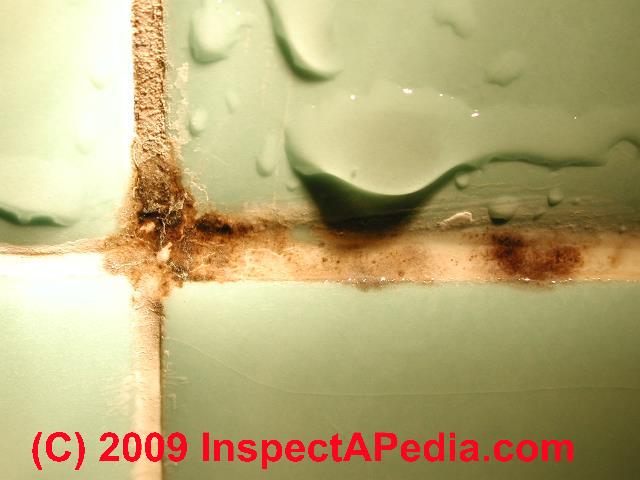
A close up of this bathroom mold on tile grout is shown at in the photo just above/left.
There is no need to perform a mold test to identify small areas of mold such as those shown here. Just remove the mold and correct the conditions that contribute to mold growth.
Whenever cleaning mold, especially when opening a wall or ceiling cavity where you have found leak damage, remain alert for the discovery of a large moldy area (more than 30 sq.ft.). If a large area of mold is discovered, stop work, seal off the work area, and consult a professional.
Our photos above show close ups of moldy bath tile grout.
Mold may also be found in bathrooms on bath caulks (page to photo) and on the surface of ceramic tiles and even toilets and sinks where those surfaces have become coated with soap scum or organic dust and debris.
These molds may appear to be "black mold" but on closer look they are usually brown members of the Cladosporium family.
Hidden Mold in Bathrooms - How to Evaluate the Risk of Harmful and Hidden Bathroom Mold
 A bit of looking around may disclose larger and more problematic mold contamination in bathrooms. Here are some places to look:
- Look for hidden bathroom mold on the back side of wallpaper,
especially above and around or near showers.
Mold genera/species growing on paper surfaces such as on the back side of vinyl wallpaper or on drywall, painted or bare, are more likely to be harmful, possibly airborne species such as Aspergillus or Penicillium as well as the less easily airborne black bath mold Stachybotrys chartarum. - Look for hidden bath mold behind floor trim and in wall cavities
where the floor has been wet, and in the lower portion of wall cavities where floors have been wet. - Hidden bathroom mold may be present in wall cavities
around bath tub or shower controls that have leaked into the wall cavity. If your bathroom provides an access panel to the tub or shower controls from the other side of the wall, remove the panel and look for water stains there. - Bathroom mold may be hidden in the ceiling,
on the ceiling side of drywall around a leaky vent fan or light fixture opening, especially over or near a shower; Bathroom moisture related mold may also be present in other ceiling or attic spaces if the bath vent fan duct has not been properly sloped and routed outdoors.
- Bathroom vanity mold
is often found growing on the back side or under-side of bath vanity cabinets - those un-coated surfaces pick up moisture and invite mold growth, particularly if the vanity is made of chipboard or pressboard.
See our Photo Guide to MOLD UNDER VANITY CABINETS
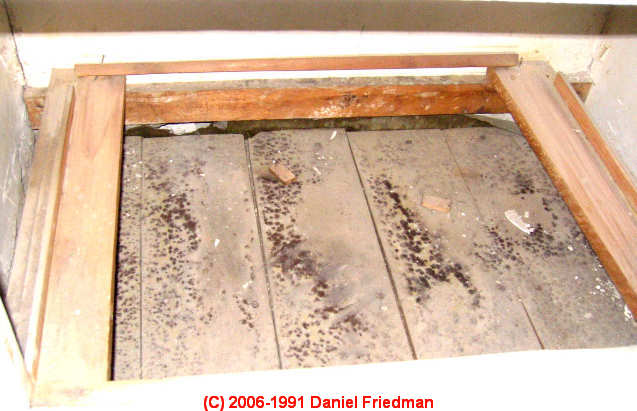
Our photo (above) shows mold found under a built-in bathroom storage chest, visible only after the bottom drawer was removed to expose the wood subflooring. - Insulation mold over bathrooms:
on occasion, especially where a bathroom is not well ventilated or where the occupants do not use the vent fan system (maybe it's too noisy?) we find non-visible mold in ceiling or wall insulation, especially around ceiling penetrations for lights or fans.
See FIBERGLASS INSULATION MOLD for details. - Marble wall mold in baths?
Mold may even be found on hidden drywall surfaces behind solid marble bath walls, as we show in our second case study
of MOLD BEHIND MARBLE or TILE - Mold below bathroom floor tiles?
Mold may be found growing on wood subfloors under bath floor tiles or sheet vinyl flooring if the bathroom floor has been wet or flooded.
If a ceramic bath tile floor has become loose we suggest exploring for damaged subfloors - otherwise simply repairing the tiles may not be a durable fix.
If the bathroom is not on a basement or slab, inspect the ceiling areas below the bathroom for leak stains. Stained areas of drywall ceiling below a leaky bathroom or bath fixture usually merit further investigation.
Photo Guide to Finding Mold Under or Behind Bathroom Vanity Cabinets
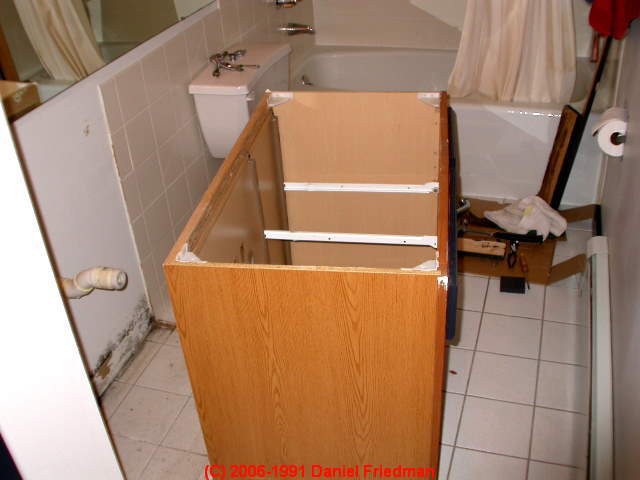
If there has been protracted leakage or spillage under built-in cabinets such as bath vanities, there may be a mold cleanup job under or behind these components.
We removed this bath vanity after receiving complaints of recurrent moldy odor in this bathroom. No amount of cleaning of other bath surfaces had reduced the mold smell. A slight slope in the bathroom floor had been sending tub spillage behind this bath vanity for a decade or more.
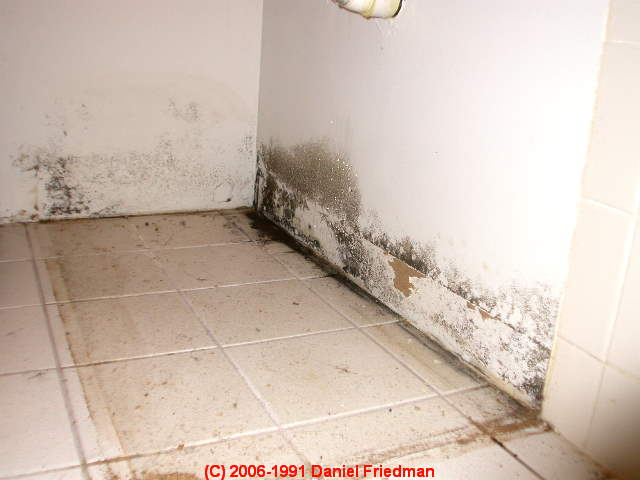
Water spillage was inconsistent - it depended on who used the shower and how much water they splashed onto the floor.
What makes a lot of sense sense is to study the building carefully to decide on the building points at most risk of having been wet from leaks due to construction details or other site observations. That's where one would make a test cut. Like behind the vanity cabinet near the most moldy corner in our photo, above right.
More mold-contaminated cabinets can be seen
at CABINET MOLD & WATER DAMAGE
Also see BROWN HAIRY BATHROOM MOLD for a Q&A on the harmfulness of "hairy brown mold" found in a bathroom.
Identifying & Removing Dense Brown Hairy Mold Found On Bathroom Floor & Under Carpeting
Question: what is this hairy brown mold found in my bathroom? Is brown hairy mold dangerous? How do I get rid of it?
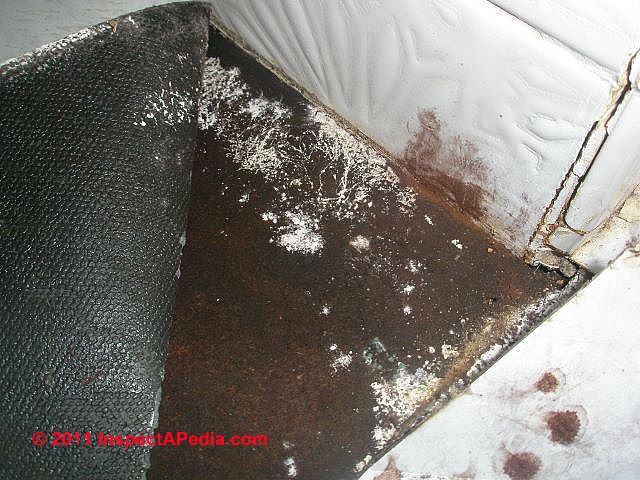
I live in Melbourne Australia and I have a major issue with my bathroom floor. Please see my brown hairy mold photographs (below). The images are of brown mold growths on the bathroom floor, & afterwards when I had scraped them off the floor.
I do understand that no competent expert would pretend to ID mold [or any other microscopic particle] from just a field photo.
But I have no idea what I'm dealing with and of course am concerned for my health and my family's. Can you tell me please - is brown hairy mold dangerous? When I scraped the protrusions off the bathroom floor, it turned into a powder & hair like structures stood on end. I would be most grateful if you could please tell me what this could be and if it is dangerous.
I'm wanting to send a specimen away for analysis & hope that I can locate a government organisation in Australia, such as the Agricultural Department, hopefully they can do this at no cost. - G. P., Melbourne, Australia
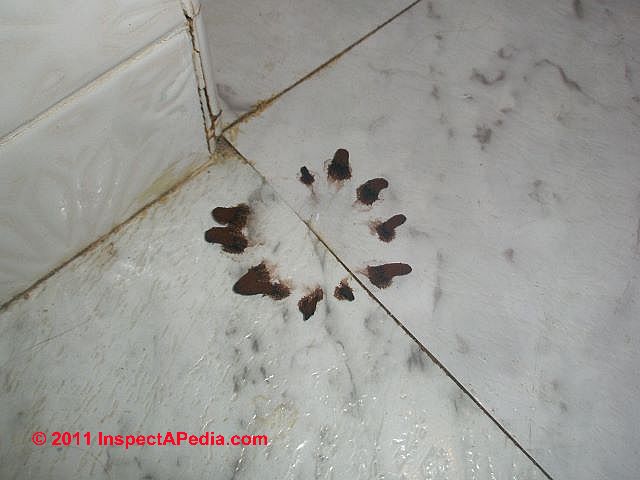
Reply: Examination of fungal material in an aerobiology lab is needed for sure identification of mold
Your photos are blurry and no competent expert would pretend to identify a mold genera or species just from email photos.
But with that caveat stated, the pattern and character of the mold in your photos resembles like a fungus Stemonitis sp.
- see BROWN MOLD PHOTOS where we include photographs of Stemonitis sp. found on a bathroom floor and growing on oriented strand board (OSB) or "waferboard" in a basement.
Enlarging your photos [click any image to see an enlarged version] we see the mold was thick under carpeting (above left) meaning that in at least this area of the building, mold growth, including in hidden cavities such as walls, floors, ceilings, is likely to be extensive.
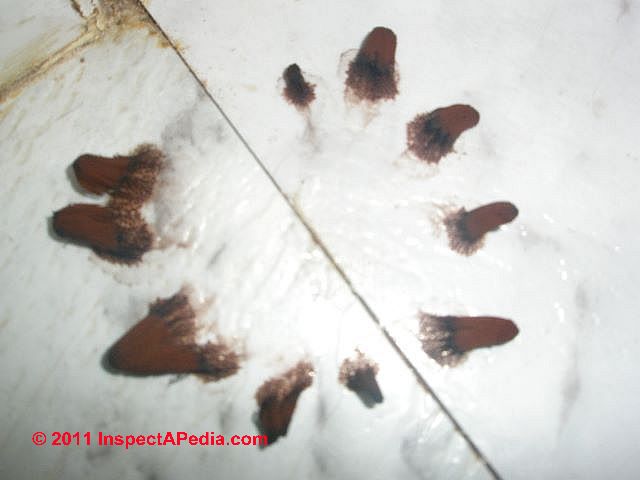
Watch out: And one would certainly expect other leak damage; that "wrinkled" looking floor baseboard trim board - if that's what it is in photo #1 at above left - means there have been leaks and probably rot.
If the mold test lab or aerobiology lab technician who examines a mold test sample you provide is familiar with myxomycetes, s/he should easily recognize the fungus from an actual sample. - you can use the clear adhesive tape sampling procedure
at TEST KIT for DUST, MOLD, PARTICLES: INSTRUCTIONS and send the sample to a qualified local lab of your choice [not to us].
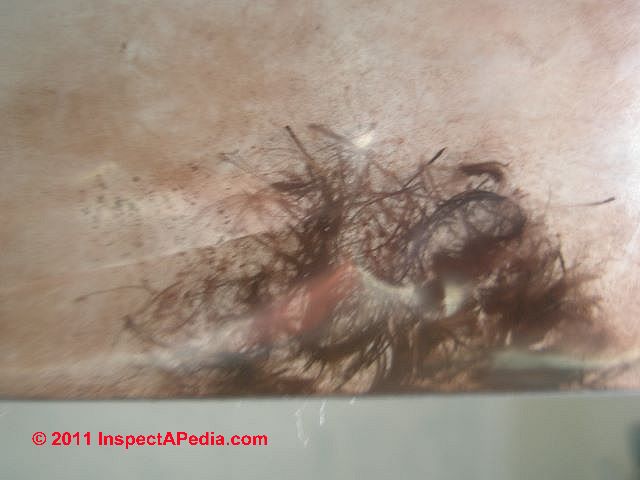
Some Brown Hairy Molds are Probably Harmless
Stemonitis sp. is a Myxomycete ( a class of fungus) that is not listed in our
nor in the authoritative Atlas of Clinical Fungi, deHoog et als. as a known toxic mold but as we warned you earlier, having so much fungal growth and leakage as we saw in that lifted-carpeting photo, you should expect that other genera/species are likely to be present even if you don't see them yourself from a superficial inspection.
Watch out for Other Leaks & Hidden Mold
Watch out: At a minimum you'd be smart to assume there are allergenic molds present and if there is more than about one square meter of moldy material, to use appropriate protection measures during cleanup as well as, of course, finding and correcting the leaks that led to these conditions. In most circumstances it is not necessary to test mold to identify the genera species.
That information will not change how mold should be removed or prevented in buildings. But on occasion, such as for medical reasons or for control of a larger, costly mold remediation project, there are reasons to identify mold on surfaces or in building air or dust.
Reader Comments, Questions & Answers About The Article Above
Below you will find questions and answers previously posted on this page at its page bottom reader comment box.
Reader Q&A - also see RECOMMENDED ARTICLES & FAQs
On 2021-03-05 by (mod)
@Will, that sounds right, it's certainly a common SNAFU
Luckily this is a pretty small area; simple surface cleaning and perhaps use of a fungicidal sealant will surely be sufficient.
See our suggestions at
MOLD CLEANUP - WOOD FRAMING & PLYWOOD
On 2021-03-05 by Will - builder says bath exhaust fan was not properly installled - causing mold growth
As a follow-up, the roofer informed me the bathroom exhaust fan was not properly attached to the tubing. Hence the accumulation of moisture/mold between these 2 rafters in particular! (and nowhere else except for adjacent to the skylight).
One last photo of black discoloration on underside of sheathing and white on the neighboring rafters. The roof repair is ongoing, thus the detached exhaust fan tubing.

Here is another picture of a rafter with maybe "cosmetic" mold.

I recently discovered a leak adjacent to a skylight in my home. A roof contractor determined that both the workmanship of the roof install and quality of materials of the roof install adjacent to the skylight were deficient. He has replaced several areas of rotten sheathing.
There are a few spots on intact lumber where there may be residual mold. This picture shows a representative area on a rafter.

Now that the cause of moisture is presumably fixed, do these areas need to be treated?
On 2020-07-04 - by (mod) - moldy toilet cistern cleanup & prevention
 Photo:
Mold growth in the interior of a toilet cistern or tank: simply cleaning with a household cleaner is in order but if the toilet is running - sometimes a cause of mold growth on condensation surfaces - then the flush valve may also need replacement.
On 2018-09-08 - by (mod) -
No, not unless the condition of the tile and grout is so poor that there have been leaks into the wall. If there are leaks in the wall cavity then there's of course a risk that there could be mold or rot or insect damage there as well.
From just what I seen your photo that would not be high on my suspicions list
On 2018-09-07 by Niigata
Bathtub drainage & grout have black mold. Does this indicate mold BEHIND THE WALL? Thank you.
IMAGE LOST by older version of Clark Van Oyen’s useful Comments code - now fixed. Please re-post the image if you can. Sorry. Mod.
On 2016-12-09 - by (mod) -
Anon:
see
https://inspectapedia.com/Admin/About_InspectApedia.php
But before you copy material from this site please see these (C) warnings and explanation of permitted uses:
https://inspectapedia.com/Admin/Content_Use_Policy.php
On 2016-12-08 by Anonymous
who made this website i need it for research project
Question: white mold in toilet bowl
(July 13, 2014) Anonymous said:
Can mold appear daily as a white fine powder on the side of the toilet bowl
Reply:
(July 14, 2014) (mod) said:
There are white colored mold genera/species but more likely you are seeing a deposit of mineral scale.
Question: we found mold when removing plaster from our SanDiego bathroom
(Aug 6, 2014) Christina said:
We had moisture damage and when my husband removed the plaster we found this. What is it? It's not mold but where do we go from here.
Plumber found there was no failure in bathroom/shower, etc. we don't know where the moisture is coming from but we live in San Diego about 1.5 miles from coast.
Reply:
From e-text alone no one can tell you what you were looking at when plaster was removed.
If you like, use the email at our CONTACT link to send us some sharp photos and we may be able to comment further.
Reader Question: is this stuff in our bathroom black mold?
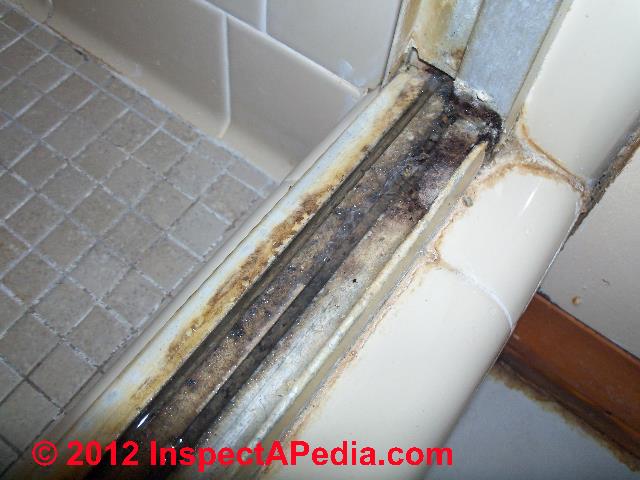 I
I
was wondering if you could tell by the pictures if this is black mold? They are pictures of my shower. The trim by the shower, behind the toilet, is gross too. And on the other side of the wall is another bathroom.
The last picture is of the tile in that bathroom and it has cracked and caved in. If you could take a look, your opinion would be greatly appreciated. - K.L.
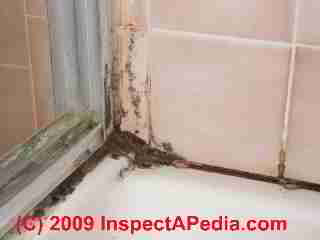
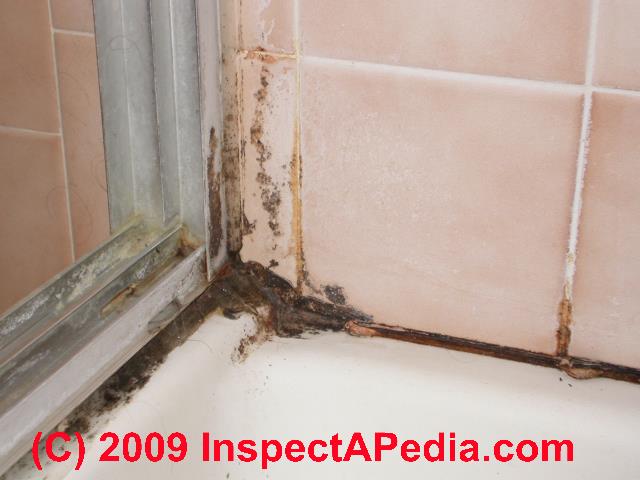
Reply: visible black stuff or mold-suspect materials + evidence of leaks and water spillage can be a clue that says look more carefully for leak damage and hidden mold in buildings
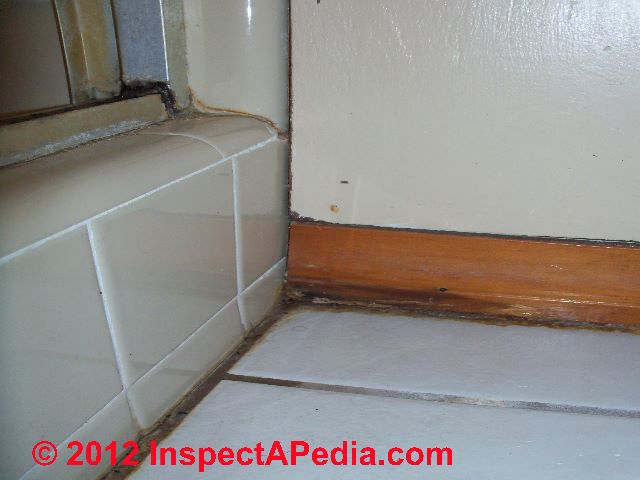 A competent onsite inspection by an expert usually finds additional clues that help accurately diagnose a problem with leaks, mold, and hidden mold.
That said, here are some things to consider:
A competent onsite inspection by an expert usually finds additional clues that help accurately diagnose a problem with leaks, mold, and hidden mold.
That said, here are some things to consider:
- We cannot reliably identify mold, harmful in particular, from just your photos.
Sometimes a close-up, more sharply focused, of mold-suspect material on a surface can unequivocally be identified as "mold" without of course permitting identification of the mold genera/species.
But nevertheless, your photos show wet deteriorated conditions in a bathroom, leaks around a shower door, onto the wall and floor and floor trim. - Those conditions make some mold growth likely
; such as on grout, possibly on tile, more likely too on wood, and on drywall, and possibly in wall cavities that have been wet - an area hidden from view. - In sum, it's likely that there is some mold in your bathroom;
But I did not see in your photos any large mold area. - Take a look at MOLD APPEARANCE - WHAT MOLD LOOKS LIKE for help in recognizing mold growth in buildings.
Also see MOLD / ENVIRONMENTAL EXPERT, HIRE ? for help in figuring out if you need to bring in a mold professional - not something that appears to be the case from your photos.
Watch out: don't assume that all "black mold" is harmful nor that it is the most important mold in your home. While some dark colored molds are indeed potentially harmful, others can be insignificant or even simply of cosmetic concern.
However the conditions that produced the mold growth that you see can indeed have produced other, less easy to spot, molds, including hidden mold in building cavities or light colored but harmful molds that move throughout building air (such as Aspergillus sp. or Penicillium sp.) and that could be of more concern.
If you have a small area of mold or even mold-suspect material (less than 30 sq ft or less than 10 ft by some EPA sources with which I disagree) then spending on testing or professional clean-up are not normally appropriate, with the warning that if in the course of ordinary cleaning and renovations you discover a larger reservoir, a professional should be consulted.
...
Continue reading at MOLD CLEANUP GUIDE- HOW TO GET RID OF MOLD or select a topic from the closely-related articles below, or see the complete ARTICLE INDEX.
Or see these
Recommended Articles
- BATHROOM MOLD REMOVAL / PREVENTION - get rid of bathroom mold and keep it away
- BROWN HAIRY BATHROOM MOLD - growing from wood subfloor or other organic surfaces
- MOLD BEHIND MARBLE or TILE - hidden mold contamination
- MOLD in BUILDINGS how to find mold and test for mold in buildings
- MOLD CLEANUP GUIDE- HOW TO GET RID OF MOLD
- MOLD on TOILETS URINALS & OTHER PLUMBING FIXTURES - photos
- WATER DAMAGED BATHROOM FLOOR REPAIR
Suggested citation for this web page
BATHROOM MOLD at InspectApedia.com - online encyclopedia of building & environmental inspection, testing, diagnosis, repair, & problem prevention advice.
Or see this
INDEX to RELATED ARTICLES: ARTICLE INDEX to MOLD CONTAMINATION & REMEDIATION
Or use the SEARCH BOX found below to Ask a Question or Search InspectApedia
Ask a Question or Search InspectApedia
Try the search box just below, or if you prefer, post a question or comment in the Comments box below and we will respond promptly.
Search the InspectApedia website
Note: appearance of your Comment below may be delayed: if your comment contains an image, photograph, web link, or text that looks to the software as if it might be a web link, your posting will appear after it has been approved by a moderator. Apologies for the delay.
Only one image can be added per comment but you can post as many comments, and therefore images, as you like.
You will not receive a notification when a response to your question has been posted.
Please bookmark this page to make it easy for you to check back for our response.
Our Comment Box is provided by Countable Web Productions countable.ca
Citations & References
In addition to any citations in the article above, a full list is available on request.
- Fungi, Identifying Filamentous, A Clinical Laboratory Handbook, Guy St-Germain, Richard Summerbell, Star Publishing, 1996, ISBN 0-89863-177-7 (English)
- Mycology, Fundamentals of Diagnostic, Fran Fisher, Norma B. Cook, W.B. Saunders Co. 1998, ISBN 0-7216-5006-6
- Our recommended books about building & mechanical systems design, inspection, problem diagnosis, and repair, and about indoor environment and IAQ testing, diagnosis, and cleanup are at the InspectAPedia Bookstore. Also see our Book Reviews - InspectAPedia.
- In addition to citations & references found in this article, see the research citations given at the end of the related articles found at our suggested
CONTINUE READING or RECOMMENDED ARTICLES.
- Carson, Dunlop & Associates Ltd., 120 Carlton Street Suite 407, Toronto ON M5A 4K2. Tel: (416) 964-9415 1-800-268-7070 Email: info@carsondunlop.com. Alan Carson is a past president of ASHI, the American Society of Home Inspectors.
Thanks to Alan Carson and Bob Dunlop, for permission for InspectAPedia to use text excerpts from The HOME REFERENCE BOOK - the Encyclopedia of Homes and to use illustrations from The ILLUSTRATED HOME .
Carson Dunlop Associates provides extensive home inspection education and report writing material. In gratitude we provide links to tsome Carson Dunlop Associates products and services.
 | HOME | ABOUT | ASK a QUESTION | CONTACT | CONTENT USE POLICY | DESCRIPTION | POLICIES | PRIVACY | |
| © 2024 - 1985 Publisher InspectApedia.com - Daniel Friedman | |||||||||