
InspectAPedia® FREE Encyclopedia of Building & Environmental Construction, Diagnosis, Maintenance & Repair |
Question? Just ask us! InspectAPedia
|
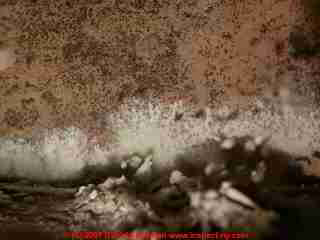 Brown Mold Growth in the Home
Detection and identification of brown mold or mushroom contamination in buildings

- POST a QUESTION or COMMENT about brown mold in buildings; should you buy a moldy house?
What does brown mold look like when found growing indoors? Brown mold identification photographs - building mold.
These mold spores and their photographs and examples of materials sometimes mistaken for mold have been collected in the U.S., Spain, Mexico, France, as well as in other countries where I've studied bioaerosols.
These photos of mold on indoor building surfaces may help you recognize mold in buildings, recognize probably-cosmetic mold, and recognize stuff that is not mold and does not need to be tested.
InspectAPedia tolerates no conflicts of interest. We have no relationship with advertisers, products, or services discussed at this website.
Photographs to Help Identify Mold in buildings
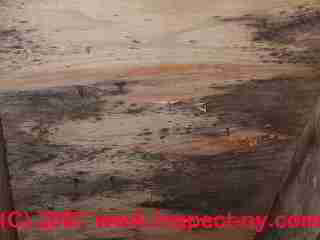 What brown or tan mold looks like in a home or other buildings
Among the 1.5 million mold species, there are a great many that may be found in buildings and that are brown or tan in color. Some of these brown molds, also sometimes appearing black, and commonly found indoors include Aureobasidium pullulans, Taeoniella sp., and even the very common Pithomyces chartarum.
Most of these are wood rot causing fungi and they appear where wood framing or building sheathing have been exposed to wet conditions.
Brown mold can be easily seen on building surfaces but it cannot be reliably identified to genera/species without analysis by a qualified aerobiologist/microscopist in a test lab.
Identification Photographs of Brown Mold in buildings
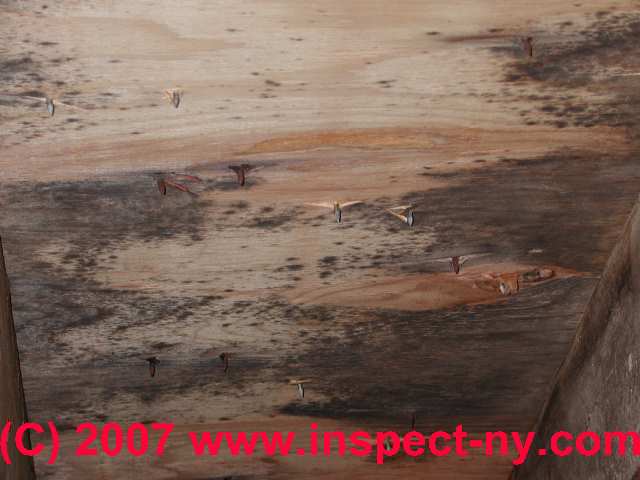
Brown mold on plywood roof sheathing [photo] in an exposed to leaks or moisture problems is one of the most common molds spotted by home inspectors. In this particular attic a sample was collected using our tape sampling method.
Our lab determined that in the case of the photo shown just above, the brown mold was predominantly Aureobasidium pullulans which is at most, an allergenic, non-toxic mold. (Often in attics we also find Aureobasidium pullulans which looks about the same, or a little darker on plywood or framing.)
Very frequently when we are asked to investigate a building where this condition has been observed, we discover that there is a more serious problem with Aspergillus sp. or Penicillium sp. mold contaminated-insulation - a condition that was missed in the initial investigation.
 Inspectors or mold remediators who call for roof replacement in a case where the plywood is not actually
damaged (delaminating) from leaks are overreacting to the "toxic black mold" they think they see, and
they are failing to identify the more serious problem that may be present.
Inspectors or mold remediators who call for roof replacement in a case where the plywood is not actually
damaged (delaminating) from leaks are overreacting to the "toxic black mold" they think they see, and
they are failing to identify the more serious problem that may be present.
As you can see in this photo of very dark mold in an attic [photo] in a wet attic these mold groups, which are "brown" in the microscope, can look pretty "black" on the plywood.

As we point out in other comments throughout our website, the public, media, and "mold inspector" focus on "toxic black mold" in buildings is often unfortunate as it fails to address more serious problems.
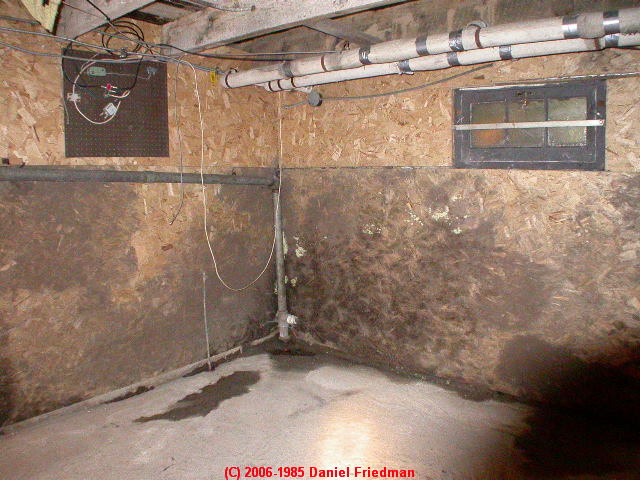
Brown mold on Oriented Strand Board (OSB) wallboard [photo] in a basement exposed to prolonged wet conditions.
This mold was, on lab testing, predominantly Cladosporium sphaerospermum which is at most, an allergenic, non-toxic mold.
Small colonies of a few square inches each of other more problematic molds and yeasts were also present.
Remediation included simply discarding this material.
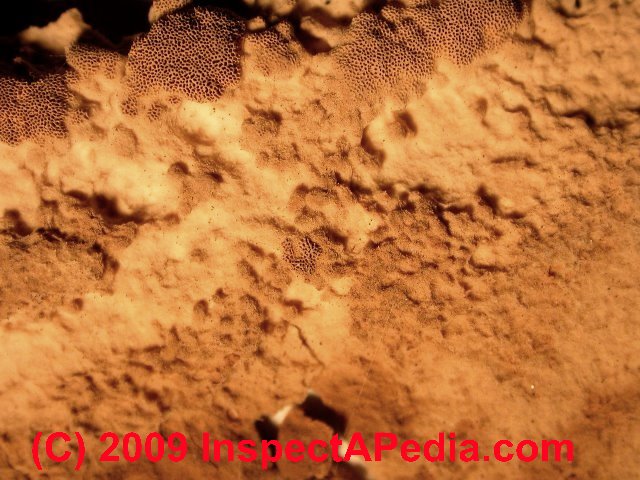
Our brown mold photo above t was obtained in a flooded basement where wooden paneling had been quite wet.
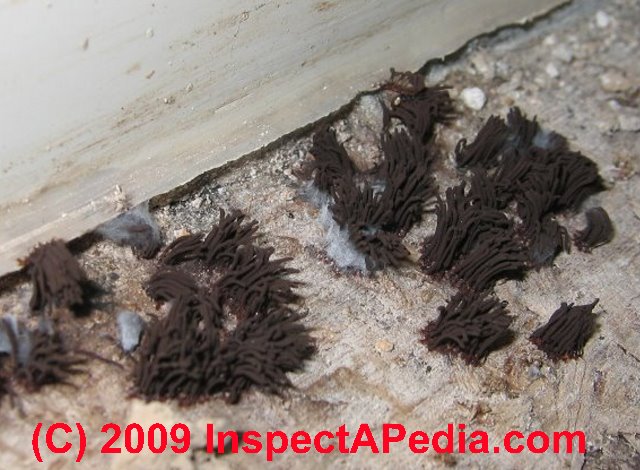
Brown Stemonitis sp. growing on oriented strand board (OSB) subflooring in an un-finished bathroom, above, is one of our more photogenic mold species.
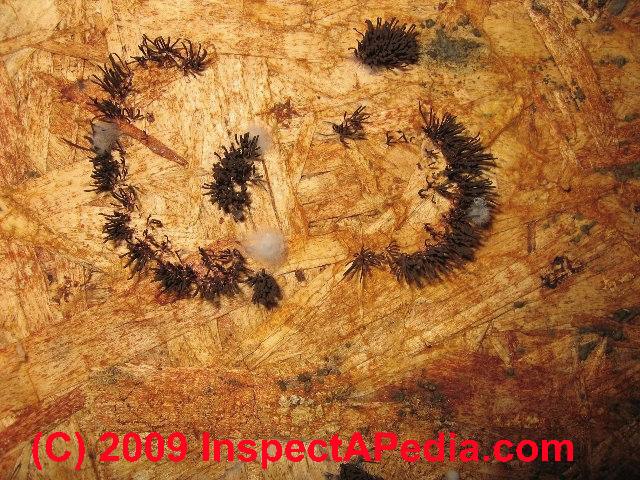
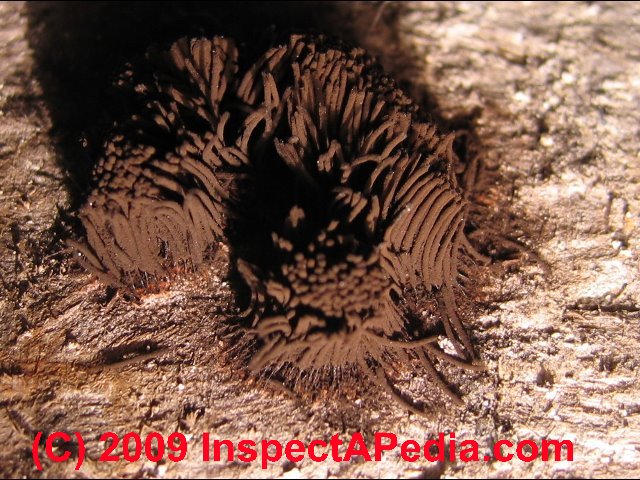
Brown Stemonitis sp. mold growing on oriented strand board (OSB) subflooring in a condominium subjected to wet conditions over many months is shown in close ups in our two photographs above and below.
More photographs of white and brown Stemonitis sp. fungal growth in bathrooms are shown and discussed
and also
at RENTAL APARTMENT MOLD SAFETY ADVICE.

Above and below we include additional photographs of Stemonitis sp. details from our forensic lab. Above is a light gray-brown Stemonitis slime mold or "pipe cleaner" fungus that we collected on tree bark.
Though it may occur, we have not found this light gray-brown Stemonitis species in buildings.
At below left is the capillum or "hair net" that holds the Stemonitis spores until the net is ruptured (easily by touch) to release spores.
At below right are Stemonitis sp. mold spores.
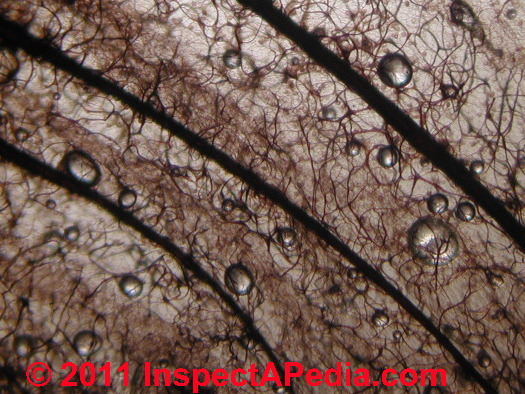
Watch out: some brown molds (or molds of other colors too) may be white at some growth stages or may include white components such as their mycelia.
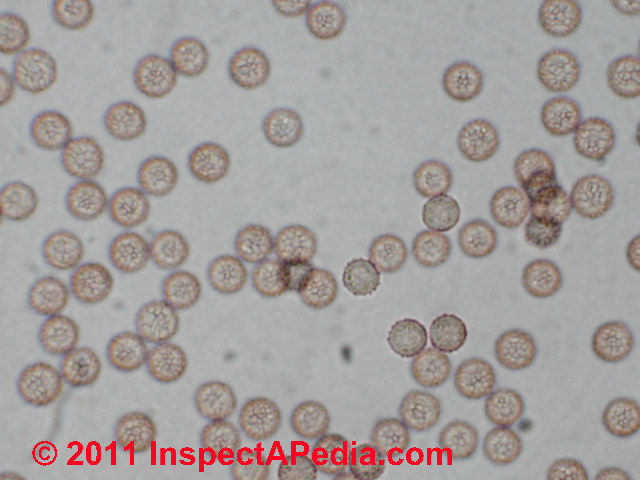
Also review RENTAL APARTMENT MOLD SAFETY ADVICE. for some examples of the white colored stage of Stemonitis sp.
Brown Mushrooms Growing On or In Buildings & Building Materials
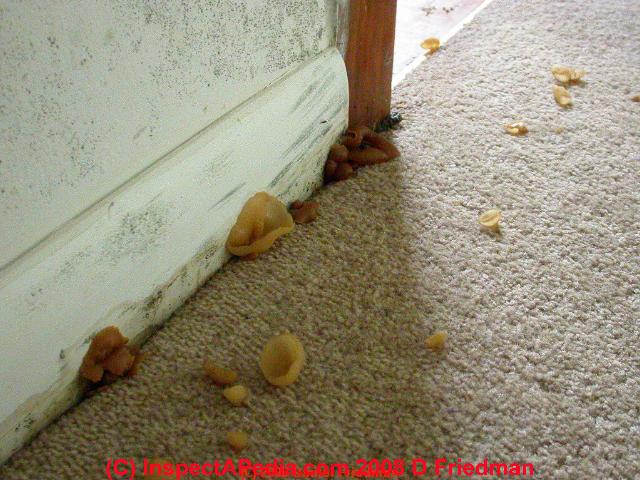
Brown fungus growing out of carpeting and floor trim combined with green mold on the exposed surface of drywall were conditions easily seen, and under which we assumed that the wall cavities were likely to be mold-contaminated in this area.

If you see mushrooms growing out of a building surface it's a safe bet that conditions have been quite wet and there is high probability of additional and substantial hidden mold growth and perhaps rot (and insect damage) in building cavities and in nearby wood structural members or subflooring.
Typically basidiomycetes or wood-rotting fungi grown on wet wood and can appear rather quickly even indoors in wet conditions. These fungal fruiting bodies may appear in any of many colours, commonly brown, white, red, even blue or very dark, almost black. More examples of mushrooms growing in or on buildings are
and
at MOLD on DIRT FLOORS - separate article, includes white mold on dirt in crawl spaces & basements
More Examples of Brown Mold Contamination in Buildings
Also see BROWN HAIRY BATHROOM MOLD for a Q&A on the harmfulness of "hairy brown mold" found in a bathroom.
Question: I'm looking at a home with mold damage, should I avoid buying it?
I am thinking about buying a house, but has a brown fluffy mold on most of the floor joists, and it looks like the pictures you have
of BROWN MOLD PHOTOS on OSB.
Since taking the joists out will not happen, would it be wise to stay away from this house cost wise? The mold 's brown and fluffy, and I found a few salamanders under there as well. Please help - Skyler
Reply: How to avoid buying a home that ends up under water
A competent onsite inspection by an expert usually finds additional clues that help accurately diagnose a problem. That said, here are some things to consider:
The mold you see may be the tip of an iceberg of bigger mold contamination, leak damage, rot. Finding salamanders in a crawl space or basement are a sure sign that there has been a serious water entry or leak problem.
That's why you need a competent, thorough inspection.
I can't say you should or should not buy a house that needs mold remediation or any other repair - but my OPINION is that the relevant questions are?
Does the price of the home reflect the repair work needed?
Will cost of making the house livable price it out of the current marketplace compared with similar homes in the neighborhood?
Do you have the time and energy to manage the work needed, or do you have someone you trust to do it for you ?
If you like the house, its price, and the neighborhood, and if you are willing to handle the repair work needed, you still should not proceed with the purchase before you have a reasonably accurate idea of the extent of repair work that will be needed - that's what can help keep you from getting in over your head and ending up with a house that is "under water".
Reader Comments, Questions & Answers About The Article Above
Below you will find questions and answers previously posted on this page at its page bottom reader comment box.
Reader Q&A - also see RECOMMENDED ARTICLES & FAQs
On 2020-09-09 by (mod) - what's this brown stuff at the window sill?
 Looks like fungal growth, perhaps Stemonitis,
Discussed at BROWN HAIRY BATHROOM MOLD
Search our website for
Brown hairy mold to see other articles on this fungus.
On 2020-09-09 by Gs
Can anyone identify this growth?
On 2020-06-14 by (mod) - trivial amount of mold visible but look further for a larger hidden reservoir
Kristin
The volume of mold in the photo, if that were all of the building mold, would be trivial.
Watch out: But of course the leak that caused that mold growth (we're seeing the fruiting body of the fungus) may have caused more extensive and thus hazardous hidden mold in the floor or wall. Investigate further.
On 2020-06-09 by Kristin Williams
Is this Brown Mold and is it dangerous?

On 2020-06-07 by (mod) -
 Marie,
That looks like a fungus, perhaps a Stemonitis mold, telling us that there's a leak into the wall trim and possibly the wall cavity - further investigation is warranted.
Fix the gutter leaks and look inside the building for leak stains or measure for moisture at the ceiling-wall intersection in this area.
It may be necessary to cut a small inspection opening in that area.
On 2020-06-07 by tdavis52 - Marie Smith
Any idea what this is?
This grew on the outside of my garage overnight. It is wet and a dark purple color. Any idea what it is?
On 2020-01-12 by (mod) -
Some molds - regardless of color - are harmful to people of all ages, with some populations such as infant, elderly, asthmatic, immune-impaired at greater risk
Stemonitis is not itself particularly toxic but may be allergenic; Check with your doctor
On 2020-01-12 by Anonymous
Is it toxic to toddlers
On 2018-09-29 - by (mod) -
That looks like stemonitis, a brown, rather hairy looking mold growth. It's not that the fungus is a high risk health hazard but that it's an indicator of wet conditions which of course means that there may be other hidden damage or other hidden mold growth.
On 2018-09-29 by Anonymous
IMAGE LOST by older version of Clark Van Oyen’s Comments Box code - now fixed. Please re-post the image if you can. Sorry. Mod.
...
Continue reading at BROWN HAIRY BATHROOM MOLD - topic home, or select a topic from the closely-related articles below, or see the complete ARTICLE INDEX.
Or see BROWN MOLD PHOTO ID FAQs - questions & answers posted originally at this page.
Or see these
Recommended Articles
- BROWN MOLD PHOTOS
- BROWN HAIRY BATHROOM MOLD - topic home
- MOLD APPEARANCE - WHAT MOLD LOOKS LIKE - a Photo ID Library for detection and identification of mold allergens on indoor building surfaces.
- MOLD APPEARANCE - STUFF THAT IS NOT MOLD
- MOLD ATLAS & PARTICLES INDEX for an atlas of building molds and for more microphotographs of building mold samples observed in our laboratory.
- MOLD GROWTH on SURFACES, PHOTOS
- MOLD RELATED ILLNESS SYMPTOMS - details about specific mold genera/species and their health effects.
- ROT TYPES, BROWN SOFT WHITE
Suggested citation for this web page
BROWN MOLD PHOTOS at InspectApedia.com - online encyclopedia of building & environmental inspection, testing, diagnosis, repair, & problem prevention advice.
Or see this
INDEX to RELATED ARTICLES: ARTICLE INDEX to MOLD CONTAMINATION & REMEDIATION
Or use the SEARCH BOX found below to Ask a Question or Search InspectApedia
Ask a Question or Search InspectApedia
Try the search box just below, or if you prefer, post a question or comment in the Comments box below and we will respond promptly.
Search the InspectApedia website
Note: appearance of your Comment below may be delayed: if your comment contains an image, photograph, web link, or text that looks to the software as if it might be a web link, your posting will appear after it has been approved by a moderator. Apologies for the delay.
Only one image can be added per comment but you can post as many comments, and therefore images, as you like.
You will not receive a notification when a response to your question has been posted.
Please bookmark this page to make it easy for you to check back for our response.
Our Comment Box is provided by Countable Web Productions countable.ca
Citations & References
In addition to any citations in the article above, a full list is available on request.
- [1] Field Guide to Mushrooms, Lincoff, Gary H., Carol Nehring, National Audobon Society, Alfred A. Knopf, 2000, ISBN 0-394-51992-2
- Our recommended books about building & mechanical systems design, inspection, problem diagnosis, and repair, and about indoor environment and IAQ testing, diagnosis, and cleanup are at the InspectAPedia Bookstore. Also see our Book Reviews - InspectAPedia.
- Kansas State University, department of plant pathology, extension plant pathology web page on wheat rust fungus: see http://www.oznet.ksu.edu/path-ext/factSheets/Wheat/Wheat%20Leaf%20Rust.asp
- A BRIEF GUIDE to MOLD, MOISTURE, and YOUR HOME, [PDF] U.S. Environmental Protection Agency US EPA - includes basic advice for building owners, occupants, and mold cleanup operations. See http://www.epa.gov/mold/moldguide.htm
- "IgG Food Allergy Testing by ELISA/EIA, What do they really tell us?" Sheryl B. Miller, MT (ASCP), PhD, Clinical Laboratory Director, Bastyr University Natural Health Clinic - ELISA testing accuracy: Here is an example of Miller's critique of ELISA - www.betterhealthusa.com/public/282.cfm - Townsend Letter for Doctors and Patients
The critique included in that article raises compelling questions about IgG testing assays, which prompts our interest in actually screening for the presence of high levels of particles that could carry allergens - dog dander or cat dander in the case at hand.
- www.tldp.com/issue/174/IgG%20Food%20Allergy.html - contains similar criticism in another venue but interestingly by the same author, Sheryl Miller. Sheryl Miller, MT (ASCP), PhD, is an Immunologist and Associate Professor of Basic and Medical Sciences at Bastyr University in Bothell, Washington. She is also the Laboratory Director of the Bastyr Natural Health Clinic Laboratory. - Allergens: Testing for the level of exposure to animal allergens is discussed at http://www.animalhealthchannel.com/animalallergy/diagnosis.shtml (lab animal exposure study is interesting because it involves a higher exposure level in some cases
- Allergens: WebMD discusses allergy tests for humans at webmd.com/allergies/allergy-tests
- Atlas of Clinical Fungi, 2nd Ed., GS deHoog, J Guarro, J Gene, & MJ Figueras, Centraalbureau voor Schimmelcultures, Universitat Rovira I Virgili, 2000, ISBN 90-70351-43-9
- "Management of Powdery Mildew, Leveillula taurica, in Greenhouse Peppers," Ministry of Agriculture and Lands, British Columbia - Original source: www.agf.gov.bc.ca/cropprot/peppermildew.htm
- Fifth Kingdom, Bryce Kendrick, ISBN13: 9781585100224, - we recommend the CD-ROM version of this book. This 3rd/edition is a compact but comprehensive encyclopedia of all things mycological. Every aspect of the fungi, from aflatoxin to zppspores, with an accessible blend of verve and wit. The 24 chapters are filled with up-to-date information of classification, yeast, lichens, spore dispersal, allergies, ecology, genetics, plant pathology, predatory fungi, biological control, mutualistic symbioses with animals and plants, fungi as food, food spoilage and mycotoxins.
- Fungi, Identifying Filamentous, A Clinical Laboratory Handbook, Guy St-Germain, Richard Summerbell, Star Publishing, 1996, ISBN 0-89863-177-7 (English)
- In addition to citations & references found in this article, see the research citations given at the end of the related articles found at our suggested
CONTINUE READING or RECOMMENDED ARTICLES.
- Carson, Dunlop & Associates Ltd., 120 Carlton Street Suite 407, Toronto ON M5A 4K2. Tel: (416) 964-9415 1-800-268-7070 Email: info@carsondunlop.com. Alan Carson is a past president of ASHI, the American Society of Home Inspectors.
Thanks to Alan Carson and Bob Dunlop, for permission for InspectAPedia to use text excerpts from The HOME REFERENCE BOOK - the Encyclopedia of Homes and to use illustrations from The ILLUSTRATED HOME .
Carson Dunlop Associates provides extensive home inspection education and report writing material. In gratitude we provide links to tsome Carson Dunlop Associates products and services.
 | HOME | ABOUT | ASK a QUESTION | CONTACT | CONTENT USE POLICY | DESCRIPTION | POLICIES | PRIVACY | |
| © 2024 - 1985 Publisher InspectApedia.com - Daniel Friedman | |||||||||