
InspectAPedia® FREE Encyclopedia of Building & Environmental Construction, Diagnosis, Maintenance & Repair |
Question? Just ask us! InspectAPedia
|
 Cat Allergies: How to Remove or Prevent Cat Dander / Allergens in buildings

- POST a QUESTION or COMMENT about cat allergies, cat dander, cat urine, odors, and related building indoor air quality and health issues
Guide to cat dander & allergens:
This article discusses methods to remove or clean up cat dander and allergens in a building, how to prevent cat dander from spreading between building areas, hypo-allergenic or non-allergenic cat breeds, and other measures to lower the level of airborne cat allergens and other airborne particles indoors.
Cat Dander: how to remove and stop the spread of allergic cat dander from current or previous presence of cats, cat hair, cat dander, and cat allergens indoors. What breeds of cat are least allergic? Why is cat dander so allergenic?
InspectAPedia tolerates no conflicts of interest. We have no relationship with advertisers, products, or services discussed at this website.
How to remove or clean up cat allergens: what to do about high levels of cat dander, cat hair, cat allergens in a building
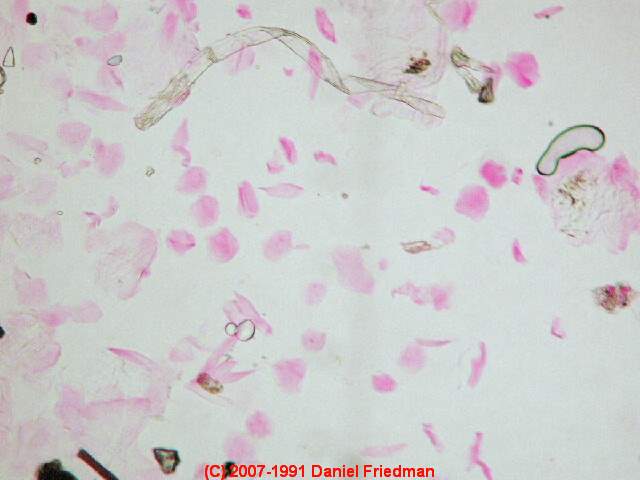
[Click to enlarge any image]
If we find that there is evidence of a high level of cat dander or other problem allergens in the building dust, we could design a cleaning regimen that can substantially reduce those levels, ranging from discard of materials to HEPA vacuuming to washing certain surfaces.
As this can get costly I wouldn't do so unless needed.
We might also suggest some special measures for more ordinary house cleaning such as buying a HEPA-rated house vacuum cleaner, reduction or elimination of wall to wall carpeting, and a regular cleaning schedule.
If there appear to be building related health or allergy complaints after cleaning we can suggest additional measures to reduce the allergen level indoors, and perhaps, (let's hope it's not needed) recommend a more thorough building investigation for other problem sources.
8 Steps to Reduce the Level of Cat Dander & Allergens Indoors
So unless no one (humans too, not just cats) will ever pass from the basement apartment into the upstairs of the building, it is likely that at least some cat dander will enter the home by that route. Here are some suggestions that should help reduce the allergenicity of your home if cats are living in the basement:
- Venting the central vac to outdoors is a good idea not only because it vents cat dander and other particles outside, but because during housecleaning you are avoiding stirring up indoor dust from the vacuum exhaust. Is your central vac a HEPA-rated unit?
- Your electrostatic air cleaner will reduce the particle level in conditioned air in the building. You might improve indoor air quality by other improved filtration steps. You can be sure that with a single common HVAC system heating (and perhaps air conditioning) the home using conditioned air, particles (including cat dander) from a basement apartment will certainly be continuously entering the air handler and ductwork.
The most effective method of reducing the level of indoor airborne particles we have found involved use of cascaded air filters
see HOW to CASCADE AIR FILTERS
and operation of the blower fan or air handler continuously so that air is continuously being filtered by the central air system.
See INDOOR AIR QUALITY IMPROVEMENT GUIDE and in
particular AIR FILTERS for HVAC SYSTEMS
and AIR FILTERS, OPTIMUM INDOOR. - Fresh air or balanced ventilation could improve the indoor air quality in the building still further (than the cascaded and improved air filtration) and might be worth considering
See VENTILATION, BALANCED - Clean the building non-cat areas: if you have not already done so, you should clean thoroughly by HEPA vacuuming and wiping the entire upstairs area after the cat-isolation methods have been taken.
- Clean the HVAC system? if you have never done so, it's probably worth having the existing duct system and air handler professionally cleaned - provided that your duct work is metal and can be cleaned.
- Get rid of carpeting?: in our OPINION, it is just about impossible to prevent high levels of indoor dust particles, including allergens, if your home contains wall-to-wall carpeting. Vacuuming carpets makes the level of airborne particles worse if the vacuum itself is leaky or not HEPA rated.
- Create a "clean zone" where your daughter will spend the most time - typically her bedroom. Remove carpeting, use blinds rather than curtains, keep the door shut, and clean this room with care.
- Some cats produce considerably less allergens in their saliva and sebaceous glands than others, including (we have read), Abyssinian cats and better still, Siberian cats. You might ask what breed of cats will be living in the apartment below.
Watch out: it may be a mistake to focus attention only on cat dander if a building occupant suffers from allergies. Check with your daughter's allergist or pulmonologist to discuss what other allergens, particles or chemicals, should be avoided. Otherwise you may address the cat dander question and find that your daughter still suffers in the home - but for other reasons.
More information: see BIOLOGICAL POLLUTANTS.
[Disclosure: I (DF) like cats and have often been owned-by or lived in homes where cats were present, even though I suffered terribly from cat allergies as a child. This advice comes from both a cat fancier and a cat-allergic person.]
Watch out: it may be a mistake to focus attention only on cat dander if a building occupant suffers from allergies. Check with your daughter's allergist or pulmonologist to discuss what other allergens, particles or chemicals, should be avoided. Otherwise you may address the cat dander question and find that your daughter still suffers in the home - but for other reasons.
Is it Possible to Clean & Isolate Cat Dander in buildings Enough to Avoid Cat Allergy Trouble?
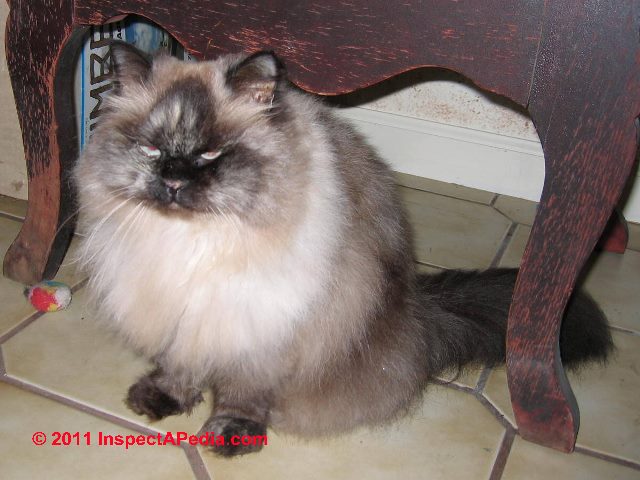
Reader question: I have a quick question I would really appreciate your opinion/best guess. I have a home that I created a basement apartment in a home with gas forced air heating.
potential tenant has 2 cats. My daughter who visits for as much as a week every couple months is allergic to cats she has lived in her in-laws home with cats for long weekends.
The result being a stuffy/plugged up nose. In your opinion, with
- a central vacuum system (exhausts to the outside),
- with a powered good electrostatic air cleaner (I created an excellent seal between the filter and the ductwork at the furnace),
- very good seal and good filter changing technique, and
- the cats always contained to the downstairs area.
Do you feel this is enough isolation to prevent significant problems for my daughter?
Thanks so much for your help. - B.A.
Reply: You can Reduce but Not Eliminate Cat Dander Allergy Problems in a Home Where Cats are Present
By email, with no specific building inspection nor test data, and not being an allergist, one cannot reliably assure that your cat-allergic daughter won't have complaints when in this home. The sensitivity of individuals and of course their exposure to allergens just varies too widely. But it is possible to give reasonable general advice about lowering or minimizing the exposure to cat allergens in a building.
Presuming that by "downstairs" area you refer to a basement apartment that is isolated from the rest of the home, all of the steps you suggested [above] are in our OPINION, all good ones, but in our experience it is just about impossible to completely eliminate cat dander from non-cat areas of a building.
In sum, animal dander such as cat or dog dander that is concentrated in the portion of a building to which the animal is physically restricted will nevertheless migrate to other building areas. Dander particles move in air flow, via HVAC systems, ventilation systems, and attached to the shoes or clothing of people moving between building areas.
Cat dander migration example: in testing an office where a worker complained of cat allergies and suspected high levels of cat allergens, the most significant reservoir of cat dander we found was on a sweater draped over a worker's desk chair. The worker lived in a home with cats. The chair itself was the second highest source of cat dander particles in that work area. The cat had never been in the office space itself!
Cat Dander (and animal dander in general) is Widespread
What do you "get" if you vacuum a cat? Most cats will not volunteer to be vacuumed, though we've met a few who didn't mind. What you get, according to our field and lab tests, if you vacuum a (willing) cat includes: cat hair, cat dander, and typically some pollen, a few dust mite fecals, and common house dust particles.
We have found by field and lab testing that cat dander is present (albeit at low levels) even in buildings where no cats live. The allergenic component of cat dander is Feline D-1 or Fel-D1, a glycoprotein that combines with cat dander (cat skin flakes).
When a cat grooms her/himself and when cat saliva (from grooming, and which contains Fel-D1) combines with additional Fel-D1 produced by cats' sebaceous glands. Fel-D1 is also written Fel d-1 and Fel D 1).
But put more simply, a glycoprotein found on cat skin flakes or cat dander, is a bothersome allergen to some people.
These cat dander particles, which is basically cat skin flakes, are often "hooked" or sharply irregular in shape, helping these particles to travel from building to building on people and their possessions, from cat-areas to non-cat areas.
While reducing the level of cat dander in the space to be occupied by the cat-allergic person (your daughter) will be helpful, it's tough to predict how she'll react in the home.
We have encountered individuals who were sensitive to very low levels of specific particles in buildings, including animal dander as well as mold and other allergens.
At ALLERGENS in buildings, RECOGNIZING we discuss and provide photos of common indoor allergenic particles found in homes and in the work place.
At ALLERGEN TESTS for BUILDINGS we discuss testing buildings for the presence of animal allergens or other allergens such as insect fragments or fecals.
Also see REDUCING PET ALLERGENS
Also see ANIMAL or URINE ODOR SOURCE DETECTION for suggestions about removal of pet odors. We give in-depth information about indoor air quality problems: causes of respiratory illness, asthma, or other symptoms such as neurological or psychological problems, air quality investigation methods, and remediation procedures such as mold cleanup, handling toxic mold contamination, and building or mechanical system repairs.
...
Continue reading at CAT DANDER in BUILDINGS or select a topic from the closely-related articles below, or see the complete ARTICLE INDEX.
Or see these
Recommended Articles
- ALLERGENS in BUILDINGS - home
- ALLERGEN TESTS for BUILDINGS
- ALLERGY & MOLD IAQ & CLEANING PRODUCTS
- ALLERGY TESTS for PEOPLE
- ALLERGY TEST ACCURACY
- ANIMAL ALLERGENS / PET DANDER
- ANIMAL DAMAGE to BUILDINGS - home
- ANIMAL or URINE ODOR SOURCE DETECTION
- ANIMAL or URINE ODOR REMOVAL
- BIOLOGICAL POLLUTANTS
- CARPETING & INDOOR AIR QUALITY
- CAT DANDER in BUILDINGS
- CAT DANDER REMOVAL
- DUST ANALYSIS for FIBERGLASS
- DUST SAMPLING PROCEDURE
- FIBER & HAIR IDENTIFICATION
- LIGHT, GUIDE to FORENSIC USE
- OZONE MOLD / ODOR TREATMENT WARNINGS
- UV LIGHT BLACK LIGHT USES
Suggested citation for this web page
CAT DANDER REMOVAL at InspectApedia.com - online encyclopedia of building & environmental inspection, testing, diagnosis, repair, & problem prevention advice.
Or see this
INDEX to RELATED ARTICLES: ARTICLE INDEX to BUILDING ENVIRONMENT
Or use the SEARCH BOX found below to Ask a Question or Search InspectApedia
Or see
INDEX to RELATED ARTICLES: ARTICLE INDEX to BUILDING INDOOR AIR QUALITY IAQ
Or use the SEARCH BOX found below to Ask a Question or Search InspectApedia
Ask a Question or Search InspectApedia
Try the search box just below, or if you prefer, post a question or comment in the Comments box below and we will respond promptly.
Search the InspectApedia website
Note: appearance of your Comment below may be delayed: if your comment contains an image, photograph, web link, or text that looks to the software as if it might be a web link, your posting will appear after it has been approved by a moderator. Apologies for the delay.
Only one image can be added per comment but you can post as many comments, and therefore images, as you like.
You will not receive a notification when a response to your question has been posted.
Please bookmark this page to make it easy for you to check back for our response.
Our Comment Box is provided by Countable Web Productions countable.ca
Citations & References
In addition to any citations in the article above, a full list is available on request.
- "IgG Food Allergy Testing by ELISA/EIA, What do they really tell us?" Sheryl B. Miller, MT (ASCP), PhD, Clinical Laboratory Director, Bastyr University Natural Health Clinic - ELISA testing accuracy: Here is an example of Miller's critique of ELISA - www.betterhealthusa.com/public/282.cfm - Townsend Letter for Doctors and Patients
The critique included in that article raises compelling questions about IgG testing assays, which prompts our interest in actually screening for the presence of high levels of particles that could carry allergens - dog dander or cat dander in the case at hand.
- www.tldp.com/issue/174/IgG%20Food%20Allergy.html - contains similar criticism in another venue but interestingly by the same author, Sheryl Miller. Sheryl Miller, MT (ASCP), PhD, is an Immunologist and Associate Professor of Basic and Medical Sciences at Bastyr University in Bothell, Washington. She is also the Laboratory Director of the Bastyr Natural Health Clinic Laboratory. - Allergens: Testing for the level of exposure to animal allergens is discussed at http://www.animalhealthchannel.com/animalallergy/diagnosis.shtml (lab animal exposure study is interesting because it involves a higher exposure level in some cases
- Allergens: WebMD discusses allergy tests for humans at webmd.com/allergies/allergy-tests
- In addition to citations & references found in this article, see the research citations given at the end of the related articles found at our suggested
CONTINUE READING or RECOMMENDED ARTICLES.
- Carson, Dunlop & Associates Ltd., 120 Carlton Street Suite 407, Toronto ON M5A 4K2. Tel: (416) 964-9415 1-800-268-7070 Email: info@carsondunlop.com. Alan Carson is a past president of ASHI, the American Society of Home Inspectors.
Thanks to Alan Carson and Bob Dunlop, for permission for InspectAPedia to use text excerpts from The HOME REFERENCE BOOK - the Encyclopedia of Homes and to use illustrations from The ILLUSTRATED HOME .
Carson Dunlop Associates provides extensive home inspection education and report writing material. In gratitude we provide links to tsome Carson Dunlop Associates products and services.
 | HOME | ABOUT | ASK a QUESTION | CONTACT | CONTENT USE POLICY | DESCRIPTION | POLICIES | PRIVACY | |
| © 2024 - 1985 Publisher InspectApedia.com - Daniel Friedman | |||||||||