InspectAPedia.com InspectAPedia®
Google
InspectAPedia
 

Free Encyclopedia of Building & Environmental Inspection, Testing, Diagnosis, Repair

Ask a Question or Search InspectAPedia

  • HOME
  • AIR CONDITIONING
  • DAMAGE ASSESSMENT
  • ELECTRICAL
  • EXTERIORS
  • HEATING
  • HOME INSPECTION
  • INTERIORS
  • PLUMBING
  • ROOFING
  • SEPTIC SYSTEMS
  • STRUCTURE
  • WATER SUPPLY
  • ENERGY SAVINGS
  • ENVIRONMENT
  • INDOOR AIR IAQ
  • INSULATION
  • MOLD INSPECT TEST REMOVE
  • NOISE
  • ODORS
  • SOLAR ENERGY
  • VENTILATION
  • EXPERTS DIRECTORY
  • CONTACT US


InspectAPedia ® Home

ENVIRONMENTAL HAZARDS - INSPECT, TEST, REMEDY
MOLD: A COMPLETE GUIDE to TEST CLEAN PREVENT

AIR CLEANER PURIFIER TYPES
AIR FILTERS for HVAC SYSTEMS
AIR POLLUTANTS, COMMON INDOOR
AIR QUALITY IMPROVEMENT STRATEGIES
ALLERGEN TESTS for BUILDINGS
ANIMAL ALLERGENS / PET DANDER
ANIMAL ODORS IN BUILDINGSS
ATTORNEYS and EXPERT WITNESSES

BASEMENT MOLD
BATHROOM MOLD
BIBLIOGAPHY ENVIRONMENTAL HEALTH, MOLD, IAQ
BIOLOGICAL POLLUTANTS

CAR MOLD CONTAMINATION
CARPET DUST IDENTIFICATION
CARPET MOLD CONTAMINATION
CAT DANDER in BUILDINGS
COMBUSTION GASES & PARTICLE HAZARDS
CONDENSATION or SWEATING PIPES, TANKS
CPSC Indoor Air Pollution Book Online Copy

DUCT SYSTEM & DUCT DEFECTS

EMERGENCY RESPONSE, IAQ, GAS, MOLD

FIBERGLASS HAZARDS
FLOOD DAMAGE ASSESSMENT, SAFETY & CLEANUP
FLOODS IN BUILDINGS-mold
FORMALDEHYDE HAZARDS

GAS EXPOSURE EFFECTS, TOXIC

HUMIDITY CONTROL & TARGETS INDOORS
HOUSE DUST ANALYSIS

INDOOR AIR QUALITY IMPROVEMENT GUIDE
INSULATION MOLD

MILDEW REMOVAL & PREVENTION
MOISTURE CONTROL in BUILDINGS
MOLD GROWTH on SURFACES, TABLE OF
MYCOPHOBIA, STAINS MISTAKEN for MOLD

NOISE / SOUND DIAGNOSIS & CURE

ODORS GASES SMELLS, DIAGNOSIS & CURES
OZONE HAZARDS
OZONE for MOLD OR ODORS

RADON HAZARD TESTS & MITIGATION

SAFETY HAZARDS GUIDE
SICK HOUSE IAQ QUESTIONNAIRE
SMELL PATCH TEST to Track Down Odors
STAIN DIAGNOSIS on BUILDING INTERIORS

VENTILATION in BUILDINGS

More Information

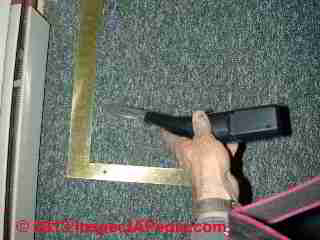
Portable hand vacuum (C) Daniel Friedman How to assemble a very low cost vacuum sampling device for building IAQ investigations
     

  • VACUUM SAMPLING EQUIPMENT, DIY - how to build a low-cost dust particle collection device for building environmental testing
    • Dust or other particle collection: qualitative sampling explained
    • List of equipment & supplies needed
    • How to use your DIY dust sampler
    • Can I just use my vacuum cleaner to collect a particle sample?
    • Higher-cost & more precise vacuuming tools
  • VACUUM CASSETTE FILTER SAMPLE TESTS for DUST / MOLD - separate article
    • VACUUMING BUILDING CAVITIES - separate article
    • VACUUMING BUILDING INSULATION - separate article
    • VACUUM SAMPLING EQUIPMENT, DIY
  • Questions & answers about vacuuming building insulation to screen for mold or other hazardous particle contamination.
  • References

Click to Show or Hide Related Topics

  • ACCURACY OF VARIOUS MOLD TEST METHODS - home
  • ACCURACY vs PRECISION of MEASUREMENTS
  • AIR TEST SAMPLING CASSETTE STUDY
  • AIRBORNE MOLD COUNT NUMBER GUIDE
  • AIRBORNE MOLD COUNT VALIDITY
  • AIRBORNE PARTICLE ANALYSIS METHODS
  • CONCENTRATION BURSTS of Mold Spores
  • CULTURE PLATE Test Errors, Mold
  • DUST SAMPLING PROCEDURE
  • FALSE NEGATIVEW Results in Mold Tests
  • HIDDEN MOLD, HOW TO FIND
  • INDOOR vs OUTDOOR Airborne Spore Counts
  • LAB & FIELD IAQ EQUIPMENT SOP
  • LAB PROCEDURES MICROSCOPE TECHNIQUES
  • LAB PROCEDURES, TECHNICAL
  • MOLD LEVEL IN AIR, VALIDITY
  • MOLD STANDARDS
  • MOLD TESTING METHOD VALIDITY
  • PARTICLE & MOLD LEVELS in DUCTWORK
  • SLIDE PREPARATION, MICROSCOPE
  • VALIDITY of MOLD TESTING METHODS
  • VARIATION IN AIRBORNE Particle Levels, Causes of
  • VARIATION IN AIRBORNE Particle Levels vs Sampler Height
  • VARIATION IN AIRBORNE PARTICLE COUNTS, Extent of
InspectAPedia tolerates no conflicts of interest. We have no relationship with advertisers, products, or services discussed at this website.

How to collect an environmental dust sample: this article describes how to build (well basically just buy) inexpensive equipment & materials to perform your own dust or particle sampling for qualitative analysis. Taking a look at dust or particles collected from a suspect surface, building area, furnishings, even insulation, can be quite helpful in detecting the presence of high levels of problem particles such as mold from a nearby problem mold reservoir, animal allergens (hair, dander), insect fragments, fiberglass or other insulation particles, or other materials. Here we explain why qualitative assessment (what are the dominant particles) is often quite sufficient to screen building areas or furnishings for certain contaminants. We further argue that quantitative analysis (how many particles of a given sort are present per cubic meter of air or per square foot of surface area) are often seriously inaccurate and can be quite misleading.

Green links show where you are. © Copyright 2013 InspectAPedia.com, All Rights Reserved. Author Daniel Friedman.

How to assemble a very low cost vacuum sampling device for building IAQ investigations

[Working draft of article in process - 2013. CONTACT US to offer suggestions or content]

Portable hand vacuum (C) Daniel FriedmanWhy would we bother to use a vacuum device and sampling cassette to collect dust particles when there is a very simple, very low-cost method to collect surface samples of dust, mold, or other particles using adhesive tape ?

  • During a building IAQ or environmental inspection and testing we use a simple vacuuming device and sampling cassette to collect dust from surfaces that cannot be easily or reliably sampled with simple adhesive tape.

    Examples are carpeting, fabrics such as drapes or couches, or clothing that is suspect of containing irritating levels of an unknown particle, possibly insect fragments, moldy dust, animal allergens, or insulation fragments. This is the methodology discussed here.

This expert-recommended mold test kit is easy, inexpensive, and
accurate *IF* you sample from a representative spot and *IF* you use a competent mold analysis laboratory!

  • We use the clear adhesive tape sampling method to collect settled dust from a surface, such as settled dust to be examined or visible or suspected mold growth on a building surface or material. Details of that easy procedure are at MOLD TEST KITS.

Watch out: in some circumstances it is appropriate and cost justified to hire an expert to investigate conditions in your home or other building or to perform necessary clean-up work. See MOLD EXPERT, WHEN TO HIRE for details.

Dust or other particle collection: qualitative sampling explained

Aspergillus niger spore chains in dust sample (C) Daniel FriedmanIn our introduction we noted that a qualitative examination of dust or particles collected from a suspect surface or material can be quite helpful in detecting the presence of high levels of problem particles.

A skilled forensic microscopist prepares one or more samples for examination by light or polarized light microscopy in order to provide a characterization of what was in the dust sample.

Lab technicians and forensic microscopists who have examined many building & environmental samples have a pretty good idea what typical house dust looks like and can recognize if the dominant or most-frequent particles in a sample are telling us something special.

If the microscopist finds usually high levels of a recognizable problem particle not found in normal house dust, then further investigation is usually justified.

Low levels of even "harmful" particles (individual toxic, allergenic, or pathogenic mold spores for example) found in air or dust samples are usually not significant. But a few technical exceptions to this rule might be noticed by your laboratory. For example the presence of Pen/Asp spores in chains is usually an indicator of nearby fungal growth. The spore chain didn't fly in through the building window. Our photo at above left shows Aspergillus niger spore chains (speciated by further examination) in a building dust sample that was otherwise low in total mold spore levels.

At ACTIVITY of MOLD in BUILDINGS we discuss the example of special meaning attached to spore chains or the presence of fresh fungal growth structures & conidiophores even when the total mold spore count is low.
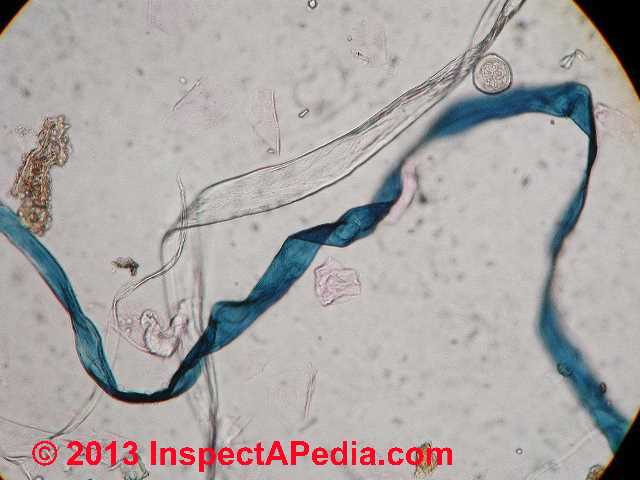

Typical house dust (C) Daniel FriedmanWhat were the dominant particles in the dust sample? If the dominant particles are those typical of house or building dust (skin cells, fabric fibers, low or incident levels of pollen, mold, road debris) then we conclude that in most cases the dust sample did not detect evidence of a problem.

Watch out: selection of the sampling area as well as intelligent collection of the sample make an enormous difference in how much you can rely on the lab findings. If your sample is probably representative of building conditions then the lab results make sense.


List of equipment & supplies needed for for DIY vacuum dust sampling
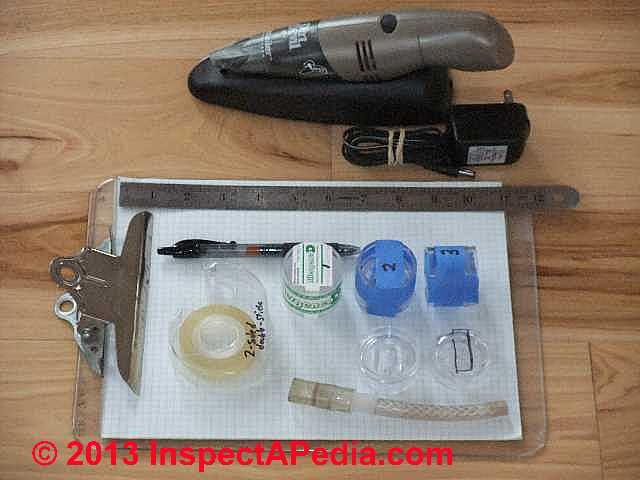
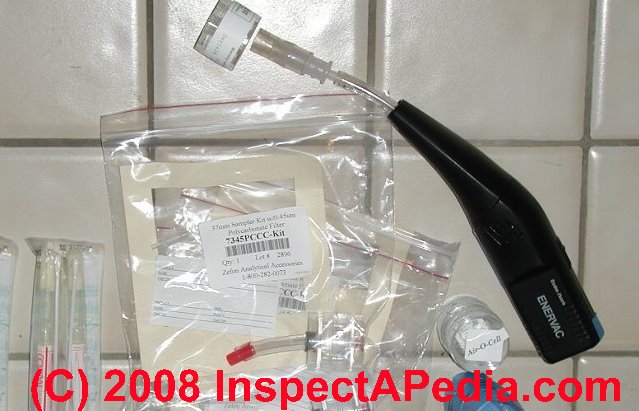
DIY vacuum sampling supplies (C) Daniel FriedmanFor a total cost typically less than $50. U.S. you can assemble the vacuum device, tubing, adapter and even purchase a single air sampling cassette.

It's easy to construct your own qualitative dust sampling kit. Here's what you need:

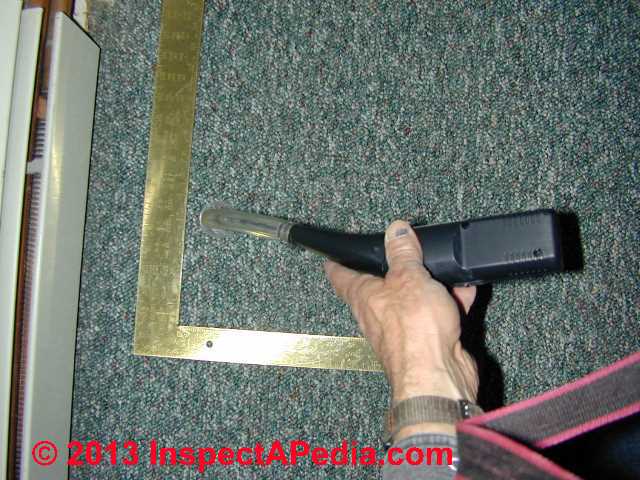
1. A small portable keyboard vacuum such as the device shown at page top (Radio Shack) or at left (Dirt Devil Detail by Royal Appliances). The Radio-Shack vacuum uses four AA batteries while the Dirt Devil Detail is rechargeable.

We bought a dozen of each of these devices to test in our laboratory where we measured air flow rates. Typically the air flow as 8-12 lpm, which puts the flow rate in the proper velocity for use with air sampling cassettes produced by several manufacturers and designed for a 10 lpm flow rate.

Technical note: if the air flow rate is too high the particle bounce rate is increased - you lose too many particles, and also the distribution of particles collected will be skewed by particle size. If the air flow rate through the air sampling device is too low or weak, particles are not sufficiently accelerated to adhere to the micro-slide's sticky collection media.
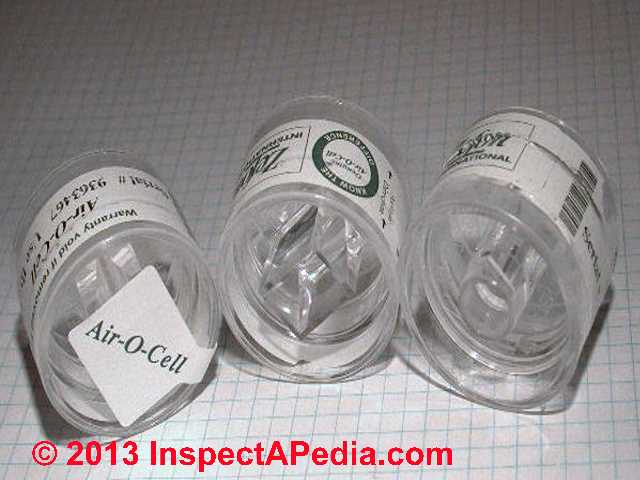

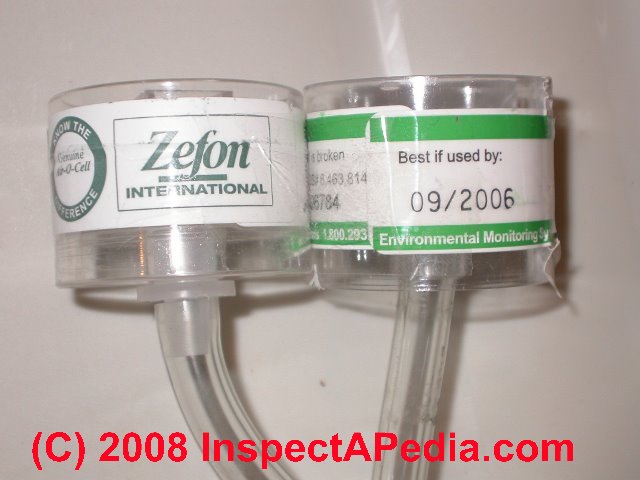
Vacuum sampling cassettes (C) Daniel Friedman2. Air sampling cassettes: you need one cassette for each sample to be collected.

Air sampling cassettes are readily available online from IAQ equipment suppliers or directly from the manufacturers such as Allergenco® or Zefon®. We report on these cassettes in detail at AIR TEST SAMPLING CASSETTE STUDY. Purchase information is also at our References section. [26][27][28]

If you plan to do a lot of sampling, here's a tip: thanks to our friend and fellow aerobiologist Larry Syzdek, we discovered that one can "re-load" used plastic air sampling cassettes with two-sided sticky adhesive tape for a still more crude particle sampler.[12]

Watch-out: using adhesive tape in an air sampling cassette is useful for qualitative testing in buildings but the approach has not been widely calibrated and risks giving an inaccurate collection of particles by type - the stickiness of the adhesive tape is not the same as that of the original micro-slide placed in these sampling cassettes by the manufacturer.
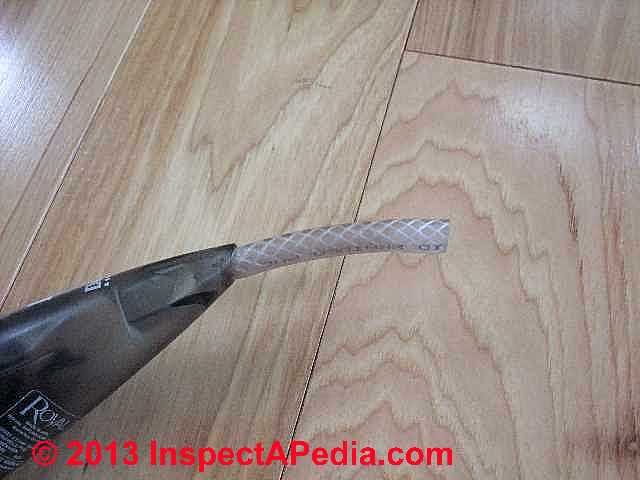

Plastic tubing inserted into vacuum (C) Daniel Friedman
3. Short (4-6-inch) plastic tubing that inserts into the end of the vacuum device. Just bring your little vacuum machine to your nearest hardware store where by test-fit you can purchase a short length of plastic tubing that fits snugly into the opening at the end of the vacuum machine.
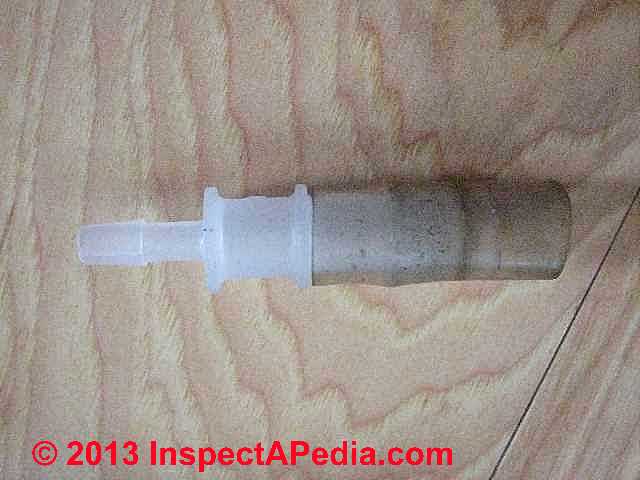


Tubing to cassette adapter (C) Daniel Friedman4. Adapter to connect tubing to the vacuum cassette. You will probably find that tubing whose outer diameter fits snugly into the end of your little vacuum will have an inner diameter that is too small to fit over the connection-end of your air sampling cassettes.

The tubing that we could just jam into our little Dirt Devil has an outer diameter (OD) of 3/8-inches and an inner diameter (ID) of 1/4-inches.

The outer diameter (OD) of the plastic fitting on the air sampling cassette intended to connect to the sampler tubing is 1/2-inch and is tapered so that when you push the tubing over the cassette fitting it will be tight and snug.

You can cobble together an adapter from assorted tubing at your same hardware store, or for very little you can purchase a suitable adapter from your air sampling cassette supplier along with your cassette order. Cassette adapters are included at no charge in orders from some suppliers.


How to use your DIY vacuum dust sampler
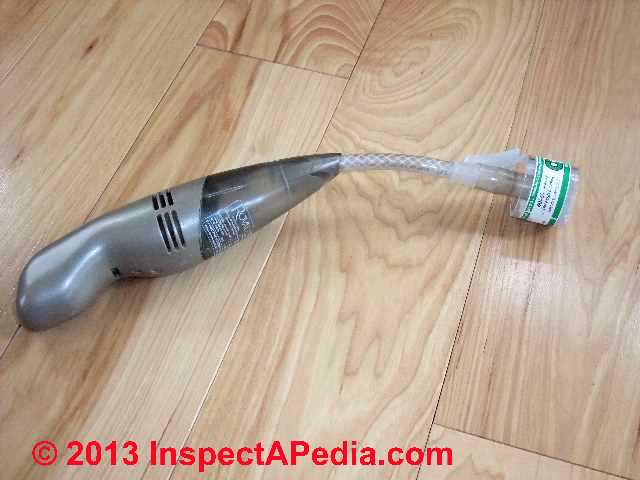
Dust sampling vacuum and cassette assembled and ready for use (C) Daniel FriedmanAssemble your vacuum sampler and tubing. Turn on the vacuum and confirm that it is drawing air through the tubing by feeling for a vacuum at the open end of the tube. If the vacuum feels quite weak, open the vacuum sampler and remove its internal filter or dust collecting bag if necessary.

Push the sampling cassette onto the open tubing end. Now remove the sticker covering the air sampling cassette's round inlet attachment. This is the side of the sample that attaches to the vacuum device's plastic tubing.

It will be obvious that one side of the sampling cassette contains an input slot (and venturi) through which particles flow into the cassette. The other side of the cassette contains the 1/2-inch plastic fitting to which tubing is connected. It is just about impossible connect the cassette incorrectly.

Watch out: to avoid confusion and sample contamination, do not un-tape the sample dust or air inlet side of the cassette until you are at the sampling location and are ready to turn on the vacuum.
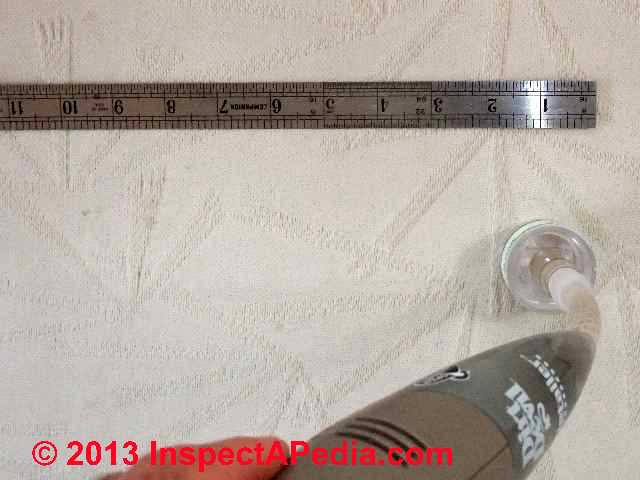

Vacuum testing dust from a couch (C) Daniel FriedmanTo vacuum sample dust from a hard surface such as a dusty table, select the test area, turn on the sampler, and keeping the cassette with its leading edge tipped just slightly up off of the surface (about 1/8" is plenty) move the cassette over the sampling space.

We tip theleading edge of the sampling cassette slightly because otherwise on a flat smooth hard surface you are just pushing the dust away from the sampler as the cassette slides across the surface. We want to pick the dust up, not push it away.

To vacuum sample dust or particles from a soft surface such as carpeting or upholstered furniture, select the sample area and turn on the vacuum sampler. Either slide the sampling cassette lightly over the sample area, or use the light tapping method we describe just below.

How much dust to collect?

Watch out: do not overload the sample with dust particles and debris. More is not better. If the cassette's internal micro-slide is overloaded with particles it may be very difficult, even impossible to analyze in the laboratory.

On hard surfaces we adjust the area vacuumed subjectively (and based on experience) based on the visible amount of dust on the surface. 4 to 12 sq.in. is usually plenty.

On fabrics and carpets we do not vacuum more than a 4 x 4 sq.in. and we take care not to "scrub" the cassette aggressively over the surface lest we overload the cassette with fibers. Better would be to tap the cassette vertically onto each sample spot on the carpet or fabric until the desired area is tested. This approach tends to cause particles in the material to become airborne and to collect in the sampler. Scrubbing the surface with the cassette will overload with fibers.

At DUST SAMPLING PROCEDURE we describe the selection of sampling location and we also illustrate using clear adhesive tape to collect a dust sample.
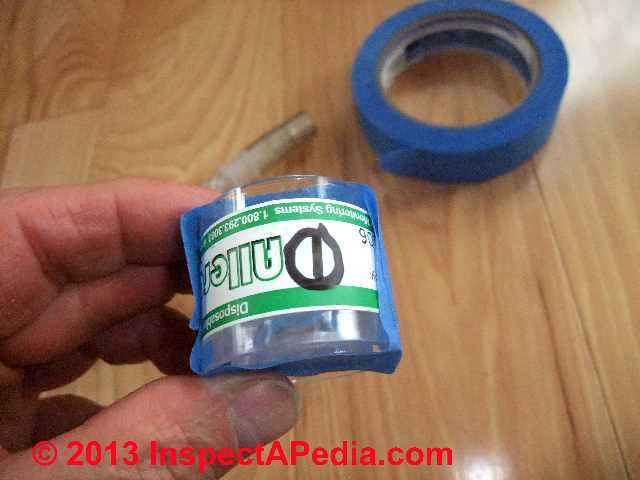

Sealed air sampling cassette ready for mailing (C) Daniel FriedmanSeal each sampling cassette: When the sample is collected, turn off the vacuum, remove the cassette, and seal its two open ends by re-using the original stickers or if you lost the original stickers or they're all messy just seal the cassette by using masking tape.

This step keeps extraneous debris out of the cassette during shipping and handling.

Label each cassette on its side with an identification number that will correspond to your chain of custody form or sample log. That assures that you can match the lab results to the areas you sampled. Do not write the sample number on the tape you used to close off its openings - that tape will be pulled off in processing and risks losing track of the sample identity.

Mail the vacuum sample cassettes to an environmental testing lab of your choice. Be sure to include your chain of custody or sample log and description and note thereon that you have prepared a surface sample, not an air sample and that you are requesting qualitative analysis of the sample contents.

You can use this chain of custody form but please do NOT mail your samples to the address on that form (my lab). Use any other independent envrionmental testing laboratory.

Can I just use my household vacuum cleaner to collect a particle sample?
Spore traps (C) Daniel FriedmanWell no (not with air sampling cassettes (left) using the equipment we describe above) and yes (with different test kits and equipment).

It is indeed possible to use a home vacuum cleaner to collect dust samples but the approach is completely different. A home vacuum cleaner is hundreds of times too powerful to use with an air sampling cassette. Its airflow rate enormously exceeds the cassette's intended air flow rate of 10 lpm.

How top Use a "Dust Sampling Sock" for Particle Collection & Quantitative Analysis

With conventional vacuum cleaners you would purchase a dust sampling adapter and test kit designed to fit over the end of your vacuum cleaner's inlet tubing or wand. That kit includes a sock-like filter that captures close to 100% of the particles sampled, permitting a laboratory analysis of particle types by percentage or by weight. A typical dust sampling sock is about 9" long x 4" wide and is designed for use in a range of vacuum cleaner nozzles.

This approach is more precise than the mini-vacuum approach we describe above. Remember that precision is not the same thing as accuracy. Typical dust kit price varies depending on quantity in which sold, but expect to pay $30. and up per test kit.

Dust sampling sock kit suppliers are listed at Reviewers [29].

Examples of higher-cost & more precise vacuuming tools
Dual air sampler parallel test (C) Daniel FriedmanAt left you can see a test we set up to study consistency of results when using two different brands of air sampling cassettes. Two calibrated air sampling pumps were run simultaneously, in parallel, with just enough distance between the sampling points to avoid interference.

Using a calibrated air sampling device permits accurate determination of the level of airborne particles in the sample area, and permits the lab to provide a count of particles per cubic meter of air.

This approach, regrettably, is precise but horribly inaccurate when performed in buildings, since even a small change (walking through the room, opening a window or door, moving the sampling device etc.) can make a difference of several orders of magnitude in the "particle count" obtained. Details are at ACCURACY vs PRECISION of MEASUREMENTS.

More Reading about dust & particle & mold sampling & IAQ investigation procedures

  • AIR TEST SAMPLING CASSETTE STUDY
  • ALLERGENS in BUILDINGS, RECOGNIZING
  • CARPET TEST PROCEDURE
  • CHAIN of CUSTODY FORM - Single Sample - Printer Friendly
  • CHAIN of CUSTODY FORM - Multiple Sample - Printer Friendly
  • DUST ANALYSIS for FIBERGLASS
  • DUST SAMPLING PROCEDURE
  • FIBERGLASS INSULATION MOLD
  • ITCHY FABRICS
  • MOLD DETECTION & INSPECTION GUIDE
  • MOLD TEST KITS
  • MOLD TESTING METHOD VALIDITY
  • At MOLD STANDARDS you will see that we have collected the most comprehensive range of published "standards" or opinions about mold exposure levels.
  • At ACCURACY OF VARIOUS MOLD TEST METHODS you can see a thorough exposition of the sources of error in mold tests and reasoning that explains why reliance on testing alone is unreliable in evaluating a building for mold risk.
  • At MOLD EXPERT, WHEN TO HIRE you can read some criteria that help decide if hiring an expert for a building is justified and appropriate.
  • MOLD & ENVIRONMENTAL INSPECTORS and MOLD CLEANUP COMPANIES contains contact information for some indoor environment building investigators. However as you may need to call someone local to you, if you have the inclination to review the articles I've suggested above, you will be better equipped to avoid someone who lacks the appropriate expertise needed in building science, mycology, and the proper use of inspection and test methods and equipment.

...


Frequently Asked Questions (FAQs) about dust sampling methods using a mini vacuum cleaner and air sampling cassettes

...

Ask a Question or Search InspectApedia

Questions & answers or comments about how to use a mini or keyboard vacuum cleaner and air sampling cassettes to collect building dust samples.

Ask a Question or Enter Search Terms in the InspectApedia search box just below.

Technical Reviewers & References

Related Topics, found near the top of this page suggest articles closely related to this one.

  • [1] AAAAI - Asthma and Immunology's Aeroallergen Network is a national U.S. network of data gatherers that is responsible for reporting current pollen and mold spore levels to the public. American Academy of Allergy,
    Asthma and Immunology, 555 East Wells Street, Suite 110, Milwaukee, WI 53202. AAAAI can be contacted also by their website at www.aaaai.org
    AAAAI provides a table of interpretations of mold and pollen counts (of airborne particles/M3 of air) at http://www.aaaai.org/nab/index.cfm?p=reading_charts
  • [2] Bioaerosols: Assessment and Control. Janet Macher, ScD., M.P.H. American Conference of Governmental Industrial Hygienists, Cincinnati, OH. 1999
  • [3] Brazil: Occurrence of airborne bacteria and fungi in bayside offices in Rio de Janeiro, Brazil, by Brickus, L. S. R., Siqueira, L. F. G., Neto, F. R. D. and Cardoso, J. N., 1998)
  • [4] Building Biology Evaluation Guidelines, available in English Language Translation, provided by the German government, original citation: www.baubiologie.de/downloads/english/richtwerte_2008_englisch.pdf
    BAUBIOLOGIE MAES Schorlemerstr. 87 41464 Neuss Telefon 02131/43741 Fax 44127 www.maes.de
  • [5] Canada: Canadian National Toxic Mold Centre, and also see Moldy Houses: Why They Are and Why We Care & Additional Analysis of Wallaceburg Data: the Wallaceburg Health and Housing Studies)
    Fungal Contamination in Buildings: Health Effects & Investigation Methods, Health Canada, Minister of Health, original citation: www.hc-sc.gc.ca/ewh-semt/alt_formats/hecs-sesc/pdf/pubs/air/fungal-fongique/fungal-fongique-eng.pdf
  • [6] California: California Department of Health Service / Environmental Health Investigations Branch report on whether it is feasible to adopt permissible exposure limits (PELs) for indoor mold - see SB 732 (Toxic Mold Protection Act of 2001, Implementation Update (August 2006)
  • [7] Connecticut: "Guidelines for Mold Abatement Contractors", Connecticut Department of Public Health, Environmental Health Section, 410 Capitol Ave M.S. #11EOH, POB 340308., Hartford CT 06134, Web search 3/31/12, original source: xxx, [copy on file as Connecticut_Mold_Remediation_Guidelines.pdf/ ]
  • [8] Canada: Mould Guidelines for the Canadian Construction Industry - original source www.cca-acc.com/documents/electronic/cca82/cca82.pdf
  • [9] IICRC S520: Standard and Reference Guide for Professional Mold Remediation 2nd Edition. Institution of Inspection, Cleaning and Restoration Certification. Vancouver, WA. 2008 IICRC Standard and Reference Guide for. Professional Mold Remediation, S520 (first ed. 2003),
  • [10] IICRC S500: Standard and Reference Guide for Professional Water Damage Restoration 3rd Edition. Institution of Inspection, Cleaning and Restoration Certification. Vancouver, WA. 2006
  • [11] J.R. Tucker, EMS-sales, presented data at the NC/SC Environmental Information Association 2005 Conference, Myrtle Beach, SC citing mold exposure standards from Brazil, mold exposure standards for Czechoslovakia, Mold exposure guidelines for Finland, Mold exposure standards set by the Nordic Council, mold standards cited by the World Health Organization WHO, and mold exposure standards for the Netherlands and lastly, mold exposure standards for Poland.

    Those figures were quoted in this article from the material provided at that conference. Mold exposure standard numbers were expressed spores per cubic meter of air and did not consider individual or viable/non-viable or genera-species specific levels. [This is a serious limitation of the standards since the spores of different genera and species vary widely in total size, mass, and toxicity. -DF]

    On 3/16/09 we received follow up correspondence from Dr. Robert Brandys who indicated that Mr. Tucker obtained the data from Brandys' book Worldwide exposure standards for Mold and Bacteria. Dr. Brandys requested that we remove the data from this web article out of respect for his © protected book.

  • [12] Larry Syzdek, Albany, NY. personal communication at PAAA aerobiology conferences.
  • [13] Listeriosis, Discussion of, Penn State University,, Oct 27, 2002. "Listeriosis is a bacterial infection usually of the brain. Listeriosis is common in ruminants, pigs, dogs, and cats, some wild animals, and humans. Animals infected with Listeria can show clinical signs of abortions or nervous system disorders." Cooperative Extension
    The Pennsylvania State University, University Park, Pennsylvania 16802 FAX (814) 863-6140. See this US CDC article on Listeriosis for more information.
  • [14] National Allergy Bureau, is hosted by the AAAAI and can be contacted at www.aaaai.org/nab. "The National Allergy Bureau™ (NAB™) is the section of the American Academy of Allergy, Asthma and Immunology's (AAAAI) Aeroallergen Network that is responsible for reporting current pollen and mold spore levels to the public."

  • OSHA - see OSHA's Policies Regarding Mold which includes the the original citations
  • [15] OSHA: Brief Guide to Mold in the Workplace, original citation: http://www.osha.gov/dts/shib/shib101003.html
  • Post-Remediation Verification and Clearance Testing for Mold and Bacteria – Risk Based Levels of Cleanliness Assurance 1st Edition. Robert C. Brandys, PhD, MPH, PE, CIH, CSP, CMR and Gail M. Brandys, MS, CSP, CMR, CIEC. OEHCS Publications. Hinsdale, IL. 2003
  • [16] Recognition, Evaluation and Control of Indoor Mold, American Industrial Hygiene Association. Fairfax, Va. 2008
    Fungal Contamination: A Manual for Investigation, Remediation and Control. Hollace S. Bailey, PE, CIAQP, CIE, CMR. Building Environment Consultants, Inc. Jupiter, FL. 2005
  • University of Minnesota - Department of Environmental Health and Safety can be contacted at http://www.dehs.umn.edu/ The University Department's advice on mold in buildings can be found at www.health.state.mn.us/divs/eh/indoorair/mold/index.html
  • [17] U.S. CDC - Mold Questions and Answers: Questions and Answers on Stachybotrys chartarum and other molds - original source: www.cdc.gov/mold/pdfs/stachy.pdf, Questions and Answers on Stachybotrys Chartarum and Other Molds. Centers for Disease Control and Prevention, National Center for Environmental Health. March 9, 2000.
  • [18] US EPA: Mold Remediation in Schools and Commercial Buildings: original EPA source - www.epa.gov/mold/pdfs/moldremediation.pdf
  • [19] USP 797 Guidebook to Pharmaceutical Compounding - Sterile Preparations, U.S. Pharmacopeai, Web search 01/23/2012 and available online at usp.org/products/797Guidebook/
  • [20] USP 797 Standards and Guidelines with USP 797 Testing Lab Services, EMLab P&K, web search 12/1/2011, original source emlab.com/s/services/USP_797.html - EMLab discusses USP 797 as it pertains to mold testing, bacteria testing, and other environmental and health related tests. For mold testing using surface cultures (swabs) that and other testing laboratories typically use broad-spectrum mold culture media such as Malt Extract Agar (MEA) or Cormeal Agar (CMA) - these media do well culturing Penicillium. Aspergillus, and Cladosporium, but beware: in our OPINION other important molds may be present, even dominant in the building but may not show up in culture tests.
  • [22]World Health Organization bulletin: Human eases Caused by Mold - http://www.inspectapedia.com/sickhouse/WHO_Mold_Bulletin.htm
  • [22] Mold Exposure Standards - levels of allergenic & toxic mold: how much mold means a problem? - http://www.inspectapedia.com/sickhouse/Mold_Standards.htm
  • [23] Guidance for Clinicians on the Recognition and Management of Health Effects Related to Mold Exposure and Moisture Indoors, [on file as /mold/Mold_Guide_UConn.pdf] - Eileen Storey, MD MPH, Kenneth H. Dangman, MD PhD MPH, Paula Schenck MPH, Robert L DeBernardo MD MPH, Chin S Yang PhD, Anne Bracker CIH MPH, Michael J Hodgson MD MPH, University of Connecticut Health Center, Division of Occupational and Environmental Medicine, Center for Indoor Environments and Health, 266 Farmington Ave., Farmington CT 06030-6210, 30 September 2004. [We have edited this file to remove blank pages in order to speed its load-time and to add a link back to this website.] This document was designed to help the healthcare provider address patients with illnesses related to mold in the indoor environment by providing background understanding of how mold may be affecting patients. The guidance was published in 2004, with support from a grant by the U.S. EPA, by the Center for Indoor Environments and Health, or CIEH at the University of Connecticut Health Center. " -- original source: oehc.uchc.edu/images/PDFs/MOLD%20GUIDE.pdf (1.13MB PDF file, slow loading)
  • [24] History of major mold outbreaks: see the WHO bulletin above, also see a nice summary of the history of major mold related illness outbreaks is at moldbacteria.com/newsletters/2005/sep2005.html provided by Dr. Jackson Kung'U, a microbiologist, mycologist, writing for that website.
  • [25] ASTM Mold Standards, web search 4/15/2012, original source: begin at http://www.astm.org/Standards/E2418.htm
    • ASTM D3273 - 12 Standard Test Method for Resistance to Growth of Mold on the Surface of Interior Coatings in an Environmental Chamber, Quoting:
      An accelerated test for determining the resistance of interior coatings to mold growth is useful in estimating the performance of coatings designed for use in interior environments that promote mold growth and in evaluating compounds that may inhibit such growth and the aggregate levels for their use (see also Note 1). This test method should preferably be used by persons who have had basic microbiological training.
    • ASTM D6008 - 96(2005) Standard Practice for Conducting Environmental Baseline Surveys, Quoting:
      The purpose of this practice is to define good commercial and customary practice in the United States for conducting an environmental baseline survey (EBS) in order to determine certain elements of the environmental condition of federal real property, including excess and surplus property at closing and realigning military installations. This effort is conducted to fulfill certain requirements of the Comprehensive Environmental Response, Compensation and Liability Act of 1980 (CERCLA) section 120(h), as amended by the Community Environmental Response Facilitation Act of 1992 (CERFA). As such, this practice is intended to help a user to gather and analyze data and information in order to classify property into seven environmental condition of property area types (in accordance with the Standard Classification of Environmental Condition of Property Area Types). Once documented, the EBS is used to support Findings of Suitability to Transfer (FOSTs), Findings of Suitability to Lease (FOSLs), or uncontaminated property determinations, or a combination thereof, pursuant to the requirements of CERFA. Users of this practice should note that it does not address (except where explicitly noted) requirements for appropriate and timely regulatory consultation or concurrence, or both, during the conduct of the EBS or during the identification and use of the standard environmental condition of property area types.
    • ASTM E 1527-00 Standard Practice for Environmental Site Assessments: Phase I Environmental Site Assessment Process (Phase I ESA). [reflects US EPA rules for environmental due diligence as of 11/1/2005, Federal Reference: 40 CFR Part 312]
    • ASTM E 1528-00 Standard Practice for Environmental Site Assessments: Transaction Screen Process (Transaction Screen) [reflects US EPA rules for environmental due diligence as of 11/1/2005, Federal Reference: 40 CFR Part 312]
    • ASTM E2018 - 08 Standard Guide for Property Condition Assessments: Baseline Property Condition Assessment Process,
      This guide is intended for use on a voluntary basis by parties who desire to obtain a baseline PCA of commercial real estate. This guide also recognizes that there are varying levels of property condition assessment and due diligence that can be exercised that are both more and less comprehensive than this guide, and that may be appropriate to meet the objectives of the user. Users should consider their requirements, the purpose that the PCA is to serve, and their risk tolerance level before selecting the consultant and the level of due diligence to be exercised by the consultant. The user should also review or establish the qualifications, or both, of the proposed field observer and PCR reviewer prior to engagement. A PCR should identify any deviations or exceptions to this guide. Furthermore, no implication is intended that use of this guide be required in order to have conducted a property condition assessment in a commercially prudent and reasonable manner. Nevertheless, this guide is intended to reflect a reasonable approach for the preparation of a baseline PCA.
    • ASTM E2418 - 06 Standard Guide for Readily Observable Mold and Conditions Conducive to Mold in Commercial Buildings: Baseline Survey Process, Quoting:
      The purpose of this guide is to define good commercial and customary practice in the United States of America for conducting a baseline survey for readily observable mold and conditions conducive to mold in a commercial building related to a commercial real estate transaction by conducting: a walk-through survey, document reviews, and interviews as outlined within this guide. This guide is intended to identify observable mold and physical deficiencies conducive to mold as a result of moisture and water infiltration through the commercial buildings envelope or substructure, or generated within the building as a result of processes or mechanical systems, excluding de minimis observable mold and physical deficiencies conducive to mold. This guide is to allow a user to assess the potential need for further assessment or other actions that may be appropriate that are beyond the scope of this guide.
    • ASTM E2722 - 09 Standard Test Method for Using Seeded-Agar for the Screening Assessment of Antimicrobial Activity in Fabric and Air Filter Media, Quoting:
      This test method provides for rapid screening of antimicrobial treatments located in or on fabrics and air filter media.
      This test method simulates actual use conditions that may occur on fabrics, for example, food and beverage spills; soiling from body contact, that is, body oils, skin cells; prolonged moisture exposure.
      This test method provides a means to screen for activity and durability of an antimicrobial treatment under conditions of organic loading.
      This test method provides for the simultaneous assessment of multiple fabric components, for example, fabric, component fibers with polymer incorporated treatments, and back coating if present, for antimicrobial activity.
      Fabrics or filter media may be cleaned prior to testing with this method in order to assess the durability of the antimicrobial effect.
  • [26] Air-O-Cell® Air Sampling Cassettes are sold to trap airborne particulates for quantitative analysis of airborne mold, pollen, house dust, allergenic particles, insect fragments, fibers, etc. Air-O-Cell® products are produced and sold by Zefon International, Zefon International, Inc., 5350 SW 1st Lane, Ocala, FL 34474, Telephone: 800-282-0073 or by website: http://www.zefon.com/store/
  • [27] Air-O-Cell Sampling Guide, EMSL - web search 06/29/2010, original source: http://www.emsltesting.com/air-o-cell_cassette_sampling_g.html
  • [28] Allergenco-D® Air Sampling Cassettes are distributed by EMS Sales, Telephone: 800-293-3003 or by website
    http://www.emssales.net
    Allergenco-D® Air Sampling Cassettes are used to trap airborne particulates for quantitative analysis of airborne mold, pollen, house dust, allergenic particles, insect fragments, fibers, etc. The cassettes use a patented laminar-flow venturi to provide a high collection efficiency (low rate of particle loss) (d50=1.7um) and a well-defined particle trace. Allergenco-D® Air Sampling Cassettes are sold to indoor air quality investigators, industrial hygienists, aerobiologists and other professionals from several sources including Environmental Monitoring Systems, Inc., 3864 Leeds Ave., Charleston SC 29405. See http://www.emssales.net/store/cart.php?m=product_detail&p=634
  • [29] Sources of dust sampling kits using a dust sampling sock and home vacuum cleaner
    • Midwest Filtration, X-cell 100 Dust Sampling kit, Midwest Filtration Company 9775 International Boulevard Cincinnati, OH 45246 513.874.6510 Phone, Website: http://www.midwestfiltration.com/, retrieved 2/26/2013, original source: http://www.midwestfiltration.com/dust-sampling.php
    • Amtek, home mold screen dust kit, website: http://store.aemtek.com/ - website does not provide location nor other direct contact information.
    • House Dust Mite Kit, website: http://housedustmite.com/ - horrible website if you are looking for contact information, probably in the U.K. as prices are in pounds.
    • PhenX Tookit, dust sampling kit, Helen Ray PhenX Project Communications c/o RTI International 3040 Cornwallis Rd RTP NC 27709-2194 USA, tel: 919.541.6954, website: http://phenxtoolkitstage.rti.org

Books & Articles on Building & Environmental Inspection, Testing, Diagnosis, & Repair

  • Our recommended books about building & mechanical systems design, inspection, problem diagnosis, and repair, and about indoor environment and IAQ testing, diagnosis, and cleanup are at the InspectAPedia Bookstore. Also see our Book Reviews - InspectAPedia.
  • Home Reference Book - Carson DunlopThe Home Reference Book - the Encyclopedia of Homes, Carson Dunlop & Associates, Toronto, Ontario, 25th Ed., 2012, is a bound volume of more than 450 illustrated pages that assist home inspectors and home owners in the inspection and detection of problems on buildings. The text is intended as a reference guide to help building owners operate and maintain their home effectively. Field inspection worksheets are included at the back of the volume. Special Offer: For a 10% discount on any number of copies of the Home Reference Book purchased as a single order. Enter INSPECTAHRB in the order payment page "Promo/Redemption" space. InspectAPedia.com editor Daniel Friedman is a contributing author.

    Or choose the The Home Reference eBook for PCs, Macs, Kindle, iPad, iPhone, or Android Smart Phones. Special Offer: For a 5% discount on any number of copies of the Home Reference eBook purchased as a single order. Enter INSPECTAEHRB in the order payment page "Promo/Redemption" space.

  • GO TO Carson Dunlop's Home Study Course Information - How to Become a Home Inspector: Carson Dunlop's nationally recognized Home Study Course, selected by ASHI the American Society of Home Inspectors and other professionals and associations. This website author is a contributor to this course.
  • GO TO Carson Dunlop's Home Study Course Information - How to Become a Home Inspector: Carson Dunlop's nationally recognized Home Study Course, selected by ASHI the American Society of Home Inspectors and other professionals and associations. This website author is a contributor to this course.
  • GO TO Carson Dunlop's Home Study Course Information - How to Become a Home Inspector: Carson Dunlop's nationally recognized Home Study Course, selected by ASHI the American Society of Home Inspectors and other professionals and associations. This website author is a contributor to this course.
    Building inspection education & report writing systems from Carson, Dunlop & Associates Ltd
  • ...
HOME ABOUT CONTACT COPYING DESCRIPTION POLICIES PRINTING PRIVACY © 2013 Copyright InspectAPedia.com