
InspectAPedia® FREE Encyclopedia of Building & Environmental Construction, Diagnosis, Maintenance & Repair |
Question? Just ask us! InspectAPedia
|
 Mold Action Guide
What to do about mold, mildew, and other indoor allergens found in buildings
- POST a QUESTION or COMMENT about what to do about a mold-contaminated building
Action Plan for Indoor Mold Contamination:
Here we describe in step by step detail just how to deal with building mold: find, test, remove, prevent indoor toxic or allergenic or even just cosmetic mold contamination & growth in buildings
This toxic mold article series provides an easy to understand step-by-step guide for dealing with toxic or allergenic indoor mold and other indoor contaminants: what to do about mold contamination in buildings: how to test-for mold, find hidden mold, clean up or remove mold, and prevent mold.
InspectAPedia tolerates no conflicts of interest. We have no relationship with advertisers, products, or services discussed at this website.
Action Guide for Dealing With Mold Contamination In or On Buildings
 The steps in this document and its accompanying articles will be sufficient for many building owners who want
to do their own mold investigation, mold testing, mold cleanup, and mold prevention in their home or office.
The photo shows a small moldy area in a residential bathroom.
The steps in this document and its accompanying articles will be sufficient for many building owners who want
to do their own mold investigation, mold testing, mold cleanup, and mold prevention in their home or office.
The photo shows a small moldy area in a residential bathroom.
Mold "mildew," moisture, in your house or office, building-related illness, involves your physician, medical treatment, sick building investigators, possibly professional cleaning companies, steps to reduce the future creation of mold or other indoor irritants, and possibly the special products to help clean buildings and air.
In this Mold Action Guide that continues below, for each step in the process of diagnosing, identifying, removing, and preventing indoor mold problems in buildings, links to in-depth articles are provided. In some cases in this document I use excerpts from longer dissertations on these subjects.
Article Contents
- ACTION GUIDE - WHAT TO DO ABOUT INDOOR MOLD
- EMERGENCY RESPONSE, IAQ, GAS, MOLD - separate article
We offer links to more detailed mold contamination detection, cleanup, prevention & health concern documents throughout this article and at the article bottom.
You can scroll down through this document in sequence, or use the links at the page toparticle outline to jump to specific subtopics of dealing with building mold concerns.
Useful articles on building mold contamination troubleshooting
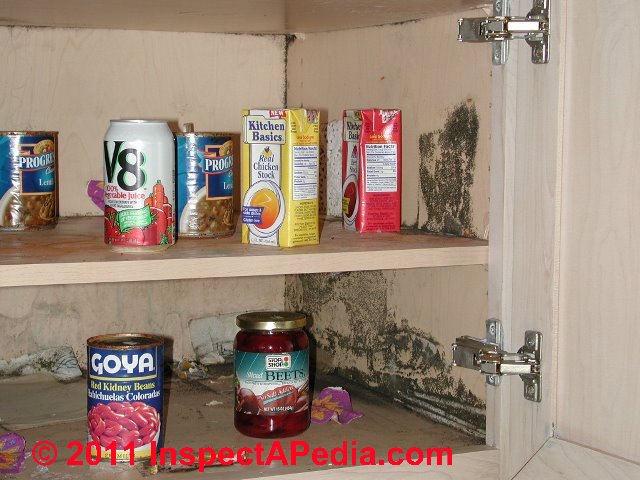
- ACCURACY OF AIR TESTS for MOLD - explains why air testing for mold, used alone, is unreliable
- CLEARANCE INSPECTIONS - guide to inspections & tests performed after a mold cleanup job to be sure it was performed correctly
- MOLD APPEARANCE - WHAT MOLD LOOKS LIKE - how to recognize mold in buildings.
- MOLD GROWTH on SURFACES, PHOTOS - photographs show what mold looks like on just about every building surface or material you can imagine
- MOLD APPEARANCE - STUFF THAT IS NOT MOLD - don't waste money on an expensive cleanup on stuff that is not harmful
- MOLD / ENVIRONMENTAL EXPERT, HIRE ? explains how to decide if t is appropriate to hire an expert to check a building for mold contamination.
- DO IT YOURSELF MOLD CLEANUP - Professional remediation was not needed for the mold cleanup shown at the top of this page. For small areas of mold you should not need to hire an expert; Here is do-it-yourself mold cleanup advice.
- MOLD: A COMPLETE GUIDE TO MOLD - Extensive, technically detailed in-depth articles about mold inspection, detection, testing, remediation, & prevention
SEE A DOCTOR? Should you consult with physicians and knowledgeable indoor environment experts
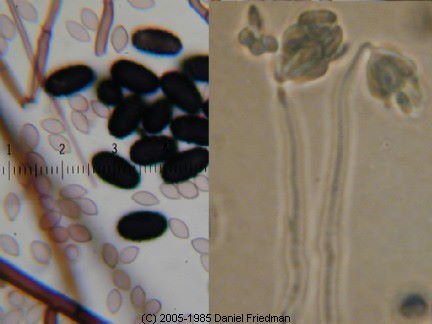 A simple clue that suggests that one may be suffering from building related illness is the abatement of symptoms
when the person with the complaint spends time out of the building. However the converse - when symptoms do not abate - does not rule
out a building as a contributor to the complaints.
A simple clue that suggests that one may be suffering from building related illness is the abatement of symptoms
when the person with the complaint spends time out of the building. However the converse - when symptoms do not abate - does not rule
out a building as a contributor to the complaints.
Some mold-related illness symptoms are slow to diminish, and more than one building can contribute to complaints.
Proving with scientific accuracy that a substance in a building has actually caused or aggravated a specific illness is a difficult and costly procedure.
A common approach taken by building diagnosticians who are considering whether or not mold in a building is (or could be) making someone sick is simply to look for substances which are believed likely to cause or aggravate illnesses and complaints. If such materials are present at significant levels they should be removed.
Some people should stay away from mold cleanup operations
If you are sick, asthmatic, immune-impaired, suffer from COPD or other respiratory illness, before attempting any mold cleanup yourself you should see your family doctor, allergist, pulmonologist, medical toxicologist, or other appropriate specialist to discuss the chances that the environment might cause or contribute to or aggravate your illness.
If you suspect that your illness is caused by or aggravated by conditions in your building you should discuss that with your physician.
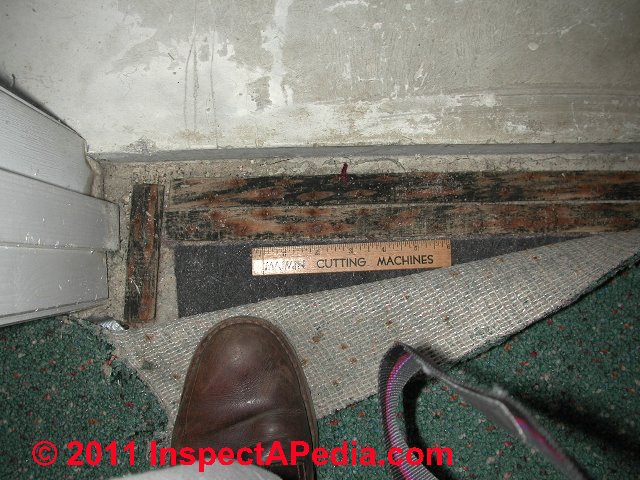 And if you are yourself or if people with these characteristics are present: elderly, immune impaired, infant, asthmatic, suffer from COPD or other respiratory or immune
disorders or any illness that could be aggravated by exposure to respiratory irritants, VOC's, allergens, mycotoxins, etc., you should be
wary of allowing any handling moldy or dusty materials without first checking with your doctor.
And if you are yourself or if people with these characteristics are present: elderly, immune impaired, infant, asthmatic, suffer from COPD or other respiratory or immune
disorders or any illness that could be aggravated by exposure to respiratory irritants, VOC's, allergens, mycotoxins, etc., you should be
wary of allowing any handling moldy or dusty materials without first checking with your doctor.
Medical relocation of certain high-risk building occupants may be needed before moldy materials are disturbed.
More Reading for Mold Related Illnesses
- ACCEPTABLE MOLD LEVEL
- MOLD DOCTORS - ENVIRONMENTAL MEDICINE on deciding when to consult a mold doctor or expert in environmental medicine as well as for a list of related articles and research and a list of medical experts.
- MOLD EXPOSURE STANDARDS
- MOLD EXPOSURE, FOOD HAZARDS
- MOLD RELATED ILLNESS GUIDE
- MOLD RELATED ILLNESS SYMPTOMS
- For background on how and why molds can be toxic, see this World Health Organization Mold Bulletin.
DO IT YOURSELF: How to Perform Your Own Mold Inspection, and Check for Mold-Causing Conditions
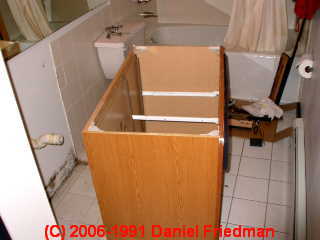 Small area mold cleanup: We emphasize that for small areas of mold contamination, generally where less than 30 square feet of contiguous mold is present, simple building cleaning and renovation procedures are all that's needed and testing is usually not appropriate. Most building mold contamination falls in this first category.
At DO IT YOURSELF MOLD CLEANUP we provide suggestions for a do-it-yourself cleanup of small areas of mold.
At MOLD / ENVIRONMENTAL EXPERT, HIRE ? we provide guidelines to help decide when it is probably justified to bring in a mold expert to perform mold inspection and testing in a building.
Reduce your exposure to mold: Examine living/working conditions for opportunities to reduce exposure to mold or other allergens. This means don't move your sick mother into a damp moldy basement while you're painting her bedroom.
More generally it means you don't need to prove that a specific mold in a building is making you sick to recognize that a problem mold is present and needs to be cleaned-up.
But if you are sick, finding out what you've been exposed to might be helpful to your doctor. I've had clients with severe mold-related illness which went unrecognized and mistreated. If you're ill, ask your doctor if there is any reason to suspect an environmental factor or if there is reason to be extra careful to avoid exposure to mold or indoor allergens
Find the Mold: Examine living/working conditions to find evidence of any mold or to determine the actual extent of mold problem in the building. In the photograph above, leaks behind and under a bath vanity had produced mold that should be removed (and when rebuilding, steps should be taken to prevent future mold growth). But this small job, less than 10 sq .ft. of moldy material, is well within the abilities of a handyman, plumber, or skilled homeowner who can follow appropriate procedures.
Clean-up Mold: remove or clean up problem mold reservoirs. But don't be fooled into spending an outlandish sum on removing a "cosmetic" mold. Later below you'll read about stuff that is not mold or is only a cosmetic mold.
Find The Causes of Mold: In addition to looking for reservoirs of existing mold, examine the building for evidence of leaks (current or old) or moisture problems as those often define the most-likely mold reservoirs. If there is mold in your attic, has there been a history of basement flooding? Even if you don't see mold on exposed building surfaces, finding mold-producing conditions or events, like traces of leaks into a wall or ceiling, can tell you where a mold problem may be hidden.
The steps in this document - THE MOLD ACTION GUIDE - will be sufficient for many building owners who want to do their own mold investigation, mold testing, mold cleanup, and mold prevention in their home or office. However do-it-yourselfers should pay close attention to what can go wrong. If you haven't already read HIRE A PROFESSIONAL? you should do so now. I encourage healthy, not-at-risk people to handle small mold problems themselves. You don't need to hire an expert to clean up moldy bath tiles or a square foot of moldy drywall. But if you are proceeding on your own, be alert for the discovery that the extent of the problem is large enough that you should stop and bring in a professional.
With these warnings made clear, continue by reviewing the next steps below - by scrolling down or by using the links at the left on any of our web pages.
If you're unsure whether to tackle mold yourself and want to know when to bring in a professional,
Mold HEALTH RISKS for Building and Home Inspectors
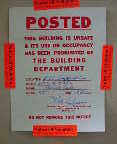
Details are at MOLD CLEANUP HEALTH RISKS
- Don't disturb large areas of mold or moldy materials (more than 30 sq .ft.). Bystanders and occupants have sued careless inspectors who cut openings or otherwise produced a burst of mold activity in a building.
Risks include contributing to illness of building occupants and contamination of building areas if substantial amounts of toxic mold are present and proper containment methods are not used.
This does not mean that invasive inspection techniques are prohibited--but methods of inspection need to be chosen based on the situation. - If you are in a seriously moldy area, wear a HEPA respirator. Repeated exposure to allergens can cause you to become sensitized even if you have not had problems in the past.
- If necessary, keep spectators calm by explaining that you wear the mask because you're entering buildings every day. But keep their noses out of the mold too. People who are at particular risk can get sick from a single exposure. (Examples: elderly, babies, people with compromised immune system.)
- Other risks may be present, related to the same conditions which caused mold growth: Sewer backups - bacterial hazards; wet areas, damaged electrical or other mechanical components, even shock hazards.
HOW TO FIND MOLD: How to Inspect Homes and Other buildings for Mold - the Basics of How to Find Problem Mold Indoors

Any experienced home inspector can identify conditions that risk water entry or high moisture levels in a house. These conditions promote the growth of mold spores. Mold is a natural organism and it's virtually everywhere. The goal of "zero" mold spores makes no sense.
A home inspection is not a reliable indicator of the presence or absence of problem mold unless there is a large non-cosmetic mold reservoir actually visible. In fact often mold samples collected by a non-expert fail to identify the more important mold reservoirs in a building.
But the visual inspection of the building by an experienced inspector is a great place to start. if building conditions such as a history of wet conditions have been present, these promote mold growth so mold problems are more likely.
- If you don't see water stains don't assume there was never a flood or a leak.
- If a building has had flooding, plumbing leaks, roof leaks, A/C condensate leaks, hidden mold may be at serious levels.
- Check HVAC equipment and duct work for presence of mold or other allergens. Pay close attention to duct work downstream from air filters and blowers;
check blower compartments and duct work for contamination (including dead mice), and check other areas where condensate may have accumulated in duct
lines, supporting mold growth.
Clean ducts in one area don't assure clean ducts everywhere; a "clean" air test does *not* guarantee no duct contamination either as variations in temperature, moisture, and mechanical disturbance can suddenly release mold spores into the building air. - If you don't see mold don't assume a severe mold infection can't be present (behind walls, under carpets, under insulation, in HVAC equipment.) I've found serious toxic mold colonies in walls which showed no external moisture stains nor external mold growth - the clue was other evidence of a history of leaks into the subfloor, confirmed by an impaction air sampler result.
- Minor changes in building conditions can cause very big variations in the level of airborne mold. Mold may be present or absent at problem-levels in house air depending on variations in humidity, temperature, season, air movement, and physical activity. Not finding airborne mold at a given moment is not an excuse for visual and in some cases invasive inspecting.
- A home inspection is not an environmental check for unhealthy mold or other bioaerosols or allergens. But if you see moldy conditions, warn your client.
- Do not be hasty to assert that a specific illness or complaint is caused by mold. The four tests (proposed by Burge, Harvard School of Public Health) are stringent beyond your means as an inspector. Mold at high levels may cause and almost certainly aggravates or contributes to a wide variety of complaints.
For detecting evidence of a mold problem in a building you should review these articles.
- MOLD APPEARANCE - WHAT MOLD LOOKS LIKE - What Does Mold Look Like? Mold spores in the Home - a Photo ID Library for detection and identification of mold allergens
- MOLD in BUILDINGS - How to Find and Test for Mold in buildings - Looking for Mold - A 'how to' photo and text primer on finding and testing for mold in buildings
- MOLD APPEARANCE - STUFF THAT IS NOT MOLD - Stuff that is Not Mold but is often mistaken for it - things you may not want to test. Not all "black mold" is toxic or harmful.
- LIGHT, FLASHLIGHT for MOLD - proper use of a flashlight can help spot mold on paneling and other building surfaces
- LIGHT AIM FINDS MOLD & OTHER PARTICLES proper aiming of a good flashlight can disclose hard to see but toxic light or white mold colonies on walls.
- MOLD SPORES in the HOME - a Photo ID Library for detection and identification of mold allergens.
- FIND & TEST for MOLD IN BUILDINGS A 'how to' photo and text primer on finding and choosing the right spots to test for mold in buildings
- FIND HIDDEN MOLD in buildings - a guide for owners and inspectors, where and how to look
- STUFF that is NOT MOLD but is often mistaken for it - things you may not want to test. Also, not all "black mold" is toxic - here are examples of harmless black mold.
- EASY TAPE SAMPLING for MOLDY SURFACES - how to send a mold sample to a lab
How to Clean or Remove Mold, Moldy Debris, Other Indoor Environmental Contaminants
 ...
... 
For small areas of mold contamination, generally where less than 30 square feet of contiguous mold is present, simple building cleaning and renovation procedures are all that's needed and testing is usually not appropriate. Most building mold contamination falls in this first category.
At DO IT YOURSELF MOLD CLEANUP we provide suggestions for a do-it-yourself cleanup of small areas of mold.
At MOLD / ENVIRONMENTAL EXPERT, HIRE ? we provide guidelines to help decide when it is probably justified to bring in a mold expert to perform mold inspection and testing in a building.
Please see these articles for full details on removing mold and assuring that the mold cleanup was handled correctly:
- MOLD CLEANUP GUIDE
- MOLD CLEANUP HEALTH RISKS
- MOLD CLEARANCE INSPECTIONS
- MOLD KILLING GUIDE
- MOLD LEVELS IN buildings
Protect the occupants and yourself from mold, demolition dust, debris, cleaning chemicals, etc. Where a large area of cleanup is involved (more than 30 sq .ft.) a professional is usually called to establish negative air in the work area and to install containment barriers of plastic or other material to protect cleaner areas of the building from cross-contamination during the cleanup.
If you used a building environmental specialist to inspect and define the scope of work, you should have baseline mold test samples of both the work area and other building areas which will permit you to state definitively, at the end of the cleanup, whether or not the cleanup has caused cross-contamination of other building areas.
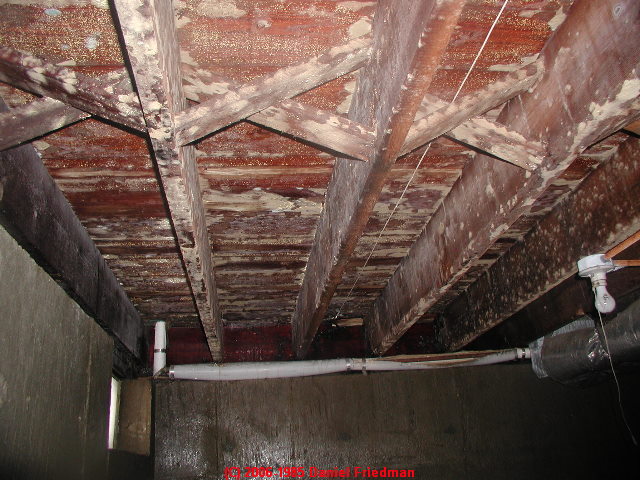
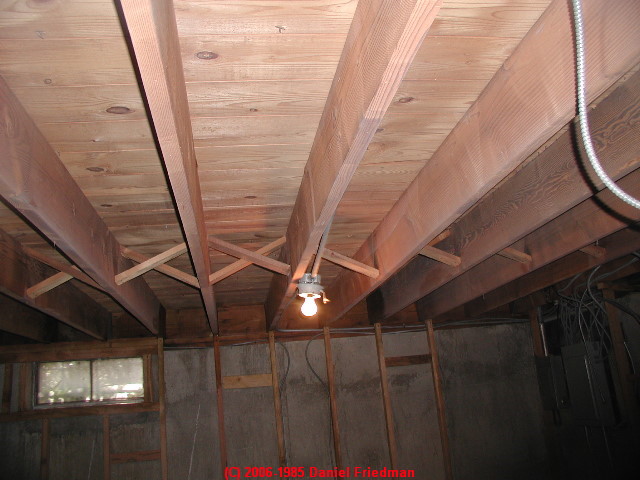
The spotless cleaning produced for the second photo above was obtained by using a professional who
used MEDIA BLASTING to clean these surfaces.
Such measures may be needed for large or complex surfaces, but quite often the necessary steps are less technical and less onerous, as we describe next.
Clean or remove mold and moldy debris: The most succinct Mold Remediation or Mold Cleanup Guidelines one could state would be this: the objective is not to sterilize your environment or "kill" mold, steps which are ineffective anyway - the operative words are "clean" or "remove" problem mold and then to correct its cause. We're talking about scrubbing here. It's the physical removal of moldy or allergenic debris that's important, not the surface sterilization.
The second I permit someone to "spray for mold" I can count on them to fail to do an adequate cleanup. Moldy drywall, paneling, trim, carpets, boxes, junk, are removed and disposed-of as construction debris or trash.
Be sure to remove insulation that has been wet or smells moldy or has been exposed to high levels of airborne mold. Clean all of the exposed surfaces. You could use water, soapy water, spray cleaners, or if you must, a dilute bleach cleaning solution. But bleaching is not the object. Keep that in mind.
More Reading: Mold Cleaning Procedures & Mold Remediation Standards Guidelines
- Also see the article links in the next section on Building Floods: preventing mold growth after a flood
- FIND & TEST FOR MOLD CONTAMINATION in BUILDINGS A 'how to' photo and text primer on finding and choosing the right spots to test for mold in buildings
- MEDIA BLASTING: Mold Removal by Media Blasting - A test report (complete article, with illustrations) on the effectiveness of baking soda media blasting for cleaning fungal contamination in buildings, Daniel Friedman, Dennis Melandro, originally published in Indoor Environment Connections, Rockville MD, June 2003
- MOLD CONTAMINATION in the HOME - a Photo ID Library for detection and identification of mold allergens.
- MOLD EXPOSURE STANDARDS - exposure levels for indoor mold, world wide standards & sources
- NOT MOLD - other stuff but is often mistaken for it - things you may not want to test. Also, not all "black mold" is toxic - here are examples of harmless black mold.
Building Floods: What to do to Prevent Mold Growth After a Building Flood or Burst Pipe
If you scrolled down instead of using the links, you can read the most current version of this article
at BUILDING FLOOD DAMAGE CHECKLIST
If your building has just been flooded by rising flood waters, a burst pipe, a waste line leak or other event, immediate action may prevent a very costly mold cleanup.
Review this checklist. If your building already has an actual or suspected mold problem, review this "Mold Action Guide" web page (this document).
If you did not take the steps in "Building Floods" below and are reading this section days or weeks after the flooding event, a comprehensive building survey for hidden mold or other contaminants may be needed before a full building cleanup plan can be made.
More Reading: For more depth of understanding of mold prevention and cleanup see these articles:
- ALLERGY & MOLD PRODUCTS to reduce indoor mold or allergen levels
- ATTIC CONDENSATION CAUSE & CURE and Ice Dam Leaks - Detection and Correcting Venting and Condensation Problems in buildings
- BUILDING FLOOD DAMAGE CHECKLIST - Advice on Cleaning Mold and Preventing Future Mold after a building flood
- CLEAN MOLDY WOOD FRAMING / SHEATHING - How to clean/seal mold from/on exposed lumber or plywood subfloor or roof sheathing indoors - some suggestions based on our field and laboratory research
- HUMIDITY TARGETS: What indoor humidity should we maintain in order to avoid a mold problem?
- MOLD-RESISTANT BUILDING PRACTICES, advice from an expert on how to prevent mold after a building flood and how to prevent mold growth in buildings by selection of building materials and by anti-mold construction details.
- OZONE WARNINGS - Use of Ozone as a "mold" remedy is ineffective and may be dangerous.
CLEARANCE INSPECTIONS: When & How to Perform a Mold Remediation Clearance Inspection
Details about mold remediation clearance inspections are now at CLEARANCE PROCEDURES. This header and link remains in the main document for people who scroll down instead of using the list of links.
HOW TO PREVENT MOLD: Correct the Causes of Mold and Prevent Indoor Mold or other indoor environment problems
For details on preventing mold contamination in buildings
see MOLD PREVENTION GUIDE for the full article on this topic.
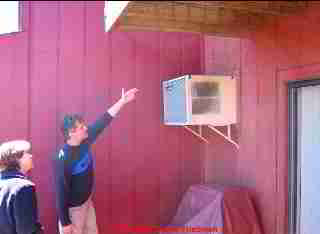
Our photo (left) shows a contractor pointing to wall leaks at an air conditioner, a source of mold found indoors at this building.
There is no point in "cleaning up" or "removing" mold if the underlying causes of a mold problem are not also addressed. Unless the causes, such as leaks or high moisture are corrected, mold will simply recur.
Band-Aid approaches like trying to "kill" or "prevent" mold by using chemical sprays, coatings, or air cleaners are insufficient and ineffective at preventing future mold and in some cases
(such as OZONE MOLD / ODOR TREATMENT WARNINGS) these approaches create their own hazards.
In the photo at above left, the contractor is pointing out to the owner that wind-blown rain running down the building's wall will enter the wall cavity at the air conditioner penetration because of improper installation and sealing there. Inside we found that the wall cavity was wet and moldy.
Proper installation and sealing at building wall and roof penetrations such as roof vents, windows, doors, and trim can prevent many building leaks which in turn reduces the chances of a future mold problem.
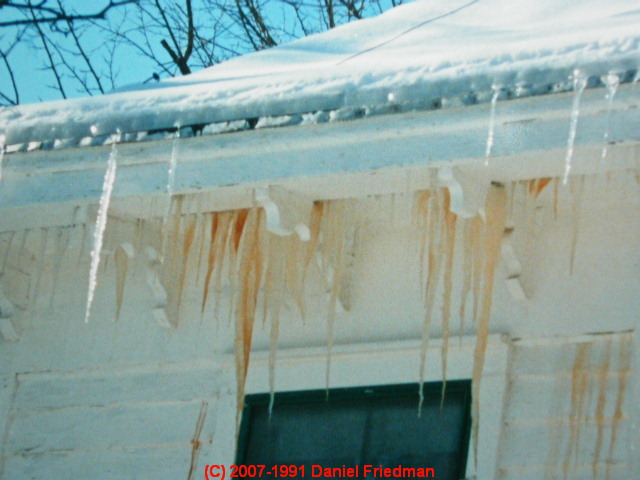 Attic Condensation and Ice Dam Leaks:
If roof leaks or attic moisture condensation due to a combination of inadequate attic
ventilation and a building moisture source (wet basement, plumbing leaks, roof leaks) causes excessive moisture or actual wet
conditions in an attic, conditions are ripe for extensive mold growth.
Attic Condensation and Ice Dam Leaks:
If roof leaks or attic moisture condensation due to a combination of inadequate attic
ventilation and a building moisture source (wet basement, plumbing leaks, roof leaks) causes excessive moisture or actual wet
conditions in an attic, conditions are ripe for extensive mold growth.
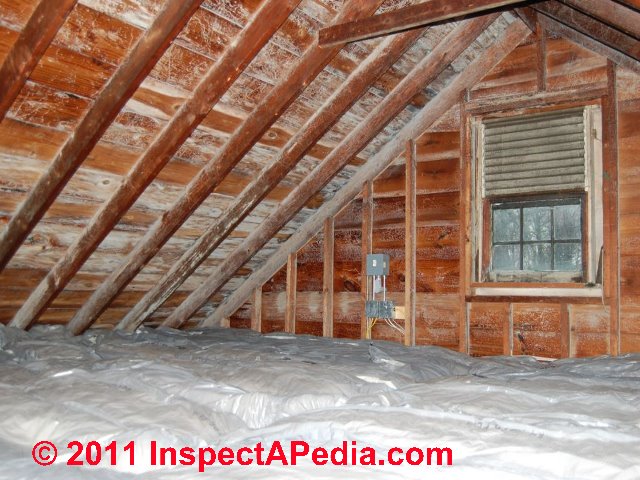
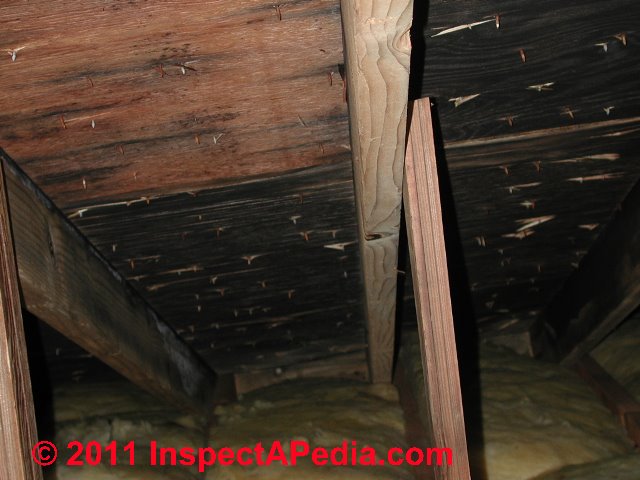
- Visible mold may appear on wood surfaces in an attic such as on rafters or roof sheathing.
- Hidden mold may be present and may be even more of a problem if it forms in insulation or in the ducts and air handler of an air conditioning or heating/air conditioning system.
- Mold from an attic might be a problem on lower floors:
Typical building air convection currents tend to move air up and out from lower to upper building levels, so one would not think that much mold would move down from an attic into the living area. But important exceptions to this can quickly move problem mold from an attic into a living area.
For more details on this topic - see ATTIC CONDENSATION & ICE DAMS Detection and Correcting Venting and Condensation Problems in buildings.
- Conditions moving mold downwards from an attic include the following:
- Mold growth in HVAC ducts or air handlers found in an attic
- Mold on any attic surface or in attic insulation if it is a species producing airborne spores and if the building uses a whole house ventilating fan, especially if there is inadequate exit venting for the fan operation. This condition pressurizes the attic and moves mold down through various openings into the floors below.
- Mold on building surfaces in an attic or attic knee wall space which opens onto or has a knee wall common with an upper floor living space such as a bedroom.
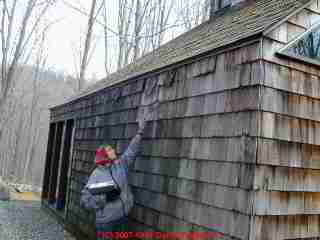
Building Exterior Leaks and Mold No mold cleanup project will be successful unless you correct the conditions that caused mold growth in the first place.
- An expert inspection and report should find and suggest remedies for site and building exterior conditions that produce mold or for building areas that serve as a mold reservoir or as amplifiers for allergens, mold, mildew, excessive pollen or pet dander.
- The basic steps: find all unwanted moisture sources, correct appropriate building, site, landscaping, & construction details. 90% of the wet basements and crawl spaces I see are caused by bad or missing roof gutters and downspouts.
- An environmental investigator who has training and experience in building science, mycology (mold science), and IAQ, or in some cases an experienced ASHI-Certified home inspector or sick building investigator who is who has a similar in-depth understanding of construction failures can be helpful at this step.
The photograph shows a double problem with this wood shingle exterior wall: shingles are improperly installed and falling off of the home, inviting water to enter the wall structure. Because there is no roof overhang or eaves, and not even a gutter on the home, roof runoff runs right down this wall.
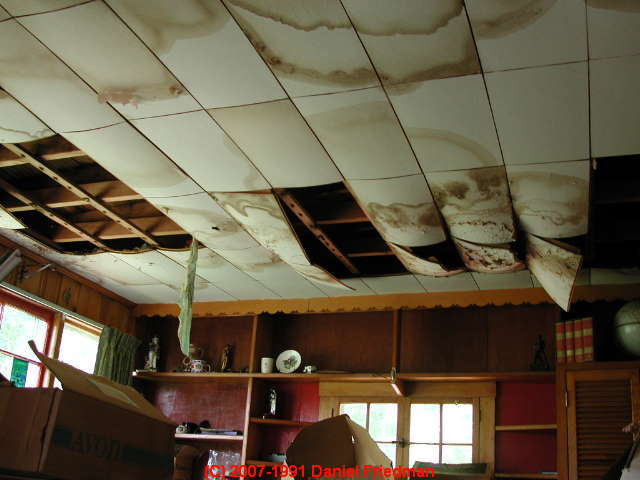
Building Interior Leaks and Mold: address interior conditions that produce or serve as reservoir or amplifier for common
allergens: mold, pollen, pet dander as well as other possible respiratory irritants such as latex, paints,
product-outgassing furniture or carpets, and renovation hazards such as lead paint or chemicals or other environmental issues.
- Plumbing leaks that are unattended, water running under kitchen or bathroom cabinets when fixtures are in use, and air conditioning system condensate leaks into the building or into the HVAC duct work are examples of indoor leaks that can lead to a mold problem if not promptly attended.
The photograph shows extensive staining from protracted plumbing leaks in a house that was left unattended. The result was extensive basement mold requiring demolition and cleaning of large area of the home.
 Indoor Humidity Control:
What indoor humidity should we maintain in order to avoid a mold problem?
A maximum indoor relative humidity of 55 should be OK, 50 better, 45 for an attic knee wall space which is not
vented to outdoors. The moisture level you detect varies depending on when, where, and how
you measure it.
Indoor Humidity Control:
What indoor humidity should we maintain in order to avoid a mold problem?
A maximum indoor relative humidity of 55 should be OK, 50 better, 45 for an attic knee wall space which is not
vented to outdoors. The moisture level you detect varies depending on when, where, and how
you measure it.
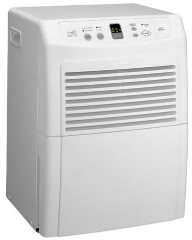
- For normal home use we like modern dehumidifiers such as this Sears ™ unit which permit setting a specific
humidity level and also permit connecting the dehumidifier to a drain so that it can operate unattended.
The article cited at the end of
this paragraph explains the need
for maintaining an anti-mold low humidity level in a building, sets moisture level targets, and tells you how
to get the indoor moisture level into the desired range.
More detail about how to control indoor humidity is
at HUMIDITY CONTROL & TARGETS INDOORS
- Mechanical Systems (Heating and Air Conditioning Systems) and Mold:
HVAC - Heating, Ventilation, Air Conditioning Systems and Duct Work Cleaning and Remediation Issues & Advice about mold are needed
from the same expert.
I often find that a building owner has paid for "duct cleaning" only to discover that simply opening the air handler unit (AHU) shows a filthy or moldy blower compartment! Thoroughness is important as is the choice of duct replacement materials to reduce the chance of new mold growth and to make the system easier to clean.
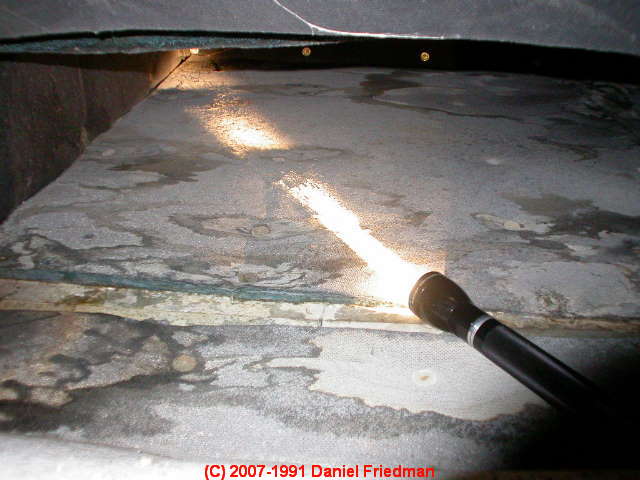
- Duct Cleaning for mold or bacterial contamination: Leaks into duct work wet organic dust and
Our experience is that fiberglass and fiberglass-lined ducts and air handlers cannot be cleaned effectively and worse,
improper cleaning may cause dangerous release of fiberglass into the building air.
Don't just spray ducts with
disinfectants and sanitizers.
However it is also our experience that it's rare (not impossible, just rare) for the duct system itself to be the source of the main mold problem in a building.
- The US EPA advises caution about using
duct cleaning sprays and chemicals, the AIHA also advises that occupants may suffer from respiratory irritation from these chemicals, and
research on fungicidal treatment of fiberglass HVAC ducts suggests that their effectiveness is limited anyway.
The photo shows stains indicating a history of leaks into this fiberglass lined HVAC duct. We recommended replacing the insulation, cleaning the duct interior (or replacing the duct work if that was less costly), and making sure that the leak source was repaired.
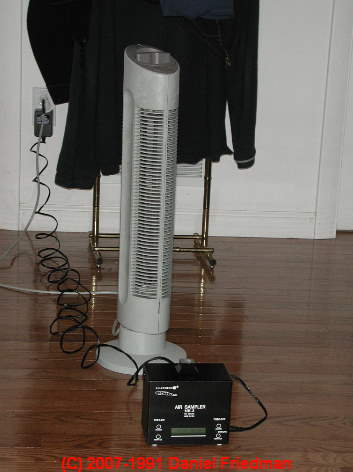
- Indoor Air Cleaning Products can help improve indoor air
quality, but watch out for products that are ineffective.
At least one study has shown that there at least up to 2005 there was not one portable free-standing home "air cleaner" or "air purifier" on the market that moved enough cubic feet of air per minute to actually clean a home much less a room of problem airborne particles.
Also see OZONE MOLD / ODOR TREATMENT WARNINGS - Use of Ozone as a "mold" remedy is ineffective and may be dangerous.
Portable air cleaners: The photo above shows a popular portable air cleaner in a room where we ran a time-lapse impaction sampler to collect particles at regular intervals to see what the machine seemed to be doing. We compared the particle levels in this room with the door shut, with the door open, and with other building areas.
OPINION: our clients' experience, confirmed by our own field testing suggest that in a room without severe dust and particle reservoirs (no pets, no wall to wall carpets), some air cleaners might reduce, but by no means eliminate, problematic airborne particles. The particle reservoir forms what is in a practical sense, an infinite particle source.
- Central HVAC systems, with a much larger air handling capacity, can be equipped with filtration that can substantially reduce the level of indoor airborne particles. Their effectiveness can be increased still further if the system permits the fan and filtration to run continuously.
- Air Cleaning Products are discussed and listed further
at ALLERGY & MOLD IAQ PRODUCTS
- Fresh Air Ventilation / Air-to-Air Heat Exchange: contact local HVAC contractors,
see VENTILATION, BALANCED- Guide to Balanced Fresh Air Ventilation Systems for Indoor Air Quality Improvement
and
See Hellevang, Kenneth, & Pederson, Carl,
"AIR to AIR HEAT EXCHANGERS for HEALTHIER ENERGY-EFFICIENT HOMES" [PDF]
My House Makes Me Sick: A Quick Action Plan for Moldy House Complaints
Reader Question: Health Crisis in My Home: Mold is Making Me Sick but I Don't See Where the Mold Is
I am sick with violent headaches and nausea that occurs when I am home more frequently than when I am out. My wife is unaffected, at least not to the extent I am. I have mold/s in my house. It smells like mildew; I can not see it on walls or surfaces inside, but I can smell it in clothes, drawers, closets, and even in open air at time, especially after a rain.
There is plenty of green mold on the outside of our home (even though I pressure-wash at least once every 3 months), and there is also a nasty grayish sediment on the outside roof overhangs (bug excrement or carcasses from spiders and scorpions eating. (yes, I have scorpions). I live in the swamps of south Georgia with high humidity and acidic soil and water. (great environment for all kinds of molds I know)
Solutions I have already tried to no avail: one dehumidifier running in master bedroom, HEPA air purifiers (large floor model from home depot) running in 3 rooms, fungus control treatment of our lawn, and mold inhibitor spray on the vinyl siding. HEPA air filters now smell like mildew when turned on even when I change the filters.
If mold is in the concrete slab (housing foundation) and the carpets (which I am removing) like I think it is, what can I do short of move and or spend 10s of thousands of dollars?
Sick and tired of fungus in Georgia - J.E. 10/28/2013
Reply: A summary of steps to address your indoor mold complaint
A competent onsite inspection by an expert usually finds additional clues that would permit a more accurate, complete, and authoritative answer than we can give by email alone. You will find additional depth and detail in articles at our website.
That said I offer these comments:
Starting at ACTION GUIDE - WHAT TO DO ABOUT INDOOR MOLD I list in more detail some suggestions that you will want to review.
But below and in response to your question I offer a more brief summary of recommendations based on your specific inquiry: If you feel that conditions are an emergency,
You should start with your own doctor and a thorough discussion of your health concerns; include among your questions for the physician whether or not the indoor environment is likely to be significant in your case (as you certainly sound and suggest)
MOLD DOCTORS - ENVIRONMENTAL MEDICINE may help but it's best to start with a referral from your own doc.
Our article MOLD / ENVIRONMENTAL EXPERT, HIRE ? helps decide when to hire a professional - which your email also suggests is probably appropriate. A true professional won't just stop by to take an air test (which would be nonsense, though profitable). Instead she will inspect the entire structure inside and out to identify risk points that deserve further or perhaps even invasive inspection to look for a hidden problem.
Regarding indoor mold contamination and air quality steps you have already taken,
An indoor air cleaner can reduce airborne particle level when it operates in a small-enough area to match its capacity. But running a portable "air purifier" will never ever actually correct an indoor mold, other particle, nor gas contamination problem any more than waving your vacuum cleaner in the air in the kitchen will suck up dust bunnies from under the living room couch. You need to find and fix the problem source.
While running a dehumidifier can reduce indoor humidity level and thus reduce the friendliness of the indoor environment to grow mold as well as some other indoor contaminants, a humidifier will never correct an indoor contamination source - to do that one needs to find and remove the problem and then to understand and fix its cause so that the problem does not recur.
If a mold reservoir is indeed in your indoor carpets, you are correct to remove them. Wall-to-wall carpets in moldy shape are discarded along with carpet padding. Area rugs that are worth the cost can usually be professionally cleaned.
Mold won't be "in the concrete" though porous materials might absorb MVOCs and thus be smelly. Following carpet removal the floors should be cleaned. Perhaps you'll consider installing a different sort of floor covering (stained polished and sealed concrete, ceramic tile, even vinyl floor tile or sheet flooring can be easily cleaned, reduce the indoor airborne particle level, and don't form a friendly mold reservoir.
Prevent future indoor mold contamination & mold growth
If you find that more extensive demolition is needed and you want to re-build or restore the building to be as mold resistant as possible,
Regarding outdoor mold contamination
Regarding pressure washing: it is not normal to need to pressure-wash a building exterior every 90 days, and may even be unconscionable on the part of your contractor. Something is wrong there. And worse, an inept pressure washer might make your indoor environmental mold problems exponentially worse by spraying exterior siding improperly so that water enters the building wall cavities. Be sure to discuss this worry with your on-site expert.
Spraying a "mold inhibitor" on exterior siding is, if you'll pardon a mixed metaphor, barking up the wrong tree (or wall). First, it is normal for there to be mold everywhere outdoors. Second, if your siding is moldy (or more likely is growing algae) it's due to other factors: shade, for example, or rain splash-up on walls, or an idiot spraying water into the wall cavities.
Cleaning the exterior walls properly once, and if walls are paintable, using a paint that includes a fungus inhibitor (also a toxic chemical), and taking steps to increase sunlight on and air flow around exterior walls are the sorts of corrective steps that might reduce that problem. But outdoor mold is not the cause of an indoor mold air quality problem, as I've discussed above.
South Georgia is indeed a very humid climate. If your building uses air conditioning, that system too needs to be inspected for proper operation and for cleanliness. Properly working, central air or even window air conditioners ought to be dropping the indoor relative humidity, making use of a dehumidifier unnecessary.
Mold Action & Cleanup Guide Articles
- ACCEPTABLE MOLD LEVEL - given that a target of "zero mold indoors" is nonsensical, just how much indoor mold should we accept?
- ACTION GUIDE - WHAT TO DO ABOUT INDOOR MOLD - home
- BLEACHING MOLD, Advice - unnecessary except for cosmetic reasons
- CHOOSE a FLOOD DAMAGE RESTORATION or MOLD REMEDIATOR
- DRYWALL MOLD RESISTANT You Must Be Kidding! You Must Be Kidding!
- Set priorities for building safety when performing an inspection to protect occupants. For example, where an elderly occupant is present, trip and fall hazards could be an immediate threat that needs attention. See ELDERLY & VETERANS HOME SAFETY.
- EXPERT DIRECTORY - private home and building inspectors
- FLOOD-CAUSED MOLD PREVENTION
- FUNGICIDAL SEALANT USE GUIDE
- GUIDANCE for CLINICIANS on the Recognition and Management of Health Effects Related to MOLD EXPOSURE & MOISTURE INDOORS, [PDF] - Eileen Storey, MD MPH, Kenneth H. Dangman, MD PhD MPH, Paula Schenck MPH, Robert L DeBernardo MD MPH, Chin S Yang PhD, Anne Bracker CIH MPH, Michael J Hodgson MD MPH, University of Connecticut Health Center, Division of Occupational and Environmental Medicine, Center for Indoor Environments and Health, 266 Farmington Ave., Farmington CT 06030-6210, 30 September 2004.
We have edited this file to remove blank pages in order to speed its load-time and to add a link back to this website.
This document was designed to help the healthcare provider address patients with illnesses related to mold in the indoor environment by providing background understanding of how mold may be affecting patients.
The guidance was published in 2004, with support from a grant by the U.S. EPA, by the Center for Indoor Environments and Health, or CIEH at the University of Connecticut Health Center. " -- original source: oehc.uchc.edu/images/PDFs/MOLD%20GUIDE.pdf (1.13MB PDF file, slow loading) - this is an absolutely excellent and wide-ranging mold reference available online in PDF format. - HUD, REBUILD HEALTHY HOMES, GUIDE TO POST-DISASTER RESTORATION FOR A SAFE AND HEALTHY HOME [PDF] U.S. Department of Housing and Urban Development (HUD)
Check Credentials & Hire only licensed & insured contractors, see pp. 33-35
Cross-contamination protection, see pp.25-28 & pp. 39-40
Mold Removal Guielines, see pp. 41 & 50-53
Remove previously or currently-wet or moldy insulation, foam padding, carpets, see pp. 48-49 - HUMIDITY CONTROL & TARGETS INDOORS
- MOLD ATLAS of Common Indoor Clinical Mold, Pathogens, Allergens, & Other Particles - Medical Health Effects of Mold: Allergenicity, Toxicity, Pathogenicity, Other
- MOLD APPEARANCE - WHAT MOLD LOOKS LIKE and
- MOLD APPEARANCE - STUFF THAT IS NOT MOLD - how to recognize mold and how to avoid wasting money testing or cleaning up stuff that is not mold; what does cosmetic mold look like and can we reliably identify it without testing?
- MOLD CLEANERS - WHAT TO USE
- MOLD CLEANUP COMPANIES
- MOLD CLEANUP, DIY
- MOLD CLEANUP GUIDE
- MOLD CLEANUP HEALTH RISKS
- MOLD CLEARANCE INSPECTIONS
- MOLD DOCTORS - ENVIRONMENTAL MEDICINE - when to see a doctor? what to ask your doctor about mold; directory of mold doctors and experts in environmental medicine, allergists, pulmonologists, etc.
- MOLD / ENVIRONMENTAL EXPERT, HIRE ? - how to decide when the mold risk in a building justifies bringing in an expert to inspect, test for mold, write a mold remediation plan, or perform a post-cleanup mold clearance inspection and test.
- MOLD EXPOSURE, FOOD HAZARDS - a history of food borne mold related illness, definitions of mycotoxins, aflatoxins, etc., moldy food advice
- MOLD EXPOSURE STANDARDS - world standards for mold exposure levels - and discussion of the difficulty of quantitative mold standards
- MOLD KILLING GUIDE - should we try to kill mold? How? Why? Why not?
- MOLD LEVELS IN buildings - reasonable guidelines help describe mold contamination levels
- MOLD PRODUCTS, INEFFECTIVE
- MOLD RELATED ILLNESS GUIDE - Mold-Related Illness: sickness and health risks or complaints caused, or suspected to be caused or aggravated by indoor airborne mold, by physical contact, or other means of mold exposure
- MOLD RELATED ILLNESS SYMPTOMS - a long list of all of the known, suspected, or simply documented health complaints voiced by people who have been or are suspected to have been exposed to problematic mold
- MOLD ODORS, MUSTY SMELLS - if you smell mold, there's mold
- MOLD PREVENTION GUIDE - how to prevent mold growth or re-growth in a building
- MOLD RESISTANT CONSTRUCTION - Mold-Resistant Building Practices advice from an expert on how to prevent mold after a building flood and how to prevent mold growth in buildings by selection of building materials and by anti-mold construction details
- MOLD SANITIZER, SPRAY, BIOCIDE USE GUIDE
- MOLD TESTING METHOD VALIDITY - building tests taken by themselves (without an expert inspection) are not very reliable for several reasons: the mold detected by some tests (such as cultures) may not be the most significant or dangerous mold present, and a test that does not detect mold does not assure that there is no problem mold present in a building
- MOLD TESTING SERVICES
- MOLD TEST KITS
- Moisture control, dehumidification, ventilation: reduce conditions that encourage mold growth
- ROOF ICE DAM LEAKS- includes a discussion of attic condensation: Detecting and Correcting Attic Condensation and Preventing Ice Dam Leaks in buildings
- HUMIDITY CONTROL & TARGETS INDOORS -What indoor humidity should we maintain in order to avoid a mold problem?
- ALLERGY & MOLD IAQ PRODUCTS -Allergy/Asthma, Air Quality, Cleaning, Filtering, Ventilating, Dehumidification Products
- CONSULTANTS & EXPERTS DIRECTORIES - Contact a home inspector or a local de-watering contractor for inspection and advice
- OZONE MOLD / ODOR TREATMENT WARNINGS World Health Organization Mold Bulletin - an excellent description of causes of mold related illness
- ROOF ICE DAM LEAKS - Attic Condensation & Ice Dams as a factor in attic and insulation mold contamination
- WHEN TO STOP LOOKING FOR MOLD
Reader Comments, Questions & Answers About The Article Above
Below you will find questions and answers previously posted on this page at its page bottom reader comment box.
Reader Q&A - also see RECOMMENDED ARTICLES & FAQs
On 2019-04-12 by (mod) - clothes are not clean when taken from the washer.
Zig
Clean of mold or dirt or what? I suspect this is a problem with the washing machine itself, its cleanliness or cycle or detergent.
Occasionally there can also be an oil leak that fouls clothes.
See WASHING MACHINE REPAIR https://inspectapedia.com/Appliances/Washing-Machine-Repair.php
On 2019-04-12 by Ziggy
My wife noticed that clothes are not clean when taken from the washer.
The laundry feels gritty.
On 2018-08-02 by (mod) - where to find an expert to test for hidden mold in building walls, floors, or ceilings:
Regarding reader's question of where to find an expert to test for hidden mold in building walls, floors, or ceilings:
Opinion:
About "testing for mold behind walls", air tests, even settled dust tests indoors are not reliable indicators of the presence/absence of problematic mold contamination in building cavities. Even if such a test suggests that a problem is present, the costd of the test was money poorly-spent as the results are not prescriptive: you are no further in knowing where the problem is or what needs to be done about it than before the test.
What is useful is a very thorough on-site visual inspection, also noting occupant complaints, building leak history, to permit an experienced environmental or mold inspector to combine building science, familiarity with building materials, familiarity with when, where, how, and why mold grows in buildings, to point out the most-suspect areas where a hidden mold problem could be present.
Those areas are investigated more aggressively, cutting test openings if necessary.
The same consultant should be able to tell you when further invasive inspection, demolition, or inspection are not justified. That's not a guarantee that there can't be a hidden mold problem. Instead, it's a guarantee that the mold-concern problem has been approached rationally without wasting the consumer's money to reduce the inspector's personal risk of a future complaint.
Also see MOLD CLEANUP COMPANIES where we offer additional advice about choosing a mold cleanup or mold remediator company.
On 2017-10-16 by Penny
Our rental has a leaking bay window in the bedroom. The landlord has not gotten it fixed properly and now the roof inside leaks in heavy rain. Like I have to put pots down and a crack across the ceiling.
They keep putting paint or some kind of glue on the inside to repair the ceiling, but have not actually fixed the problem outside. We can’t afford to move, we have addressed this in writing. Please help!
On 2017-01-07 by (mod) - plastic house wrap is a moisture trap?
Scott:
The plastic house wrap you describe should be perforated so that it's not a moisture trap.
Dark spots on the exterior walls: if you're sure they're not stains or deposits from some external source, I'd look for leaks into the wall structure.
On 2017-01-07 by scott
I have an addition about 8yrs old.And have started seeing dark spots on ext. walls only and have like dribble spots around the area.But it only where the truses are so I cut some holes in the drywall.
There is A poly vapor barrier then Ins.exterior sheathing and plastic ty-vek then vinly siding.Does this mean double vapor barrier? can anybody help??
On 2016-09-04 by Fathima bedroom smelling like mold
After recent rains i have notice my bedroom smelling like mold, mildew like damp smell.
I cant pin point where its coming from. Need to find the source but dont know how. I have been on all fours sniffing around but cant seem to find exactly where its coming from. What do i do. Can anyone help.
On 2015-10-01 by Anonymous
There is a musty smell coming from my vents. It only smells when the furnace our air conditioner is off. With the recent change of weather we are using neither.I came home after a few hours away the whole house has this terrible smell. Can someone please tell me how to get rid of it?
On 2012-10-17 by Mike
Hi. Thanks for all the great information on your site. I have some mold that was caused by 3 window units around the house. Somehow some of the drainage went into the walls and created mold all under the window. The mold is inside the walls and all over the structural lumber underneath.
Is that something that a diy can do? I might also have some florring mold under carpet. Probably in the plywood that was used for the subfloor. Thanks
On 2012-02-14 by (mod) - don't leave plastic or other housewrap as the "final" exposed surface on a building exterior
Mel, I don't have a clear image of your situation (you can send photos using the CONTACT link found at page top or bottom)- but it doesn't sound like good building practice to leave plastic nor housewrap as the "final" exposed surface on a building exterior.
On 2012-02-14 by (mod) - if you smell mold, there is mold contamination
Aida, if you smell mold, there is mold somewhere almost certainly. Small areas, less than 30 sqft of contiguous mold, do not require hiring an expert and can be cleaned using ordinary household cleaners. But if no one finds and fixes the causes of high indoor moisture or leaks, the mold problems will recur.
If, during the cleanup, you find evidence of a larger problem, the work should stop and an expert consulted.
At RENTERS & TENANTS GUIDE TO MOLD (article links at page left)
you will find more details of advice about mold when you are a renter.
On 2011-10-25 by Mel
Our walkout lower level has unfinished exterior walls with insulation covered by plastic sheeting on the interior. Small black spotted areas appear in various areas and seen to be on the insulation with some transfer to the plastic. Would a simple cleaning, or dusting, solve the problem. One suggestion was to replace the plastic with a product like Tyvek.
On 2011-08-07 by Aida
We have been living in a rental house for a year and half and the house has always moisture but recently we have been smelling the presence of mold. I recently found some on the wood backing of my bed and my jeans that I left on the floor had mold growing on it. What steps should I take to resolve this?
On 2011-08-02 by (mod) - mold found in our rental property
If there are large areas of problem mold (more than 30 sqft contiguous) then a professional cleaning and containment are needed and you wouldn't have people in the building during the work.
As long as the containment is properly performed and you do some tests before and after to confirm that the containment worked (you didn't blow mold out of the work area) then the occupants' belongings are ok and were ok to remain in the building.
In any mold cleanup job if there are occupants who are at extra risk such as but not limited to elderly, infant, asthmatic, immune compromised, then they ought not to be in the building before, during, nor after the a problem mold cleanup job until there has been a successful cleanup operation.
With high risk people I'd apply that recommendation even for smaller cleanups.
On 2011-08-02 by Mary Bear Mader
On a recent walk through of rental property, I found several interior walls that have mold.
The home is on the coast. I have hired a company to come and test for mold/mildew and provide an estimate for restoration. Will the tenants have to move our during restoration? Thank you.
On 2011-07-26 by (mod) - can't figure out where the moisture is coming from
Thanks for the kudos, Angela. We are dedicated to making our information as accurate, complete, useful, and unbiased as possible: we very much welcome critique, questions, or content suggestions for our web articles.
While it is not at all reliable to try to identify a mold genera/species from photos of a building surface, an experienced mycologist or forensic lab technician might have a guess at the common molds found on that surface material that look like (whatever). You are welcome to use the CONTACT link found on our pages to send us some photos. And you can send a sample to any qualified mold test lab.
If the total square footage is under 30 sqft. normal cleaning by a homeowner or handyman is usually adequate. But it sounds like you may need help from a home inspector or plumber to be sure you found and fixed the mold-causing leak.
On 2011-07-26 by Angela Adams
Your site is awesome!!!! Very informative with a wealth of details. Tho, I've been searching and still can't find a pic that is similar to the mold?? that I have in my basement shower. Some black stuff on the tile and one concrete wall in the bathroom. Doesn't appear to be spreading but very unsightly and probably not healthy.
I'm trying to decide if the job is a simple cleanup job that I can do myself or should I hire the pros? The shower (bathroom) is quite small and located in the basement/laundry room.
Can't figure out where the moisture if coming from...assuming the shower. Since noticing it we now leave the light on and keep the window open.
Any suggestions?
On 2011-07-06 by (mod) - Preserving and storing moldy documents:
You can have moldy documents professionally cleaned - but it's quite expensive. You can yourself do some very gentle cleaning by taking the items outdoors on a warm dry day; gently HEPA vacuum the surfaces or where possible wipe with disposable cloths (don't re-use the cloth or you will spread mold) to remove what mold you can;
For documents that won't be damaged by sunlight, some exposure can reduce the mold odor;
Make SURE that the documents and books are dry.
Then they can be stored inside of sealed plastic containers and accessed when needed.
A mold reservoir indoors can be a hazard to anyone if it's toxic, allergenic, and large; Even a small reservoir such as opening a box of moldy books can be a hazard to someone who is sensitive such as an asthmatic or someone with mold-related illness, compromised immune system, etc. But if your documents are in a clean, sealed container, they won't be contributing anything to indoor air.
On 2011-07-03 by Anonymous
this website is very helpful. But i still am looking for specific advice on how to deal with old, moldy letters -
1- do they need to be stored in a plastic container?
2. can they cleaned, and with what? The suggestion on the website involves a package but not sure that helps with 100s of od letters that have developed mold.
3. are the letters a danger to residents of the house?
thanks, Fred Hill
Question: My elderly parent with health concerns lives in an older home that has roof leaks. Should we test for mold?
My mothers home is about 45 yrs. old. Recently, we noticed water spots on a wall and ceiling plus in the base ment ceiling tiles. This is a 2-story w/ attached dbl. garage. There has been NO flashing where the garage roof and the 2ns story meet.
This is where the problems occur. She has also had many respiratory, memory lapses and constant sinus problems.
We have read quite-a-bit on MOLD and believe this might be the problem. Could you advise us of the best road to take and who to call. - Thanks. W.B., Louisville KY
Reply: Set Priorities and Take a Sufficiently Broad Approach When Looking for Building-caused or Building-aggravated Health Worries
A competent onsite inspection by an expert usually finds additional clues that help accurately diagnose a problem. That said, here are some things to consider:
Since you know there is an ongoing leak, you need a competent roofing contractor to install the missing flashing and to inspect the rest of the roof for other flashing or leak problems you may not have noticed. More about roofing inspection, diagnosis, and repair is
at ROOFING INSPECTION & REPAIR.
Ask your doctor, or in this case your mom's doctor if s/he can name specific environmental contaminants that, if present, would be likely to cause or aggravate any of your mom's medical problems.
In the absence of a large visible mold problem, you may be best served by a thorough onsite visual inspection for conditions that might produce mold or other unsafe building conditions;
You could hire a consultant to test for mold (unreliable without an accompanying thorough inspection) but because other hazards could be present, a more complete inspection that covers your mold concern plus other hazards may be more appropriate.
We have no business nor financial connection with any product or service discussed at our website.
Question: bicarbonate of soda or borax for mold smell removal
(May 28, 2015) maggie said:
I live at the coast.what substance will absorb dank smells from a cupboard? the plaster was exposed so i painted with universal undercoat and a paint that pr0tect surfaces from mould and mildew.
Is it bicarb or borax for example?
Reply:
Maggie
You need to find and remove the odor source. Absorbents may improve odor somewhat in an enclosed space but wont' fix the problem.
...
Continue reading at MOLD CLEANUP GUIDE or select a topic from the closely-related articles below, or see the complete ARTICLE INDEX.
Also see these
Recommended Articles
- ALLERGY & MOLD IAQ PRODUCTS
- CHOOSE a FLOOD DAMAGE RESTORATION or MOLD REMEDIATOR
- EMERGENCY RESPONSE, IAQ, GAS, MOLD
- MOLD ACTION GUIDE - WHAT TO DO ABOUT MOLD
- MOLD CLEANUP GUIDE- HOW TO GET RID OF MOLD - home
Suggested citation for this web page
ACTION GUIDE - WHAT TO DO ABOUT INDOOR MOLD at InspectApedia.com - online encyclopedia of building & environmental inspection, testing, diagnosis, repair, & problem prevention advice.
Or see this
INDEX to RELATED ARTICLES: ARTICLE INDEX to MOLD CONTAMINATION & REMEDIATION
Or use the SEARCH BOX found below to Ask a Question or Search InspectApedia
Ask a Question or Search InspectApedia
Try the search box just below, or if you prefer, post a question or comment in the Comments box below and we will respond promptly.
Search the InspectApedia website
Note: appearance of your Comment below may be delayed: if your comment contains an image, photograph, web link, or text that looks to the software as if it might be a web link, your posting will appear after it has been approved by a moderator. Apologies for the delay.
Only one image can be added per comment but you can post as many comments, and therefore images, as you like.
You will not receive a notification when a response to your question has been posted.
Please bookmark this page to make it easy for you to check back for our response.
Our Comment Box is provided by Countable Web Productions countable.ca
Citations & References
In addition to any citations in the article above, a full list is available on request.
- Johanning E1, Auger P, Morey PR, Yang CS, Olmsted E., "Review of health hazards and prevention measures for response and recovery workers and volunteers after natural disasters, flooding, and water damage: mold and dampness", Environ Health Prev Med. 2014 Mar;19(2):93-9. doi: 10.1007/s12199-013-0368-0. Epub 2013 Nov 20.
Abstract: Health problems and illnesses encountered by unprotected workers, first-responders, home-owners, and volunteers in recovery and restoration of moldy indoor environments after hurricanes, typhoons, tropical storms, and flooding damage are a growing concern for healthcare providers and disaster medicine throughout the world. Damp building materials, particularly cellulose-containing substrates, are prone to fungal (mold) and bacterial infestation. During remediation and demolition work, the airborne concentrations of such microbes and their by-products can rise significantly and result in an exposure risk. Symptoms reported by unprotected workers and volunteers may relate to reactions of the airways, skin, mucous membranes, or internal organs. Dampness-related fungi are primarily associated with allergies, respiratory symptoms or diseases such as dermatitis, rhinosinusitis, bronchitis, and asthma, as well as changes of the immunological system. Also, cognitive, endocrine, or rheumatological changes have been reported. Based on the consensus among experts at a recent scientific conference and a literature review, it is generally recommended to avoid and minimize unnecessary fungal exposure and use appropriate personal protective equipment (PPE) in disaster response and recovery work. Mycologists recommend addressing any moisture or water intrusion rapidly, since significant mold growth can occur within 48 h. Systematic source removal, cleaning with "soap and water," and "bulk removal" followed by high-efficiency particulate air vacuuming is recommended in most cases; use of "biocides" should be avoided in occupied areas. Public health agencies recommend use of adequate respiratory, skin, and eye protection. Workers can be protected against these diseases by use of dust control measures and appropriate personal protective equipment. At a minimum, a facial dust mask such as the National Institute for Occupational Safety and Health (NIOSH)-approved N95 respirator should be used for mold remediation jobs. For any large-scale projects, trained remediation workers who have medical clearance and use proper personal protection (PPE) should be employed. - Atlas of Clinical Fungi, 2nd Ed., GS deHoog, J Guarro, J Gene, & MJ Figueras, Centraalbureau voor Schimmelcultures, Universitat Rovira I Virgili, 2000, ISBN 90-70351-43-9
- A BRIEF GUIDE to MOLD, MOISTURE, and YOUR HOME, [PDF] U.S. Environmental Protection Agency US EPA - includes basic advice for building owners, occupants, and mold cleanup operations. See http://www.epa.gov/mold/moldguide.htm
- Disease Prevention in Home Vegetable Gardens [PDF], Patricia Donald,Department of Plant Microbiology and Pathology,
Lewis Jett
Department of Horticulture, University of Missouri Extension - extension.missouri.edu/publications/DisplayPub.aspx?P=G6202 - Fifth Kingdom, Bryce Kendrick, ISBN13: 9781585100224, - we recommend the CD-ROM version of this book. This 3rd/edition is a compact but comprehensive encyclopedia of all things mycological. Every aspect of the fungi, from aflatoxin to zppspores, with an accessible blend of verve and wit. The 24 chapters are filled with up-to-date information of classification, yeast, lichens, spore dispersal, allergies, ecology, genetics, plant pathology, predatory fungi, biological control, mutualistic symbioses with animals and plants, fungi as food, food spoilage and mycotoxins.
- Fungi, Identifying Filamentous, A Clinical Laboratory Handbook, Guy St-Germain, Richard Summerbell, Star Publishing, 1996, ISBN 0-89863-177-7 (English)
- US EPA: Mold Remediation in Schools and Commercial Building [ copy on file as /sickhouse/EPA_Mold_Remediation_in_Schools.pdf ] - US EPA
- Mycology, Fundamentals of Diagnostic, Fran Fisher, Norma B. Cook, W.B. Saunders Co. 1998, ISBN 0-7216-5006-6
- US EPA: Una Breva Guia a Moho - Hongo [on file as /sickhouse/EPA_Moho_Guia_sp.pdf - - en Espanol
- Mycology, Fundamentals of Diagnostic, Fran Fisher, Norma B. Cook, W.B. Saunders Co. 1998, ISBN 0-7216-5006-6
- Our recommended books about building & mechanical systems design, inspection, problem diagnosis, and repair, and about indoor environment and IAQ testing, diagnosis, and cleanup are at the InspectAPedia Bookstore. Also see our Book Reviews - InspectAPedia.
- "IgG Food Allergy Testing by ELISA/EIA, What do they really tell us?" Sheryl B. Miller, MT (ASCP), PhD, Clinical Laboratory Director, Bastyr University Natural Health Clinic - ELISA testing accuracy: Here is an example of Miller's critique of ELISA - www.betterhealthusa.com/public/282.cfm - Townsend Letter for Doctors and Patients
The critique included in that article raises compelling questions about IgG testing assays, which prompts our interest in actually screening for the presence of high levels of particles that could carry allergens - dog dander or cat dander in the case at hand.
- www.tldp.com/issue/174/IgG%20Food%20Allergy.html - contains similar criticism in another venue but interestingly by the same author, Sheryl Miller. Sheryl Miller, MT (ASCP), PhD, is an Immunologist and Associate Professor of Basic and Medical Sciences at Bastyr University in Bothell, Washington. She is also the Laboratory Director of the Bastyr Natural Health Clinic Laboratory. - Allergens: Testing for the level of exposure to animal allergens is discussed at http://www.animalhealthchannel.com/animalallergy/diagnosis.shtml (lab animal exposure study is interesting because it involves a higher exposure level in some cases
- Allergens: WebMD discusses allergy tests for humans at webmd.com/allergies/allergy-tests
- In addition to citations & references found in this article, see the research citations given at the end of the related articles found at our suggested
CONTINUE READING or RECOMMENDED ARTICLES.
- Carson, Dunlop & Associates Ltd., 120 Carlton Street Suite 407, Toronto ON M5A 4K2. Tel: (416) 964-9415 1-800-268-7070 Email: info@carsondunlop.com. Alan Carson is a past president of ASHI, the American Society of Home Inspectors.
Thanks to Alan Carson and Bob Dunlop, for permission for InspectAPedia to use text excerpts from The HOME REFERENCE BOOK - the Encyclopedia of Homes and to use illustrations from The ILLUSTRATED HOME .
Carson Dunlop Associates provides extensive home inspection education and report writing material. In gratitude we provide links to tsome Carson Dunlop Associates products and services.
 | HOME | ABOUT | ASK a QUESTION | CONTACT | CONTENT USE POLICY | DESCRIPTION | POLICIES | PRIVACY | |
| © 2024 - 1985 Publisher InspectApedia.com - Daniel Friedman | |||||||||