
InspectAPedia® FREE Encyclopedia of Building & Environmental Construction, Diagnosis, Maintenance & Repair |
Question? Just ask us! InspectAPedia
|
 Allergens in Buildings
Home Page & Index to Articles
- POST a QUESTION or COMMENT about how to identify common indoor allergens and related particles by transmitted light microscopy.
Building allergens: sources, causes, cleanup, removal, control: home page and index to key articles. We also include a photo guide to common indoor allergens.
This article and others in this series use photographs to illustrate and help identify various indoor allergens like mold, cat allergens, dog allergens, mouse or rodent allergens, dust mites, cockroach and other insect fragments, mite fecals, and other help in identification of indoor allergens such as cockroaches, dust mites, fleas, house dust, mold, mildew, pet dander, pollen.
InspectAPedia tolerates no conflicts of interest. We have no relationship with advertisers, products, or services discussed at this website.
Photographs of Indoor Allergens and Allergenic Particles
 Article Contents
Cat Dander and Cat Hair in buildings
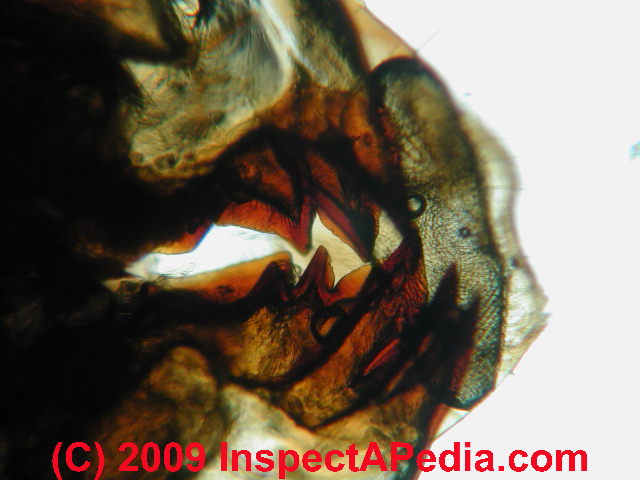
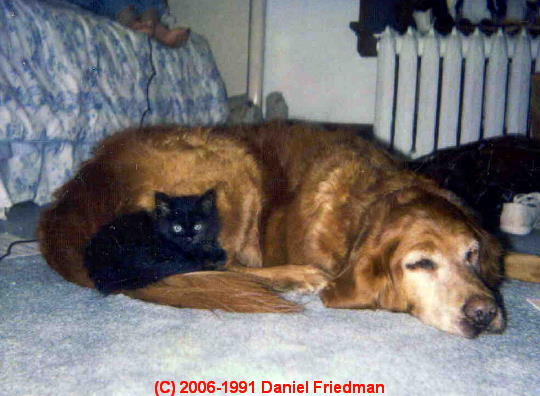
Cat dander (the black kitten Pippin at above left) is for many people a more serious allergen (and asthma aggravator) than dog dander (the dog katie, above). Our page top photo shows insect jaws collected during a survey for dust containing cockroach parts and allergens.
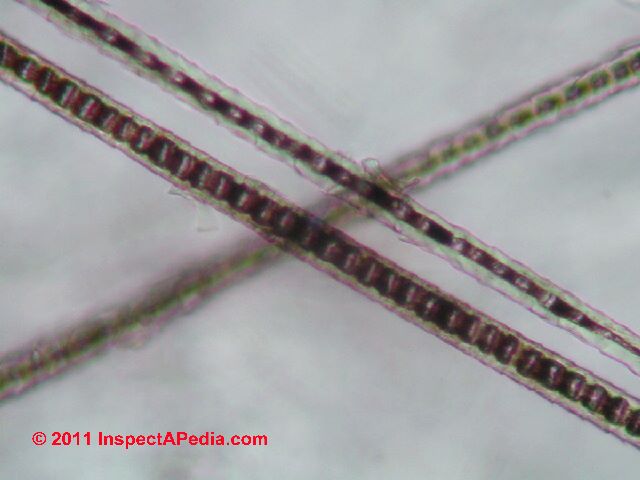
Cat dander is widespread and we even find it present, usually at lower levels, in offices and homes where no cats reside. Animal dander may be brought in by dust and clothing on visitors. Our second photo (above left) shows cat hair in the microscope.
Details about finding and removing animal dander in buildings are provided
Dog Dander and Dog Hair in buildings
Animal allergen Photos is our article on inspecting and addressing allergens from cats, dogs, and many other animals.
Pets, Pet Hair and Pet Dander as well as dust mites associated with animal dander are very common allergens in buildings.
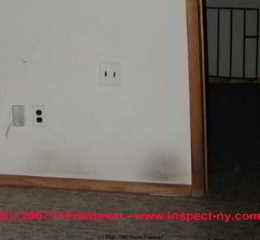
The wall stains in this photo (above left) were caused by pets, probably a large dog, indicating that further indoor screening for animal dander may be in order.
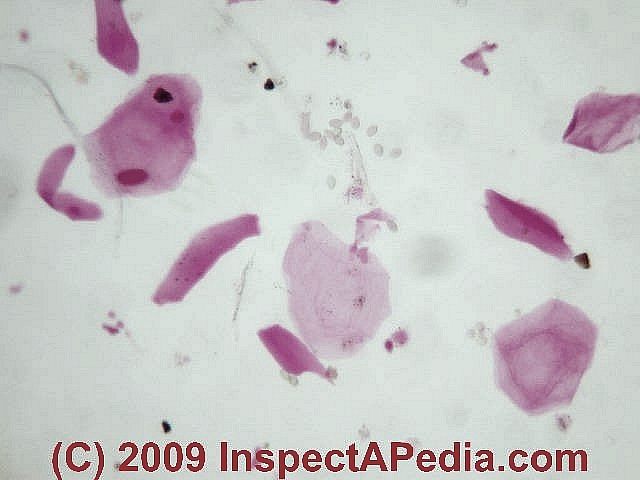
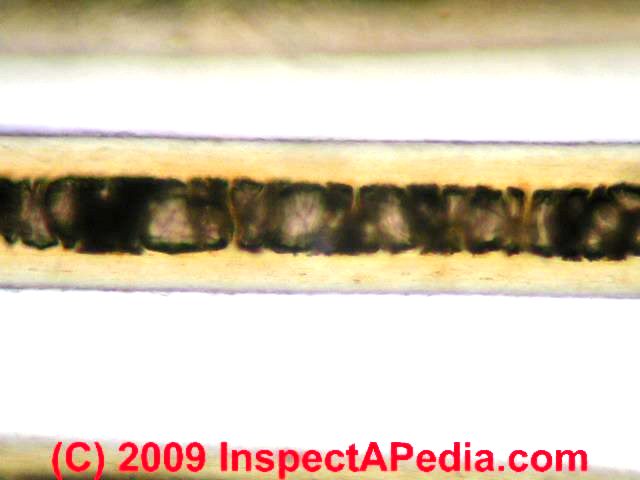
Our photos above and below show dog dander (along with human skin cells) stained pink with acid fuchsin to aid visibility for the photograph). Our photo at right shows dog hair collected in an indoor dust sample, in this case the hair is further identified as from a golden retriever.
Testing people for exposure to allergens is a different activity from testing buildings for the presence of animal or other allergens.
When human tests, such as the ELISA and RAST tests for exposure to allergens, indicate that someone has been exposed to problematic levels of animal allergens, there may still be confusion about just where the exposure is occurring. We discuss testing buildings for presence of allergenic particles such as dog dander, cat dander, insect or roach fragments, etc.
at ALLERGEN TESTS for BUILDINGS.
Pet control - if you can't say goodbye to your bird, cat, dog, guinea pig, hamster, tropical fish, then limit the areas they occupy and limit the airflow from that area to sleeping or other areas of the building, use allergenic bedding, eliminate wall-to-wall carpeting, improve housecleaning including use of a HEPA-rated vacuum cleaner.
For more details see our
article DOG, CAT & OTHER ANIMAL DANDER - Information for Asthmatics and Indoor Air Quality
ELISA and RAST tests for Allergen Exposure - The Basics
ELISA "enzyme-linked immunosorbent assay" is a rapid immunochemical test procedure that involves an enzyme (a protein that catalyzes a biochemical reaction) that tests for hormones, bacterial antigens, and antibodies. ELISA testing also involves an antibody or antigen (immunologic molecules).
RAST is an older allergen test (exposure detection) in popular use for testing humans, radioallergosorbent test, an IgE test: In this test, a sample of blood is taken, mixed with the suspected allergen, and the level of immunoglobulin E (IgE) is measured. IgE is an antibody produced by the immune system that indicates an allergic reaction.
The ELISA and RAST allergen exposure tests, their accuracy and their usefulness are discussed
at ALLERGEN TESTS for BUILDINGS.
Cockroach Fecals, Fragments, Hairs as Indoor Allergens and Causes of Asthma
Cockroaches (also see photo at page top) - are the source one of the most common insect allergens found indoors in urban areas.
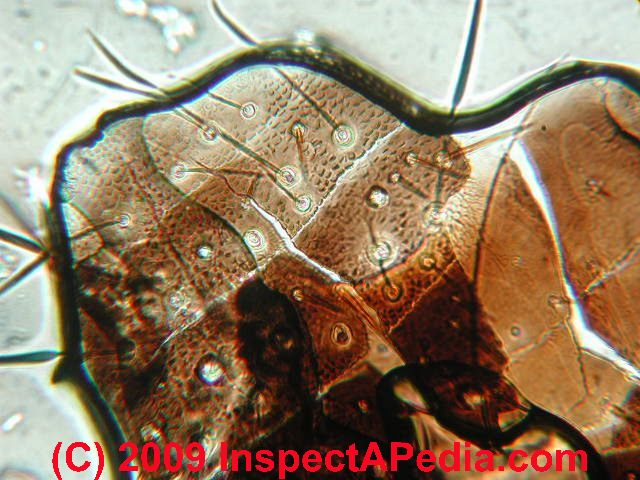
Cockroach fecal pellets, insect hairs, and insect fragments are often identified in house dust where roaches are present.
Our photo, left, shows cockroach carapace parts and hairs from an indoor dust sample.
Photos and Examples of Dust Mites and Dust Mite Fecals in buildings
Dust mites: our photo (left) shows a dust mite collected in an indoor surface dust sample.
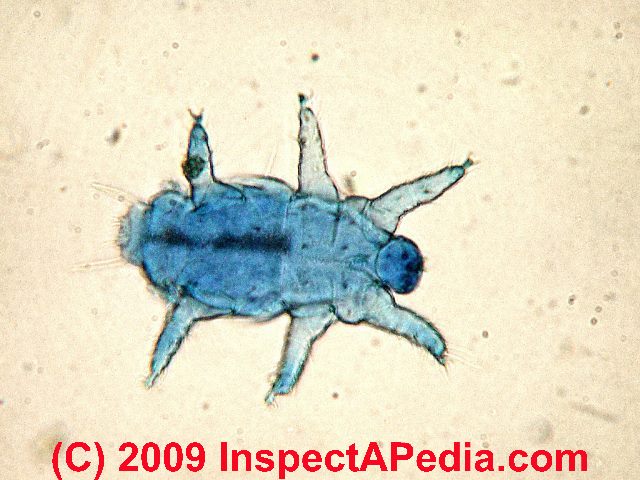
We've stained the mite blue using lactophenol cotton blue to make its parts more attractive and easy to discern.
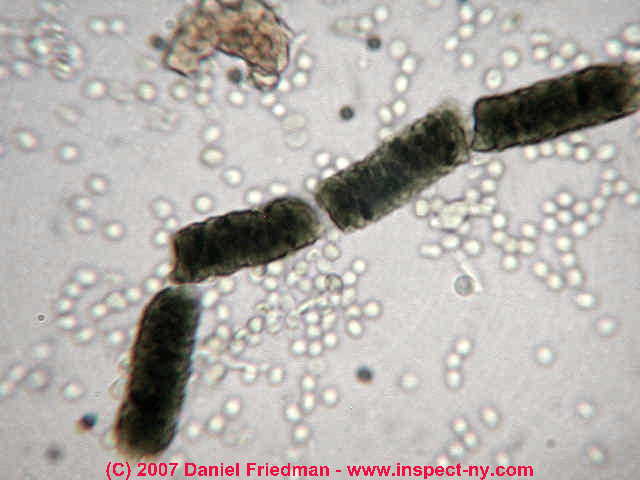
Photo of Dust mite fecal pellets & Pen/Asp Mold Spores
Our photo (left) shows a mix of dust mite fecal pellets and Penicillium/Aspergillus spores collected in a surface dust sample from a building.
A close examination of the dust mite fecal pellets (large dark colored particle chain in our photo) can assist in a building investigation for allergens by telling us what the dust mite or other insect was eating
- in this case mold spores.
The small hyaline (colorless) spherical particles are Pen/Asp spores at about 1-5u in diameter.
Photos of Dust Mites
At a much loser magnification than the dust mite fecal photos just above, you can see a dust mite surrounded by other house dust particulate debris.
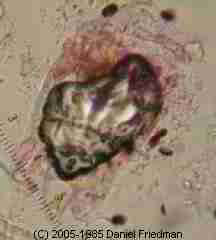
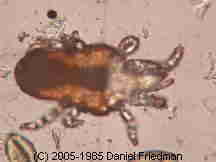
Here is another mite found among pollen in the flower of a Tulip Poplar.
You won't see dust mites without a microscope, but if your home has any or all of dampness, wet areas, pets, lots of dust and organic debris, old mattresses and pillows, couches, carpets, heavy curtains, or if you go to sleep with wet hair on your pillow, you're likely to have a high dust mite population.Mites, mite parts, and mite fecals show up in indoor dust samples examined by microscope. Dust mites are present wherever people and animals live. But high levels of mite fecals raises the level of allergens in the Building and may be a problem.
Fiberglass Insulation Mold comments about a field study in process, & more about health hazards from fiberglass insulation - DJF
Fleas and Bedbugs as serious building pests also may produce allergens.
Pollen Allergens in Building Air and Dust Samples
...
Plant Allergen Levels |
||
| Pollen Allergen |
Pollen |
Allergy Hazard Level |
| Grasses | > 0 - 5 | Low |
| 5 - 20 | Moderate | |
| 20 - 200 | High | |
| > 200 | Very High | |
| Trees | > 0 - 15 | Low |
| 15 - 90 | Moderate | |
| 90 - 1500 | High | |
| > 1500 | Very High | |
| Weeds | < 0 - 10 | Low |
| 10 - 50 | Moderate | |
| 50 - 500 | High | |
| > 500 | Very High | |
Notes to the table above
- Definitions of Pollen Allergy Hazard Levels
Absent = no allergic reaction, no symptoms
Low = Only individuals who are extremely sensitive to these pollens will experience symptoms
Moderate = Many individuals with any sensitivity to these pollens will experience symptoms
High = Most ndividuals with any sensitivity to these pollens will experience symptoms
Very High = Almoste all individuals with any sensitivity at all to these pollens will experience symptoms, and extremely-senitive people could have severe symptoms - Source: National Allergy Bureau & AAAIA
- For mold allergen or hazard levels and exposure standards, see
MOLD EXPOSURE STANDARDS
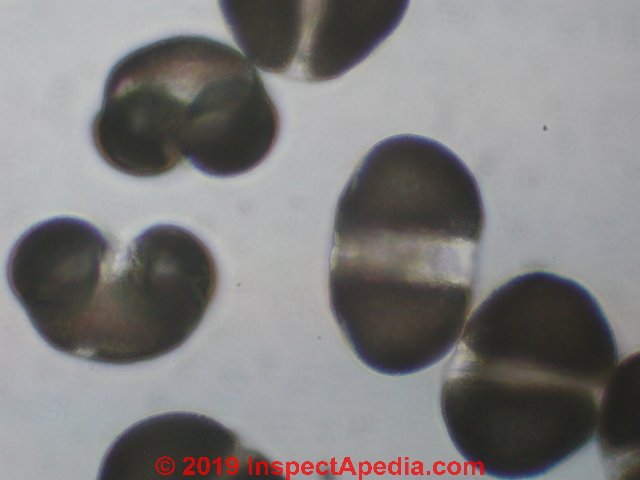
Above: red spruce pollen, detailed
at RED SPRUCE IDENTIFICATION & POLLEN PHOTOS
See our
POLLEN PHOTO LIBRARY a photo library of pollen & the flowers, shrubs, trees from which pollen was collected.
Mice and Rats in buildings as Allergen Sources
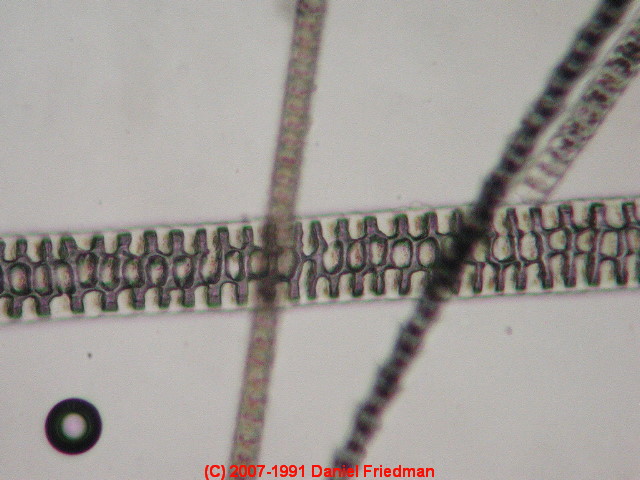
Mice hair, dander, and fecals are often observed during an indoor air quality or environmental inspection.
Our photo (left) shows mouse hair found in indoor dust during an environmental inspection and test.
We often find mouse droppings, hair, dander, and mouse remains in attics, basements, walls, ducts, and food-storage cabinets.
If mice and rats are a problem in a building, in addition to needing professional extermination services, you'll need to look at the housekeeping practices in the home and in neighboring apartments or homes, especially food storage.
Rodents, Mice, Squirrel Control - I find high levels of mouse and rodent dander, fecal dust, and urine-contaminated dust in some buildings, and high levels of these materials in building insulation in those locations.
If you have a mouse problem, particularly if mice and their waste (fecals or urine) are contaminating the building HVAC or building insulation, may need both steps to clean up or remove infected materials and steps to stop an ongoing rodent problem.
If squirrels are a problem, the cleanup needs to include closing off entry openings into the building. Get some help from a licensed pest control expert.
Mold Allergens and Toxins in buildings
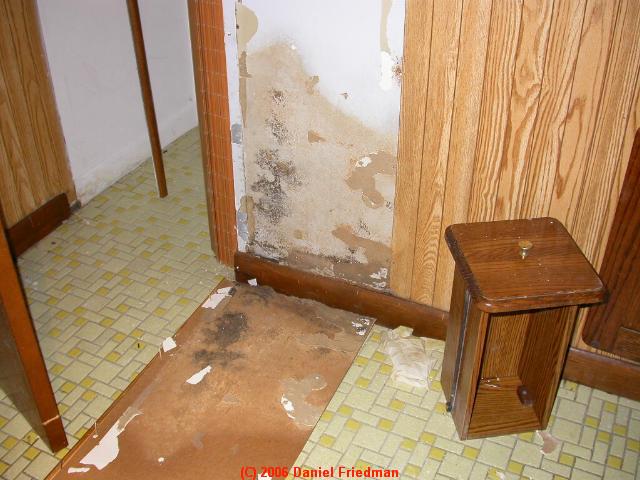
What mold looks like inside a building
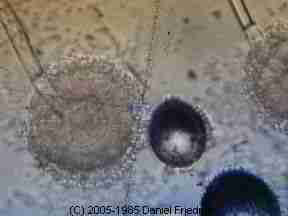
Mold, a photo library of mold spores for allergy and asthma sufferers - Aspergillus, Penicillium, Stachybotrys, Cladosporium, etc.

Meruliporia incrassata - Serpula lacrymans the "house eating fungus," field and lab photos
How to Find and Test For Mold in buildings - Looking for Mold - A 'how to' photo and text primer on finding and testing for mold in buildings
Recognizing Mold: What mold looks like mold identification photos to help identify mold - choosing what to sample in buildings
Wood & Other Building Dust & Allergens
Reader Question: to avoid wood allergens can I just paint the wood surfaces before insulating the wall cavity?
I have been doing a lot of research regarding the correct way to insulate my home. I have a typical raised ranch where the block wall extends about 4 feet above the slab and in my case it is also above grade.
My question is about the correct way to insulate the 4 feet of stud framed wall that extends above the block. I would like to know if I can paint the plywood with a vapor barrier paint before I insulate to help eliminate any moisture problems and since some members of my family have wood allergies?
Is there any reason why I shouldn’t use the same paint in my attic on the sheathing and rafters? - C.C. New York 11/21/2013
Reply:
First, you might want to read a bit about the topic starting at VAPOR BARRIERS & CONDENSATION in BUILDINGS But I can add a few specific thoughts:
Even if building occupants have wood allergies, it is not necessary nor appropriate to paint all of the wood framing and sheathing before enclosing a wall.
Proper wall construction will include an air and water barrier on the outside of the wall, insulation in the wall, a vapor barrier on the inside or warm side of the wall (unless you live in a cooling climate such as Florida), and a finish material of drywall or equivalent.
The drywall is then painted or wallpapered or sometimes covered with paneling (which you will eschew as you're avoiding wood and certainly won't be moving to plastic).
That wall construction means that any particles associated with the wood wall structure (which would be minimal anyway in a finished building) will be below the limits of detection.
If your concern is not for particles but for gases or VOCs I'd want to know more, as my research has not found such complaints traced to normal framing lumber.
Ask your doctor, but I suspect she will confirm that the allergy is more specific than that - perhaps to wood dust, to specific wood species, or to mold contamination growing on wood. Pure wood allergies to all forms of wood would be a surprise.
Check With Your Doctor About Allergens
... and About Whether or Not Building Tests for Allergens or Mold are Recommended
Of course since individual sensitivity to allergens varies, we suggest that anyone suffering from allergies and considering steps to further clean their home should also consult with their allergist and their general physician.
- Safety Warning: if indoor air quality complaints include respiratory distress, headaches, nausea, and similar symptoms, it is important to immediately rule out unsafe heating equipment, chimneys, flues, or carbon monoxide hazards.
See CARBON MONOXIDE - CO - The types, accuracy, and variability of human tests for allergy sensitivity and allergy or mold exposure are discussed further
at ALLERGY TESTS. - The combination of allergy testing limitations and occupant complaints that may in some cases justify a building survey for physical particles or other evidence of significant levels of problem allergens, molds, or other conditions is discussed
at ALLERGY TEST LIMITATIONS.
Reader Comments, Questions & Answers About The Article Above
Below you will find questions and answers previously posted on this page at its page bottom reader comment box.
Reader Q&A - also see RECOMMENDED ARTICLES & FAQs
On 2020-05-10 by Anonymous - fine fibers forming in my recently built pine home
I have fine fibers forming in my recently built pine home. I am developing allergic reactions to these spores and my girlfriend and I break out in rashes. I built this home under oak trees in los Padres national forest. What could be going on here?
On 2020-05-10 by (mod)
The most common indoor particles are fabric fibers snd skin cells.
Beyond that, you'd need to test a dust sample to identify the dominant particles
In the ARTICLE INDEX you will find an easy DIY
DUST SAMPLE METHOD using simple clear adhesive tape.
Question: what are the particles that come out of a household vacuum cleaner?
I wish you had more photos of things that come out of a vacuum. My apartment has old carpet and the previous owner had cats. For about 6 months now I've had to dust out my vacuum after every room twice a week.
The can has flat heavy grey mounds in it and the filter is loaded with fine white to light grey powder. Is this against the law? Our agent says they do Not change carpet while occupied. I never cared about the burns or the stains that came back after we moved in, but this dust never ever goes away
Cloverallovermd@hotmail - Karen 9/30/11
Reply:
Karen,
In this artice we illustrate the more common and perhaps irritating particles found in carpeting, except that mold is dealt with separately as it's such a large topic.
Also see CARPET MOLD.
The main particles collected from a carpet used on floor surfaces will be carpet fibers and non-fungal granular debris - road dirt and dust.
See HOUSE DUST COMPONENTS for details and more photos.
I can't make a reliable guess about the light powder you find in your vacuum, but two common sources of stuff that has that appearance are dusts and powders used as "dry" carpet cleaners and deodorants and in some cases particles of foam carpet backing below a deteriorated carpet.
Unfortunately your agent is telling you you are out of luck - not having requested removal, subfloor cleaning, and new carpets before you moved in. We can't say what hazards (if any) are present in your carpeting just from your description. But if that is shown to be a health hazard in the building you can review that concern vis-a-vis the terms of your lease.
Question: which particles are mite fecals and which are mold spores
Your picture on the web site of the dust mite waste and penicillin does not allow the viewer to know which is which. After considering it for a while I believe the segmented one must be the penicillin, - Frank - 9/13/12
Reply:
Thanks for the question, Frank. In the article above we have changed the text to make clear that the larger particles are the dust mite fecals - they are much much larger than typical Penicillium or Aspergillus mold spores.
...
Continue reading at ALLERGEN TESTS for BUILDINGS or select a topic from the closely-related articles below, or see the complete ARTICLE INDEX.
Or see these
Recommended Articles
- BIOLOGICAL POLLUTANTS
- MOLD / ENVIRONMENTAL EXPERT, HIRE ?
- ENVIRONMENTAL HAZARDS - INSPECT, TEST, REMEDY - home
Suggested citation for this web page
ALLERGENS in BUILDINGS at InspectApedia.com - online encyclopedia of building & environmental inspection, testing, diagnosis, repair, & problem prevention advice.
Or see this
INDEX to RELATED ARTICLES: ARTICLE INDEX to BUILDING ALLERGENS
Or use the SEARCH BOX found below to Ask a Question or Search InspectApedia
Ask a Question or Search InspectApedia
Try the search box just below, or if you prefer, post a question or comment in the Comments box below and we will respond promptly.
Search the InspectApedia website
Note: appearance of your Comment below may be delayed: if your comment contains an image, photograph, web link, or text that looks to the software as if it might be a web link, your posting will appear after it has been approved by a moderator. Apologies for the delay.
Only one image can be added per comment but you can post as many comments, and therefore images, as you like.
You will not receive a notification when a response to your question has been posted.
Please bookmark this page to make it easy for you to check back for our response.
Our Comment Box is provided by Countable Web Productions countable.ca
Citations & References
In addition to any citations in the article above, a full list is available on request.
- Is Indoor Air Quality a Problem in our Home? industrial hygienists view
- MedicineNet.com provides a detailed definition of ELISA at www.medterms.com/script/main/art.asp?articlekey=9099
- ELISA testing accuracy: Here's a critique of ELISA
http://www.betterhealthusa.com/public/282.cfm - Townsend Letter for Doctors and Patients
The critique included in that article raises compelling questions about IgG testing assays, which prompted my interest in actually screening for the particles that could carry allergens - dog dander or cat dander in the case at hand.
http://www.tldp.com/issue/174/IgG%20Food%20Allergy.html contains similar criticism in another venue but interestingly by the same author, Sheryl Miller. Sheryl Miller, MT (ASCP), PhD, is an Immunologist and Associate Professor of Basic and Medical Sciences at Bastyr University in Bothell, Washington. She is also the Laboratory Director of the Bastyr Natural Health Clinic Laboratory. - Testing for the level of exposure to animal allergens is discussed at http://www.animalhealthchannel.com/animalallergy/diagnosis.shtml (lab animal exposure study is interesting because it involves a higher exposure level in some cases)
- "IgG Food Allergy Testing by ELISA/EIA, What do they really tell us?" Sheryl B. Miller, MT (ASCP), PhD, Clinical Laboratory Director, Bastyr University Natural Health Clinic - ELISA testing accuracy: Here is an example of Miller's critique of ELISA - www.betterhealthusa.com/public/282.cfm - Townsend Letter for Doctors and Patients
The critique included in that article raises compelling questions about IgG testing assays, which prompts our interest in actually screening for the presence of high levels of particles that could carry allergens - dog dander or cat dander in the case at hand.
- www.tldp.com/issue/174/IgG%20Food%20Allergy.html - contains similar criticism in another venue but interestingly by the same author, Sheryl Miller. Sheryl Miller, MT (ASCP), PhD, is an Immunologist and Associate Professor of Basic and Medical Sciences at Bastyr University in Bothell, Washington. She is also the Laboratory Director of the Bastyr Natural Health Clinic Laboratory. - Allergens: Testing for the level of exposure to animal allergens is discussed at http://www.animalhealthchannel.com/animalallergy/diagnosis.shtml (lab animal exposure study is interesting because it involves a higher exposure level in some cases
- Allergens: WebMD discusses allergy tests for humans at webmd.com/allergies/allergy-tests
- Atlas of Clinical Fungi, 2nd Ed., GS deHoog, J Guarro, J Gene, & MJ Figueras, Centraalbureau voor Schimmelcultures, Universitat Rovira I Virgili, 2000, ISBN 90-70351-43-9
- Mycology, Fundamentals of Diagnostic, Fran Fisher, Norma B. Cook, W.B. Saunders Co. 1998, ISBN 0-7216-5006-6
- US EPA: Mold Remediation in Schools and Commercial Building [Copy on file at /sickhouse/EPA_Mold_Remediation_in_Schools.pdf ] - US EPA
- In addition to citations & references found in this article, see the research citations given at the end of the related articles found at our suggested
CONTINUE READING or RECOMMENDED ARTICLES.
- Carson, Dunlop & Associates Ltd., 120 Carlton Street Suite 407, Toronto ON M5A 4K2. Tel: (416) 964-9415 1-800-268-7070 Email: info@carsondunlop.com. Alan Carson is a past president of ASHI, the American Society of Home Inspectors.
Thanks to Alan Carson and Bob Dunlop, for permission for InspectAPedia to use text excerpts from The HOME REFERENCE BOOK - the Encyclopedia of Homes and to use illustrations from The ILLUSTRATED HOME .
Carson Dunlop Associates provides extensive home inspection education and report writing material. In gratitude we provide links to tsome Carson Dunlop Associates products and services.
 | HOME | ABOUT | ASK a QUESTION | CONTACT | CONTENT USE POLICY | DESCRIPTION | POLICIES | PRIVACY | |
| © 2024 - 1985 Publisher InspectApedia.com - Daniel Friedman | |||||||||