
InspectAPedia® FREE Encyclopedia of Building & Environmental Construction, Diagnosis, Maintenance & Repair |
Question? Just ask us! InspectAPedia
|
 Asbestos Identification & Hazards
Home Page & Index to Articles
- POST a QUESTION or COMMENT about what building materials may contain asbestos, visual identification of asbestos-containing materials in buildings, and possible asbestos material identification by testing, use, age, appearance
Asbestos hazard recognition, danger assessment, remediation, removal or cleanup: home page and index to key articles about hHow to recognize asbestos in buildings and what to do about it.
Here is a visual guide to identifying asbestos in buildings.
This article series assists building buyers, owners or inspectors who need to identify asbestos materials (or probable-asbestos) in buildings by simple visual inspection.
In the articles listed below, we provide photographs and descriptive text of asbestos insulation, asbestos floor tiles, asbestos siding, asbestos roofing, and other asbestos-containing products to permit identification of definite, probable, or possible asbestos materials in buildings.
We discuss asbestos safety advice & asbestos hazard reduction. Asbestos cleanup advice. Certification & Licensing for Asbestos Abatement, Removal, & Cleanup Companies. Are Carbon Nanotube Health Risks Similar to Asbestos? List of major U.S. Asbestos Product Producers & Companies
InspectAPedia tolerates no conflicts of interest. We have no relationship with advertisers, products, or services discussed at this website.
Guide to Asbestos Identification & Exposure Hazards in Buildings
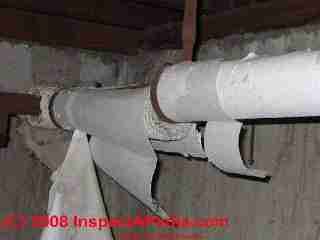
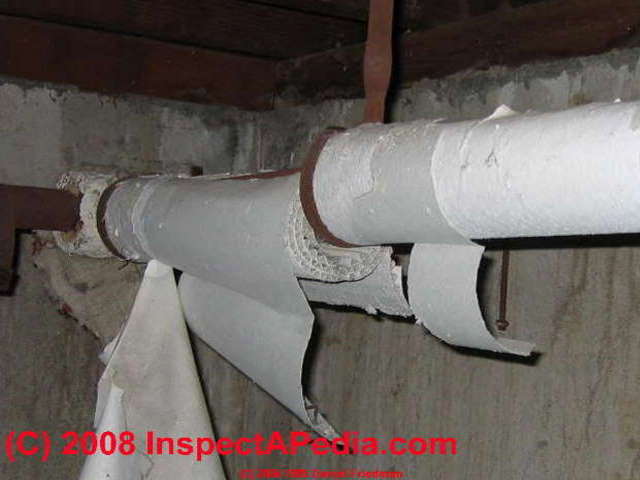
 Asbestos Fibers, Asbestos Dust & Asbestos-Containing Materials that can be Identified by Visual Inspection
While an expert lab test using polarized light microscopy (and in some cases TEM) may be needed to identify the specific type of
asbestos fiber, the percentage content of asbestos in a material, or to identify the presence of asbestos in air or dust samples,
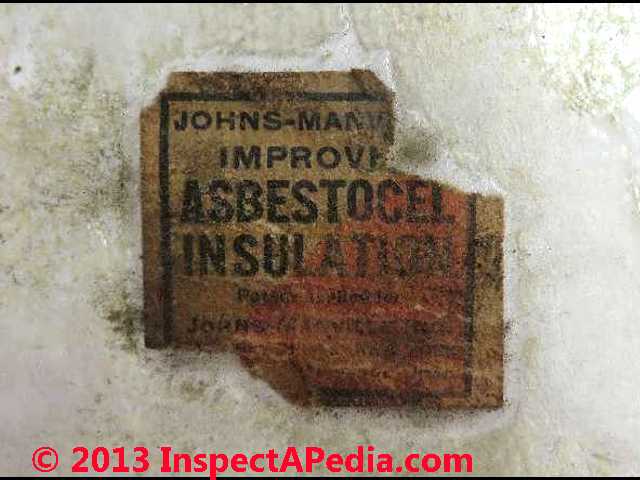
many asbestos-containing building products
not only are visually obvious and easy to recognize, but since there were not other look-alike products that were not asbestos, a visual identification of this material can be virtually a certainty in many cases.
[Click to enlarge any image]
Use These Helpful Guides for Visual Identification of Asbestos-Containing Products Found On or In Buildings
- ASBESTOS IDENTIFICATION IN BUILDINGS - this page - provides a detailed guide to recognizing asbestos-containing materials in buildings and links to in depth articles about individual asbestos-containing building materials
- ASBESTOS LIST of PRODUCTS provides our detailed list of known products in which asbestos was used
- ASBESTOS PHOTO GUIDE to Materials provides a photo guide to common asbestos-containing products.
- DOES THIS MATERIAL CONTAIN ASBESTOS? - 5 easy questions to tell if a BUILDING MATERIAL probably contains asbestos -
- HAZARD vs RISK - what's the difference, why you should care
Basic asbestos safety advice
The US EPA indicates that not all asbestos-containing products are dangerous.
A health risk exists only when asbestos fibers are released from a product [into the air where they are inhaled for example]. Products that are friable (easily crumbled or made into dust that is easily airborne) are more dangerous than products in which binders immobilize the asbestos fibers.
EPA also indicates that not everyone exposed to asbestos will develop an asbestos-related illness or disease. Most people exposed to small amounts of asbestos do not develop asbestos-related health problems. Cigarette smokers are at much higher risk of asbestos-related disease.
Quoting from the US EPA Basic Advice on asbestos in homes: [REFERENCES]
What if I have asbestos in my home?
The best thing to do is to leave asbestos-containing material that is in good condition alone.
If unsure whether or not the material contains asbestos, you may consider hiring a professional asbestos inspector to sample and test the material for you.
Before you have your house remodeled, you should find out whether asbestos-containing materials are present.
If asbestos-containing material is becoming damaged
(i.e., unraveling, frayed, breaking apart) you should immediately isolate the area (keep pets and children away from the area) and refrain from disturbing the material (either by touching it or walking on it).
You should then immediately contact an asbestos professional for consultation.
It is best to receive an assessment from one firm and any needed abatement from another firm to avoid any conflict of interest. In such a scenario as described above, asbestos-containing material does not necessarily need to be removed, but may rather be repaired by an asbestos professional via encapsulation or enclosure.
Removal is often unnecessary.
Basic Asbestos Debris Cleanup Advice
In most cases, it is safest (and least costly) to leave the asbestos-containing materials alone. For Asbestos handling regulations,
see ASBESTOS MATERIAL REGULATIONS
and ASBESTOS REGULATION UPDATES.
Friable, damaged asbestos materials in a living area or such materials located where the asbestos is likely to be carried to an occupied space need professional asbestos remediation.
If you are cleaning-up in a building area where asbestos products may have been dislodged, such as a basement where asbestos pipe insulation has fallen to the floor, the US EPA recommends avoiding causing airborne dust and debris - a condition that could be harmful.
- If hiring a contractor to remove asbestos,
the US EPA guidelines for asbestos removal, for protection of the rest of the building, for proper asbestos waste disposal, and any other local or state environmental regulations must be followed.
In most areas contractors must be specially licensed to test or remove asbestos from buildings. In some areas it may be legal for a building owner or another contractor to remove asbestos, though still it must be disposed-of legally.
See ASBESTOS REMOVAL CERTIFICATIONS)
- Do not run a vacuum cleaner
or dry-sweep up asbestos debris that has fallen to the floor - you'll simply cause it to become airborne - a potentially harmful condition. Professional asbestos abatement contractors use a combination of wet mopping and HEPA vacuuming to clean up asbestos from building surfaces. - Do not disturb asbestos
or asbestos-suspect material if you do not absolutely have to do so - Seal the work area off
from the rest of the building if asbestos material has to be disturbed. Simple poly plastic sheeting and duct tape may suffice, but be sure the duct tape is adhered continuously to the plastic edges and that it binds securely - else it may be necessary to secure the plastic using nailed-furring strips.
You don't want your containment barrier to fall down in the middle of a cleanup project. Use an air-lock and change footwear or take similar precautions so that you do not bring asbestos debris into other building areas on your shoes or clothing. - Wear an approved respirator,
protective clothing, gloves, hat, goggles, that can be disposed-of after the cleanup. - Wet the asbestos
with a hand sprayer when moving it; - Drill or cut only
if it is absolutely necessary, then do it outside (and having wet the material) - Demolition of asbestos materials during removal
should remove the asbestos in the largest feasible pieces, not in many small pieces. - Bag the removed asbestos
in sealed plastic bags and (according to the EPA) dispose of it in an approved land-fill (check with your community building department and your state environmental regulatory association) - Perform a final cleanup
of the work area using wet mops, sponges, disposable rags/ wipes. Do not track wet asbestos-contaminated water into other building areas.
-- US EPA. Our list of asbestos information articles is just below.
How to recognize asbestos materials in buildings, Photographs of asbestos in building products, List of asbestos-containing building materials
Are Carbon Nanotube Health Risks Similar to Asbestos?
We are monitoring studies of possible health risks from other products containing carbon nanotubes. The New York Times reported that to date no illnesses have been reported concerning nanotube-containing articles and that current popular consumer products such as tennis rackets that contain nanotubes are of little risk to consumers.
But because nanotube-based fibers are very small, they could pose a health risk.
Consumer caution (not fear) are advised. Carbon nanotubes include bundles of fibers that are similar to but more uniform than naturally-occurring asbestos fibers. The Times article "In Study, Researchers Find Nanotubes May Pose Health Risks Similar to Asbestos", New York Times 21 May 2008 p. A-22, reported on an article published at the website of the journal Nature NanotechnologyOn 5/21/08.
For details about carbon nanotube health concerns, and health research regarding nanotechnology in industrial or research processes
Also see MICRO-PHOTOGRAPHS OF DUST FROM THE WORLD TRADE CENTER collapse following the 9/11/01 attack. Links to U.S. government and other authoritative research and advice are included.
Certification & Licensing for Asbestos Abatement, Removal, & Cleanup Companies
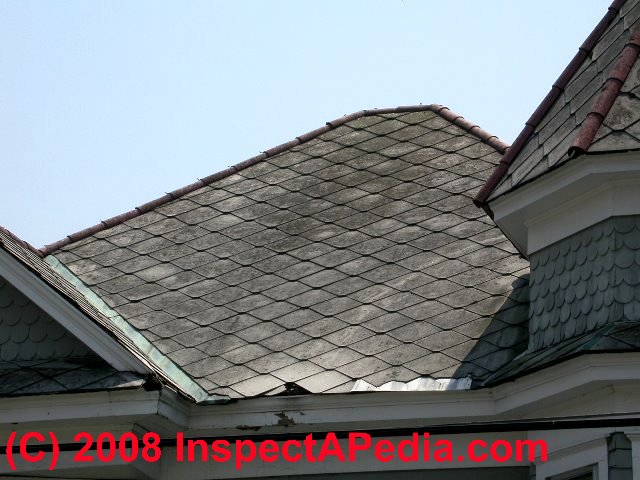 As we discuss and share details at ASBESTOS REMOVAL, AMATEUR, INCOMPLETE, building owners arranging for asbestos cleanup, or any other environmental cleanup for that matter, should be sure that the company they are using is properly certified, licensed, and that the work is conducted with proper supervision and by workers who themselves are properly trained.
Failure to take these precautions risks serious consequences including contamination of other building areas by asbestos dust and debris, health risks and harm to the cleanup workers themselves, and future health risks and harm to building occupants as well as potential issues should the property later be offered for sale.
Also see ASBESTOS REMOVAL CERTIFICATIONS. Excerpts are below.
Watch out: in 2010 The New York Times reported [paraphrasing from that article] that over a five year period beginning in 2001 hundreds of asbestos-removal training certificates were given to people who had completed no training whatsoever.
... 65 to 80 percent of those receiving certification as qualified asbestos removal experts had not received the necessary training.
An example of a simple asbestos test report from a certified asbestos testing lab is shown in
this ASBESTOS TEST LAB REPORT RESULT .
Stuff that is Not Asbestos nor Likely to be Asbestos Containing
 It will be patently obvious that despite the enormous list of products in which asbestos was used, the list of materials that do not and never did contain asbestos will be still longer - so long we won't attempt to list all such items.
But the question of whether or not certain materials contained harmful levels of asbestos has come up often for certain products.
Those we will describe here.
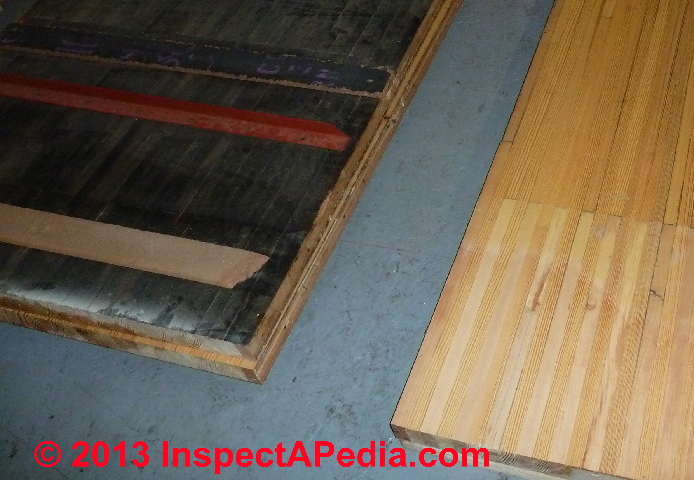
Reader Question: does the brown insulating board found under bowling alley lane material contain asbestos?
On the underside of bowling lane floors there is a fiberboard type material I believed was used for sound dampening. I've handled and ripped off this material so many times without once thinking what it was- I think I was told it was homosote and harmless.
Since many of these bowling lanes were installed many years ago, it worried me even more. Now I'm not so sure what it is and scared at the thought of what it could be.
Also, if you have those names or contact info for anyone who might be willing to test this material for me, that would also be incredibly helpful. I can't thank you enough for your help with this- feel free to call or email me back with any information. - A.S. 11/5/2013
Reply: The material looks like and probably is a wood fiber insulating board - not asbestos-containing. But protect yourself from demolition dust.
The material I can see in your online photos is almost certainly wood fiber based Homasote type insulating board. That is not an asbestos product. You can see more examples of this product
If nevertheless you want to have as sample of the material tested for asbestos content, the cost is usually minor - about $50. U.S. You can use any certified asbestos testing laboratory - and can find one via help given
Details of this question & answer are
at SHEATHING, FIBERBOARD ASBESTOS CONTENT or select a topic from the closely-related articles below, or see the complete ARTICLE INDEX.
Reader Comments, Questions & Answers About The Article Above
Below you will find questions and answers previously posted on this page at its page bottom reader comment box.
Reader Q&A - also see RECOMMENDED ARTICLES & FAQs
On 2023-11-29 by Anonymous
is asbestos use in various gasket common today?
[Note: this reader question and our reply has been moved to ASBESTOS FRICTION MATERIALS]
On 2023-11-19 by InspectApedia Publisher - it is not correct to assume that asbestos is or is not present in an older building
@Susan,
Sorry, but No absolutely not. NO ONE can say with certainty what materials were used in all buildings at any time. The number of people working on buildings around the world is in the millions as is the number of products. We may know what is common or what has been reported or not, but nobody can say for sure what is or is not present in a given building just by text or a photo.
Asbestos was widely used in many products but it is not correct to assume that asbestos is or is not present in an older building. If it has not been done to make such a statement about asbestos, an expert inspection and often actual material testing would be required. Even then such an inspection cannot, without dismantling the whole structure, be certain about materials in inaccessible or hidden areas.
Bottom line: Do not panic about asbestos materials. In general asbestos-containing building materials or materials that *might* contain asbestos are safe and harmless if the materials are undisturbed and in good condition.
What if unknown materials must be disturbed, creating significant levels of dust?
Often on an older building records of just when work was performed, by whom, and using what exact products (brand and manufacturing date and supplier source) is simply not known.
In that case, IF dusty demolition of older building drywall walls or ceilings is required then one would either use dust control and cleaning methods that presumed that the materials contained asbestos OR one would have to test sufficient representative samples of the drywall and joint compound to see if asbestos is present.
On 2023-11-18 by Susan
@InspectApedia Publisher, Thank you very much!So in your experience/knowledge all the joints in older building under 1980 contain asbestos joint/mud?
I am guessing the contractors in canada doesnt test the part where are joints (i heard that they take the sample somehwere in the middle rather so they can still perform their job instead of new asbestos removal company)
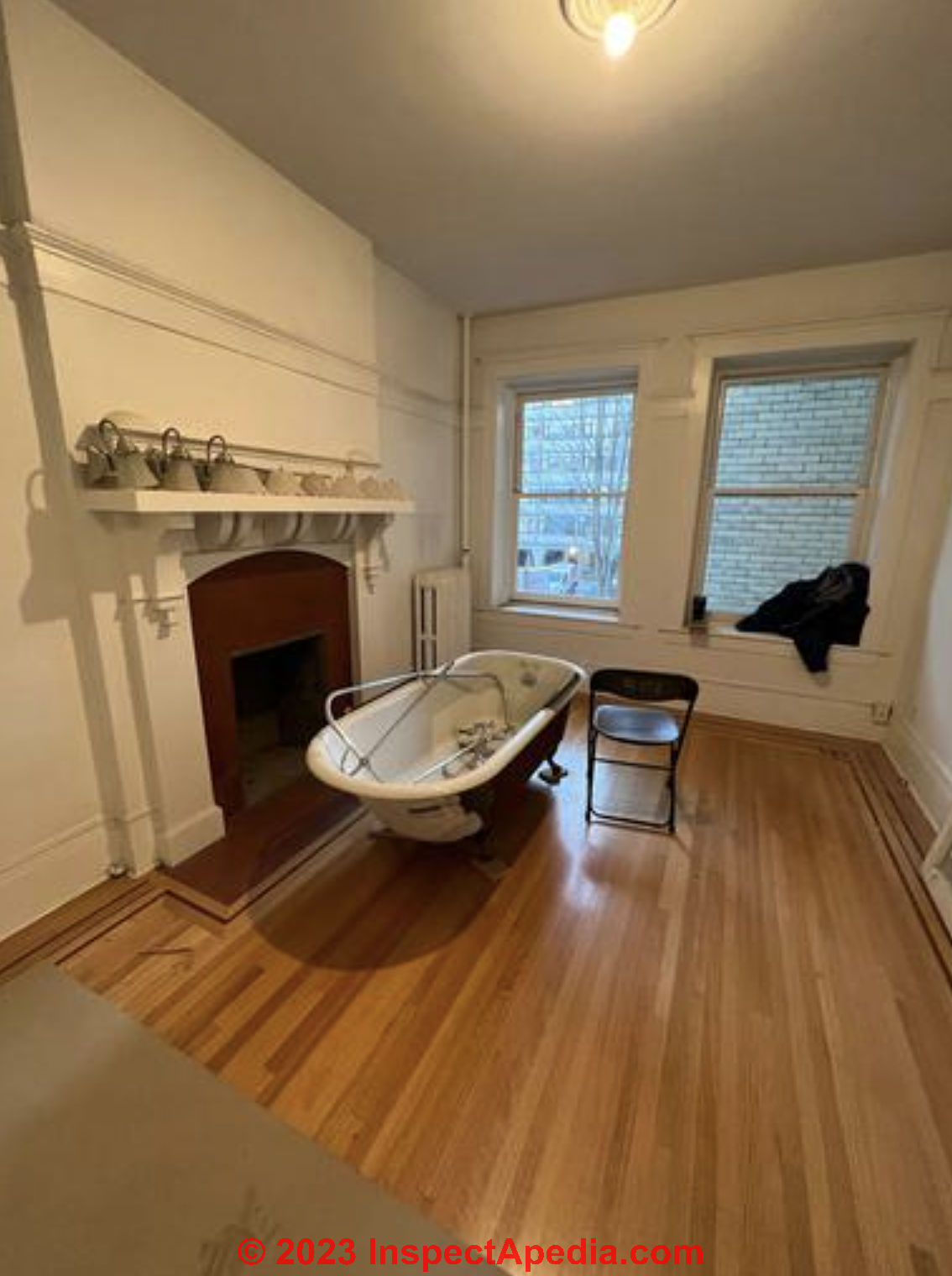
because from what i seen any special asbestos precautions were not applied like some plastic walls or after cleaning of the dust, the other rooms what seems not going to be renovated are widely open without cover on the floors, the dusty old bathtub randomly put there.
I guess its a normal thing, since in other old building i was living i seen also drywall cutted out (more then half meter) and no precausions whatsovever, workers casually walking with regular clothes, only have mask.
So in older buildings there must be a lot of asbestos in air in halways since this is how its done and the workers just open the doors of the condos withouth any barier so the air goes everywhere? If all or almost all the mud/joints contains asbestos I just dont understand that any precautiions are made in these older buildings when doing renovations, is this common?
Otherwise I cannot explain that if all/most old joints are asbestos that I never ever seen in these bulding any precuations or workers in plastic suits, and renovations are done here constantly. Just dont know how to feel even safe to rent or visit these old buildings.
On 2023-11-18 by InspectApedia Publisher - drywall or joint compound in your building may well have contained asbestos
@Susan,
Unfortunately without a shred of actual data our discussion becomes far too speculative to be reliable. Bottom line: yes drywall or joint compound in your building may well have contained asbestos. If dust was not properly contained and/or not properly cleaned up then that professional cleanup would be in order.
Throwing away clothes or living in deep panic are costs to your wallet and health that are possibly greater than the actual dust itself.
If it would put your mind at ease now, collect some samples of representative settled dust and have those tested for asbestos, BUT keep in mind that will not tell you much about any hazards you may have faced as we know nothing about the dose or exposure level & duration.
On 2023-11-17 by Susan
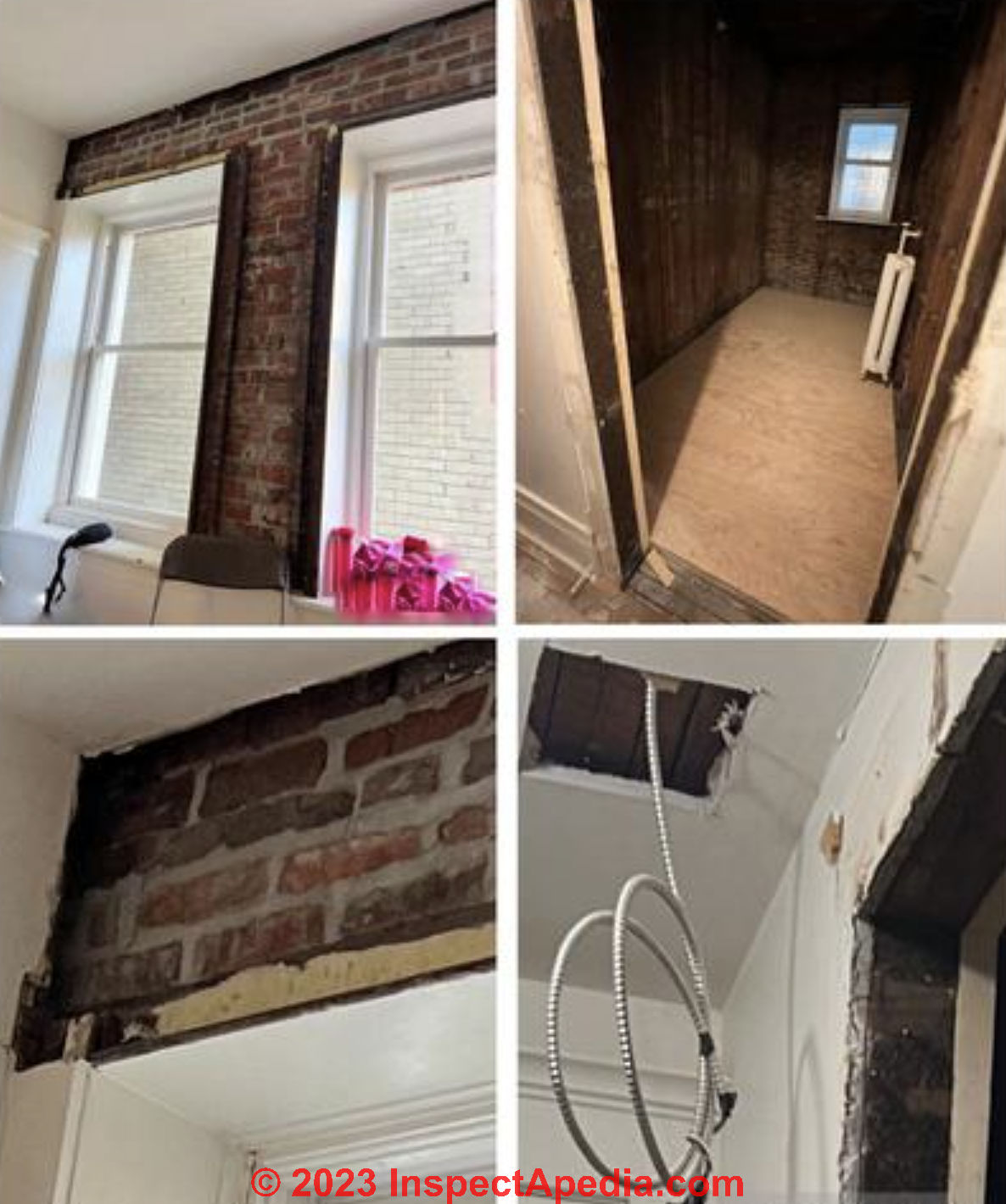
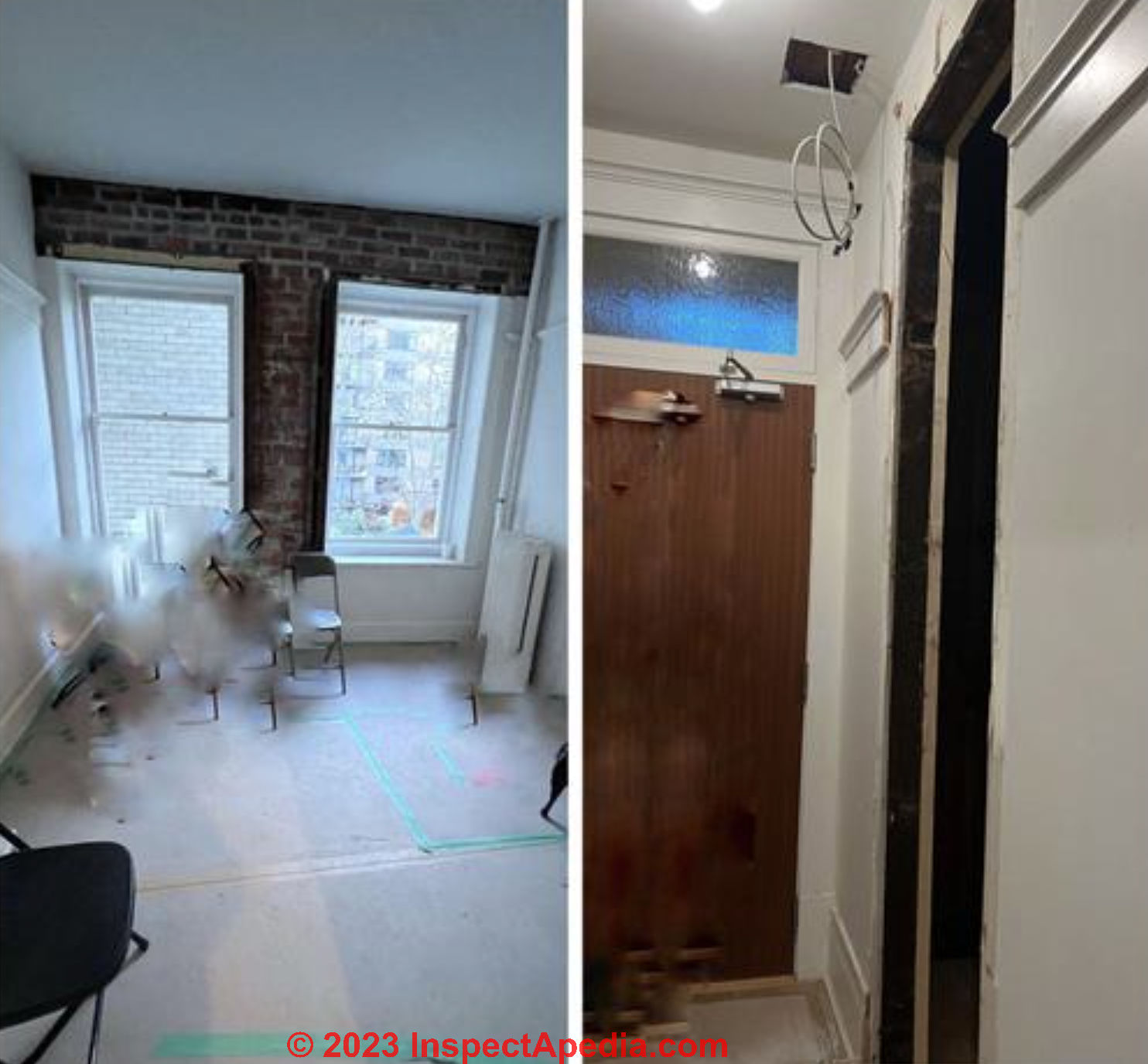
@InspectApedia Publisher, Thank you very much for your answer! Very appreciate it. This is in Canada, west, building built in 1910 year, and I seen other 2 aparments on another floors in that bulding with exact same work done (all bathroom walls out, some walls cut out in rooms) some ppl still living in the other not renovated aparments in that building.
They were not working while I was there, I had to stay there bc my work required for me to wait there for 3 hours (filming of a movie in that bulding and this was offered as a place to stay warm and I do not think they were considering that this could be hazardous). So I am guessing the aparments are between renovations.
From whatever I read about asbestos I read it should to be in totally all joints/mud on the walls in old buildings and since the walls in bahtroom were tore out and some of the walls in rooms were cut out exactly in that joint part, and the dust from that work is still there as when someone put bag or clothes on floor or windows evertyhing was very dusty, doesnt it mean that the dust will 100% contain asbestos?
I think the regulation for cutting walls with asbestos joints in canada is less strict then in US. Thats why after I realized there might be asbestos and how much dust is still there I became really concerned if I was exposed to a lot of hazardoust stuff as well if washing of the clothes will be enough.
If you would have any additional information and advice please let me know. Thank you so much for your help!
On 2023-11-17 by InspectApedia Publisher - how do I clean clothing that has been exposed to asbestos
@Susan,
Depending on the country and city where this building is located contractors may have been required by law to stop work if they suspected that asbestos containing materials were present. That work was started until the area could be assessed and any asbestos abatement required could be completed.
Knowing the building ages well as work that's been done on it can be helpful in guessing at that probability.
In any case if you don't have evidence that you've had an acute exposure to asbestos dust than ordinary laundering of your clothes is certainly sufficient. If the contractors left a dusty mess it would be appropriate to require that to be cleaned up.
On 2023-11-17 by Susan
Hi, I had to spent 3 hours in this condo (due to work) built 1910 with some walls cut out and whole bathroom taken out. It was dusty there, dust on floor and windows, counters. They are renovating many apartments in this old building(so I am guessing its contractor,not someone DYI) .
Would u be able to tell me if being in this place is a high exposure to asbestos? And mostly what would u suggest to do with all my clothes and shoes I was wearing, can I just wash them or it would be better to throw them out.
What to do with some what didnt get the dust and the ones what got also some dust on.
Please and thank you! (I understand u will most likely be not able to tell from photos if the walls and bahthroom contained asbestos and if the contractor followed guidelines, but just your opinion from your experience how safe was being there and what would u do with the clothes would be really appreciated, thank you!)
 ...
... 
On 2023-10-30 by Anonymous
do i have to worry about brake gasket releasing asbestos, i was still small at the time when asbestos were used in brake gasket. but it was banned not soon after.
[Note: this reader question and our reply has been moved to ASBESTOS FRICTION MATERIALS]
On 2023-10-27 by InspectApedia DF (mod) - no action is needed if the plaster isn't going to be disturbed
@Anonymous,
First, no action is needed if the plaster isn't going to be disturbed.
Further, if the plaster is only "suspected" of containing asbestos, in my OPINION it would be more economical to treat the wall or ceiling being disturbed as "presumed to contain asbestos" - that is, dust control, proper clean-up, etc - than to spend hundreds of dollars testing representative samples.
On 2023-10-12 by Anonymous - (multiple questions from this reader are listed below)
@InspectApedia Publisher, so what you are saying is that, there is no meanningful risk? btw is this kind of situation normal?
oh, i see what you ate talking about, so i am basically worrying about undetectable risks. and i think the encapsulation were done by pros using professional sealant.
am i right? is this kind of situation normal?
some gov article suggest there were some asbestos fibers in ambient environment, so does that mean almost everyone have contact some asbestos fibers at extreme low level?
if a plaster is suspected asbestos, and the owner want to install a new radiator for heat. is it required to deal with the asbestos before the procedure?
On 2023-10-12 by InspectApedia Publisher
@Anonymous,
Just to make sure I understand, now I see that you're asking about a hairline short crack in the covering of asbestos suspect pipe insulation and a building that you used to live in.
This is a case where the anxiety is more likely to be a health hazard to you than the item itself that you are describing.
And with all due respect I've tried to warn you that if you continue asking questions like this of some environmental professionals, you'll make them so nervous that there's something going to be forced to say yes you need a complete asbestos survey of the building you're used to live in as well as the building you live in now as well as all of your possessions, and you need all of your possessions professionally cleaned.
You need to follow up by thorough multi-sample testing for remains of individual asbestos particles or fibers even at extremely low levels..
Can see that you're probably talking about many thousands of dollars of expense to address what is most likely a risk beneath the level or limits of detection. That is to say, there's no reasonable conclusion, based just on the information you've given, that there's a meaningful risk.
On 2023-10-12 by Anonymous - (multiple questions from this reader are listed below)
@InspectApedia Publisher, so basically to reduce their trouble and make me spend money on their product.
that helped with some of my concern. But i am still worried about the possibilities of the crack on the encapsulation releasing fibers from minor disturbance like walking and wind. i was told about this whole asbestos thing after i moved out. yet i still lived in there for 4 years.
On 2023-10-11 by InspectApedia Publisher
@Anonymous,
The OPM point is that if you contact someone who actually is an expert and make them very nervous by your level of fear about something that they know has no reasonable actual level of concern, they may give you advice that's safe for them by spending a lot of your money unnecessarily.
By spending your money it costs them nothing to reduce their risk that you might later complain that you didn't get an adequate warning.
On 2023-10-11 by Anonymous
@InspectApedia Publisher, i read i, and it is true that my concern all came from the articles i read saying how dangerous it is. But i do not quite understand the OPM part, does it mean, like I contact an inspection company, then what they say is always we are not sure, we have to get it tested. then thiis kind of statemnt gives me worrys, makes me want to spend money to ensure safety?
On 2023-10-10 by InspectApedia Publisher
@Anonymous,
I recommend that you read HAZARD vs RISK - what's the difference https://inspectapedia.com/hazmat/Hazard-vs-Risk.php
and
OTHER PEOPLE's MONEY https://inspectapedia.com/home_inspection/Other_Peoples_Money.php
those should lead you to drop this question.
On 2023-10-10 by Anonymous
@InspectApedia DF, how big it will be a concern. I was wondering if it is possible for this kind of crack to release fibers upon disturbance like winds and walking vibration. since the crack is still bigger than the fibers
btw, the crack is not on the insulation it was on the encapsulation.
its width is less than 1 millimeter, the length is around a fingers length.
this is the only crack i found and the encapsulation itself is still very hard and smooth in place. do you mean by not concern, that it would not release any fibers in this situation?
On 2023-10-09 by InspectApedia DF (mod) - "is a hairline crack on asbestos pipe encapsulatoin worriable"
@Anonymous,
No, not likely, but of course my answer is a bit of a pig in a poke, that is, speculative, because I can't see your pipe asbestos insulation nor the crack nor whether or not that's the only possible concern.
To me a "hairline crack" means a crack less in width than a human hair - about 0.008 to 0.01 cm in width or about as wide as the thickness of a piece of paper, in one location, and of perhaps just a few inches in length, and absent any indication of other damage to the pipe insulation - it all remains securely in place and undisturbed. That'd not be a concern.
Though to allay any concern, you could certainly spray a bit of encapsulant paint over the crack.
On 2023-10-09 by Anonymous
is a hairline crack on asbestos pipe encapsulatoin worriable.
On 2023-10-07 by Anonymous
@InspectApedia Publisher, no i am just wondering is asbestos really that scarry that it is stronger than most of the carcinogen expect tobbaco.
On 2023-10-07 by InspectApedia Publisher
@Anonymous,
Question for you,
Are you the same reader who was recently asking about hazards of tobacco smoke on the skin, hands, and a mouse pad?
On 2023-10-07 by InspectApedia DF (mod) -Both tobacco and asbestos are hazardous substances
@Anonymous,
It's unfortunately too easy to fall into a pit of fear of environmental hazards before we understand where we need the guardrails around those abysses.
I recommend reading HAZARD vs RISK - what's the difference
at
https://inspectapedia.com/hazmat/Hazard-vs-Risk.php
If we define "hazard" as something that is potentially dangerous
and
if we define "risk" as the chances of occurrence of actual bodily harm from the hazard or hazardous substance
then that article will help sort out your question.
Both tobacco and asbestos are hazardous substances.
But the dose makes the poison.
And while cautious government experts may correctly state that "no level of asbestos exposure is safe" it's most-likely that far more people are exposed to and may be affected by smoking than by exposure to asbestos.
By that measure, both substances are hazardous but the risk of tobacco smoke exposure - the chances of exposure and harm - are greater than the risk of asbestos exposure and harm.
Even clean water can be hazardous to your health if you drink enough of it at one time.
Asbestos was very hazardous at high levels of exposures, such as dockyard workers in the 1940s who moved and worked in air so thick with airborne asbestos that it was opaque, or for occupants of the World Trade Center tower collapse site where air was also thick was asbestos (and other harmful substances).
But far more people have smoked and been harmed by tobacco than the number exposed to and suffered illness from airborne asbestos.
According to the US CDC
... an estimated 28.3 million adults in the United States currently smoke cigarettes.2 More than 16 million Americans live with a smoking-related disease.
- source: https://www.cdc.gov/tobacco/data_statistics/fact_sheets/adult_data/cig_smoking/index.htm#:~:text=This%20means%20an%20estimated%2028.3,with%20a%20smoking%2Drelated%20disease.
Compare that to this statement also from the US CDC about asbestos hazards and who is at risk:
Currently, the people most heavily exposed to asbestos in the United States are those in construction trades. This population includes an estimated 1.3 million construction workers as well as workers in building and equipment maintenance [American Thoracic Society 2004].
Because most asbestos was used in construction, and most asbestos produced is still used in this industry, risk to these workers can be considerable if the hazard is not recognized and Occupational Safety and Health Administration (OSHA) standards are not enforced.
- source: https://www.atsdr.cdc.gov/csem/asbestos/who_is_at_risk.html
Finally
If you truly want to have an informed, unbiased, intelligent exposure about hazards and risk, beware of making statements like yours that say "I heard somewhere" or "someone told me", or "some article said", and take care to cite your sources AND to read the expertise and credibility of your sources.
InspectAPedia tolerates no conflicts of interest. We have no relationship with advertisers, products, or services discussed at this website.
On 2023-10-07 by Anonymous
i am reading some articles that gives me a feeling of that asbestos is the strongest carcinogen other than tobbaco, is it true? are other substance like benzene more strong?
On 2023-08-10 by InspectApedia DF (mod) - age of building, specific product, and country location help determine presence of asbestos
@Anonymous,
The age of building and of the specific building product as well as country location all figure into a guess about whether or not it is likely to contain asbestos.
For example, in North America if asphalt or vinyl floor tiles or sheet flooring or ceiling tiles or drywall and joint compound were made or installed before 1986, treat the material as presumed to contain asbestos. So those items in your 1999 building would not have asbestos.
Please take a look at
IDENTIFY ASBESTOS-CONTAINING MATERIAL - Easy steps to decide if a building product probably contains asbestos
and let us know if you have additional questions.
For a list of asbestos laws, and bans and ban-dates by country see
ASBESTOS MATERIAL REGULATIONS https://inspectapedia.com/hazmat/Asbestos_Materials_Regs.php
On 2023-08-10 by Anonymous
does a house built 1999 have asbestos? i am considering for rent.
On 2023-08-06 by InspectApedia Publisher
@Anonymous,
Please post a larger view so that we understand what we are looking at.
On 2023-08-06 by Anonymous
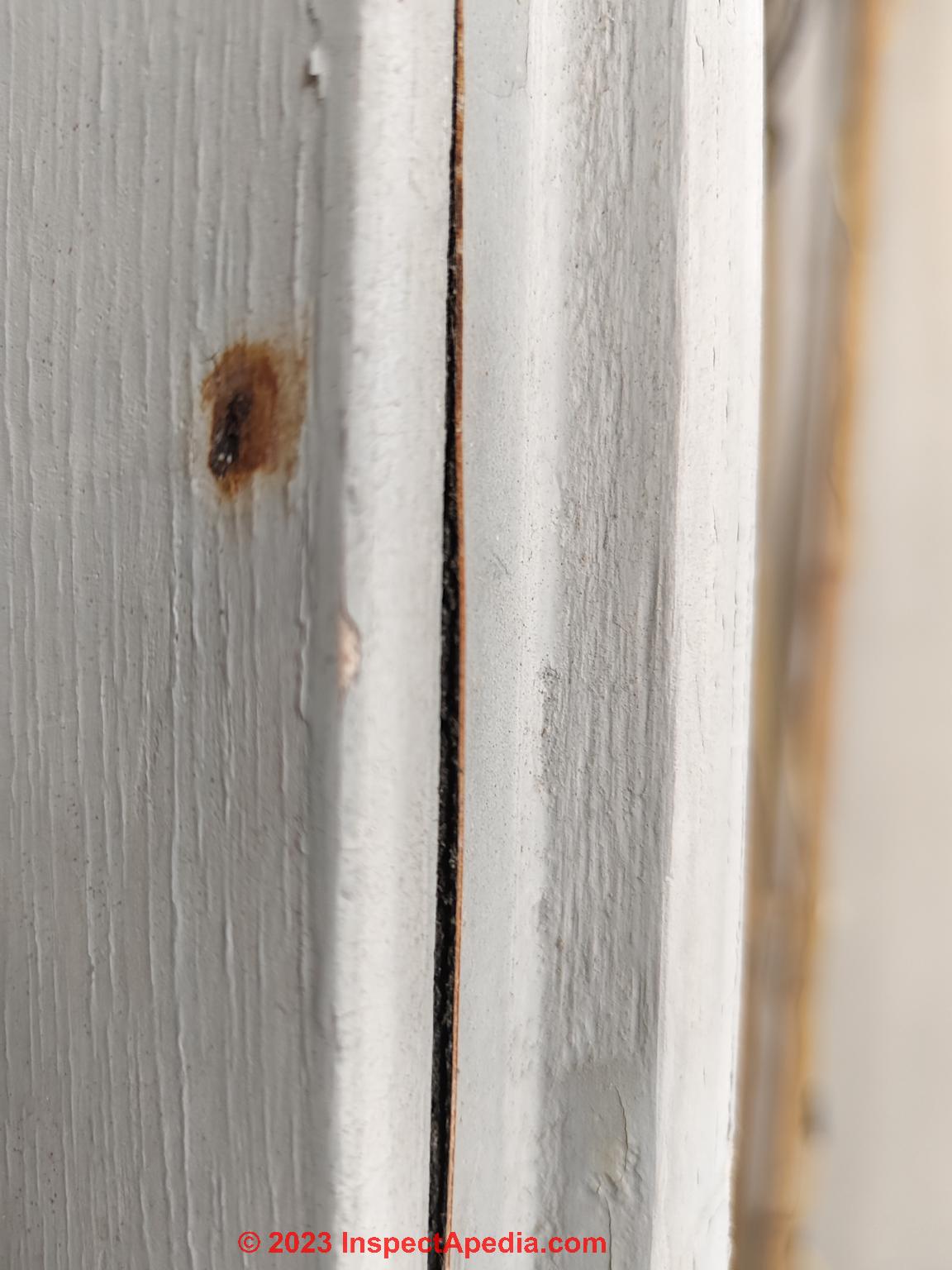
this is a refractory door, is this red tile contain asbestos? it feels soft touching on it.
is it even refractory tile for blockong smokes and fire for the seams?(additional question on the previous question with picture might not shown yet.)
nevermind, i thought the tile was the material but it was just dettached from the black refractory material inside the seam, so i don't think it is asbestos anymore.
this is the clearest view i can get, it was juat the tile dettached from the black refractory material. i have mistaken the tile itself was the refractory material. i don't think it is asbestos anymore.
[Ed. note: multiple questions from single reader were combined here]
On 2023-07-30 by Anonymous
@InspectApedia DF, sorry i can't do that i am not the home owner, so i don't have the right to force them to do it, otherwise i wouldn't be here to ask these questions. so if possible please just give me some advice on is it encapsulation paint is more likely to be the case based on my informations? i don't need a certain answer.
tbh i doubt that normal paints for anti corrosive or insulation paint can't even adhere on the asbestos insulation
is the encapsulation sealant typically more thicker than other paints like anti corrosive paint and insulation paint?
if someone did put anti corrosive paint on the insulation, since it is not desinged to adhere onto such surface, does that mean it would not last long as expected before cracking?
[Ed. note: multiple questions from single reader were combined here]
On 2023-07-30 by InspectApedia DF (mod)
@Anonymous,
We have reached the limit of what we can suggest, advise, or state through written messages. As we’ve said multiple times now, no one can say what kind of paint or encapsulation you have from an online message or photo.
If you are have further concerns, we recommend having an on site inspection by an asbestos remediation professional. We can not provide that service.
On 2023-07-30 by Anonymous
@InspectApedia Publisher, can you at least tell if it is encapsulation or not? the paint is thick, smooth, and properly done, doesn't look like DIY.
not like tell if it is certainly which one, but which one is more likely.
for addition, the whole pioe wasn't coverd in asbestos insulation, also tge paint only covering the sections with asbestos insulation on.
[Ed. note: multiple questions from single reader were combined here]
On 2023-07-29 by InspectApedia Publisher (mod)
@Anonymous,
I answered this above
No one say by mere inspection by eye what kind of paint you're seeing.
On 2023-07-29 by Anonymous
@InspectApedia Publisher, there was a thick paint on it i think it was encapsulation , but someone(might not know anything about encapsulation)said it could be anti corrosive paint. so i just ask incase.
so normally no one would put anti corrosive paint on pipe insukation, right?
[Ed. note: multiple questions from single reader were combined here]
On 2023-07-29 by InspectApedia Publisher (mod) - no reason to spray or paint an anti-corrosive paint onto insulation covering pipe
@Anonymous,
With respect, nobody can tell you with certainty that a particular type of paint might or might not have been used anywhere on anything in a building.
But in general, there would be no reason to spray or paint an anti-corrosive paint onto insulation covering pipe. The insulation itself is certainly not something that "corrodes".
But as I began, anybody might have used any sort of paint on anything in a building.
Question: what is the concern here?
On 2023-07-26 by Anonymous
@InspectApedia Publisher, i mean typically does it comes with mulyiple layers? or did you mean there were instances that one layer is sufficient? the encapsulation i saw has a hairline of dent, it is not a crack i can tell that the asbesto wasn't exposed. the inside of the dent is still the sealant.
was anti-corrision paint used on the asbestos insulation on furnace pipe?
On 2023-07-25 by InspectApedia Publisher
@Anonymous,
NO ONE can tell you from a photo or your text what an unknown contractor did at an unknown job.
On 2023-07-25 by Anonymous
@InspectApedia Publisher, i understand, also i was told that the encapsulation on asbestos on pipe were to be done with multiple layers to provide more robust protection and make sure it still properly preventing release when there are some minor damage on the outer layer. is this right?
On 2023-07-26 by Anonymous
@InspectApedia DF, thank you, i was just no sure what composition in smoke was the reason asbestos exposure gets worse, i found that on website that the tar may only affect if the smoke is continuing and prolonged, but with occasional second hand smoke exposure the tar is not likeky to stay in lung for long. which this made me relieved.
On 2023-07-26 by InspectApedia DF (mod) - are and chemicals from smoking that are present in lungs will increase the risk of cancer
@ri,
As stated previously, and now finally, the tar and chemicals from smoking that are present in lungs will increase the risk of cancer, with or without asbestos exposure. Due to compromised lung health, the added component of asbestos exposure will increase the risk for potential further complications.
On 2023-07-26 by Anonymous
@InspectApedia DF, sorry for my anxious, just let me ask this one last question, you mentioned that any tar inhaled can increase the risk, so was it the tar and its chemicals the reason why it increase cancer risk with asbestos exposure?
On 2023-07-26 by InspectApedia DF (mod)
@ri,
We do not have the answers to your questions.
On 2023-07-26 by Anonymous
@InspectApedia DF, for the non-smokers increase risk of cancer are you referring to the article? abd what do you mean by any source of smoke, smokes from wood? in thr article does smoker means activly smokers for years? and for the low exposure group, does that mean they were exposed to low levels of asbestos for 24 years(average yrars of exposure in the article)?
On 2023-07-26 by Anonymous
@InspectApedia Publisher, do you guys know if quitting smoke reduce the risk?
On 2023-07-25 by InspectApedia Publisher - Perspective on Environmental Hazards of "Non-Detectable levels of Airborne Asbestos"
@Anonymous,
We understand.
Perspective on Environmental Hazards of "Non-Detectable levels of Airborne Asbestos"
On one hand, experts say that there is no "safe" level of airborne asbestos.
On the other hand, a cautious, experienced person, reading the text of a generic inquiry like yours, without a shred of actual quantitative data, no site specifics, none of the details that an onsite expert would see, is not going to be so foolish as to promise you that there is no possible hazard from something about which you inquire.
Properly encapsulated asbestos suspect materials in a properly-cleaned site would not be expected to be producing detectable or hazardous levels of airborne asbestos.
So what's left. We think that most environmental experts would agree that if there is no detectable level of airborne asbestos in a building then there is no detectable hazard from that substance, and if there is no detectable hazard then there's nothing more useful to say about the risk.
Put another way, you are enormously more-likely to be hurt falling down stairs or die in an automobile accident or shot by a crazy person waving an automatic rifle about, than to be injured or die from an undetected level of airborne asbestos.
On 2023-07-25 by Anonymous
@InspectApedia Publisher, sorry i was just a bit anxious, i mistaken your meaning of that it might still release small amount just not big enough to be detectable which still might posses risk if ihaling.
On 2023-07-24 by InspectApedia Publisher - Normal brick and mortar walls are not friable
@Anonymous,
Normal brick and mortar walls are not friable - don't release harmful dust by crumbling the material between a thumb and forefinger - and do not contain asbestos.
On 2023-07-24 by InspectApedia Publisher - what does it mean by not releasing harmful level or detectable level?
@Anonymous,
The original asbestos pipe insulation often included friable materials, but once encapsulated it's not a concern as long as you leave it alone.
That's the purpose of and function of "encapsulation".
re your question
what does it mean by not releasing harmful level or detectable level?
I'm at a loss to explain further than the direct absolute meaning of those words.
"not releasing" - means nothing is being released
or
"harmful levels" - means levels that could be a health concern
or
"not detectable" and similar phrases are a safe choice of words to mean that IF any particles are being released they are not detectable - which should mean to you that the level of particles would be so infinitesimally small as to be of no interest.
On 2023-07-23 by Anonymous
@InspectApedia Publisher, i was told any level of asbestos is danger, not releasing detectable level, does it mean zero release?
i was just wondering since you said don't grind the brick and mortar, i thought you are referring to normal walls
what does it mean by not releasing harmful level or detectable level?
is encapsulated asbestos insulation on furnace pipe non-friable like mortar and brick? i found research about this kind of encapsulation would use sealant that penetartes to make sure it is tightly bound.
[Ed. note: multiple questions from single reader were combined here]
On 2023-07-22 by InspectApedia Publisher
@Anonymous,
Details that answer this question are at the article we cited for you earlier.
"Specialized" means exactly that, or to re-state, that means not in normal everyday construction of brick walls or walkways would we use asbestos-containing bricks or mortar.
Examples of "specialized" uses of bricks and mortar in high heat applications (fireplace liners, kilns, industrial processes) are cited in the article we recommend.
Please do take a look and let us know if that page needs clarification.
On 2023-07-22 by InspectApedia Publisher - is encapsulated furnace pipe going to release any asbestos in low or zero level?
@Anonymous,
Properly-done, once asbestos piping has been encapsulated it is not releasing harmful levels of asbestos into building air and is probably not releasing detectable levels either.
There remains one caveat: if/when you have to have work done on the piping, such as repairing a leak or replacing a section of piping, extra care will be needed then as the workers will have to disturb the encapsulated insulation.
Otherwise, simply leave it alone.
On 2023-07-22 by Anonymous
is encapsulated furnace pipe going to release any asbestos in low levrl or release zero? the condition is quite new.
i read the article it says normslly brick and mortar wouldn't contain asbestos unless it is used on soecialized high heat environments. is that right?
On 2023-07-21 by InspectApedia DF (mod)
@ri,
As mentioned earlier, we are not medical professionals. You are encouraged to speak to your doctor about your concerns and questions.
On 2023-07-21 by ri
@InspectApedia Publisher, does occasional second hand smoke exposure also do the sane? i read some articles says the lung usually recovers from short term exposure
On 2023-07-20 by InspectApedia Publisher - does second hand smoke exposure affect people with history of asbestos exposure?
@ri,
Ample research, now over many years, has shown that smokers themselves as well as people who breathe second-hand smoke are at increased risks for cancers.
Anyone who has tar in their lungs (from cigarette smoke, for example) will, if they breathe in ANY harmful particle (asbestos, aspergillus spores, silica, etc.) will be at greater risk than those who do not.
Keep in mind that if nobody is grinding up your bricks or mortar, most likely there is no detectable indoor asbestos hazard from those non-friable materials.
On 2023-07-20 by ri
@InspectApedia DF, alright i don't quite understand the part you said As far as second hand smoke and its relation to asbestos exposure, it may be similar to a non-smoker’s increased risk for lung cancer due to second hand smoke exposure. are you simply refering that the risk increase from second hand smoke exposure with asbestos exposure isn't much?
in a way that there is no synergistic effect like directly smoking
On 2023-07-20 by InspectApedia DF (mod) - was asbestos used in mortar and bricks?
@ri,
Yes, asbestos has been used in bricks and mortar at times. Please see our article on this topic at
ASBESTOS USE IN BRICKS & MORTAR
You also mention “smoke amplifies asbestos exposure” which may be a bit misleading. Perhaps more accurately, one could say asbestos exposure for a smoker amplifies the health risk. I.e., whether one is a smoker or not doesn’t determine amount of asbestos exposure but rather the amount of exposure can affect a smoker in ways different than a non-smoker.
With regard to increased risk from asbestos exposure if you are a smoker, there are a number of factors that need to be considered. Level of exposure is just one factor. Please see this report
NON-OCCUPATIONAL EXPOSURE TO MINERAL FIBRES
Excerpts:
…workers who were cigarette smokers, exposure to asbestos dramatically increased the risk of lung cancer (Hammond et al., 1979x; McDonald, 1980).
…It is well established that asbestos exposure increases the already high risk that smokers run of contracting ling cancer (Selikoff et al., 1960. One hypothesis to explain this synergistic effect is that carcinogenic compounds in the cigarette smoke, in particular polycyclic aromatic hydrocarbons (PAIs), are adsorbed on the surfaces of the asbestos fibres. This may increase the retention of these substances in the lung and this also the risk of cancer developing (Harington, 1973).
See also
LUNG CANCER MORTALITY FROM EXPOSURE TO CHRYSOTILE ASBESTOS & SMOKING
As far as second hand smoke and its relation to asbestos exposure, it may be similar to a non-smoker’s increased risk for lung cancer due to second hand smoke exposure. In our opinion, the condition of the lungs due to smoke exposure, intentional or not, can increase the potential damage from asbestos exposure although the risk may be less than that for a smoker. As we are not medical professionals, this is a good question to discuss with your doctor.
It is also worth noting that a history of asbestos exposure of sufficient duration, dose and latency can cause lung cancer, regardless of smoke exposure from any source.
On 2023-07-20 by ri
was asbestos used in mortar and bricks? also i heard that smoke amplifies asbestos exposure, so does occasional second hand smoke exposure also does the same on people with history of asbestos exposure?
On 2023-04-25 by InspectApedia Publisher (mod) - how to clean vermiculite insulation debris
@Dusty,
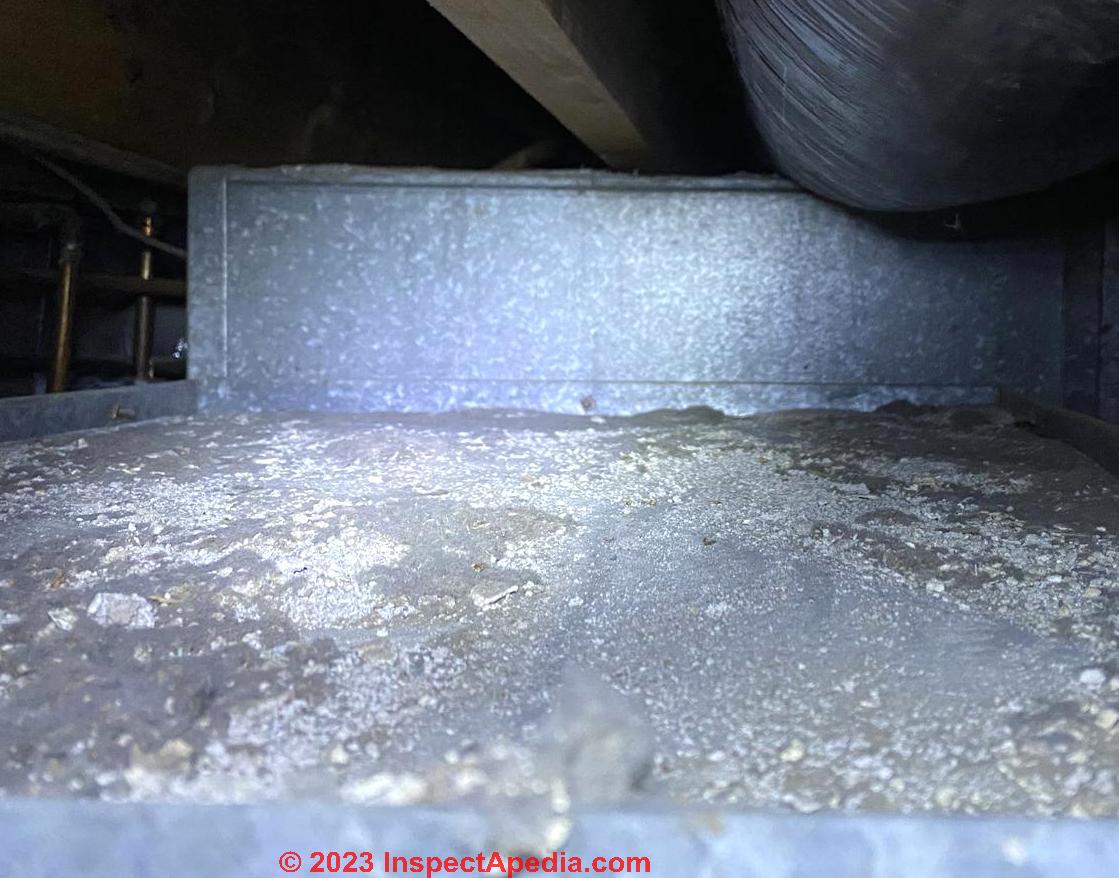
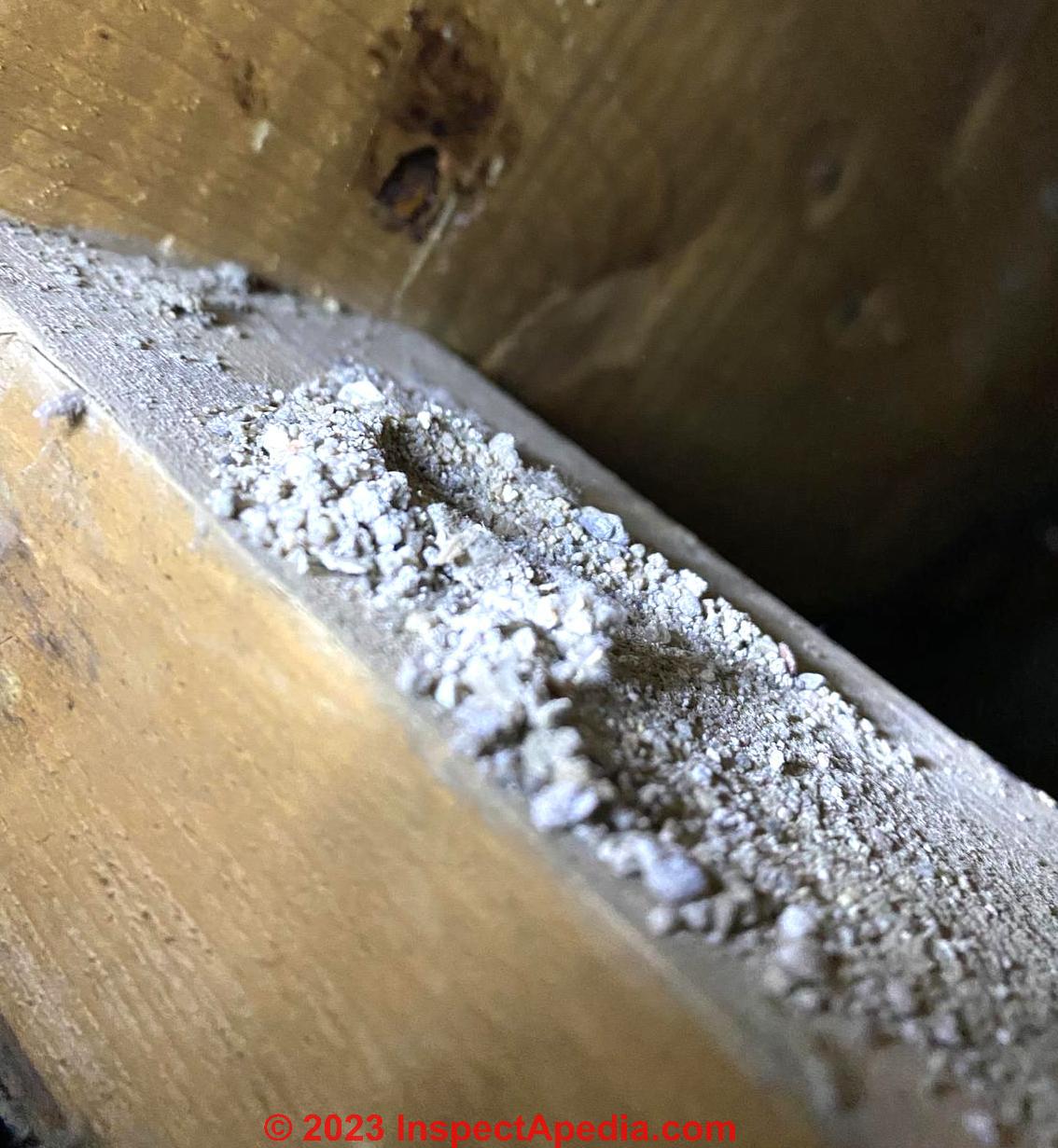
That looks like vermiculite insulation, a material that often contains asbestos.
Proper cleaning would include damp wiping and HEPA vacuuming.
On 2023-04-25 by Dusty
Before I clean this dust/debris up I wanted to ask if any risks or thoughts on origin of this dust/debris? It appears kind of gritty and looks like it may have trickled down between the floor boards from the main floor. (This is the basement in the pic).
A decent amount of this dust has settled onto HVAC vents and joists in the basement. Wondering what it might be and if any risks? (House is from late 50's Canada)
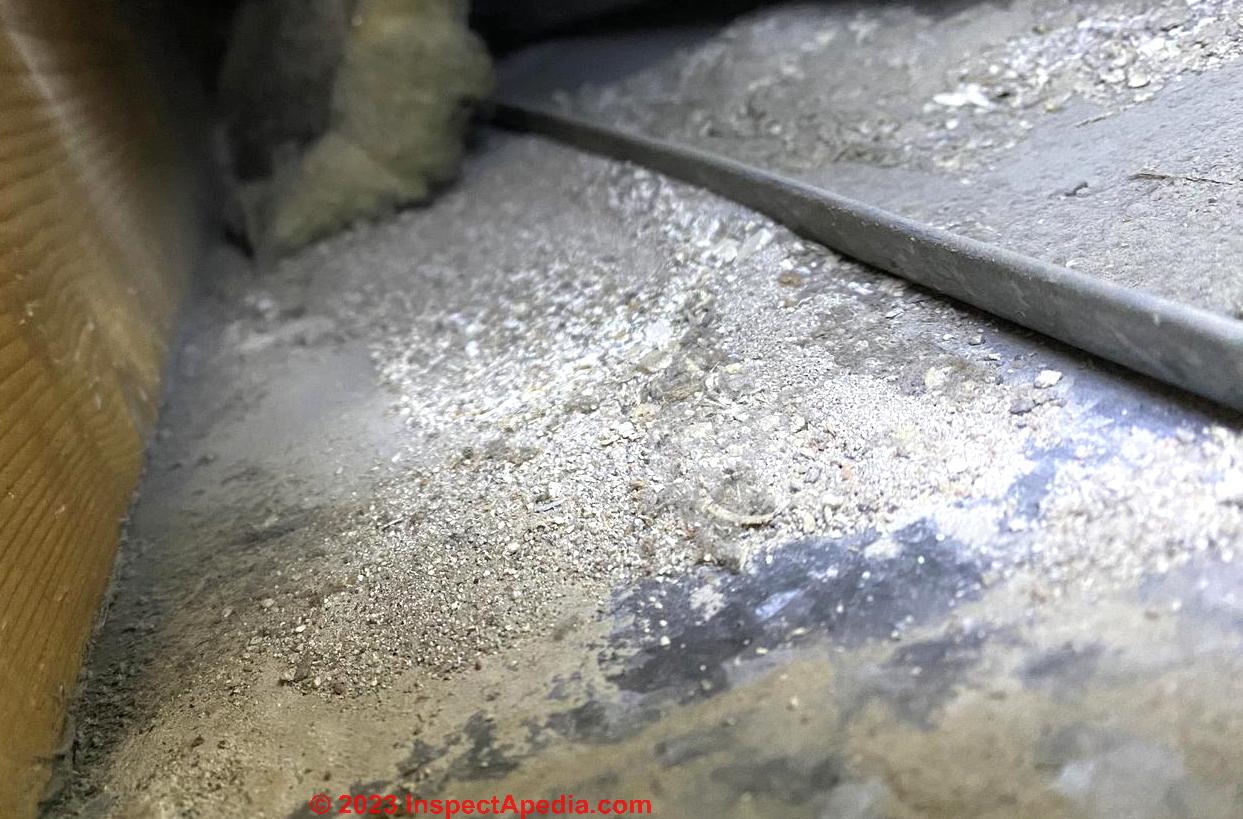
And a big collection of it right on top of the main HVAC vent, ideally would want to figure a way to contain and clean up without sending this throughout the house...any tipcs?
On 2023-04-25 by Dusty
Close up of the texture of it
On 2023-03-01 by InspectApedia Editor
@Hannah,
That looks like fiberglass insulation.
On 2023-03-01 by Hannah
I was wondering if it’s possible to visually identify this yellow pipe insulation as asbestos insulation or not. It doesn’t look like the asbestos insulation I’ve seen on this site, more like fiberglass, but I wanted to make sure and the building manager had not gotten back to me yet. Thank you.

On 2023-02-14 by InspectApedia Editor - asbestos in fiberboard panels?
@Karole,
Are you able to see any markings or labels on the panels? This would help in determining an answer. It looks like a wood fiber based board.
Keep in mind that in its current state, even if it were asbestos containing material, it's not friable or creating dust and therefore has minimal risk.
See more of our discussion on this topic at
ASBESTOS IN FIBERBOARD BUILDING SHEATHING & INSULATING BOARD
On 2023-02-14 by Karole
Hi , I have a ceiling which we placed plasterboard over ... i ve always thought it was old hard board panels . The cottage is really old and I suspect that ceiling is well before 1970 . I know our other ceilings are plaster board , replaced in 1998 and no one has ever mentioned asbestos .
Our new neighbours recently found old hidden asbestos in a ceiling . I wondered if it is possible to tell by the pictures if there could be asbestos in these panels ?

On 2023-02-12 by InspectApedia Editor
@Tom,
You also asked this question at
ASBESTOS FLOORING HAZARD LEVELS
https://inspectapedia.com/hazmat/Asbestos_Floor_Hazard_Level.php
which is where we answered.
On 2023-02-12 by Tom
I recently renovated my entire home renovated and an asbestos survey conducted by an environmental firm prior to start of the work identified several materials containing asbestos.
My contractor had all of it removed except for one area with asbestos positive (non-friable) sheet flooring that was in a degraded condition. The flooring company covered the asbestos sheet flooring with laminate wood before my contractor could have it removed.
Is this something I should be worried about?
...
Continue reading at ASBESTOS PHOTO GUIDE to MATERIALS or select a topic from the closely-related articles below, or see the complete ARTICLE INDEX.
Or see ASBESTOS IDENTIFICATION IN BUILDINGS FAQs - questions & answers about how to recognize asbestos - posted originally at this page
Or see these
Recommended Articles
- ASBESTOS IDENTIFICATION IN BUILDINGS - home
- ASBESTOS LIST of PRODUCTS
- ASBESTOS UNDER the MICROSCOPE
- ASBESTOS PRODUCING COMPANIES & TRUSTS
- ASBESTOS PHOTO GUIDE to MATERIALS
- ASBESTOS PRODUCTS BANNED vs PERMITTED U.S. 2023
- COMMON OCCURRENCES OF ASBESTOS
- DOES THIS MATERIAL CONTAIN ASBESTOS? - 5 easy questions to tell if a BUILDING MATERIAL probably contains asbestos -
- HAZARD vs RISK - what's the difference, why you should care
Suggested citation for this web page
ASBESTOS IDENTIFICATION IN BUILDINGS at InspectApedia.com - online encyclopedia of building & environmental inspection, testing, diagnosis, repair, & problem prevention advice.
Or see this
INDEX to RELATED ARTICLES: ARTICLE INDEX to ASBESTOS HAZARDS
Or use the SEARCH BOX found below to Ask a Question or Search InspectApedia
Ask a Question or Search InspectApedia
Try the search box just below, or if you prefer, post a question or comment in the Comments box below and we will respond promptly.
Search the InspectApedia website
Note: appearance of your Comment below may be delayed: if your comment contains an image, photograph, web link, or text that looks to the software as if it might be a web link, your posting will appear after it has been approved by a moderator. Apologies for the delay.
Only one image can be added per comment but you can post as many comments, and therefore images, as you like.
You will not receive a notification when a response to your question has been posted.
Please bookmark this page to make it easy for you to check back for our response.
Our Comment Box is provided by Countable Web Productions countable.ca
Citations & References
In addition to any citations in the article above, a full list is available on request.
- [1] 07: thanks to Gary Randolph, Ounce of Prevention Home Inspection, LLC Buffalo, NY, for attentive reading and editing suggestions. Mr. Randolph can be reached in Buffalo, NY, at (716) 636-3865 or email: gary@ouncehome.com
- [2] 06/07: thanks for photographs of transite asbestos heating ducts, courtesy of Thomas Hauswirth, Managing Member of Beacon Fine Home Inspections, LLC and (in 2007) Vice President, Connecticut Association of Home Inspectors Ph. 860-526-3355 Fax 860-526-2942 beaconinspections@sbcglobal.net
- [3] "Woman Wanted by E.P.A. is Arrested", Leslie Kaufman, The New York Times, 3 November 2010 p. A 17.
- [4] June 1997 - Window Putty - OSHA case cites contractor for asbestos exposure during removal of window putty http://www.osha.gov/pls/oshaweb/owadisp.show_document?p_table=NEWS_RELEASES&p_id=1091
- [5] Asbestos Identification and Testing References
- Asbestos Identification, Walter C.McCrone, McCrone Research Institute, Chicago, IL.1987 ISBN 0-904962-11-3. Dr. McCrone literally "wrote the book" on asbestos identification procedures which formed the basis for current work by asbestos identification laboratories.
- Stanton, .F., et al., National Bureau of Standards Special Publication 506: 143-151
- Pott, F., Staub-Reinhalf Luft 38, 486-490 (1978) cited by McCrone
- [6] ASBESTOS IN YOUR HOME U.S. EPA, Exposure Evaluation Division, Office of Toxic Substances, Office of Pesticides and Toxic Substances, U.S. Environmental Protection Agency, Washington,D.C. 20460
- [7] Asbestos products and their history and use in various building materials such as asphalt and vinyl flooring includes discussion which draws on ASBESTOS, ITS INDUSTRIAL APPLICATIONS, ROSATO 1959, D.V. Rosato, engineering consultant, Newton, MA, Reinhold Publishing, 1959 Library of Congress Catalog Card No.: 59-12535 (out of print, text and images available at InspectAPedia.com).
- [8] "Handling Asbestos-Containing roofing material - an update", Carl Good, NRCA Associate Executive Director, Professional Roofing, February 1992, p. 38-43
- [9] EPA Guidance for Controlling Asbestos-Containing Materials in buildings, NIAST, National Institute on Abatement Sciences & Technology, [republishing EPA public documents] 1985 ed., Exposure Evaluation Division, Office of Toxic Substances, Office of Pesticides and Toxic Substances, U.S. Environmental Protection Agency, Washington,D.C. 20460 Copy on file as ASBESTOS IN YOUR HOME - U.S. EPA, Exposure Evaluation Division, Office of Toxic Substances, Office of Pesticides and Toxic Substances, U.S. Environmental Protection Agency, Washington,D.C. 20460
- [10] Asbestos In Your Home, U.S. Environmental Protection Agency, website: http://www.epa.gov/iaq/pubs/asbestos.html
Also see asbestos.com/companies/
- Asbestos Identification and Testing References
- Asbestos Identification, Walter C.McCrone, McCrone Research Institute, Chicago, IL.1987 ISBN 0-904962-11-3. Dr. McCrone literally "wrote the book" on asbestos identification procedures which formed the basis for current work by asbestos identification laboratories.
- Stanton, .F., et al., National Bureau of Standards Special Publication 506: 143-151
- Pott, F., Staub-Reinhalf Luft 38, 486-490 (1978) cited by McCrone
- Asbestos NESHAP ADEQUATELY WET ASBESTOS GUIDANCE, EPA340/1-90-019, December 1990, U.S. ENVIRONMENTAL PROTECTION AGENCY, Office of Air Quality Planning and Standards, Stationary Source Compliance Division, Washington, DC 20460,original web source: http://www.epa.gov/region04/air/asbestos/awet.htm
- Asbestos products and their history and use in various building materials such as asphalt and vinyl flooring includes discussion which draws on ASBESTOS, ITS INDUSTRIAL APPLICATIONS, ROSATO 1959, D.V. Rosato, engineering consultant, Newton, MA, Reinhold Publishing, 1959 Library of Congress Catalog Card No.: 59-12535 (out of print, text and images available at InspectAPedia.com).
- EPA ASBESTOS MATERIALS BAN: CLARIFICATION 1999
- Basic Information about Asbestos, US EPA, web search 08/17/2010, original source: http://www.epa.gov/asbestos/pubs/help.html
- "Handling Asbestos-Containing roofing material - an update", Carl Good, NRCA Associate Executive Director, Professional Roofing, February 1992, p. 38-43
- EPA Guidance for Controlling Asbestos-Containing Materials in buildings, NIAST, National Institute on Abatement Sciences & Technology, [republishing EPA public documents] 1985 ed., Exposure Evaluation Division, Office of Toxic Substances, Office of Pesticides and Toxic Substances, U.S. Environmental Protection Agency, Washington,D.C. 20460
- EPA, ASBESTOS IN YOUR HOME [PDF] - U.S. EPA, Exposure Evaluation Division, Office of Toxic Substances, Office of Pesticides and Toxic Substances, U.S. Environmental Protection Agency, Washington,D.C. 20460
- Vermiculite:
Protect Your Family from Asbestos-Contaminated Vermiculite Insulation, U.S. EPA , web search 08/17/2010, original source: http://www.epa.gov/asbestos/pubs/verm.html
Web search 01/20/2011, original source: http://epa.gov/asbestos/pubs/verm_questions.html - Proteja su familia del aislante de vermiculita contaminado con asbesto, U.S. EPA HOJA INFORMATIVA - Proteja a su familia del aislante de vermiculita contaminado con asbestos, web search 08/17/2010, original source http://www.epa.gov/asbestos/pubs/verm-ques-sp.pdf
- [copy on file as /hazmat/Vermiculite_US_EPA.pdf/ Current Best Practices for Vermiculite Attic Insulation - May 2003, U.S. EPA
- [copy on file as] /hazmat/Vermiculite_Health_Canada.pdf] Vermiculite Insulation Containing Amphibole Asbestos - September 2009, Health Canada
- Managing Asbestos in Place, How to Develop and Maintain a Building Asbestos Operations and Maintenance (O&M) Program, U.S. EPA, web search 01/20/2011, original source: http://www.epa.gov/asbestos/pubs/management_in_place.html
- Asbestos Strategies, Lessons Learned about Management and Use of Asbestos: Report of Findings and Recommendations on the Use and Management of Asbestos, 16 May 2003, US EPA, web search 01/20/2011, original source: http://www.epa.gov/asbestos/pubs/asbstrategiesrptgetf.pdf
prepared by the: Global Environment & Technology Foundation, 7010 Little River Turnpike, Suite. 460, Annandale VA 20003 - Other US EPA Publications on asbestos: web search 01/20/2011, see http://www.epa.gov/asbestos/pubs/pubs.html
CONTINUE READING or RECOMMENDED ARTICLES.
- Carson, Dunlop & Associates Ltd., 120 Carlton Street Suite 407, Toronto ON M5A 4K2. Tel: (416) 964-9415 1-800-268-7070 Email: info@carsondunlop.com. Alan Carson is a past president of ASHI, the American Society of Home Inspectors.
Thanks to Alan Carson and Bob Dunlop, for permission for InspectAPedia to use text excerpts from The HOME REFERENCE BOOK - the Encyclopedia of Homes and to use illustrations from The ILLUSTRATED HOME .
Carson Dunlop Associates provides extensive home inspection education and report writing material. In gratitude we provide links to tsome Carson Dunlop Associates products and services.
 | HOME | ABOUT | ASK a QUESTION | CONTACT | CONTENT USE POLICY | DESCRIPTION | POLICIES | PRIVACY | |
| © 2024 - 1985 Publisher InspectApedia.com - Daniel Friedman | |||||||||