
InspectAPedia® FREE Encyclopedia of Building & Environmental Construction, Diagnosis, Maintenance & Repair |
Question? Just ask us! InspectAPedia
|
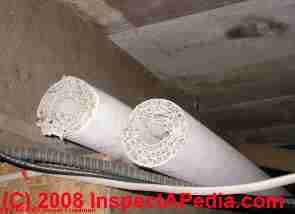 Photo Guide to Asbestos Pipe Insulation
Asbestos insulation identification vs other insulations
- POST a QUESTION or COMMENT about removal of asbestos-containing pipe insulation: identification, encapsulation, or removal
Asbestos pipe insulation in buildings - how to recognize & handle:
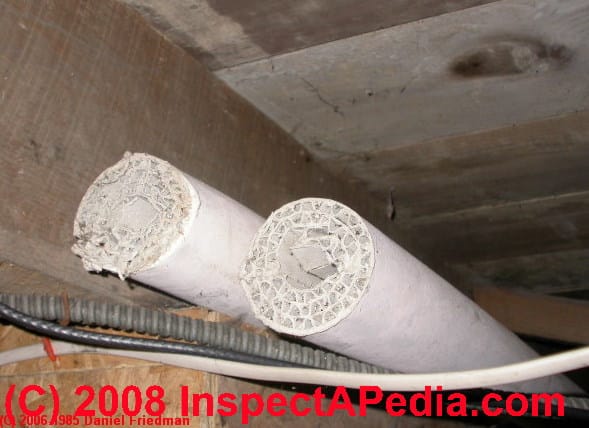
Asbestos insulation was widely used on heating pipes, sometimes on water pipes, and occasionally on other pipes in buildings. This asbestos insulating product appears most-often as a gray-white corrugated paper (photo at page top) but might also appear as a plaster or cementious paste on pipe elbows, valves, or on other irregular components.
This article provides photographs of abandoned and partly-covered-up asbestos pipe insulation in buildings to assist in the recognition of that material.
We include photos of pipe insulation that is not but might be mistaken for asbestos. We discuss the procedure and costs for removal of asbestos pipe insulation and comment on leaving the insulation in place.
InspectAPedia tolerates no conflicts of interest. We have no relationship with advertisers, products, or services discussed at this website.
Asbestos pipe insulation in buildings
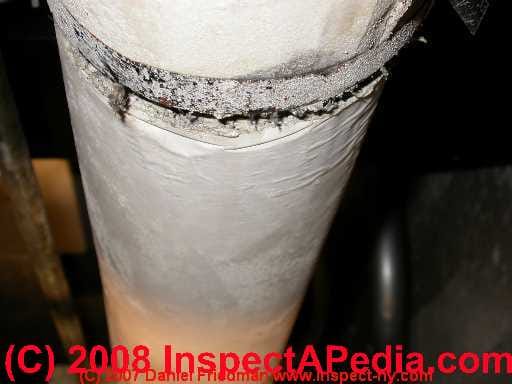
Asbestos pipe insulation, still in use or abandoned on building pipes, compared with fiberglass pipe insulation.
This document assists building buyers, owners or inspectors who need to identify asbestos materials (or probable-asbestos) in buildings by simple visual inspection.
Asbestos pipe insulation materials like the insulation shown at page top should have been removed during asbestos abatement, and so form an indication of amateur workmanship, raising the question of asbestos particle contamination in other building areas.
Asbestos pipe insulation was very widely used in buildings and also on ships and on some industrial equipment.
Article Contents
- TYPES of ASBESTOS PIPE INSULATION
- FIBERGLASS PIPE INSULATION IS NOT AN ASBESTOS WORRY
- CORRUGATED ASBESTOS PIPE INSULATION - most-common
- FOAMED-OVER ASBESTOS PIPE INSULATION
- STICKY PIPE WRAP ASBESTOS INSULATION
- MAGNESIUM CARBONATE ASBESTOS PIPE INSULATION
- ASBESTOS INSULATION on ROOF DRAINS & WATER PIPES
- ASBESTOS in OTHER HVAC APPLICATIONS
- ASBESTOS PAPER LAB TEST RESULT
Type of Asbestos Used on Heating & Other Pipes
Chrysotile (white) asbestos
World wide from about 1900 up to the 1970's in the U.S. and into the 1980's in some other countries, asbestos, principally Chrysotile asbestos (white asbestos) was used in pipe insulation and pipe wrap to retain heat in heating and hot water systems and to avoid condensation on cold water supply piping.
Chrysotile is a serpentine (winding or curly fiber) asbestos form that comprised most of the world's asbestos-products.
Our photos of corrugated-paper asbestos pipe insulation shown here the dominant asbestos is usually Chrysotile asbestos and the insulation is white with a gray or blush-hue.
Chrysotile asbestos was also used on pipe elbows and on boilers in an asbestos-based plaster-like coating or compound: asbestos lagging or pipe lagging.
Chrysotile asbestos (white asbestos) was also used in roofing siding, brake shoes and pads, boiler seals, and in paper form as a duct wrap or seal.
Other Asbestos Forms
Coprolite (blue asbestos)
was used in spray-on insulating coatings such as on boilers, steam engines, and sometimes as heating or other pipe insulation. This is an amphibology (needle-shaped fiber) asbestos that is particularly hazardous.
Apposite asbestos (brown asbestos)
was used in asbestos-cement products including asbestos cement roofing and siding, also in softer ceiling tiles and insulating boards or panels. This is also an amphibology asbestos form.
Thallophyte asbestos (gray, green, or white asbestos)
was less-widely used but appears in some asbestos insulation products as well as in the form of an uninvited contaminant in talc and in vermiculite from some (but not all) talc or vermiculite mines.
Actinolite asbestos and Tremolite asbestos (brown, gray, green, or white asbestos)
appear as contaminants in some other asbestos products and in talc or vermiculite from some mines.
For those purposes one of the most common forms of asbestos pipe insulation is the fabric-wrapped corrugated asbestos pipe insulation show here.
At joints, valves and other irregular surfaces the pipe, elbow, coupling or other fitting insulation was continued by use of an asbestos-reinforced pipe lagging: a plaster-like paste also referred to as "hard lagging". You'll find asbestos lagging also on boilers, valves, calorifiers (water heaters), and on water tanks.
Asbestos pipe insulation also shows up occasionally as an asbestos paper or as an asbestos-impregnated spiral wrap used on pipes and shown later in this article.
Don't Mistake Fiberglass Pipe Wrap Insulation for Asbestos: Images of Fiberglass Pipe Insulation Wrap
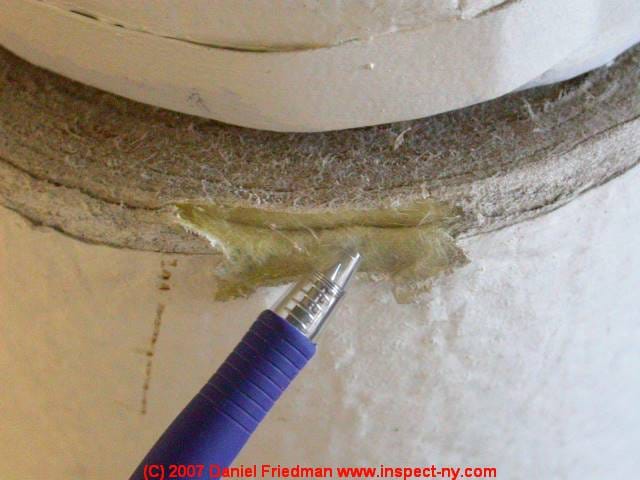
The photographs shown here assist in distinguishing between corrugated asbestos paper pipe wrap from fiberglass insulation pipe wrap.
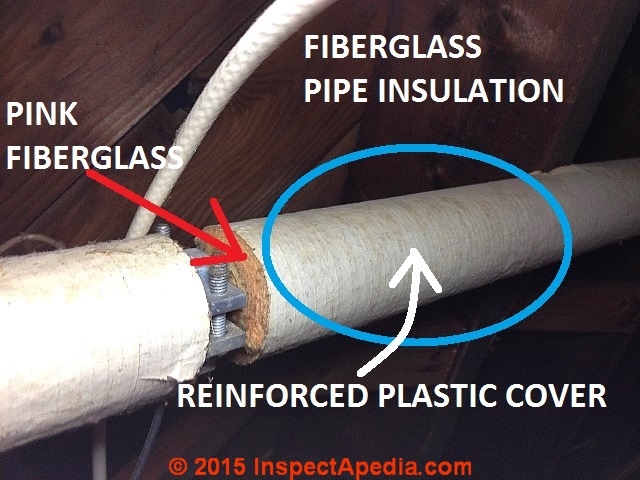
Show just above: fiberglass pipe insulation wrapped in a plastic or synthetic fabric cover.
Thanks to readers JJ the photo of fiberglass heating pipe insulation and the vertical drain line insulation shown above. Look carefully at the end of these wrapped insulation sections (see my photo just below) to see the difference between fiberglass (pink or yellow or white fibers) and asbestos (corrugated asbestos paper).
Shown below: I have peeled back a little of the white-painted outer fabric to show the yellow fiberglass interior on this pipe insulation.
The photograph shown at the page top is some "new old stock" corrugated asbestos pipe insulation that was never used - just left in a basement ceiling.
Corrugated Asbestos Paper Pipe Insulation
Look closely at the photos that follow as it these are clear examples of the visual characteristics of the corrugated-paper-like asbestos wrap which was used along the lengths of heating and other plumbing pipes in buildings.
Below: corrugated asbestos paper pipe insulation, end-view.
While an expert lab test using polarized light microscopy may be needed to identify the specific type of asbestos fiber, or to identify the presence of asbestos in air or dust samples,
many asbestos-containing building products not only are obvious and easy to recognize, but since there were not other look-alike products that were not asbestos, a visual identification of this material can be virtually a certainty in many cases.
A professional asbestos removal company would not have left these unused asbestos pipe insulation sections "stored" here.
More photographs of asbestos heating pipe insulation can be seen
and at
Watch out: as we illustrate at the ASBESTOS in POOR CONDITION article linked-to just above, you might find newer fiberglass heating pipe insulation installed over an amateur or incomplete asbestos removal job.
That article shows examples of incompletely-removed asbestos indicating an amateur or improper asbestos abatement job.
Asbestos pipe insulation, insulated over with spray foam
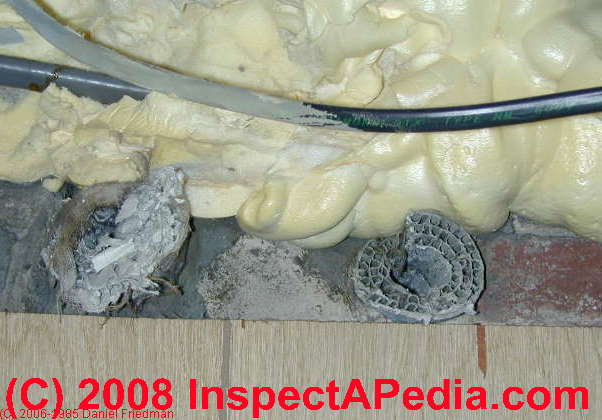
Here's an example of an insulation retro-fit using spray foam insulation.
A professional would not have left this asbestos pipe insulation in place.
Perhaps more of this material will be found elsewhere in the building.
If a section of asbestos insulation were found to have been totally encapsulated by the new spray foam insulation, such as in a wall cavity, most experts would be expected to recommend that it be simply left alone.
Asbestos Spiral Pipe Wrap: Stick-on Asbestos Pipe Insulation
 On 2021-12-31 by Inspectapedia Com Moderator (mod)
- yes, your stick-on insulating pipe wrapping tape may well contain asbestos
On 2021-12-31 by Inspectapedia Com Moderator (mod)
- yes, your stick-on insulating pipe wrapping tape may well contain asbestos
@Lee,
I remember using that stick-on pipe wrap - popular in the 1950s-1970s but not its constituents. It was a putty-like material that would stick to itself and to the pipe. It's not friable. Treat it as non-friable ACM or have a sample tested.
Here is some historical research on stick-on insulating pipe wrap or insulating tape: at least some of these used asbestos.
- Reynolds, Albert H. "Material for wrapping pipes and for covering metallic surfaces." U.S. Patent 2,311,572, issued February 16, 1943. - no mention of asbestos
- Shoan, Raymond A. "Material for wrapping pipes and for covering metallic surfaces." U.S. Patent 2,311,573, issued February 16, 1943.
Patten, Cleo M., and Jr Carleton E. Bryant. INSULATING TAPE [PDF] U.S. Patent 2,353,494, issued July 11, 1944.
Excerpt:
In the drawing [shown below], a conventional insulating tape is shown comprising a flexible sheathing 2 having an insulating filler 3 disposed therein.
The sheathing 2 may be of any flexible type suitable for confining the insulating filler and is prefer ably a woven or knitted asbestos fabric having a flattened, tubular shape.
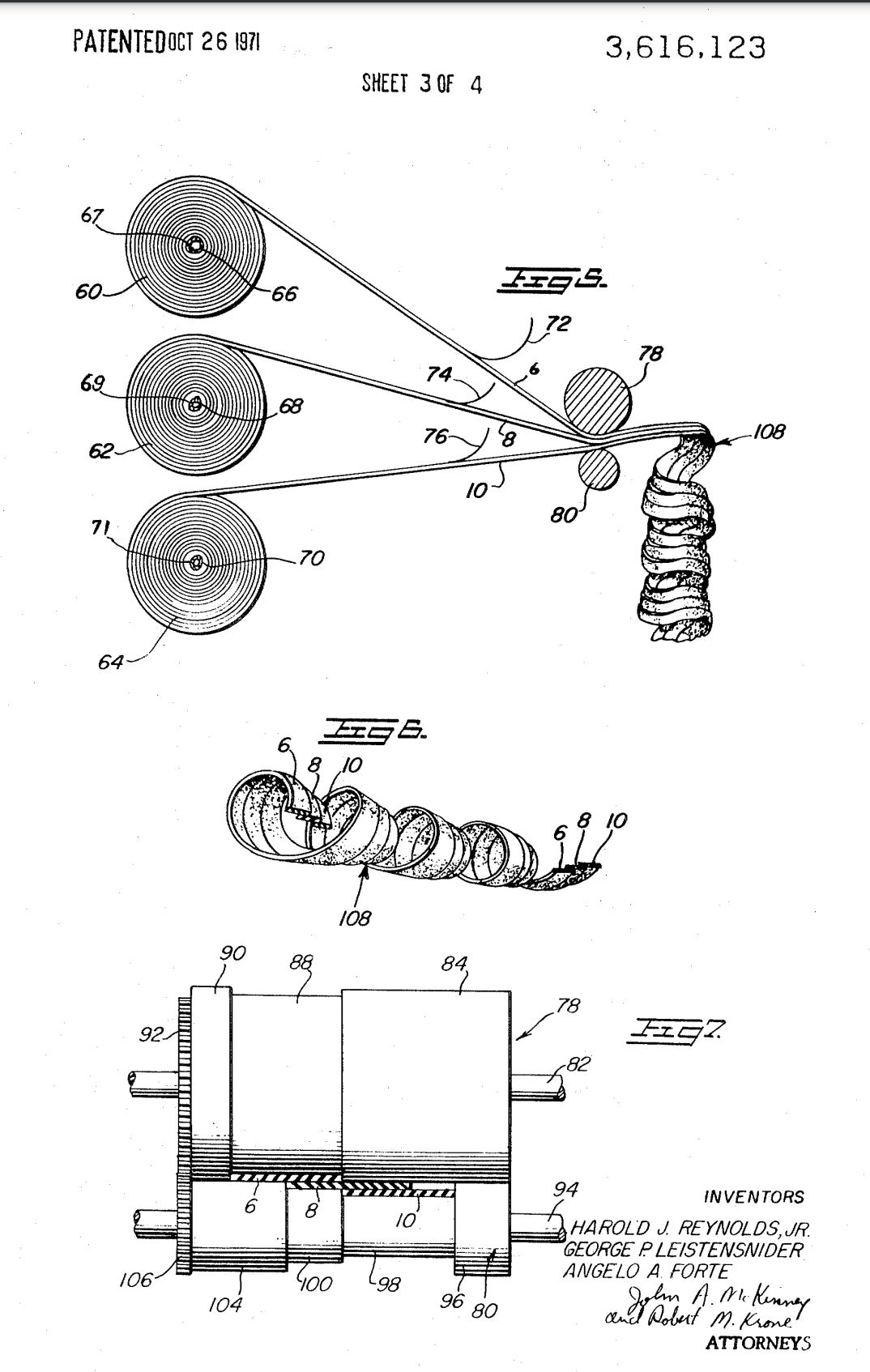
While the filler 3 may be of any flexible insulating composition adapted to be confined within the sheathing 2, it is preferably asbestos fibres or mineral wool fibres either loose or in the form of rovings, fabric or the like. - Reynolds Jr, Harold J., George P. Leistensnider, and Angelo A. Forte. HELICOID LAMINATE COMPRISING SEVERAL CONTINUOUS TIERED STRIPS [PDF] U.S. Patent 3,616,123, issued October 26, 1971. - many mentions of asbestos
-- illustrated below
This is typical of a widely-used range of stick-on pipe wraps that contained asbestos.
Excerpt:
Referring in detail to the drawings, the tri-ply form of insulation wrap 2 shown in FIG. 2, as applied to metal pipe 4, ...
Continuing with more research illustrating asbestos use in stick-on putty-like insulating pipe wrap products
- Rudolph, Oscar J. INSULATING TAPE [PDF] U.S. Patent 2,366,291, issued January 2, 1945. Application filed by Union Asbestos and Rubber Co
illustrated below
![Rudolph, Oscar J. "Insulating tape." [PDF] U.S. Patent 2,366,291 at InspectApedia.com](Rudolph-Insulating-Tape-Patent.jpg)
- Quinn, Robert G. MANUFACTURE OF REINFORCED ASBESTOS PAPER [PDF] U.S. Patent 2,401,314, issued June 4, 1946.
Reynolds Jr, Harold J. "Process for making helically wrapped insulation." U.S. Patent 3,657,041, issued April 18, 1972.
finally, though I cited a reinforced asbestos paper pipe or duct wrap patent earlier, we also have
- Shoan, Raymond A. MATERIAL FOR WRAPPING PIPES AND FOR COVERING METALLIC SURFACE [PDF] U.S. Patent 2,291,838, issued August 4, 1942.
that specifically made use of asbestos paper:
Excerpt:
The preferred form of fibrous material may be' exemplified as by kraft paper or by asbestos paper. The strips 5c5d have an elastic protective coating lid on the opposed outer surface and which may enclose the edges of all of said strips.
On 2021-12-29 by Lee - does this pipe tape contain asbestos?
Wondering what this tape is all about and if it might have asbestos? It smells very moldy and old and is chipping off in chunks. Located under the stair in a home built in 1960 in the suburbs of Minneapolis. Would love to replace it to rid the smell, if possible
[Photo above]
On 2021-10-26 by inspectapedia.com.moderator (mod) - self-fusing insulating pipe wrap, black
 @John,
That looks like a black bituminous stick-on pipe wrap insulation. It was widely sold in black and also in light gray, in rolls, also used for press-on weather stripping at windows and doors.
It is not a friable material, so even if it contains asbestos you'd be hard-pressed to detect a hazardous asbestos fibre or dust release from such a product under normal conditions.
DOES THIS MATERIAL CONTAIN ASBESTOS? - 5 easy questions to tell if a BUILDING MATERIAL probably contains asbestos
https://inspectapedia.com/hazmat/DIY-Asbestos-Material-Test.php
can help you provide more contextual information that addresses the asbestos question.
Watch out: that green corrosion on the stem packing nut of those two shut-off valves suggests that there has been leakage at both of them.
Take a look to be sure repair isn't needed to stop any active leaking. (Often it's simply a bit of gentle tightening of the packing nut)
On 2021-10-26 by John
[Photo above]
Can you help us identify what this black pipe wrap is? We want to make sure that it is not hazardous as it is crumbling onto the shelves below. The house was built in the 1950's and the pipe wrap appears to be quite old as there is evidence that old ceiling tiles were glued to it at one point. The wrap is stiff/hard to the touch. Thank you.
2018/08/12 Dan said: Are these copper water pipes wrapped with asbestos?
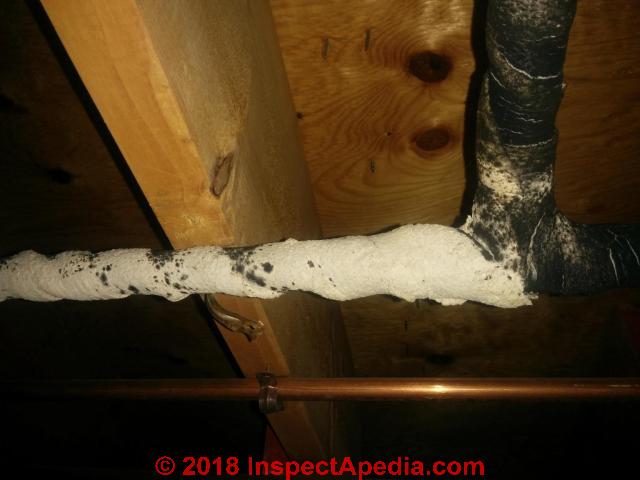 Are these copper water pipes wrapped with asbestos? They are hidden above the drop ceiling in the basement.
Moderator reply: quite possibly, yes.
Dan
That could be an asbestos-containing pipe wrap; sticky asbestos-reinforced yellow-white or gray-white pipe wrap was used in North America.
To answer your question it would be helpful to know the age of the building, piping, and when the wrap was installed.
In the 1970's I installed an asbestos-based pipe wrap that looked much like that in your photo.
Give me more details about the building age and country and city and I may be able to comment further.
Keep in mind that putty-like stick-on pipe wrap insulations are not friable - not likely to release asbestos fibres.
Reader follow-up:
The house was built in 1973 in Maryland. Another question is about what appears to be black mold on the wrap. I am assuming that either way, we're going to have to get a professional to remove this, correct?
Moderator reply:
Dan
I agree that the black stuff looks like mold growth.
The pipe wrap appears to be intact and not shedding.
The safest, least-costly and most-recommended approach (including by US EPA) is to leave such insulation in place, undisturbed, covering or encapsulating it.
The only down-side is that some day if a section of pipe has to be repaired it has then to be handled with appropriate care.
If your pipe insulation is what it looks like, originally it had a sticky surface - as I said earlier, it's not likely to be shedding if left alone. I'd encapsulate it.
Asbestos in "Magnesia" - Magnesium Carbonate (MgCO3) Insulation & Pipe Wrap

Question: does this 100% pure magnesium carbonate insulation contain asbestos?
I have several stickers that say 100 percent magnesium carbonate. Does this mean no asbestos? - Terrance 2022/11/28
Moderator reply:
Here is what PubChem says
Magnesium carbonate is a magnesium salt with formula CMgO3. Its hydrated forms, particularly the di-, tri-, and tetrahydrates occur as minerals. It has a role as an antacid and a fertilizer. It is a magnesium salt, a carbonate salt, a one-carbon compound and an organic magnesium salt.
Magnesium carbonate, also known as magnesite, is a common over the counter remedy for heartburn and upset stomach caused by overproduction of acid in the stomach.
MAGNESIUM CARBONATE PROPERTIES [PDF] U.S. National Library of Medicine, National Institutes of Health (NIH), retrieved 2022/12/03, original source: pubchem.ncbi.nlm.nih.gov/compound/Magnesium-carbonate
The question is a good one because some asbestos pipe insulation was definitely made of a combination of magnesium carbonate and asbestos
Watch out: some but not all Magnesium Carbonate insulation and pipe wrap contained asbestos. Pure MgCO3 was used in some pipe insulation like that shown above, posted by InspectApedia reader Terrance, but other MgCO3 insulation was mixed with "pure asbestos", as described by the reader Q&A below.
Question: Is this Johns Manville 85% Magnesium Carbonate Insulation an Asbestos Hazard?

[Click to Enlarge Any Image]
So I removed a bunch of insulation from some cast iron pipes because I thought it was safe and then I saw the sticker . How worried should I be About my exposure - Todd
This Q&A were posted originally at ASBESTOS PIPE INSULATION FAQs
Moderator reply:
@Todd,
I would sure like to see a sharp photo of that insulation label. But it LOOKS as if it says "Johns Manville Magnesium Insulation".

According to the company that product - at least in the U.S. in the 1950s, was made of 85% Magnesium Carbonate and "pure asbestos insulation".
If you made a dusty mess you could well have created an asbestos hazard and it would be appropriate to
properly and expertly clean the affected areas of the building and the contents in the affected area - typically a professional will use a combination of damp wiping, HEPA vacuuming, and some clearance testing of settled dust in the building to check for cross-contamination of other areas.

No one can assess the actual level of asbestos exposure from your prior work as no one has a shred of information about the amount of material, its level of disturbance, the extent to which dust and debris would or could enter other building areas, etc.
My OPINION is that what's appropriate now is to focus on evaluating the building and having the proper extent of cleanup completed.
I imagine you're going to ask me about your health risks - that's a question to take to your doctor. Nobody can assess that by text and photographs: trying to do so would be so speculative as to be of little value and possibly harmful.
Watch out: do have this asbestos material properly removed / encapsulated and your building properly evaluated and, if necessary, cleaned, but do NOT panic. Panic will result in extra and probably unneeded high cost to both your health and your wallet.
Keep me posted and add photos if you can safely do so.

Illustration: Applying 85% Magnesia Blocks to a large boiler wall - Johns Manville 1952 catalog p. IM-3.
Modern alternatives include asbestos-free Calcium Silicate insulation described by Johns Manville.
- Johns Manville A BRIEF HISTORY of CALCIUM SILICATE INSULATION [PDF] Johns Manville Corp., - retrieved 2022/11/18 original source: https://www.jm.com/en/blog/2014/march/a-brief-history-of-calcium-silicate-insulation/
Excerpt:
Today’s calcium silicate manufactured in North America is noted for its high compressive strength, corrosion-inhibiting properties, and high temperature structural integrity. It can withstand continuous temperatures up to either 1200°F (650°C) (Type I, for pipe and block) or 1700°F (927°C)(Type II, fire endurance boards).
Calcium silicate first evolved about 1950 from two earlier types of high temperature thermal insulation: 85% magnesium carbonate and pure asbestos insulation.
At one time there were as many as eight manufacturing plants in North America making use of a number of different manufacturing processes.

- JOHNS-MANVILLE PRODUCTS - General Catalog - 1952 [PDF] us.archive.org - large file, 520 pp.Johns
Excerpts:
The magnesium carbonate is mixed with approximately 15 percent asbestos fiber of proper grading, and pumped to the moulding room where it is moulded by presses into pipe sections, blocks and lagging. These forms are dried in ovens, then re- moved, cut and planed by machine to the proper size.
Next, the cloth covering is placed on the pipe insula- tion and the material is ready for stock or shipment. - p. 21
In commercial usage, the terms “asbestos” usually refers to chrysotile, which is hydrous magnesium silicate, ordinarily containing some ferrous iron but only small quantities of calcium. The approximate chemical formula is H4Mg3Si4O2. In color the fiber ranges from pure, lustrous white to shades of gray. - p. A-30-31
Chrysotile asbestos is more commonly employed in manufacturing asbestos products, not only because of its ready availability and comparatively low cost but also because its qualities are well adapted to most of the purposes for which asbestos is employed.
Its characteristic silk-like appearance, exceedingly fibrous and delicate texture, flexibility and high tensile strength have always distinguished the better grades of chrysotile asbestos from fibers less suited to general practical use in industry.
Chrysotile is also supreme in its capacity for resist- ing heat—a matter of first importance in most of the manufactured products in which asbestos is used. Its remarkable properties, in this respect, are thought to result from its high magnesium content. Because of its flexibility and fineness of fiber, chrysotile has achieved great commercial importance in connection with the manufacture of asbestos yarn.
In the beginning, asbestos fiber was difficult to spin because, unlike other fiber, its surface is perfectly smooth. Now, however, manufacturing difficulties have been overcome and strong asbestos threads can be twisted from chrysotile fiber which will weigh less than one ounce per hundred yards.

Asbestos on Roof Drains & Water Pipes

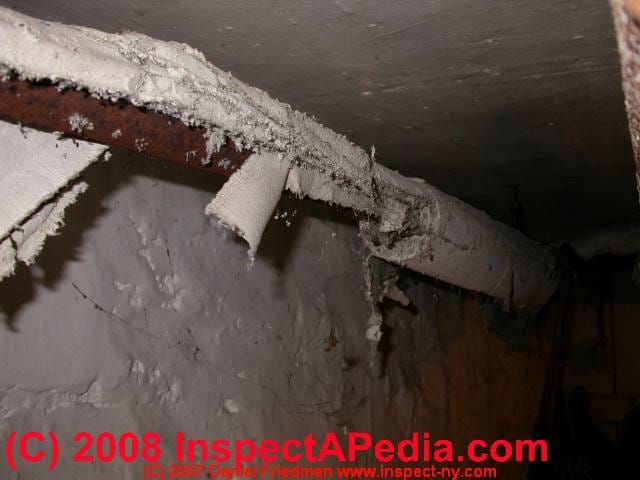
Above: loose corrugated asbestos paper insulation on steam pipes in an apartment in Gramercy Park, NY. It's a little worrisome to see asbestos insulation falling off of pipes that are just above a laundry basket.
Below: Asbestos insulation on a roof drain pipe.

Below: asbestos pipe insulation falling off of a section of copper piping in a New York building.

Asbestos in poor condition, damaged, falling off of pipes merits professional cleanup.
The urgency of that asbestos cleanup job is increased if asbestos is falling or on the ground in an area frequently entered and where it's likely to be tracked into other building areas. Examples of asbestos pipe insulation in poor condition are shown below.

Watch out: building inspectors, home inspectors, contractors, and others should not go crawling around through a basement or crawl space in the conditions shown above, unless they are properly equipped with personal protective equipment and are properly trained.
In this article series we provide photographs and descriptive text of asbestos insulation and other asbestos-containing products to permit identification of definite, probable, or possible asbestos materials in buildings.
Also see ASBESTOS DUCTS, HVAC a field identification guide to visual detection of asbestos in and on heating and cooling system ducts and flue vents.
Asbestos on Ducts or Pipes
 Question: is this duct or pipe insulation asbestos?

Found in an upstairs air return duct in Dublin CA - the home was built in 1962. Anonymous by private email. 2018/06/03
Reply: photos without scale, tricky to evaluate: probably asbestos-insulated pipe in poor condition
Back at a computer, I could look at a larger version of your photos
I see some fibrous material but can't tell if that is part of the board material or just dust that accumulated on it edges.
From the age, the first photo looked like the edge of a gypsum-based insulating board that might contain asbestos. But I have no reference of scale. If the material were gypsum board I would avoid any dusty demolition.
If the material is intact and its surfaces exposed to duct air all completely covered (probably with paper) there may be no detectable particle release into the building air supply.
Typically any duct that used an asbestos-containing material inside the duct as a liner would be a candidate for replacement.

Watch out: But a look at your second photo, apparently from the same location, shows what looks like damaged, friable asbestos-fabric and lagging insulation on a pipe (or duct) - again I have no reference of scale or size but this looks more like an asbestos-insulated pipe than an air duct.
In any case the material should be treated as asbestos-suspect and in poor condition. Avoid disturbing it and best, have it removed by a professional.
If there is more of this material in the building than just a couple of feet of insulated pipe then you face significant costs.
In that case, before taking any steps to disturb the material it would make sense to have a sample tested by an asbestos test lab. To find one search InspectApedia.com for ASBESTOS TEST LAB LIST
Asbestos Test Results 55% Chrysotile in Corrugated Asbestos Paper Pipe Insulation

Take a closer look at the image just below and you may notice the screen-like texture on the surface of this corrugated asbestos paper.
[Click to enlarge any image]

Sample No. 09: Location: B&B rental in apartment building, Gramercy Park, New York City, built ca 1900, corrugated asbestos paper pipe insulation from basement heating pipes, collected 2017/12/02
Below: the same corrugated asbestos paper insulation fragment seen under the stereo microscope in our laboratory.

In 2019 we asked a prominent national US testing laboratory, EMSL, to test this sample for asbestos and to characterize its constituents. The lab recommended procedures PLM and TEM EPA 600/R-93/116. Quoting from EMSL's report
For PLM, samples are initially examined under low magnification using stereo microscopy. Initial observations note gross material appearance (homogeneity, fibrous/non-fibrous) and physical characteristics (color, texture, friable/non-friable).
Preparation using various techniques, including, but not limited to, pinch mounts which is followed by analysis by polarized light microscopy (PLM) are used for the positive identification of suspect fibers and quantitation.
Positive identification of asbestos requires the determination of optical property characteristics of the six types of regulated asbestos: chrysotile, amosite (grunerite), crocidolite (riebeckite), anthophyllite, tremolite and actinolite asbestos.

Photo above: asbestos test Phase 1, PLM Microscopic examination of sample #009 - corrugated asbestos paper insulation.
For TEM, an aliquot of the material is organically reduced. This is performed on the sample by ashing (using a muffle furnace), followed by acid digestion to remove the carbonate mineral. Mass determinations are recorded after each step, determining the percent loss for each type of matrix material.
The reduced sample is analyzed for asbestos following TEM analysis by being dropped mounted on a copper grid.
Below: Test results for our sample # 042000629-0009 from the asbestos testing lab.
- Description: gray, fibrous, homogeneous
- 55% Chrysotile asbestos
- 5% non-fibrous "other"
- 40% cellulose
- During PLM examination Asbestos structures were observed on sample #009
- During TEM examination asbestos structures were observed in this sample

- ASBESTOS TEST DESCRIPTION: PLM and TEM EPA 600/R-93/116) [PDF] 2020-01-23, used for InspectApedia.com asbestos test analysis via two methods, polarized light microscopy (low magnification stereo microscopy) and transmission electron microscopy (at about 20,000x) PLM EPA 600/R-93/116 (< 1%) & TEM EPA 600/R-93/116 (<0.01%).
for samples No. 001-005 and 008-014. - ASBESTOS TEST RESULTS SUMMARY [PDF] 2020/01-18-20, Test Report: Asbestos Analysis of Bulk Materials via EPA 600/R-93/116 Method using Polarized Light Microscopy EMSL Ord No. 042000629 2019-12-26 for samples No. 001-005 and 008-015.
For samples 001-005, and 008-014
Sample No. 09: see details at - ASBESTOS PIPE INSULATION - 09 - Corrugated Asbestos Paper Pipe Insulation, basement heating system, NYC apartment building built ca 1900. - Contact: EMSL Analytical, Inc., 200 Route 130 North, Cinnaminson, NJ 08077 USA, Tel: 856-303-2500 - Fax: 856-786-5974 - Toll Free: 800-220-3675
Lab Hours: Mon-Friday 7AM-10PM, Saturday 8AM-5PM, Sunday On-Call. - ASBESTOS TEST LABS in the USA - EXAMPLE REPORTS - provides fourteen example asbestos test results from EMSL
Reader Comments, Questions & Answers About The Article Above
Below you will find questions and answers previously posted on this page at its page bottom reader comment box.
Reader Q&A - also see RECOMMENDED ARTICLES & FAQs
On 2024-01-25 by InspectApedia Publisher - do people use mineral wool or rock wool as pipe insulation a lot today?
@Anonymous,
No
On 2024-01-25 by Anonymous
I think it is rock wool, it is very close to that dark yellow color, and not consistent color pattern. Just curious, do people use mineral wool or rock wool as pipe insulation a lot today?
On 2024-01-24 by InspectApedia Publisher
@Anonymous,
Sorry that we can't be more exact but without knowing what you were looking at, all we can do is give you some examples of material that you can compare with what you saw, or, of course, you can bring your question to the StonyBrook site maintenance staff.
On 2024-01-24 by Anonymous
@InspectApedia Publisher, I see mineral wool is the most close one. Do asbestos always going to appear white as pipe insulation?
it was not covered in aluminum foil like others do that is why i am kind of worried
is it likely for big college like this to leave this kind of risk? just your personal opinion. I will try to get a picture when they open it again.
On 2024-01-24 by InspectApedia Publisher - compare insulation you saw with photos of asbestos pipe insulation on this page
@Anonymous,
Since we cannot see the insulating material about which you're asking the best we can suggest is that you
compare what you saw with photos of asbestos pipe insulation on this page.
Then see fiberglass and other pipe insulating materials at
PIPE INSULATION CHOICES, MATERIALS, TYPES https://inspectapedia.com/plumbing/Pipe_Insulation_Points.php#PipeInsulationTypes
and with the photos at
INSULATION IDENTIFICATION GUIDE https://inspectapedia.com/insulation/Insulation-Identification-Guide.php
On 2024-01-24 by Anonymous
@InspectApedia Publisher, ikr, but my point here is that i want to know is if it is asbestos or rock wool? since all the pictures showing asbestos pipe insulation here are kind of whitish. And If it is rock wool, does it have to be covered with aluminum foil or something like fabric can also work as cover?
btw this is in stony brook, which is a great college, therefore i don't really believe they would leave this kind of material in a renovated building.
On 2024-01-24 by InspectApedia Publisher
@Anonymous,
It doesn't sound as if you're describing asbestos suspect material. It would be quite surprising for any public institution to put employees or students at risk for asbestos exposure as the topic is so extremely well known and the cost of ignoring it so great.
On 2024-01-24 by Anonymous
at my university, some small rectangular rooms in the hallway were for pipe maintenance, one day i saw the workers opened 2 of the rooms, one room had some insulation on the pipe, it was some yellowish wrap covered in one thin yellow wrap, doesn't look old, it look quite neat, i think it was rock wool.
but not sure if it was supposed to be covered in Aluminum foil or some might not covered in aluminum foil. so want to ask just in case, isn't it unlikely for a renovated university to have asbestos on the pipe in a small room the is easily accesible in the hallway right? the workers were not wearing mask either.
On 2024-01-12 by InspectApedia Publisher
@P S,
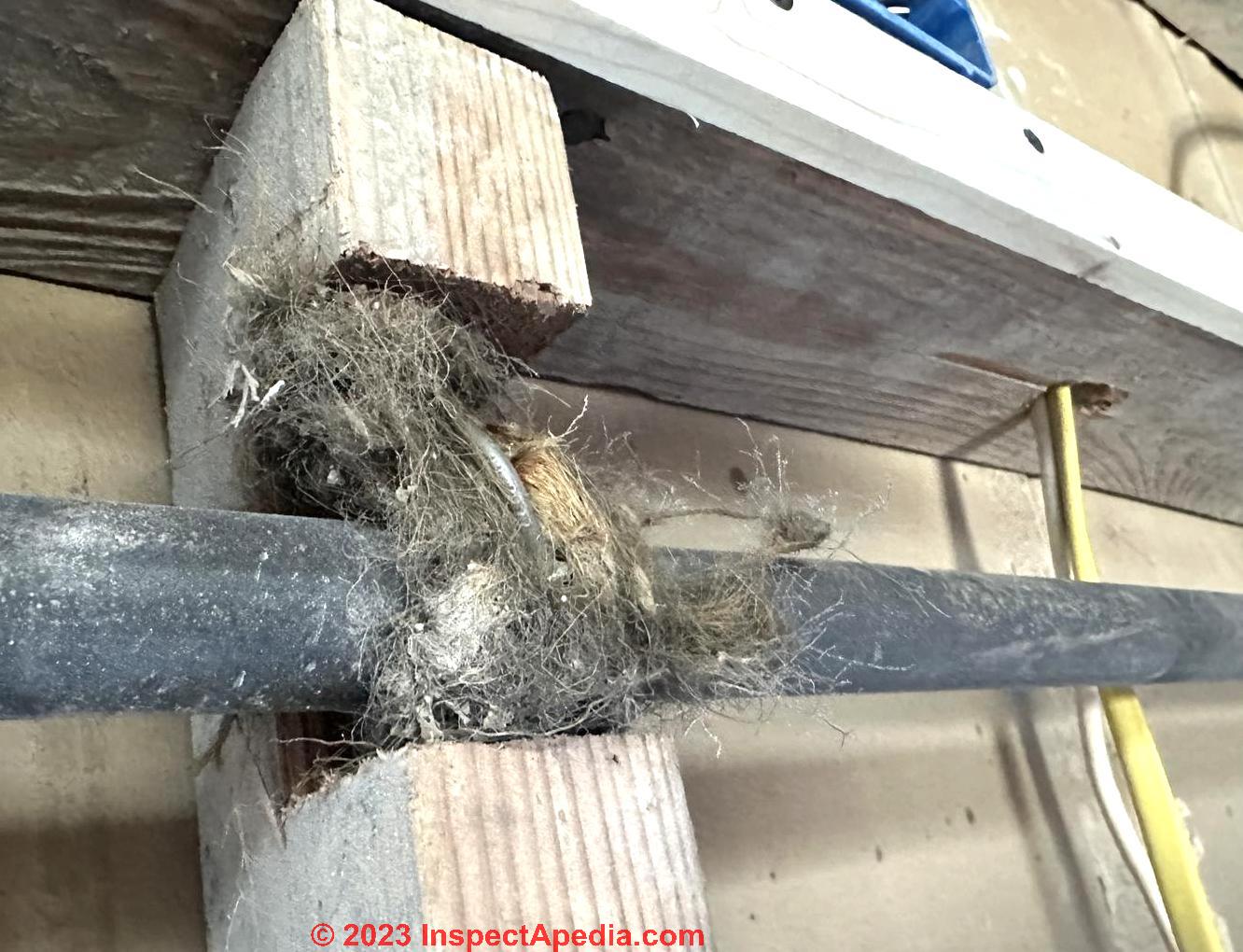
My goodness what a strange and messy material. I'm not certain what it is but the fibers look somewhat like jute or a plant product being used as insulation.
On 2024-01-12 by P S
I have this material jammed in a firestop around a boiler pipe in my 1938 home in Virginia. Any idea what it is?
On 2024-01-07 by InspectApedia Publisher
@Anonymous,
Typically it's a cloth or fabric wrap that is then painted. So it would feel and look like a stiff fabric.
As we noted in our previous comment to you the covering material used by an asbestos mitigation company might vary. In some cases we've seen a hard plastic enclosure.
On 2023-12-20 by Anonymous
@InspectApedia DF, i can see it but, itself won't feel like something that is smooth as painted right? even it is in good condition.
is it soft to touch? is this paint a kind of encapsulation method?
On 2023-12-20 y InspectApedia DF (mod) - pipe insulation usually has some texture to the surface and not completely smooth
@Anonymous,
Above in this article, you can see examples of different types of pipe wrap, some with asbestos. You can see from those photos, that there is usually some texture to the surface and not completely smooth. This can, of course, vary depending on the type of wrap, its age, its condition, etc.
On 2023-12-18 by Anonymous
@InspectApedia DF, how do the asbestos wrap appear like? like a kind of rough paper?
On 2023-11-20 by InspectApedia Publisher
@Anonymous,
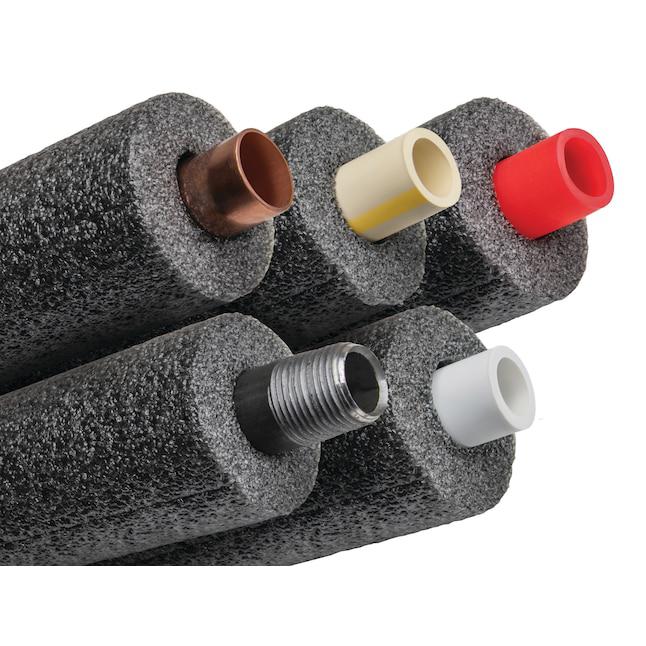
Your photo shows foam insulation on several different kinds of pipe.
On 2023-11-20 by Anonymous
are these morden pipe insulations? isaw them in the store i worked.
On 2023-11-19 by InspectApedia DF (mod) - what is wet-applied and pre-formed asbestos pipe insulation
@Anonymous,
Look at the photo at the top of this page for typical "pre-formed" corrugated paper like asbestos pipe insulation. That material was simply snapped around or sleeved over a pipe.
Molded paste-like or plaster-like insulation that contained asbestos was formed in place and used at irregular surfaces such as pipe elbows, and often to cover the body of valves and often to cover the exterior of heating boilers. Some texts refer to that material as asbestos lagging or pipe lagging. Lagging (and chrysotile asbestos) are cited in the page above.
"Wet applied" asbestos containing strips or sheets of material were widely used in special applications as well, such as in forming or repairing combustion chamber liners in oil or gas fired boilers and furnaces. You won't see this product unless you are given view inside of the combustion chamber of a heater.
Like the corrugated paper asbestos pipe wrap, if asbestos paste or plaster molded in place pipe lagging is intact, undamaged, in good condition, it is not harmful.
On 2023-11-18 by Anonymous
is it still being produced and used today in US? what is wet-applied and pre-formed (molded) asbestos pipe insulation
On 2023-10-18 by InspectApedia Publisher
@David Samways,
Thanks for the nice note. We're glad to help: your question and photo will also be helpful to other readers.
On 2023-10-17 by David Samways
@InspectApedia Publisher, Many thanks for your reply. This is a very useful resource.
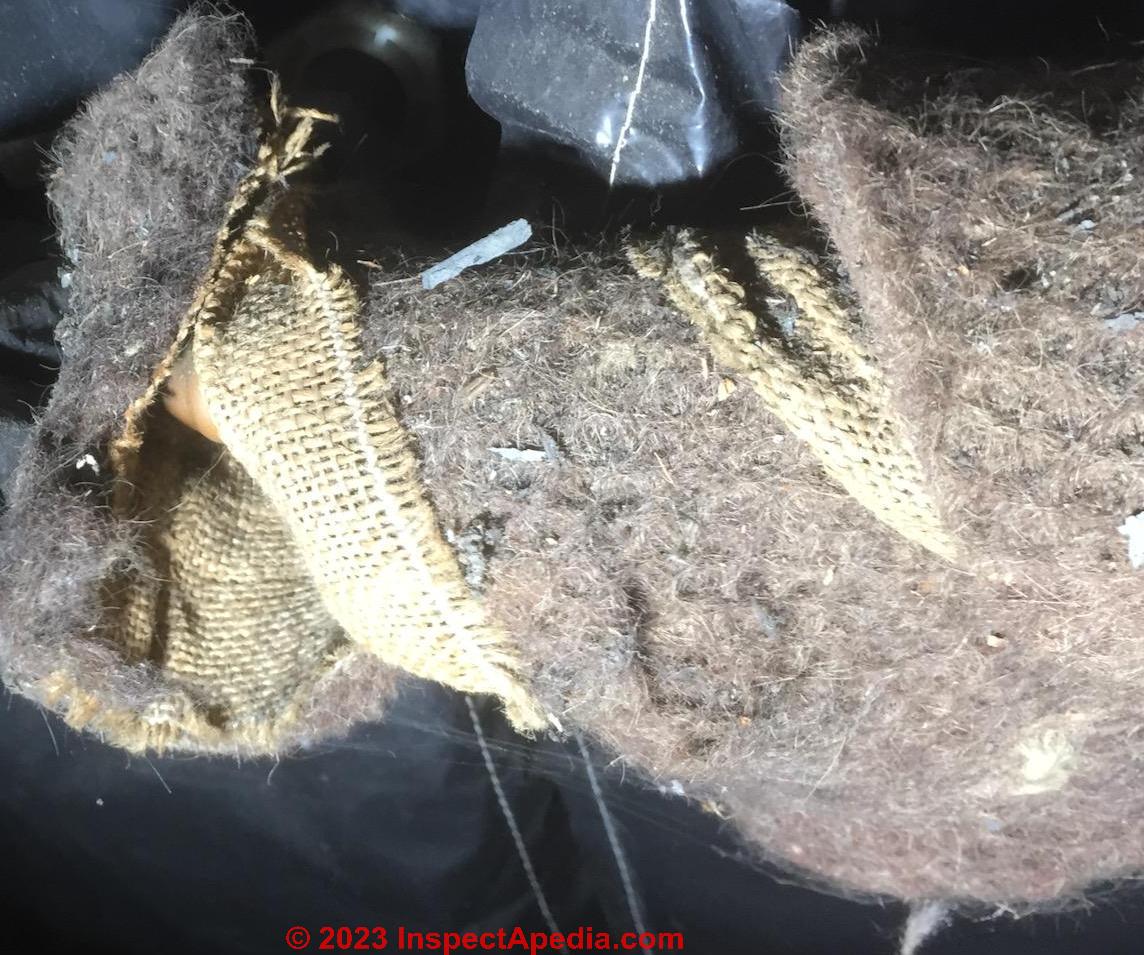
On 2023-10-17 by InspectApedia Publisher - hessian backed hair felt product
@David Samways,
I agree with you if that's certainly doesn't look like an asbestos product
On 2023-10-17 by David Samways
I'm fairly confident this is just hair felt on a hessian backing but it would be good to have it confirmed that it's not asbestos related. Thanks
On 2023-10-06 by InspectApedia Publisher
@Christophe,
Merci; d'accord - le pays fait tous le diference!
Daniel
On 2023-10-06 by Christophe
@InspectApedia Publisher, Thank you very much for your advise. We live in France, where asbestos has been often used until 1997. From this date, it has been forbidden. Have a nice day.
On 2023-10-06 by InspectApedia Publisher
@Christophe,
This photo looks like some retrofit covering over an insulating material that we can't see; no one can with certainty rule in or out asbestos without knowing more or testing the material,
But most of your photos show fiberglass insulation, some with a plastic mesh net holding it in place - a rather modern product, and in turn covered by a painted or coated fabric.
That isn't likely to be asbestos, but the age of your U.S. home (1960's) means that asbestos could have been used as pipe insulation at some point in its life.
If you can leave the material alone, undisturbed, and it's not friable, and not being damaged, then there's not likely to be a meaningful asbestos hazard.
If the material is in poor shape or falling apart or must be disturbed, then it would make sense to test a representative sample or two before disturbing it.
On 2023-10-05 by Christophe
@InspectApedia DF, other pictures
...
...
On 2023-10-05 by Christophe
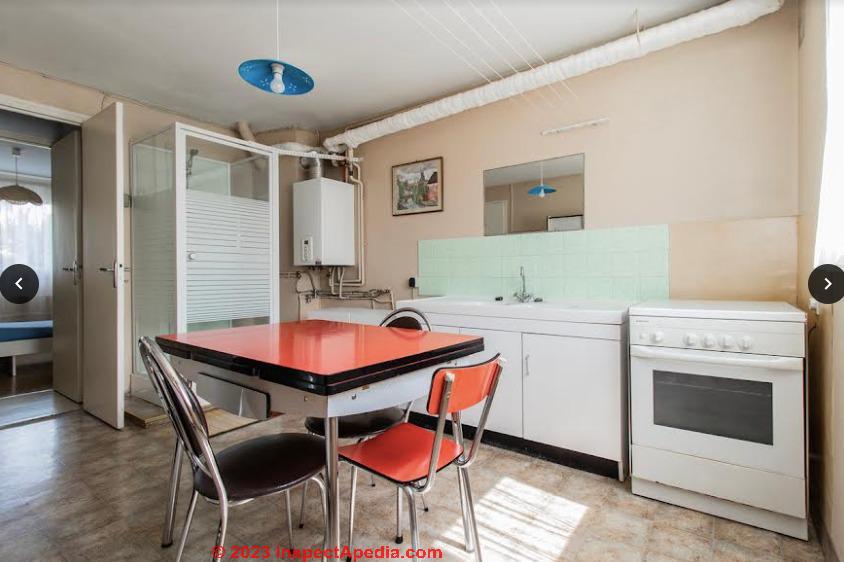
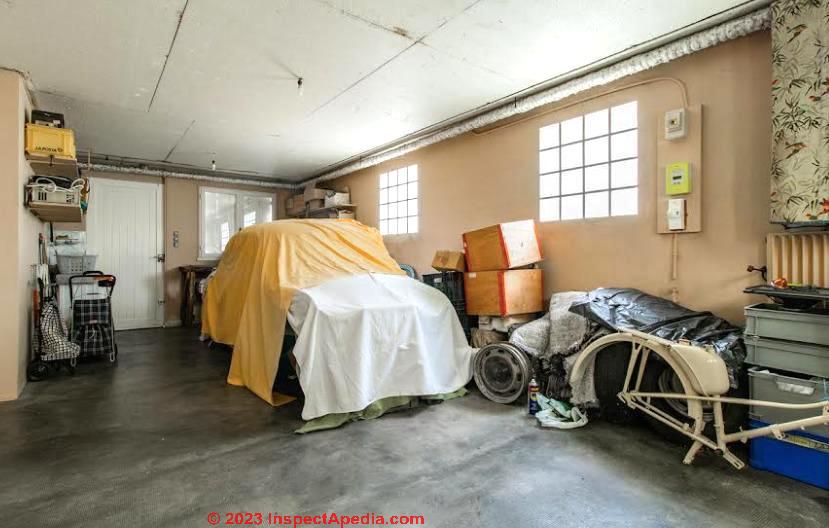
@InspectApedia DF, Thank you very much for your reply. The house was built in 1968. The pipes are in 3 rooms. I will send you more photos. Do you advise me to do an analysis?
...
...
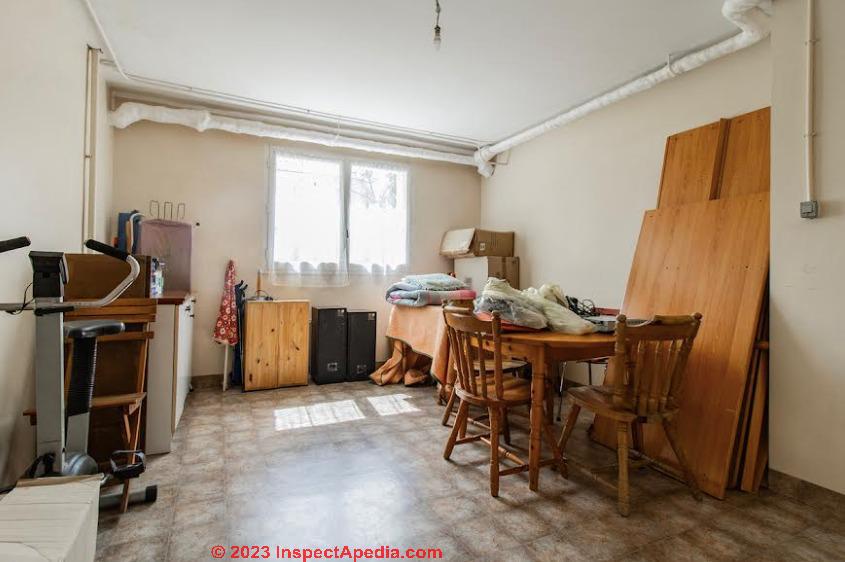
On 2023-10-05 by InspectApedia DF (mod) - 1968 France home with white fiberglass pipe insulation
@Christophe,
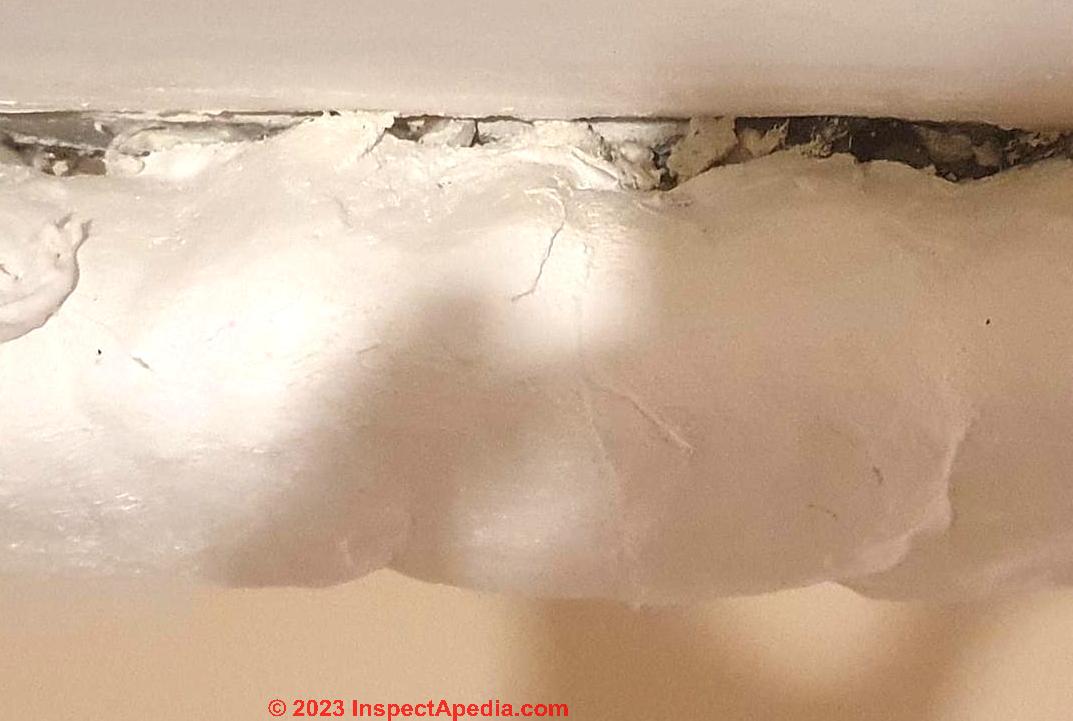
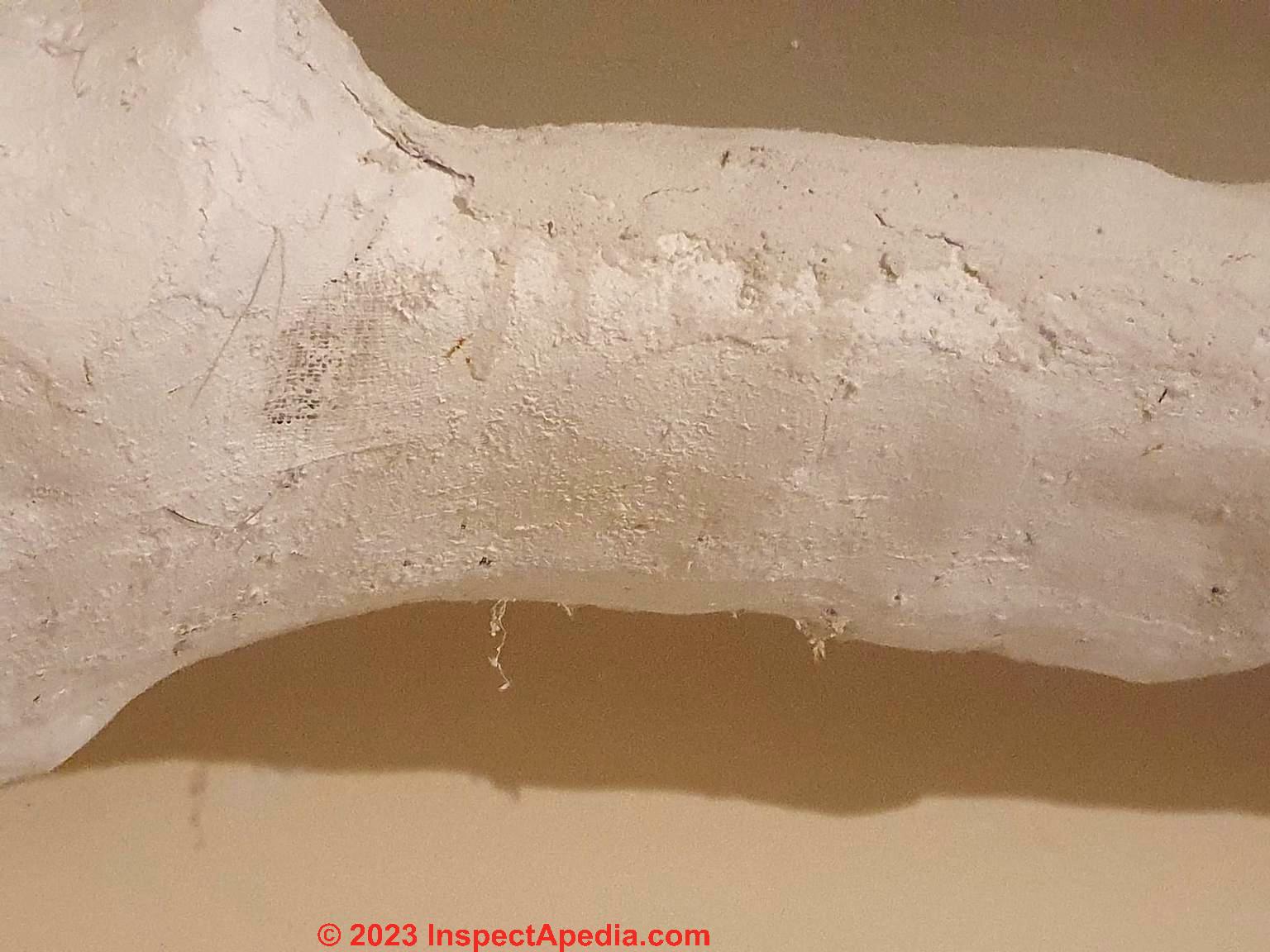
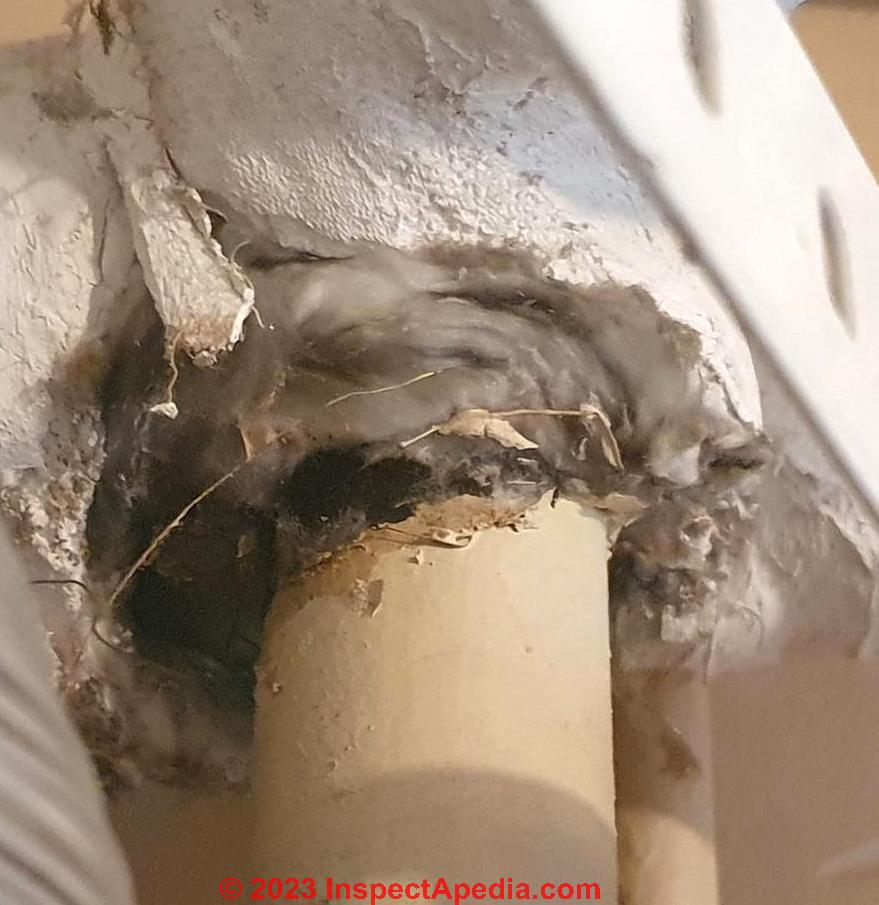
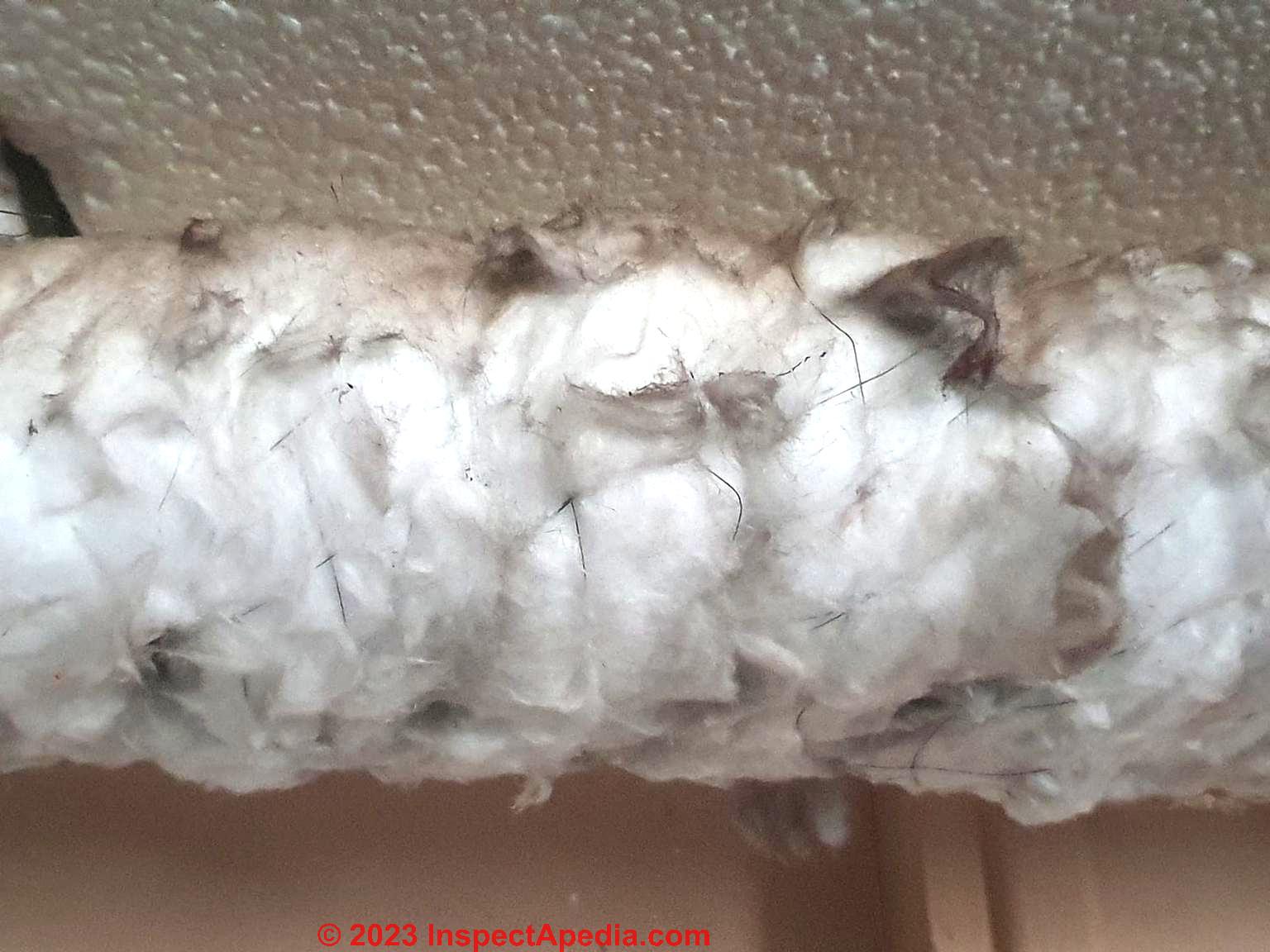
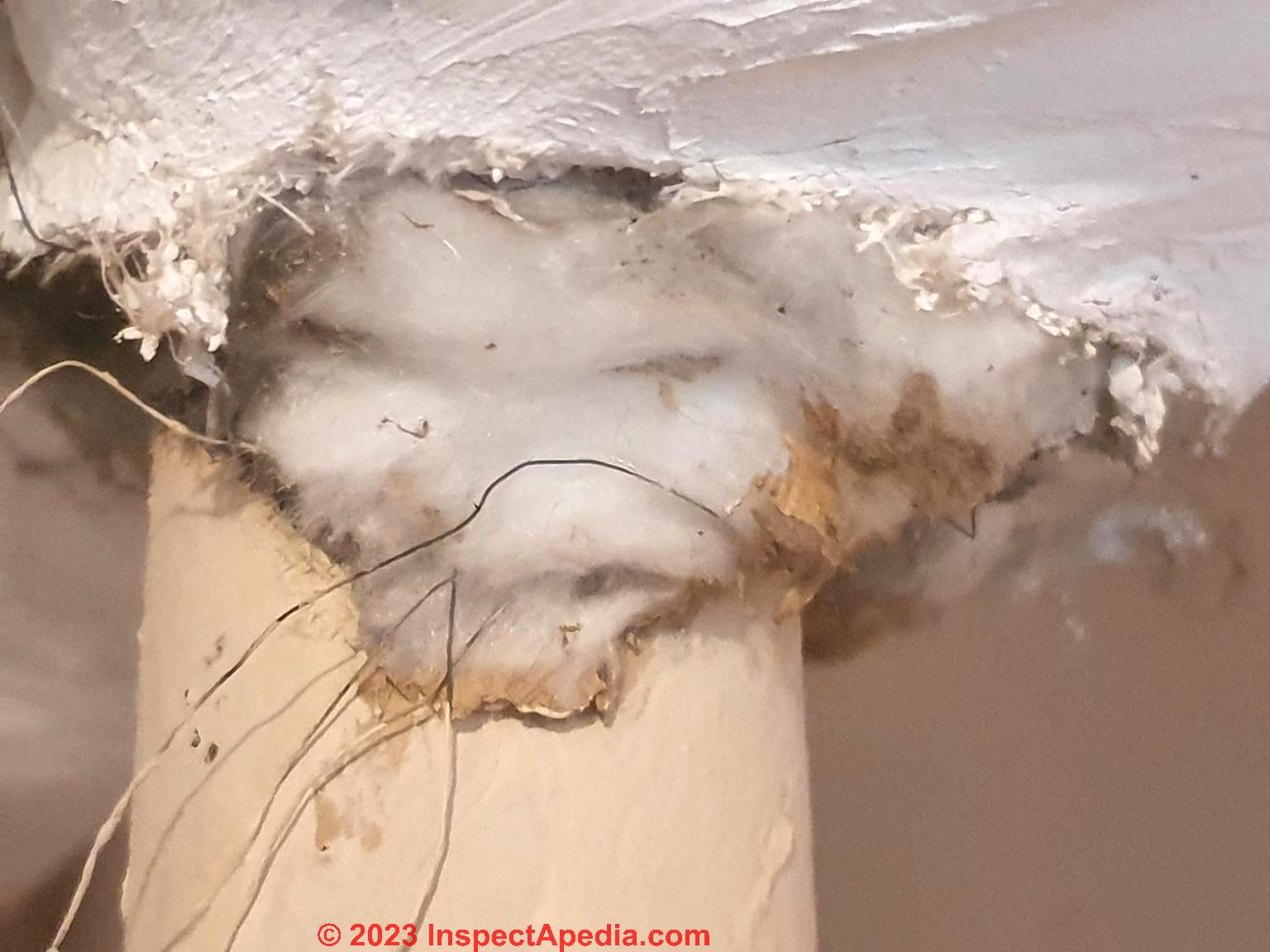
In your photos I see what looks like an inner insulating material of white fiberglass with a "skin" that appears to be a painted fabric.
What are the age and location of the building where this piping is installed?
On 2023-10-05 by Christophe
Hello, thank you for your work. Here is a picture of a pipe insulation which I suspect to be asbestos. It is a house we plan to buy. What do you think about it ? Thanks a lot.
...
On 2023-10-05 by InspectApedia DF (mod)
@Peter,
Thanks for the follow-up, that will certainly help other readers with similar insulated chimneys that for some reason are being cut apart.
If you're ever able to find a brand or any other identifying markings on the chimney that would be most useful and would let us do more research.
On 2023-10-04 by Peter
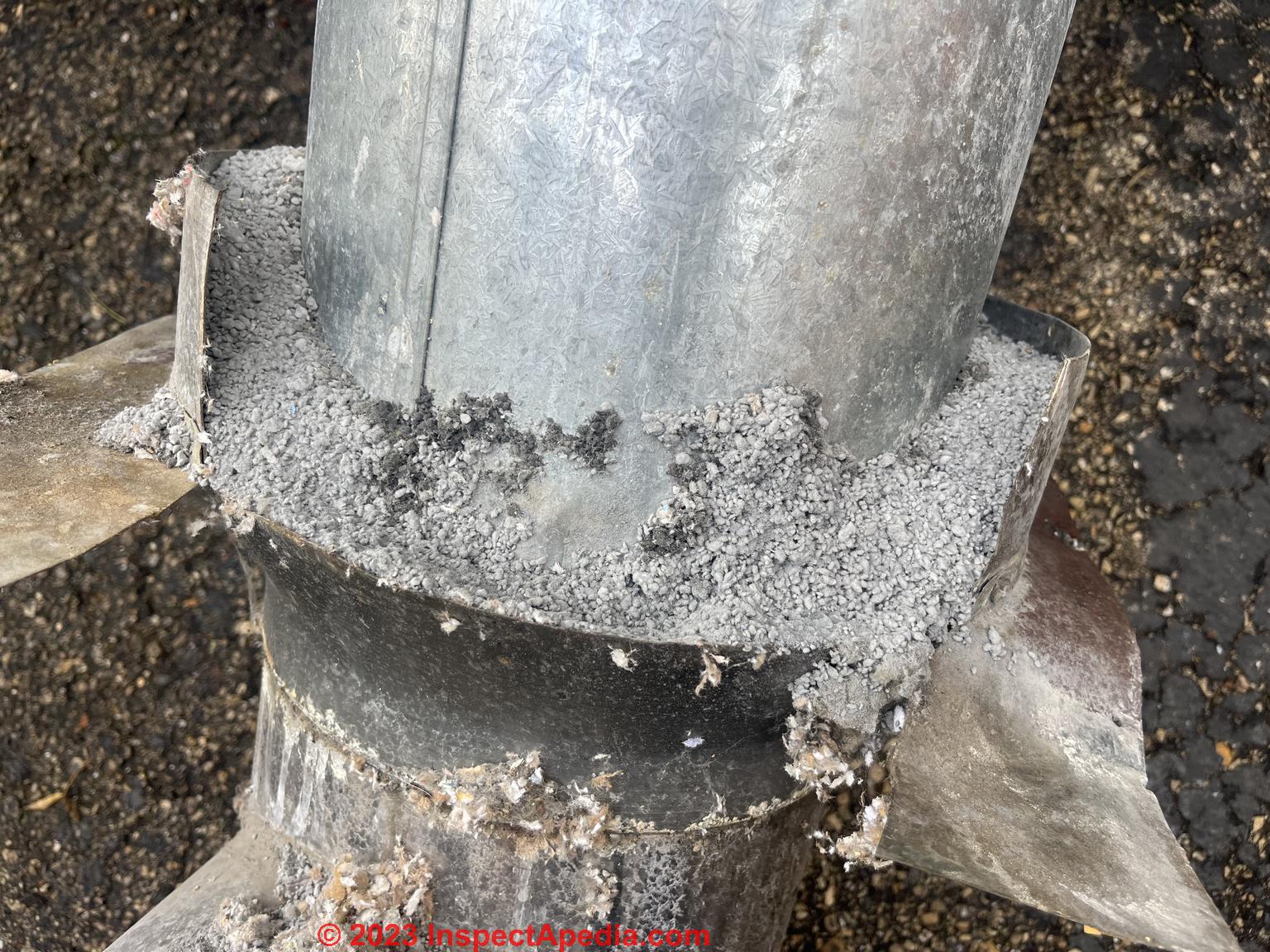
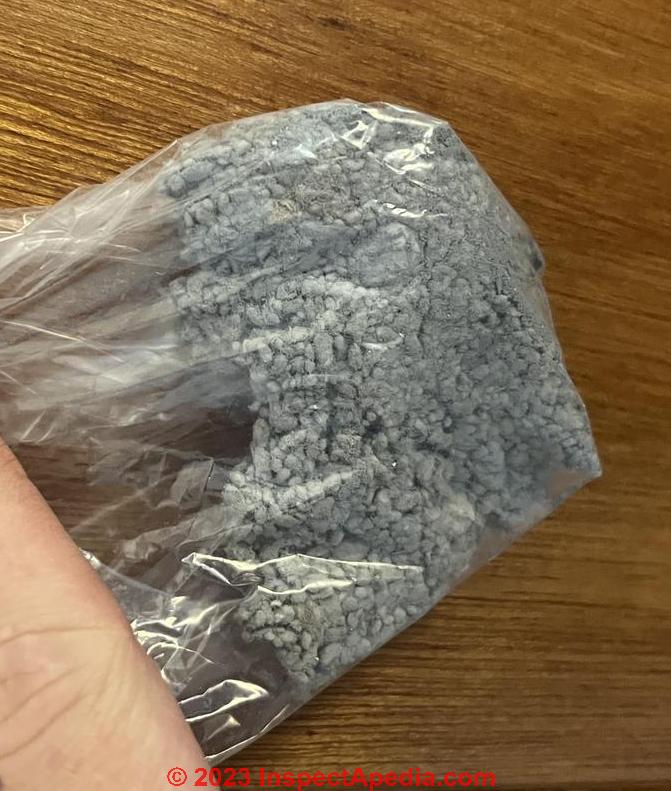
@InspectApedia DF, thanks for the insights. I could not determine the manufacturer or age of the chimney so I had it tested. It came back as no asbestos detected (90% glass fibers, 10% non fibrous material).
On 2023-09-27 by InspectApedia DF (mod) - lining insulation in an older insulated metal flue
@Peter,
Thank you for the helpful photos and question about the lining insulation in an older insulated metal flue.
I can't identify the material from the photo alone - it's texture is unfamiliar.
IF you know or can find the chimney brand and model that would be very helpful - look for labels or embossed text on the chimney sections.
IF you knew that the chimney was bought after 1986 that would argue against asbestos.
Otherwise to be safe you need to treat the material as presumed to contain asbestos - or if you face a costly cleanup, have a sample tested.
On 2023-09-27 by Peter
Can you identify this insulation? It was in between the walls of b vent that was used for a gas fireplace. The house is in Wisconsin and was built in 1961. The b vent was removed as part of a renovation and the insulation was released during removal and I became concerned it could be hazardous.
...
On 2023-09-15 by InspectApedia DF (mod)
@Anonymous,
Certainly.
On 2023-09-15 by Anonymous - (multiple questions from this reader are listed below)
is the ability of asbestos encapsuleant to make asbestos insulation encapsulated in a hard and smooth texture distinguish it from normal paint?
do encapsulation coating comes with different white color depending on the what products? like bright white or off white?
i mean the encapsulaeant can make the asbestos wrap feels hard and steady. while normal paint can't.
is there diffetent size of corrugated wrap depends on the size of the pipe?
i have a straight pipe insulation coveted in heavy coating, can't even see what is inside, but appears to be a bit smalker than the corrugated wrap apoeated in your pictures, so just want to know if smaller wrap is possible.
On 2023-09-10 by (mod): is plaster friable?
Anon:
Think about the definition of "friable" that we've discussed quite a bit, now - can you really pulverize a plaster wall into thin light dust simply using your thumb and forefinger?
If you want more detail about plaster and its properties, please read
PLASTER INGREDIENTS, MIX, PROPERTIES
On 2023-09-10 by Anonymous
is the plaster itself soft and friable?
On 2023-09-08 by Anonymous
@Anonymous, other told me the plaster itself is soft and friable, so i am not sure if there could be something like encapsuleant that makes it non friable
On 2023-09-05 by Anonymous
@InspectApedia Publisher, is it possible that it was a encapsulaent that made it non friable and smooth, i was told the plaster itself was friable.
On 2023-09-04 by InspectApedia Publisher (mod)
@Anonymous,
Friable definition: "easily crumbled between your fingers". If you use the Search box on any of our pages, and do a search for “friable”, you will find MANY articles discussing this topic.
On 2023-09-04 y Anonymous
@InspectApedia DF, i thought it was the paint thst made it nonfriable. so my question is just if the plaster itself is friable or not.
On 2023-09-03 y InspectApedia DF (mod)
@Anonymous,
You’ve already answered your own question in one of your comments.
You said “…it was covered by some sort of thick and firm white paint, have it is in very good condition, looking new too. it also have a smooth surface. feels hard when touching on it…”
And we’ve also said, “…if it's not shedding insulating material, then it's not releasing a meaningful enough amount of material to be considered a risk…”
Friable definition: "easily crumbled between your fingers". If you use the Search box on any of our pages, and do a search for “friable”, you will find MANY articles discussing this topic.
Hopefully you’ve read our Hazard vs. Risk article that we cited in our last response to you - now found above on this page in the Reader Q&A section. You may need to clear or refresh your browser cache to see the updated page.
On 2023-09-03 by Anonymous
so is it friable? i don't see the answers
On 2023-09-02 by Anonymous
@InspectApedia Publisher, thank you, that help a lot, but i still want to know if the plaster is friable or not?
On 2023-09-02 by InspectApedia Publisher - you must weigh Hazard vs. Risk before spending your money or getting sick from worry
@Anonymous,
InspectApedia exists to be helpful to others and to do so without bias or conflict of interest.
So we want to help you, Anonymous but
with all due respect, you seem to be asking a blizzard of questions without ever reading what we ask you to read. When we point to an article it's because we know that there you will not only find a thoughtful answer to a question but because in the articles here we take time and trouble to research the question and give information that has a proper balance between noticing that something **might** be harmful and understanding when we need to do something about it - and when not.
That is, one needs to balance risk management lest we throw money wildly into wind while actually placing ourselves at greater risk from something more important that we have ignores.
As a simple example, you are thousands of times more likely to be badly hurt by falling down stairs than by walking past a pipe that is insulated with or painted with something that might have contained asbestos.
Please read HAZARD vs RISK where we try to explain this problem.
and help us be more helpful to you by posting there your reaction to and suggestions for the information we explain there.
Thanks
Daniel
On 2023-09-01 by Anonymous
@InspectApedia Publisher, sorry for bunch of questions, but please answer them it helps a lot. one last question, is the asbestos on pipe friable? will the small damages like dents release fibers on its own wothout diaturbances?
it was covered by some sort of thick and firm white paint, have it is in very good condition, looking new too. it also have a smooth surface. feels hard when touching on it. i am not sure if it is encapsulated wrap or plaster, it is on a straight pipe.
i was worried becuase i live in that basent for 4 years. i was told the pipe was not damaged at all by the time i stepped in, the dent appeared at a later time.
(Ed. note - a number of this reader's comments were combined here)
On 2023-09-01 by InspectApedia Publisher - "small hairline dent" is not likely to be a concern
@Anonymous,
If your "small hairline dent" is the same as my idea of that sort of damage, my answer would be no.
Put another way, if asbestos- or asbestos-suspect pipe insulation is undamaged, that is, it's not shedding insulating material, then it's not releasing a meaningful enough amount of material to be considered a risk, even though asbestos itself is a hazardous material.
On 2023-09-01 by Anonymous
is a small hairline dent worrisome on a asbestos plaster on pipe?
is the plaster like paste only used on irregular shape? is it friable?
does this coruggated wrap comes with different size?mine was on a furnace straight pipe, seems to be smaller than those appear on the photo, it was covered under a heavy, thick, and firm coating that looks very new.i moved in 2009, these existed before i moved in.
(Ed. note - a number of this reader's comments were combined here)
On 2023-08-23 by Oz
@InspectApedia Publisher, thanks so much.
On 2023-08-22 by InspectApedia Publisher (mod) - burlap or jute (Hessian) fabric spiral-wound drain line with a water-resistant exterior coating
@Oz,
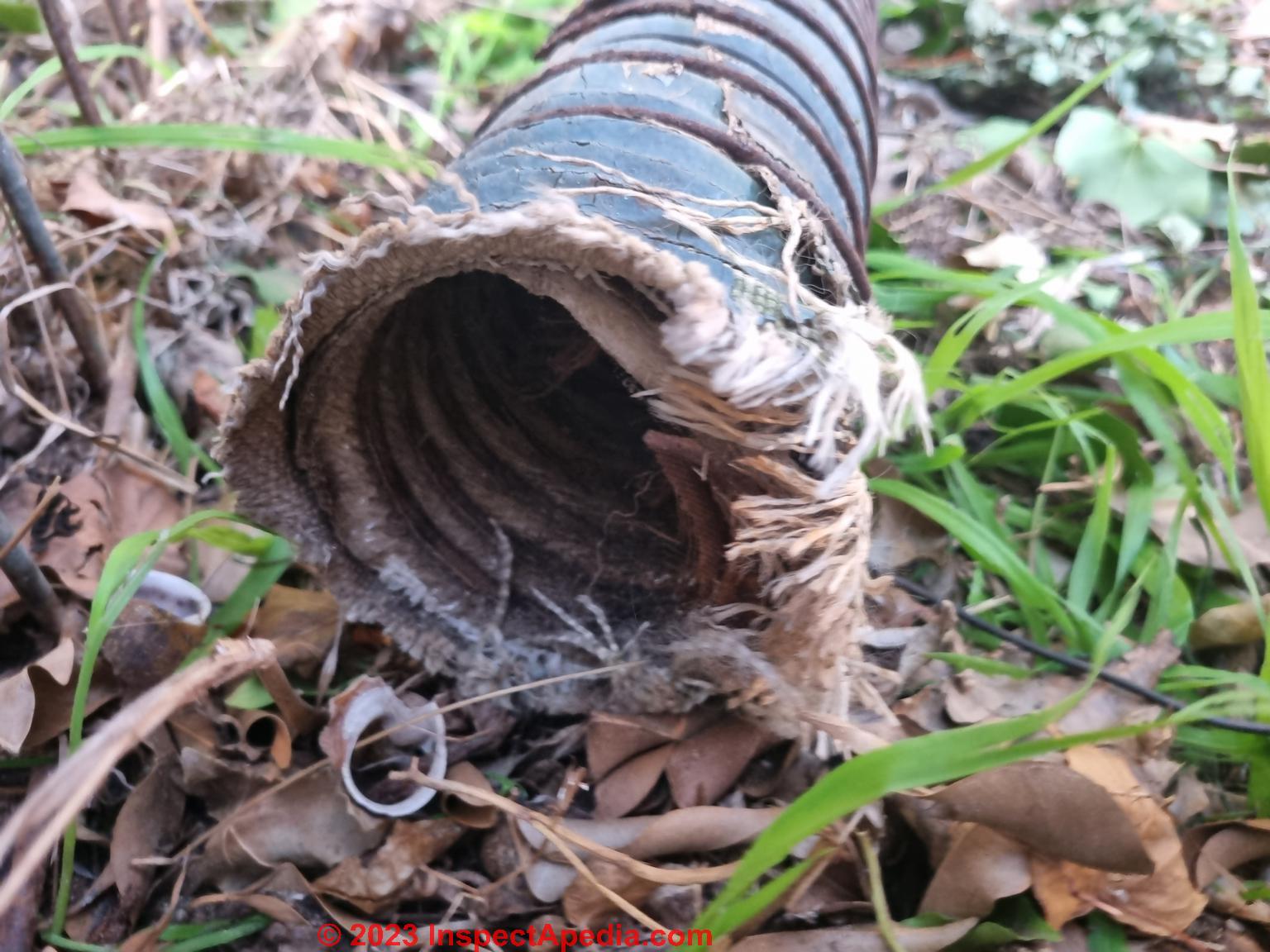
That looks like a burlap or jute (Hessian) fabric spiral-wound drain line with a water-resistant exterior coating.
On 2023-08-22 by Oz
Any thoughts on this waste found half buried in the garden please? Is it a pipe insulation? Is it fibreglass,Hessian or worse? It's a tube around 6 feet long with wire wrapped around a corrugated exterior. Thankyou
On 2023-08-04 by InspectApedia Publisher
@Jennifer,
It should be safe to simply remove the insulation kraft paper facing scraps. If you find that doing so is tearing the asbestos-suspect paper tape, stop and use a simple spray to wet the materials to ease their separation.
Don't make a dusty mess of the tape and you should be ok.
On 2023-08-04 by Jennifer
@InspectApedia Publisher,
Thanks so much! So is it safe to remove the dark brown blackish stuff? And should I just leave a paper or cloth tape alone?
On 2023-08-04 by InspectApedia Publisher - ductwork shows asbestos paper tape and fiberglass insulation
@Jennifer,
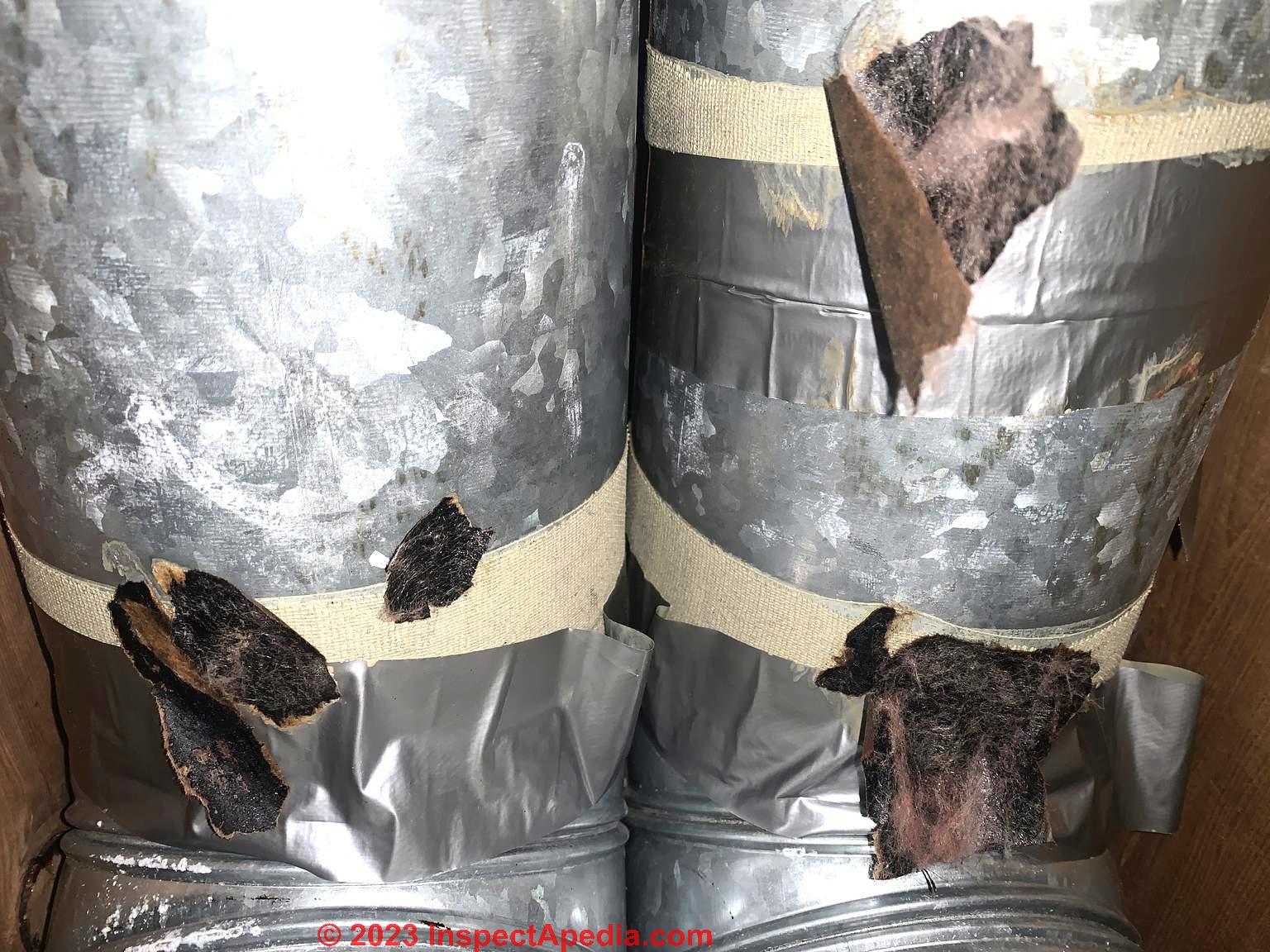
Your photo shows
1. white cloth or paper-like tape on metal ductwork that may well contain asbestos
2. scraps of pink fiberglass insulation kraft paper facing that is brownish paper on one side and asphalt-coated on the interior side (to cause the facing to stick to the fiberglass)
3. Silver conventional duct tape covering some of the asbestos-suspect duct joint tape.
On 2023-08-04 by Jennifer
Hello, I recently happened to spot this strange looking black type of paper or almost looks like sandpaper on the back side… It has, but looks like pink insulation over it. It’s in my basement.
On 2023-08-03 by InspectApedia DF (mod)
@Lynne,
Thank you.
We've worked hard on this material for decades, so are really grateful when a reader finds it useful and trustworthy.
We also welcome your photos, questions, criticism or suggestions.
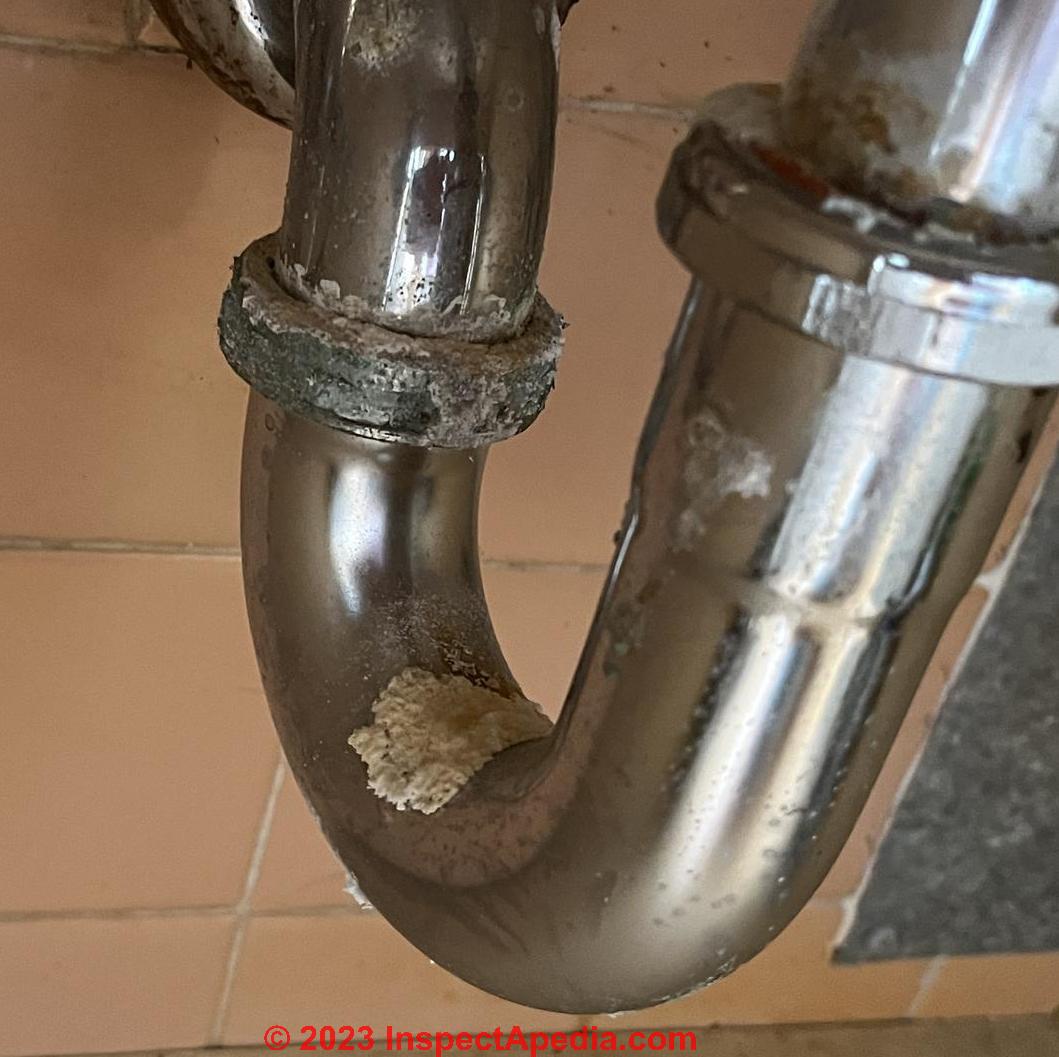
On 2023-08-01 by InspectApedia Publisher - leaky trap corrosion is not asbestos
@Lynne,
Your photo of a corroded, leaky trap under a sink shows gray-white oxidized metal salts that are deposited when the chrome-plated brass trap material is corroded by water. It is not an asbestos substance.
But your leaky sink trap parts need replacement.
On 2023-08-01 by Lynne
Hi! I've discovered this very helpful site and wonder if you can help me? I'm considering renting a place in San Francisco (it was built in 1945) and want to be sure it has no problems with asbestos or other hazards.
I took this image of the bathroom pipe under the sink (in the part visible to me casually walking through as a tenant, just inside the under-sink cabinet, not inside a wall) and wonder what the putty-like substance is.
Is it possibly asbestos or is it more likely something else? Thank you so much for any guidance you may have!
...
Continue reading at ASBESTOS in POOR CONDITION or select a topic from the closely-related articles below, or see the complete ARTICLE INDEX.
Or see ASBESTOS PIPE INSULATION FAQs - questions and answers posted originally on this page
Or see these
Recommended Articles
- ASBESTOS in GOOD CONDITION
- ASBESTOS REMOVAL, AMATEUR
- ASBESTOS on HEATING BOILERS
- ASBESTOS TESTING LAB LIST
- CEMENT ASBESTOS PIPE MANUFACTURE
- CARDBOARD CORRUGATED FIBERBOARD
- INSULATION IDENTIFICATION GUIDE - home
- PIPE INSULATION CHOICES, MATERIALS, TYPES
Suggested citation for this web page
ASBESTOS PIPE INSULATION at InspectApedia.com - online encyclopedia of building & environmental inspection, testing, diagnosis, repair, & problem prevention advice.
Or see this
INDEX to RELATED ARTICLES: ARTICLE INDEX to ASBESTOS HAZARDS
Or use the SEARCH BOX found below to Ask a Question or Search InspectApedia
Ask a Question or Search InspectApedia
Try the search box just below, or if you prefer, post a question or comment in the Comments box below and we will respond promptly.
Search the InspectApedia website
Note: appearance of your Comment below may be delayed: if your comment contains an image, photograph, web link, or text that looks to the software as if it might be a web link, your posting will appear after it has been approved by a moderator. Apologies for the delay.
Only one image can be added per comment but you can post as many comments, and therefore images, as you like.
You will not receive a notification when a response to your question has been posted.
Please bookmark this page to make it easy for you to check back for our response.
Our Comment Box is provided by Countable Web Productions countable.ca
Citations & References
In addition to any citations in the article above, a full list is available on request.
- ASBESTOS IN YOUR HOME U.S. EPA, Exposure Evaluation Division, Office of Toxic Substances, Office of Pesticides and Toxic Substances, U.S. Environmental Protection Agency, Washington,D.C. 20460
- "Handling Asbestos-Containing roofing material - an update", Carl Good, NRCA Associate Executive Director, Professional Roofing, February 1992, p. 38-43
- EPA Guidance for Controlling Asbestos-Containing Materials in buildings, NIAST, National Institute on Abatement Sciences & Technology, [republishing EPA public documents] 1985 ed., Exposure Evaluation Division, Office of Toxic Substances, Office of Pesticides and Toxic Substances, U.S. Environmental Protection Agency, Washington,D.C. 20460
- In addition to citations & references found in this article, see the research citations given at the end of the related articles found at our suggested
CONTINUE READING or RECOMMENDED ARTICLES.
- Carson, Dunlop & Associates Ltd., 120 Carlton Street Suite 407, Toronto ON M5A 4K2. Tel: (416) 964-9415 1-800-268-7070 Email: info@carsondunlop.com. Alan Carson is a past president of ASHI, the American Society of Home Inspectors.
Thanks to Alan Carson and Bob Dunlop, for permission for InspectAPedia to use text excerpts from The HOME REFERENCE BOOK - the Encyclopedia of Homes and to use illustrations from The ILLUSTRATED HOME .
Carson Dunlop Associates provides extensive home inspection education and report writing material. In gratitude we provide links to tsome Carson Dunlop Associates products and services.
 | HOME | ABOUT | ASK a QUESTION | CONTACT | CONTENT USE POLICY | DESCRIPTION | POLICIES | PRIVACY | |
| © 2024 - 1985 Publisher InspectApedia.com - Daniel Friedman | |||||||||