
InspectAPedia® FREE Encyclopedia of Building & Environmental Construction, Diagnosis, Maintenance & Repair |
Question? Just ask us! InspectAPedia
|
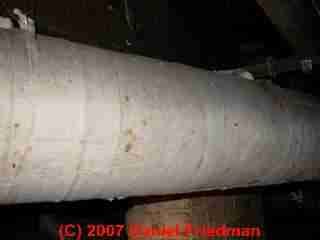 Asbestos Paper Wrap on Air Ducts
Identify asbestos duct insulation & what to do about it
- POST a QUESTION or COMMENT about how to identify asbestos paper sealant,coating, or insulation on heating ductwork
Asbestos paper HVAC duct wrap identification & handling:
As a visual aid to recognizing asbestos materials in buildings, this article describes and illustrates asbestos paper duct wrap that was usually applied to the exterior of metal heating ducts in buildings prior to 1970.
We describe the difference between asbestos paper wrap or duct seal, asbestos pipe insulation, and hardcast asbestos lagging or plaster used on boilers and pipe joints. We discuss the PACM designation for asbestos materials and we offer general advice for options in handling asbestos paper duct seal and wrap.
InspectAPedia tolerates no conflicts of interest. We have no relationship with advertisers, products, or services discussed at this website.
Asbestos Paper Duct Insulation Identification & Handling
 Definition of Asbestos Paper: a term applied to a group of building papers made wholly or principally of fibrous asbestos and used as a preventative against fire and for insulating purposes. (West 1924)
Asbestos paper was widely used in a stunning range of products, from banknotes and filter papers to wallpaper.
Here we focus on asbestos paper used as an insulating wrap on heating ducts but we will also list some of the many other uses of asbestos in paper products. The same asbestos paper was used to wrap duct registers, metal ductwork, and in many other applications, even on some electrical cables.
Asbestos paper was known as early as 1700, when ...Professor Bruckner used it for his writings, but the object of obtaining an imperishable document was defeated because, although the paper would withstand the fire, the printing would not.
The same result is recorded by Pontoppidian, Bishop of Bergen , in his Natural History of Norway published in 1750. About the middle of the last century [1850] asbestos boards were used for book covers in Italy, and shortly thereafter a vain effort was made to induce the Italian Government to manufacture asbestos banknotes. (Bowles 1937)
Bowles noted that crocidolite asbestos based paper was produced in thicknesses up to 1/4-inch. He also noted that use of short-fiber asbestos was often limited by transportation costs and limitations of manufacture into other products, but short fibers were used in manufacture of both asbestos paper and asbestos millboard and in heat-insulating cements, cold-molded products, and asbestos fillers. (Bowles p. 79)
Asbestos paper insulation used to Seal or Insulate Heating Ducts or Air Conditioning Ductwork Exterior Surfaces, Bends, Connections
This document assists building buyers, owners or inspectors who need to identify asbestos materials (or probable-asbestos) in buildings by simple visual inspection.
In this article and others of the series we provide photographs and descriptive text of asbestos insulation and other asbestos-containing products to permit identification of definite, probable, or possible asbestos materials in buildings.
While an expert lab test using polarized light microscopy may be needed to identify the specific type of asbestos fiber, or to identify the presence of asbestos in air or dust samples, many asbestos-containing building products not only are obvious and easy to recognize, but since there were not other look-alike products that were not asbestos, a visual identification of this material can be virtually a certainty in many cases.
Also see ASBESTOS DUCTS, HVAC a field identification guide to visual detection of asbestos in and on heating and cooling system ducts and flue vents.
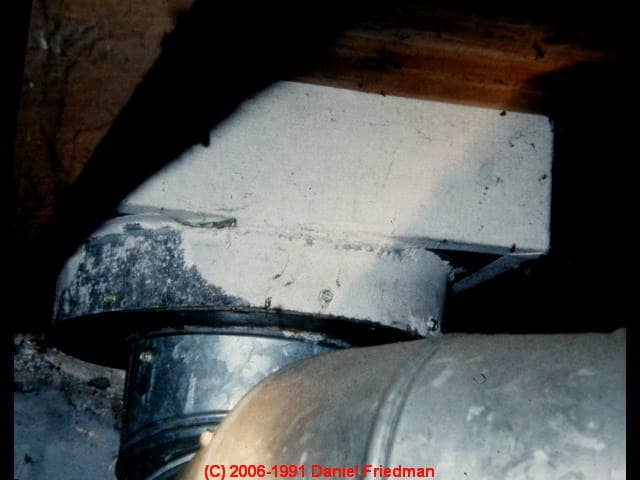
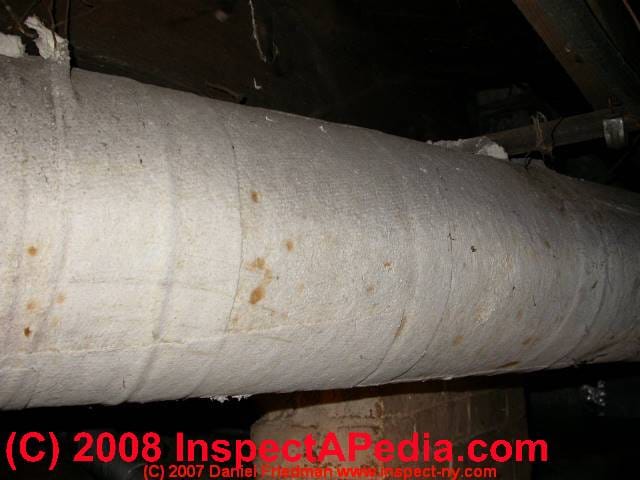
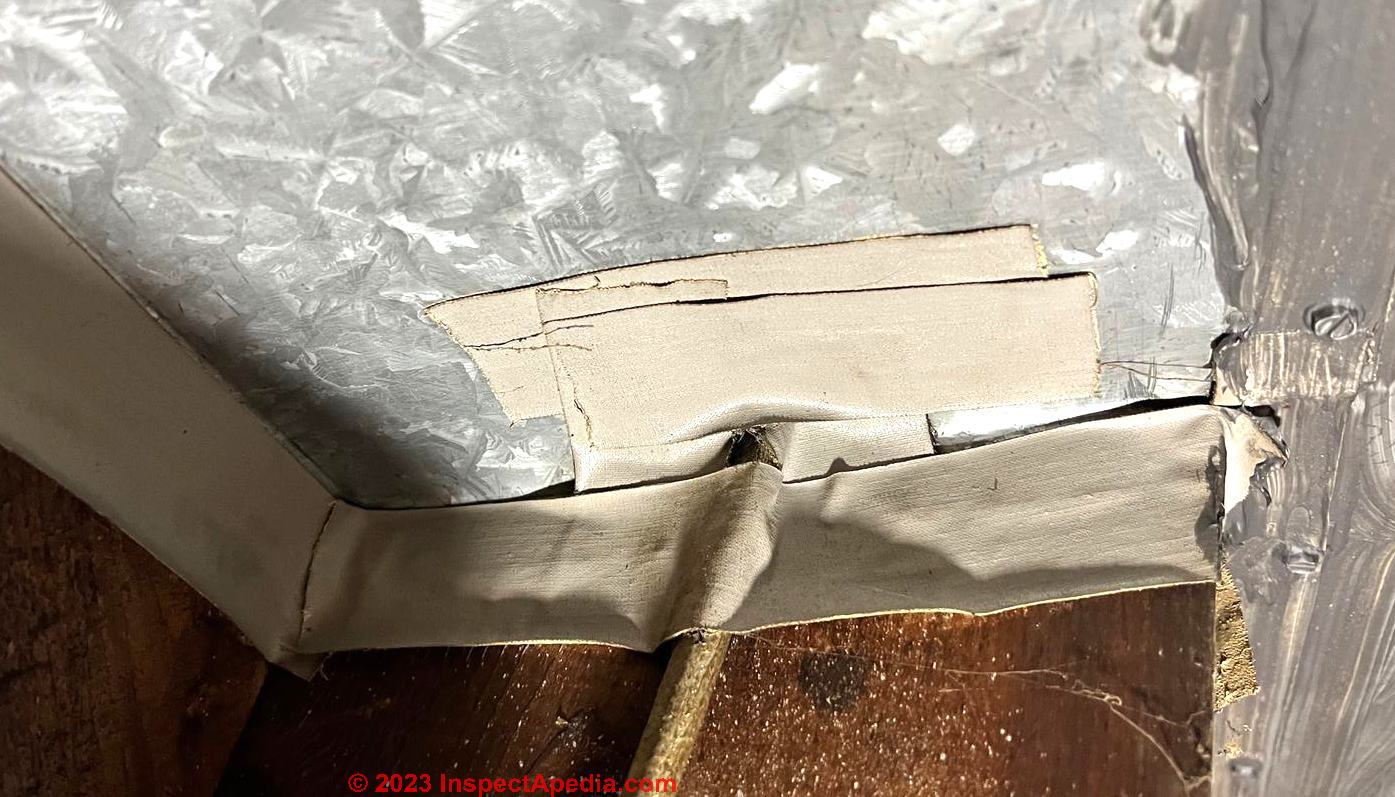
This asbestos paper-like material is on the exterior of a hot air supply duct. On homes even into the 1960's we find this material used to seal joints in metal heating ducts.
On older homes from perhaps 1920 the material was often wrapped around the entire duct exterior rather than simply at the joints.
Since the duct is normally under positive pressure, any openings in the duct would be more likely to leak hot air out than to suck asbestos fibers into the air path.
If on the other hand we found asbestos material in the air path or on a return duct it would be a more urgent repair topic.
Examples of Asbestos Suspect Material Commonly Found on Heating and Air Conditioning Systems in buildings
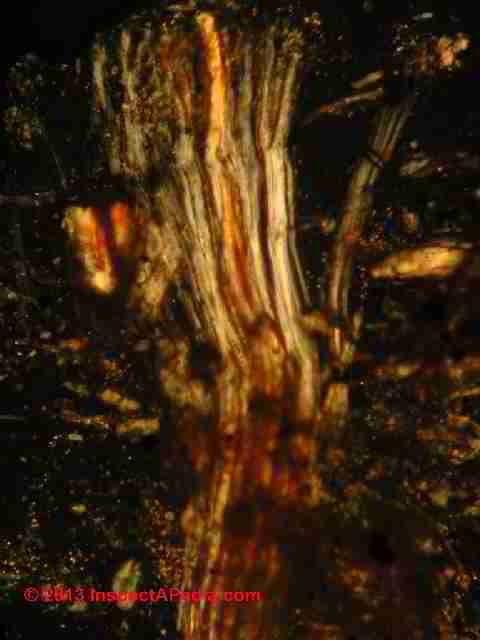 Our photo (left) shows a photograph of asbestos fibers collected from a sample of asbestos paper duct wrap, taken through our lab microscope [DF].
We often see what may be asbestos containing insulating material on the heating system, including the following:
- Asbestos duct insulation:
white "paper" wrapped on outside of some heating ducts.
See ASBESTOS PAPER DUCT INSULATION (this article as it continues below) - Asbestos electrical insulation,
including asbestos paper products, discussed
at ASBESTOS ELECTRICAL WIRE INSULATION - Asbestos insulation:
other asbestos insulation materials:
See ASBESTOS INSULATION - Asbestos pipe insulation:
white corrugated insulating material on and hanging from pipes, white paste material surrounding certain plumbing joints.
See ASBESTOS PIPE INSULATION - Asbestos vibration dampeners:
white woven material used as flexible joint between some heating ducts or between the air handler and the supply air plenum in HVAC systems.
See ASBESTOS DUCT VIBRATION DAMPERS - Cement asbestos "millboard"
used as a partial heat shield on wall/ceiling surfaces.
See CEMENT ASBESTOS SHEET PRODUCTS
Heating and Cooling Duct Asbestos Paper Wrap Risks
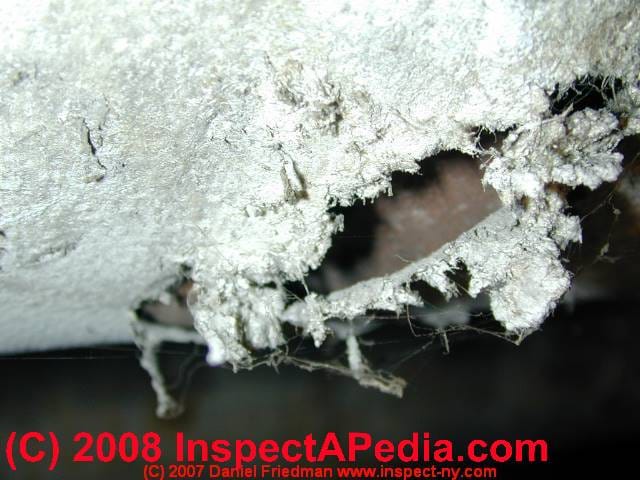
The photograph shows asbestos paper duct wrap that has been damaged and is in poor condition. Is this material a hazard? Is it releasing asbestos fragments or fibers into the heating system air ducts?
Asbestos air duct wrap was produced and installed in both paper and asbestos fabric forms.
OPINION-DF: We have not located conclusive data or studies which evaluate hazards regarding specifically the presence of asbestos paper wrap on ductwork in residential buildings.
Like other asbestos fibers in buildings from other sources, if disturbed and distributed in the living area of a building at levels above government standards, there is a potential health risk.
There is also a potential economic risk as future buyers may be concerned about this material. Disposal costs for this material are increasing.
Depending on condition and location of asbestos material, treatment ranges from doing nothing to complete removal. Removal could involve significant costs.
General advice about asbestos suspect paper wrap material on heating or cooling duct work: You should obtain proper technical information and health and safety guidelines before attempting to do anything with this material. It is the breathing of fibers when this material is disturbed, not it's mere presence, which is considered a health risk.
When the material is not found in living areas in poor condition treatment is not usually an emergency and you have time to become informed, obtain estimates, and select an appropriate course of action.
If asbestos materials are inside the duct work, such as used for lining of a stud or floor joist bay which serves as an air duct, or perhaps where used as the vibration damper material connecting an air handler to the supply plenum of a system, because of the possible release of fibers continuously and directly into the path of moving air in the building, this material should be removed.
If asbestos materials have been disturbed inside a building without proper containment and cleanup, additional evaluation of the level of asbestos particles in building may need to be evaluated as additional expert cleaning might be needed.
Advice for Handling Asbestos or Asbestos-Suspect Insulation on Boilers, Ductwork, Furnaces
Reader Question: Unknown wrap on ductwork, I think it's asbestos hardcast wrap
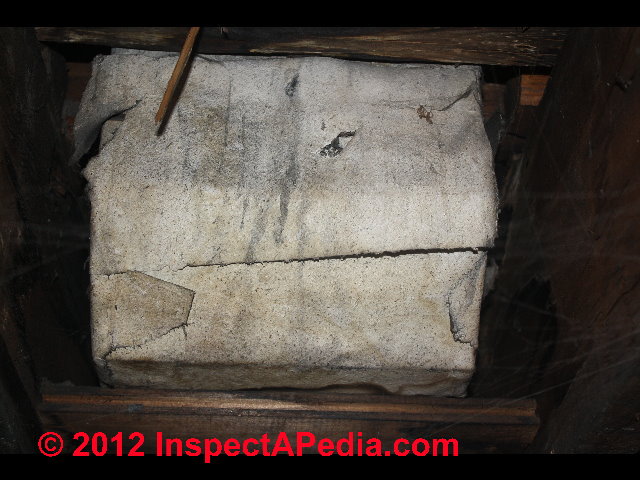
I love the forum, but didn't know how to post this image for advice. My kitchen has a drop ceiling that we had to lift to accommodate a plumber coming in to repair a leaking stack.
I discovered this ductwork covered with this unknown wrap.
I know that the only way to know for certain is to have it tested, but there was nothing in the home inspection about it - assuming the inspector wasn't lazy and didn't lift the tiles - and there was nothing in the home seller disclosure about asbestos, so my gut tells me it's probably just hardcast wrap.
I would like to defer to more experienced eyes, however for a more informed opinion... Many thanks, M.B.
Reply: Definition of Hardcast Asbestos Insulation vs. Asbestos Paper Ductwrap, Definition of PACM, Modern Substitutes

A competent onsite inspection by an expert usually finds additional clues that help accurately assess how much ductwork or other asbestos-suspect materials may be present in your home.
That said, your photo looks very much like a metal HVAC duct that has been wrapped using an asbestos paper wrap.
A few more photos of such material, information about the age of your home and its heating system design and history could increase our confidence in that conclusion, or of course you could test a small piece of the material.
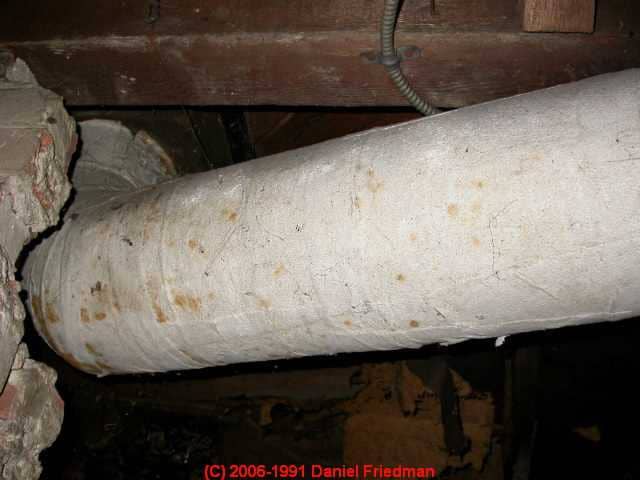
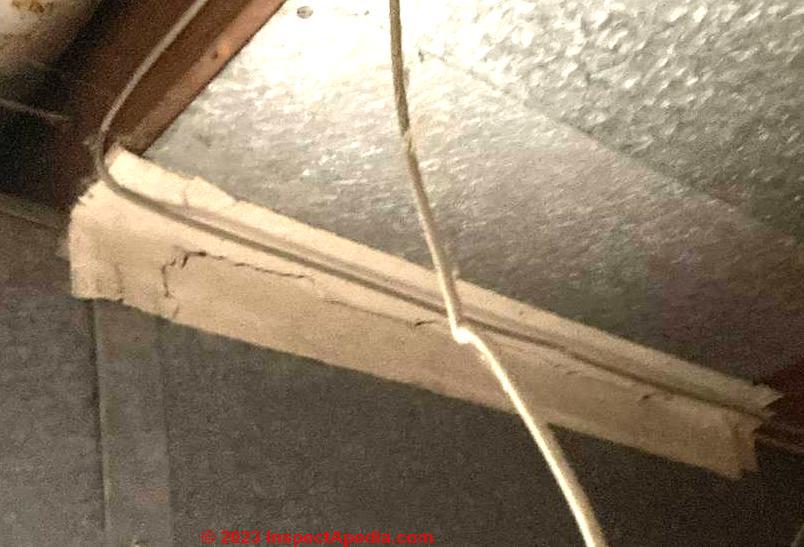
At left we include another photograph of asbestos paper used on an old metal heating duct where the duct makes a 90-degreen turn to direct warm air up through the floor and into a room that is on the other side of the gypsum board partition wall shown in our photo.
I don't use the term "hardcast" asbestos for the material in your photo - I use the term asbestos paper ductwrap or seam wrap because the material is a thin (perhaps 1/8" or less) asbestos paper product, typically applied wet or dampened to allow installation around bends and to adhere to the metal duct surface.
Asbestos Hardcast Insulation on Heating Boilers
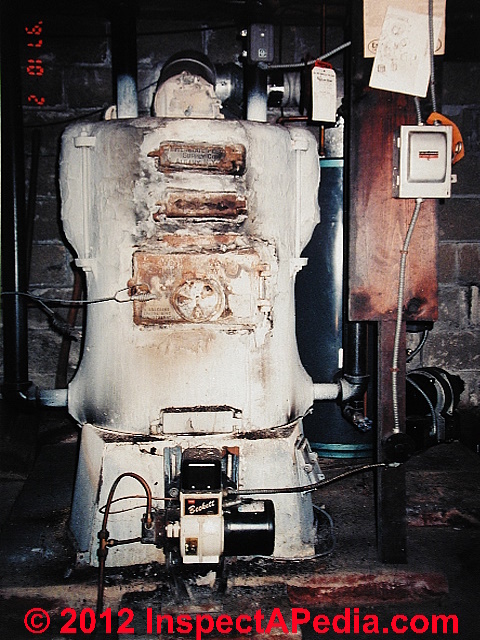 I use the term "hardcast" asbestos to refer to an asbestos paste or "plaster" that was typically applied in a layer of about 1" or greater, used to completely or partially coat old hot water or steam boilers and used on heat distribution piping at elbows or valves.
See ASBESTOS on HEATING BOILERS for details.
On heating and other piping installations a similarly thick corrugated asbestos paper wrap was used on the straight sections and sometimes on the boiler exterior and on occasion even in the interior of some warm air furnaces.
See ASBESTOS PIPE INSULATION for more images of asbestos on piping.
Hardcast asbestos, when it needs to be removed, is usually handled following a number of asbestos remediation safety procedures (area signage, isolation, dust control, protective gear, etc) and with a "glove and bag method along with wetting, cleaning the exposed metal surfaces and sealing the cleaned surface as well.
Option 1: leave asbestos paper ductwrap in place, possibly covered or spray-sealed:
Best practice is to leave the material you show alone unless other building conditions or very poor condition require its professional removal. Some asbestos contractors use an encapsulant spray or paint where the paper wrap is to be left in place.
As long as the asbestos paper is on the outside of supply ducts (ducts that are normally under neutral or positive air pressure) the chances that asbestos from the paper is entering the duct system and building air are very low. In my OPIION, should we find asbestos materials of any sort inside the duct system or air handler, that is a different (and more serious) concern.
Option 2: remove asbestos paper ductwrap, consider complete duct R&R:
If asbestos-paper wrapped duct seal/insulation does need to be removed for other reasons (building renovations, reconstruction, or materials in damaged, exposed, friable conditions), the removal is handled using asbestos remediation precautions.
But more often it is much less expensive and an easier asbestos abatement job to remove the duct entirely, intact, from the building than it would be to try to remove just the paper wrap followed by duct cleaning.
In sum, in most cases it will be easier and less costly to remove old asbestos-wrapped ducts and replace them with new ducts in the same area (if the ducts are still needed) than to try to clean and re-use the old ductwork.
Treat the Material as PACM - presumed asbestos containing material
This material is reasonably treated as "Presumed Asbestos Containing Material" or "PACM". Asbestos "hardcast" asbestos paper and paper tape were used as an air leak seal and slight insulating covering on metal heating ducts usually dating from before 1965 but may have been used up to around 1981.
Contemporary fireproof substitute products for asbestos cloth or paper used on HVAC ducts
A contemporary substitute for asbestos cloth and perhaps as a substitute for fireproof asbestos paper duct-wrap - that is if an application requires fireproof duct sealing material - and for asbestos paper tape (duct joint seal) used in high temperature operations is Silicone Hi-T, a waterproof and chemically waterproof and airtight and non-combustible (and ozone-resistant) flex-duct-connector tape available from
- Carlisle Coatings & Waterproofing, Inc., 900 Hensley Lane, Wylie TX 75098, Tel: 800-527-7092, Website: www.hardcast.com [copy on file in our records as Hardcast-Hardware-Catalog-Final-25.pdf ] Carlisle C&W, under the brand name Hardcast(R) distributes a wide range of tapes and seam sealers.
Reader Question on HVAC Duct Asbestos Paper Wrap: should I replace my air ducts?
 5/1/2014 Anonymous said:
I think I have asbestos wrapped on some of my heating ducts, on the outside of the ducts. Should I replace these ducts?
Reply: Asbestos paper wrap on supply air ducts & return air ducts
Asbestos paper on the exterior of HVAC supply ducts is unlikely to release asbestos into the circulating air inside the ductwork (since the ducts are under positive pressure), unless the ductwork has been damaged or disturbed.
That is to say that there is most likely an asbestos hazard if the material is in poor condition (torn, shredded, in an area subject to abuse) or if it is likely to be disturbed or has been disturbed.
Asbestos paper on the outside of return air ducts, since they are under negative pressure, if it is damaged, could potentially release asbestos into the duct interior if there are holes or openings nearby in the duct system.
In general, asbestos that is friable (soft, such as pipe lagging and paper) that is in a location to be damaged is just about always a potential hazard, more-so if the material is located in a space occupied by people or in the case of air ducts, if the material might be picked-up and re-distributed through the building by the HVAC system (or by other activities).
Friable vs. Non-Friable Asbestos vs Asbestos Paper Duct Wrap
Friable asbestos-containing-material is any material containing more than one percent of asbestos by weight or area that can (the material) be crumbled, pulverized, made into a powdery substance by the human hand - that is by light pressure and disturbance. If you don't think that paper air duct wrap can be friable check out my two photos just below.

Non-friable asbestos-containing material is also any material containing more than one percent of asbestos but that is hard enough that it cannot be pulverized by hand.
OPINION: Asbestos paper duct wrap is not easily pulverized, but it can be easily torn by hand - an observation that in my opinion means it can be damaged enough to release at least some asbestos particles into the air.

However it seems likely that there is a difference in hazard between the amount of material that can be released by tearing paper and the particle release from crumbing pipe lagging or asbestos pipe insulation.
What this means is that panic about asbestos paper duct wrap is not appropriate, but in the problem circumstances I describe the ductwork may merit either encapsulation or removal and replacement by a qualified professional. Any activity such as tearing, duct repairs, drilling, cutting, even disturbing during a duct cleaning operation may release asbestos fibers.
Friable and nonfriable asbestos are defined
at ASBESTOS DEFINITION & COMPOSITION
Hazardous Corrugated Asbestos Paper Duct Insulation
 This photo of corrugated asbestos paper used as heating duct insulation or possibly as a heat shield was provided to us by InspectApedia.com reader.
[Click to enlarge any image]
Question: is this something I can remove?
A home inspection of my parent's house discovered what appears to be some sort of heat shield around a few ducts near the furnace. (photo attached).
The home inspector suspected these contain asbestos.
Is this something that can be easily removed without a major undertaking? Is it safe to remove myself, with eye/nose/skin protection? - Mark 2019/02/16
Reply:
Mark
That looks to me like corrugated asbestos paper . If the pieces are intact, not frayed, falling apart, making a dusty mess, AND are readily accessible it should be possible to lift away, bag, the material for disposal as hazmat, followed by appropriate damp wiping and HEPA vacuuming.
If there's more than the couple of pieces in your photo and if it's not trivial to remove and bag the material - or depending on laws where you live - it may be necessary to get professional help.
OPINION: While it is unusual to find corrugated asbestos paper used on heating ductwork, where present, this type of paper insulation, particularly when falling and loose, is a potential asbestos exposure hazard that deserves professional attention.
Question: is this paper on my metal ductwork asbestos?
(Apr 13, 2018) Allen said:
Do you think this is asbestos?

Reply:
Well It sure looks like asbestos paper duct-wrap insulation, Allen , by color, appearance, and location.
The paper appears to be in good condition. But I'm left wondering what happened to the paper wrap, probably asbestos paper wrap, that would have been on the rest of the ductwork? Was it removed by an amateur? Is there additional cleaning needed at the home?
Can you tell us the age and location of the home?
Should You Leave Asbestos Paper Duct Wrap Alone?
 Often the asbestos hazard in buildings is much greater from disturbing material than by leaving it alone or sealing it in place. Here is what the US CPSC says about asbestos in their "Asbestos in the Home" publication
Even if asbestos is in your home, this is usually NOT a serious problem. The mere presence of asbestos in a home or a building is not hazardous.
The danger is that asbestos materials may become damaged over time. Damaged asbestos may release asbestos fibers and become a health hazard.
THE BEST THING TO DO WITH ASBESTOS MATERIAL IN GOOD CONDITION IS TO LEAVE IT ALONE!
Disturbing it may create a health hazard where none existed before. Read this before you have any asbestos material inspected, removed, or repaired. - retrieved 5/1/14, original source https://www.cpsc.gov/en/Safety-Education/Safety-Guides/Home/Asbestos-In-The-Home/
However there is nothing in that document that directly addresses HVAC air ducts and blowers where asbestos might be present in the air path.
Watch out: If there is asbestos in the air pathway of an HVAC system such as inside of HVAC ducts, inside the air handler or blower compartment, or damaged asbestos where particles may be picked up into the return air system and redistributed, I would expect experts to recommend elimination of that hazard.
Bottom line: leave asbestos alone if you can. If it's damaged, friable, being disturbed you probably need to do something about it.
Reader Question: what should we do about fragile, loose asbestos paper on our heating ducts?
18 May 2015 Anon wrote (private email)\
My husband found what seems to be asbestos wrapped ducts (running right through a joist, so they have to be removed).
Taking a look at the picture, could you tell me what you think. - A. N-J.
Reply:
Yes that looks like asbestos paper-wrapped HVAC duct as well as a not-so-nice chopped-out floor joist.
While asbestos paper that is on the outside of supply air ducts (normally under neutral or positive air pressure) and that is in good condition is not likely to put detectable asbestos into the HVAC air handling system, when the asbestos duct insulation is loose, damaged, friable, falling-off (as in your asbestos duct wrap photograph), or when the ductwork has to be disturbed for renovations or repair, it makes sense to remove the asbestos-covered ducts using the least-disturbing method that can be managed.
Typically it's least expensive to remove the ductwork entirely rather than to try to clean and salvage the old metal ducts.
A professional asbestos abatement company will most likely agree that the ductwork can be removed with minimal disturbance, thus keeping the costs of remediation down.
At ASBESTOS DUCTS, HVAC, the home page for this subject, we include advice about staying out of trouble when handling or removing asbestos or asbestos-containing HVAC ducts.
Also see ASBESTOS REMOVAL, WETTING GUIDELINES
and ASBESTOS REMOVAL CERTIFICATIONS
Watch out: depending on its age and composition, that ceiling material may also contain asbestos.
Removal vs. Encapsulation vs Replacement of Paper-Covered HVAC Ducts
With all of that general advice and with the reclama that I'm not an asbestos remediation expert, my layperson opinion is that the least hazardous way to deal with suspect ductwork is to either encapsulate the paper ductwork or replace it entirely.
For paper duct covering in good condition that does not need to be disturbed for other reasons, encapsulation (coating, painting, covering with a protective layer) is more economical and less risky than disturbing the ductwork by replacing it.
For ducts that need to be removed, say because of damage or because of other building renovation or repair work, removal is probably appropriate.
Question: how can we find out if asbestos was used to line our HVAC heating air ducts?
2018/04/29 Lee by the Sea said:
Our house is a one-story wood-frame bungalow in coastal Southern California, built in 1954. It has forced-air heating with cylindrical asbestos paper ducts. Each duct ends at an adapter that guides the hot air into the space between two studs and above a door header.
That space is closed up by lath and plaster on either side, forming a box-like space.
A hole cut in the plaster lets the air out through a louvered vent. // I was told by a heating salesman that asbestos material was probably used to line the inside of the box-like space, so it should be sealed off and not used when the asbestos paper ducts and asbestos-cement adapters are abated and replaced with modern ducting.
Is such asbestos lining actually used like that? How can that be determined? Can asbestos lining be abated? Is there any way to get air to the vents without abating such asbestos lining?
This Q&A were posted originally at ASBESTOS INSULATION
Reply:
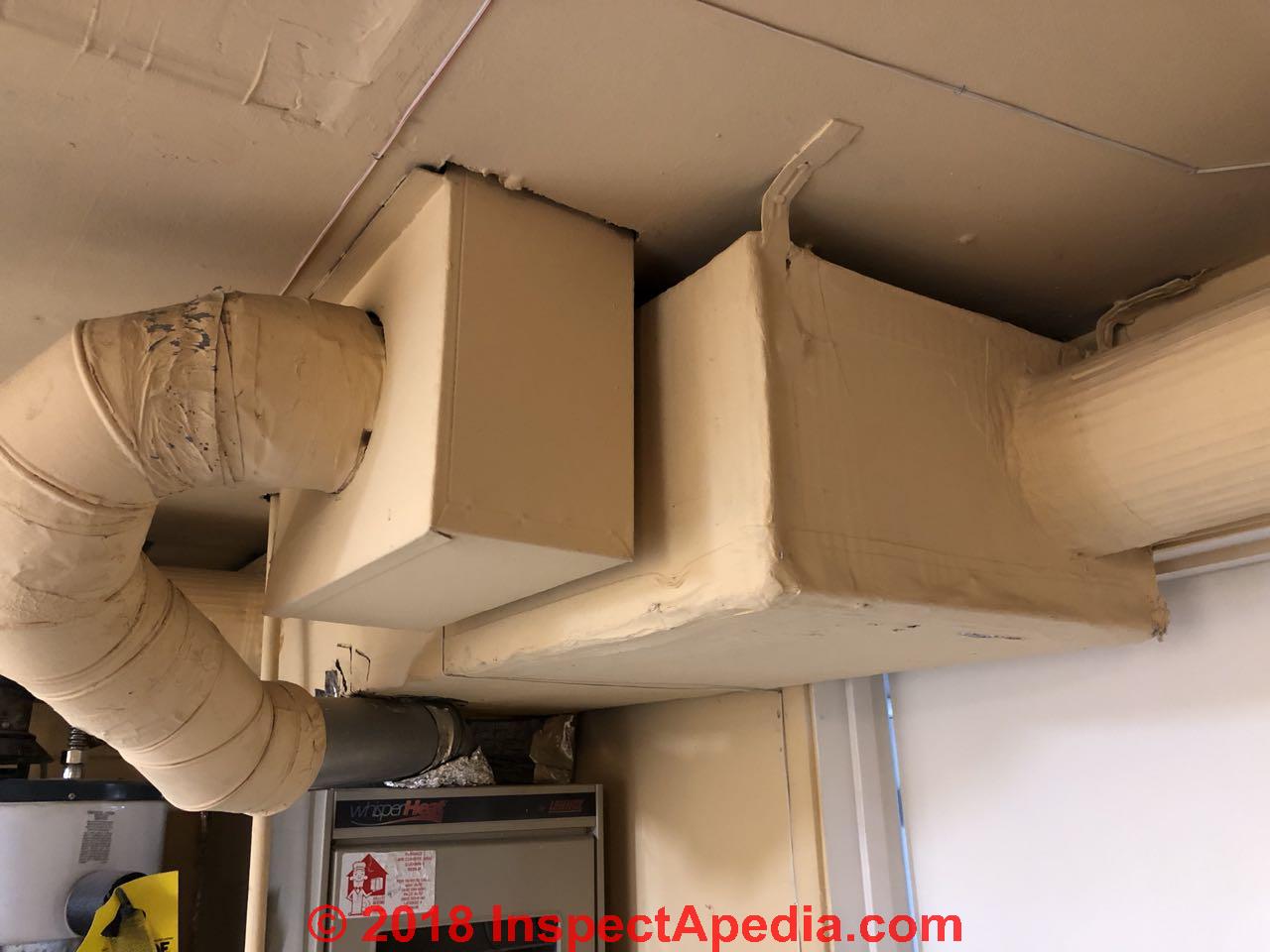 I would be stunned if your ducts were actually simply asbestos paper, though I acknowledge that I may be a bit of a stickler about wording.
More-likely they're metal duct with paper wrapping, or less likely, cement-asbestos (which would not be paper-wrapped) transite duct material.
Shown here: asbestos paper wrapping on the outside of air ducts and register boxes and a hot air heating furnace supply plenum. Photo by an inspectApedia.com reader.
[Use the "Add Image" button next to the Comment button to attach photos = one by one - to comments so we can take a look. ]
Asbestos paper was not often used on the interior of ducts nor of supply registers or supply register boxes, but it's worth taking a look-see. You'd simply remove the (usually two) screws holding the register grille in place, shine a light into the duct register box, and take some sharp photos for us to see.
At the article I recommended you'll read that asbestos paper wrap on an air SUPPLY duct EXTERIOR is of little risk if it's intact, since supply ducts are under positive pressure. You'd seal, paint, or encapsulate, or if ducts for other reasons needed to be replaced, you'd replace entire sections.
It would never make economic sense to pay to simply remove the asbestos-based paper.
On return ducts, asbestos paper over holes in the ductwork could be a (small but real) potential hazard - we'd need to know more about your system to comment.
Let's look and learn what's there before letting some fool start tearing anything apart.
Asbestos Warning: incomplete removal, amateur workmanship on the Air Conditioning or Heating System
 Watch out: for amateur asbestos "removal" jobs like the one in my duct photo at left. When I see this kind of work some troublesome questions come to mind:
- As this work was done by an amateur, what other stupid or incomplete work was done by the same person?
- Did the amateur track asbestos dust and debris through the building during this job?
- Do we need to test and perform further competent cleaning of other contaminated building areas?
Watch out: even if we decide to completely remove asbestos-insulated air ducts, the ducts must be removed by an asbestos cleanup professional using proper methods to assure that the material is disturbed as little as possible and that dust and particle release is avoided and that any additional needed cleaning is performed.
The following is an example of building or home inspection report language when the inspector detects evidence of improper, incomplete, or amateur "asbestos remediation" efforts in a building.
Amateur removal of asbestos from a building can create very serious health and cost concerns because of the possibility that the amateur cross-contaminated other building areas with asbestos debris and also because of the possibility that the asbestos products that were removed were disposed of improperly. we have on occasion found "removed" asbestos insulation simply disposed of by dumping it on the same property or stuffing it into a crawl space or attic.
Improper/Incomplete Asbestos Duct Insulation or Pipe Wrap Removal
Watch out: When we observe that a considerable amount of this insulating material has been removed leaving scraps or remainders and without cleaning and sealing of the exposed ducts or piping, we issue the following warning:
Asbestos duct or piping insulation removal has not followed approved methods and procedures: we saw that HVAC duct work or piping has not been cleaned nor sealed, and that the suspect material has been left in some places - details not found when materials were removed by trained professionals.
Unprofessional removal of controversial materials in a building may raise health, legal, or marketing concerns for future property owners. You should attempt to obtain documentation regarding who did what to the property regarding this topic.
Additional testing to assure that no hazards or legal issues remain, may involve significant expense.
Asbestos Paper Duct Wrap Hazards, History & Research
 Illustration: R.A. Shoan's 1942 patent for asbestos paper used for wrapping pipes and for covering metallic surfaces, cited in detail below.
[Click to enlarge any image]
- Abatement, Traditional Asbestos. "section 02 82 11 Traditional Asbestos Abatement." In Specifications For Bldg# 1, 5th Floor/sleep Clinic/bldg# 16 Conf., p. 259864. 2012.
- Abatement, Asbestos. "SECTION 02.82. 00 ASBESTOS ABATEMENT."
- Abatement, Asbestos. "1.1. 3 Related Work." Issued For Construction Documents Va Project No. 523a5-12-308 Date: 07/13/11 (1911).
- Andés, Louis Edgar. The Treatment of Paper for Special Purposes: A Practical Introduction to the Preparation of Paper Products for a Great Variety of Purposes... Scott, Greenwood & Son, 1907.
This book includes a description of methods used for manufacturing asbestos paper. (pp. 56-58). - "Asbestos in the Home", U.S. EPA, https://www.cpsc.gov/en/Safety- Education/Safety-Guides/Home/Asbestos-In-The-Home/
- ASBESTOS IN YOUR HOME U.S. EPA, Exposure Evaluation Division, Office of Toxic Substances, Office of Pesticides and Toxic Substances, U.S. Environmental Protection Agency, Washington,D.C. 20460
- Asbestos products and their history and use in various building materials such as asphalt and vinyl flooring includes discussion which draws on ASBESTOS, ITS INDUSTRIAL APPLICATIONS, ROSATO 1959, D.V. Rosato, engineering consultant, Newton, MA, Reinhold Publishing, 1959 Library of Congress Catalog Card No.: 59-12535 (out of print, text and images available at InspectAPedia.com).
- "Asbestos, a Guide for New Jersey Residents", State of New Jersey Department of Health & Senior Services, retrieved 5/1/14, original source: http://www.state.nj.us/health/iep/documents/asb_in_home_full.pdf
- Barman, Waldemar J. "Air conduit." U.S. Patent 2,108,159, issued February 15, 1938.
- Bowles, Oliver. ASBESTOS [PDF] (book) No. 403. US Government Printing Office, 1937.
Introduction excerpt:
The mineral asbestos, because of its unique fibrous character, is allied to cotton and wool but has the advantage of heat and fire resistance; therefore, it supplies many industrial needs for which no substitutes are yet available.
This report covers the essential features of the asbestos industry, including occurrence , production, mining, milling, utilization, international trade, and marketing. The United States leads all countries in the manufacture of asbestos products, but domestic sources furnish only a small fraction of the raw material required . As the United States is dependent to so great an extent on foreign supplies of raw materials, the bulletin deals at length with the asbestos industry in foreign lands.
Excerpts:
Other early uses of asbestos paper were for ornamental wallpaper and carpet linings. Asbestos paper is now a very important product, but its present uses as a fireproofing and heat-insulating material were not con templated by the pioneer investigators or manufacturers.
It was first made in America at Waltham , Mass., about 1878. Italian fiber was used until 1879, when the shorter grades of Canadian asbestos were tried and found to be quite satisfactory. Its principal use at that time was to protect hair -felt insulation from the heat of steam pipes.
The value of asbestos paper for heat insulation was speedily recognized and the industry grew rapidly. At present, a number of large factories make, in alị, more asbestos paper in a day than was made in an entire year 25 years ago.
The most important development of recent years is the manufac ture of pre-shrunk paper. It does not absorb moisture and, therefore, when used as a pipe covering it does not shrink under the infiuence of heat . Thus, gaps in the covering, through which heat might escape, do not appear.
PRODUCTION of ASBESTOS PAPER & MILLBOARD
Asbestos of paper-stock grade is mixed with a large amount of water to make a thin slurry, which is agitated thoroughly by 5 - foot drums covered with slats. Starch, flour, or size and sodium silicate, derived partly from the overflow squeezed out of the paper at a later stage, are added to the slurry. This is then conveyed to a paper machine similar to that used in the manufacture of paper from rags or wood pulp.
All particles of stone or other impurities are eliminated in a sand-catching and knot-removing machine. The sheets of paper pass between rollers to remove most of the water and are dried in hot cylinders and wound in rolls.
If a two-ply paper is desired, one side of a sheet is coated lightly with sodium silicate, and the two sheets are run together over several hot rolls.
Crimped paper is made by passing it over corrugated rolls. In the manu facture of air -cell pipe covering, the tips of the corrugations are coated with sodium silicate, and a flat sheet is added.
When this process is repeated , a two-ply, three -ply, or thicker ai -cell [asbestos paper] covering may be made.
[Asbestos] millboard is generally classed with paper because it is manufa tured by the same general process. It is simply a thick paper; it bears the same relation to asbestos paper that cardboard bears to wrapping paper. The board usually is built up on rectangular screens ratherthan on drums.
- EPA Guidance for Controlling Asbestos-Containing Materials in buildings, NIAST, National Institute on Abatement Sciences & Technology, [republishing EPA public documents] 1985 ed., Exposure Evaluation Division, Office of Toxic Substances, Office of Pesticides and Toxic Substances, U.S. Environmental Protection Agency, Washington,D.C. 20460
- Froehlich, Phillip A., and Bruce A. Hollett. "Evaluation of glove bag containment and asbestos abatement clearance: Methodologies for asbestos removal." Applied Occupational and Environmental Hygiene 8, no. 11 (1993): 937-944.
- Hunting, Katherine L., and Laura S. Welch. "Occupational exposure to dust and lung disease among sheet metal workers." British journal of industrial medicine 50, no. 5 (1993): 432-442.
- Jones, Robert H. ASBESTOS AND ASBESTIC: With some Account of the Recent Discovery of the Latter at Danville, in Lower Canada [PDF] RSA Journal 45 (1896): 544. Journal of the Society of Arts; London, Nov. 20, 1896,
Excerpts:
When the Canadian form of asbestos, which is technically named chrysotile, was first discovered, about a score of years ago, I had occasion to go over to Quebec to examine what, to all intents and purposes, was a new mineral, and report upon its qualifications and capabilities. I then became so impressed with its manifest importance, that I determined to make a special study of it, as well as of asbestos generally.
...
Asbestos is oneo f the most marvellous productions of inorganic nature. It is a physical paradox: a mineralogical vegetable, both fibrous and crystallie, elastic yet brittle, a floating stone, which is capable of being carded, spun, and woven as wool, flax, or silk.
Occupying the apparent position of a connecting link between the animal and vegetable kingdoms, it would appear toposess some of the characteristics of both, while being strangely different from either.
...
Under the Romans, it [asbestos] was believed to be of vegetable origin ... Herodotus tells us that his countrymen made a kind of cremation cloth of it, in which they enwrapped the bodies to be consumed on the funeral pyre, in order that the ashes and un-consumed particles be kept separate from the remains of the fuel, so as to be preserved in vases, or in the family urn.
...
A very interesting account of the mining for and use of asbestos is given in Marco Polo's "Travels in Great Tartaruy" (A.D. 1280) ... - Marc, Henri M. "Manufacture of ducts." U.S. Patent 2,434,465, issued January 13, 1948.
- Oberta, Andrew F. Asbestos Control: Surveys, Removal, and Management. Vol. 23. ASTM International, 2005.

Illustration: The 1946 patent for reinforced asbestos paper, U.S. Patent 2,401,314, issued June 4, 1946, by Quinn, cited below.
- Quinn, Robert G. MANUFACTURE OF REINFORCED ASBESTOS PAPER [PDF] U.S. Patent 2,401,314, issued June 4, 1946. [Illustrated above]
Excerpts:
This invention relates to thermal insulation, and is particularly concerned with reinforced as bestos paper laminate sheets and a method of manufacturing said sheets.
Thermal insulation sheets and tapes have been manufactured heretofore by embedding reinforc ing fibers or fabrics between outer layers of Com paratively weak asbestos fiber felts or papers. An object of the present invention is to provide a reinforced asbestos paper laminate sheet or tape having properties particularly adapting it for application as a smooth wrapping or covering for uneven surfaces such as tubular pipe insula tion.
For such purposes a sheet or tape must possess exceptionally high tensile and tear strength and have sufficient elasticity or stretch to con form closely to any curved or uneven surface to which it is applied.
A particular object is to provide a reinforced asbestos paper which exhibits stretch and flexi bility without substantial loss of tensile strength on being wetted with water, and which possesses sufficiently high internal strength or resistance to delamination to withstand application by wrapping while wet on curved or uneven surfaces, followed by shrinkage drying, without delamination or loss of fireproofing and heat resisting properties.
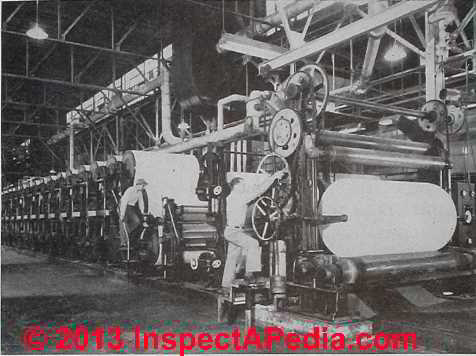
Asbestos paper production in huge rolls: Figure 5.2. (Courtesy Johns-Manville Corp.) excerpted from Rosato cited below.
- ASBESTOS, ITS INDUSTRIAL APPLICATIONS, ROSATO 1959, D.V. Rosato, engineering consultant, Newton, MA, Reinhold Publishing, 1959 Library of Congress Catalog Card No.: 59-12535 (out of print, text and images available at InspectAPedia.com).
- EPA ASBESTOS MATERIALS BAN: CLARIFICATION 1999
- Shoan, Raymond A. MATERIAL FOR WRAPPING PIPES AND FOR COVERING METALLIC SURFACES [PDF] U.S. Patent 2,291,838, issued August 4, 1942. [Illustrated at the start of these references]
Note that this patent specifically made use of asbestos paper:
Excerpts:
This invention relates to improvements in material for wrapping pipes and for covering metal lic surfaces for over and underground protection against corrosion and in the method of making such material and it consists of the matters hereinafter described and more particularly pointed out in the appended claims.
The material of the present invention is in sheet or strip form for application either by hand or by machine, to the metal surface to be protected.
The preferred form of fibrous material may be' exemplified as by kraft paper or by asbestos paper. The strips 5c5d have an elastic protective coating lid on the opposed outer surface and which may enclose the edges of all of said strips. - West, Clarence Jay. Classification and Definitions of Papers. Lockwood trade journal Company, Incorporated, 1924.
Reader Comments, Questions & Answers About The Article Above
Below you will find questions and answers previously posted on this page at its page bottom reader comment box.
Reader Q&A - also see RECOMMENDED ARTICLES & FAQs
On 2023-09-06 by InspectApedia DF (mod)
@Sree G,
Thank you.
We've worked hard on this material for decades, so are really grateful when a reader finds it useful and trustworthy.
We also welcome any additional photos, questions, criticism or suggestions. If you find something different as you work on this project, please let us know.
On 2023-09-06 by Sree G
@InspectApedia Publisher,
Thank you ! Thank you very much for replying to this so fast !
On 2023-09-06 by InspectApedia Publisher (mod) - simple inexpensive steps to seal edges of abestos-suspect paper duct insulation in floor air supply registers
@Sree G,
Thank you for your generous words about inspectApedia
About that asbestos probable or asbestos suspect material whose edges we see at the floor register, my opinion is that it's perfectly reasonable to seal that against the flow of building air using silicone sealant and or foil tape.
If I were using foil tape, which is probably quite sufficient, I would probably put a double layer.
You may find as I do that the foil tape is incredibly sticky and that as long as the surfaces are reasonably clean it'll do exactly what you want.
It seems to me you're going to want to check every air supply register and correct any of them where you have that material exposed in the air path.
At this website we talk about what we call the other people's money problem which is something to watch out for in cases like this. If you call in asbestos abatement company they might tell you that everything needs to be torn out at tremendous expense. That's giving you advice that's safer for them and of course more profitable as well.
Don't panic about this as the anxiety may be a worse health hazard than the material itself.
But do cover up that friable asbestos in the air path.
On 2023-09-06 by Sree G - can I handle this exposed asbestos by sealing?
@InspectApedia moderator - First , Thank you and your team for managing this amazing platform ! As a novice home owner , your forum by far has been of tremendous source of information for me.

Going back to the novice home owner part - Our family of 3 recently moved into a house built in the late 1950's , here in South Western Ontario .
I was completely oblivious to the dangers of asbestos before our move in and my chance running into this forum.
Fast fwd 3 months after move in , I am cleaning some of the floor vents when I notice that there seems to be cardboard-like material around the heating registers in all the rooms. There's no wrap on the ducts -- just the cardboard to presumably protect the wood from the sheet metal tubes.
It's aged -- it was obviously cut to be put into place and has minor fraying as in one of the pictures I have attached. I am worried sick that theere could be loose asbestos fibres being blown in all over the place .
Can I handle this by sealing (using silicone caulk) and taping of the vent edges (using reflective tape) to enclose the exposed asbestos edges ? (assuming I take all precautions - respirator , HVAC vaccum and wet wipe the area ). Or would this require an abatement crew ?
On 2023-08-06 by InspectApedia DF (mod)
@Nikkismirl,
After working on this material for decades, we are grateful that readers find it helpful and trustworthy. And we're glad to lessen your worry.
On 2023-08-06 by Anonymous
@InspectApedia Publisher, Thanks again so much for your time and detailed explanation. This site and your knowledge are invaluable and you are helping a worried mom who just moved into a new house she didn't know contained asbestos sleep better tonight. Thank you!!
On 2023-08-05 by InspectApedia Publisher
@Nikkismirl,
Distinguish between asbestos spray insulation and deposits from plumbing leaks:
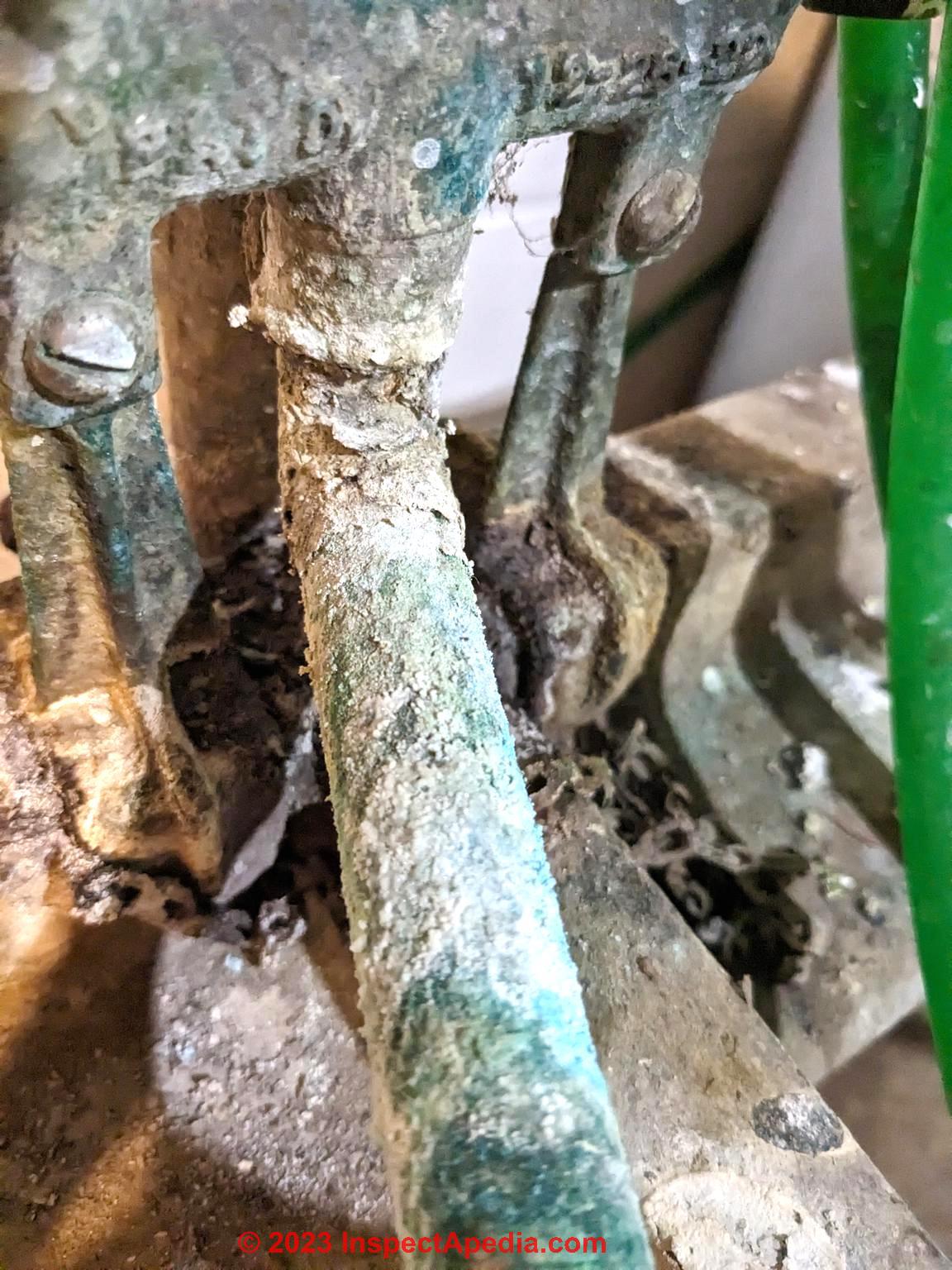
In your photo we see
Green and white salts built up from leaks and condensate on brass or bronze metal plumbing components.
On 2023-08-05 by InspectApedia Publisher - green and white mineral deposits due to plumbing leak
@Nikkismirl,
White, green, gray colored rough material on plumbing components is not asbestos spray insulation
No, that does not look like asbestos spray.
Consider that if anything had been deliberately sprayed on those surfaces you'd see the same stuff on the surrounding surfaces where in this photo, we don't.
So I doubt it's a spray of any sort.
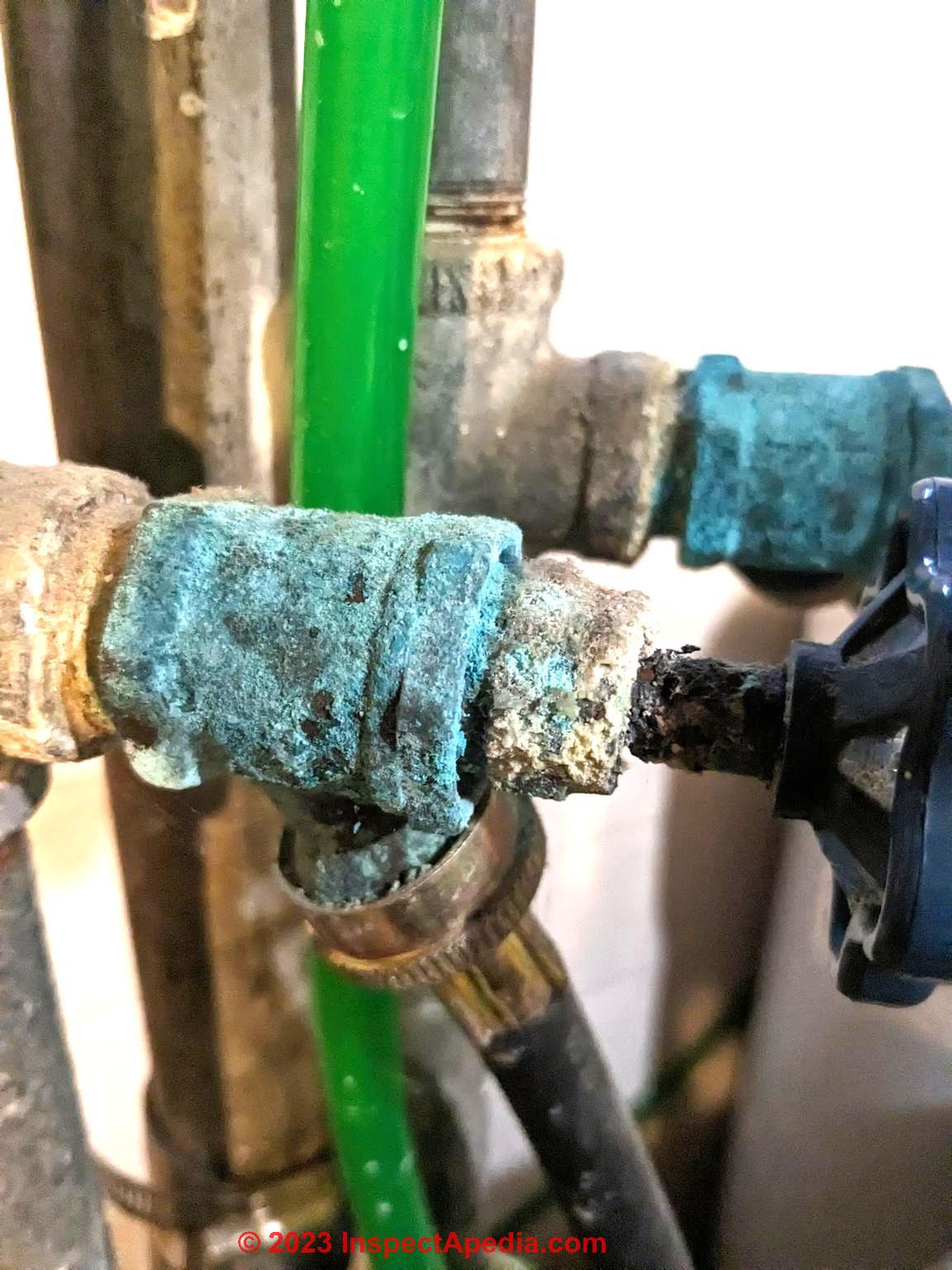
It looks like extensive mineral scale or corrosion from moisture on brass surfaces of what looks like an old shower or tub plumbing drain connection.
Take a look as well at the reddish brown exfoliating rust on that right-hand bracket near the (drain?) elbow - this area has been wet, perhaps from condensate but most-likely also from leaks.
For example I see what looks like a drip mark that has washed away a bit of debris on that flat surface at lower left of the horizontal drain pipe in your photo.
On 2023-08-05 by Nikkismirl
Does this looks like asbestos spray or coating to you? It is think and on water pipes in the utility room/laundry room of a 1938 house. It looks shimmery like mica. I will post additional pics.
 ...
... 
On 2023-08-06 by InspectApedia Publisher - need an accurate onsite diagnosis of the cause of the condensation and leaks
@Brett Allen,
No, not quite. Before starting on a fix I would want an accurate onsite diagnosis of the cause of the condensation and leaks that you are reporting.
Let's make sure that you have an on-site HVAC expert who agrees with what's needed.
For example it would be unfortunate to have an oversized air conditioning system that doesn't dehumidify and then have to buy more equipment to do with the first system should have been doing.
On 2023-08-06 by Brett Allen
@InspectApedia Publisher, so in simple terms, my best course of action is to use a dehumidifier to attempt to take some more moisture out of the air? Though it would seem like the dehumidifier would have to be in the attic in order for it to have an impact on duct condensation?
Currently the Attic has a vent but no fan, so options could be 1) add a fan or 2) seal the attic and turn the attic into a conditioned space (which would obviously raise utility bills but I’d rather have that then water dripping though the ceiling 3 months out of the year). I appreciate your thoughts, have had several different hvac personal out and have yet to get a good solution.
On 2023-08-05 by InspectApedia Publisher - If your air conditioning system is oversized then it will not dehumidify the building
@Brett Allen,
If your air conditioning system is oversized then it will not dehumidify the building and that can lead to condensation or condensate problem in duct work.
That's because it cools the building down too quickly and doesn't run long enough to remove enough humidity from the indoor air.
On 2023-08-05 by Brett Allen
@InspectApedia Publisher, Air handler is within a closet on the second floor, where it then sends the air upwards into the attic ducts and then back down. We replaced our evaporator coil and condenser in may of this year and we’re having significant condensation buildup on the plenum and unit but for the most part the duct work in the attic appeared good with no real sweating.
On 2023-08-05 by InspectApedia Publisher - investigate condensate handling problem first
@Brett Allen,
Where is the air handler supplying these A/C ducts,?
If above, look first for a condensate handling problem there, before disturbing the ductwork.
On 2023-08-05 by Brett Allen
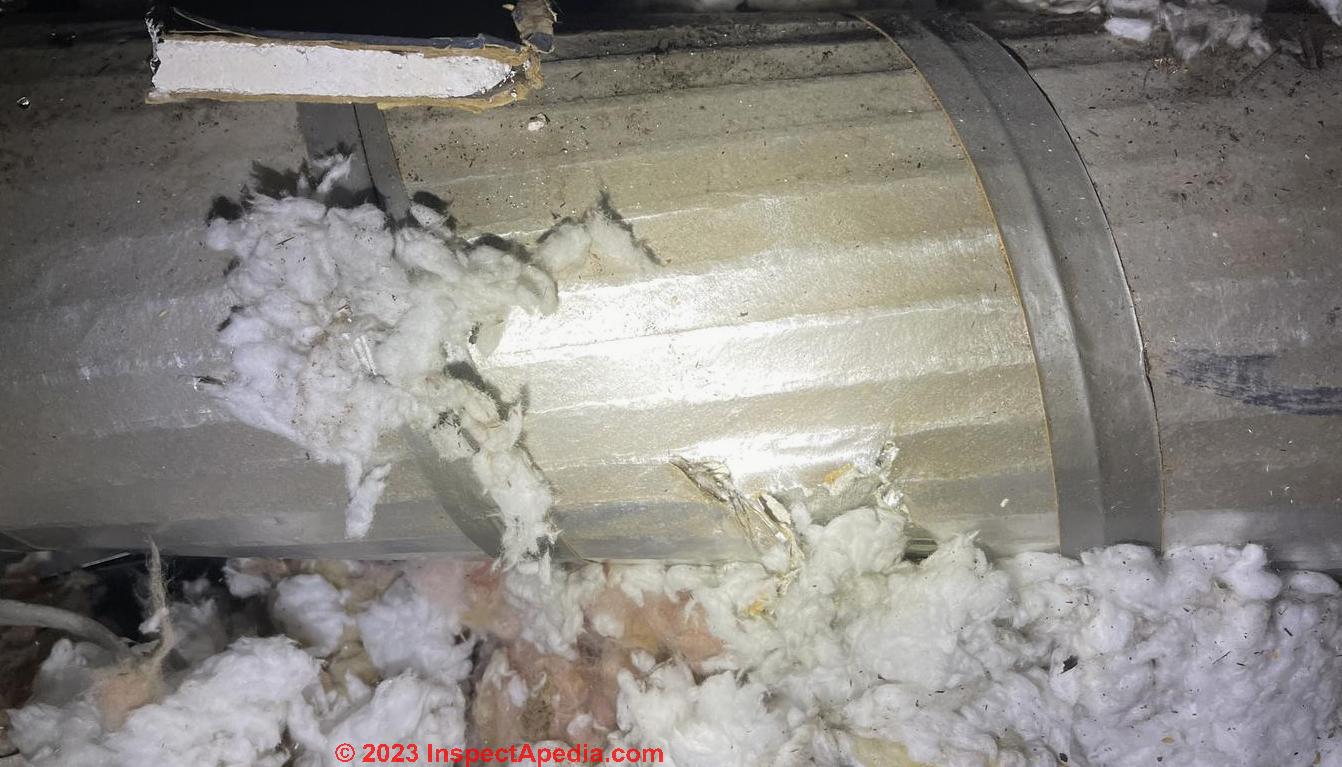
Having an ongoing issue with water dripping through the ceiling of the first floor (2 story home) built in 1971 and realized that our metal duct work that runs down through our walls from the attic appears to be wrapped with abestos insulation.
We believe our is sweating ducts due to no insulation (besides abestos), not sure the best way to handle this? Photo is where I took apart the wall to examine the ductwork and made the unfortunate discovery.
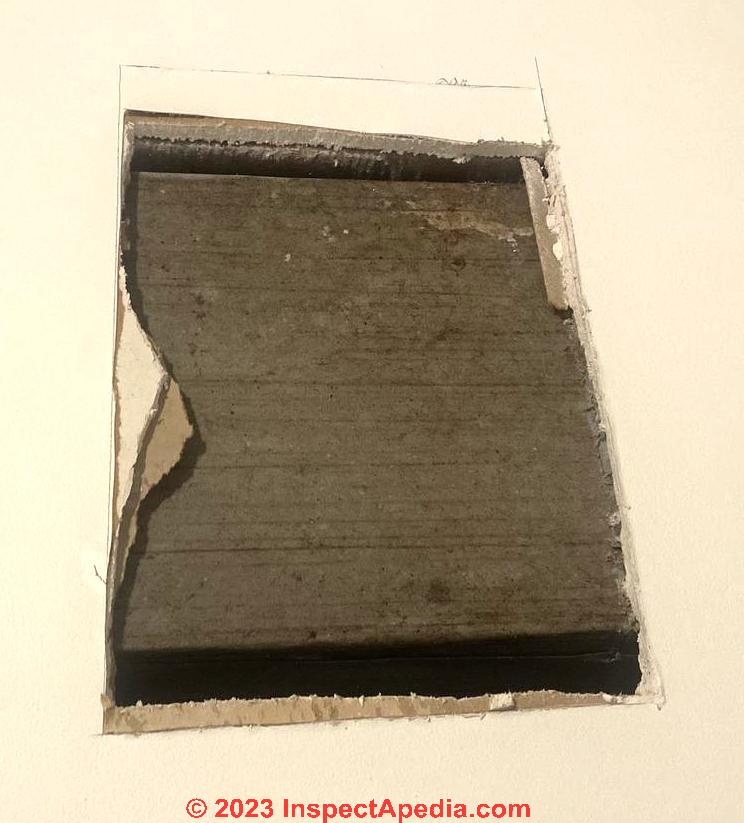
Second photo from attic facing downward
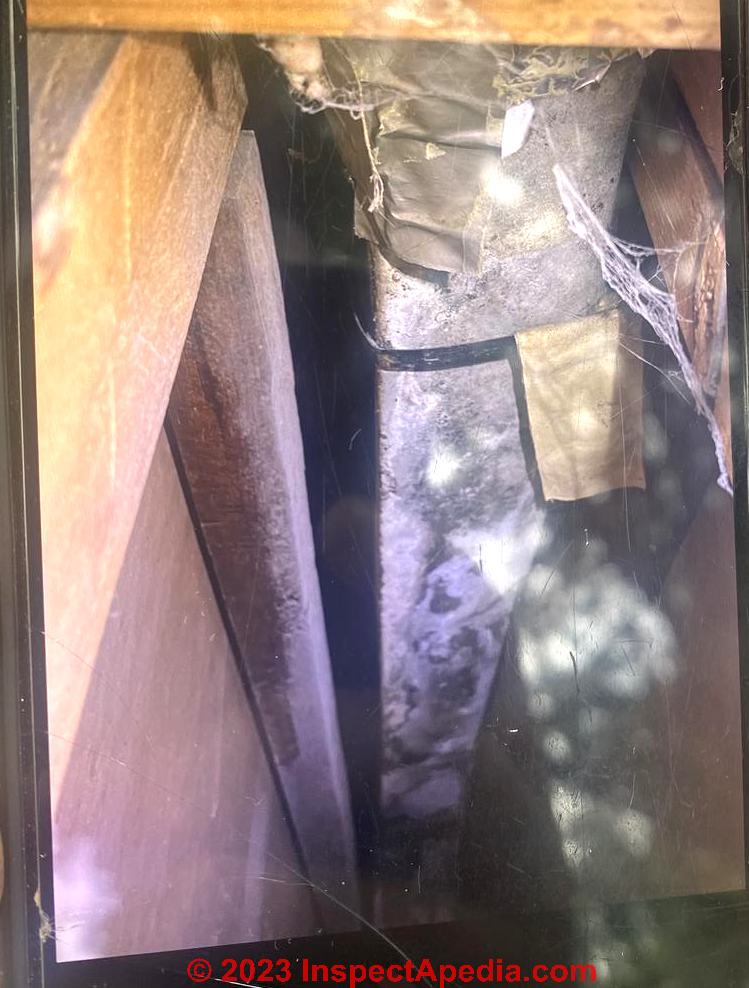
On 2023-08-03 by InspectApedia Publisher - acceptable procedures for removing asbestos or asbestos suspect materials
@Nikki Smirl,
Right, I understand that. Fortunately there are acceptable procedures for removing asbestos or asbestos suspect materials typically involving wetting to soften and minimize dust and particle release and of course if you can't remove the material without any article release then you might need to set up some area containment.
That simply means hanging plastic and perhaps creating negative air. If you have a lot of this material to remove and your contractor is an experienced, trained, or depending on where you live certified for asbestos removal then you may want to get a bid from someone who does have that certification.
Frankly for a very small job and a competent contractor I would think it's possible to follow the recommended asbestos abatement procedures without making it into a tremendous and very expensive job.
Unfortunately, depending on where you live, maybe illegal to disturb asbestos materials except by a certified asbestos abatement contractor.
On 2023-08-03 by Nikki Smirl
@InspectApedia Publisher, thank you so much for your quick reply. I so greatly appreciate this resource. Our problem is that some of the tape is on a return vent that is square and cannot be replaced without removing the tape because it is bolted in underneath the tape.
See image below. Any thoughts about what to do about this?
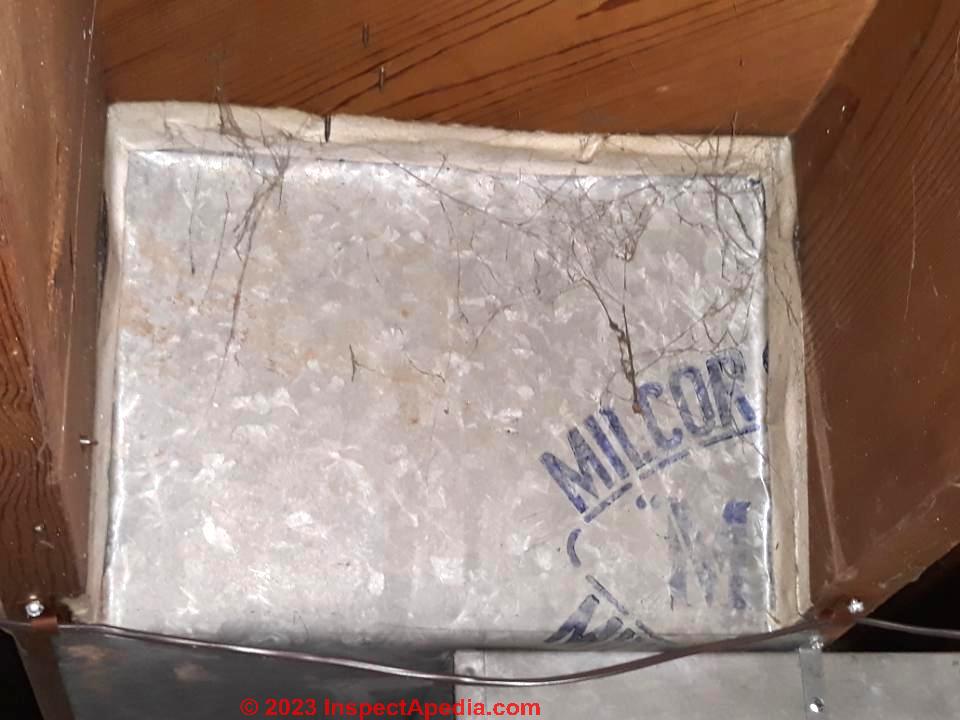
On 2023-08-03 by InspectApedia Publisher - asbestos tape on our supply ducts
@Nikkismirl,
Yes, that certainly looks like an asbestos paper tape wrapped around joints in metal ductwork.
I agree that because the return ducts are under "negative pressure" when the blower fan is running, it's possible for some asbestos fibers to be drawn into the duct system - especially if the duct joint is damaged, kinked, or bent.
In your photo no such damage is obvious but of course one's view is quite incomplete.
"Encapsulating" by using an asbestos encapsulant paint can reduce the exterior risk but would have no effect on any leaks into the return duct system at joints that might be bent or have openings as I mentioned.
If you are going to remove the ductwork and replace it - which may be less costly than an in-place asbestos removal, cleaning, and re-taping job - have the contractor remove the ducts in as large sections as can be m managed, disturbing or cutting apart joints as little as possible.
On 2023-08-02 by Nikkismirl
Hello! Thank you so much for your help, in advance. We just moved into a home and have discovered what we assume by appearance is asbestos tape on most of our supply ducts. and on a return duct. The tape on the supply ducts is on the seams.
We are planning on either encapsulating the tape on the supply ducts or removing the ducts and replacing them. We would like your opinion on the safest option for what to do with the tape on the return duct as we have learned that asbestos fibers from loose tape are much more likely to enter the air supply from a return duct with tape.
Image of the return duct with tape is attached. Is it best to have the tape completely removed and the duct resealed? I am nervous about the removal releasing fibers into the duct if the job isn't done perfectly. Thanks again!
This situation is making me so nervous! I don't want my kids to breathe in any fibers through our HVAC.
Here is an image of on of the supply ducts with tape at the seams
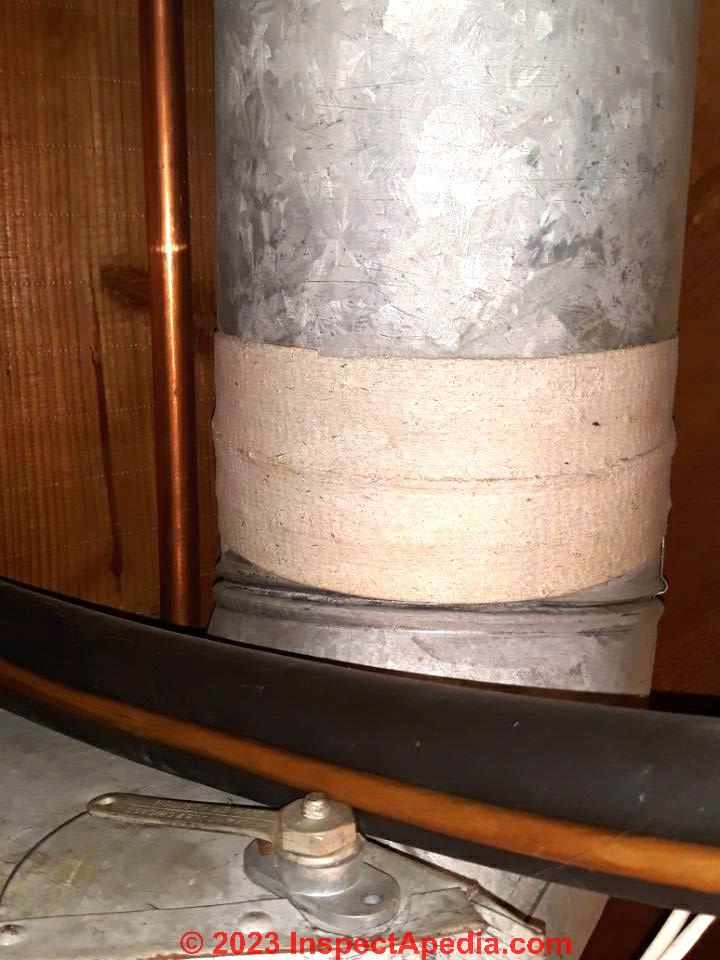
On 2023-07-25 by InspectApedia Publisher - asbestos paper covered ductwork
@Ayesha,
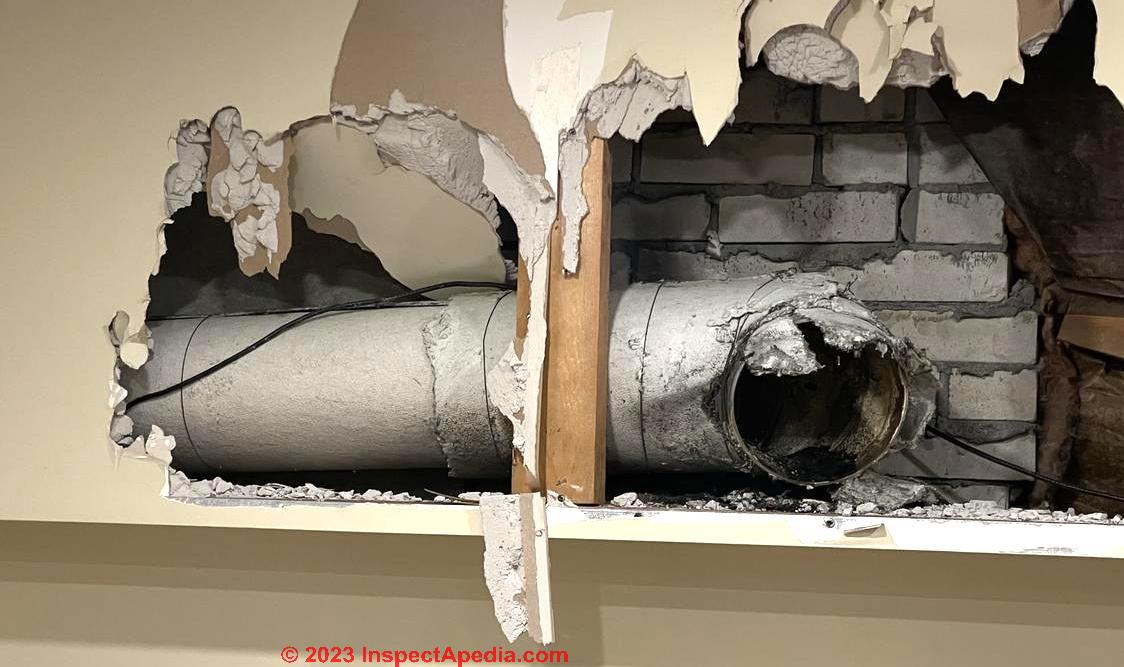
Yes, that looks like asbestos paper covered ductwork.
If you can remove it intact, it may be possible to do so with minimal hazard and cost.
On 2023-07-25 by Ayesha
Hello! Could this be be covered in asbestos flame retardant? House was built in 1965 and contractor just broke open a wall and found this sitting in the wall
On 2023-07-20 by InspectApedia Publisher
@Dunagrad,
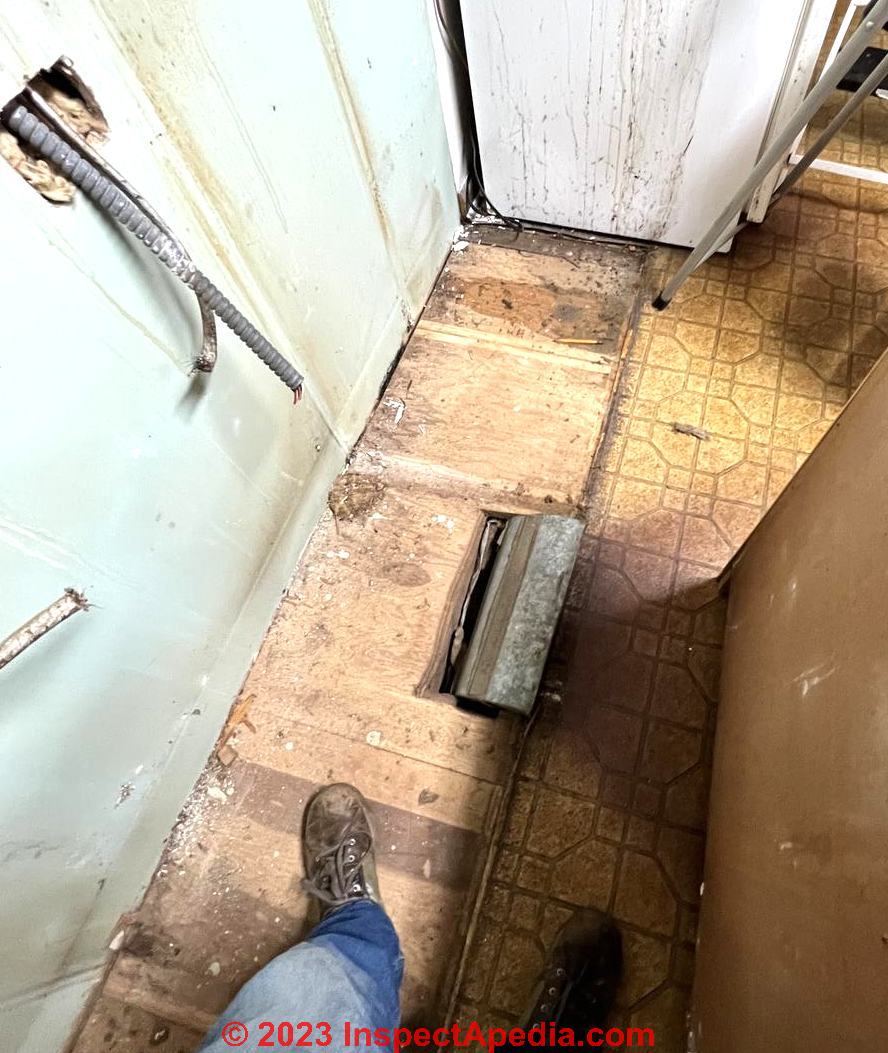
For sure in the U.S. in 1960s it could be a duct tape/seal that contained asbestos. As long as it's only on the duct exterior, safest is to simply tape over it with modern duct tape.
Yep, all looks like the same stuff we've already discussed.
On 2023-07-20 by Dunagrad
@InspectApedia Publisher, Itnis a home built in 1961 on Oak Ridge, TN. Here is a picture of the vent. It may be cloth-backed. I’ll try to get a better picture tomorrow. In the meantime, this is a shot of where it is in the kitchen.
 ...
... 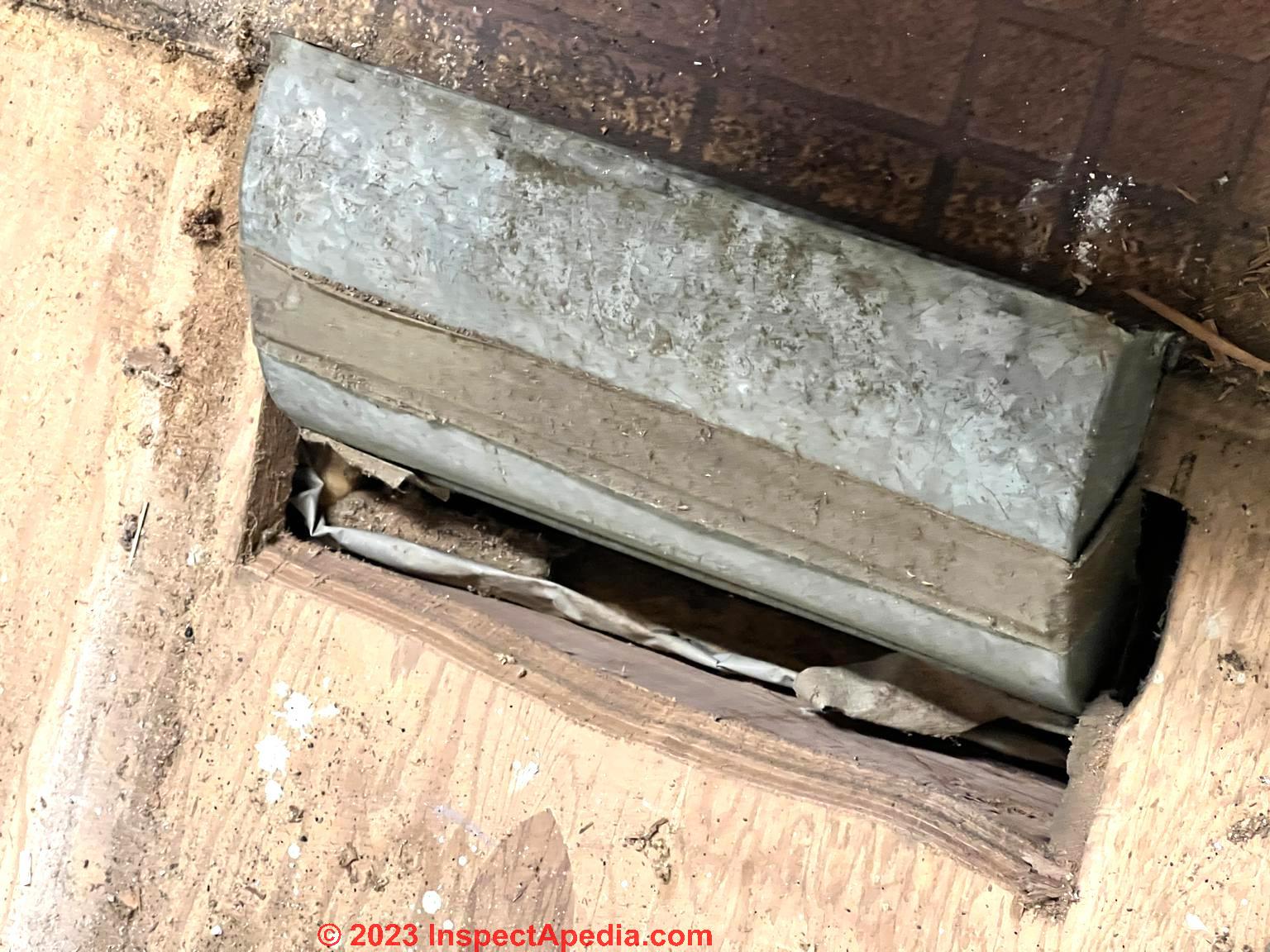
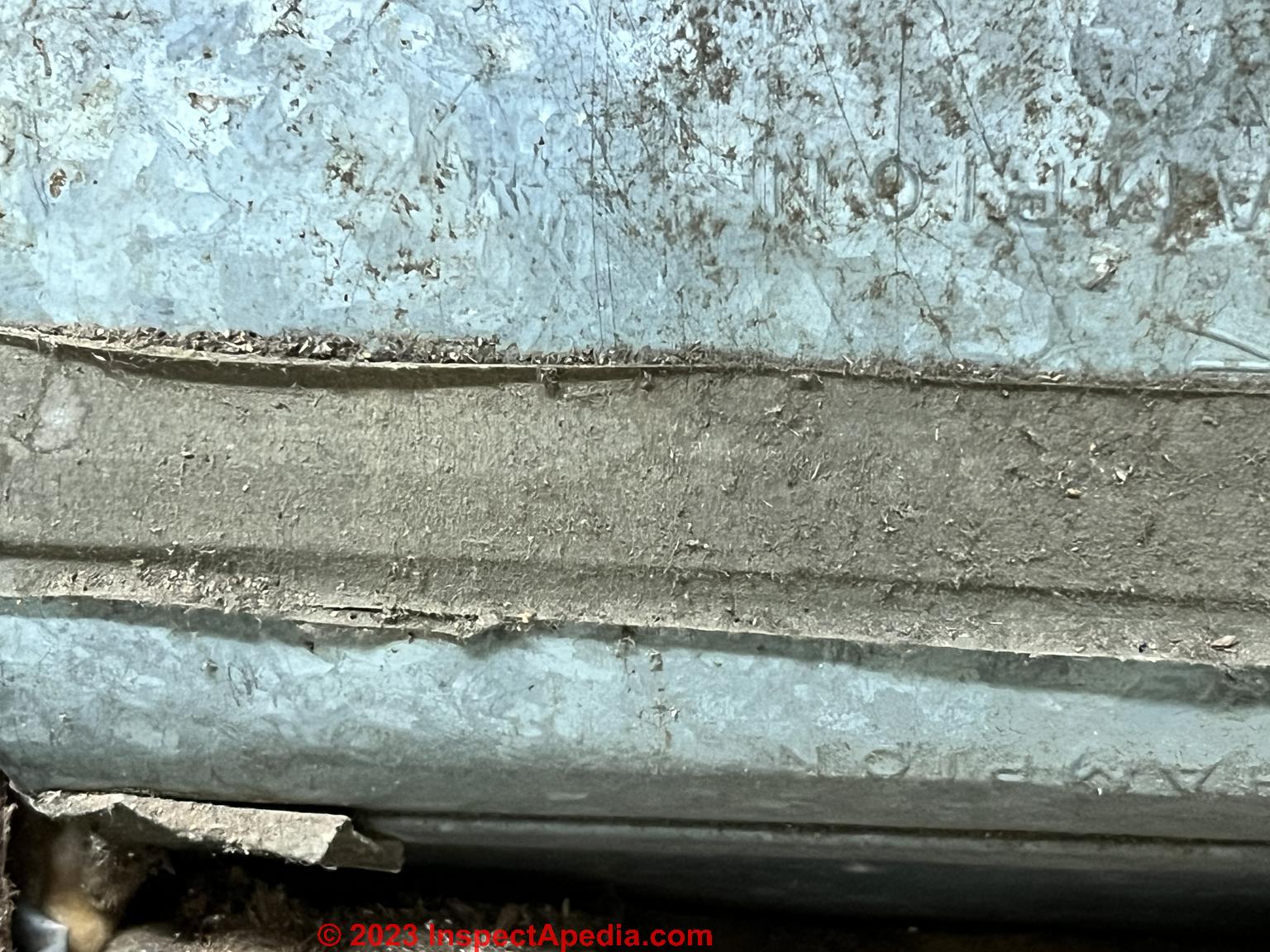
On 2023-07-20 by InspectApedia Publisher - Does this look like asbestos tape or maybe just old duct tape?
@Dunagrad,
I can't say with confidence what that tape is either.
Where is the building, what's its age, what's the age of the materials in question?
If the "tape" is adhesive-backed cloth it's not likely to be asbestos.
If it's paper, it could be asbestos.
On 2023-07-20 by Dunagrad
This air vent was fed into the cooktop cabinet I just removed and sits exactly where my new range needs to go. The insulation appears to be fiberglass. What about the tape around the duct. It has a darker grey color than what I’ve seen in most of the pictures here. Does this look like asbestos tape or maybe just old duct tape? I can try to get a closer picture if needed. Thank you.
On 2023-07-17 by InspectApedia Publisher - Fiberboard insulating sheathing used as HVAC Duct Insulation
@Natalie,
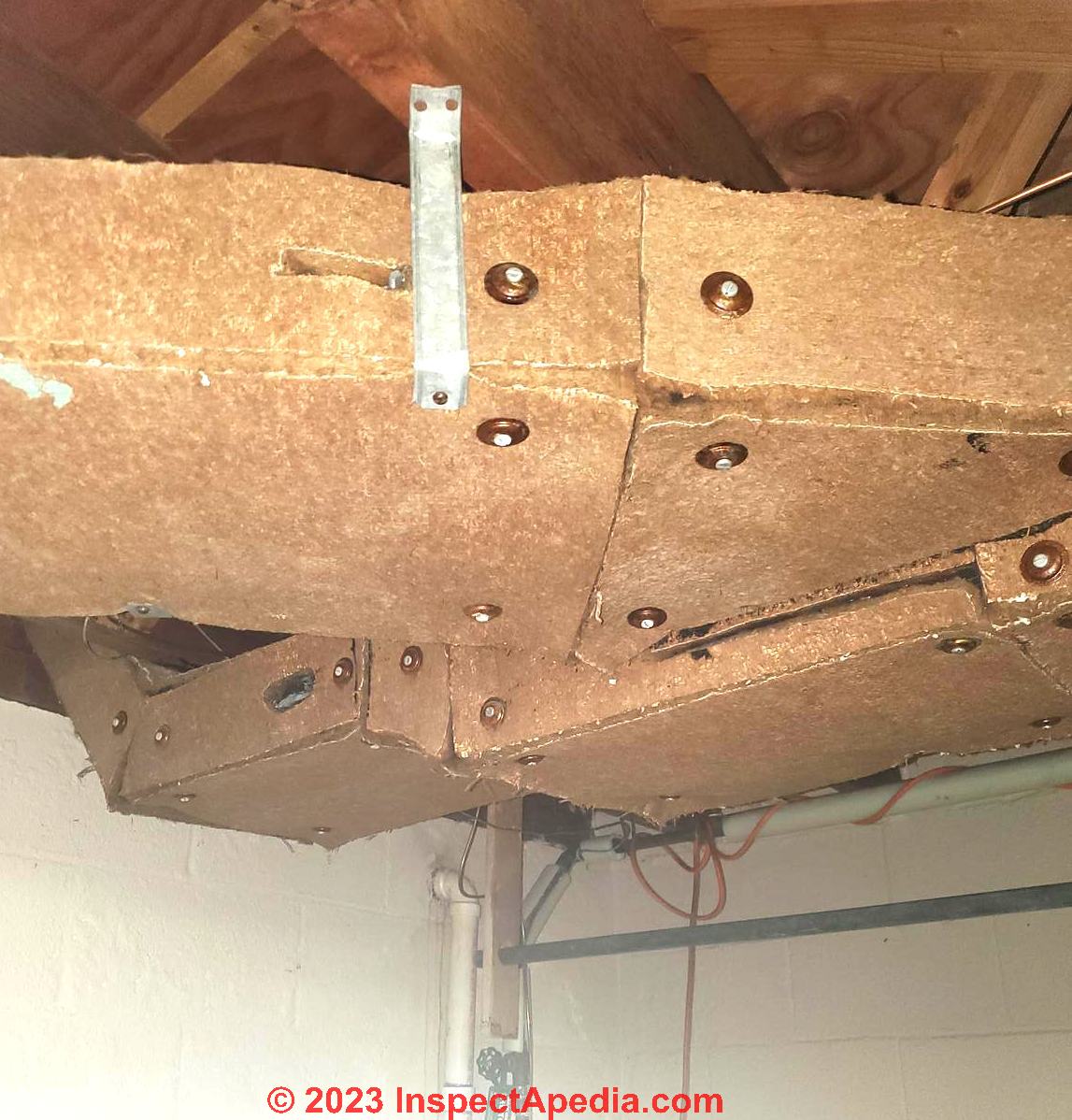
Fiberboard insulating sheathing used as HVAC Duct Insulation
That looks to me as if someone cut up some fiberboard insulating sheathing and fastened it to the duct exterior as "insulation"
Take a look at FIBERBOARD SHEATHING IDENTIFICATION
On 2023-07-17 by Natalie
Can you identify this type of ductwork bat or sheet insulation? Covers all sides of supply and return ducts, and is about 1/2 to 1" thick the outsides surface appears to be a tightly woven material and the padding more like a dense fiberglass type material. House was built in 1955.
On 2023-05-12 by InspectApedia Editor
@Dan,
What we said about the duct is that it is not familiar to us, i.e. we don't know exactly what its composition is. If you're able to post an image of the inside of the ductwork, that would be helpful.
The Comment Box software we use only allows one image per comment but you are welcome to post as many comments as you wish, and therefore images.
On 2023-05-12 by Dan
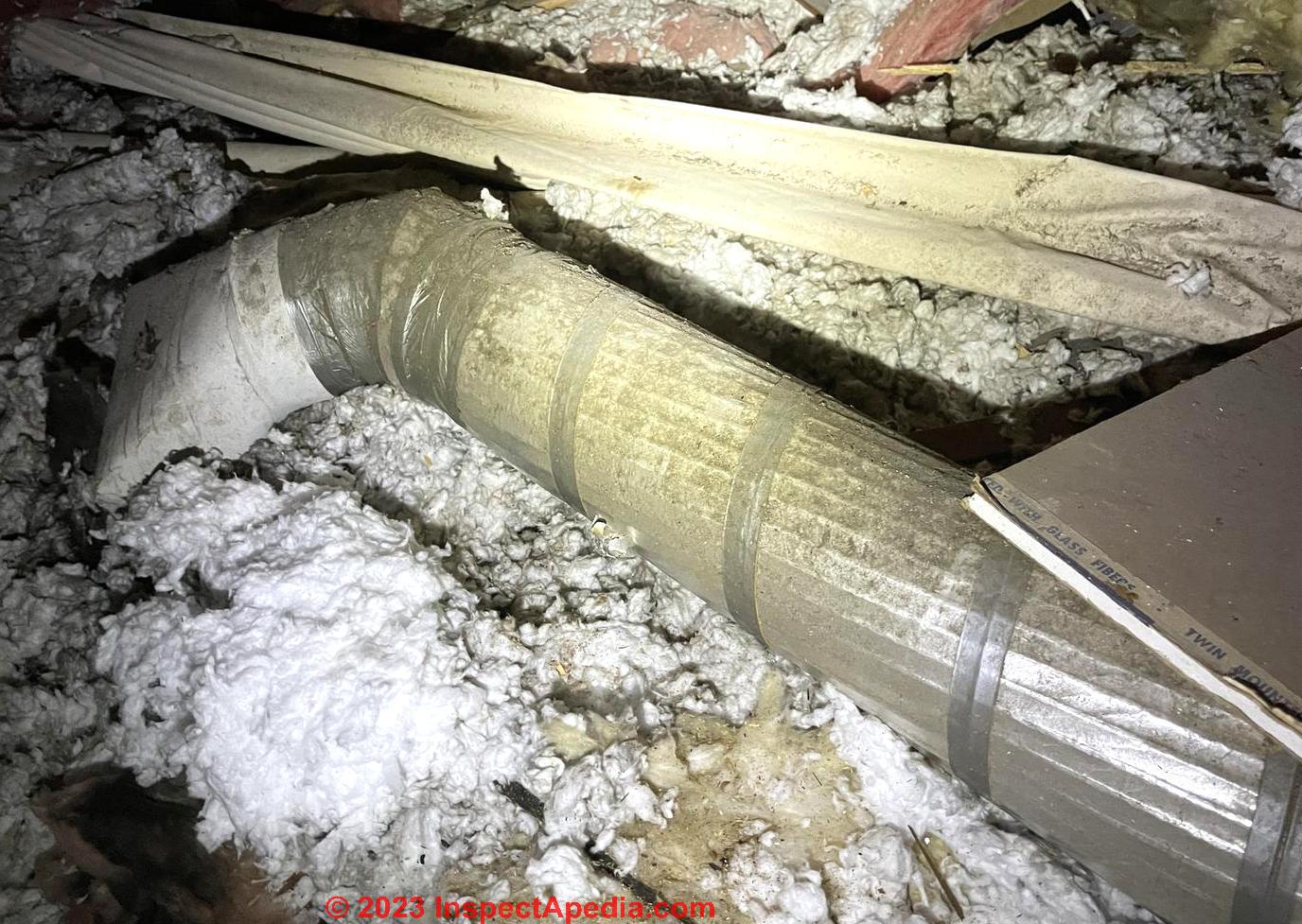
@InspectApedia Publisher, accidentally posted the same picture before, sorry about that. Sharing another picture. Unfortunately the system doesn't allow me post multiple pictures. So only the white paper wrap is asbestos based right? Not the entire duct right?
On 2023-05-05 by InspectApedia Publisher - paper wrap might be asbestos tape
@Dan,
Yes - check at least that paper wrap near the register end of the duct.
The duct elbow and sections are not familiar - with those longitudinal reinforcing wires. I don't know what materials are used there. It'd be worth a look inside that ductwork as well: if opportunity permits please post some sharper photos of the duct inside.
On 2023-05-05 by Dan
Hi, does this look like asbestos containing hvac duct? House details: built in 1964, bay area California. Thanks.
On 2023-04-21 by InspectApedia Publisher - is this decaying asbestos wrap on a HVAC duct
@Lex D,
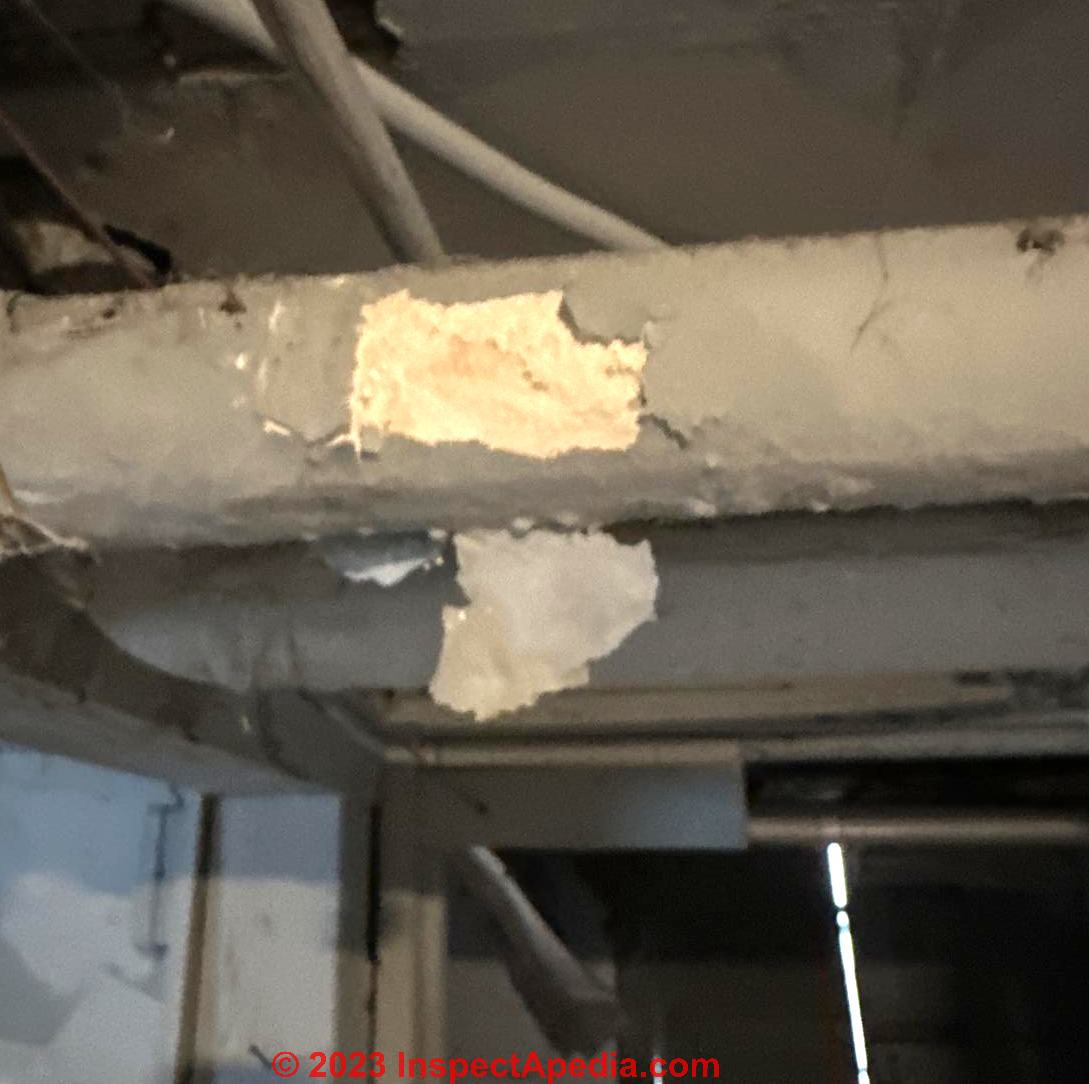
It could be asbestos pipe wrap, but no one can tell from just your photo as we can't see any of the identifying details nor do we have context such as country and city of location and building age.
But please do take a look at the end of some of that insulating material and compare that image with those shown above on this page.
There you can easily identify typical pipe insulation that Is corrugated asbestos paper.
On 2023-04-21 by Lex D
I’m curious if this is decaying asbestos wrap on a HVAC duct, and if so - what’s the best way to deal with? Can I wrap duct tape over it for now to stabilize it until I get the pipes removed?
On 2023-01-23 by InspectApedia Publisher - tape on a roll with an adhesive backer.
@Jim,
It certainly looks like a fabric tape.
It's not a common asbestos product if it is in fact as it appears, tape that came on a roll with an adhesive backer.
It's less likely but possible - but it's not a product with which we're familiar.
On 2023-01-23 by Jim
What does this look like to you, asbestos tape perhaps or no? It's old, crusty and rigid (a piece fell off and retained its original shape the same as when it was attached to the duct work). This is on a return duct joint. House is from 1941 but the duct work is not original to the home; was added at some point later.
On 2022-07-08 y InspectApedia-911 (mod)
@Lori,
That certainly looks like asbestos paper. It would be very helpful if you would provide contextual clues such as the location and age of the building where that material is installed.
On 2022-07-08 by Lori
Is this asbestos tape?
On 2022-07-04 by InspectApedia-911 (mod) - Salt Mountain Asbestos Company non-metallic air ducts
@Liz H,
That looks like a hybrid asbestos or perhaps asbestos and paper (corrugated cardboard) product used to build non-metallic air ducts. It's not a product we've seen first-hand but it's constituents are pretty obvious.
Our first try at finding the history of the Salt Mountain Asbestos Company was not successful, but we're still researching that company's name, address, history, product line and patent disclosures such as for its non-metallic duct plainly identified as using asbestos.
This detail from your photo (sharper photos are what we need) strongly suggests asbestos paper on a corrugated paper core. That might make sense in that a pure-asbestos corrugated paper (such as was used on pipe insulation) may have lacked structural strength needed for air ducts.
The substantive worry for your duct system extends considerably beyond that hole punched into it. Rather, blowing air across old asbestos-paper-lined ductwork risks blowing at least low levels of asbestos particles into building air whenever the ducts are in use.
The US EPA and other expert sources note that there is no safe level of asbestos exposure.
You probably face a costly asbestos abatement job to remove and replace that ductwork.
Sorry for the bad news. Please do post some sharper closer photos of the material and keep us posted - we may be able to offer more-helpful suggestions.

On 2022-07-01 by InspectApedia-911 (mod)
@Liz H,
It would be helpful to see more photos including sharp close-ups
On 2022-06-30 by Liz H
Have you ever seen anything like this with domestic duct work completely made of a cardboard/asbestos material? Our contractor accidentally broke into it, and now we don't know what we need to do to remedy this. Note label stuck on duct.

Adding a photo of the label.

On 2022-07-04 by InspectApedia-911 (mod) - asbestos paper on the duct exteriors
@Tim H,
Yes, that looks like asbestos paper on the duct exteriors.
On 2022-07-03 by Tim H
Discovered what I assume is asbestos in our unfinished basement. Looks like wrap at three locations on the heating ducts, mostly at the bends. Previous owners appear to have torn off large segments and driven bolts through others presumably while installing a furnace around 2010. Northern Ohio early 1950s construction.
What is the likelihood that this is asbestos wrap and what is the risk of asbestos fibers having been released in this renovation? Thank you.

A view of one of the cut portions.

...
Continue reading at ASBESTOS DUCTS, HVAC or select a topic from the closely-related articles below, or see the complete ARTICLE INDEX.
Or see ASBESTOS PAPER DUCT INSULATION FAQs - questions & answers posted originally on this page
Or see these
Recommended Articles
- ASBESTOS BOOKS & BOOKBINDING
- ASBESTOS HVAC DUCTS - Guide to Identification of Asbestos Materials On or In Heating and Cooling Duct Work: carbon monoxide hazards of transite chimneys and vents
- ASBESTOS INSULATION
- ASBESTOS TESTING LAB LIST if you need to have asbestos-suspect material tested
- ASBESTOS TEXTILES - includes asbestos cloth vibration dampeners used on duct systems
- ASBESTOS TRANSITE PIPE AIR DUCT - Hazards of Asbestos-containing Transite Pipe HVAC Ducts: duct collapse, mold, radon, asbestos fiber release
Suggested citation for this web page
ASBESTOS PAPER DUCT INSULATION at InspectApedia.com - online encyclopedia of building & environmental inspection, testing, diagnosis, repair, & problem prevention advice.
Or see this
INDEX to RELATED ARTICLES: ARTICLE INDEX to ASBESTOS HAZARDS
Or use the SEARCH BOX found below to Ask a Question or Search InspectApedia
Ask a Question or Search InspectApedia
Try the search box just below, or if you prefer, post a question or comment in the Comments box below and we will respond promptly.
Search the InspectApedia website
Note: appearance of your Comment below may be delayed: if your comment contains an image, photograph, web link, or text that looks to the software as if it might be a web link, your posting will appear after it has been approved by a moderator. Apologies for the delay.
Only one image can be added per comment but you can post as many comments, and therefore images, as you like.
You will not receive a notification when a response to your question has been posted.
Please bookmark this page to make it easy for you to check back for our response.
Our Comment Box is provided by Countable Web Productions countable.ca
Citations & References
In addition to any citations in the article above, a full list is available on request.
- 3/07: thanks to Gary Randolph, Ounce of Prevention Home Inspection, LLC Buffalo, NY, for attentive reading and editing suggestions. Mr. Randolph can be reached in Buffalo, NY, at (716) 636-3865 or email: gary@ouncehome.com
- 06/07: thanks for photographs of transite asbestos heating ducts, courtesy of Thomas Hauswirth, Managing Member of Beacon Fine Home Inspections, LLC and (in 2007) Vice President, Connecticut Association of Home Inspectors Ph. 860-526-3355 Fax 860-526-2942 beaconinspections@sbcglobal.net
- June 1997 - Window Putty - OSHA case cites contractor for asbestos exposure during removal of window putty http://www.osha.gov/pls/oshaweb/owadisp.show_document?p_table=NEWS_RELEASES&p_id=1091
- Stanton, .F., et al., National Bureau of Standards Special Publication 506: 143-151
- Pott, F., Staub-Reinhalf Luft 38, 486-490 (1978) cited by McCrone
- Asbestos Identification, Walter C.McCrone, McCrone Research Institute, Chicago, IL.1987 ISBN 0-904962-11-3. Dr. McCrone literally "wrote the book" on asbestos identification procedures which formed the basis for current work by asbestos identification laboratories.
- In addition to citations & references found in this article, see the research citations given at the end of the related articles found at our suggested
CONTINUE READING or RECOMMENDED ARTICLES.
- Carson, Dunlop & Associates Ltd., 120 Carlton Street Suite 407, Toronto ON M5A 4K2. Tel: (416) 964-9415 1-800-268-7070 Email: info@carsondunlop.com. Alan Carson is a past president of ASHI, the American Society of Home Inspectors.
Thanks to Alan Carson and Bob Dunlop, for permission for InspectAPedia to use text excerpts from The HOME REFERENCE BOOK - the Encyclopedia of Homes and to use illustrations from The ILLUSTRATED HOME .
Carson Dunlop Associates provides extensive home inspection education and report writing material. In gratitude we provide links to tsome Carson Dunlop Associates products and services.
 | HOME | ABOUT | ASK a QUESTION | CONTACT | CONTENT USE POLICY | DESCRIPTION | POLICIES | PRIVACY | |
| © 2024 - 1985 Publisher InspectApedia.com - Daniel Friedman | |||||||||