
InspectAPedia®FREE Encyclopedia of Building & Environmental Construction, Diagnosis, Maintenance & Repair |
Question? Just ask us! InspectAPedia
|
 Identify Asbestos Transite Chimneys, Flues, & Pipes in Buildings
What does transite chimney or pipe look like?
Hazards of transite chimmeys & flues
Hazards of transite piping

- POST a QUESTION or COMMENT about how to recognize asbestos or transite asbestos chimneys, HVAC ducts, flues, or pipes.
Transite asbestos chimneys, ducts, flues, pipes:
This article assists in the recognition of transite pipe used for chimneys or heating flues and discusses potential hazards of this material when it is found in buildings.
This document assists building buyers, owners or inspectors who need to identify asbestos materials (or probable-asbestos) in buildings by simple visual inspection. We provide photographs and descriptive text of asbestos insulation and other asbestos-containing products to permit identification of definite, probable, or possible asbestos materials in buildings.
InspectAPedia tolerates no conflicts of interest. We have no relationship with advertisers, products, or services discussed at this website.
- Daniel Friedman, Publisher/Editor/Author - See WHO ARE WE?
Transite Asbestos Chimneys, Ducts Pipes: Identification & Dangers
 Transite pipe is an asbestos-cement product which was used for both HVAC ducts and for chimney or flue material to vent gas-fired appliances. As we illustrate here, transite pipe chimneys, ducts, and sometimes water or even sewer piping are usually easy to identify by visual inspection alone.
Here we also describe both asbestos exposure hazards and other safety concerns where transite pipe chimneys are still in use, but keep in mind that this is not a friable material. The asbestos-containing dust hazard will come chiefly from improper demolition of transite that creates high levels of dust.
Asbestos is safe and legal to remain in homes or public buildings as long as the asbestos materials are in good condition and the asbestos can not be released into the air. - US EPA .
However, as a Category II non friable material, transite chimneys, ducts, or water pipes that would be disturbed during other building demolition work should be removed before that work begins.
Article Contents
- TRANSITE CHIMNEY & DUCT IDENTIFICATION - by visual inspection
- TRANSITE CEMENT CHIMNEY SAFETY HAZARDS, CARBON MONOXIDE - more urgent than asbestos exposure
- TRANSITE CHIMNEY & DUCT HANDLING HAZARD - asbestos exposure?
- TRANSITE CHIMNEY FIRE CLEARANCES & LABELING
- TRANSITE CHIMNEY, PIPE,& ASBESTOS CEMENT SIDING SEALANTS
If you need help understanding the meaning of "friable" material or in the classification and handling of transite chimneys as a category II non-friable material
see ASBESTOS LEFT in PLACE in BUILDINGS - MANAGEMENT GUIDES
...
Transite Chimney or Flue Pipe Identification
It's usually possible to identify transite chimneys or flues by a visual inspection. You'll recognize this cement asbestos material by its grey-white cementious surface, smooth or dimpled in a screen-like pattern, by it's relatively hard cement-like nature, by its location and application of use, and other features that we list below.
Really? Yes, though it's helpful to understand that as with some other asbestos-containing products, part of our confidence in identification comes from the knowledge that there were not other non-asbestos products that looked the same and that were used for the same purpose.
While an expert lab test using polarized light microscopy and or phase contrast microscopy may be needed to identify the specific type of asbestos fiber, or to identify the presence of asbestos in air, dust or drinking water samples, many asbestos-containing building products not only are obvious and easy to recognize, but since there were not other look-alike products that were not asbestos, a visual identification of this material can be virtually a certainty in many cases.
An example is the asbestos cement transite pipe described on this page where a combination of physical appearance and context of use and location will almost always allow a correct identification of this material.
To identify a transite pipe chimney or flue outside orinside a building, look for the features listed and illustrated just below.
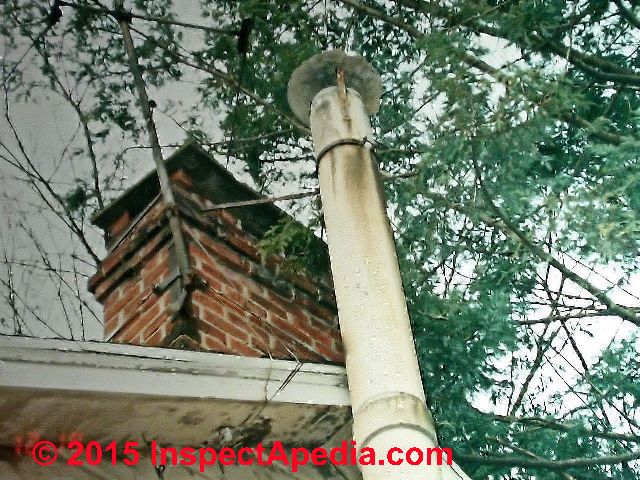
- A hard, cementious, round, non-metallic "pipe" usually 6" in diameter or more, in use as a chimney or flue, usually for gas fired equipment - often first observed outdoors and in use as a "chimney" - photo below.
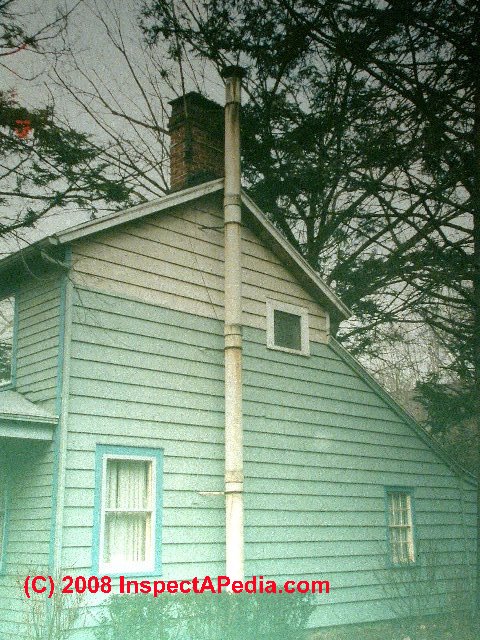
Our photo above shows a transite (asbestos cement) chimney on the exterior of an older home.
Watch out: when run outdoors like this in a cold climate, in this case in New York, this chimney may be too cold to perform safely in winter, especially if venting a gas-fired appliance.
- White or gray in color if it has not been painted
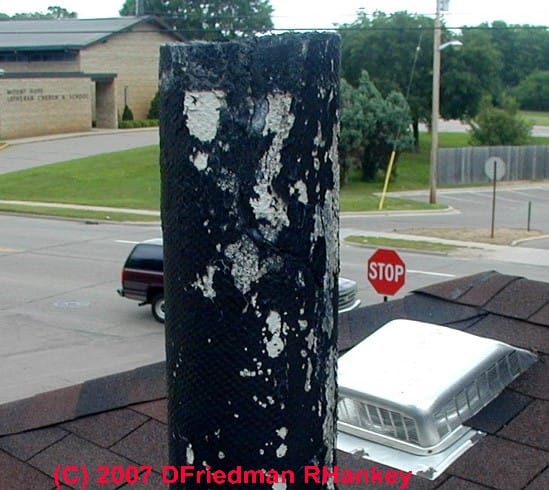
In the transite chimney vent photo above we note that the exterior has been painted black. We don't know why, possibly the naturally gray-white transite flue was painted black for cosmetic reasons, or perhaps in an effort to slow down its surface deterioration.
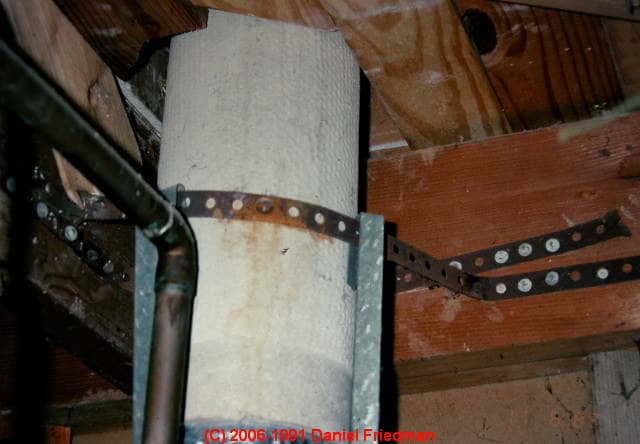
- Surface texture Often transite chimneys, ducts, or pipe have a dimpled surface (photo above) but surface may also be smooth (photo below). These photos also show the range of white to gray color of the material in its natural state.

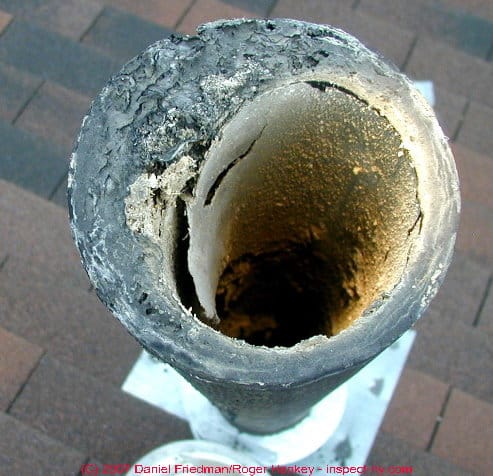
- Visible above the rootop - photo below where, courtesy of Roger Hankey, we see a transite vent looking down from the rooftop to expose its swollen and delaminated condition.
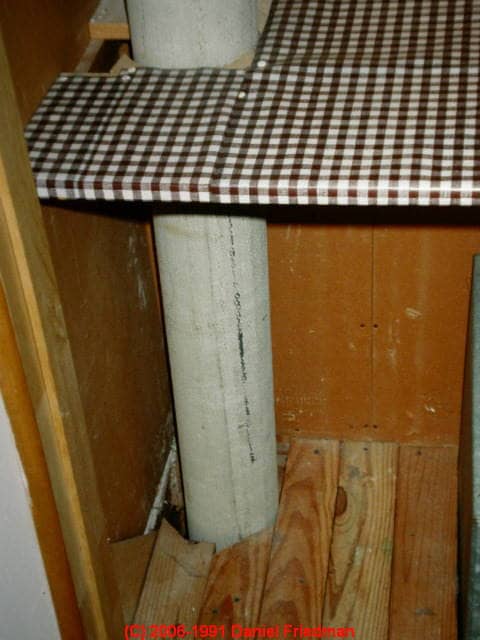
- Visible inside the building where it passes through floors such as in our photo below: a transite duct is passing through a building closet. This photo above, showing transite duct material, is provided courtesy of Thomas Hauswirth, a Connecticut home inspector.
- Visible near the heating equipment that it is venting
- By an manufacturer's identification stamp or label - as shown below for this Van-Packer Model G Type B Gas Vent Pipe.

On some transite chimneys and pipes you may also find a stamped identification label such as the Van Packer Co. transite chimney label shown here, courtesy of InspectApedia reader B.B.
Watch out: Some transite pipe chimneys still in use may be unsafe if the chimney or flue pipe has deteriorated such that the flue may become blocked or may leak flue gases into the building. Our photo above shows an example of this condition.
That is a much more immediate hazard than possible asbestos exposure. Unsafe transite pipe heating flue vents may only be noticed by a careful building inspection such as shown in these rooftop photographs of a transite flue vent pipe which deteriorated, became swollen, and risk becoming blocked.
In cold climates with these vents from the 1950's era, the real hazard is not so much asbestos fibers as the dangerous obstruction of the vent/flue by the deterioration of the interior of the pipe and the risk of an unsafe chimney or flue, including the risk of fatal carbon monoxide poisoning if the flue becomes blocked or fails to draw.
Incorrect spellings of transite piping or transite duct material that we've seen include transit pipe, transit ducts, Transide pipe, transide ducts, tranisite pipe, and transight pipe. "Transite" is the correct spelling.
...
Safety Hazards of Transite Asbestos Cement Chimneys
Here we describe transite (asbestos cement) chimney and flue safety hazards other than potential asbestos exposure.
Where transite pipe (asbestos-cement pipe) has been used as a building chimney to vent combustion gases, if the chimney becomes blocked there could be a dangerous carbon monoxide hazard in the building.
The transite pipe chimney - carbon monoxide hazard occurs when the (usually above-roof outdoor portion) of a transite pipe chimney becomes soft with age and exposure to weather, leading to swollen chimney sides and even chimney internal collapse.
Acidic flue-gas-condensate combined with the effects of frost in cold climates causes a delamination and swelling and blockage of the transite pipe chimney-flue.
A blocked or constricted flue vent pipe can cause production of dangerous or even fatal carbon monoxide gas in the building.
Also, the swollen and collapsing transite pipe chimney may block the adequate venting of exhaust gases from the building heating equipment.
Blocking the venting of exhaust gases, in this case for natural gas or LP gas fired heating appliances, is very likely to interfere with proper combustion at the appliance itself. In turn, this condition results in the production of carbon monoxide at high levels.
- Ultimately transite pipe cement asbestos chimney vent flue that becomes blocked creates a multiple safety hazard:
- Increased production of carbon monoxide at the heating appliance
- Failure to vent combustion gases fully outside the building
- Leakage of carbon monoxide gases into the building
See CHIMNEY INSPECTION DIAGNOSIS REPAIR and
see CARBON MONOXIDE for more information.
In our photo below we see the outdoor base of the transite chimney shown at the top of this page. Concerns that one can see here include:
Soot marks showing that the chimney was leaking flue gases, risking inadequate draft and also water leaks that may follow the chimney interior into the heating appliance, damaging that system.
Watch out: because we know that transite chimneys were intended for use only with gas fired heating equipment, when we see black soot like that in our photo we know that gas fired heating equipment was producing sooty exhaust. In turn this indicated improper and unsafe gas heater operation that risks production and leakage of fatal carbon monoxide gas.
If you find a sooty gas flue like this the building occupants need to be warned of a serious carbon monoxide hazard risk and the equpment should be shut down unless or until it has been inspected and repaired by a qualifed heating technician.
Other hazards are also in this particular transite chimney photo.
The location of this chimney elbow and wall thimble at and perhaps below ground surface mean that there is risk of rain, surface runoff or water from snow melt entering the building or damaging the heating appliance are increased. In turn that can cause expensive damage to the heating equipment or might even make that equipmentb unsafe.
Transite-asbestos piping used as plumbing vents or as chimneys for gas-fired appliances such as gas furnaces becomes swollen and deteriorated due to condensation of the water vapor in the combustion gases being vented, especially above the roof line or in a cold attic.
While the transite pipe shown above was in use as an exhaust flue (what is the fire rating and fire clearance required?), this material was also used in some buildings for both exposed air ducts and for in-slab duct work for heating and air conditioning systems, as shown in the photos below.
See also SLAB DUCTWORK
Transite pipe, which contains significant percentage of asbestos fibers, was often used for heating ducts and on occasion heating and cooling ducts in older buildings.
The transite pipe was used in a buried-in-slab construction methods which placed the transite piping below or in a building floor slab, and asbestos-containing transite pipe ducts were also used in exposed areas such as shown in the crawl space photographs above.
At CHIMNEY INSPECTION DIAGNOSIS REPAIR we describe chimney inspections in detail.
Our separate description of potential asbestos exposure hazards from transite chimneys is found at
TRANSITE CHIMNEY & DUCT HANDLING HAZARD - asbestos exposure?
...
Health Hazards from Handling or Touching Transite Pipe or Asbestos Cement Piping
Asbestos hazards of transite duct or chimney piping: Cementious duct material may contain asbestos. What is this "cement"
duct work made of? Cement and asbestos fibers.
How much asbestos is in Transite pipe? While it's cementious, transite ducts or even transite pipe used
for heating flue vents is a potential asbestos hazard in buildings.
Transite pipe typically contains about
15% to 25% asbestos fibers, typically fibrous chrysotile asbestos.
A careful asbestos testing lab may report both fibrous and fragmented
asbestos which can occur in still smaller pieces (thus more easily remaining airborne and increasing human exposure to asbestos).
The balance will be cement and possibly other fibers or binders.
Where are the chief health risks with cementious asbestos materials?
Transite pipe, whether it has been used as an air duct, flue vent, chimney, or water pipe, is still a cementious material that is unlikely to release high levels of airborne fibers when it is in good condition.
Touching transite pipe, or simply removing and disposing of an intact section of this material from a building by carrying it outside should not release a significant level of airborne asbestos fibers unless:
- The transite pipe was deteriorated, soft, friable -
crumbly and easily made into powder and debris - this can happen where the material was exposed to weather such as the upper portion of a flue vent, plumbing vent, or chimney where it extends above a building roof or where transite air ducts were placed below a floor slab and exposed to water. - The transite pipe was removed or attacked using power tools
such as saws, grinders, or sanders, producing asbestos-containing dust - The transite pipe was removed or attacked during demolition using hammers
and similar implements
In summary, if it has become soft and friable, or if transite pipe is damaged or is cut mechanically (such as by using power equipment), friable, airborne asbestos fibers may
be generated - a health and potentially a costly cleanup concern.
 Other Transite Chimney Warnings
At left we see the outdoor base of the transite chimney shown at the top of this page. Concerns that one can see here include:
Soot marks showing that the chimney was leaking flue gases, risking inadequate draft and also water leaks that may follow the chimney interior into the heating appliance, damaging that system.
Chimney elbow and wall thimble at and perhaps below ground surface: the risk of rain, surface runoff or water from snow melt entering the building or damaging the heating appliance are increased.
Old Transite Chimney or PIpe Demolition Hazards?
An InspectApedia reader asked:
I am hoping that you might be able to offer us some direction. We have a family cottage constructed in the 1950s and added on to until the 80s. Last year, my parents had contractors redoing the roof and asked them to remove an old oil stove as well.
The contractors had a difficult time removing the chimney pipe and sent a piece of the metal crashing into the cottage as they wrestled with the stovepipe atop the roof.
This sent debris, mostly looking like soot, all over the kitchen.
Recently, however, my concern has risen because I was looking at old pictures and now see that there was a piece of pipe that looks alot like asbestos cement at the exposed part of the chimney. As I was not there when it was demolished I asked my parents who believe the potential transite part was broken apart during demolition. Now I am concerned that there may be asbestos contamination in the cottage itself.
Unfortunately, we, including my toddler, have spent some time there since. What steps can we take to evaluate any contamination inside the building and clean it? Thank you for any suggestions you might have.
Reply: safety priorities when removing old transite chimneys or vents
I trust you understand that with no data on level of material release nor exposure any opinion about the actual risk level in the case you describe would be nonsense.
What you can do is
- Make sure that the chimneys & vents in the home that are currently in use are safe -avoiding fire and carbon monoxide hazards
- HEPA vacuum, damp wipe, clean dust from building indoor surfaces where dust and debris may have been present
Someone not concerned for tossing your money at a problem to reduce their risks (the other people's money or OPM problem) might suggest swab and air tests in the building for asbestos contamination.
...
Fire Clearance Requirements for & Label Descriptions of Asbestos Cement or Transite Heating Flues & Chimneys
In
use as a gas-fired appliance chimney/vent transite pipe may have been classed as a type "B" flue vent which required 1" clearance from combustibles in some jurisdictions.
Some product labels like the Van Packer gas vent shown on this pagge specified a 1 1/2" clearance distance from combustibles.
But as we indicate below, the fire clearance required for transite pipe or cement-asbestos pipe flues and chimneys varied from 1" to 3" and limited temperatures to 330 to 550 F depending on the clearance.
Ervin McKinney kindly provided a copy of a November 1948/1949 Underwriters Laboratories UL List of Inspected Gas, Oil, and Miscellaneous Appliances that includes specifications for Outlet and Vent Piping (540 116). That document indicates that
Vent piping of noncombustible, corrosion resistant material of adequate strength and heat-insulating value is acceptable according to Section 1006 of the Building Code Recommended by the National Board of Fire Underwriters (1949 Edition.)
This piping is intended for use only with gas-burning appliances which produce flue gas temperatures not in excess of 550 F.
Unless otherwise indicated in specific listings, spacing to combustible material shall be not less than 1 in. provided that for vents of floor furnaces spacing shall be not less than 3 in. for a distance of not less than 3 ft. from the outlet of the draft hood.
Asbestos Cement Chimney & Flue Venting Products described in this 1948-1949 document include
Enderle, Inc., Ltd., Frank X., Los Angeles Calif.
Cylindrical outlet and vent piping of asbestos, sand, and cement, bell and spigot type.
Markings: "Enderle Vent" stenciled on each length of pipe and fitting.
Cylindrical outlet and vent piping of cement and asbestos having a galvanized iron outer jacket.
Markings: "Enderle Cased Vent" stenciled on each length of pipe and fitting.
Johns-Manville Corp. New York, NY., [Transite or cement asbestos flue vent and chimney piping description]
Consists essentially of cement and asbestos fiber built up in cylindrical and oval form: supplied with couplings, elbows, tees, joint cement, etc.
Suitable for use with 1-in. clearance to combustibles when flue gas temperatures do not exceed 330 F, or with 1 1/2-in. ventilated clearance when flue gas temperatures do not exceed 550 F.
Authorities having jurisdiction should be consulted regarding installation.
Marking: "J-M Transite Flue Pipe for Gas Venting" on each section of piping and on each fitting.
This same document also describes several other flue gas vent piping products made of vitreous coated steel, asbestos, sand, and cement, sand and pumicite with aluminum collar joints, sheet aluminum tube and asbestos insulating or steel spring spacer with an outer shell of galvanized sheet metal, and other aluminum and galvanized sheet metal piping.
See this PDF copy of 1948/1949 Underwriters Laboratories UL List of Inspected Gas, Oil, and Miscellaneous Appliances.
...
Transite Asbestos Sealant & Cement Asbestos Roof & Siding Sealants, Advice & Sources
- ASBESTOS ENCAPSULANTS & SEALERS - home - our complete list of Sealant Paints & Coatings for Asbestos, Asbestos Cement or Transite Surfaces
- Australia: "Sealing, Painting, Coating and Cleaning of Asbestos Cement Products" [PDF], Victoria Government, Australia, retrieved 2019/08/28 original source: http://www.asbestos.vic.gov.au/in-the-workplace/sealing-painting-coating-and-cleaning-asbestos-cement-products
- Australia: SAFE PRACTICES for HOMEOWNERS REPAIRING or REMOVING SMALL AMOUNTS of ASBESTOS MATERIALS [PDF] retrieved 2019/08/28 original source: https://asbestosawareness.com.au/wp-content/uploads/2016/11/Fact-Sheet-2-Detailed-Asbestos-Management-1.pdf
- Australia: SAFE CUTTING HANDLING REMOVAL of TRANSITE PIPE [PDF] retrieved 2019/08/28 original source: https://www.qldwater.com.au/_literature_232979/Asbestos_Cement_Pipe_Cutting_Guidelines_June_2014
- Australia: ASBESTOS GUIDE for MINOR RENOVATION [PDF] Queensland Government, Australia, retrieved 2019/08/28 original source: https://www.bundaberg.qld.gov.au/files/document19919.pdf
- Canada IHSA, ASBESTOS [PDF] health and safety advice, retrieved 2019/08/28 original source https://www.ihsa.ca/rtf/health_safety_manual/pdfs/hazards/Asbestos.pdf
Excerpts:
If you have any concerns about material that you believe may be asbestos, have it checked before work is started. Otherwise, treat the material as if it is asbestos.
Asbestos is a "designated substance" under Ontario health and safety legislation. This means that its exposure is prohibited, regulated, restricted, limited, or controlled.
Owners must notify contractors of the presence of any designated substances on a project before work begins or tenders are submitted.
Contractors also have a responsibility to advise subcontractors. IHSA has developed a guide for creating this notification report. Owner’s Duties: Designated Substances on Construction Projects (W130) is available to download for free from our website. - First Place Supply, 47 N. Treaty Hwy Pocatello, ID 83202 USA Tel 866-523-7168 Web: https://www.firstplacesupply.com
- Hong Kong EPD ACM IDENTIFICATION & ABATEMENT LIBRARY [PDF] retrieved 2019/08/28 original source: https://www.epd.gov.hk/epd/sites/default/files/epd/english/environmentinhk/air/asbestos/files/ACMLibrary_Book1.pdf
- Metro Supply Co., Tel: 973-478-1970 (NY) or 718-383-0117 (NJ) in the U.S., Website: http://metrosupplycollc.com Email: sales@metrosupplycompany.com
(This is a US company but their webstie gives no mailing or street address - Ed.) - Norkran Asbestos Encapsulation Products, 25200 Easy St., Warren MI 48089 USA, Website: https://www.norkan.com/asbestos-encapsulation.php Tel: 800-227-8479 Email: sales@norkan.com
Includes also residential paint and epoxy floor coatings - UK: Rawlins Paints, "Asbestos Roof Paint", Rawlins Paints
Northspeed House
LS11 9NF Leeds
United Kingdom Tel: 0113 2455450 Email: sales@rawlinspaints.com
includes coatings for asbestos cement roofing and corrugated cement asbestos sheets or panels,
Website excerpt:
Corrugated asbestos roofing, asbestos cement and asbestos sheeting require specialist coatings to seal, repair and protect large surface areas. Rawlins Paints offer a wide selection of solvent and water-based rubber sealants and protective coatings for industrial properties, factories and commercial buildings.
To help you get the right asbestos paint or sealant coating for the job, please refer to product data-sheets, or contact our technical support team, who'll be happy to assess your situation and provide recommendations for single or compatible combination products for roofing.
Asbestos roofing should not be left un-coated or unprotected, and in sealing the fibrous cement sheeting, these asbestos compatible paints and coatings will prevent water damage, or water seeping through to the underlying substrates and building architecture.
Areas around asbestos sheets, such a roof tiles, flashings, box gutters, service ducts, outlet pipes, and areas which require a flexible coating, can also be protected and repaired using specialist paints and associated waterproofing products.
Some of the photos and text describing transite flue deterioration in this article were provided courtesy of Roger Hankey a Minneapolis home inspector and ASHI member.
...
...
Continue reading at CHIMNEY INSPECTION DIAGNOSIS REPAIR - home: asbestos cement transite pipe chimneys may have operating and safety problems, concerns completely separate from asbestos handling questions, or select a topic from the closely-related articles below, or see the complete ARTICLE INDEX.
Or see TRANSITE ASBESTOS CHIMNEYS, DUCTS, PIPES FAQs, diagnostic questions & answers posted originally at this page.
Or see these
Transite Pipe Articles
- ASBESTOS CEMENT PRODUCTS - topic home, where we include research on the chrysotile asbestos content & hazard of asbestos cement & transite products.
- ASBESTOS DUCTS, HVAC other sources of asbestos in HVAC duct systems
- ASBESTOS ENCAPSULANTS & SEALERS - coatings, encapsulants, fiber release control for asbestos containing materials
- ASBESTOS IDENTIFICATION IN BUILDINGS - home
- ASBESTOS LEFT in PLACE in BUILDINGS - MANAGEMENT GUIDES
- ASBESTOS MATERIAL REGULATIONS
- CEMENT ASBESTOS PIPE MANUFACTURE
- TRANSITE ASBESTOS CHIMNEYS, DUCTS, PIPES
- TRANSITE PIPE AIR DUCT ASBESTOS RISK
- TRANSITE WATER SEWER PIPE ASBESTOS RISK
Suggested citation for this web page
TRANSITE ASBESTOS CHIMNEYS, DUCTS, PIPES at InspectApedia.com - online encyclopedia of building & environmental inspection, testing, diagnosis, repair, & problem prevention advice.
Or see this
INDEX to RELATED ARTICLES: ARTICLE INDEX to CHIMNEYS & FLUES
Or use the SEARCH BOX found below to Ask a Question or Search InspectApedia
Ask a Question or Search InspectApedia
Try the search box just below, or if you prefer, post a question or comment in the Comments box below and we will respond promptly.
Search the InspectApedia website
Note: appearance of your Comment below may be delayed: if your comment contains an image, photograph, web link, or text that looks to the software as if it might be a web link, your posting will appear after it has been approved by a moderator. Apologies for the delay.
Only one image can be added per comment but you can post as many comments, and therefore images, as you like.
You will not receive a notification when a response to your question has been posted.
Please bookmark this page to make it easy for you to check back for our response.
IF above you see "Comment Form is loading comments..." then COMMENT BOX - countable.ca / bawkbox.com IS NOT WORKING.
In any case you are welcome to send an email directly to us at InspectApedia.com at editor@inspectApedia.com
We'll reply to you directly. Please help us help you by noting, in your email, the URL of the InspectApedia page where you wanted to comment.
Citations & References
In addition to any citations in the article above, a full list is available on request.
- Roger Hankey is principal of Hankey and Brown home inspectors, Eden Prairie, MN. Mr. Hankey is a past chairman of the ASHI Technical Committee and the ASHI Standards Committee. Mr. Hankey serves as co-chairman of ASHI legislative committee, and has served in other ASHI professional and leadership roles. Contact: 952 829-0044 - hankeybrown@comcast.net
- Ervin McKinney, a gas industry expert in Lorain OH, kindly provided this PDF copy of 1948/1949 Underwriters Laboratories UL List of Inspected Gas, Oil, and Miscellaneous Appliances [PDF] October 2010
This document describes the properties and acceptability of transite asbestos cement chimneys and vents and specifies a clearance to combustible materials in this confusing text:
PIPING --- OUTLET AND VENT (540 I16)
Vent piping of noncombustible, corrosion-resistant material of adequate strength and heat-insulating value is acceeptable according to section 1006 of the Building Code Recommended by the National Board of Fire Underwriters (1949 Edition). This piping is intended for use only with gas-burning appliances which produce gas temperatures not to exceed 550F.
Unless otherwise indicated in specific listings, spacing to combustible material shall be not less than 1 in. provided that for vents of floor furnaces spacing shall not be less than 3 in. for a distance of not less than 3 ft. from the outlet of the draft hood. - [19] Thomas Hauswirth, Managing Member of Beacon Fine Home Inspections, LLC and (in 2007) Vice President, Connecticut Association of Home Inspectors Ph. 860-526-3355 Fax 860-526-2942 beaconinspections@sbcglobal.net 06/07: thanks for photographs of transite asbestos heating ducts
- ASBESTOS IN YOUR HOME U.S. EPA, Exposure Evaluation Division, Office of Toxic Substances, Office of Pesticides and Toxic Substances, U.S. Environmental Protection Agency, Washington,D.C. 20460
- "Handling Asbestos-Containing roofing material - an update", Carl Good, NRCA Associate Executive Director, Professional Roofing, February 1992, p. 38-43
- EPA Guidance for Controlling Asbestos-Containing Materials in buildings, NIAST, National Institute on Abatement Sciences & Technology, [republishing EPA public documents] 1985 ed., Exposure Evaluation Division, Office of Toxic Substances, Office of Pesticides and Toxic Substances, U.S. Environmental Protection Agency, Washington,D.C. 20460
- In addition to citations & references found in this article, see the research citations given at the end of the related articles found at our suggested
CONTINUE READING or RECOMMENDED ARTICLES.
- Carson, Dunlop & Associates Ltd., 120 Carlton Street Suite 407, Toronto ON M5A 4K2. Tel: (416) 964-9415 1-800-268-7070 Email: info@carsondunlop.com. Alan Carson is a past president of ASHI, the American Society of Home Inspectors.
Thanks to Alan Carson and Bob Dunlop, for permission for InspectAPedia to use text excerpts from The HOME REFERENCE BOOK - the Encyclopedia of Homes and to use illustrations from The ILLUSTRATED HOME .
Carson Dunlop Associates provides extensive home inspection education and report writing material. In gratitude we provide links to tsome Carson Dunlop Associates products and services.
 |
HOME | ABOUT | ASK a QUESTION | CONTACT | CONTENT USE POLICY | DESCRIPTION | POLICIES | PRIVACY | |
| © 2026 - 1985 Publisher InspectApedia.com - Daniel Friedman | |||||||||