 Master Photo Guide to Asbestos-containing Products & Materials
- POST a QUESTION or COMMENT about how to visually identify asbestos containing materials and products
Asbestos product photo guide:
This article provides a photo guide to and list of asbestos-containing products & materials, and links to detailed articles about individual asbestos-containing products & materials found in buildings and in a wide range of products used in both home and industry.
We include photographs of a very wide range of examples of asbestos-containing products & materials found on or in or around buildings as well as other ACM products.
Page top photo: asbestos cement roof tiles on a hom ein Newburgh, New York.
InspectAPedia tolerates no conflicts of interest. We have no relationship with advertisers, products, or services discussed at this website.
- Daniel Friedman, Publisher/Editor/Author - See WHO ARE WE?
List & Photographs of Asbestos-containing Materials used in buildings, Homes, Appliances, Products, and industry
 Here is our extensive photo guide to examples of the many forms in which asbestos was used.
This list includes photographs of asbestos-containing materials and our links to more detailed articles about individual asbestos-containing products where you will find more photographs or descriptions of these materials.
These asbestos and asbestos-containing product photographs can assist in recognizing possible asbestos-containing materials, especially in old buildings, mechanical systems, or in old equipment. We include links to detailed articles about these individual asbestos-containing products.
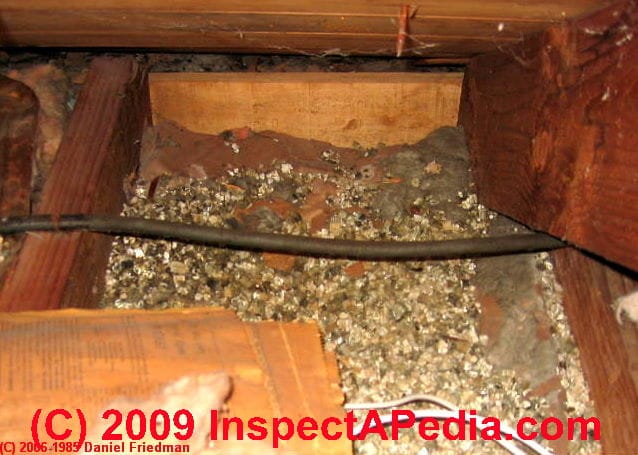
Photo above: vermiculate loose fill building insulation may indeed contain asbestos, depending on where the vermiculite was mined. (From the Libby mine = yes).
Asbestos was banned in all home construction uses beginning in 1990, but beware: pre-1990 products might have been used in some homes built shortly afterwards.
Low asbestos risk in some materials: One should note that some of these products contain such small amounts of asbestos, or asbestos in forms not easily converted to airborne fibers (non-friable), that the risk from the product is likely to be very small.
One might elect to dispose of an old asbestos-containing toaster, but not to hire an environmental test firm or asbestos abatement company for that procedure.
Many other asbestos-containing products, both historic and among some current products, encapsulate the asbestos fibers in cementious or resinous materials which minimize the possible release of asbestos fibers into the air.
Note: most of the uses of asbestos listed here are obsolete
and the products mentioned have not been manufactured for quite some time. However these products may still be encountered, particularly in older buildings and among old consumer products.
However some current materials may contain and are permitted to contain asbestos.
In May 1999 Asbestos Materials Bans Clarification was issued by the U.S. EPA clarified that there are some categories of asbestos-containing products that are NOT subject to a ban.
For example, the Asbestos National Emission Standards for Hazardous Air Pollutants, or NESHAP) rules issued in November, 1990 prohibits spray-on application of materials containing more than 1% asbestos to buildings, structures, pipes, and conduits unless the material is encapsulated with a bituminous or resinous binder during spraying and the materials are not friable after drying. [Italics inserted by -DF]. Thanks to Susan Kimball, Argus Pacific, for this clarification.
While an expert lab test using polarized light microscopy may be needed to identify the specific type of asbestos fiber, or to identify the presence of asbestos in air or dust samples, many asbestos-containing building products not only are obvious and easy to recognize, but since there were not other look-alike products that were not asbestos, a visual identification of this material can be virtually a certainty in many cases.
This document and other asbestos identification articles given here aid building buyers, owners or inspectors who need to identify asbestos materials (or probable-asbestos) in buildings by simple visual inspection.
We provide photographs of asbestos containing materials and descriptive text of asbestos insulation and other asbestos-containing products to permit identification of definite, probable, or possible asbestos materials in buildings.
Contact Us to add items and photographs to this list of asbestos containing materials.
- ASBESTOS IDENTIFICATION IN BUILDINGS provides a detailed guide to recognizing asbestos-containing materials in buildings and links to in depth articles about individual asbestos-containing building materials
- ASBESTOS LIST of PRODUCTS provides our complete, detailed list of known products in which asbestos was used
- ASBESTOS PHOTO GUIDE to MATERIALS provides a photo guide to common asbestos-containing products
- INSULATION MATERIAL IDENTIFICATION GUIDE - advice about identifying various insulation materials found in buildings.
- ASBESTOS ORIGIN & NATURE - gives details about the origins, manufacture, and uses of asbestos
- Also see WTC DUST PARTICLE - MICRO PHOTOGRAPHS collapse following the 9/11/01 attack. Links to U.S. government and other authoritative research and advice are included.
Asbestos Hazard Basics
See ASBESTOS REGULATION Update for details
and then see EPA ASBESTOS MATERIALS BAN: CLARIFICATION 1999 - 2003 clarification for a description of what asbestos-containing materials are currently banned or not banned in the U.S.
Asbestos Product Pictures - Alphabetic List of Uses of Asbestos
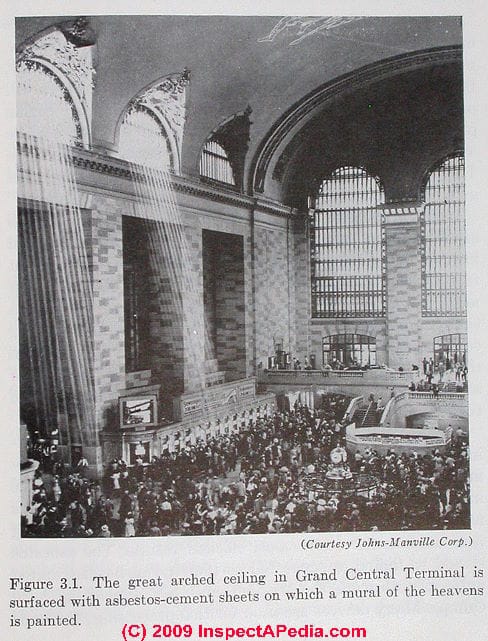
Rosato's photo shows asbestos cement sheets that were used to line the arched ceiling in Grand Central Terminal in New York City. The asbestos sheets served as a base for painting a mural of the heavens.
- Abrasives containing asbestos were manufactured but saw limited use.
Fibers were used as fillers with rubber-resins in a combination of theses substances in relative proportions by weight: asbestos fibers (25p), sulfur (100p), latex rubber (100p), Water (100-200p), and dry Hemoglobin (25p).
This material was heated and shaped into hard forms such as rods for special applications. Abrasives that used asbestos are described
at ASBESTOS OTHER PRODUCTS. - Acoustical ceiling tiles contained asbestos
- Adhesives were manufactured containing asbestos and are discussed
at ASBESTOS OTHER PRODUCTS. - Ammunition wadding contained asbestos
- Appliances
that contained asbestos include: older blankets (electric-blankets), broilers, clothes dryers, dishwashers, refrigerators, ovens, ranges, toasters, toaster ovens, hairdryers, popcorn poppers, may contain asbestos gaskets or asbestos-containing parts.
Asbestos use in appliances was banned in 1979 but in most cases the asbestos-containing parts are unlikely to be a source of health concern, except for hair dryers that contained asbestos heat shields. Hair dryers using asbestos were recalled in 1979.
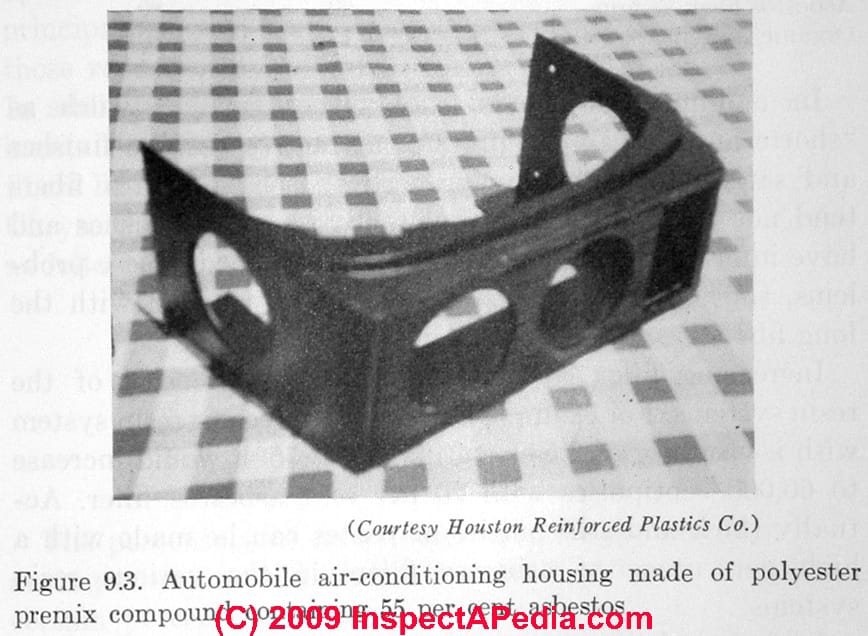
- Asbestos-containing automotive parts such as this automobile air-conditioning housing (photo at left) made of a polyester premix compound containing 55 percent asbestos (Rosato, courtesy of Houston Reinforced Plastics Co.)
- Asbestos-cement flat sheets & wallboard
used for interior sheathing (refrigerator rooms), partitions, instrument mounting boards, tank liners, blackout or bombproof board, exterior sheathing for half-timbered home designs, lab table tops, cabinets.
See ASBESTOS MILLBOARD - Asbestos cloth,
asbestos fabrics were used for packing, insulation mattresses, firefighting blankets, ironing board covers, prison cell padding, berets, theatre scenery, and HVAC duct vibration dampers as well as a huge number of other applications.
For a photo example
see ASBESTOS DUCT VIBRATION DAMPENERS.
For details about asbestos fabrics
see ASBESTOS TEXTILES. - Asbestos composition material
such as insulation compounds, lamp sockets, underground insulation, phonograph records, buttons, heater cord insulation, missile and aircraft plastics
- Automotive products containing asbestos included not only the widely recognized
BRAKE SHOES & PADS but also automotive undercoating paint to which asbestos fibers were added. Asbestos was used in plastic-formed housings in automobiles, such as air conditioner duct housings shown just above.5][11] - Automotive undercoatings
contained asbestos and other fibers as a filler or strengthener.
Asbestos use in automotive undercoatings is cited by various reliable sources including these citations: [5][11] Asbestos automotive undercoating is described
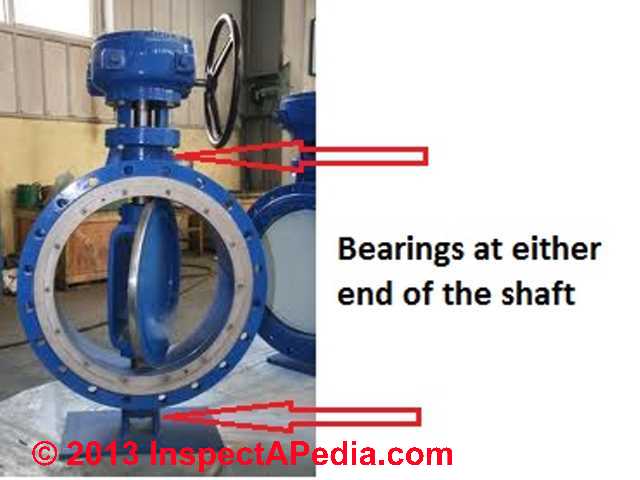
at ASBESTOS OTHER PRODUCTS. - Asbestos Bearing Components:
asbestos has been used in many industrial components including in gaskets or seals that are not necessarily visible, such as the asbestos-containing bearings shown just below.
Photos of asbestos in bearing materials were provided courtesy of Damian Murphy, of Mairin OHS&E Consulting Pty Ltd in Moe, Victoria, Australia, an Australian asbestos testing laboratory technician. - http://mairin.net.au - [11] Mr. Murphy offered these comments:
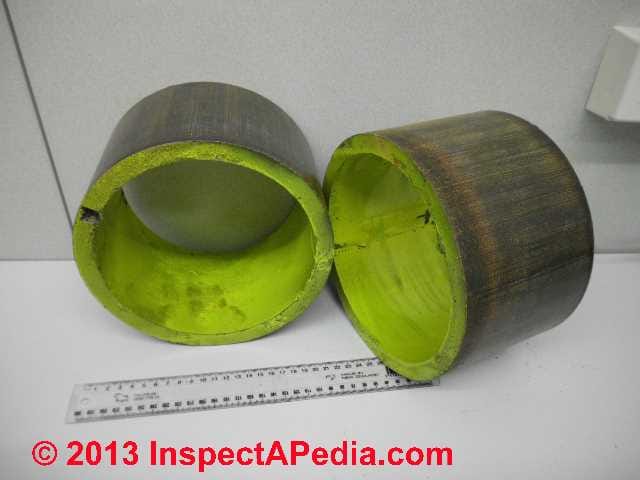
A client brought in some shaft bearings from a 78” butterfly valve installed in [a commercial facility] in Australia.
They were full of chrysotile asbestos. I had previously never heard of asbestos being used in this way and couldn’t see any reference to it on your site so I thought I would drop a line with a photo. These bearings are approximately 21cm diameter and 13cm wide.
(The second picture (below) of the valve at above-right is just a generic butterfly valve to indicate where the bearings were located in the valve.) - D.M. 3/12/2013
Also see ASBESTOS PRODUCTS in AUSTRALIA
- Asbestos Base flashing
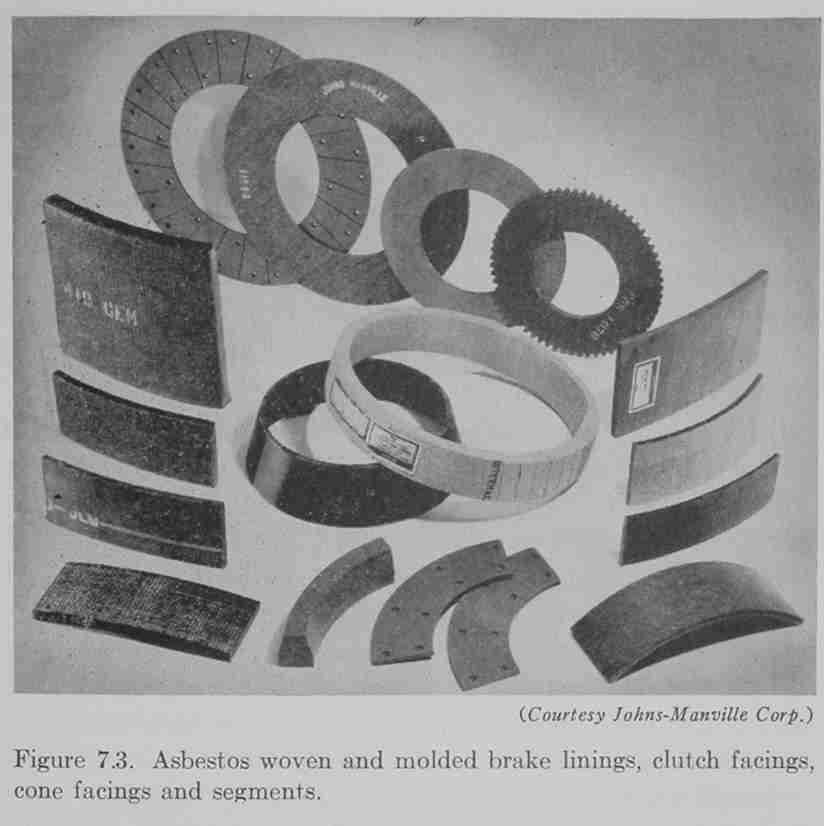
and asbestos fibers used in roofing mastics and sealants (generally not friable). - Asbestos Brake pads & Clutch facings
and other automotive parts such as gaskets, a hazard for automotive repair garage workers;
BRAKE SHOES containing asbestos were used in applications other than automotive, such as elevator brake shoes and brake shoes on other machinery.
- Asbestos Bricks
made of asbestos were fabricated, often for use as heating boiler or furnace combustion chamber or kiln liners; we found asbestos bricks and slab materials as well as asbestos wet-pack relining materials used in oil fired heating boiler and furnace combustion chambers.
See ASBESTOS in BRICKS or MORTAR - Asbestos Building insulation
depending on the mine from which it was obtained, some vermiculite insulation (photo at left), a loose-fill building insulation material, contains asbestos.
See VERMICULITE INSULATION. - Asbestos Carpet underlayment - old products
- Asbestos Caulking putties -
see ASBESTOS in PUTTY. Asbestos use in caulks & sealants is described further at Asbestos automotive undercoating is described
at ASBESTOS OTHER PRODUCTS.
- Asbestos Ceiling tiles
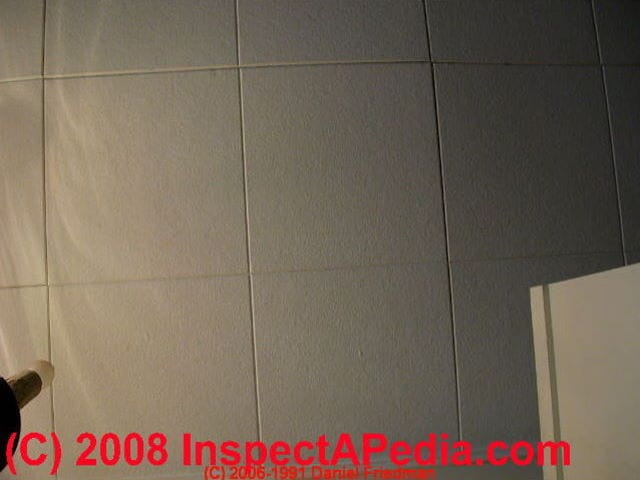
containing asbestos were widely used in buildings, particularly acoustical ceiling.
See CEILING TILES ASBESTOS CONTENT; also ceiling fireproofing slabs of asbestos (as well as spray-on asbestos) were used in commercial buildings
and
see FIREPROOFING ASBESTOS SPRAY-ON.
- Asbestos Ceiling fireproofing panels
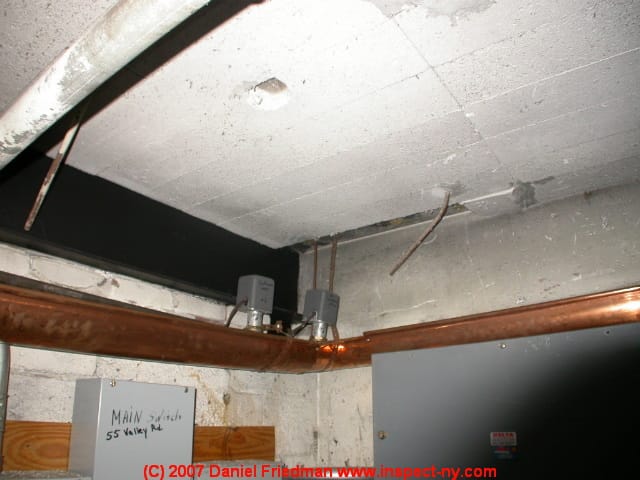
(photo above also included tremolite asbestos - particularly hazardous. Even in good condition this material may be hazardous and should be professionally evaluated and removed.
Compare this thick soft asbestos fireproofing board with the harder, cementious
ASBESTOS MILLBOARD
Also see FIREPROOFING ASBESTOS SPRAY-ON.
- Asbestos Ceiling paints, textured or popcorn ceilings
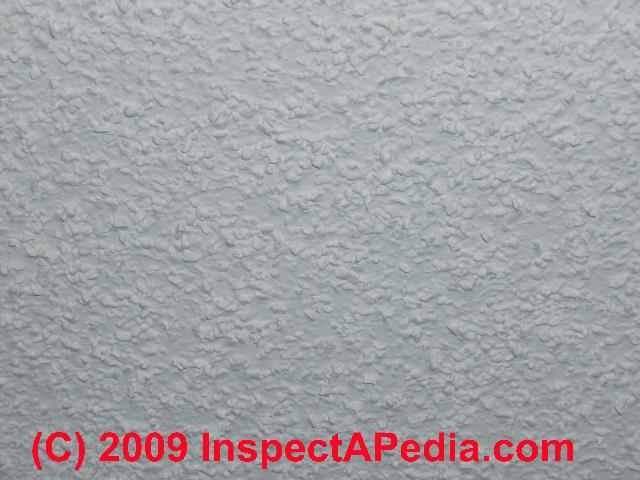
containing asbestos included spray-on acoustical ceilings and ceilings sprayed for fireproofing.
Textured ceiling paints were particularly popular in North America in the 1970's. If you are considering removing textured ceiling paint or "popcorn ceiling paint" in a building, since removing popcorn ceiling paint or textured paints that may contain asbestos are trickier than you may realize.
Details about recognizing & dealing with textured ceiling paints or popcorn ceilings that main contain asbestos are
at CEILING PAINT TEXTURED / POPCORN ASBESTOS
- Asbestos Cements
and cementious products including some cement pipes contained asbestos fibers as a strengthening material. Asbestos cement roof ing is described just below, and cement wallboard and cement siding containing asbestos are described later in this document.
Complete details about asbestos cement history, composition, products and hazards are found
at ASBESTOS CEMENT PRODUCTS
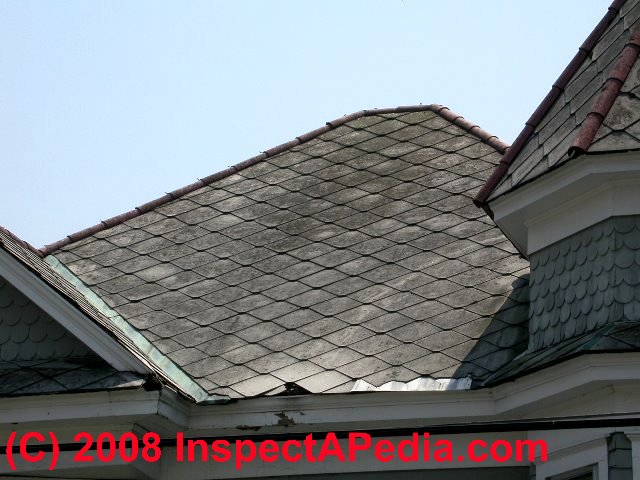
- Cement-Asbestos roofing shingles or roofing tiles -
see ASBESTOS ROOF MATERIALS which describes in detail asbestos cement roof shingles (or "tiles") and asbestos cement corrugated roof panels - Cement-Asbestos building siding -
see ASBESTOS CEMENT SIDING which describes asbestos-containing building siding shingles.
Also see ASBESTOS SIDING
and ASBESTOS MILLBOARD
and ASBESTOS WALLBOARD - essentially the same as asbestos millboard - link just above
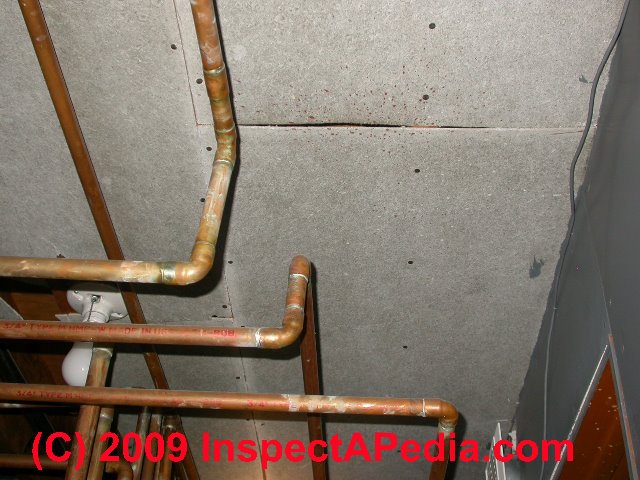
- Asbestos Cement board
used as a "fire proofing" over and near boilers and wood stoves - also called "cement wallboard" and "asbestos millboard".
Asbestone Corporation, a producer of asbestos cement board in the U.S. in the 1950's was purchased by National Gypsum in 1954. Ultimately Asbestone cement board products were one of National Gypsum's asbestos liability sources.
Asbestos millboard (photo above) used for stoves and heaters, in garages, as fireproof wallboard, as gaskets, as washers in electrical applications, stove mats,
safes, motion picture booths, automobile hoods. Asbestos millboard is a cementious product that was produced in sheets and used for fire barriers and in other applications.
The material is quite similar to cement asbestos roof shingles and siding, and was produced in sheets of varying thickness (typically 1/8"- 1/4") and dimension depending on its intended use.
Asbestos millboard was used as a fire barrier behind and over and around wood stoves, coal stoves, & heating appliances in buildings up to 1978. It was also used in some locations where a moisture-resistant building material was desired.
Also see ASBESTOS CEMENT FLAT SHEETS.
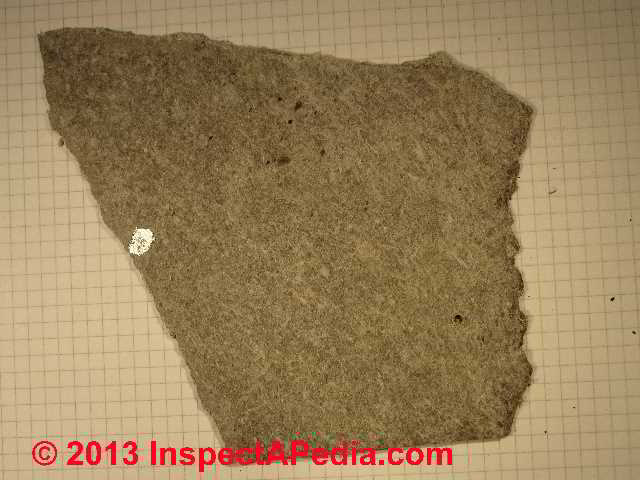
Comparing drywall, plasterboard, and cement asbestos millboard
Above we illustrate a fragment of cement asbestos millboard that is about 1/8" thick and his hard - cementious, and at above right we take a look at the edges of two layers of drywall or plasterboard in an older home - showing that that material, principally made of gypsum, is comparatively soft, paper-faced, and easily cut with a knife.
Note that older drywall products and drywall joint compound often also contained asbestos.
Also see DRYWALL, FIBERBOARD, PLASTER INTERIORS
- Asbestos Brake & Clutch parts
used in automotive & other industries (Rosato) - Clothes dryers
used asbestos on internal parts as gaskets, wiring covering, and possibly insulation - Asbestos Coatings
to protect sheet iron and metal ware were sometimes performed using a solution of asbestos, soluble silicates, and phenolic resin to protect metal from oxidation when exposed to heat.

Above: an asbestos-containing Aristocrat brand saucepan manufactured by West Bend using Bakelite, an asbestos-containing thermoplastic. Photo courtesy of an InspectApedia.com reader.
- Asbestos in cookware
including Bakelite and similar asbestos-containing plastics in handles and lids
See details at ASBESTOS in PLASTICS

- Asbestos Cooling tower
components -
see ASBESTOS in COOLING TOWERS for details - Asbestos Deck undersheeting
on building exterior decks in some insttallations used asbestos as internal insulation
- Asbestos content in Drywall, wallboard or "Sheetrock" or gypsum board:
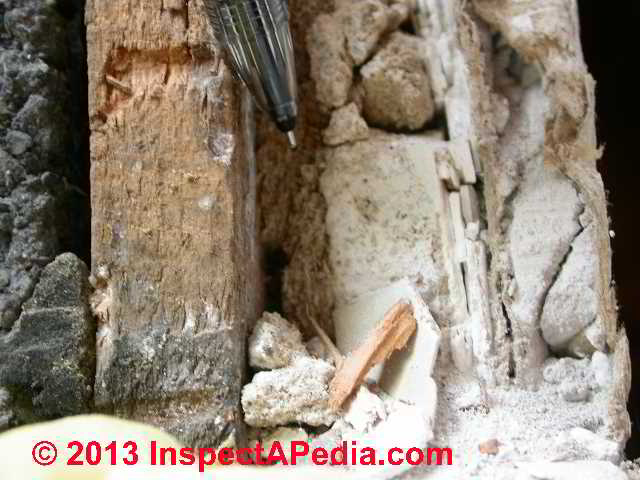
Principally you'll find that references to asbestos in a drywall system focus on asbestos that was contained in joint compound or in some paint or spray products such as "popcorn ceiling paint" that may have been sprayed on drywall ceilings.
Keep in mind that asbestos-containing joint compound may have been applied not only up to 18" wide over drywall joints but also in patches, repairs, around penetrations or fixtures, and in some buildings as a skim coat over an entire wall or ceiling surface.
Drywall systems that may contain asbestos - at least in finishes, taping joint compounds, skim coats, or in systems that applied plaster over gypsum board date from about 1910 through the early 1980's in North America (1982 in Canada). Taping drywall joints dates from as early as the 1920's. Asbestos-use in plaster overlaps this period.
In Canada most provinces classify the asbestos hazard associated with drywall removal as a "low risk or type 1" hazard requiring normal dust control. (Pinchin 2011). The U.S. advice is typified by the U.S. EPA quotes included in the citation below.
See ASBESTOS in DRYWALL for details.
Also see notes on the widespread use of asbestos in plaster and plaster products
at PLASTER TYPES & METHODS in BUILDINGS
and
at PLASTER INGREDIENTS, MIX, PROPERTIES - Drywall or "joint compound" asbestos content:
on older buildings may contain asbestos fibers. Asbestos was universally used in drywall joint compound prior to the early 1980's. In joint compound the asbestos content varied but typically was between 3-6%.
Even if the gypsum board itself did not contain asbestos this means that by weight the asbestos content of the wall system was about 0.25%. (Redmond 2011), "Sheetrock mud" is a synonym for drywall compound or joint compound that before 1978 may have contained asbestos fibers.
See ASBESTOS in DRYWALL for details.
- Duct Asbestos insulation:
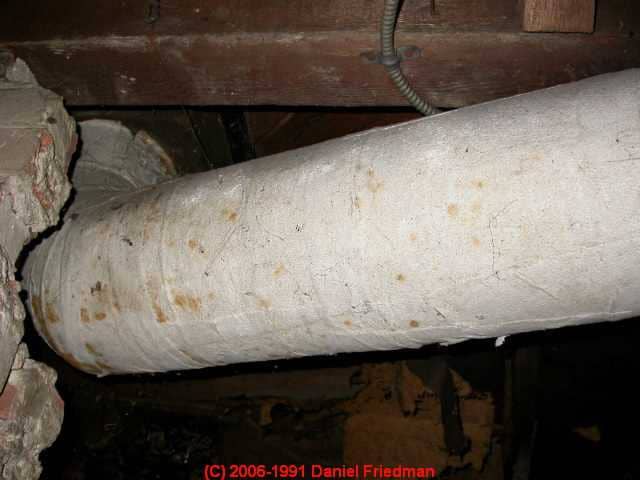
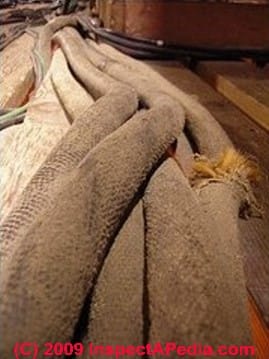
asbestos paper was used to wrap the exterior of heating ducts and their connection to heating registers.
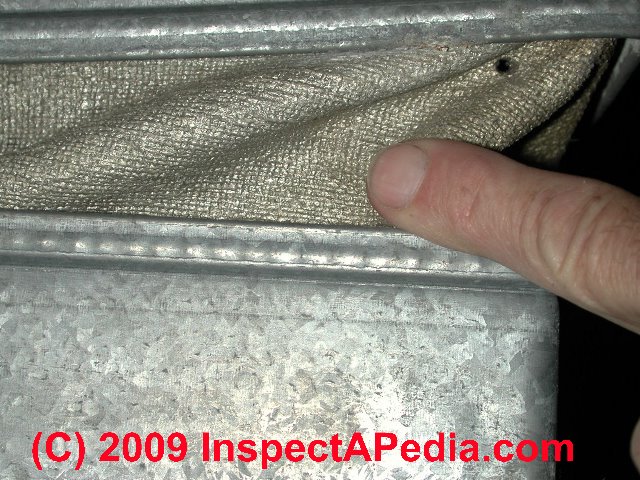
See ASBESTOS AIR DUCTS. Asbestos fabric was used to form the vibration damper at the connection between heating ducts and heating furnaces.
See ASBESTOS DUCT VIBRATION DAMPENERS. (Photo below).
- Asbestos Ducts for heating systems:
air ducts, especially where air ducts were buried in concrete floors and slabs, were made using transite pipe. Asbestos paper was also used as an insulating and air leak seal product on both the exterior and the interior of HVAC ducts used for both air conditioning and heating.
See TRANSITE PIPE AIR DUCT ASBESTOS RISKS for identifying photos and also a list of problems that occur with this type of duct system.
IL DEC (Illinois, USA) asserts that asbestos was used for air duct lining; we have found this material on the exterior and on the interior of air ducts (but don't rule it out).
See ASBESTOS DUCTS, HVAC and also
see ASBESTOS PAPER DUCT INSULATION for examples of asbestos paper used on the exterior of metal ductwork
See ASBESTOS LINER INSIDE HVAC DUCTS for an example of what looks like corrugated asbestos paper liner inside of metal heating or air conditioning ducts.
- Asbestos Electrical panel components, asbestos
including panel partitions and in some applications such as theater wiring and appliances, electrical wire insulation; - Asbestos Electrical wiring insulation, asbestos,
- particularly commonly used in theaters was asbestos insulation on electrical wiring where fire was an extra concern or where high heat was more likely. Details are
at ASBESTOS ELECTRICAL WIRE INSULATION - Asbestos felt for acoustical applications, piano padding, noise insulation, use in plastics and asbestos felt was widely used in liquid and air filters. Also
see ASBESTPS USED in PIANOS? Did Starr Pianos contain asbestos? (Starr piano photos) - Asbestos Fireproofing materials
used in buildings, including spray-on fireproofing material such as was used in the lower floors of the World Trade Center in New York City, and tremolite asbestos slabs that were glued to building ceilings.
See FIREPROOFING ASBESTOS SPRAY-ON
and see ASBESTOS INSULATION
- Asbestos Electrical Wiring insulation:
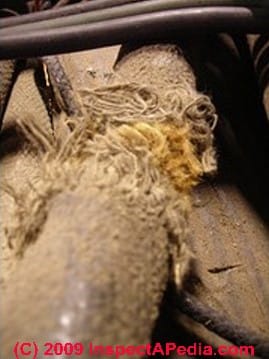
Electrical wiring insulation, such as in theatres, may contain asbestos. Also electrical wires in electric range tops and possibly some electric ovens and clothes dryers. The photo shown here (at left) is of old theater wiring which often includes asbestos wire insulation.
Here is a second photo of theater wiring with asbestos-suspect covering. [Photos of theater wiring contributed by randomblogmail]
See ASBESTOS ELECTRICAL WIRE INSULATION.
Also
See OLD ELECTRICAL WIRING TYPES - Asbestos Electric motor
parts such as Quinterra-wrapped coils in an electric motor armature - Asbestos Elevator equipment panels:
to resist heat from fires to try to keep elevators working in a fire - Asbestos Exterior siding: Cement-asbestos wall shingles - outside, and not easily friable unless being demolished or cut with power tools. See photos at Asbestos Siding in this document.
And see ASBESTOS CEMENT SIDING for details about cement asbestos building siding, its repair, removal, demolition, or cover-over. - Fabrics that contained asbestos
or were made entirely of asbestos were numerous and were used in a wide range of applications such as aluminized suits for fire-fighters, foundry workers, and furnace repairmen.
See FIREPROOFING, Gaskets,
and ASBESTOS TEXTILES for examples.
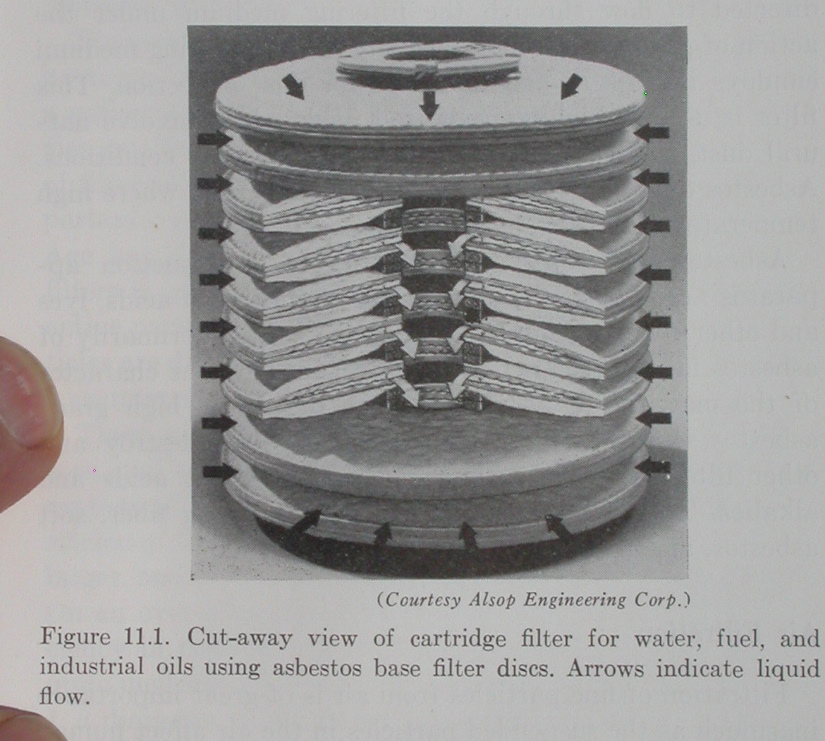
- Asbestos Filters containing asbestos for various applications were made containing long asbestos fibers. (Photo at left - Rosato)
Chrysotile asbestos was used for filtering wines, fruit juices, beer, pharmaceuticals, sugar, blood plasma, and other liquids as well as filters for gases including simple air filters used for military purposes in order to attempt to filter out certain toxic substances.
Blue Bolivian and blue African asbestos were important asbestos fibers that in combination with cellulose formed a paper sheet used for fine filtration.
Arizona chrysotile and Canadian chrysotile asbestos fibers were used similarly for operation at high temperatures and because very small particles could be filtered. Asbestos fabrics and felts were used in these filtering applications.
Details are at ASBESTOS FILTERS.
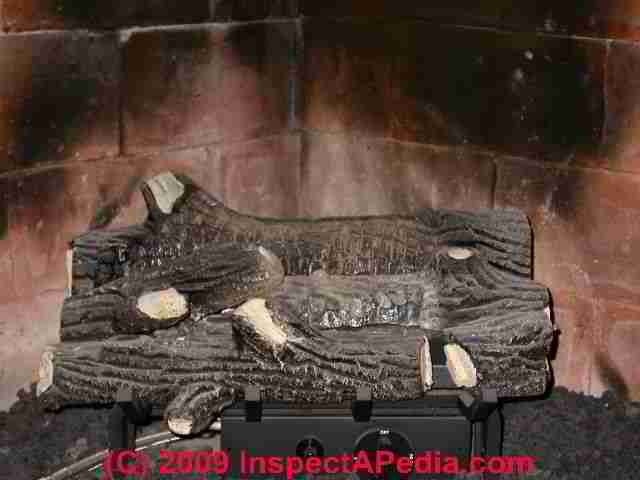
- Asbestos Fireplaces, Asbestos fireplace logs,
steel zero-clearance insert fireplaces, wood stove gaskets, gas fireplaces, gas fireplace "fake" logs - prior to 1977.
Click the photo to see more details (with the fire out). See more photos of asbestos used in fireplaces
at ASBESTOS in UNUSUAL PLACES. - Asbestos Fire barriers:
Cement-asbestos boards used as fire or heat barriers, such as over and around heating equipment. Also fire blankets (used by fire departments) and fire curtains both as fire barriers and in some theaters.
- Asbestos Fireproofing
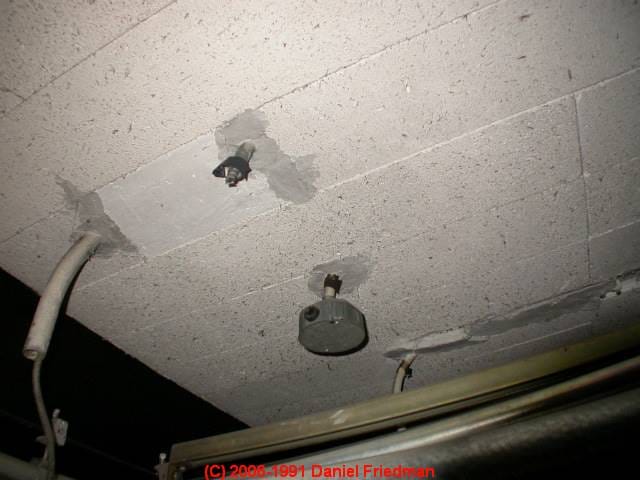
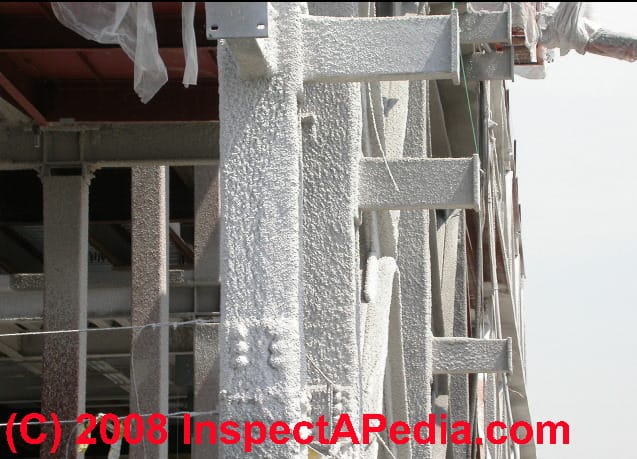
Asbestos spray-on insulation or trowel-on for fireproofing on structural members or under roofs in commercial buildings - has been banned since 1973. Our photo shows tremolite asbestos ceiling insulating panels.
Spray-on or troweled on ceiling or wall materials used between 1945 and 1978 may have contained high levels of asbestos fibers. These materials are often soft and crumbly - easily made friable.
If the sprayed-on or troweled-on asbestos fireproofing material in a building is loose, falling off, or damaged, it should probably be professionally repaired or removed by a trained qualified asbestos removal contractor.
See FIREPROOFING ASBESTOS SPRAY-ON
and ASBESTOS INSULATION Because there are
also MODERN SPRAY-ON FIREPROOFING that looks a lot like the older asbestos-containing material, if documentation is not available confirming the age and composition of a spray-on fire resistant insulation product, lab testing may be needed.
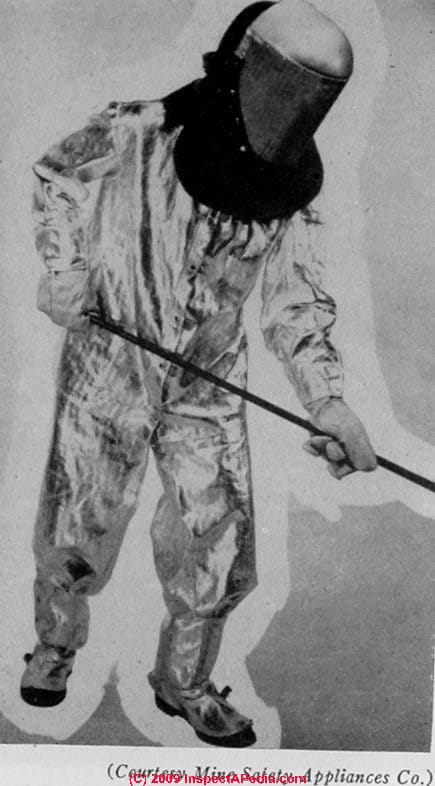
- Asbestos Fire Protective Suits & Clothing
such as the fire gear shown in our photo (left) provided to Rosato by Mine Safety Appliances, Corp.
Asbestos blankets were provided to and used by fire departments for use in firefighting.
- Asbestos Flooring materials
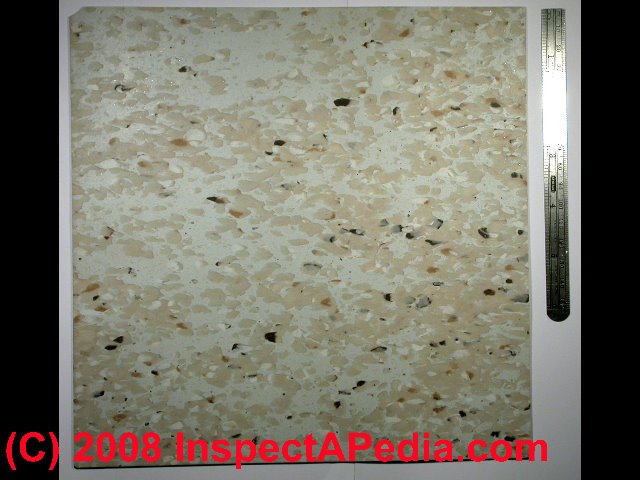
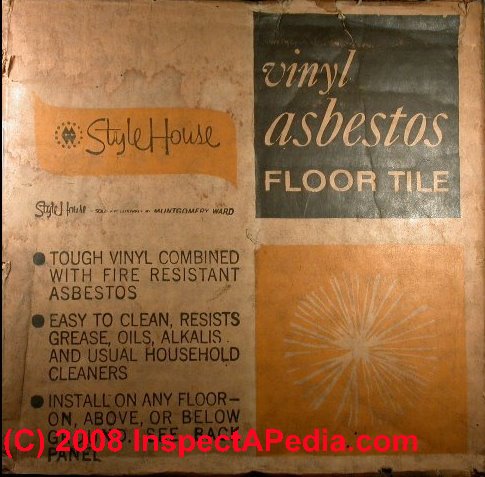
in buildings: such as vinyl-asbestos floor tiles. Flooring backing materials such as the backing on sheet flooring also contained asbestos in some products. Sheet flooring such as early vinyl flooring contained asbestos fibers and filler.
Asbestos Flooring and floor tiles can contain hazardous amounts of asbestos fiber, released during demolition, sanding, cutting, grinding, polishing, or even by being walked-on in high traffic areas, in particular, where asbestos fibers were added to asphalt-based floor tiles.
Our photo (above) shows an asbestos-vinyl floor tile marketed by Montgomery Wards [image ]
Asbestos in flooring products was also used in Vinyl Asbestos Sheets, Tiles, and Undersheeting. Asbestos fibers were also often contained in the mastic used to attach some flooring products.
See RESILIENT SHEET FLOORING ID GUIDE - home - Asbestos furnace cement & sealant paper asbestos tape
asbestos including chrysotile asbestos was a significant ingredient in cement used at heating boilers, furnaces, and at chimneys to seal the flue vent connector (shown below.)
Also see SHEET FLOORING TYPE IDENTIFICATION
For a photo guide to vinyl-asbestos floor tile patterns, sizes, and years of manufacture,
see ASBESTOS FLOORING IDENTIFICATION - home and also
see ASBESTOS FLOOR TILE IDENTIFICATION PHOTOS 1949-1959
See FLOOR TILES THAT MAY CONTAIN ASBESTOS for details about asbestos-containing flooring products.
- Asbestos Gaskets
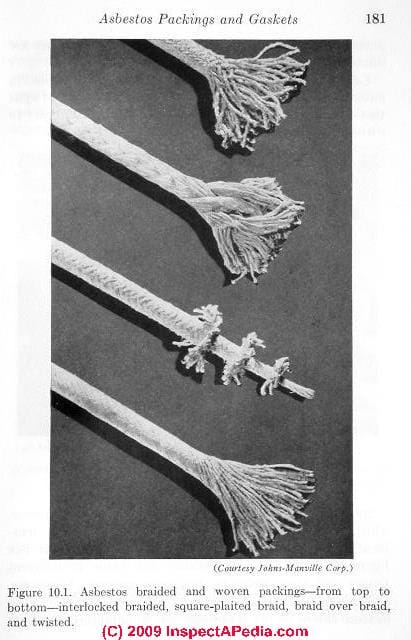
made of or containing asbestos were fabricated to withstand high pressure and high temperature applications such as steam equipment, and rope gaskets made of braided or woven asbestos were widely used in many applications where a thick rope-like gasket sealer or asbestos packing was needed.
These asbestos yarn gaskets were found, for example, on wood and coal stove doors and lids in many products.
Photo of braided asbestos ropes and packing gaskets is from Rosato. - Asbestos Gasket materials such as braided asbestos packings
and ASBESTOS ROPE GASKETS and sheet gaskets used in a wide variety of applications such as wood stoves, coal stoves, oven door gaskets, possibly some dishwashers, automotive engine head gaskets (often sandwiched between metal plates);
- Anti-Graffiti Plaster Coatings
contained 4 to 14% asbestos as illustrated by Rawlins (1984)- Rawlins, Patrick R. ."Anti-graffiti facing of walls or similar surfaces ", U.S. Patent 4,428,994, issued January 31, 1984." describes a multilayer protective coating-applying primer and sealing layer containing aggregate, then plaster, binder, filler and dye layer, and then finishing layer as a facing to protect from graffiti:
Excerpt:
An example of the proportions of the solid constituents of the further coating composition (excluding subsequently added water-soluble dye) are as follows: - Semi hydrated plaster: 34%
- China clay/whiting: 34%
- Asbestos: 4%
- Resin binder: 5%
- Colouring pigment powder:
- 3% Exfoliated mica: 10% Mica:
- 10% Asbestos is included in the above example to provide a fibrous binder.
- Rawlins, Patrick R. ."Anti-graffiti facing of walls or similar surfaces ", U.S. Patent 4,428,994, issued January 31, 1984." describes a multilayer protective coating-applying primer and sealing layer containing aggregate, then plaster, binder, filler and dye layer, and then finishing layer as a facing to protect from graffiti:

- Asbestos Heating Boilers & Heating furnaces: vibration damper material,
typically located between the blower compartment and the supply plenum, may be asbestos-based cloth on older furnaces.
See ASBESTOS DUCT VIBRATION DAMPENERS.
Asbestos was used for door insulation on heating boilers. Hot water boilers were coated with a thick asbestos insulating paste; other models used corrugated asbestos paper insulation.
See ASBESTOS INSULATION - Asbestos Heating & air ducts (HVAC) containing asbestos
included transite pipe used in building slabs- see Guide to Identifying Asbestos Transite Chimneys, Flues, & Pipes,
TRANSITE CHIMNEYS
also vibration dampers in air ducts and paper air duct wrap on heating systems.
See ASBESTOS AIR DUCTS
and ASBESTOS DUCT VIBRATION DAMPENERS
- Asbestos handles for appliances,
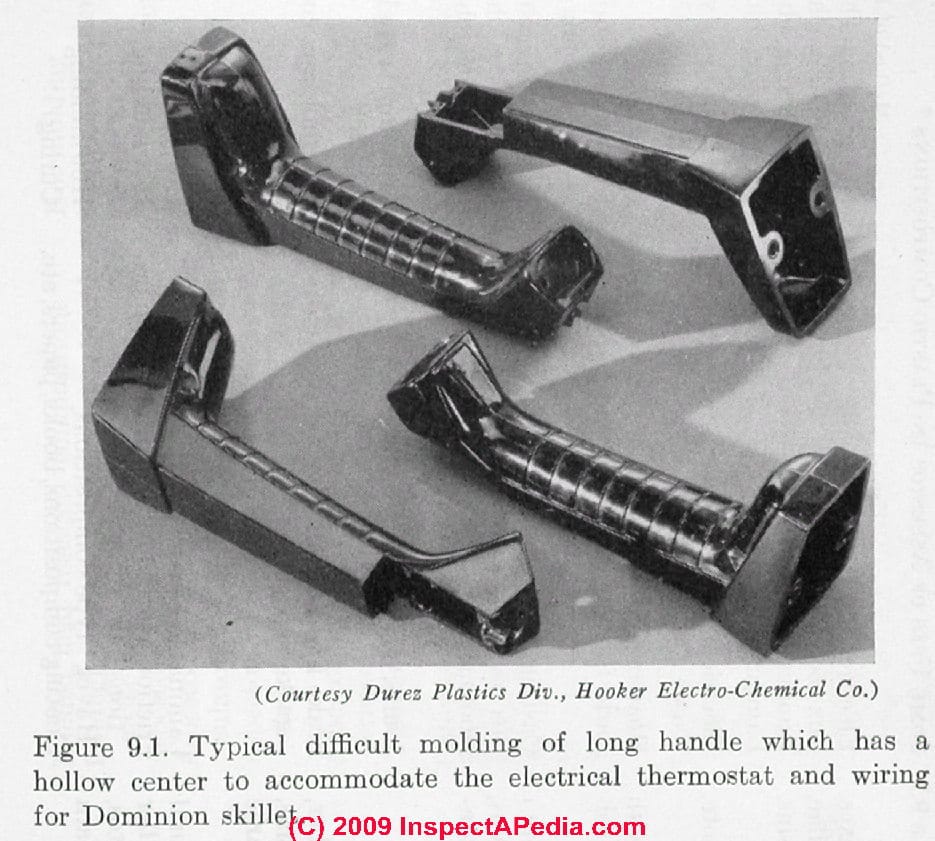
(photo above, Rosato, Courtesy Durez Plastics Division, Hooker Electro-Chemical Co.) included difficult asbestos-plastic moldings using a hollow center that was used to carry the electrical thermostat and wiring for the Dominion electric skillet.
- Asbestos covered hoses
such as this flue cleaning hose (photo below, Rosato, courtesy of the Gates Rubber Co.) were produced to avoid transfer of heat to the hands of the operator using the hose to clean flues, or to resist fire damage such as asbestos fabric fire hoses.
Also see ASBESTOS TEXTILES.

- Asbestos Insulation
used in walls and floors included asbestos or asbestos-containing products. Also spray-on fireproofing insulation.
See ASBESTOS INSULATION and in the list above also see "Fireproofing".
Blown-in insulation that may contain asbestos includes some brands of vermiculite.
Homes constructed between 1930 and 1950 may contain wall or ceiling insulation made of asbestos. In these homes asbestos insulation was placed in the wall cavity behind a plaster and lath or plasterboard finish wall.
Some sources (Illinois EPA) indicate that asbestos was used for loose blown-in fill building insulation as well as batt insulation.
Asbestos wall or ceiling insulation should be left un-disturbed, but if building construction or renovations require that it be disturbed, then an asbestos remediation professional should be consulted.
See examples of asbestos insulation products at
- Asbestos Joint compound and ceiling or wall patching compound
manufactured up to 1977 may contain asbestos fibers. It's best to leave this material alone or cover it over during renovations. - Asbestos Lubricants
containing asbestos particles and fibers were used in industrial applications. The asbestos fibers were added in amounts from 5% up to 50% by weight to lubricants to give solidity and to control the rate at which lubricant greases would melt.
Studies showed that these asbestos-containing lubricants were more effective than other lubricants in heavy-duty applications such as tractor roller greases and clothes washing machine gears.
Roasato in estimated that by 1952 millions of pounds of asbestos-filled lubricants had been used in the U.S. Lubricants that made use of asbestos are detailed
at ASBESTOS OTHER PRODUCTS. - Asbestos Mastics
and adhesives used in construction and in flooring or ceiling tile installation including vinyl or asphalt vinyl or asbestos vinyl floor tiles, carpet tiles, ceiling tiles. - Medical uses of asbestos
included an asbestos foot powder which used 50% by weight of powdered asbestos and talc.
ASBESTOS in TALCUM POWDER in another article in this series provides more information about asbestos in baby powder, body powders, and other talcum powder products.
MEDICAL USE of ASBESTOS is described separately in another article in this series.

- Ornamental Materials using asbestos
included ceiling medallions, cornice trim and other interior features, window displays, hanging ornaments, Christmas tree decorations, such as those discussed in Glaser's 1954 patent and illustrated just above.- Glaser, Clarence F., "Ornamental device." U.S. Patent 2,821,802, issued February 4, 1958.
Excerpts:
The invention relates to novel and improved decorative articles, and to methods and means for making the same.
The invention is particularly adapted for the manufacture of hanging ornaments such as window or display decorations, and Christmas tree ornaments.
...
2,821,802 Patented Feb. 4, 1958 The base of the cone is then filled with a mixture of' the following materials: Percent by volume Asbestos pipe-covering powder 50 Plaster of Paris 20 Flour paste 30 This mix 12 hardens quite rapidly, but while it is still soft I insert the end of a wire hook 113 in such manner as to permanently retain the hook when the mixture fully hardens.
- Glaser, Clarence F., "Ornamental device." U.S. Patent 2,821,802, issued February 4, 1958.
- Paints, varnishes, finishes, & textured paint
on older buildings may contain asbestos fibers, particularly where fireproof paint was needed. Also an asbestos-oil based paint was used where acid resistance or metal corrosion resistance were needed.
Asbestos-filled asphalt paint was used damp proofing on building foundations and as a roofing sealant for many decades up to 1978. The "popcorn ceiling" spray-on paint used in homes before 1978 often contained asbestos fibers and should not be demolished without taking appropriate precautions.
See CEILING PAINT TEXTURED / POPCORN ASBESTOS. And paints containing asbestos are also described at Asbestos automotive undercoating is described
at ASBESTOS OTHER PRODUCTS..
- Paper made of asbestos
was used as heating air duct wrap, ceiling heat barriers, and was experimented with as a fireproof writing paper (but inks were not fireproof).
Asbestos paper was also used in thicker form, as was asbestos cement board, as a fire and heat barrier during building welding, soldering, or plumbing work, to permit work on copper piping or tubing in tight quarters where combustible materials were nearby.
See ASBESTOS AIR DUCTS
and PAPER DUCT INSULATION, ASBESTOS
Asbestos paper used for a wide range of applications including in roofing products, filing cabinet liners, soldiers helmets, armored car roofs, welding applications, boiler jackets, gaskets, motor parts.
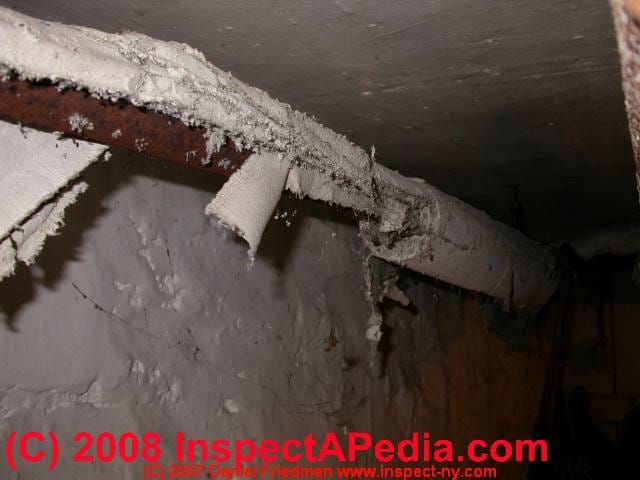
Below: fragments of white cloth/paper tape and white sealant cement closed the connection of this rusted flue vent connector ("stack pipe") into the base of a stone chimney in a New York home that was built in 1870.
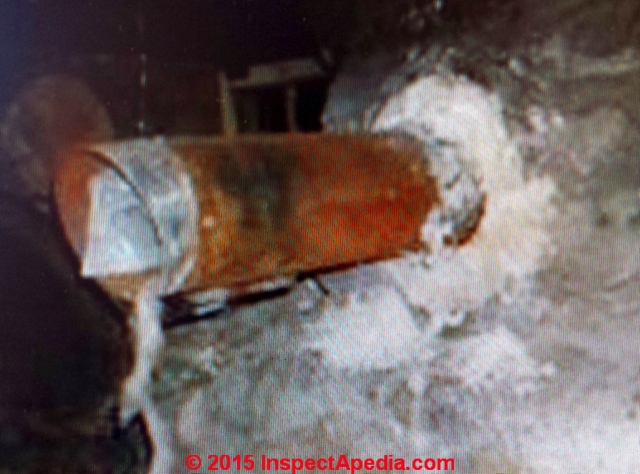
The homeowner had a sample of the sealant at this metal flue-to-chimney tested the white sealant cement for asbestos and reported:
Just to update you ... The insulation around the pipe [referring to a white sealant paste around the connection of a flue vent connector to a masonry chimney] was 40% Chrysotile. - Anon [by private email] 2015/12/22
- Asbestos Pipe insulation
made of high asbestos content papers (for straight pipe runs) and mastics (for pipe elbows) were applied on hot water and steam heating systems and occasionally also on ordinary building plumbing piping.
See ASBESTOS PIPE INSULATION.
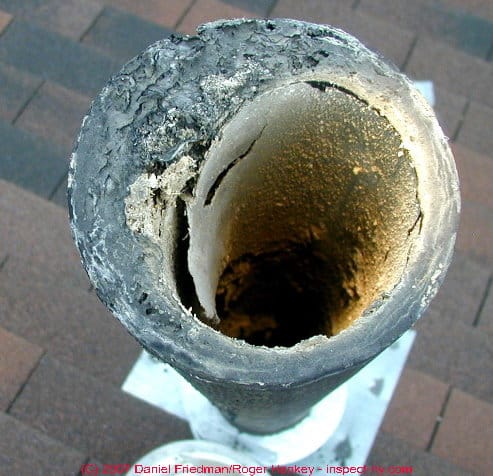
- Asbestos Cement Pipes
used for air ducts or chimneys contained asbestos. Cement asbestos pipe was used for water piping (mains in streets) and for plumbing vents on homes (photo at left).
See TRANSITE ASBESTOS CHIMNEYS, DUCTS, PIPES
and TRANSITE PIPE AIR DUCT ASBESTOS RISKS for identifying photographs and advice.
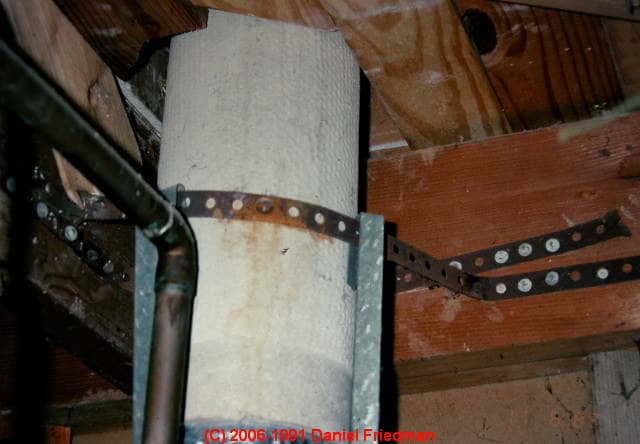
- Asbestos pipes
such as the cement asbestos or transite pipe used for a gas chimney in our photo above were used for water, sewage, gases, special liquids, as gas vent pipes (photo at left), as conduits, as air ducts, and as purlins, rafters, etc. for wartime buildings.
See ASBESTOS PIPE INSULATION
Also see this a photo of Asbestos Cement Water Piping being installed (Rosato).

- Plastics
containing asbestos were a very important product that saw widespread application in automotive and other industries. Asbestos fibers were used to reinforce or fill plastics made of phenolic resins (phenol-formaldehyde resins) since the development of those products beginning in 1909.
Examples of asbestos-containing plastic resin products include automobile air conditioner housings, door and other handles, electrical components, roofing products, brake linings, door stripes,electrical spools, structural tiles, wood veneer panels, acid proof coatings, and innumerable other products. -- Cummins - Asbestos Content in Plaster,
plaster used for acoustical ceilings and asbestos-containing plaster was used in spray-on plaster coatings.
Asbestos might have been included in some residential plaster formulations as well but we have not (as of 2015) found patents confirming asbestos-plaster mixes specifically intended for residential use.
See PLASTER INGREDIENTS, MIX, PROPERTIES for details. - Asbestos Potholders
and ironing board pads - old products - Raw asbestos, such as for making yarn, flooring, rope, automotive parts, insulation materials, sewer piping, auto body undercoating
- Asbestos in road surfacing materials is discussed
at ASBESTOS OTHER PRODUCTS. - Asbestos Rocket motor tubes
and other products in aerospace and missile programs. Shown (from Rosato) is a U.S. Navy official photo of a Vanguard rocket. Asbestos parts included the 6 1/2 foot nose cone, electrical and thermal insulation, conduits, etc. - Asbestos Packing materials
such as loose packing and rope and gasket packing materials used to seal pipe penetrations between building areas
Asbestos Used In Pianos
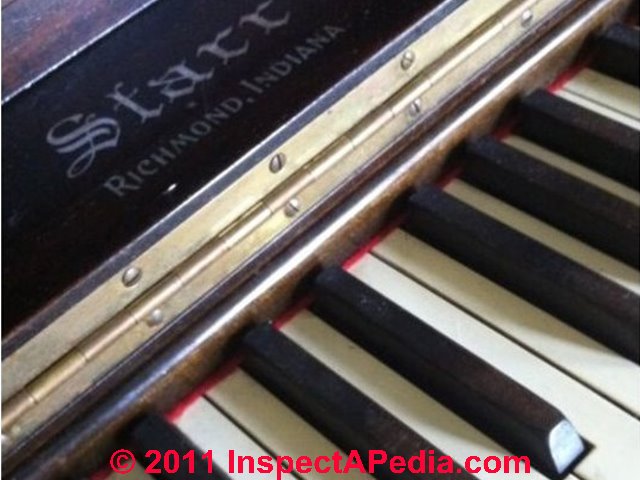
Reader Question: Did the Starr Piano company use any asbestos in any part / parts in there Star Remington Model?
Reply:
Certainly where asbestos is a general concern, an inspection onsite by an expert will provide far more assurance about asbestos risks than we can provide by web discussion. That
Asbestos was used in some piano padding. I have not found a referral to asbestos specifically used within pianos themselves. However it wouldn't surprise me if pianos made for humid climates didn't use ASBESTOS MILLBOARD for some component parts.
Details about the use of asbestos in pianos are found at
see ASBESTOS in PIANOS
- Asbestos Paints and coatings,
including textured paints and heat resistant paints; also popcorn spray-on paint used on ceilings.
See CEILING PAINT TEXTURED / POPCORN ASBESTOS - Asbestos Powders
including talcum powder and foot powders.
ASBESTOS in TALCUM POWDER provides more information

- Asbestos Putty: Window or Plumber's Putty,
such as asbestos-containing window putty (photo above) from some manufacturers may contain asbestos fibers. (Unlikely to be friable nor a meaningful source of airborne asbestos hazards except perhaps during demolition of a very large amount of such material.)
Here is a closeup photo of window putty from the 1950's vintage steel casement windows shown at left. This putty was tested and confirmed to contain asbestos fibers and filler. - Asbestos Range hoods
on cookstoves used asbestos products - Asbestos Road paving
containing asbestos: was experimented with in the early 1950's, and rubber latex compounds to which asbestos fibers were added was used for road surfacing.
- Asbestos Roofing materials
containing asbestos included: asphalt roofing shingles (photo above left) and other products that contained asbestos fibers such as asphalt shingles, roll roofing, and asphalt sealants, coatings, some roofing felts, and mastics,
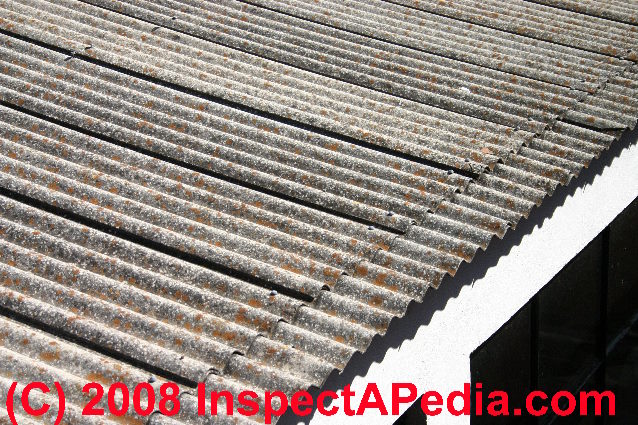
and also Cement-asbestos roof shingles and corrugated cement asbestos sheet roofing (photo above right) - a cementious product also used outside, and not easily friable unless being demolished or cut with power tools.
See ASBESTOS REGULATION Update
and ASBESTOS ROOF MATERIALS
...
- Asbestos Roofing mastics
often contained asbestos fibers and asbestos was a major ingredient in cement-asbestos slate-look alike products or "roof tiles" or cement asbestos roof shingles; these products use asbestos with a binder of portland cement.
These materials do not have to be removed and should be left alone; in some communities special demolition and disposal regulations may apply if cement asbestos roofing or siding have to be removed from a building (rather than covered-over).
Because this is a cementious product it does not readily release asbestos fibers but using a sander, power saw, or violent demolition might indeed cause harmful levels of asbestos to be released during that procedure. - Asbestos rope-gaskets -
see ASBESTOS PACKINGS & GASKETS - Asbestos Sealants
containing asbestos included products that combined long and short asbestos fibers with resins and cements or other ingredients for production of sealant coatings and caulks -
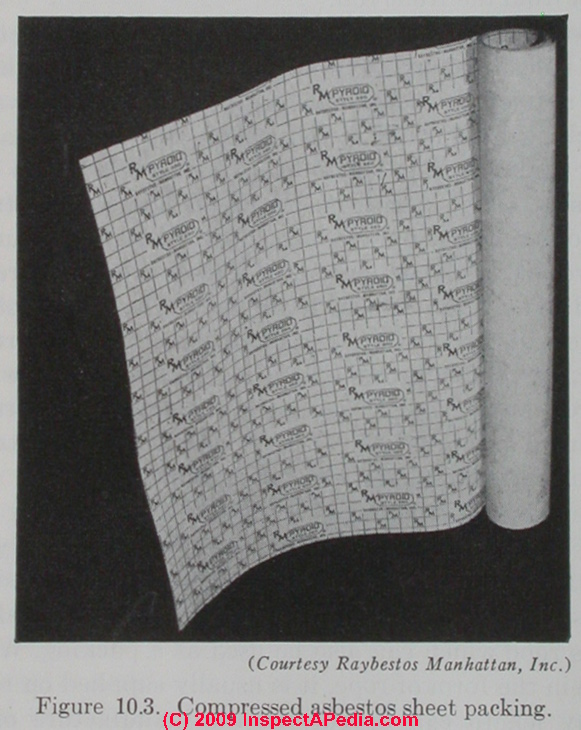
see ASBESTOS OTHER PRODUCTS - Asbestos sheet packing (Rosato) shown in our photograph above
- Asbestos Siding
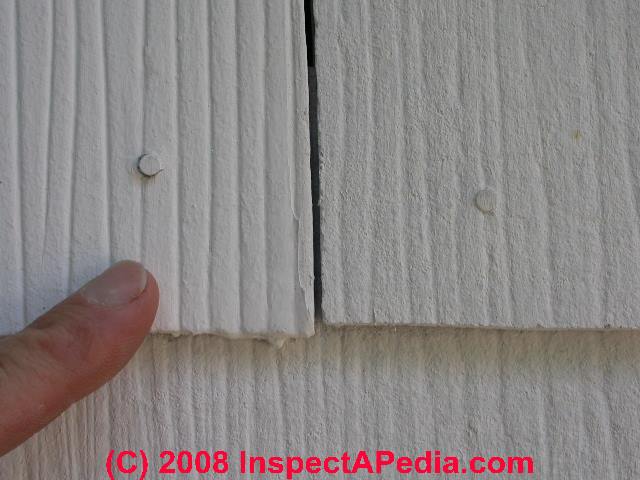
some building siding materials contain asbestos: Cement-asbestos siding shingles (photo at left) (non-asbestos-containing replacement products now available) and cement asbestos board siding as well as undersheeting.
This is a cementious material and is unlikely to release significant levels of airborne asbestos fibers unless during severe demolition activities or someone using a power saw or sander on the material.
See ASBESTOS CEMENT SIDING for more details about cement asbestos building siding, its repair, removal, demolition, or cover-over.

- Asbestos use in Silos, Grain & Agricultural Storage Buildings:
Asbestos was widely-used in silos and other agricultural buildings in roofing, in cement-asbestos board products used as roofing or siding, and in some fire-resistant coatings.
Most of these forms are not friable except during demolition or mechanical disturbance.
Details are now found at ASBESTOS in SILOS - with special thanks to reader Claire, 2022/03/09for these photographs and question. Shown above, an old storage silo, probably constructed of fiberglass, found at a property in Queensland, Australia.
While fiberglass is not an asbestos product, even non-asbestos silos or other farm buildings or building components were sometimes painted with an asbestos-containing paint.

- Asbestos in sound deadening products
has been documented by patent search. For example:- Cheyney, Charles C. "Sound deadener." U.S. Patent 1,865,677, issued July 5, 1932.
Excerpt:
Fig. 1 is a perspective view of my complete device. stance, as asbestos, fiber, plaster, rock wool,. or cork board, or any other suitable material which will have a deadening effect upon sound vibrations.
- Cheyney, Charles C. "Sound deadener." U.S. Patent 1,865,677, issued July 5, 1932.
- Asbestos Spackling compounds - see joint compounds
and DRYWALL ASBESTOS CONTENT drywall content - Asbestos Spray-on decorative coatings
containing asbestos have been banned for use in buildings since 1978 - Stoves and Asbestos stove gaskets,
wood stoves, coal stoves, and some kitchen ranges, used asbestos fibers;
asbestos fibers were a significant component of ASBESTOS MILLBOARD (a cementious asbestos sheet product) used as a fire barrier behind and over wood stoves, coal stoves, & heating appliances in buildings up to 1978. - Asbestos tape,
used for oil burning apparatus, oven pull strings, insulating armatures, electrical wire insulation - Asbestos Taping compounds such as joint compound intended to be heat resistant and other drywall joint compounds in general.
See DRYWALL ASBESTOS CONTENT - Asbestos Textiles
that contained asbestos included: felts, and yarns were produced for a wide range of uses that we list just below. Asbestos-based textiles used longer and better grade asbestos fibers such as
Quebec Standard Crudes No. 1 and No. 2 and Group 3 chrisotile asbestos, crocidolite asbestos, and amosite asbestos, sometimes in blends. Blue asbestos textiles were manufactured for acid resistant applications using pure crocidolite. Standard numbering systems were used to identify different asbestos textiles.
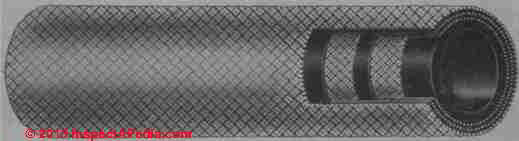
Flue cleaning hose is covered with a braid of heat resistant asbestos cord. Such a cover protects the hose from the hot walls of flues and resists the transfer of heat to the hands of the operator. (Courtesy The Gates Rubber Co.)
Details are at ASBESTOS TEXTILES
ASTM D299-52 numbered types of asbestos yarn, for example. Asbestos textiles were further described (and represented by identifying digits) by cut, number of plies, and amount of metallic strand in the fabric.
"Cut" for asbestos fabrics was calculated as (grain weight of 100 yards of a single yarn) / 7000 grains. "Plies" in asbestos yarn refers to the number of asbestos yarn strands twisted together. ASTM D677-50 pertained to woven asbestos cloth. ASTM D577-52 provided methods for testing asbestos cloth for heat resistance.
Here is a list of typical uses of asbestos in textiles: - In fabrics, asbestos used was predominantly Chrysotile, sometimes blended with crocidolite and amosite.
- Brake linings
- Cloth for a variety of applications ranging from furnace vibration dampers to aluminum-coated high temperature protective clothing
- Electrical tape
- Fire hoses
- Filters
- Gas mask filters
- Gaskets & gasket cloth
- Packing's
- Rope
- Safety clothing
- Spark plugs
- Steam hoses
- Stocking covers for lead cables
- Tubing
- Twine & sewing thread
- Vibration dampers in duct work -
see ASBESTOS DUCT VIBRATION DAMPENERS - Wire coverings for electrical wire or fixture components
- Other products where fire and heat resistance were needed
- Textured Asbestos paint used on building interiors included asbestos fillers and fibers.
See CEILING PAINT TEXTURED / POPCORN ASBESTOS - Theaters: Asbestos products in theaters
included products to localize or control fires, wall sections in sets, fireplace fireboxes, fake dust on cobwebs, camera booth insulation, noise insulation, and for dressing scenes as having winter snow!
Electrical wiring in theaters, especially for lighting, was often jacketed in an asbestos-braided fabric to resist fire. - Thermal Asbestos paper products -
see ASBESTOS AIR DUCTS
or ASBESTOS PAPER DUCT WRAP for examples - Asbestos Thermos Insulation -
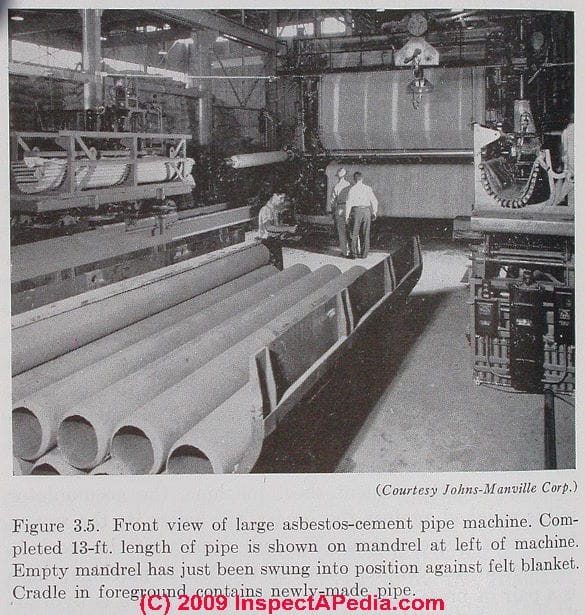
- Transite Asbestos pipes,
a cement-asbestos product, were widely used for warm air heating ducts, especially embedded in floor slabs, also for gas fired heating appliance chimneys, and for water transport in some cities as well.
See TRANSITE ASBESTOS CHIMNEYS, DUCTS, PIPES
and TRANSITE PIPE AIR DUCT ASBESTOS RISKS for identifying photographs and advice.
and TRANSITE WATER SEWER PIPE ASBESTOS RISK
and BUILDING & FABRIC ASBESTOS CONTAMINATION by WATER
Photo at left from Rosato shows asbestos-cement pipe coming out of the fabricating machine. - Vermiculite Asbestos building insulation
can contain significant levels of asbestos fibers, or little or none, depending on the mine from winch the vermiculite was obtained.
See VERMICULITE INSULATION for details.
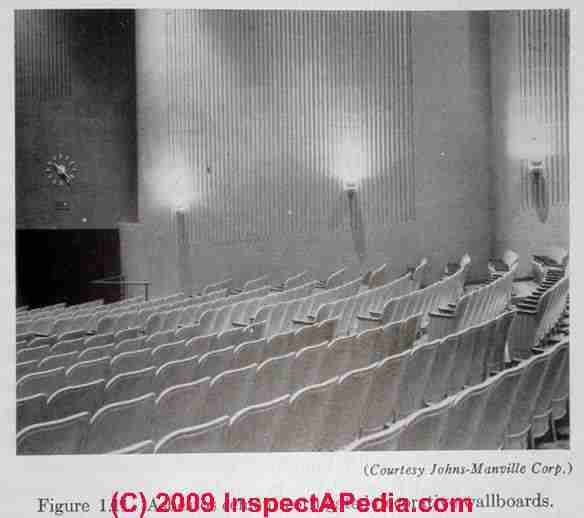
- Asbestos Wall coverings,
such as asbestos-fiber reinforced papers and - Asbestos Wallboard: used as fireproofing in a cement-asbestos form on furnace and boiler room ceilings and walls, and corrugated decorative wallboard used in theaters. Photo above is from Rosato.
Fire-rated gypsum board or drywall also contained asbestos
Gypsum Wallboard (drywall) joint compound contained asbestos.
See details at ASBESTOS MILLBOARD
See DRYWALL ASBESTOS CONTENT
Asphalt impregnated felt backed wallboard or tileboard was used in areas where moisture resistance was important such as in bathroom or kitchen tile board products. Examples of faux-tile wallboard (and possibly ceiling) products include Asbestolux wallboard (Amosite fibers) and wallcoverings, Peerless wallboard, Utilitye Wall Board (cardboard laminated together with asphalt).
Synonym: Bitumen-impregnated felt backed wallboard or tileboard, used in bathrooms and kitchens ca 1900 - 1960.
See TWENTIETH-CENTURY BUILDING MATERIALS HISTORY AND CONSERVATION [PDF] Getty Conservation Institute, First published in 1995 as "Twentieth-Century Building Materials: History and Conservation" by Technical Preservation Services, National Park Service, U.S. Department of the Interior. ISBN 978-1-60606-325-5 (and currently at Getty Publications 1200 Getty Center Drive, Suite 500 Los Angeles, California 90049-1682 www.getty.edu/publications/ ) - Asbestos in water
See BUILDING & FABRIC ASBESTOS CONTAMINATION by WATER - Water heater Asbestos
used asbestos for water heater jacket insulation, more-likely as an asbestos lagging, a plaster-like cementious coating, or as a combination of asbestos lagging and corrugated asbestos paper insulation.
ASBESTOS SAFETY CARDS [PDF], U.K. HSE, retrieved 2018/07/29, original source: http://www.hse.gov.uk/asbestos/assets/docs/beware-asbestos-reference-cards.pdf
Also see INSULATE HOT WATER TANK? - Asbestos Welding rods
containing asbestos were produced in which asbestos was added to a potassium silicate to form a paint-on coating for wire electrodes used in arc welding.
Asbestos used in welding rods is described
at ASBESTOS OTHER PRODUCTS.
- Asbestos wick packing used for packing for piping, armor plate, etc.
- Asbestos Window putty -
asbestos was used as a filler in window putty used to secure glass panes. A window putty removal procedure is suggested by U. Washington. We suggest that in some cases it may be more economical to replace the window.
Other environmental and health agencies such as U. Washington EHS point out that window putty binds asbestos in a matrix - depending on its condition it may not be a hazard.
Here is a closeup photo of asbestos-containing window putty from the 1950's vintage steel casement windows shown at left. This putty was tested and confirmed to contain asbestos fibers and filler.
If the window putty is cracked, drilled, sanded, or otherwise disturbed, it could result in the release of asbestos fibers into the air that could present a health risk.
OSHA has cited contractors for exposing workers to asbestos during window renovations (June 1997) Window putty is normally on the exterior of windows: it is unlikely that it will release measurable levels of asbestos fibers indoors except during remodeling or demolition.
Based on their age, we would have guessed that the steel casement windows shown in our photo (above left) included both lead paint and asbestos-containing window putty. Lab tests confirmed that the window putty contained asbestos.
The building owner was able to significantly reduce the cost of removing this asbestos material by having the contractor remove the entire windows intact rather than attempting to remove every inch of putty from the frames.
The windows were replaced with newer more energy-efficient units.
- Asbestos in Woodstoves
gasket materials used in doors and also between some wood stove sections; possibly also on some coal stoves and other similar appliances; heat reflectors and heat protection coverings for woodstoves were made of asbestos millboard or cement board, or metal-covered asbestos material.
We have observed that metal covered asbestos heat shields used a soft friable asbestos board product. - Asbestos yarns, such as used to make asbestos cloth, gas mantles, fire hoses
See ASBESTOS TEXTILES
Asbestos ropes used as gaskets are discussed
at ASBESTOS PACKINGS & GASKETS.
...
Reader Comments, Questions & Answers About The Article Above
Below you will find questions and answers previously posted on this page at its page bottom reader comment box.
Reader Q&A - also see RECOMMENDED ARTICLES & FAQs
Is clothes dryer electric wire an asbestos worry?
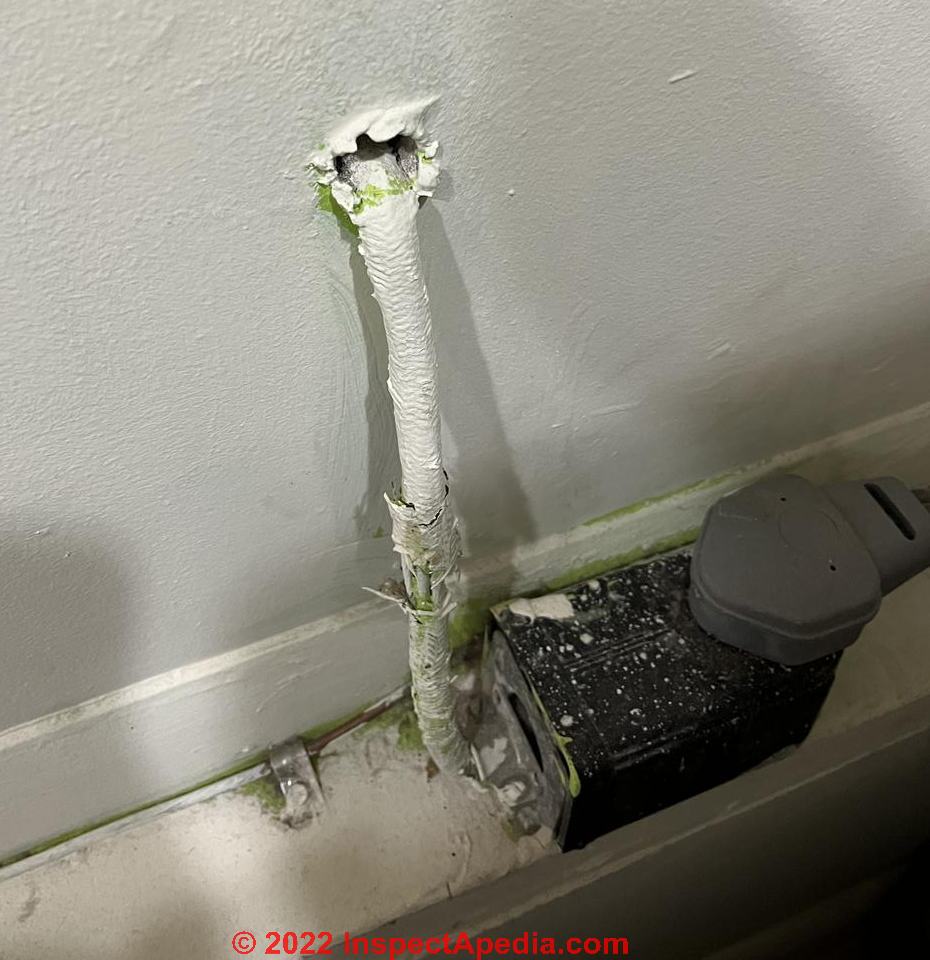
Hi, this is behind the dryer and hooks to some sort of box which then connects to the dryer. I’m concerned what the contents might be? House is built in 1963 - On 2022-08-08 by Jake C
Reply by InspectApedia-911 (mod)
@Jake C,
Looks like frayed electrical cable that needs replacement.Followup by Jake
@InspectApedia-911, thanks for the quick response! Would this contain asbestos? Also thanks so much for your help! Is there a way to donate to your site?
Reply by InspectApedia-911 (mod) - does 1960s residential-use wire insulation use asbestos
@Jake,
It'd be unlikely but not impossible for 1960s residential-use wire insulation to use asbestos. Asbestos was used in some electrical wire insulation however.
Take a look at
DOES THIS MATERIAL CONTAIN ASBESTOS? - 5 easy questions to tell if a BUILDING MATERIAL probably contains asbestos
and also
ASBESTOS ELECTRICAL WIRE INSULATION
Thank you for offering to donate to InspectApedia. But please don't send us money. InspectApedia is supported by a small advertising income from Google Ads - annoying to some but permitting us to maintain the website.
Your most- helpful contribution is in the form of questions, content suggestions, photos, criticism. Working together makes us smarter.
Thanks.
Was it common to use asbestos in firebricks in the 1940's?
Wondering how common it was to use asbestos in firebricks in the 1940's? We are renovationg a 1940's house that had tile all over the fireplace.
We broke off the tile off recently. I had tested the mortar and brick on the outer portion, (hearth/mantle) of the fireplace that was negative, but never thought about the inside having different brick.
I have seen so many mixed opinions on this so wanted to check on here. I know it has been found in firebricks but didn't know how common it was in the 40's. - On 2022-08-06 by robby b
Reply by InspectApedia-911 (mod) -
@robby b,
Fire-brick, by which I think you mean the bricks used to form the actual fire chamber in a fireplace, was hard-fired clay intended to withstand high temperature. Some of those might contain asbestos but in my opinion that wasn't common.
More clearly: asbestos was not regularly used in refractory fire-brick.
For example discussion of this question, see
Paglietti, Federica, Sergio Malinconico, Beatrice Conestabile della Staffa, Sergio Bellagamba, and Paolo De Simone. "Classification and management of asbestos-containing waste: European legislation and the Italian experience." [PDF] Waste management 50 (2016): 130-150.
copy at https://inspectapedia.com/hazmat/Asbestos-Containing-Waste-Paglietti.pdf
Asbestos was more likely in fake logs in gas fireplaces and in fire-backs used in other gas heating equipment including fireplace inserts.
Is there asbestos in an old "fake brick" wall indoors?
Would an internal fake brick wall in an old hall be likely to have asbestos sheeting behind it? - On 2022-05-30 by Susan Stewart
Reply by InspectApedia-911 (mod) - Would fake brick wall be likely to have asbestos sheeting behind it?
@Susan Stewart,
Normal residential wall construction uses drywall and joint compound on wood or metal studs, over which someone might have built a brick veneer. (That's what I'm guessing you mean by "fake brick wall".)
Older drywall (you don't give location nor building age) may contain asbestos and certainly joint compound did.
A fire-resistant wall would have been of different construction and might have used asbestos such as cement ASBESTOS MILLBOARD
But my goodness: behind a brick veneer wall? Asbestos isn't radioactive. It won't creep through a brick wall; as long as you're not demolishing or hacking into the wall there's no detectable possible asbestos effect from what's behind it.
Does this fiberglass grain silo have asbestos?

Hi there. We have an old grain silo on our recently purchased farm that we would like to dispose of but are concerned it could be asbestos? It looks like fibreglass. Advice welcomed

On 2022-03-09 by claire

by Inspectapedia Com Moderator -
@claire,
Thank you for the photos and interesting question about the use of asbestos in agricultural silos and, as perhaps in your photo, smaller storage tanks.
It's a fair question to ask, since fire hazards have always been a significant worry at silos, barns, and other agricultural buildings.
And indeed some research has reported the use of asbestos in silos, as I'll cite below. The most common use of asbestos in those environments was in cement-asbestos sheets and in some cement-asbestos or asphalt-asbestos roofing products.
While a photo examination is by no means an exhaustive lab test, the material in your photos looks to me like heavy fiberglass.
I can't say what might have been used to coat or paint it, however. Asbestos was used in silo roof or wall coatings.
If you avoid grinding sawing or otherwise making a dusty mess, it's not likely that this silo would present a measurable airborne particle (or asbestos) hazard.
Please find your question and photos and our more detailed reply now online at
ASBESTOS in SILOS
Does this crumbly foam insulation in our walls contain asbestos?
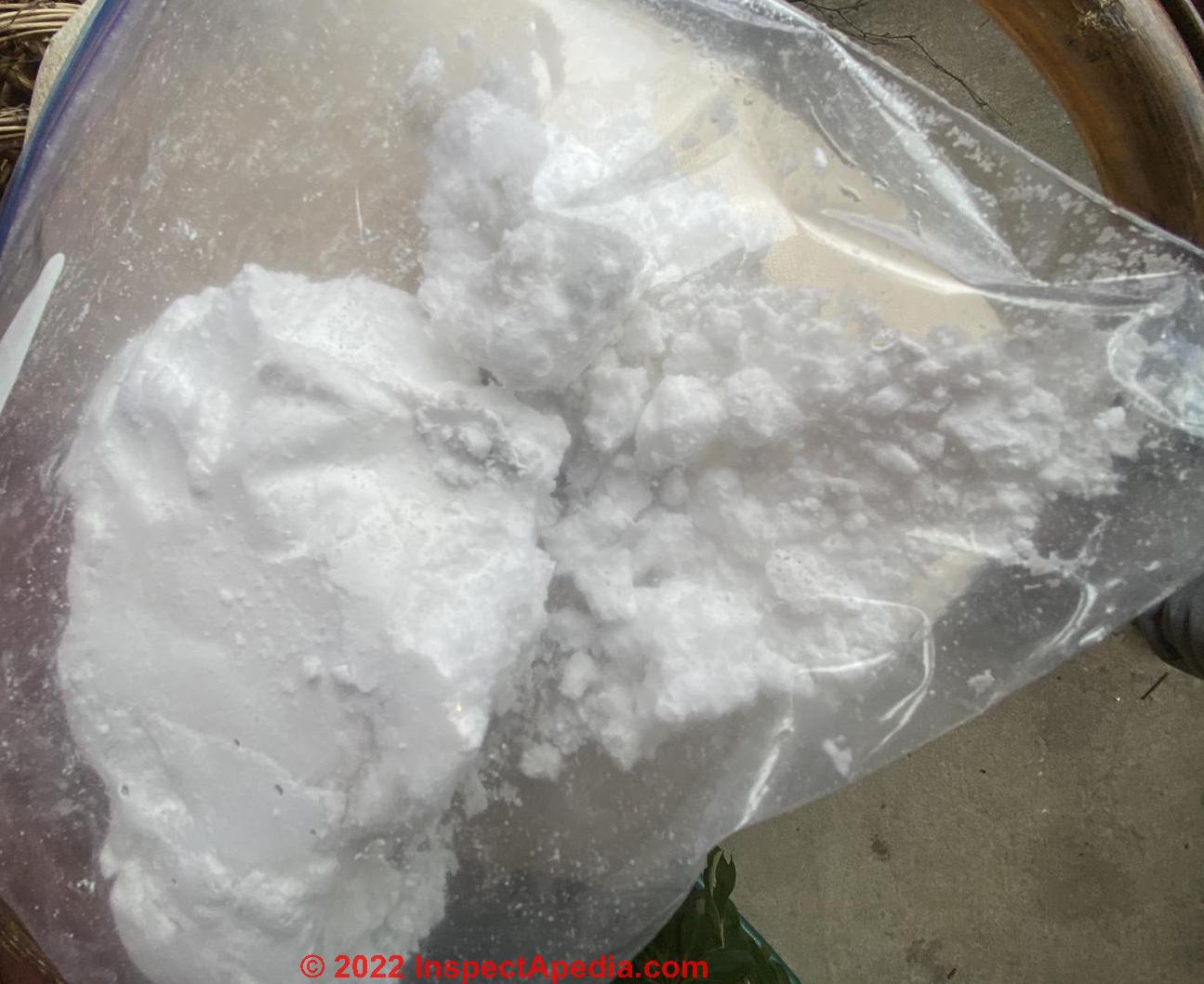
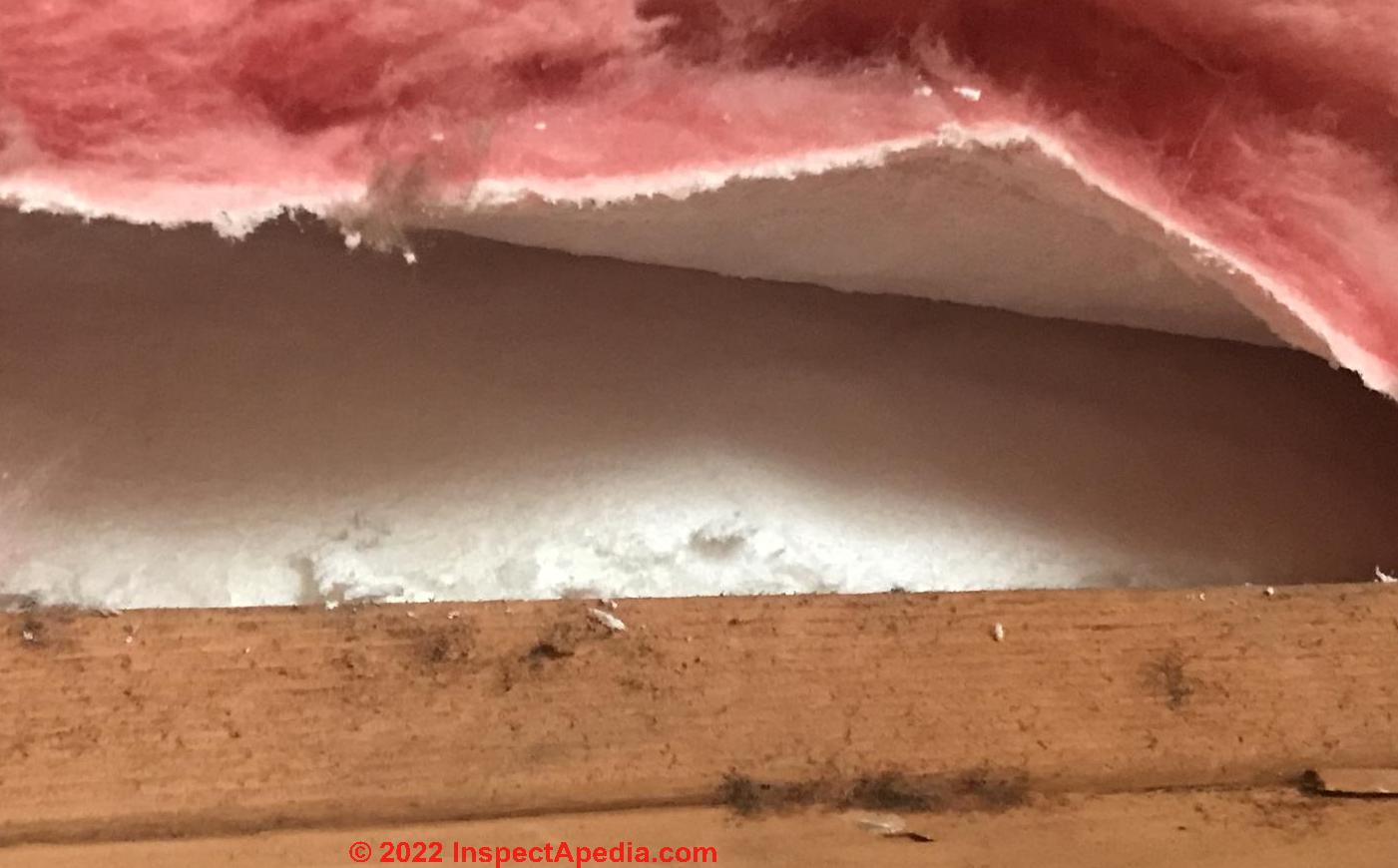
We are taking walls out of our 1972 home that has 3% asbestos in the drywall.
After removing the drywall we found this white substance behind our owens corning insulation.
It looks like foam and turns to powder if touched. Does this look like asbestos to you?
On 2021-12-29 by Martha Herr
by Inspectapedia Com Moderator - UFFI insulation looks like foam and turned to powder if touched
@Martha Herr,
That is almost certainly a spray foam insulation product. Not asbestos. UFFI was popular in the 1970s and you can read about itUREA FORMALDEHYDE FOAM INSULATION, UFFI - topic home,
Does Particle Board Contain Asbestos?
 Does particle board contain asbestos? Attached is a pic showing the particle board that is present throughout our home which was built in 1974.
The main subfloor is 1-1/2" tongue and groove planks with the particle board on top of that.
The picture [above] is from our living room which is a sunken (by about 4") living room, and what's shown is the face of the edge of the room where it steps up to the adjacent hallway.
I'm going to get a sample of the vinyl sheet and glue tested for asbestos, but removing a sample of the particle board would be difficult to do with disturbing it too much. - On 2021-08-18 by David
Reply by inspectapedia.com.moderator (mod) - No. particleboard is a wood product, not asbestos
@David,
"Particleboard" is a reconstituted wood product: made of wood or cellulose chips, sawdust, planer shavings, compressed and combined with a binder adhesive. It's not an asbestos product.
See details at
PARTICLEBOARD PROPERTIES & MANUFACTURE [PDF]
U.S. EPA, Environmental Protection Agency, retrieved 2021/08/17 original source: https://www3.epa.gov/ttnchie1/ap42/ch10/final/c10s06-2.pdf
More details are at
DEFINITIONS, ENGINEERED WOOD HDF LDF LVL MDF MDO OSB
Follwup by David
@inspectapedia.com.moderator,
Thanks very much for your help! I really appreciate your website,
I've been referring to it for years and it's been really helpful!!!
I want to work on my heating equipment - does it contain asbestos?
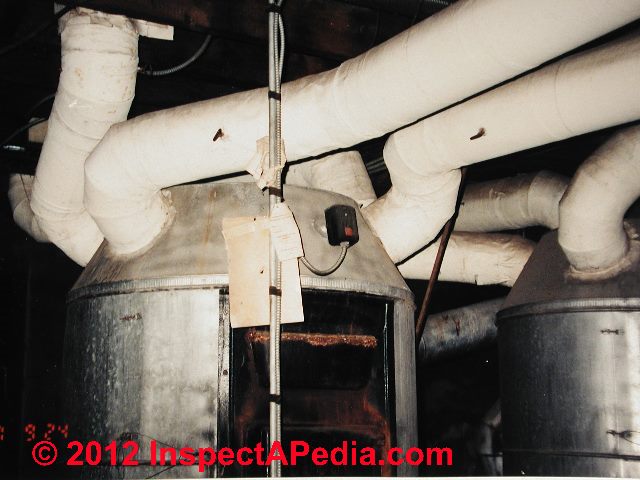
Thank you for your website. I would like to do the work on my furnace safely, and knowing if that material contains asbestos would be helpful. - Mark Seashock
Reply: Examples of visibly detected asbestos on heating equipment
Mark, in our articles and photos there are quite a few of asbestos insulation installed on heating equipment, mostly boilers, and I have found asbestos corrugated paper insulation right inside the air plenum some older heating furnaces as well as of course ubiquitous asbestos pipe insulation, and paper duct wrap (photo above).
Some of these materials are unmistakably asbestos-containing as there were not other look-alike products that did not contain asbestos.

In other cases, such as pipe lagging and plasters used on piping elbows, the material content may be more uncertain.
If you are in doubt, do not disturb the material, and don't run a conventional (non-HEPA) vacuum cleaner to clean up dust and debris in the area before you have had an inspection by an expert and/or testing by a certified asbestos testing laboratory.
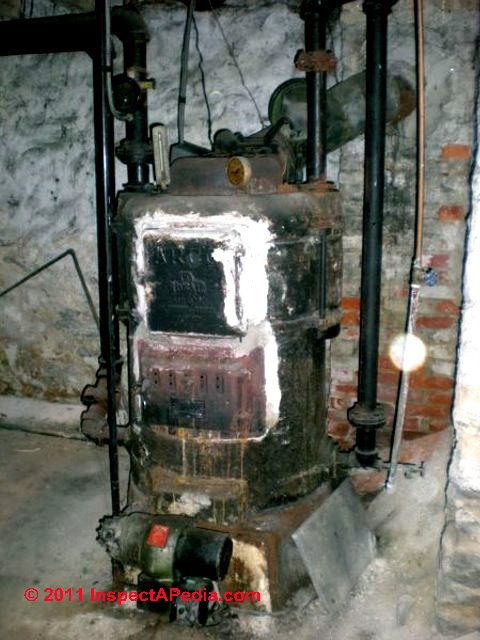
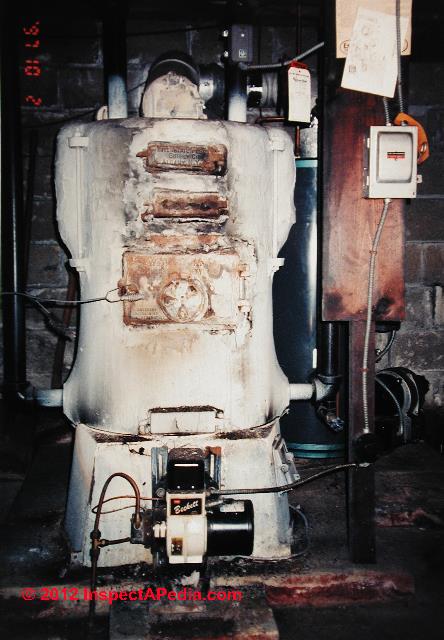
Our photo (above left) shows a coal-fired heating boiler converted to an oil burner, from which asbestos insulation was almost certainly removed. What about that white cementious plaster sealing the combustion chamber doors?
Apparently it was added after the asbestos jacket was removed. Uncertain? Test it. Our photo, above right, shows a traditional asbestos-insulated heating boiler of similar vintage. More details are at


- Asbestos Heating Boilers & Heating furnaces: vibration damper
material, typically located between the blower compartment and the supply plenum, may be asbestos-based cloth on older furnaces.
See ASBESTOS DUCT VIBRATION DAMPENERS.
Asbestos was used for door insulation on heating boilers. Hot water boilers were coated with a thick asbestos insulating paste; other models used corrugated asbestos paper insulation. - Asbestos Heating & air ducts (HVAC) containing asbestos
included transite pipe used in building slabs- see
Guide to Identifying Asbestos Transite Chimneys, Flues, & Pipes, also vibration dampers in air ducts and paper air duct wrap on heating systems.
See ASBESTOS AIR DUCTS
and ASBESTOS DUCT VIBRATION DAMPENER
Thank you to our readers for their generous comments
Followup by Jake
Also thanks so much for your help! Is there a way to donate to your site?
On 2021-09-23 by Anonymous
Thank you very much for all your help! This site is the best!
On 2021-09-26 by bathroom pipes asbestos
Thanks a lot for your help!
@InspectApedia-911, thanks for the quick response! Would this contain asbestos? Also thanks so much for your help! Is there a way to donate to your site? - Jake
Thank you for your website. I would like to do the work on my furnace safely, and knowing if that material contains asbestos would be helpful. - Mark Seashock
On 2021-09-27 by Anonymous
@inspectapedia.com.moderator, Thank you very much for explanation! Love your page and that you are helping people! You helped me a lot thank you so so much!
On 2021-08-18 by David
@inspectapedia.com.moderator,
Thanks very much for your help! I really appreciate your website, I've been referring to it for years and it's been really helpful!!
On 2017-11-15 by Tracy
Great resource and first rate research!
On 2021-05-04 by Mag
thank you very much This site is very helpful !
...
Continue reading at ASBESTOS LIST of PRODUCTS or select a topic from the closely-related articles below, or see the complete ARTICLE INDEX.
Or see ASBESTOS PHOTO GUIDE to MATERIALS FAQs - questions and answers posted originally on this page
Or see these
Recommended Articles
- ASBESTOS IDENTIFICATION IN BUILDINGS - home
- ASBESTOS LIST of PRODUCTS
- ASBESTOS PRODUCING COMPANIES & TRUSTS
- ASBESTOS PHOTO GUIDE to MATERIALS
- ASBESTOS PRODUCTS BANNED vs PERMITTED U.S. 2023
- COMMON OCCURRENCES OF ASBESTOS
- DOES THIS MATERIAL CONTAIN ASBESTOS? - 5 easy questions to tell if a BUILDING MATERIAL probably contains asbestos -
- HAZARD vs RISK - what's the difference, why you should care
Suggested citation for this web page
ASBESTOS PHOTO GUIDE to MATERIALS at InspectApedia.com - online encyclopedia of building & environmental inspection, testing, diagnosis, repair, & problem prevention advice.
Or see this
INDEX to RELATED ARTICLES: ARTICLE INDEX to ASBESTOS HAZARDS
Or use the SEARCH BOX found below to Ask a Question or Search InspectApedia
Ask a Question or Search InspectApedia
Share this article:Ask a Question or Search the InspectApedia website using the box just below.
Need to make a private comment? Email editor@inspectApedia.com. We welcome email with your website content critique, corrections, suggestions or questions. Email is monitored daily but our workload may prevent an immediate reply. For immediate results, we hope you'll first try asking your question using the search box just above.
Citations & References
In addition to any citations in the article above, a full list is available on request.
- [1] ASBESTOS HISTORY & PROPERTIES [Book online] D.V. Roasato, engineering consultant, Newton MA, Reinhold Publishing Co., NY, 1959, Library of Congress Catalog No. 59-12535. We are in process of re-publishing this interesting text. Excerpts & adaptations are found in InspectApedia.com articles on asbestos history, production & visual identification in and on buildings.
- [2] "Asbestos in Plastic Compositions", A.B. Cummins, Modern Plastics [un-dated, pre 1952]
- [3] "Asbestos in Your Home," Spokane County Air Pollution Control Authority, Spokane WA 509-477-4727 www.scapa.org provides a one-page image, a .pdf file drawing of a house warning of some possible sources of asbestos in the home. The sources are not ranked according to actual risk of releasing hazardous levels of airborne asbestos fibers and the list is useful but incomplete.
- [4] The US EPA provides a sample list of asbestos containing products epa.gov/earth1r6/6pd/asbestos/asbmatl.htm
- [5] "Characterization of asbestos exposure among automotive mechanics servicing and handling asbestos-containing materials", Gary Scott Dotson, University of South Florida, 1 June 2006, web search 3/9/2012 original source: scholarcommons.usf.edu/cgi/viewcontent.cgi?article=3505&context=etd [copy on file as /hazmat/Automotive_Asbestos_Exposure.pdf ].
- [6] Photos of theater wiring possibly containing asbestos are from http://filmhacks.wordpress.com/2007/07/10/photos-and-a-question/ - used by permission, September 2008. Thanks to randomblogmail
- [7] Thanks to Susan Kimball, Argus Pacific Corp., Puget Sound, WA, for pointing out that some products are permitted to contain more than 1% asbestos fibers by current standards provided that the fibers are encapsulated in an appropriate binder. Argus Pacific, in Seattle, WA 98119, 206.285.3373, is an industrial hygiene firm who also provide OSHA and DOSH regulated training in Washington State, providing classes in asbestos, lead, mold, hazardous waste, emergency response, and other occupational health, safety, and professional development topics. -- September 2008.
- [8] " Work Practice for Window Removal and Window Putty Patching With Less Than Or Equal To 1% Asbestos Window Putty and Caulking" University of Washington, 2002 http://www.washington.edu/admin/asbestos/1putty.html
- [9] How do I Manage Asbestos in our House or Apartment Building?, Illinois Department of Environmental Conservation, provides this article at http://www.epa.state.il.us/small-business/asbestos-in-home/
- [11] Damian Murphy, Marin OHS&E Consulting,Mairin OHS&E Consulting Pty Ltd 18-20 Kirk Street Moe Vic 3825 P: 03 5127 2311 F: 03 5127 2399 E: enquiries@mairin.net.au, personal correspondence to Daniel Friedman. 3/12/2013 Website: www.mairin.net.au
- [12] Asbestos in buildings - employee notice, University of Washington dept. of Environmental Safety, http://www.ehs.washington.edu/ohsasbestos/index.shtm
- [13] Window putty to be exempted from asbestos removal by State of Maine - http://list.uvm.edu/cgi-bin/wa?A2=SAFETY;wYpdKg;20010307113643-0500A
- [14] EPA Region 6 identifies window putty as asbestos containing - http://www.epa.gov/earth1r6/6pd/asbestos/asbmatl.htm
- June 1997 - Window Putty - OSHA case cites contractor for asbestos exposure during removal of window putty http://www.osha.gov/pls/oshaweb/owadisp.show_document?p_table=NEWS_RELEASES&p_id=1091
- [15] Asbestos Identification and Testing References
- Asbestos Identification, Walter C. McCrone, McCrone Research Institute, Chicago, IL.1987 ISBN 0-904962-11-3. Dr. McCrone literally "wrote the book" on asbestos identification procedures which formed the basis for current work by asbestos identification laboratories.
- Stanton, .F., et al., National Bureau of Standards Special Publication 506: 143-151
- Pott, F., Staub-Reinhalf Luft 38, 486-490 (1978) cited by McCrone
- [16] EM>ASBESTOS IN YOUR HOME U.S. EPA, Exposure Evaluation Division, Office of Toxic Substances, Office of Pesticides and Toxic Substances, U.S. Environmental Protection Agency, Washington,D.C. 20460
- "Handling Asbestos-Containing roofing material - an update", Carl Good, NRCA Associate Executive Director, Professional Roofing, February 1992, p. 38-43
- [17] EPA Guidance for Controlling Asbestos-Containing Materials in buildings, NIAST, National Institute on Abatement Sciences & Technology, [republishing EPA public documents] 1985 ed., Exposure Evaluation Division, Office of Toxic Substances, Office of Pesticides and Toxic Substances, U.S. Environmental Protection Agency, Washington,D.C. 20460
- [18] EPA ASBESTOS MATERIALS BAN: CLARIFICATION 1999
- [19] Building Failures, Diagnosis & Avoidance, 2d Ed., W.H. Ransom, E.& F. Spon, New York, 1987 ISBN 0-419-14270-3
- [20] Asbestos products and their history and use in various building materials such as asphalt and vinyl flooring includes discussion which draws on ASBESTOS, ITS INDUSTRIAL APPLICATIONS, ROSATO 1959, D.V. Rosato, engineering consultant, Newton, MA, Reinhold Publishing, 1959 Library of Congress Catalog Card No.: 59-12535 (out of print, text and images available at InspectAPedia.com).
- In addition to citations & references found in this article, see the research citations given at the end of the related articles found at our suggested
CONTINUE READING or RECOMMENDED ARTICLES.
- Carson, Dunlop & Associates Ltd., 120 Carlton Street Suite 407, Toronto ON M5A 4K2. Tel: (416) 964-9415 1-800-268-7070 Email: info@carsondunlop.com. Alan Carson is a past president of ASHI, the American Society of Home Inspectors.
Thanks to Alan Carson and Bob Dunlop, for permission for InspectAPedia to use text excerpts from The HOME REFERENCE BOOK - the Encyclopedia of Homes and to use illustrations from The ILLUSTRATED HOME .
Carson Dunlop Associates provides extensive home inspection education and report writing material. In gratitude we provide links to tsome Carson Dunlop Associates products and services.
 |
HOME | ABOUT | ASK a QUESTION | CONTACT | CONTENT USE POLICY | DESCRIPTION | POLICIES | PRIVACY | |
| © 2026 - 1985 Publisher InspectApedia.com - Daniel Friedman | |||||||||