
InspectAPedia® FREE Encyclopedia of Building & Environmental Construction, Diagnosis, Maintenance & Repair |
Question? Just ask us! InspectAPedia
|
 Asbestos Ceiling Tile Identification
6 Easy Steps to tell if CEILING TILES are likely to contain asbestos
- POST a QUESTION or COMMENT about how to identify ceiling tiles that contain asbestos
Asbestos-containing ceiling tiles: identification, risk reduction, action plan.
Some but not all old ceiling tiles contain asbestos.
Here we discuss how to recognize & handle ceiling tiles that may contain asbestos. We describe the appearance, ingredients, years of manufacture, history, and producers of various types of ceiling tiles & coverings as an aid in determining whether or not a particular ceiling covering or tile is likely to contain asbestos.
This document assists building buyers, owners or inspectors who need to identify asbestos materials (or probable-asbestos) in buildings by simple visual inspection.
InspectAPedia tolerates no conflicts of interest. We have no relationship with advertisers, products, or services discussed at this website.
Asbestos-containing Ceiling Tiles: Examples of materials that might contain asbestos fibers
 Asbestos may have been used in the ceiling tile tiles and in lay-in ceiling tiles in suspended ceilings in the tile body or in paper facing or backing on the ceiling tiles; asbestos was also a common ingredient in some mastic adhesives used for glue-up application of ceiling tiles.
Asbestos-containing ceiling tiles are not considered friable but are soft enough that unnecessary sampling or disturbance may release asbestos dust and particles.
In addition, some ceiling tiles such as used in suspended ceilings may be holding a collection of asbestos-containing dust and debris (from other sources) on the hidden upper side of the tile.
In these articles we explain how to recognize and handle asbestos-suspect ceiling tiles or other ceiling or wall or building sheathing products.
[Click to enlarge any image]
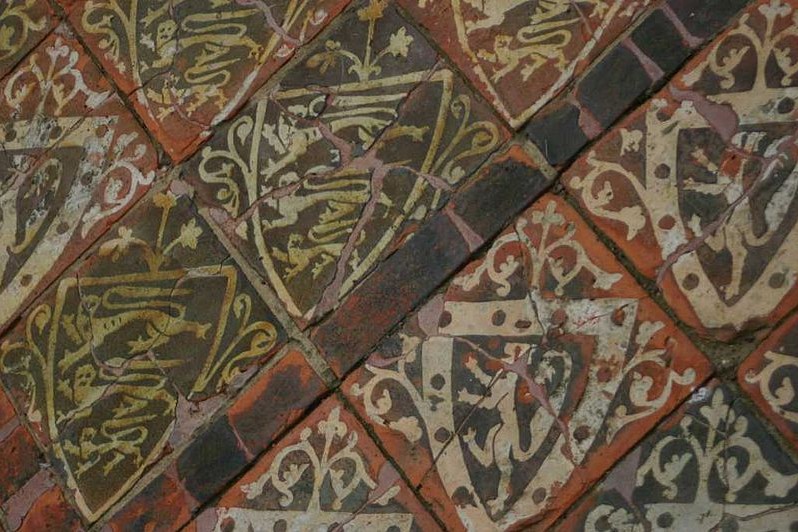
Photo above: An encaustic heraldic tile used on the ceiling at Cleeve Abbey, dating from the middle ages, late in the twelfth century. Cleeve Abbey, a Cistercian monastery was, in 1536, converted by Henry VIII to a country house as part of the dissolution of the monasteries. - Wikipedia.
These are ceramic tiles, not an asbestos product.
6 easy steps to make a guess at asbestos hazard from unknown ceiling tiles

- Look at the ceiling tile material:
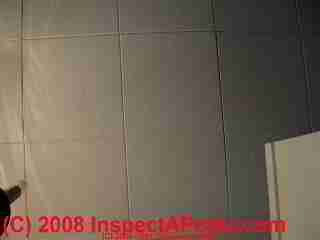
Some ceiling tiles or suspended ceiling drop-in panels are quite-obviously made of fiberglass - by visual inspection.
While it is not possible to identify all forms of asbestos by mere visual inspection, it is possible to identify some materials that are definitely not asbestos.
Fiberglass, like that in our photo shown here, is not an asbestos product. If your ceiling tile is homogeneous fiberglass it is not likely to contain asbestos unless by cross-contamination from another asbestos source.
Watch out: However, the presence of fiberglass fibers as an ingredient in some products does not allow us to rule out the presence of asbestos as well. Fiberglass and asbestos were combined in some products, particularly fabrics and yarns.
See details at FIBERGLASS ASBESTOS COMBINATIONS - Manufacturer's stamps or data on packaging:
Look for any evidence of the manufacturer: a stamp on the back of a tile, packaging left-over, records of the installation.
Often one can infer the date of manufacture of a product by ancillary stamps or statements such as compliance with laws or standards whose initial date is known. - Age of building:
Next consider the age of the home as a floor under the maximum age of the ceiling. If the building age is newer than the last date of use of asbestos in your country that can provide a credible "no asbestos" conclusion for the material in question. - Age of the ceiling itself:
Next consider the age of the ceiling, e.g. dates or records of renovations - for the same reason given in the question above.
Date threshold: If the ceiling was installed in the U.S. after the mid-1980's it's not at all likely to contain asbestos.
In other countries, the last date at which asbestos products including asbestos ceiling tiles were sold will differ.
See ASBESTOS MATERIAL REGULATIONS - where we provide asbestos last used, last sold or last imported dates for most countries. - Manufacturer statements:
If the ceiling is made by one of the manufacturers who assert their products never contained asbestos or who give specific dates after which production of asbestos-containing ceiling tiles ceased.
Keep in mind that a ceiling installed shortly after that production date could still contain asbestos if new old stock asbestos-containing ceiling tiles were used. - Test the material:
If you know nothing about the ceiling and can not remove it without making a dusty (and potentially hazardous) mess, then you may want to have a sample tested.
What forms of Asbestos were used in Ceiling Tiles?
Amosite asbestos, also a widely used form of asbestos, was used in some ceiling tiles as well as in roof and floor tiles.
Chrysotile asbestos, one of the most commonly used asbestos fibers, was used in production of some ceiling materials.
Crocidolite asbestos was also used in ceiling tile production.
Ceilings were also covered with cement-asbestos products as a fire barrier in boiler rooms and similar locations.
How to Recognize Asbestos suspect ceiling tiles
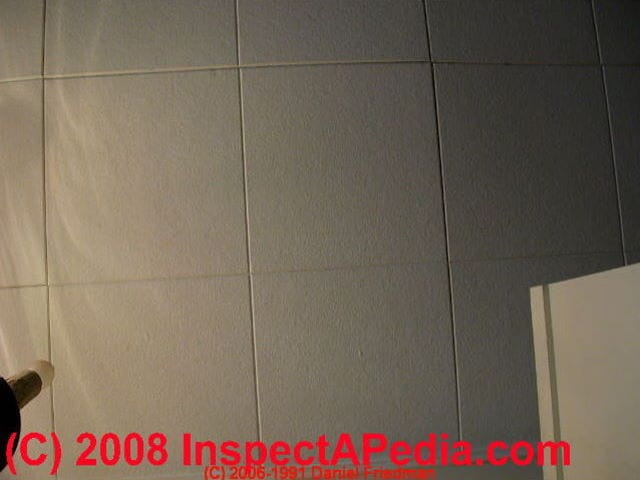
Some acoustic ceiling tiles contain asbestos. If renovation is planned, it may be smart to simply handle this material as if it contained asbestos particles.
In these photographs of older square ceiling tiles, the photo (above left) shows a smooth ceiling tile and the second photo (below left) an acoustic ceiling tile with its characteristic pattern of holes.
Both of these products might contain asbestos fibers, though the principal material is usually cellulose.
The larger suspended ceiling segment, 2'x4' in size (photo below left), was pushed aside to show the older layers of ceiling materials above.
The suspended ceiling tile, if made of fiberglass or cellulose is not a likely asbestos fiber source.
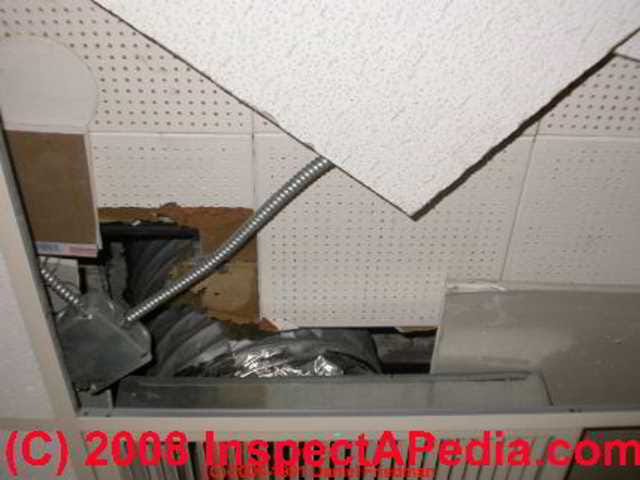
Our concern in this particular instance was that the entire cavity above the suspended ceiling was being used as an air conditioning return air plenum, exposing all of the building HVAC system and occupants to whatever particles were released by materials in the cavity, including possibly asbestos from the older layer of acoustic ceiling tiles.
The remediation contractor removed all of these layers to expose (and clean) the concrete ceiling above prior to installing a new suspended ceiling.
More Asbestos-Suspect Ceiling Tile Photographs
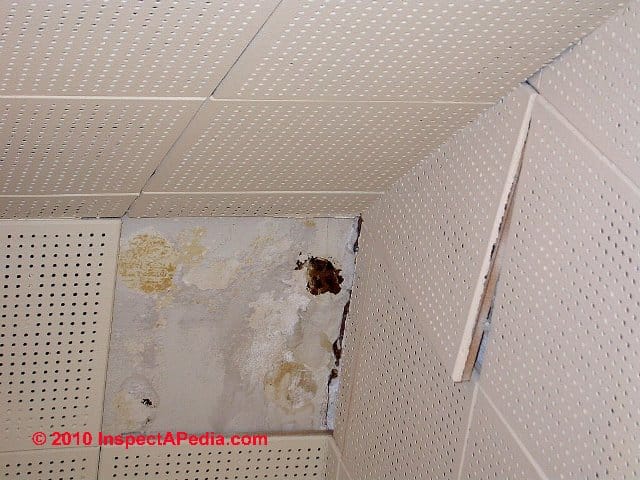
Our perforated acoustic ceiling tile photo above shows that these particular asbestos-containing ceiling materials were also sometimes applied to a vertical wall.
Below we show a different pattern of asbestos-suspect ceiling tiles found in a government building we examined in Poughkeepsie, NY.
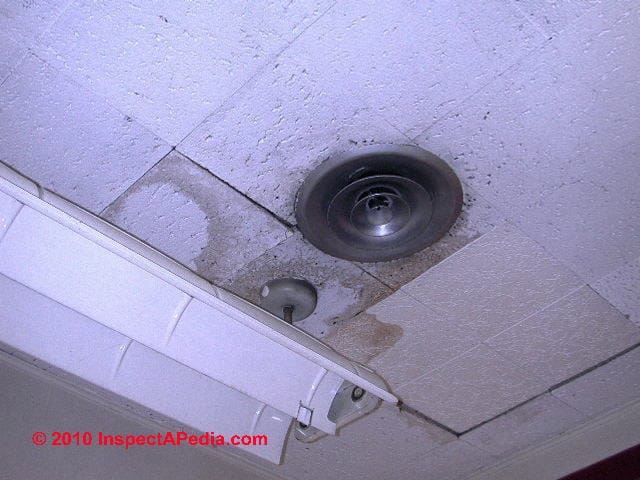
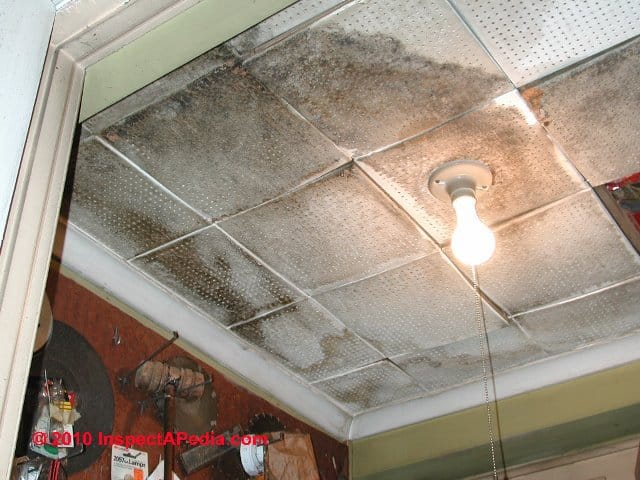
As you can see from the photographs shown here, these acoustic ceiling tiles over a wet area can support mold growth.
Also see MOLD INFORMATION CENTER.
List of Materials Used to Produce Ceiling Tiles & Ceiling Coverings
We moved this list to CEILING TILE MATERIALS - separate article.
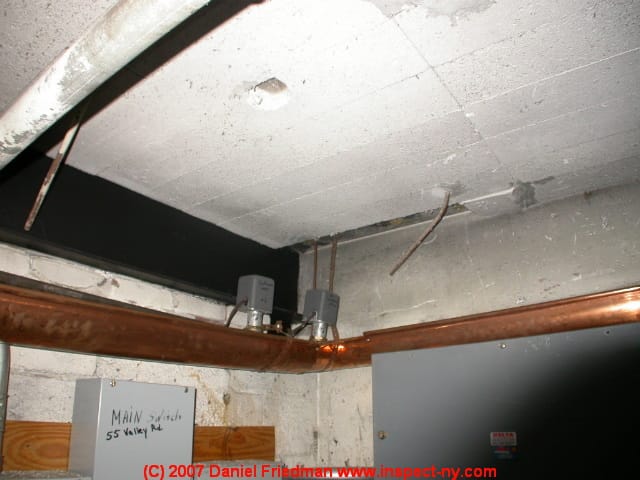
Our photo (above) shows tremolite asbestos panels glued to the ceiling over a basement of a commercial building in White Plains, New York.
Tremolite asbestos panels were used as a fire-proofing over a boiler room and where other heating equipment was installed.
Dates of Ceiling Tiles: age, appearance, types, materials, manufacturers help ID use of Asbestos
This discussion has moved
to ASBESTOS CEILING HISTORY / DATES
Which ceiling tile brands are reported to have contained asbestos? Which ceiling tiles are asbestos free?
This topic moved
to ASBESTOS CEILING TILE MANUFACTURERS
Reader Comments, Questions & Answers About The Article Above
Below you will find questions and answers previously posted on this page at its page bottom reader comment box.
Reader Q&A - also see RECOMMENDED ARTICLES & FAQs
On 2024-01-22 by JCD - was asbestos ever mixed with cellulose based ceiling tile products?
Hello - I've noticed some references throughout this website that imply that a cellulose based product might be expected to be mixed with asbestos:
"Asbestos was used in some Celotex products and/or may appear in some Celotex products such as cellulose-based insulating board depending on when and where the product was manufactured"
"But usually the yellow papery like material such as shown in your photo of the ceiling tile edge is cellulose - a wood product.
Making trouble for that assumption is the fact that there were some similar-looking ceiling tiles that did include asbestos, as we describe separately."
Based on many conversations with asbestos experts, I've never really heard of a purely wood-based ceiling tile or wood based board deliberately containing asbestos, except in the glue or adhesive holding the tile up to the ceiling (this is common) or in the paint on the tile surface, or a similar coating (this is very rare and many people have never seen it even over decades of experience).
Just wondering if you have come across a concrete example of a wood/cellulose ceiling tile containing asbestos within the tile material itself, or it's just a theoretical possibility (i.e., cross-contamination is possible). I haven't been able to find more concrete information on this website other than the references above which imply that a wood-based tile might contain asbestos.
On 2024-01-22 by InspectApedia Publisher (mod) - Asbestos is not found in plant-based (cellulose) ceiling tiles nor in cellulose-based fiberboard - with rare exceptions
@JCD,
Bottom line:
Asbestos is not found in plant-based (cellulose) ceiling tiles nor in cellulose-based fiberboard - with rare exceptions of cross-contamination or in one report by Kollman cited here.
Details:
Thank you, this is an important question; to clarify: in our article series on ceiling tiles and also fiberboard products we report that while cellulose products are generally a plant product and do not contain asbestos, there was at least one instance of reported cross-contamination when these plant-based (cellulose) products were manufactured at the same site where asbestos-based products were also being produced.
At SHEATHING, FIBERBOARD ASBESTOS CONTENT
we state
The history of fiberboard insulating products is interesting in that while the product itself is not an asbestos-based material, there were some questions of cross contamination with asbestos because of the manufacturing location of some brands.
Fiberboard is basically a plant-fiber based product.
and later on that same page:
There were reports of asbestos cross contamination in fiberboard made at the same site where asbestos containing products were made. Since Johns Manville produced a wide range of other products, some of which contained asbestos, you could see why or how the question arose.
However to date, except for Kollman (1975) I have not found scholarly studies nor other information that confirmed that wood fiberboard based insulating board did actually contain asbestos.
Also see FIBERBOARD SHEATHING IDENTIFICATION https://inspectapedia.com/structure/Fiberboard-Sheathing-Identification-Key.php
Concluding:
In my OPINION even in that case of asbestos cross-contamination into non-asbestos products like ceiling tiles or fiberboard, the level of asbestos in such products is most likely very low, and in all events, if these products are not being made into dust such as by demolition, sanding, chopping, sawing, the level of such asbestos is most-likely below the limits of detection and so not hazardous.
Citation:
- Kollmann, Franz FP, Edward W. Kuenzi, and Alfred J. Stamm. "Fiberboard." In Principles of Wood Science and Technology, pp. 551-672. Springer Berlin Heidelberg, 1975. [Significantly this article refers to the occasional blending of asbestos with wood fiber products.] Lundgren, S. Ake. "Hardboard as construction material—a viscoelastic substance." Holz als Roh-und Werkstoff 15, no. 1 (1957): 19-23.
[ cf p. 551 - This book is available from Utah State University, Springer and also online via Google Books and other sources - Ed.]
Continuing: here is the excerpt from Kollman p. 551
Perhaps, the best factor for classifying fiberboard is the density. This is internationally recognized. There is a rather simple difference between pressed and not pressed sheets hut the range of qualities is wide and there is an overlapping.
Another point which should be taken into consideration is the fact that wood fibers are blended occassionally with mineral fibers (such as asbestos), plastics and with other chemical additives.
Some half-hard fiberboard contain no less than 20% of thermoplastic bonding agents.
And thank you. That you took the time to post a question helps us see where we need to add or clarify information - workinig together helps us both.
On 2024-01-22 by JCD
@InspectApedia Publisher, thanks for the thorough response. This is really a tremendous resource for people who are planning home renovations to understand the precise nature of potential risks!
On 2023-11-27 by Anonymous - damaged ceiling tiles when fixing dryer vent - asbestos worry?
We had to fix a dryer vent, and some of the drop ceiling was damaged. I didn't think about it until afterwards that it may contain asbestos. I'll buy a test kit off Amazon too but wanted to get some opinions on the possibility.
The house was built in 1974 or 76, but I don't think the drop ceiling was added until way later in the eighties.
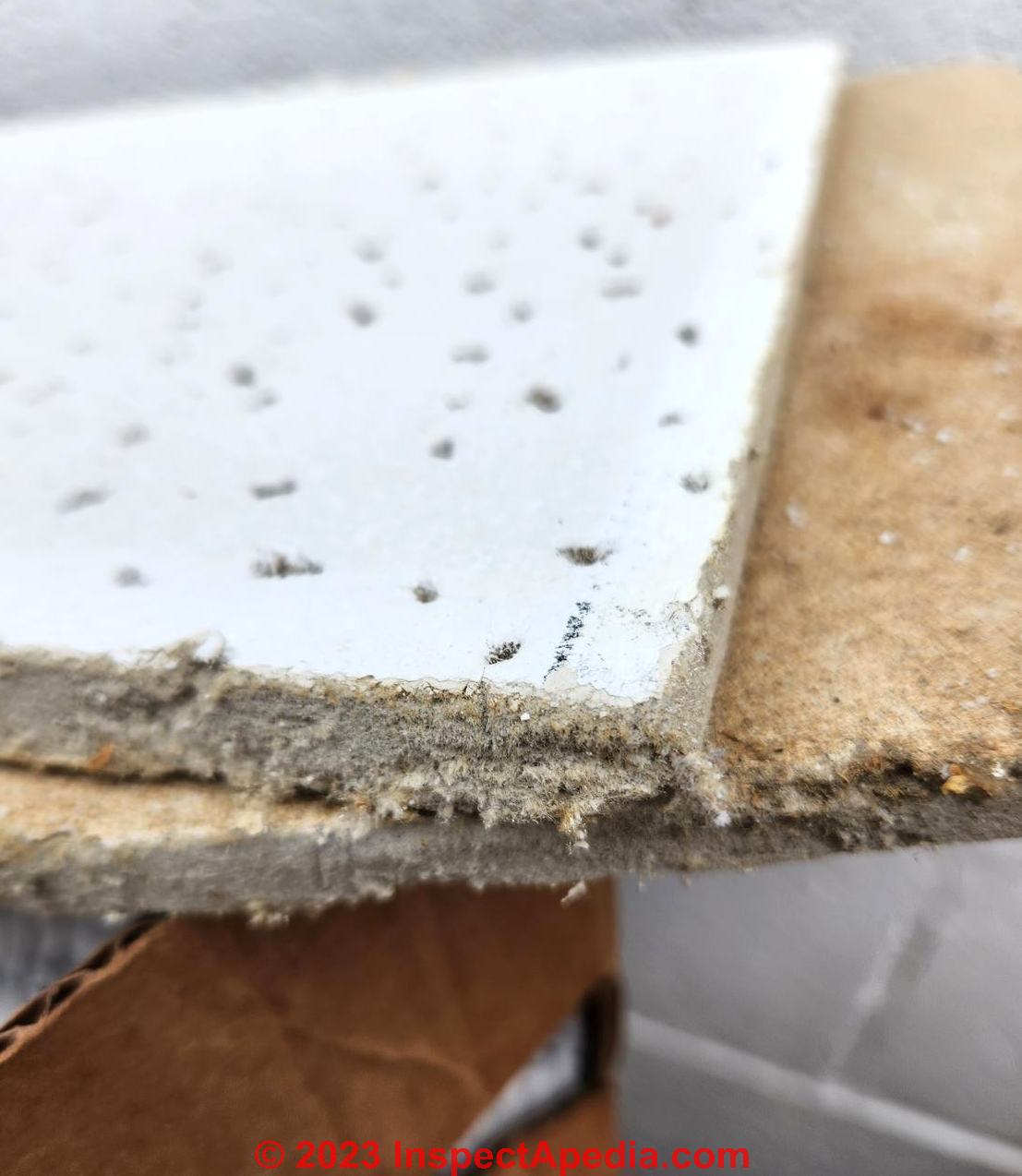
On 2023-11-27 by InspectApedia Publisher - can't be certain of its asbestos content by visual inspection alone
@Anonymous,
Unfortunately for acoustic ceiling tile like that one we can't be certain of its asbestos content by visual inspection alone, but I can suggeste that you simply damp wipe up any dust and avoid chopping, grinding, or sawing those tiles to make more of a mess.
IF the ceiling tile is in the U.S. and was made after around 1986 it's not at all likely to contain asbestos.
https://inspectapedia.com/hazmat/Current-Asbestos-Containing-Products-US.php
ASBESTOS PRODUCTS BANNED vs PERMITTED U.S. 2023
is as specific as one can get on this question without having a **** SPECIFIC ASBESTOS TEST REPORT on a SPECIFIC INDIVIDUAL PRODUCT ****
Any further, answer, with respect we must explain, is simply so speculative as to be unreliable.
On 2023-11-10 by Bystanding Bob - so ceiling tiles with asbestos weren't banned but manufactureres quit using asbestos?
@InspectApedia Publisher, so ceiling titles were not banned, but manufactures themselves stopped using them.
Do you know anything about aftermarket car components like brake pads? I know they were not banned also, but most said only in aftermarket product.
would ceiling tiles installed at 2012 contain asbestos
is there any detail like even the use of asbestos in ceiling tiles is not banned, then would there be any restriction like it can only be used in specialuse or setting?
is it likely that some small factory product produce ACM ceiling?
do today's fissured Ceiling Tile contain asbestos? i saw they are mostly made by armstrong
On 2023-11-09 by InspectApedia Publisher (mod)
@Anonymous,
All of your ceiling tile asbestos questions are answered in detail in the article above on this page. Please take a look and do let me know if you find any of that unclear.
On 2023-11-09 by Bob
@InspectApedia Publisher, they banned it right? in us
On 2023-11-02 by InspectApedia Publisher
@Bob
If the ceiling was installed in the U.S. after the mid-1980's it's not at all likely to contain asbestos.
In other countries, the last date at which asbestos products including asbestos ceiling tiles were sold will differ.
On 2023-11-01 by Bob
@InspectApedia Publisher, does it still contsin asbestos today?
On 2023-11-10 by Moderator
@Anonymous,
As a bystander watching all this, I must say that
You seem to be asking many similar questions but not reading nor understanding authoritative texts already here. Please take a look at the article above.
On 2023-11-10 by Bystanding Bob
@Bystanding Bob, upon reading your articles I do understand, but what I am worry about is minor factory using asbestos and whether it is used in residential cases. basically i am just worrying about possible residential uses.
On 2023-10-30 by Anonymous - do ceiling tiles with small holes contain asbestos?
are ceiling tiles that we see often has small holes on it, and usually very white contain asbestos?
On 2023-10-31 by InspectApedia Publisher - small holes in ceiling tiles = acoustic tile
@Anonymous,
The small holes in ceiling tiles that you name are usually an indicator that it's an acoustic ceiling tile.
That means it's intended to reduce building noise level.
It has nothing to do with whether or not it would contain asbestos.
Our best information on your question is in the article above.
Please take a look and let me know if any of that is unclear.
On 2023-09-10 by Diane Sandoval - wierd spongy tiles on the cieling

I am renovating a house I just got but the house has these wierd spongy tiles on the cieling not sure what it is made of or if it has asbestos but it is also glued on with a black adhesive.
The House is 1890s build in Kansas.
On 2023-09-10 by InspectApedia Publisher (mod) - asbestos ceiling tiles: Just looking isn't enough
@Diane Sandoval,
Unfortunately I can't tell just by looking at them whether or not those tiles definitely contain or don't contain asbestos. Same for the mastic adhesive.
If however as it appears from your photo the torn are cut edges of the tiles show that the material is gray white and its interior and I would consider it a possible asbestos containing material and treated accordingly.
The best option is to leave such suspect material in place and simply cover it over with a new layer of material such as drywall.
If you have to remove it and can't do so without creating potentially hazardous dust then it's worth having a sample tested.
So let us know your plans.
On 2023-07-14 by Steve Grauer - asbestos in these old ceiling tiles?
Our house was built in 1924.

We have a drop ceiling in the basement, although I am not sure when it was installed. Some tiles are loose and have become dislodged, and fallen to the floor. They appear to be mostly wood cellulose, but I wanted to get the opinion of an expert.
On 2023-07-21 by InspectApedia Publisher (mod) - these tiles look like cellulose - a plant product
@Steve Grauer,
I agree with you about the appearance of the tiles - looks like cellulose. Step through the tips above on this page to improve that guess and let me know what you think.
On 2023-06-01 by InspectApedia DF (mod) - do my 1986 Strata brand ceiling tiles contain asbestos?
@Anonymous,
Let’s start with telling us what country you live in, as the asbestos regulations will vary with regard to when it was banned.
The steps outlined above on this page give you our best advice on identifying whether your ceiling tiles contain asbestos or not. They take into consideration factors such as age, markings, location. It’s worth starting there.
Also above are links to different manufacturers of ceiling tiles and images found on those pages may help you with yours.
As far as removal of the tiles, please see our article
CEILING TILE REMOVAL PROCEDURES
https://inspectapedia.com/hazmat/Asbestos-Ceiling-Tile-Removal-Procedure.php
Now about your question:
Once removed, how do I safely get rid of the tiles?
The answer is - as Mark Cramer says ... it depends.
On where you live.
In most communities ceiling tiles can be disposed-of as construction waste.
On 2023-06-01 by Anonymous
I live in a Strata that was built in 1986. We are replacing suspended ceiling tiles in a Spa room. How do I identify if these tiles contain asbestos?
Or do I just assume they contain asbestos and wear breathing protection? It is a small area (about 50 square feet). Once removed, how do I safely get rid of the tiles?
On 2023-05-12 by ModestD - ceiling in Ontario library?
Hey,
I have recently started a new job and was told that white dust is falling from the ceiling on a ceiling that is known to contain ACM. The floor above has someone putting poles in place for volleyball and then dust falls into the area below. Would this be asbestos? The main ceiling is Transite/pegboard but this portion of the ceiling does not look like this. Here is a picture.
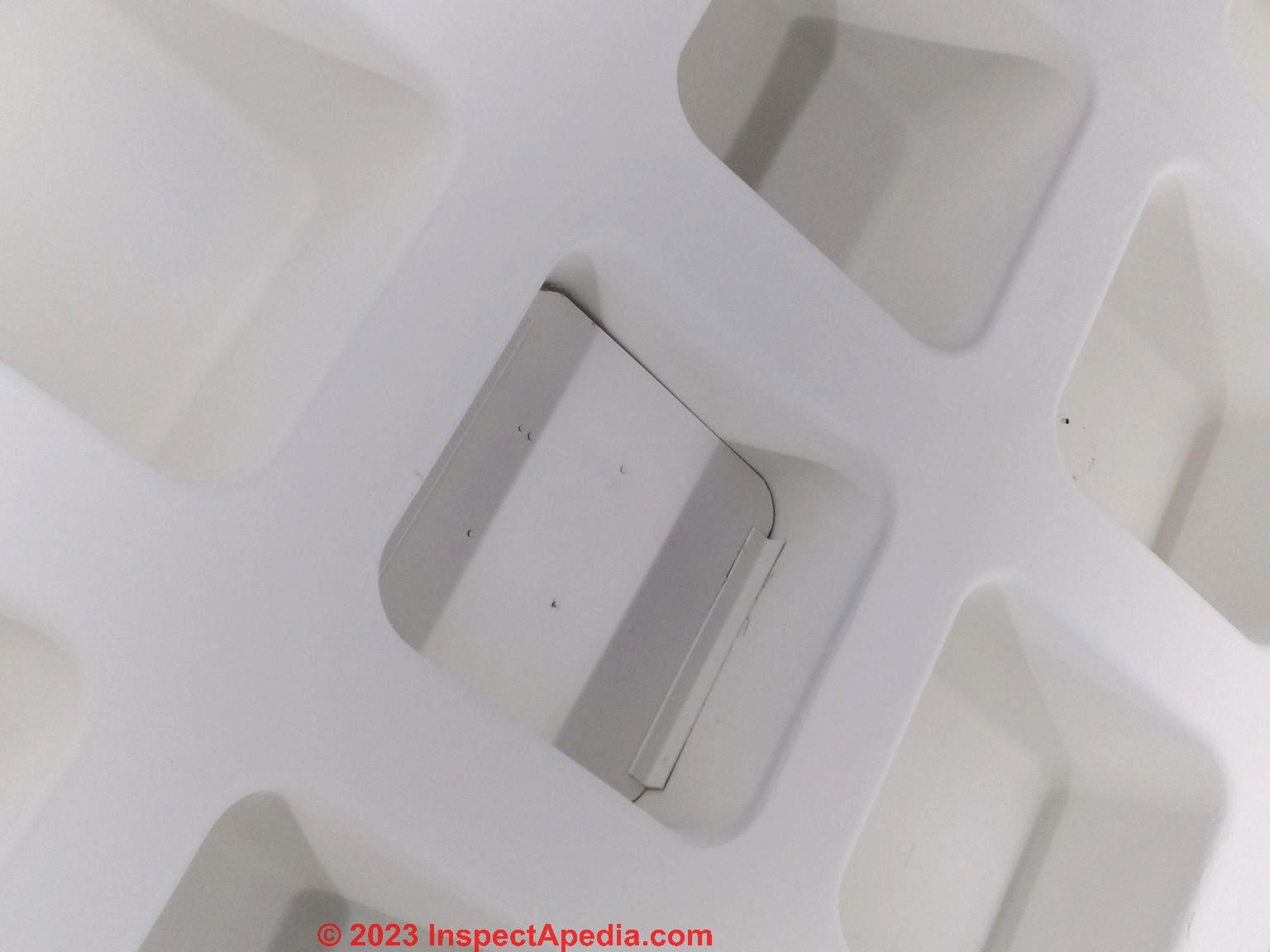
On 2023-05-12 by InspectApedia Publisher - Ontario library ceiling tiles hard to identify
@ModestD,
I'd like to be helpful but I don't know what the scale is of your photo and can't tell what we are looking at.
Transite asbestos is a term for a type of cement asbestos that was frequently used to make pipes and other cementious products.
"Pegboard" refers to a utility board with many small round holes used to contain pegs that serve as brackets to support things, is not a product I've seen made out of cement asbestos.
Your photo, if it's a close-up seems to show rectangular holes in some material. Is that an acoustic ceiling?
What's the location, country and city and if you don't know the age of the ceiling nor exactly what it is made of, it would be helpful to give the building age.
To say that you were told that asbestos dust is falling is a bit uncertain as a guideline.
Told by whom, of what authority and with what expertise and with what supporting information.
In most countries it would be illegal for a workplace to contain a known falling asbestos dust hazard.
In the US you would call OSHA to get help if that were the case.
Perhaps if you can give good more information we can provide more specific comment.
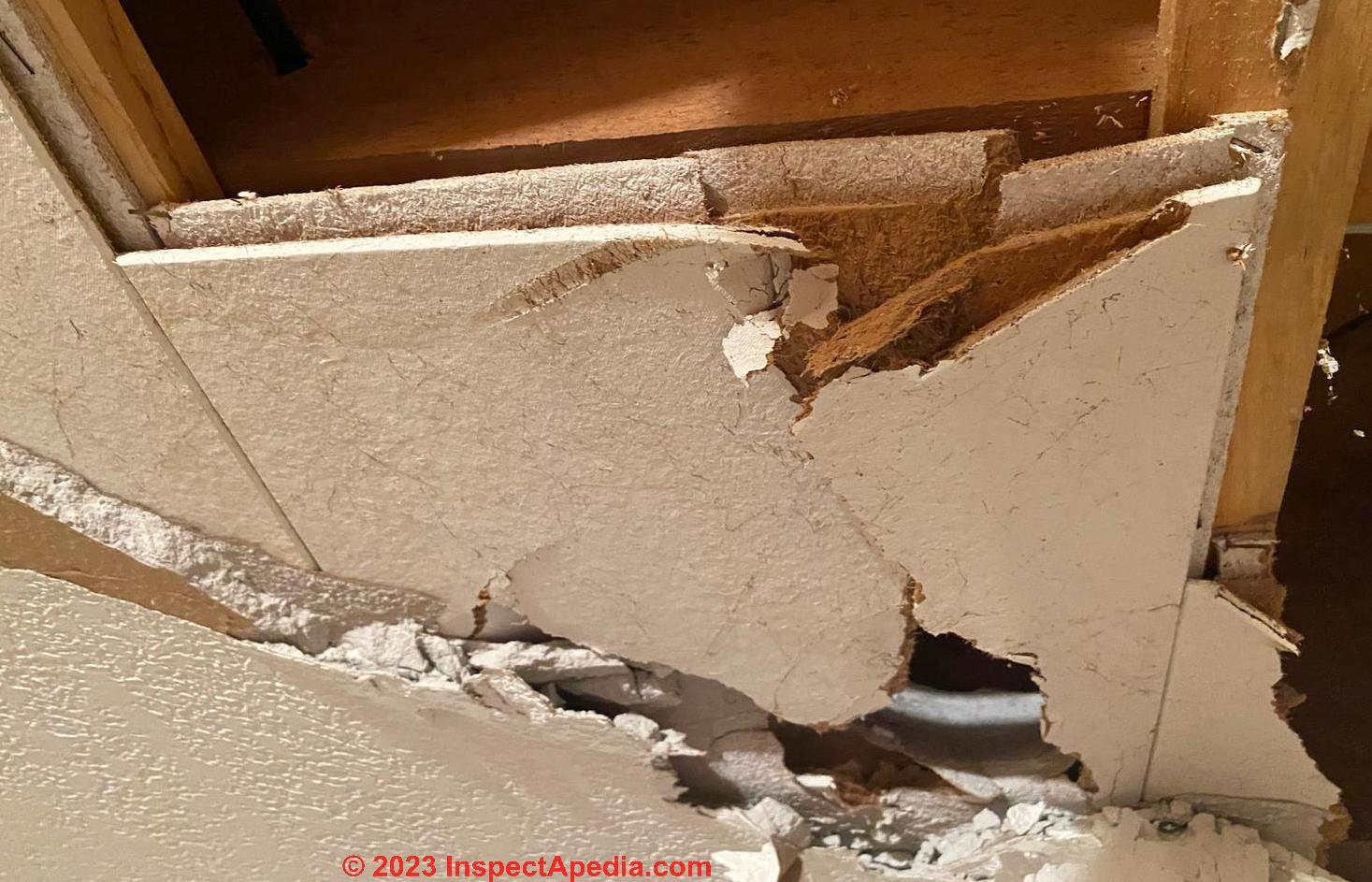
On 2023-04-30 by KA - asbestos in 1950s Ontario home ceillings?
Old house layers to be removed. So removed this from ceiling and wondering if wood base or asbestos tiles? 1950's house southern Ontario. The basement may have been finished later. No markings on back of tiles. Stapled to ceiling.
Thanks for opinions.
Thank you for looking into this, it is actually a library ceiling located in Canada, Ontario.
After further investigation it looks like the asbestos is actually located above said ceiling, or on single tile ceilings located in 4 areas of the library.
I also noted that they drilled into this ceiling in the past to mount a TV, but my superiors told me the entire ceiling is asbestos (it isn't). Thanks for all your help.
On 2023-04-30 by InspectApedia Editor - ceiling tile, drywall, and joint compound may all contain asbestos
@KA,
Looks like a wood-fibre product but to be certain you'd need to do a lab test.
By the way that drywall and joint compound used to install it are likely to contain asbestos if they're of a similar age
On 2023-03-30 by Kelly
NW Ohio built in early 60s I need to remove this ceilng tile mess and figure out what to replace it with. This is a long shot but does this tile resemble those manufactured with asbestos?
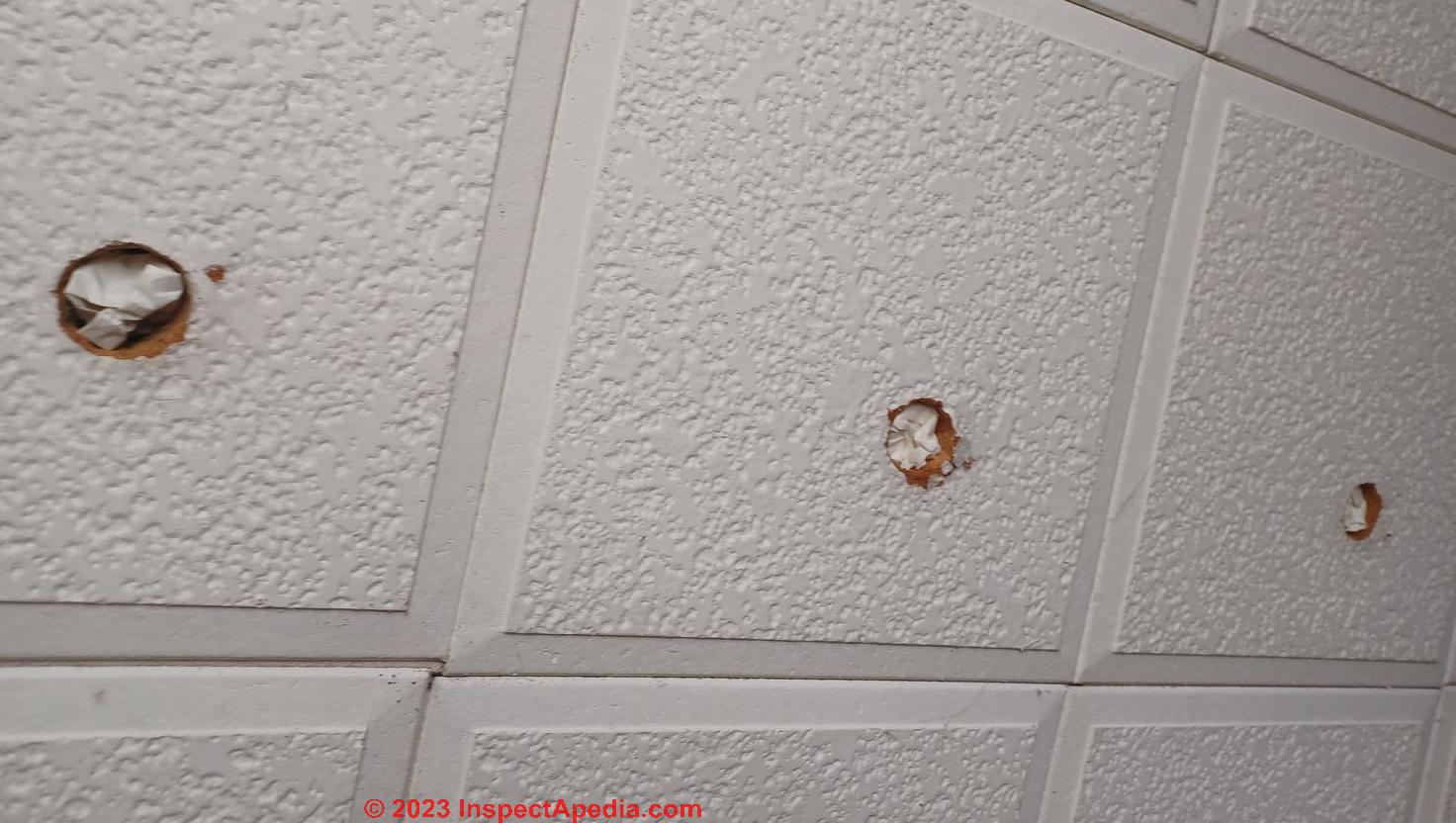
On 2023-03-30 by InspectApedia Editor
@Kelly,
Usually when we see yellow fibrous ceiling tiles that's a wood or plant-based product not asbestos. But keep in mind that unless you find a product identification label and can trace the manufacturer's asbestos-use, a text and photo alone don't approach the confidence of an asbestos test.
IF you can not replace these tiles without creating dust, safest is to do an asbestos test. Or simply treat the material as presumed to contain asbestos and remove it with dust control, PPE, HEPA vacuuming, damp wiping cleanup etc.
An option that's preferable in some buildings is to simply laminate a layer of drywall right over the existing ceiling, leaving the old materials harmlessly in-place.
On 2023-03-21 by San Diego Guy
Just moved into an apartment and wanted to repaint the metal frame in between the drop ceiling panels, concerned about possible asbestos presence. We don't know how old the building is, but found property records going back to at least 1993.
The tiling goes across the whole unit, and I think the unit is an old converted office. The unit was probably inspected and cleared as it’s run by a leasing company and multiple people have lived here before.
The panels are generally 2'x4', have that kind of pockmarked appearance shown elsewhere, and are damaged in some parts revealing a kind of fuzzy/hair interior. Attached are photos of the ceiling. How could we safely obtain a sample for testing to begin with?
On 2023-03-30 by InspectApedia Editor
@San Diego Guy,
Please try again to post a photos of the panels you describe.
On 2023-01-26 by InspectApedia Publisher - fiberglass ceiling panels - not asbestos
@Bob,
Thanks for the great photo and helpful ceiling tile question.
In your photo those are fiberglass ceiling panels, surfaced on one side with a thin plastic cover on the "down" side; probably from a suspended ceiling, not "ceiling tiles" of the sort that were stapled or glued in place.
An example of similar drop ceiling sections is at
ASBESTOS-FREE CEILING TILES
On 2023-01-27 by Bob
@InspectApedia Publisher, correct. they are from suspended drop ceiling in basement which simply laid in the suspened grid system.
Older drop ceiling tiles 2x4, can anyone identify if they are fiber only or asbestos?
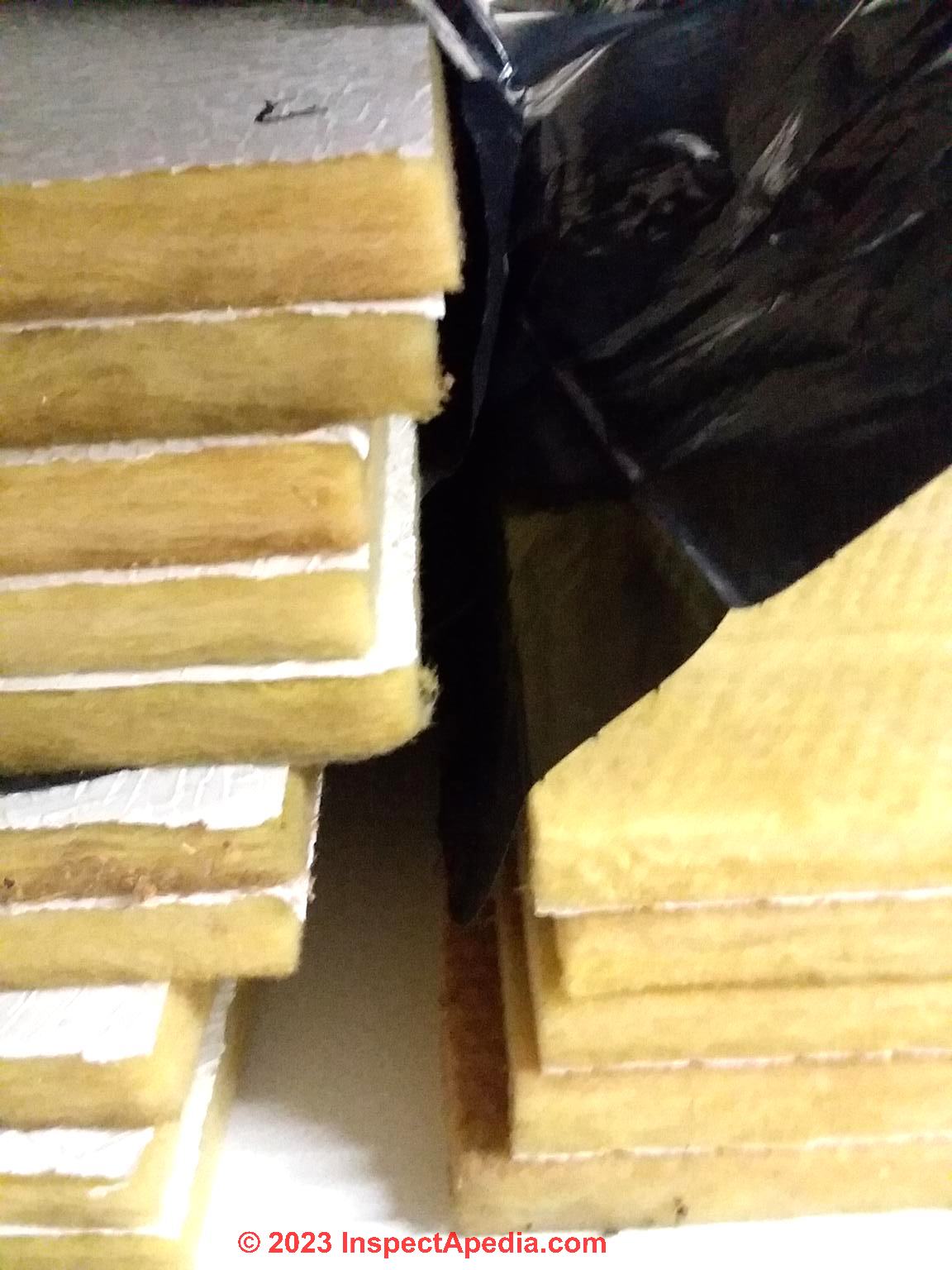
On 2022-12-10 by Chris - does this ceiling material contain asbestos?
Hi there can you tell if this contains asbestos.

We recently removed it and somebody said we should have left it.
There are no fibers present however the paper looks fluffy. Can asbestos be in the backing fiber? Much appreciated. I have since moved out and waiting on the manufacturer to tell us
On 2022-12-10 by InspectApedia (Editor)
@Chris,
Take a look at
DO THESE CEILING TILES CONTAIN ASBESTOS? -
6 Easy Steps to tell if CEILING TILES are likely to contain asbestos -
And then let me know what you think
On 2022-11-18 by Mark - concearned if these ceiling tiles might contain abstestos or any other toxic materials?
Hi just concearned if these ceiling tiles might contain abstestos or any other toxic materials? house was built 1870 in Hudson Massachusetts

On 2022-11-18 by InspectApedia (mod)
@Mark,
We can't answer that question without any information about your home - location, age, etc. Please see the section above on this page:
6 easy steps to make a guess at asbestos hazard from unknown ceiling tiles
This provides our best advice for determining an answer to your question.
On 2022-09-30 by Em - mice contaminated our ceiling tiles but we are worried about asbestos - can we remove them?
We had a mouse infestation and cleared them out.

But they pooed on the ceiling tiles on our basement so we decided we should remove them. However the possible asbestos hazard stopped us. Including two photos. Thank you for your hard work.

On 2022-09-30 by InspectApedia-911 (mod)
@Em,
Besides trying to answer the questions above on this page, the only additional way I can suggest to make a more accurate estimate of the asbestos Hazard for those particular tiles would be to have a sample testing.
It appears to me in cross section to be a gray material so I can't rule out asbestos based on appearance
On 2022-09-22 by Tiffany
I can't tell if my apartment ceiling tiles have asbestos. They look painted over. Found lead paint in the apartment with a test.
They look damaged from being in the bathroom and above the shower. Look white all the way through too. Some tiles have holes that look to have been filled or covered up.
I'm on the second floor of a family home that was turned into apartments in central Maine.
I saw that it was built in 1900, renovation listed in 1950. I can't determine the material or age of the tiles. Any help would be greatly appreciated!

On 2022-09-22 by InspectApedia (Editor) - lead paint and asbestos concerns in bathroom
@Tiffany,
Indeed I see the wrinkled paint.
I don't see holes to be filled, but speculate that you could patch small holes using a phenolic or vinyl caulk with little worry.
IF there is no more water leaks and no mold smell, you might leave the ceiling as is.
If you're able to leave the ceiling alone and it's not shedding lead paint it's not a meaningful hazard.
Alternatively it can be covered with drywall.
IF the ceiling had to be demolished (say fixing water damage) it'd make sense to inspect or test a sample (for asbestos) before proceeding to make a dusty mess.
...
Continue reading at DO THESE CEILING TILES CONTAIN ASBESTOS? , or select a topic from the closely-related articles below, or see the complete ARTICLE INDEX.
Or see ASBESTOS CEILING TILE FAQs - questions and answers posted originally at the bottom of this page. Or see ASBESTOS CEILING TILE FAQs-7 where other recent Q&A are posted.
Or see these
Recommended Articles
- ASBESTOS CEILING TILES
- ASBESTOS-FREE CEILING TILES
- ASBESTOS CEILING TILE ID REQUESTS
- ASBESTOS CEILING TILE REMOVAL PROCEDURES
- ASBESTOS-SUSPECT CEILING COVEROVER
- ASBESTOS TESTING LAB LIST - certified asbestos testing labs
- CEILING TILE HISTORY / DATES - list of asbestos ceiling tile brands, manufacturers & how to identify them
- CEILING TILE IDENTIFICATION
- CEILING TILE INGREDIENTS
- CEILING TILE REMOVAL PROCEDURES
- CEILINGS, DROP or SUSPENDED PANEL
- DO THESE CEILING TILES CONTAIN ASBESTOS? - 6 Easy Steps to tell if CEILING TILES are likely to contain asbestos -
- CEILING FINISHES INTERIOR
- CEILINGS, DROP or SUSPENDED PANEL
- FIBERGLASS ASBESTOS COMBINATIONS
- HISTORY & DATES OF ASBESTOS CONTAINING MATERIAL BANS & REGULATIONS
Suggested citation for this web page
ASBESTOS CEILING TILES at InspectApedia.com - online encyclopedia of building & environmental inspection, testing, diagnosis, repair, & problem prevention advice.
Or see this
INDEX to RELATED ARTICLES: ARTICLE INDEX to ASBESTOS HAZARDS
Or use the SEARCH BOX found below to Ask a Question or Search InspectApedia
Ask a Question or Search InspectApedia
Try the search box just below, or if you prefer, post a question or comment in the Comments box below and we will respond promptly.
Search the InspectApedia website
Note: appearance of your Comment below may be delayed: if your comment contains an image, photograph, web link, or text that looks to the software as if it might be a web link, your posting will appear after it has been approved by a moderator. Apologies for the delay.
Only one image can be added per comment but you can post as many comments, and therefore images, as you like.
You will not receive a notification when a response to your question has been posted.
Please bookmark this page to make it easy for you to check back for our response.
Our Comment Box is provided by Countable Web Productions countable.ca
Citations & References
In addition to any citations in the article above, a full list is available on request.
- Thermafiber, Inc. (now a division of Owens Corning®) at Thermafiber, Inc., 3711 Mill Street, Wabash, IN 46992, Tel: 888-834-2371 (U.S. & Canada) - 260-563-2111 Website: www.thermafiber.com or Thermafiber technical services at 888-834-2371 (U.S. & Canada) ; Phone: 260-569-0801, Fax: 260-563-8979 or Email: technicalservice@owenscorning.com
- 3/07: thanks to Gary Randolph, Ounce of Prevention Home Inspection, LLC Buffalo, NY, for attentive reading and editing suggestions. Mr. Randolph can be reached in Buffalo, NY, at (716) 636-3865 or email: gary@ouncehome.com
- [1] Celotex 1973 Celotex Acoustical Systems catalog, January 1973
- [2] Celotex Home Building Materials, 1947 catalog, lists: Cane fiber products: Celotex sheathing, Celotex insulating lath (board), Celotex interior finish, Celo-Siding, Celo-Rok Gypsum products [may contain asbestos]: Celo-Rok anchor lath, Celo-Rock wallboards, Celo-Rok plasters, and Other Products: Celotex rock wool, Celotex roofing, Celotex hard boards, Celotex Cemesta, Celotex Corporation, Chicago IL
- [3] Celotex Insulating Cane Board, product catalog
- [4] Celotex Building Insulating Materials, 1948 Catalog, listing: Cemesto insulation, Cemesto roof decks, Cemesto exterior wall coverings, Cemesto interior wall coverings [we believe the Cemesto lines refer to cement-asbestos products - ed. ]
- [5] Celotex Sound Conditioning, 1948 Catalog, including perforated asbestos board sheets
- Celotex ceiling products division was purchased by Ceiling Products & Gypsum Wallboard (BPB) of the U.K. beginning in 1999
- Celotex roofing products division was purchased by Certainteed Corporation (Valley Forge PA) beginning in 1999
- [6] Certainteed Ceilings, Adagio fiberglass/mineral fiber composite acoustical ceiling product MSDS, web search 11/22/2011, original source: certainteed.com/resources/Adagio_MSDS_2010.pdf
- [7] "Board of Education for the School District of the City of Detroit v. Celotex, et al., Circuit Court of Wayne County, Michigan, No. 84-429634-ND"
- [8] Armstrong Corporation, web search 6/22/12, original source: http://www.armstrong.rs/commclgeu/eu1/uk/rs/FAQ_other.html, [Copy on file as Armstrong_Ceil_Asbestos.pdf]
- [9] Lipsitz & Ponterio, LLC, "Carpenters and Mesothelioma", Lipsitz & Ponterio, LLC, 135 Delaware Ave, 5th Floor, Buffalo, NY 14202-2415 (716) 849-0701. Web search 6/22/12, original source: http://www.mesotheliomacarpenter.com/carpenters-asbestos-exposure/ceiling-tile/ [Copy on file as LiIpsitz_Asbestos.pdf]
- [10] INACHI forum discussion about asbestos ceiling tiles, web search 6/22/12, original source: http://www.nachi.org/forum/f18/asbestos-ceiling-tiles-14709/ [Copy on file as Inach_Ceil_Asbestos.pdf]
- [11] Celotex [UK] History, Celotex Insulation Specialists, web search 6/30/12, original source: http://www.celotex.co.uk/celotex-history [Copy on file as Celotex_History_UK.pdf ]
- [13] Brian Greer, "History of Tin Ceilings", Brian Greer's Tin Ceilings, web search 6/30/12, original source: http://www.tinceiling.com/company/historytin.php
- [14] Armstrong Corporation, "Corporate History: a Historical Summary", web search 6/30/12, original source: https://www.armstrongflooring.com/corporate/corporate-history.html
- [15] "Ceilings Pressed in Time", Old House Journal, web search 6/30/12, original source: http://www.oldhousejournal.com/ceillings_pressed_in_time/magazine/1070
- [16] Steven Mlynarek, Morton Corn, Charles Blake, "Asbestos Exposure of Building Maintenance Personnel", Regulatory Toxicology and Pharmacology, 23, 213–224 (1996) ARTICLE NO. 0045, http://library.certh.gr/libfiles/PDF/GEN-PAPYR-4810-ASBESTOS-by-MLYNAREK
-in-RTAP-VOL-23-ISS-3-PP-213-224-Y-1996.pdf - [17] National Institute of Occupational Safety and Health (NIOSH) (1989). In NIOSH Manual of Analytical Methods (P. M. Eller, Ed.), Method 7400. NIOSH, Washington, DC.
- [18] U.S. Environmental Protection Agency (USEPA—Green Book) (1990). In Managing Asbestos in Place: A Building Owners Guide to Operations and Maintenance Programs for Asbestos-Containing
- [19] U.S. Department of Labor, Occupational Safety and Health Administration (USDOL) (1994). In Occupational Exposure to Asbestos: Final Rule, FR Vol. 59, No. 153:40964–41162. Materials, Report 2OT-2003. USEPA, Washington, DC.
- [20] U.S. Department of Labor, Occupational Safety and Health Administration
(USDOL) (1986). In Occupational Exposure to Asbestos: Tremolite, Anthophyllite, and Actinolite: Final Rule, FR Vol. 51, No. 119:22631–22644. - [21] U.S. Environmental Protection Agency (USEPA) (1990). In Environmental Asbestos Assessment Manual, Superfund Method for the Determination of Asbestos in Ambient Air, Part 2, Technical Background Document, Report EPA/540/2-90/005 b. USEPA, Washington, DC
- [22] Ceiling - Frequently Asked Questions, Armstrong Corporation, web search 6/30/12, original source: https://www.armstrongflooring.com/resclgam/na/ceilings/en/us/article17697.html
- [23] BPB America Inc., 5301 West Cypress St., Suite 300, Tampa, FL 33607, Tel: 866-427-2872 E-mail: crc@bpb-na.com Web: www.bpb-na.com. Acoustic ceiling tile & accessories.
- [24] Affa Tile Company No. 1116/8, Poonamalee High Road, Opposite Hotel Shan Royal, Koyambedu Chennai, Tamil Nadu - 600 107, India, E-Mail: affatiles@gmail.com website: http://www.affatiles.com Tel:044-24757498, 044 - 24757497
- [25] Made-in-China.com, online sevice to connect buyers with product suppliers in China, web search 6/30/12
- [26] "Directive 2003/18/EC of the European Parliament and of the Council of 27 March 2003 amending Council Directive 83/477/EEC on the protection of workers from the risks related to exposure to asbestos at work". Publications Office of the European Union. 27 March 2003 Web search 6/30/12, original source: http://eur-lex.europa.eu/LexUriServ/LexUriServ.do?uri=CELEX:32003L0018:EN:NOT,
- [27] H. M. Murray, testimony before the Departmental Committee on Compensation for Industrial Diseases "Minutes of Evidence, Appendices and Index", 1907. p. 127
- [28] D. Auribault, "Note sur l'Hygiène et la Sécurité des Ouvriers dans les Filatures et Tissages d'Amianté (On hygiene and security of the workers in the spinning and weaving of asbestos)" in Le Bulletin de l'Inspection du Travail, 1906, pp 120–132.
- [29] Wikipedia entry on Asbestos and various citations from that article, web search 6/30/12, original source: en.wikipedia.org "Asbestos"
- EPA ASBESTOS MATERIALS BAN: CLARIFICATION 1999
- EPA Guidance for Controlling Asbestos-Containing Materials in buildings, NIAST, National Institute on Abatement Sciences & Technology, [republishing EPA public documents] 1985 ed., Exposure Evaluation Division, Office of Toxic Substances, Office of Pesticides and Toxic Substances, U.S. Environmental Protection Agency, Washington,D.C. 20460
- In addition to citations & references found in this article, see the research citations given at the end of the related articles found at our suggested
CONTINUE READING or RECOMMENDED ARTICLES.
- Carson, Dunlop & Associates Ltd., 120 Carlton Street Suite 407, Toronto ON M5A 4K2. Tel: (416) 964-9415 1-800-268-7070 Email: info@carsondunlop.com. Alan Carson is a past president of ASHI, the American Society of Home Inspectors.
Thanks to Alan Carson and Bob Dunlop, for permission for InspectAPedia to use text excerpts from The HOME REFERENCE BOOK - the Encyclopedia of Homes and to use illustrations from The ILLUSTRATED HOME .
Carson Dunlop Associates provides extensive home inspection education and report writing material. In gratitude we provide links to tsome Carson Dunlop Associates products and services.
 | HOME | ABOUT | ASK a QUESTION | CONTACT | CONTENT USE POLICY | DESCRIPTION | POLICIES | PRIVACY | |
| © 2024 - 1985 Publisher InspectApedia.com - Daniel Friedman | |||||||||