
InspectAPedia® FREE Encyclopedia of Building & Environmental Construction, Diagnosis, Maintenance & Repair |
Question? Just ask us! InspectAPedia
|
 Identify Asbestos-Containing Flooring
Home page
- POST a QUESTION or COMMENT about how to identify asbestos-containing flooring materials and what to do when asbestos-containing floor tiles or sheet flooring are found in a building.
How to Identify Floor Tiles & Sheet Flooring That May Contain Asbestos:
This article explains how to identify floor tiles that are likely to contain asbestos, by making a simple visual inspection, noting the probable age of the building and age of its materials, and similar clues.
This document assists building buyers, owners or inspectors who need to identify asbestos materials (or probable-asbestos) in buildings by visual inspection.
InspectAPedia tolerates no conflicts of interest. We have no relationship with advertisers, products, or services discussed at this website.
How to Identify Asbestos Floor Tiles & Sheet Coverings - Asbestos Suspect Floor Tiles & Sheet Flooring
 Asbestos is safe and legal to remain in homes or public buildings as long as the asbestos
materials are in good condition and the asbestos can not be released into the air.
Asbestos is safe and legal to remain in homes or public buildings as long as the asbestos
materials are in good condition and the asbestos can not be released into the air.
For a quick check and five easy questions that can help tell you if an unknown floor covering contains asbestos, try
DOES THIS FLOORING CONTAIN ASBESTOS?
Or we invite you to wade through the more detailed discussion below.
[Click to enlarge any image]
Our photo (left) shows Armstrong® Excelon 12x12 vinyl asbestos flooring made in 1972, identified in our floor tile photo guide
ASBESTOS FLOOR TILE IDENTIFICATION PHOTOS - a detailed photo guide to asphalt asbestos and vinyl asbestos floor tiles, and resilient flooring produced in 1949 -1980.
Asphalt Asbestos, Plastic Asbestos, and Vinyl Asbestos floor tiles were sold in 6"x6", 9" x 9" and in some years 12" x 12" sizes.
We have also seen very small asphalt asbestos floor tiles in a 1 1/2" size bonded to a jute backed fabric.
Details of Asbestos Floor Tile Identification
 If you can identify your floor tile collection name or model number, or if you recognize it in the extensive library of flooring color and pattern photographs provided in these pages, laboratory testing of the sample to screen the flooring for asbestos may be unnecessary.
While an expert lab test using polarized light microscopy may be needed to identify the specific type of asbestos fiber, or to identify the presence of asbestos in air or dust samples, many asbestos-containing building products not only are obvious and easy to recognize, but since there were not other look-alike products that were not asbestos, a visual identification of this material can be virtually a certainty in many cases.
[Click to enlarge any image]
Our photograph at above left shows asbestos fibers and asbestos filler fragments from an Armstrong vinyl asbestos floor tile examined in our forensic laboratory.
The asbestos floor tile identification articles in this series illustrate that with the combination of design appearance and an idea of floor tile age, many asbestos-containing floor tiles or sheet flooring products can be reliably identified even before confirmation by a test by a certified asbestos testing laboratory.
Asphalt-based asbestos floor tiles and later, plastic or vinyl-based asbestos flooring were popular in the U.S. in the 1940's - 1970's and were produced by some manufacturers (Armstrong) as late as 1980.
 Some asbestos-containing flooring products were manufactured (we estimate) as early as the late 1920's. Manmade water resistant sheet flooring products (early forms of linoleum) were used on ships from the early 1900's.
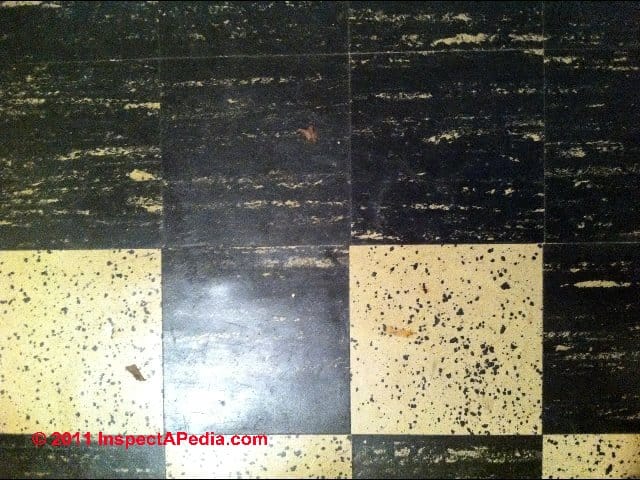
Photo at left from a 1950's home shows Armstrong Excelon-type VAT, courtesy of reader Kim, who adds that asbestos testing indicated that the white floor tiles contained 7% and the black contained 5% asbestos. We suspect the actual asbestos levels are higher in these tiles because both fibers and fine asbestos filler particles were often used.
If the flooring is being demolished, sanded, buffed with steel-wool floor polishers, or subject to heavy traffic, it might be a source of unacceptable asbestos particle release.
Armstrong was by no means the only company producing asbestos-containing floor tiles, though the company may have been the largest producer.
Armstrong® produced the Excelon Tile™ series beginning with a plastic asbestos floor tile series in 1954, referring to the product as vinyl plastic asbestos floor tiles beginning in 1955, and vinyl asbestos tiles from 1957 to 1980.
Resilient sheet flooring containing asbestos was also produced, finding wide use as early as 1968. The Solarian flooring brand appeared in 1977.
Not all old floor tiles or sheet flooring contain asbestos
Adding to modern confusion about which vinyl floor tiles from the 1950's to 1980's do or do not contain asbestos, some lines such as the Excelon Supreme (ca 1977) did not contain asbestos.
And some six-inch asphalt based or floor tiles tested by a reader were reported to be asbestos free even though their pattern matched other 9x9 asbestos-containing floor tiles in the Armstrong line. That's right 6" x 6" - though that floor tile size was rare.
Who produced vinyl or asphalt asbestos flooring?
Vinyl asbestos floor tiles were produced by a number of manufacturers, and the decorative tile patterns were varied, often annually as styles and tastes changed. It is possible to make a tentative identification of floor tiles based on the individual tile pattern, color, and thickness.
Guides for identifying specific floor products that do or do not contain asbestos
On occasion, the original flooring packaging or installation literature may be available for a given home: often an extra box of floor tiles was kept for future repairs.
The vinyl-asbestos floor tile package label information, combined with a simple comparison of tiles in the package with tiles installed in the building may be sound confirmation of asbestos-containing materials.
Historical information about the dates of flooring installation may also be sufficient to rule in or out the possibility that flooring in a building contains asbestos.
- See ASBESTOS FLOORING IDENTIFICATION GUIDE INDEX - all brands, all years for a complete index to ID guides for asbestos-containing flooring materials as well as to similar floor coverings that do not contain asbestos.
- For a multi-year photo guide to asphalt & vinyl asbestos flooring identification including the Armstrong brand
see ASBESTOS FLOOR TILE IDENTIFICATION PHOTOS.
Manufacturers of Asphalt-Asbestos or Vinyl-Asbestos Floor Tiles (VAT) such as Armstrong™ Flooring and EverWear™ Vinyl Asbestos Floor Tiles™
Below are photos and links to some less-well-known flooring brands.
AMITCO Floor Tiles

Amitco International, an international flooring company established in 1964, that has principal locations in the U.S. and U.K.
Details about Amitco flooring are now found
at AMITCO ASBESTOS FLOOR TILES
Armstrong Floor Tiles & Sheet Flooring Confirmed as Containing Asbestos
Details about tests or other documents confirming the use and level of asbestos in older Armstrong floor tiles & sheet flooring are now found
at ARMSTRONG FLOORING ASBESTOS
EverWear, Kentiles & Other 9x9" and 12x12" asbestos-containing floor tiles
Details about Kentile flooring are
at KENTILE KENFLEX ASBESTOS FLOOR TILE GUIDE.
Details about EverWear vinyl asbestos flooring are
at EVERWEAR ASBESTOS FLOOR TILE GUIDE. An example is just below.
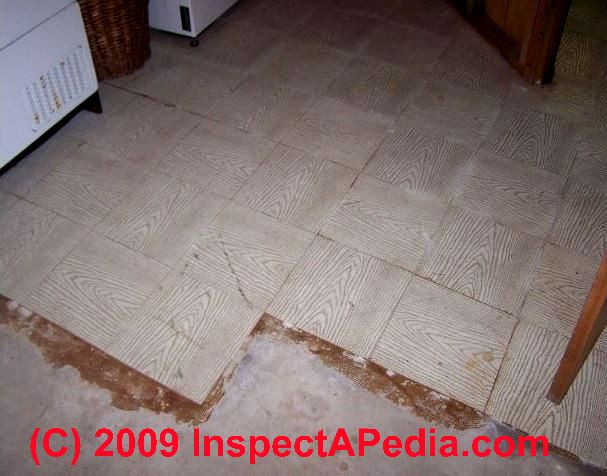
These photographs of EverWear Vinyl Asbestos floor tiles were provided courtesy of home inspector David Grudzinski,
For photographs and text describing other vinyl or asphalt based asbestos-containing flooring, start
at ASBESTOS FLOOR TILE IDENTIFICATION PHOTOS.
Do Vinylasa Floor Tiles from American Tile Co. contain asbestos?
Not likely as at least some sources describe the company as specializing in non-asbestos formulated floor tiles. Please see
Other (Brand Uncertain) Asphalt-Containing 9" x 9" Floor Tiles that Contain Asbestos
See ASBESTOS FLOOR TILE IDENTIFICATION PHOTOS for flooring produced between 1949 and the late 1980's and in some cases, later products up to the present.
Below we provide additional example photographs of asbestos-containing floor tiles in both 9" x 9" and 12" x 12" sizes.
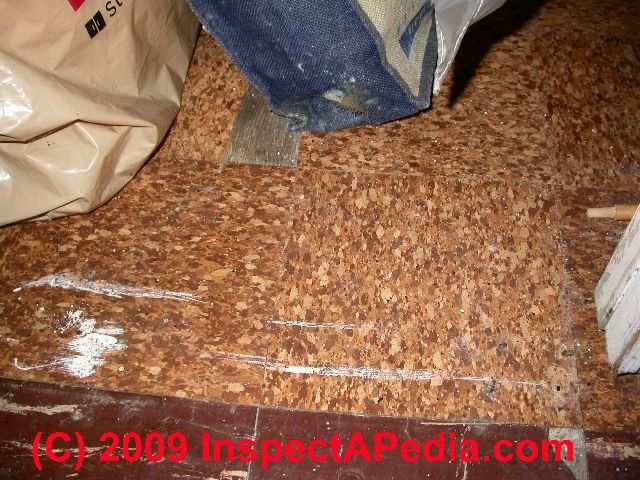
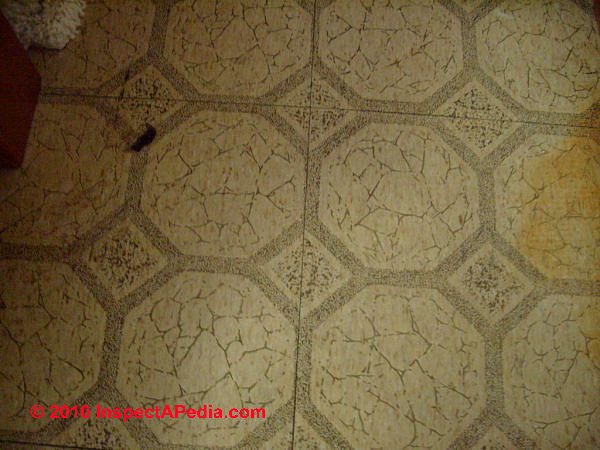
Above we show a 9" x 9" cork patterned vinyl asbestos floor tile found in a 1960's ranch style home in New York.
You can assume this floor tile contains asbestos. Cork pattern vinyl asbestos floor tiles were produced in at least three hues by Armstrong as well as Montgomery Ward and Sears and possibly Kentile and other companies.
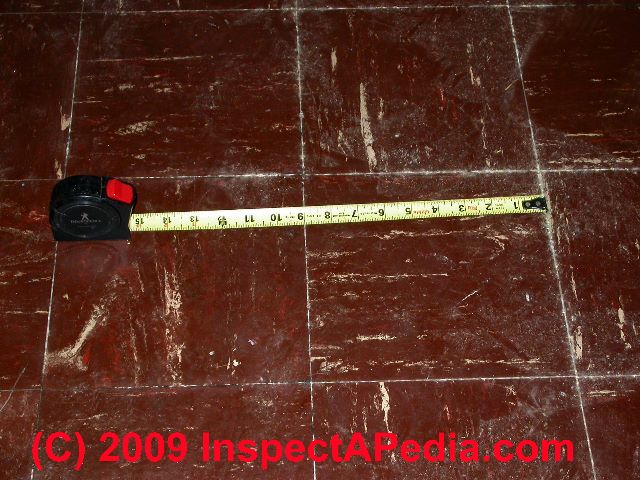
Below: we show a 9" x 9" reddish brown asphalt or vinyl asbestos floor tile found in the same home.
Other (Brand Uncertain) Asphalt-Containing 12" x 12" Floor Tiles that Contain Asbestos
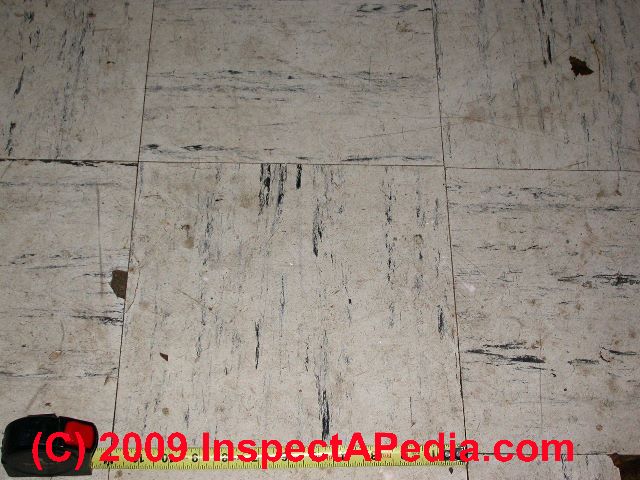
Below is a 12" x 12" vinyl asbestos floor tile found in the same home as the 9" x 9" flooring shown above.
See a very similar and long-running popular Armstrong floor tile pattern beginning in 1955 at
ASBESTOS FLOOR TILE IDENTIFICATION PHOTOS: Armstrong's Seneca white [Image]
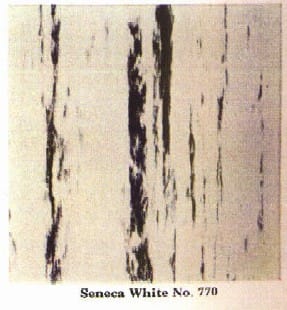
It is likely that this is an asbestos-containing floor tile.
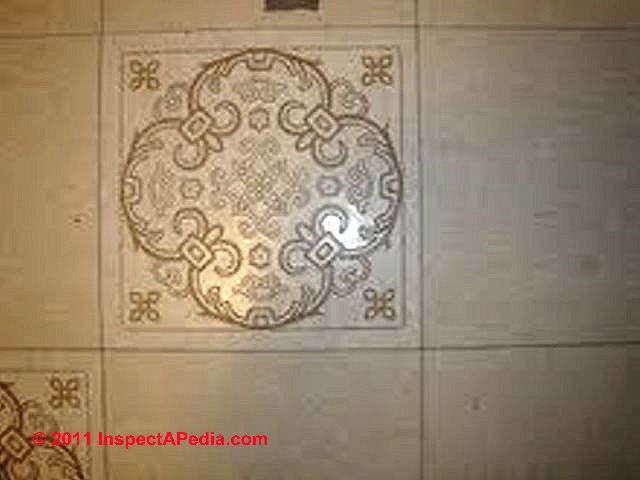
At above left is a 12" x 12" vinyl asbestos floor tile found in a home built in 1969.
Testing found 3% chrysotile asbestos in this floor tile sample. Thanks to reader R.M. for the photo and test information.
We have not identified the manufacturer of this floor tile though it may be an Armstrong tile (See Craftlon Collection 12" x 12" Adelphi II Aalst 54431 (showing a second color, Aalst)

at ARMSTRONG FLOOR TILE LIST - 1969.
See also ASBESTOS FLOOR TILE IDENTIFICATION PHOTOS.
CONTACT us if you know this image and brand.
Asbestos-containing Vinyl Based Sheet Flooring Product Photos
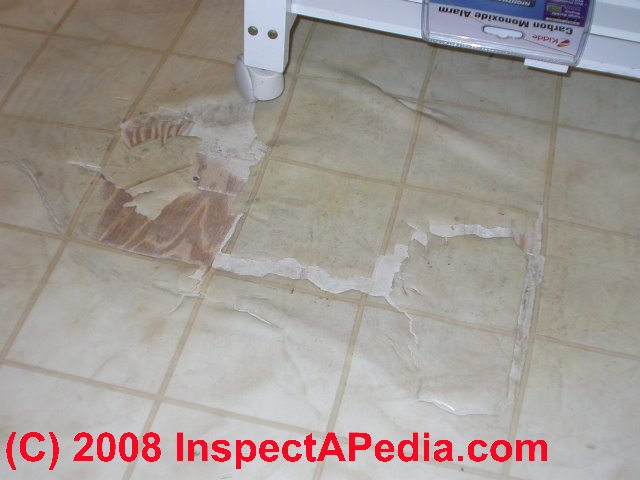
The resilient sheet flooring shown at above left is a modern product (we are using this photo as a placeholder) and does not contain asbestos.
But before about 1978, in products that looked like this same material, asbestos fibers were used as a strengthen material on vinyl sheet flooring backing.
Details for identifying asbestos or asbestos-suspect sheet flooring products are
at RESILIENT SHEET FLOORING ID GUIDE.
See other examples of linoleum and sheet flooring
at CONGOLEUM-NAIRN FLOOR TILES & LINOLEUM
Reader Comments, Questions & Answers About The Article Above
Below you will find questions and answers previously posted on this page at its page bottom reader comment box.
Reader Q&A - also see RECOMMENDED ARTICLES & FAQs
On 2024-01-23 by InspectApedia Publisher - Canada, Armstrong peel and stick floor tiles
@Tammy,
Yes, that looks like 1970s - 1980s flooring - you'll see other photos of it in this article series.
I suggest reading
ASBESTOS FLOORING HAZARD LEVEL ASSESSMENT
https://inspectapedia.com/hazmat/Asbestos_Floor_Hazard_Level.php
If you're able to add simply lift it up without chopping, grinding, sawing the material the hazard should be but slight to none..
Damp wipe and HEPA vacuuming up any mess are appropriate cc cleanup.
On 2024-01-23 by Tammy
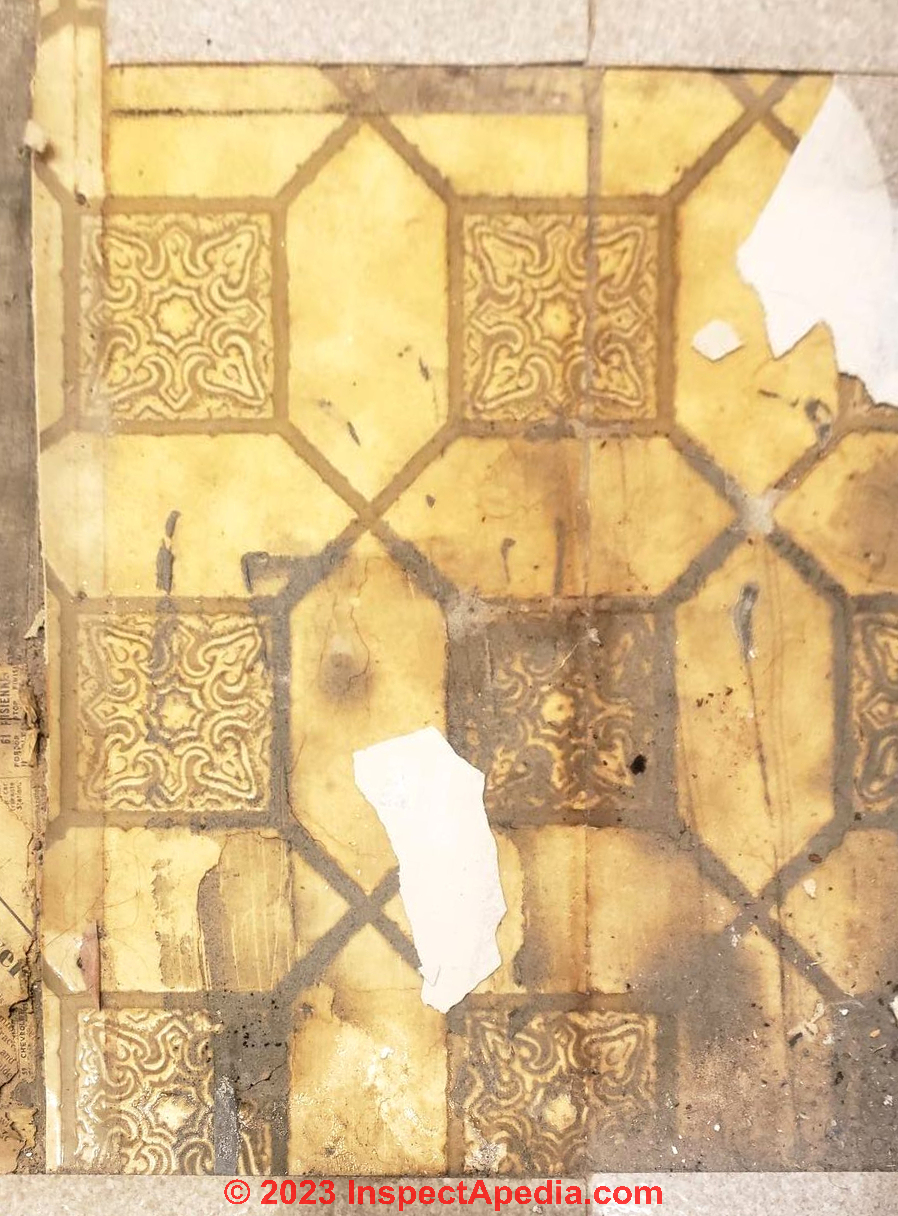
Curious if this could be asbestos, it was found in a washroom in the side ov the house built 1883, I'm not sure when it was laid down as it was there when I bout the house,
the pic is ov the floor I need to pull to replace rotten board under neath, there were stick down tiles that were laid over this floor the stick down tiles are stamped on bottom saying, made in Canada, Armstrong 11290622065
On 2024-01-17 by InspectApedia DF (mod)
@Joseph Mannino,
We are usually able to respond within just a few hours if not much sooner but given our workload, sometimes it may be a day or so.
I’m not sure how your last question is much different than your previous comments that we responded to earlier (now visible as you scroll down on the page).
The amount of dust, if any, released by the hammering of a nail would be so small and as noted, damp wiping is a good method of cleaning that up. Asbestos risk is present if the material is friable and being sanded, ground up, or chopped in some fashion. If there is now dust on the nail, again, damp wiping would be the right thing to do.
If your question is whether the flooring contains asbestos and if so, what to do about it, please see these two articles:
DOES THIS FLOOR CONTAIN ASBESTOS? - 5 easy questions to tell if your FLOOR probably contains asbestos
https://inspectapedia.com/hazmat/DIY-Asbestos-Floor-Test.php
and
ASBESTOS WETTING & CLEANUP GUIDELINES
https://inspectapedia.com/hazmat/Asbestos_Wetting_Procedure.php
These articles and others in the Recommended Articles list above will be helpful.
On 2024-01-17 by Joseph Mannino
I sent a comment 9 hours ago i just need your opinion because i need to know what to do next. Maybe that will help me deal with this situation. Thank you
On 2024-01-17 by InspectApedia DF (mod) - Damp wiping the stair tread is a perfectly reasonable cleanup step
@Joe mannino,
With the apology that of course I can't see your installation and have no actual quantitative or qualitative data about it, based just on your message I would say that the probability that there was an asbestos hazard from what you described is far beneath the limits of detection.
In other words it's not something that you should worry about, and the worry is more likely a greater health hazard than the material itself.
Damp wiping the stair tread is a perfectly reasonable cleanup step.
In contrast, what would be likely to create an airborne asbestos dust hazard would be activity like sawing sanding grinding or chopping of asbestos containing material to create a dusty mess.
On 2024-01-17 by Joseph Mannino
The nail i hammered into the metal nose on the edge of the stair tread into asbestos vinyl sheet flooring which i also put a clear sealant around the edge of meta plate is coated with black dust.
I think thats from hammering the nail into the vinyl and now the dry adhesive has spilled out into the sealant. The asbestos vinyl sheet flooring is from 1975.
Now i went from joy to nervous wreck that could be asbestos adhesive. PANIC i should have left it alone. God knows how much adbestos leaked out with the hammering. Please help
On 2024-01-17 by Joe mannino
Hi, i was hammering a nail thru a aluminum nose on a stair tread and nail bent and i had to straight it and pull it out to hammer it back in the aluminum nose which was on top of asbestos vinyl sheet flooring. I am wondering the risk i took in relaeasing asbestos fibers. I am sick to my stomach i wiped down stair tread but still very worried, please help
The nail made a hole went thru the the asbestos vinyl sheet flooring this would not create a measurable abestos danger. Just making sure i understand
On 2023-11-30 by InspectApedia Publisher - use of small screws to punch holes in the formica cabinets results in little risk
@Joe mannino,
From just the information in your question in my OPINION there is absolutely no meaningful asbestos hazard from the work you describe.
The anxiety is probably a greater health hazard.
On 2023-11-30 by Joe mannino
I have kitchen from 1996 and i changed the hinges 8 hinges but it required me to use small screws to punch holes in the formica cabinets. So my question is did the adhesive contain asbestos in 1996? and if it did, how much risk did i take and is my health in danger from this event. Please respond losing sleep over this, Thank you
On 2023-11-26 by InspectApedia DF (mod) - good type of sealant to use on ceramic tile
@Ally,
Sure, sealants are discussed in
ASBESTOS FLOORING HAZARD REDUCTION
inspectapedia.com/hazmat/Asbestos-Flooring-Hazard-Reduction.php
And there you will also find a link to our page that lists actual floor sealant products that are designed specifically for your situation.
On 2023-11-26 by Ally
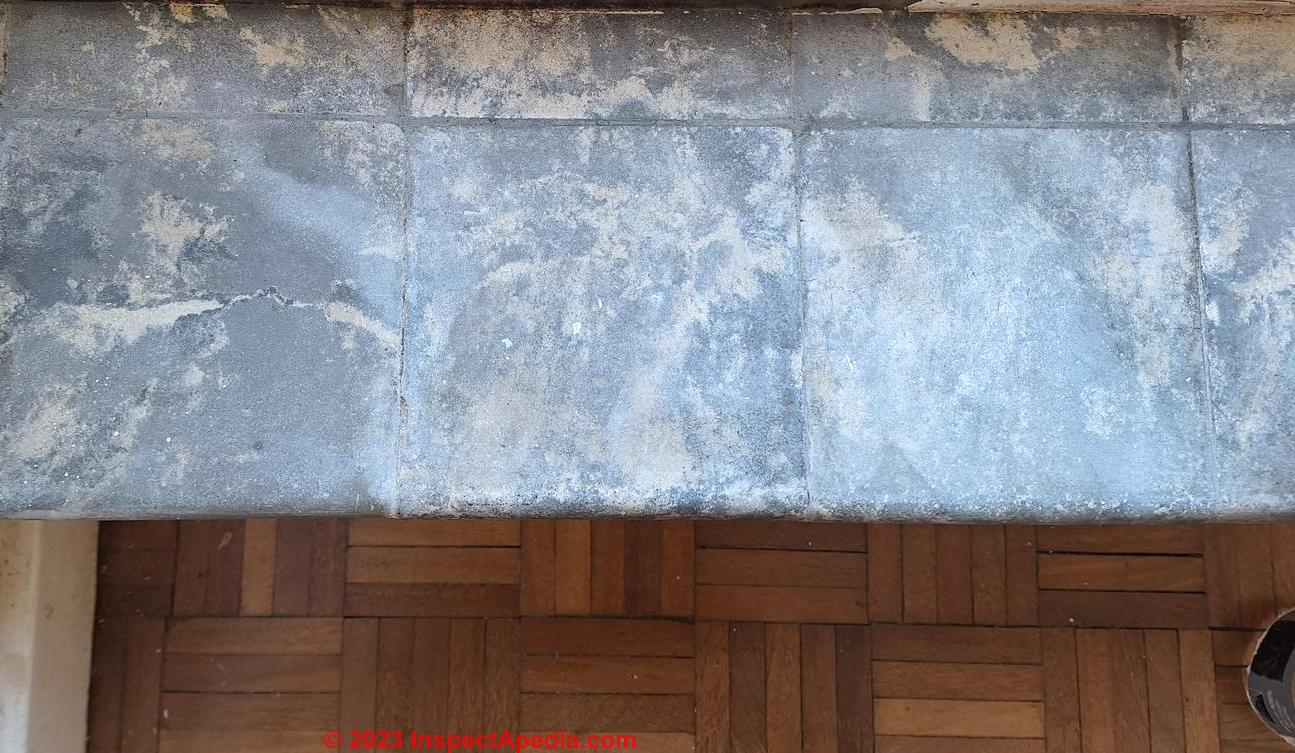
@InspectApedia Publisher, thanks for your reply. They are slightly chipped along the bottom curved edge which juts out a bit from the sill. (The tiles appear to be perhaps 1.5cm thick).
This doesn't bother me but would this make them friable? Does anyone know of a good type of sealant to use on this sort of tile?
On 2023-11-26 by InspectApedia Publisher
@Ally,
Possibly, but
If it's a stone-like or ceramic like product it is certainly not friable and even if it contains asbestos, which is not so likely, it would not be hazardous if you're just leaving it alone.
On 2023-11-25 by Ally
Could these tiles be asbestos? I assume they date back to the 70s or further back. They are on the windowsills and feel slightly rough to the touch like stone.
On 2023-11-19 by InspectApedia DF (mod) - 9x9 tiles still available today
@L,
Yes, you can purchase 9x9 tiles today. But no floor tiles since 1986 contain asbestos.
On 2023-11-17 by L
is the statement of most 9x9 floor tile contains asbestos correct? don't they still selling today as using for hallway?
On 2023-11-03 by Anonymous
@InspectApedia Publisher, there was a list of ban of product from reentering the market at 2019, the products on the list were previously banned right? the list was a final ban to ensure they don't comeback again right?
On 2023-11-02 by InspectApedia Publisher - is the residential use of vinyl-asbestos floor tile in US banned?
@Anonymous,
Yes, since 1986.
On 2023-11-02 by Anonymous
is the residential use of vinyl-asbestos floor tile in US banned?
On 2023-09-13 by InspectApedia Publisher
@Frank Giovannini,
If you're flooring was made in the US before 1986 it could indeed contain asbestos. Some 1970s and early '80s peel and stick floor tiles are in that category.
On 2023-09-13 by Frank Giovannini
I have some peel and stick armstong flooring and wondering if it contains asbestos. It says RA Armstong on the back. The tiles were put on partical board and just come right up so I am really questioning the adhesive more than the tile.
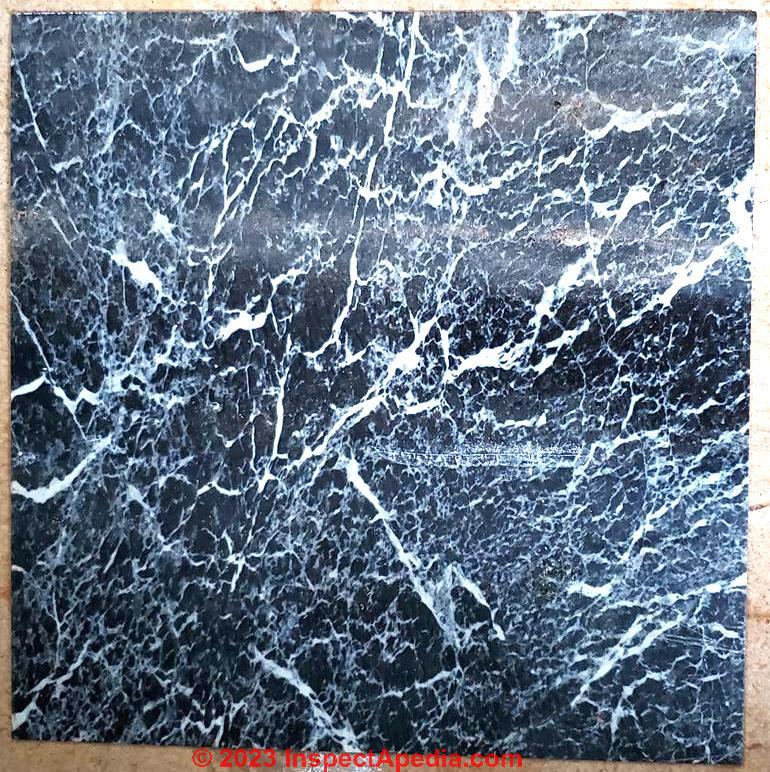
On 2023-09-13 by InspectApedia Publisher - Asbestos Release when Removing Carpet Tack Strips
@Marcia,
Asbestos Release when Removing Carpet Tack Strips
In my OPINION, YES, removing carpet tack strips that have been nailed down through asbestos-containing flooring may release enough asbestos debris to cause a measurable level of airborne asbestos.
The actual risk depends on the age and condition and type of flooring. More-brittle, thicker asbestos-containing flooring = greater risk of making and thus releasing asbstos dust.
Prudent would be to use proper dust control and asbestos dust cleanup (damp wiping, HEPA vacuuming) and personal protective equipment.
As the worker begins the job she will see whether the tack strips come up neatly leaving simply small holes in the older flooring below, or whether instead, the flooring is broken-up and dusty.
On 2023-09-13 by Marcia
Can carpet tack strips nailed into asbestos tile be removed safely without danger of the fibers being released into the air? I intend to replace the carpeting with wood flooring. Thanks.
On 2023-09-13 by InspectApedia Publisher (mod)
@Marcia,
Asbestos Release when Removing Carpet Tack Strips
In my OPINION, YES, removing carpet tack strips that have been nailed down through asbestos-containing flooring may release enough asbestos debris to cause a measurable level of airborne asbestos.
The actual risk depends on the age and condition and type of flooring. More-brittle, thicker asbestos-containing flooring = greater risk of making and thus releasing asbstos dust.
Prudent would be to use proper dust control and asbestos dust cleanup (damp wiping, HEPA vacuuming) and personal protective equipment.
As the worker begins the job she will see whether the tack strips come up neatly leaving simply small holes in the older flooring below, or whether instead, the flooring is broken-up and dusty.
Asbestos Release when Installing Carpet Tack Strips
In my OPINION the technically-exact answer is NO
and
a more-reasonable "real world" answer is YES
That is, nailing through a tack strip and through then an asbestos-containing floor tile, by punching a tiny hole or maybe cracking the tile, may indeed release a very small amount of damaged flooring particles. In my OPINION those are principally trapped between the under-side of the tack strip and the upper surface of the floor,
and later the whole assembly will be covered by carpeting.
In that scenario, I am very doubtful that a meaningful, or perhaps even measurable level of airborne asbestos would be detected from a normal residential carpet tack strip installation job.
If you're nervous anyway, wear appropriate PPE and use damp wiping and HEPA vaccuming around the tack strips and flooring after the tack strips are installed and before the carpeting is laid.
Thanks for a helpful question.
On 2023-09-12 by Marcia - Can carpet tack strips nailed into asbestos tile be removed safely without danger of the fibers being released into the air?
Can carpet tack strips nailed into asbestos tile be removed safely without danger of the fibers being released into the air? I intend to replace the carpeting with wood flooring. Thanks.
On 2023-09-08 by InspectApedia DF (mod) - balance hazard vs. risk before spending money on testing
@Angeliqueanthian,
If you're just planning to cover it with new flooring, there is no need to spend the money to have it tested. The results won't change your plan of action. As long as it's not friable (easily crumbled between your fingers), you don't need to worry about any potential asbestos risk.
In the future, if for some reason you or someone else chooses to remove it, please read our article on
ASBESTOS FLOORING REMOVAL GUIDE - live link in that same list of recommended articles.
On 2023-09-08 by Angeliqueanthian
@InspectApedia DF, Many thanks for your reply. I am so glad I came across your website, as I had no idea about the possibility of asbestos and had planned to just remove everything!
Do you think it would be a good idea to have it tested professionally?
On 2023-09-08 by InspectApedia DF (mod)
@Angeliqueanthian,
Given the age of the home, it's very possible that they are asbestos containing. It's also possible that the backing and adhesive may be as well.
If in good condition as they look like they might be, the safest and simplest thing to do is to cover with new flooring as you suggest.
In the related list of Recommended Articles just above on this page, see the live link for
ASBESTOS FLOORING HAZARD REDUCTION
We welcome any additional questions you may have.
On 2023-09-08 by Angeliqueanthian
Hi,
We purchased our first home last year, and the floor is covered in a horrible orange carpet. We decided to lift it up to check what was underneath, and found the tiles as per the picture. The house was built in the 70s/early 80s.
Is it likely that they contain asbestos? Should we get it professionally checked. If it does contain asbestos, can we/ should we remove them or just lay new flooring on top?
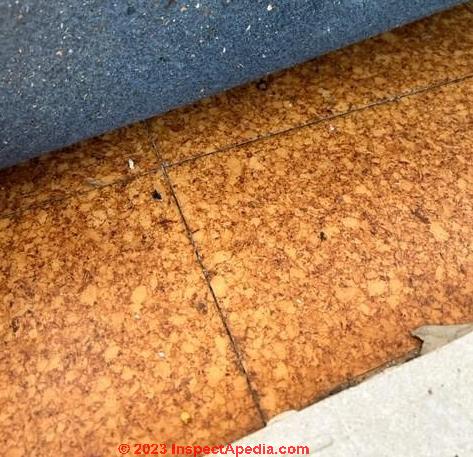
On 2023-09-07 by InspectApedia Publisher
@Rachel,
Very likely, yes. Both of those patterns resemble 1950s / 1960s floor tiles that contained asbestos.
On 2023-09-07 by Rachel
Our home was built in the 50's and we are renovating our bathroom. Is this asbestos flooring?
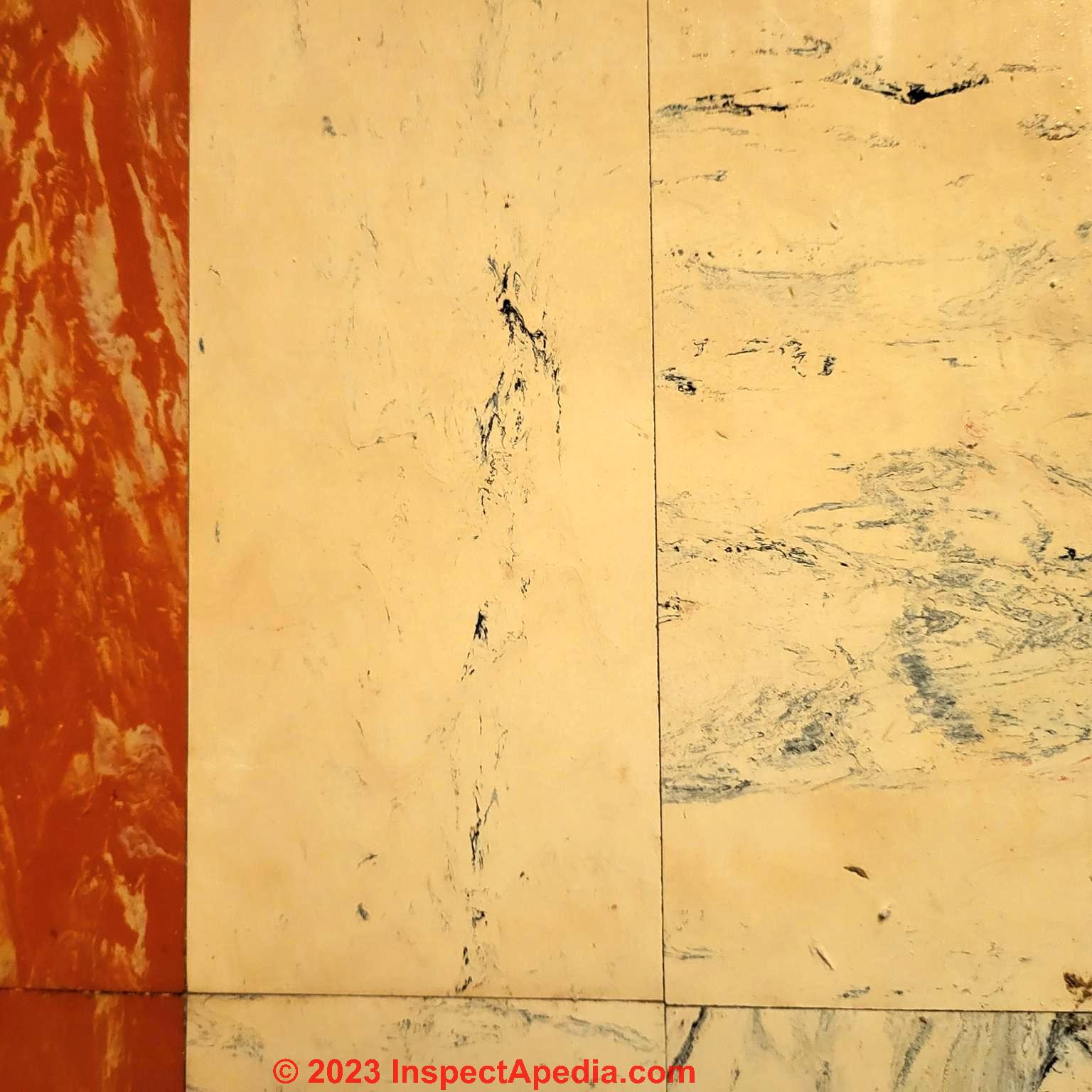
On 2023-09-02 by InspectApedia Publisher - 1988 flooring in good condition doesn't contain asbestos and not friable
@Mike,
Sure. We can't be certain that someone didn't keep and later sell "new old stock" flooring made before manufacturers in the U.S. stopped using asbestos.
Keep in mind that flooring itself isn't friable - the dust hazard might be made if you chop saw or grind the material or if you similarly disturb asbestos-containing mastic. If you're not making dust there's not likely to be much risk.
Please read over and help me out by giving your thoughts to this article we're working-on:
HAZARD vs RISK - what's the difference and why you should care
On 2023-09-02 by Mike
@InspectApedia DF, thank you for the fast response. I do believe you are correct but I will be testing it anyway for my paranoia and anxiety lol. Thank you so much and I will follow up with test results.
On 2023-09-02 by InspectApedia DF (mod)
@Mike,
As we discuss in the article above, 1986 was the last year asbestos was allowed in the US. So if your home was built in 1988, no.
On 2023-09-02 by Mike
House built in 1988 so cal, home flooded recently so I ripped up the linoleum without thinking. Is this asbestos?
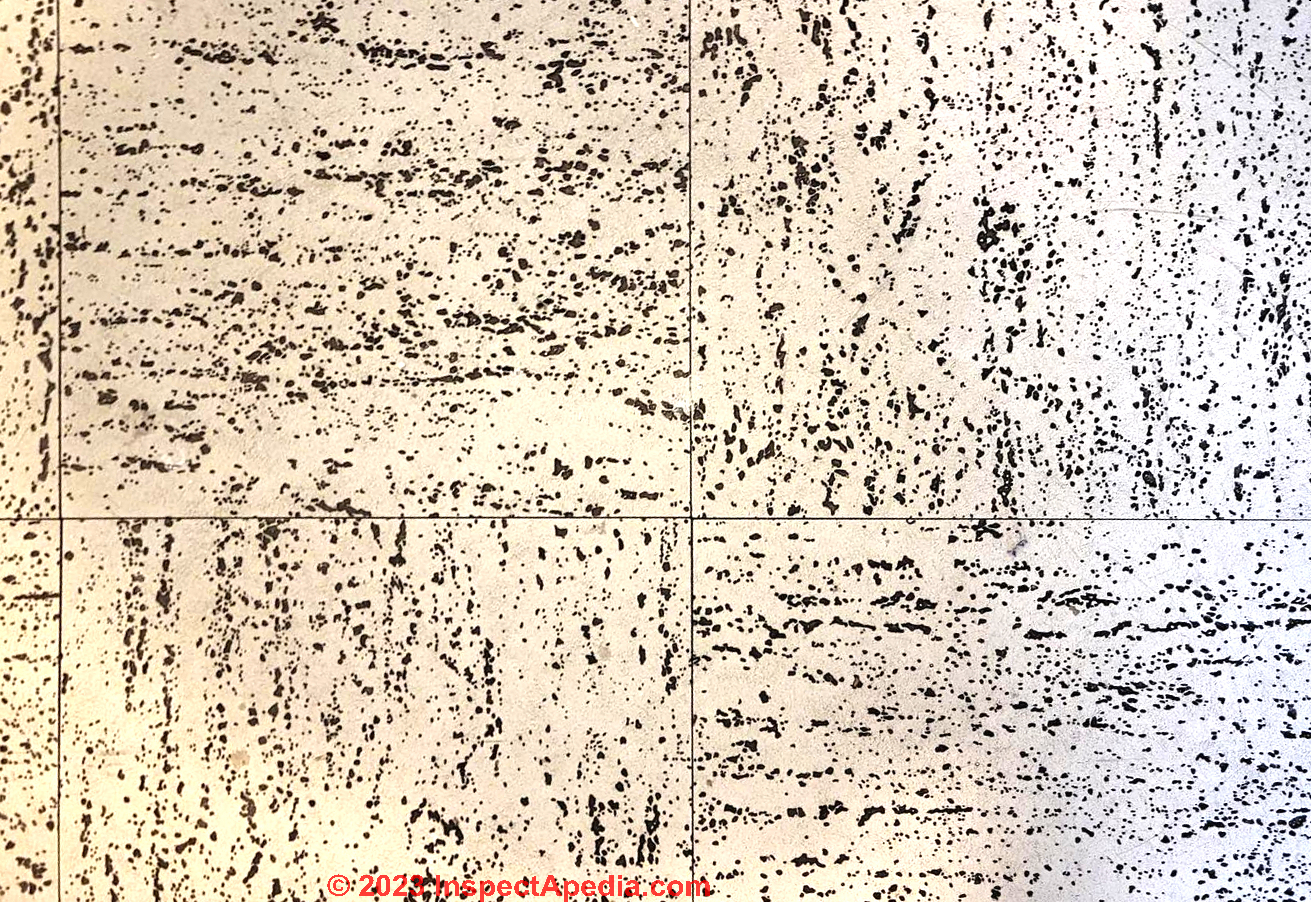
On 2023-08-27 by InspectApedia DF (mod) - granite patterned floor tiles
@NLG,
We have no way of knowing the exact age of installation from a photo alone. Some asbestos containing patterns were manufactured over several years, and sometimes even continued to be made without asbestos after 1986, the year asbestos was banned in the US.
Although your pattern seems to have a white background, the pattern matches the Granite Gray pattern shown in this article
GRAY ASPHALT ASBESTOS & VINYL ASBESTOS FLOOR TILES
https://inspectapedia.com/hazmat/Gray-Floor-Tile-Asbestos.php
We don’t have an exhaustive list or photos for every pattern ever made so I would guess that your flooring is something like Granite White or Granite Cream. Also keep in mind that similar patterns were made by more than one manufacturer.
The best starting point for you is to answer the 5 easy questions found at
DOES THIS FLOOR CONTAIN ASBESTOS? - 5 easy questions to tell if your FLOOR probably contains asbestos
(Live link found just above in the Recommended Articles list)
In that same list see our article on
ASBESTOS FLOORING HAZARD REDUCTION
where you'll read that the safest and simplest thing to do is to leave the flooring in place and cover with new flooring or use a sealant on it.
On 2023-08-27 by NLG
I am hoping someone can identify this flooring, as I strongly suspect it contains asbestos but haven't found a photo to match, other than possibly one posted by a reader.
At the very least, it would be extremely helpful to know the approximate year this tile was made and/or installed. In fact, any info. or educated guesses would be most helpful. Thank you.
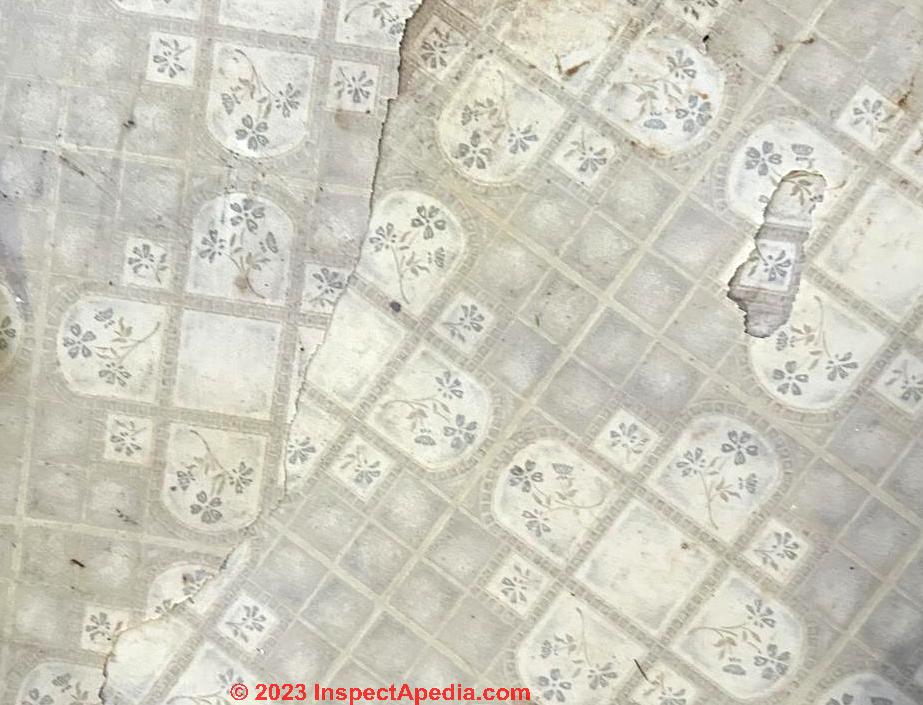
On 2023-08-26 by InspectApedia DF (mod) - 1970s Canadian yellow brick pattern sheet flooring
@Melissa Morgan,
Given the age, very possibly, yes. Unless you have a manufacturer or pattern name, start with answering the 5 easy questions found at
DOES THIS FLOOR CONTAIN ASBESTOS? (live link just above in the Recommended Articles list)
If after reviewing those questions, you have more questions, we welcome additional questions or comments.
On 2023-08-25 by Melissa Morgan
Would you know if this sheet flooring contains asbestos? I believe it’s from the 70’s in Canada.
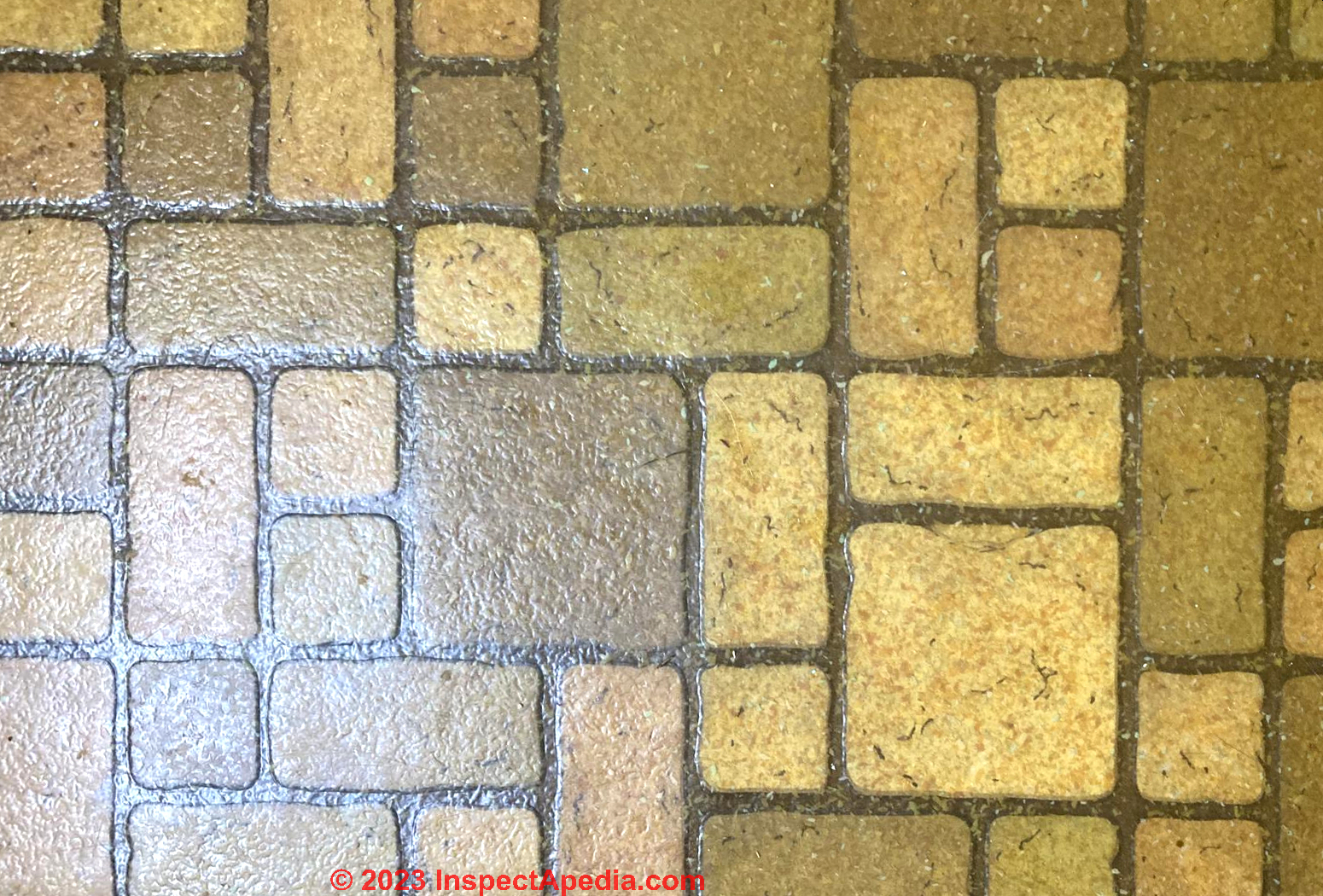
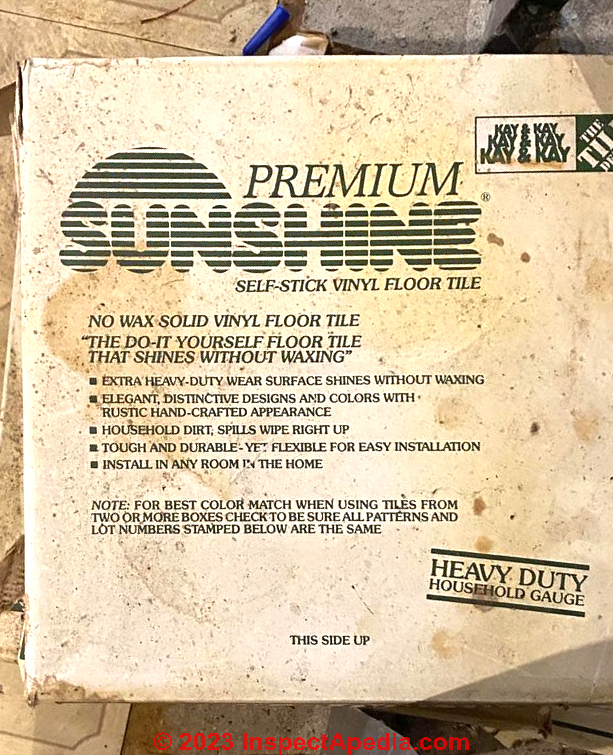
On 2023-08-10 by InspectApedia DF (mod) - Sunshine peel and stick floor tiles
@Jared,
Asbestos use in flooring was discontinued/banned as of 1986. So the flooring is fine.
On 2023-08-10 by Jared
My wife and I recently bought and moved into our first house. There is some old peel-and-stick vinyl tile covering most of the basement floor (directly on concrete). The house was built in 1988 and the tile was clearly put down as a diy project.
I cannot find anything about the brand of tile containing asbestos, but I am not sure. Is it possible this vinyl tile has asbestos in it? I included a picture of the tile and box. Thanks!
On 2023-08-01 by InspectApedia Publisher - can I cover asphalt asbestos tiles with perfect primer?
@Rob,
That's a common approach. Please read through
ASPHALT-ASBESTOS PAINT / SEALANT
and let us know what questions remain.
Thanks.
DF
On 2023-07-31 by Rob
I have old asphalt asbestos tiles can I cover them with perfect primer ? Has anyone done this specifically with asphalt asbestos tile?
On 2023-07-03 by InspectApedia DF (mod) - warning on back of box indicates asbestos content
@Julia D,
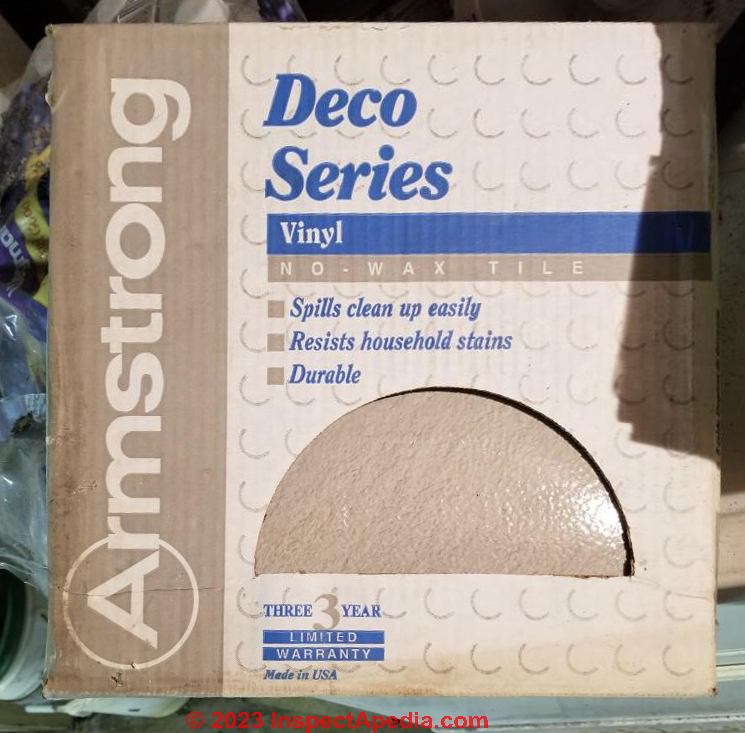
Since such a comprehensive warning is included on the packaging of those tiles, I’d say there’s a really good chance that they contain asbestos. Thank you for sharing that wording with us.
It would help other readers, and we would be very grateful, if you could post a clear photo of all that printed warning on the box. In fact, if you contact us by email (see Contact info at bottom of page), we will PayPal you $10 for that clear high res photo as it will be so helpful to many.
Armstrong Peel-and-Stick Floor vinyl floor tiles were introduced late in 1969 and continue in popular use today. Some popular patterns that once contained asbestos were continued without asbestos after 1986, the last year asbestos in flooring was allowed in the US. (We don’t know your location.)
That does not mean the flooring is dangerous - it's not radioactive - but if it is sawn, ground, sanded, or otherwise demolished or made into friable dust there is a potential asbestos hazard.
The box looks old enough to be pre-1986 and I would suspect that the stick adhesive on those tiles has lost some of its stickiness after all these years and so wouldn’t be worth using anyway.
I would not put them down for at least a couple reasons:
1) over the life of the building, they may become worn or damaged in such a way as to present an asbestos risk
2) at the time of reselling the home, the presence of asbestos containing flooring may mean that the buyer requires either a cost adjustment or remediation before sale of the flooring
In most communities, you can simply dispose of these tiles as construction waste.
Please do post photos of any other printing on the box, either here or via email. (You can only add one image per comment but can post as many comments as you wish.) Thank you.
On 2023-07-03 by Julia D
A friend gave us several boxes of unused peel and stick vinyl floor tile made in the USA by Armstrong. It is the Deco Series no wax tiles Item 28892, A lot J001A, 12 x 12 .045” thick tile, three-year warranty.
On the box it states under how to install,
Warning:
in place, resilient, floor, covering and asphaltic adhesive. Do not sand, dry sweep, dry, scrape, drill, Saul, bead, blast, or mechanically chip or pulverize, existing resilient flooring, backing, lining salt, or asphaltic cut back adhesive. These products may contain either asbestos fibers or crystalline silica.
And it goes on to talk about regulations may require material to be tested. Determine if asbestos contact yada yada.
Personally, I know peel and stick tiles have come along way and I really don’t want to waste my time labor wise to put down these tiles if they’re just gonna come up in a year or so. I’d rather do it the right way and buy a more modern safe product.
Can anyone tell me if these contain asbestos? I have the original boxes. Thank you.
On 2023-06-30 by InspectApedia Publisher
@Anonymous,
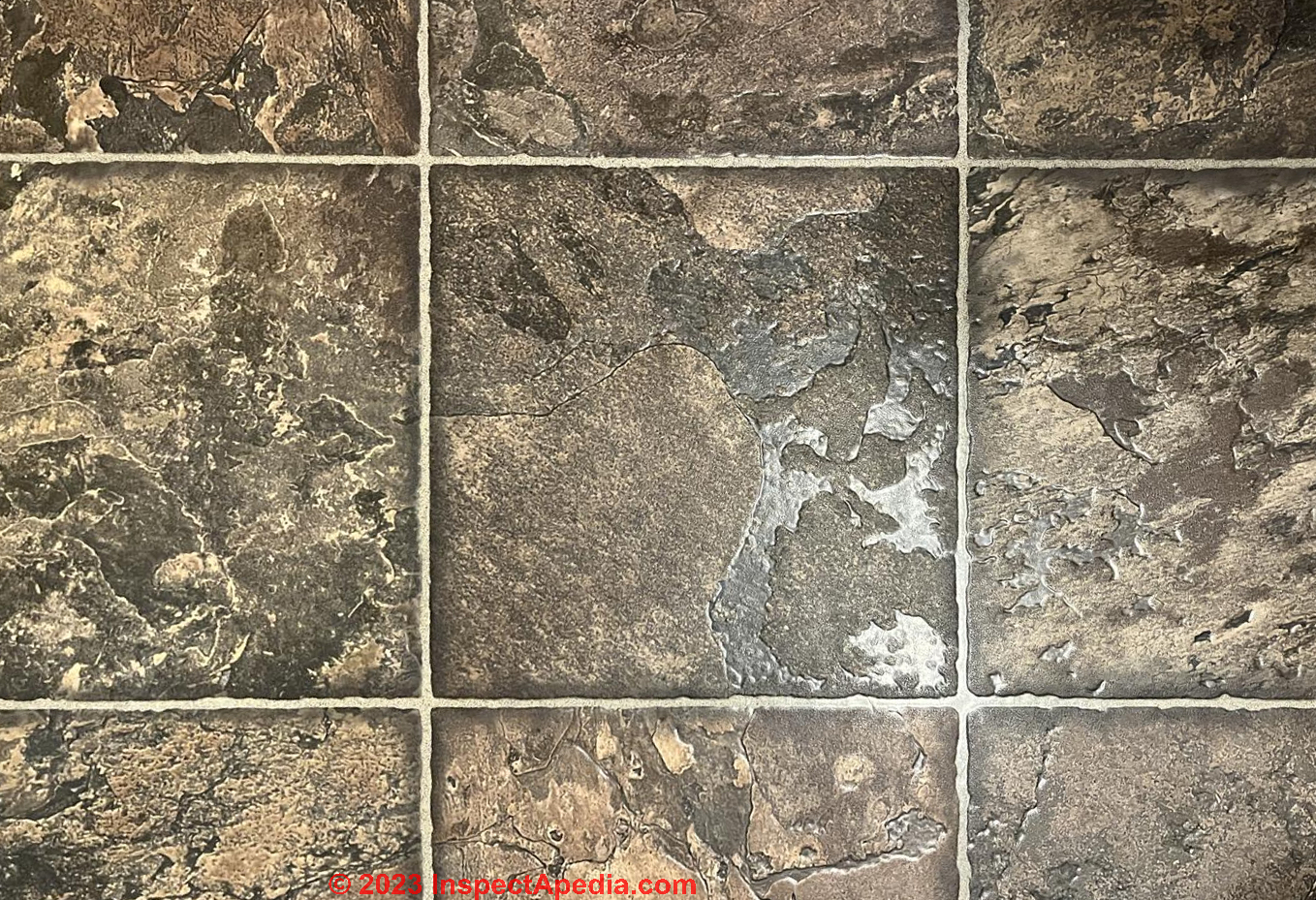
That floor could contain asbestos. It looks in good shape, nothing to panic about.
Click the live links in the Recommended Articles list to read
ASBESTOS FLOORING HAZARD LEVEL ASSESSMENT
and
ASBESTOS FLOORING HAZARD REDUCTION
On 2023-06-30 by Anonymous
This building is for 1983.
On 2023-06-28 by InspectApedia Publisher - basement tile floor has presumed asbestos containing tile
@Tekla,
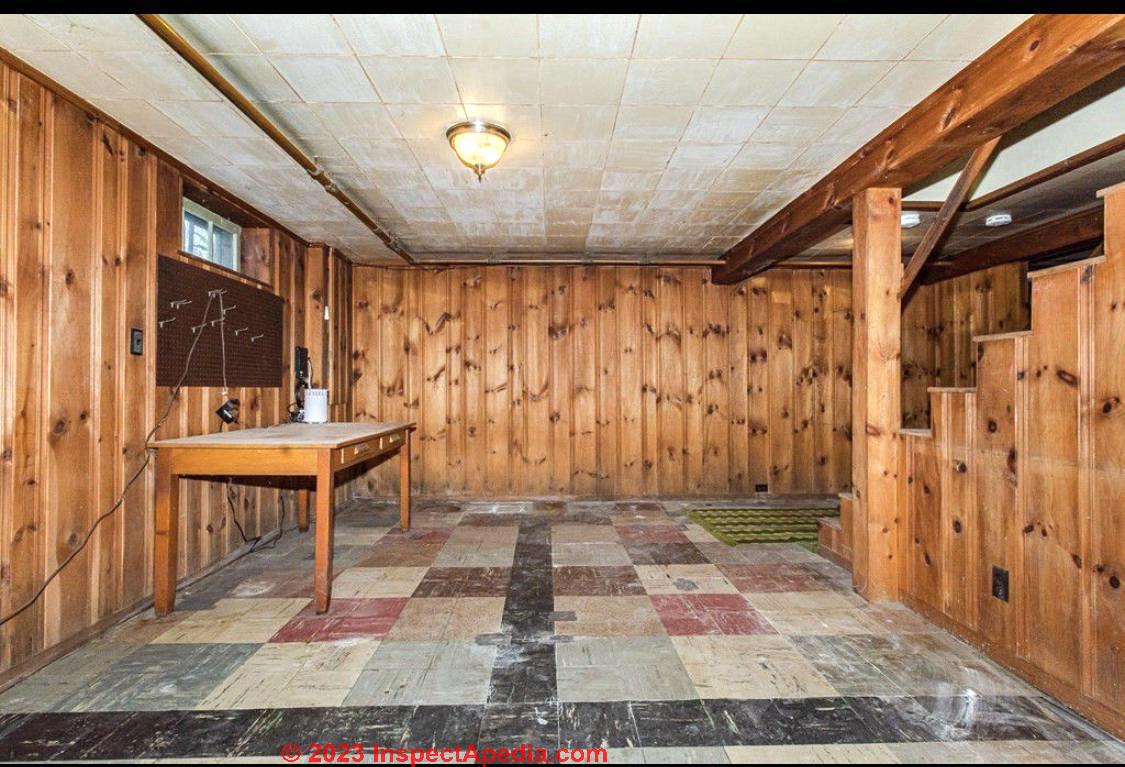
Thanks for a great floor photo. Where is this building and what's its age? IT looks like flooring from the late 1950s or 1960s.
If the floor has lots of loose tiles, simply painting or sealing it is a bad idea and a waste of money, as the poorly adhered, now painted tiles are likely to continue to break up.
If most of the floor is well adhered, then sealing it before covering it is a reasonable approach.
In the Recommended Articles list at the end of this article,
Take a look first at ASBESTOS FLOORING HAZARD LEVEL ASSESSMENT
Then with those results in mind, read
ASBESTOS FLOORING HAZARD REDUCTION
and let me know what you think.
On 2023-06-28 by Tekla
Hello! Your site has been very helpful to read through, thank you!
The attached is my basement tile floor which has presumed asbestos containing tile. It is disturbed, cracked, duct-taped covered in multiple areas that you can see if you’re able to zoom in.
We just recently bought the home and are assessing work needed to be completed.
My question: we are thinking abatement due to the damage. The quote we received includes abatement as well as paint/seal of the floor with two coats of paint.
Is this the correct course of action? Thank you!
On 2023-04-05 by InspectApedia Publisher
@Amy,
That looks to me like 1960s asphalt asbestos floor tile. But you might want to take a look at some of the examples starting at
ASBESTOS FLOORING IDENTIFICATION GUIDE INDEX
On 2023-04-05 by Amy
I'm hoping to better identify this type and age of floor tile. It is in a 1920s house. The flooring layers are origional wood subfloor, then what appears to be tongue and groove pine followed by this material. Last is thin modern subfloor and sheet vinyl.

On 2023-02-16 by InspectApedia Editor
@Dejan,
If we are able to identify this tile further, we will add that here. And yes, dealing with one apartment is a much more manageable job than all 700 units.
We, of course, would like to see a photo of your finished project once completed. As you say, you can only add one photo per comment but you're welcome to post as many comments, and therefore photos, as you wish.
Thank you for your donation to the cause of your choice. Working together and caring together make us all better.
On 2023-02-16 by Dejan
@InspectApedia Editor , thank you for your very quick answer and your enthusiasm to make the world a better and safer place.
I know it’s hard for you to guess, i try to give so many informations as i can. I am allowed to upload just one pic at a time. So here is another one if it helps for better identification. Manifacturer unknown to us. May be european, russian or even american since it looks similar to the Armstrong tiles from the 80’s. Of course all of this information i found on this website which i appreciate very much.
We are just discussing if we should do a new floor over these old tiles, it would also be vinyl tiles from Tarkett, swedish manufacturer, should be asbestos free now.
And i am in just one appartement, so it’s not all mine lol. Just for better understanding.
Tanks for everything.
Donations made.

On 2023-02-16 by InspectApedia Editor - treat that flooring as presumed to contain asbestos
@Dejan,
Unless you get testing done, you should treat that flooring as presumed to contain asbestos. I can't give you a definite answer from one photo. The European Union ban on asbestos regulations came into force in 2004, several years after this flooring's installation.
That is a big project and whether it has to be replaced or not, we discuss the best practices for doing so in the Recommended Articles list just above on this page - specifically with our Hazard Reduction and Removal Guide articles.
The simplest and safest way to deal with asbestos containing flooring, if possible, is to leave it in place and cover with new flooring - also discussed in those articles.
And thanks for your thanks... We've worked hard on this material for decades, so are really grateful when a reader finds it useful and trustworthy.
And thank you for your offer of a donation but we would ask that you make a contribution to your local battered women's shelter, homeless shelter, or food bank instead.
In order to absolutely assure our readers that we write and report without bias we do not sell any products nor services, nor do we have any business or financial relationships that could create such conflicts of interest.
On 2023-02-16 by Dejan
Hello guys!
First off many thanks for your website and information that you put out for free. I am ready to pay or donate some euros.
Second my vinyl tiles, please take a look and if you can tell me if they contain asbestos.
It’s an appartement building in Bosnia Hercegovina, Europe, built between 1985-1989. All flats have the same tiles. It’s about 7 buildings over approximately 700 appartements. Huge project back then.
Thanks.

On 2023-02-09 by Mak Church (mod)
@Nicole Abt,
I would sure be grateful if you would ask that someone to give you and us their source because I'm not aware of any floor tiles that were recalled because of a special content.
See
DOES THIS FLOOR CONTAIN ASBESTOS?
for which a live link is given just above on this page
On 2023-02-09 by Nicole Abt
Someone has said to me this floor tile was actually all recalled because of asbestos and I was just wondering if anyone can second that by taking a look. Ty any help is appreciated

On 2023-02-06 by InspectApedia Publisher - best method for removing asbestos flooring
@Charles,
Yes the floor may contain asbestos.
Yes if you can remove whole tiles, intact, the risk of creating asbestos-containing dust from the tiles is minimized.
Keep in mind that the mastic may also contain asbestos.
Please read
ASBESTOS FLOORING REMOVAL GUIDE
On 2023-02-06 by Charles
Hi, I have a condo built in 1965. I found this tile with what appears to be black mastic underneath. The tile comes apart whole (does not crumble) and I wanted to remove it, place a vapor barrier, and continue LVP through the condo. Would this be a safe bet and might this be asbestos?
PS, I’m from Chicago IL if it helps.

On 2023-01-28 by Mak Church (mod) - positive test for asbestos reported
@Peter,
Thank you for your photo of this striking pattern and for your test results. That will help other readers as well.
If you find any markings telling us the brand or pattern name, that would also be helpful.
As we state above the comment box, any image posted must be approved by a moderator so there may very well be a delay before the image is visible.
On 2023-01-28 by Peter
@InspectApedia Publisher, did this work? I had attached the photo...but it's not showing up

On 2023-01-26 by Peter
Just an FYI, or to add to the catalog - 40% Chrysotile Asbestos positive. Couldn't find an example of this exact linoleum/Vinyl sheet anywhere. Anyone in the future - I've had this tested...so now you can put the money for testing towards the hefty abatement bill
On 2023-01-24 by InspectApedia Publisher
@Rob,
Looks like late 1960s or earlier asphalt asbestos floor tile.
See the examples shown on this page
BROWN ASBESTOS FLOOR TILES
On 2023-01-23 by Rob
This room was added to our house probably 1970. 9*9 tile. Having problem identifying

On 2023-01-12 by InspectApedia Publisher - Basement backed up and I ripped carpet out and broke a ton of tiles
@Brandon harris,
Because some popular floor coverings were made both with asbestos and later, without it, appearance of a modern vinyl floor tile alone isn't a guarantee about its asbestos content.
First see
DOES THIS FLOOR CONTAIN ASBESTOS? - 5 easy questions to tell if your FLOOR probably contains asbestos -
live link above in Recommended Articles list
Then if you're not confident in the answer you would either treat the floor and the mastic adhesive as Presumed to Contain Asbestos or you would need a lab test of a representative sample of BOTH the flooring and the mastic adhesive, checking for asbestos. If you decide to do that, let me know the results as that will help other readers.
On 2023-01-12 by Brandon harris
@InspectApedia Publisher, Thank you for the information. I think the only other question I have is can it be identified or would I need a lab test to confirm if it is actually asbestos. My anxiety is terrible about this
On 2023-01-12 by InspectApedia Publisher
@Brandon harris,
Yep that sure changes my impression of the condition of the floor.
Luckily if you can pick up whole intact tiles the fibre release and dust creation is trivial, probably beyond detection.
See the additional advice at
ASBESTOS FLOORING HAZARD REDUCTION inspectapedia.com/hazmat/Asbestos-Flooring-Hazard-Reduction.php
and after you've read that we will appreciate hearing any questions or critique if that article leaves you with questions.
On 2023-01-12 by Brandon harris
@InspectApedia Publisher,
Well it was. I layed carpet over it when we first moved in and taped it down. We had a backup recently which required me to rip it out… subsequently a ton of tiles popped up. There is also some tiles that have cracked in the laundry room due to water in there

On 2023-01-12 by InspectApedia Publisher (mod)
@Brandon harris,
That floor looks as if it's in very good condition. Please read the best advice I can give for that situation, found at
ASBESTOS FLOORING HAZARD LEVEL ASSESSMENT
and
ASBESTOS FLOORING HAZARD REDUCTION
On 2023-01-12 by Brandon harris
This is in my basement… house build in 1957
I am very concerned as I had Carpe over this taped to floor . Basement backed up and I ripped carpet out and broke a ton of tiles
 ...
... 
On 2022-12-20 by InspectApedia (mod) - white brick patterned flooring
@Mel,
It sounds like it would have been installed before 1986, the last year asbestos was allowed to be used in North America. That doesn't mean however that it does contain asbestos but that would be very possible.
Your sample testing will give you a definitive answer, but in the meantime, without us having any additional information about your home, take a look at the live link just above in the Recommended Articles list for
DOES THIS FLOOR CONTAIN ASBESTOS? - 5 easy questions to tell if your FLOOR probably contains asbestos
On 2022-12-20 by Mel
I have sent this out to sample but looking for some insight on if this flooring could contain asbestos in the meantime while I wait. There's no brand on the back but seems to read "< - 6". i haven't been able to find a similar one in this website. the house was built in 1955 but not sure when it would have been put in as it is in the basement. thank you!

On 2022-12-10 by InspectApedia (Editor) - easy questions to determine if flooring has asbestos
@Erin,
Nice flooring - sorry, no, no one can tell for sure if that floor contains asbestos; you can make a reasonable guess: see
DOES THIS FLOOR CONTAIN ASBESTOS? - 5 easy questions to tell if your FLOOR probably contains asbestos -
live link at our Recommended Articles list.
Or if you have to create a dusty mess by demolishing the floor then treat the floor as presumed to contain asbestos.
Or keep the floor and see the advice at ASBESTOS FLOORING HAZARD REDUCTION
On 2022-12-10 by Erin
Our home was designed in 1942 but built around 1952. We need to put new flooring in the bathroom. As you can see it’s breaking apart.
Can you tell if there’s asbestos? Do we take out or put over? And do you have any recommendations of what we should use to replace it in the same style? We are trying to keep the period specific design.
Realized my pic isn’t super clear. Small squares are light yellow/cream color. Larger squares are a light green/gray.
 ...
... 
On 2022-10-12 by InspectApedia-911 (mod)
@Asif,
Yes it certainly is. You would need to Simply collect a sample of the flooring and of its adhesive and send those to the asbestos test lab.
Short of actual testing, for the best guess you can make see
DOES THIS FLOOR CONTAIN ASBESTOS? - 5 easy questions to tell if your FLOOR probably contains asbestos
https://inspectapedia.com/hazmat/DIY-Asbestos-Floor-Test.php
On 2022-10-12 by Asif
Hi
Is it possible to identify whether these floor tiles are asbestos or not?
Thanks

On 2022-10-10 by InspectApedia (mod)
@RobNM,
See the live link above in the Recommended Articles for this
DOES THIS FLOOR CONTAIN ASBESTOS? - 5 easy questions to tell if your FLOOR probably contains asbestos
That's a good starting point.
On 2022-10-10 by InspectApedia-911 (mod)
@RobNM,
Unfortunately the word linoleum is used so broadly and inconsistency that you can't assume anything about the content of a particular flooring product by arbitrarily applying that name. For example some sheet flooring that's called linoleum has a asphalt saturated felt backer that contained asbestos.
On 2022-10-09 by RobNM
 Hey we recently got a home from 1958 with a lot left original.
We planned to update one bathroom at a time. I started pulling out the old vanity and took the carpet off the floor (was not held down with tacks or anything, just sitting on top of the floor)..
Underneath is this, linoleum?… was about to rip it up when I was warned about the potential for asbestos in old sheet flooring!
I’m doubtful that this photo means much, but here’s what it looks like. The fact that it’s crumbling, almost seems to be biodegrading, where water has trickled over time seems to suggest it’s linoleum rather than vinyl, but I’m no pro just reading info here.
Not sure what to do, if I read correctly linoleum contains no asbestos but the adhesive often does? Should I test the material, and if I do test it what’s the best way of getting deep down, making sure to get down to the adhesive?
Thanks!
Key to Thicknesses or Gauges & Weights of Vinyl-Asbestos Floor Tiles & Floor Tile Application
Vinyl Asbestos Floor Tile Thickness and Dimensions & asphalt floor tile thickness and dimension data:
This topic is now found at ASBESTOS FLOOR TILE DIMENSIONS
Flintkote Asbestos-containing Floor TIles & Other Asbestos products
This topic moved to its own page at FLINTKOTE ASBESTOS PRODUCTS GUIDE
Montgomery Wards Vinyl Asbestos Floor Tile Packaging
This information is now at MONTGOMERY WARD ASBESTOS FLOOR TILE IDENTIFICATION.
Sears & Roebuck Vinyl-Asbestos Floor Tiles
Details about Sears vinyl asbestos tile flooring are at SEARS ROEBUCK VINYL ASBESTOS FLOOR TILE RECOGNITION.
Asphalt asbestos floor tiles as an asbestos fiber source in buildings
This discussion has moved to ASBESTOS FLOORING HAZARD LEVEL ASSESSMENT
...
Continue reading at DOES THIS FLOOR CONTAIN ASBESTOS? - 5 easy questions to tell if your FLOOR probably contains asbestos or select a topic from the closely-related articles below, or see the complete ARTICLE INDEX.
Or see ASBESTOS FLOOR TILE IDENTIFICATION FAQs the first in a series of collections of questions & answers about how to identify asbestos-containing floor tiles, posted originally at this page
Recommended Articles
- ASBESTOS DISPOSAL REGULATIONS
- ASBESTOS FLOOR TILE COMPOSITION
- ASBESTOS FLOORING DAMAGE HAZARDS
- ASBESTOS FLOORING HAZARD LEVEL ASSESSMENT
- ASBESTOS FLOORING HAZARD REDUCTION
- ASBESTOS FLOOR TILE IDENTIFICATION COLOR KEY - home
- ASBESTOS FLOORING IDENTIFICATION GUIDE INDEX - all brands, all years
- ASBESTOS FLOORING REMOVAL GUIDE
- ASBESTOS REMOVAL, WETTING GUIDELINES
- ASBESTOS RISK ASSESSMENT
- ASBESTOS TESTING LAB LIST
- DOES THIS FLOOR CONTAIN ASBESTOS? - 5 easy questions to tell if your FLOOR probably contains asbestos -
- DOES THIS MATERIAL CONTAIN ASBESTOS? - 5 easy questions to tell if a BUILDING MATERIAL probably contains asbestos -
- MARBLE / STONE CHIP PATTERN FLOORING ASBESTOS
- RESILIENT SHEET FLOORING ID GUIDE
Suggested citation for this web page
ASBESTOS FLOORING IDENTIFICATION at InspectApedia.com - online encyclopedia of building & environmental inspection, testing, diagnosis, repair, & problem prevention advice.
Or see this
INDEX to RELATED ARTICLES: ARTICLE INDEX to ASBESTOS HAZARDS
Or use the SEARCH BOX found below to Ask a Question or Search InspectApedia
Ask a Question or Search InspectApedia
Try the search box just below, or if you prefer, post a question or comment in the Comments box below and we will respond promptly.
Search the InspectApedia website
Note: appearance of your Comment below may be delayed: if your comment contains an image, photograph, web link, or text that looks to the software as if it might be a web link, your posting will appear after it has been approved by a moderator. Apologies for the delay.
Only one image can be added per comment but you can post as many comments, and therefore images, as you like.
You will not receive a notification when a response to your question has been posted.
Please bookmark this page to make it easy for you to check back for our response.
Our Comment Box is provided by Countable Web Productions countable.ca
Citations & References
In addition to any citations in the article above, a full list is available on request.
- In addition to citations & references found in this article, see the research citations given at the end of the related articles found at our suggested
CONTINUE READING or RECOMMENDED ARTICLES. - Thanks to reader Aaron Cramer for contributing photographs of Sears Roebuck vinyl asbestos floor tiles, August 2010. Mr. Cramer has worked in asbestos litigation defense work in Pittsburgh - related to hot-tops and generally steel mills and presently works with U.S. Patent Office procedures and litigation. He can be contacted at 34 Lodge Street, Pittsburgh, PA 15227, Tel: 412-207-7237 and email: arcramer@comcast.net
- David Grudzinski, Advantage Home Inspections, is a professional home inspector in Cranston, RI. 02910. He can be reached at 401-935-6547, fax- 401-490-0607 or by email to contact/us@advantagehomeinspections.us 04/26/2009
- Thanks to reader R.M. for the photo and test information documenting chrysotile asbestos in a vinyl-asbestos floor tile from a 1969 home. January 2011.
- Thanks to reader Kim for the photo of black and white VAT resembling Armstrong Excelon from a 1952 home - January 2011.
- EVER WEAR TILE CO is currently (2009) in the Terrazzo, Tile, Marble, and Mosaic Work industry in Fallon, NV. 775) 423-6221. [We do not know the company history nor whether there is an association with EverWear vinyl asbestos floor tiles discussed in this article.]
- Thomas Hauswirth, Managing Member of Beacon Fine Home Inspections, LLC and (in 2007) Vice President, Connecticut Association of Home Inspectors Ph. 860-526-3355 Fax 860-526-2942 beaconinspections@sbcglobal.net 06/07: thanks for photographs of transite asbestos heating ducts
- Gary Randolph, Ounce of Prevention Home Inspection, LLC Buffalo, NY, for attentive reading and editing suggestions. Mr. Randolph can be reached in Buffalo, NY, at (716) 636-3865 or email: gary@ouncehome.com3/07
- "Asbestos in your home or at work," Forsyth County Environmental Affairs Department, Winston-Salem NC12/08
- "Asbestos Floor Tile Removal", the University of Minnesota's advice on removing VAT (vinyl asbestos or asphalt asbestos floor tile) can be read in detail at www.health.state.mn.us/divs/eh/asbestos/floortile/index.html
- EPA, ASBESTOS IN YOUR HOME [PDF] - U.S. EPA, Exposure Evaluation Division, Office of Toxic Substances, Office of Pesticides and Toxic Substances, U.S. Environmental Protection Agency, Washington,D.C. 20460
- Resilient Floor Covering Institute, 1030 15th St. NW, suite 350, Washington D.C.
- ASBESTOS REGULATIONS FOR SCHOOLS (the Asbestos Hazard Emergency Response Act, "AHERA") [PDF] (96 pp, 589k), web search 08/17/2010, original source: http://www.epa.gov/asbestos/pubs/2003pt763.pdf,
- Asbestos Regulations: State asbestos regulatory agencies (5 pp, 17k) (original source http://www.epa.gov/asbestos/pubs/statecontactsapril2009.pdf ) for information on how to find an accredited asbestos professional.
- Asbestos products and their history and use in various building materials such as asphalt and vinyl flooring includes discussion which draws onASBESTOS, ITS INDUSTRIAL APPLICATIONS, ROSATO 1959, D.V. Rosato, engineering consultant, Newton, MA, Reinhold Publishing, 1959 Library of Congress Catalog Card No.: 59-12535 (out of print).
- EPA Guidance for Controlling Asbestos-Containing Materials in buildings, NIAST, National Institute on Abatement Sciences & Technology, [republishing EPA public documents] 1985 ed., Exposure Evaluation Division, Office of Toxic Substances, Office of Pesticides and Toxic Substances, U.S. Environmental Protection Agency, Washington,D.C. 20460
- The ABCs of Asbestos in Schools (August 2003), U.S. EPA, Web search 08/17/2010, original source: http://www.epa.gov/asbestos/pubs/abcsfinal.pdf - aqui se encuenta la misma documenta escrito en Espan~ol: El ABC del Asbestos en las Escuelas, copy on file as /sickhouse/EPA_Asbestos_ABCs_Schools_Spanish.pdf, fuente original: http://www.epa.gov/asbestos/pubs/spanishabcs.pdf
- How to Manage Asbestos in School buildings, AHERA Designated Person Self Study Guide, U.S. EPA 910-B-96-001, January 1996, web search 08/17/2010, original source: http://www.epa.gov/region2/ahera/e23.pdf
- MANAGING ASBESTOS in PLACE: A Building Owner's Guide to Operations and Maintenance Programs for Asbestos-Containing Materials ("Green Book"), web search 08/11/2010, original source: http://www.epa.gov/asbestos/pubs/management_in_place.html
How to Develop and Maintain a Building Asbestos Operations and Maintenance (O&M) Program, This information is designed to assist building owners and managers in understanding how to develop and maintain an operations and maintenance program for asbestos-containing materials in their buildings.- Monitoring Asbestos-Containing Material (ACM), U.S. EPA, web search 08/11/2010, original source: http://www.epa.gov/asbestos/pubs/section6.html, quoting:
Periodic Visual Reinspections and Air Monitoring
A visual reinspection of all ACM should be conducted at regular intervals as part of the O&M program to help ensure that any ACM damage or deterioration will be detected and corrective action taken.- EPA's ASBESTOS REGULATIONS FOR SCHOOLS (the Asbestos Hazard Emergency Response Act, "AHERA") [PDF] (96 pp, 589k), web search 08/17/2010, original source: http://www.epa.gov/asbestos/pubs/2003pt763.pdf, require that an accredited inspector reinspect school buildings at least once every three years to reassess the condition of ACM.
- The AHERA regulations for schools also require a routine surveillance check of ACM every six months to monitor the ACM's condition. This surveillance can be conducted by a trained school custodian or maintenance worker.
- While only school buildings are required to have surveillance checks every six months, it is a good practice for other buildings with ACM. The asbestos program manager (APM) should establish appropriate surveillance and reinspection intervals, based on consultation with the building owner and any other qualified professionals involved in the O&M program.
- EPA recommends a visual and physical evaluation of ACM during the reinspections to note the ACM's current condition and physical characteristics. Through this reinspection, it is possible to determine both the relative degree of damage and assess the likelihood of future fiber release.
- Maintenance of a set of visual records (photos or video) of the ACM over time can be of great value during reinspections.
- EPA recommends a visual and physical evaluation of ACM during the reinspections to note the ACM's current condition and physical characteristics.
Additional Prevention Measures
- Supplemental Air Monitoring:
As part of an O&M program, a carefully designed air monitoring program to detect airborne asbestos fibers in the building may provide useful supplemental information when conducted along with a comprehensive visual and physical ACM inspection and reinspection program. For employees who are, or may reasonably be expected to be exposed to airborne concentrations of asbestos fibers above the permissible limits set by the Occupational Safety and Health Administration (OSHA), regulations require that the employer conduct both initial and periodic air sampling. For more information about the OSHA exposure monitoring requirements, see the regulations at 29 CFR § 1910.1001(d).
If the ACM is currently in good condition, increases in airborne asbestos fiber levels at some later time may provide an early warning of deterioration or disturbance of the material. In that way, supplemental air monitoring can be a useful management tool. If an owner chooses to use air monitoring in an "early warning" context, a knowledgeable and experienced individual should be consulted to design a proper sampling strategy. (See Useful Links for more information on air monitoring.) This air monitoring should supplement, not replace, physical and visual inspection. Visual inspection can recognize situations and anticipate future exposure (e.g., worsening water damage), whereas air monitoring can only detect a problem after it has occurred, and fibers have been released.
- Sampling Methods
Note that the collection of air samples for supplementary evaluation should not use aggressive air sampling methods. Aggressive sampling methods, in which air is deliberately disturbed or agitated by use of a leaf blower or fans, should only be used at the completion of an asbestos removal project inside the abatement containment area.
- Methods of Air Sampling Analysis
The most accurate and preferred method of analysis of air samples collected under an O&M program requires the use of transmission electron microscopy (TEM). Phase contrast microscopy (PCM), which is commonly used for personal air sample analysis and as a screening tool for area air monitoring, cannot distinguish between asbestos fibers and other kinds of fibers which may be present in the air. PCM analysis also cannot detect thin asbestos fibers, and does not count short fibers. TEM analysis is more expensive than PCM analysis. However, the more accurate information on actual levels of airborne asbestos fibers that can be derived from TEM should be more beneficial to the building owner who elects to use supplemental air monitoring in the asbestos management program. TEM analysis is most reliably performed by laboratories accredited by
the National Institute of Standards and Technology and who follow EPA’s quality assurance guidelines. (
See References, U.S. EPA, Dec. 1989, Transmission Electron Microscopy Asbestos Laboratories: Quality Assurance Guidelines. Washington, DC: EPA 560/5-90-002).- Selecting a Lab
Selection of a reliable and experienced air monitoring firm and analytical laboratory is important, if the building owner elects to conduct supplemental air monitoring under the O&M program. A consultant knowledgeable in air sampling and analysis protocols can be contacted for recommendations if the building owner or APM has limited knowledge in this area. Contact your state asbestos regulatory agency (5 pp, 17k, PDF) for information on how to find an accredited asbestos professional. In addition, the National Institute for Standards and Technology (NIST) maintains a listing of accredited asbestos laboratories under the National Voluntary Laboratory Accreditation Program (NVLAP). You may call NIST at (301) 975-4016.
- Monitoring Asbestos-Containing Material (ACM), U.S. EPA, web search 08/11/2010, original source: http://www.epa.gov/asbestos/pubs/section6.html, quoting:
- "Asbestos Floor Tile Removal Guide & Instructions - copy on file as Asbestos_Floor_Tile_Removal_MDH.pdf ] - ", Minnesota Department of Health, retrieved 12/7/2010, original source: http://www.health.state.mn.us/divs/eh/asbestos/floortile/index.html
- Asbestos Identification and Testing References
- Asbestos Identification, Walter C.McCrone, McCrone Research Institute, Chicago, IL.1987 ISBN 0-904962-11-3. Dr. McCrone literally "wrote the book" on asbestos identification procedures which formed the basis for current work by asbestos identification laboratories.
- Stanton, .F., et al., National Bureau of Standards Special Publication 506: 143-151
- Pott, F., Staub-Reinhalf Luft 38, 486-490 (1978) cited by McCrone
- ASBESTOS IN YOUR HOME U.S. EPA, Exposure Evaluation Division, Office of Toxic Substances, Office of Pesticides and Toxic Substances, U.S. Environmental Protection Agency, Washington,D.C. 20460
- Asbestos products and their history and use in various building materials such as asphalt and vinyl flooring includes discussion which draws onASBESTOS, ITS INDUSTRIAL APPLICATIONS, ROSATO 1959, D.V. Rosato, engineering consultant, Newton, MA, Reinhold Publishing, 1959 Library of Congress Catalog Card No.: 59-12535 (out of print, text and images available at InspectAPedia.com).
- EPA ASBESTOS MATERIALS BAN: CLARIFICATION 1999
- "Handling Asbestos-Containing roofing material - an update", Carl Good, NRCA Associate Executive Director, Professional Roofing, February 1992, p. 38-43
- EPA Guidance for Controlling Asbestos-Containing Materials in buildings, NIAST, National Institute on Abatement Sciences & Technology, [republishing EPA public documents] 1985 ed., Exposure Evaluation Division, Office of Toxic Substances, Office of Pesticides and Toxic Substances, U.S. Environmental Protection Agency, Washington,D.C. 20460
- In addition to citations & references found in this article, see the research citations given at the end of the related articles found at our suggested
CONTINUE READING or RECOMMENDED ARTICLES. - Our recommended books about building & mechanical systems design, inspection, problem diagnosis, and repair, and about indoor environment and IAQ testing, diagnosis, and cleanup are at the InspectAPedia Bookstore.
Also see our Book Reviews - InspectAPedia. - In addition to citations & references found in this article, see the research citations given at the end of the related articles found at our suggested
CONTINUE READING or RECOMMENDED ARTICLES.
- Carson, Dunlop & Associates Ltd., 120 Carlton Street Suite 407, Toronto ON M5A 4K2. Tel: (416) 964-9415 1-800-268-7070 Email: info@carsondunlop.com. Alan Carson is a past president of ASHI, the American Society of Home Inspectors.
Thanks to Alan Carson and Bob Dunlop, for permission for InspectAPedia to use text excerpts from The HOME REFERENCE BOOK - the Encyclopedia of Homes and to use illustrations from The ILLUSTRATED HOME .
Carson Dunlop Associates provides extensive home inspection education and report writing material. In gratitude we provide links to tsome Carson Dunlop Associates products and services.
 | HOME | ABOUT | ASK a QUESTION | CONTACT | CONTENT USE POLICY | DESCRIPTION | POLICIES | PRIVACY | |
| © 2024 - 1985 Publisher InspectApedia.com - Daniel Friedman | |||||||||