
InspectAPedia®FREE Encyclopedia of Building & Environmental Construction, Diagnosis, Maintenance & Repair |
Question? Just ask us! InspectAPedia
|
 Asbestos in Vermiculite Building Insulation
Vermiculite identification, hazards, mangement, testing
- POST a QUESTION or COMMENT about vermiculite insulation & asbestos content of vermiculite
Vermiculite insulation home page:
Vermiculite identification photos, hazards, history, advice: what is vermiculite insulation, how is it identified, & what should be done about potential vermiculite-asbestos hazards ascribed to Zonolite ZAI attic insulation?
This article series explains how to recognize vermiculite building insulation that may contain asbestos fibers.
We provide photographs and descriptive text of asbestos insulation and other asbestos-containing products to permit identification of definite, probable, or possible asbestos materials in buildings.
InspectAPedia tolerates no conflicts of interest. We have no relationship with advertisers, products, or services discussed at this website.
- Daniel Friedman, Publisher/Editor/Author - See WHO ARE WE?
Vermiculite Building Insulation: properties, uses, asbestos content
This article permits visual identification of vermiculite insulation; we include our own as well as US EPA photographs of various forms of vermiculite insulation to assist in recognizing vermiculite in buildings.
We describe the history of vermiculite insulation, the asbestos hazard that may be present depending on which vermiculite insulation product is present, and how asbestos is identified in vermiculite insulation.
We give the history of the Libby vermiculite mine, its purchase by WR Grace Corporation, the asbestos-related bankruptcy filing, asbestos abatement cost claims & filings & the current ZAI settlement trust that may assist building tenants or owners with vermiculite removal costs.
We also list other, including current producers of vermiculite insulation.
This document assists building buyers, owners or inspectors who need to identify asbestos materials (or probable-asbestos) in buildings by simple visual inspection.
Watch out: vermiculite from some sources contains asbestos and can be an asbestos dust hazard in buildings. Details about the asbestos content in some vermiculite insulation products is found in this article.
Article Contents
- WHAT is VERMICULITE INSULATION & WHERE IS IT FOUND in BUILDINGS?
- LOOSE FILL VERMICULITE ATTIC INSULATION HAZARD
- WHICH VERMICULITE PRODUCTS CONTAIN ASBESTOS ?
- HOW is ASBESTOS IDENTIFIED in VERMICULITE PRODUCTS?
- VERMICULITE HAZARD RESEARCH CITATIONS
[Click to enlarge any image]
What is vermiculite insulation & where is it used?
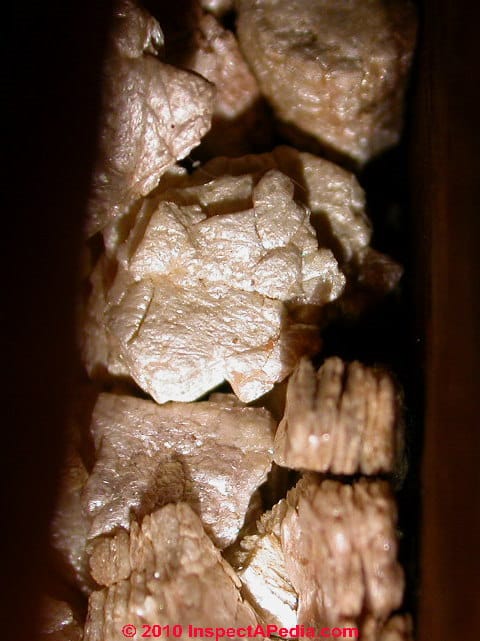
 Vermiculite is a mineral (hydrated laminar magnesium-aluminum-iron silicates or hydrated phlogopite or biotite mica) from the phyllosilicate group. Vermiculite looks somewhat like mica in that it includes shiny flat plates of material that can be separated.
Vermiculite has a wide range of uses in industry, construction, packaging, insulation, packaging, even animal feed.
Building owners of older structures that had little or no attic insulation are most-often familiar with vermiculite that was poured into attic floors as a loose-fill insulating product.
In some buildings vermiculite may also have been blown into previously-uninsulated wall cavities.
See VERMICULITE LOOSE FILL Attic Insulation May Go Unrecognized as a Potential Hazard
In addition to its use as an insulation product and in construction as a masonry fill, a cavity fill, & in concrete blocks, vermiculite is added to soils in horticultural applications and to cement to make a lightweight concrete swimming pool base.
In contemporary building construction (2016) vermiculite is used in lightweight concrete and it has been widely used in spray-applied fireproofing. Spray-on fireproofing takes advantage of the light-weight and fireproof properties of vermiculite.
Older spray fireproofing that also used vermiculite may have employed Libby Amphibole Asbestos (LAA) from the Libby Montana mine: a vermiculite source that contained asbestos in several forms that we list later in this article.
After 1991 spray-applied fireproofing that uses vermiculite would not be expected to use Libby-Montana vermiculite, so it would not be expected to be contaminated with asbestos. Pure vermiculite would not contain asbestos.
Vermiculite is also used in special applications such as industrial filters [17], in ceramics (ground & exfoliated, bonded with calcium silicate to form an unfired insulating layer), as a heat resistant component in brake linings (Yun 2010) and even as a treatment for oil-contaminated waters (Mysore 2005) and as a dessicant (>Spitze 1942).
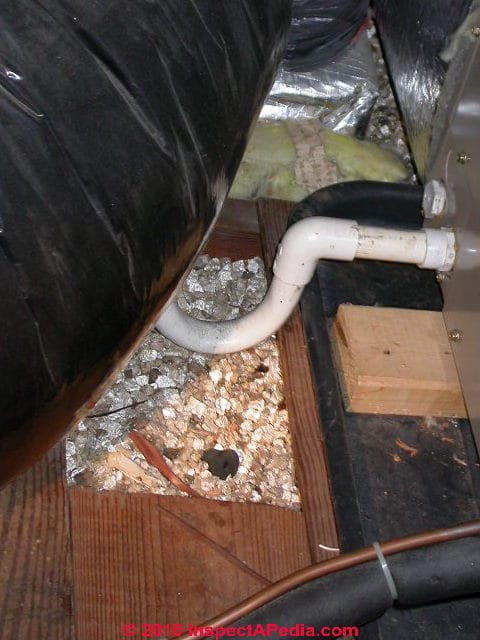
And as we illustrate below, vermiculite insulation can show up as an insulating layer in many products such as a ceiling light fixture.
Details about the properties of vermiculite are
Also see ASBESTOS STYROFOAM PANELS where we discuss WR Grace / Zonolite Styrofoam panels that were sometimes combined with asbestos materials.
Vermiculite Loose Fill Attic Insulation - a Potential Hazard

These photographs by David Grudinski illustrate a potential asbestos hazard that merits further investigation.

Loose-fill vermiculite from the attic of this home was found falling through a ceiling opening into the occupied space below.
A cursory inspection of the attic showed fiberglass insulation in the attic floor. The vermiculite was below the fiberglass.

We cannot assert that this is an asbestos hazard but it might be. Common-sense advice would include:
- Close off the opening that spills vermiculite into the occupied space
- Avoid tracking dust debris from the attic into the occupied space
- Have a representative sample of the vermiculite insulation tested for asbestos.
See ASBESTOS TESTING LAB LIST
Home inspector David Grudzinski provided more vermiculite insulation photographs now found
at VERMICULITE LOOSE FILL Attic Insulation May Go Unrecognized as a Potential Hazard
Vermiculite insulation: falling into home from loose beaverboard / fiberboard ceilings

These photos illustrate another home in Rhode Island with Vermiculite. A 1952 Colonial in North Smithfield RI. I tend to find Vermiculite in older homes of the older less developed towns on the outskirts of the state. In this case, Vermiculite was filled in the rafter bays after "Beaver board" was nailed to the underside of the rafters.
In this home, the homeowner was unaware, and the realtors had no knowledge of the issue.
Recent renovations to the home have caused the Vermiculite to be disturbed and the product is spilling out of the home. The bath fan is adding further potential contamination by blowing the product around in the attic.
I took the time to explain the concerns to the buyer and shared the information about the Zonolite Trust which offers grants for mitigation.
Watch out: As many are unaware, testing for Asbestos under PLM has proven unreliable with Vermiculite. The fibers are too random among the mass of vermiculite in the homes.

The Zonolite Trust has been testing for Barium as a marker to confirm the product in fact was mined at the Grace mine in LIbbey . - David Grudzinski, cited above.
Which Vermiculite Insulation Products Contain Asbestos? Does All Vermiculite Contain Asbestos?
Vermiculite building insulation might contain asbestos
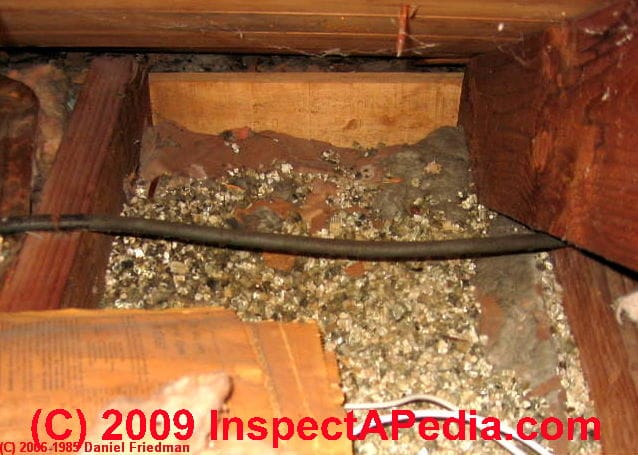
Our vermiculite insulation photo (left) from the attic of a home in New York state, shows how you might spot the presence of vermiculite insulation even when most of the attic floor has been covered-over. You'll also notice that while most of the vermiculite insulation particles in this photograph are silver-tan or silver gray, some dark fragments are also present, as well as incidental debris.
Does All Vermiculite Contain Asbestos
No.
Libby Amphibole Asbestos mined at the Libby Montana site until 1990 was formed in the Triassic period (225 million years ago) and contained tremolite asbestos as well as other forms of asbestos including winchite and richerite, two forms of fibrous amphiboles.
See ZONOLITE BRAND VERMIULITE INSULATION ZAI & CLAIMS
Most of the vermiculite in the currently operating vermiculite mines (listed below) was formed 1.5 to 3 billion years ago in the pre-Cambrian and Archaen periods.
See this VERMICULITE MSDS from Schundler[17]
How is Asbestos Identified in Vermiculite Products?
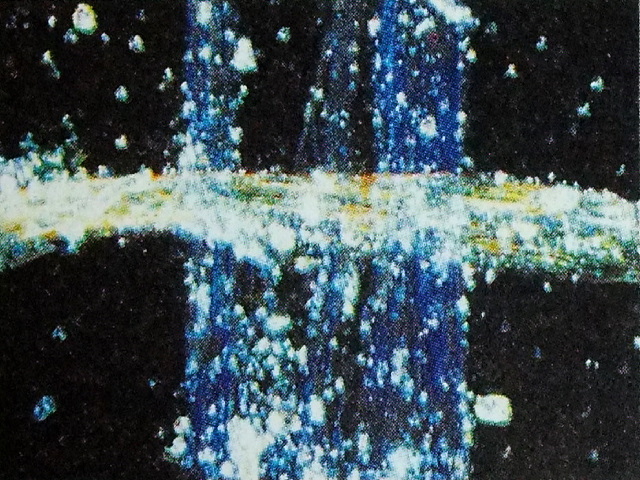
While an expert lab test using polarized light microscopy may be needed to identify the specific type of asbestos fiber, or to identify the presence of asbestos in air or dust samples, many asbestos-containing building products not only are obvious and easy to recognize, but since there were not other look-alike products that were not asbestos, a visual identification of this material can be virtually a certainty in many cases.
Also see ASBESTOS DUCTS, HVAC a field identification guide to visual detection of asbestos in and on heating and cooling system ducts and flue vents.
Also see Micro-Photographs of Dust from the World Trade Center collapse following the 9/11/01 attack. Links to U.S. government and other authoritative research and advice are included.
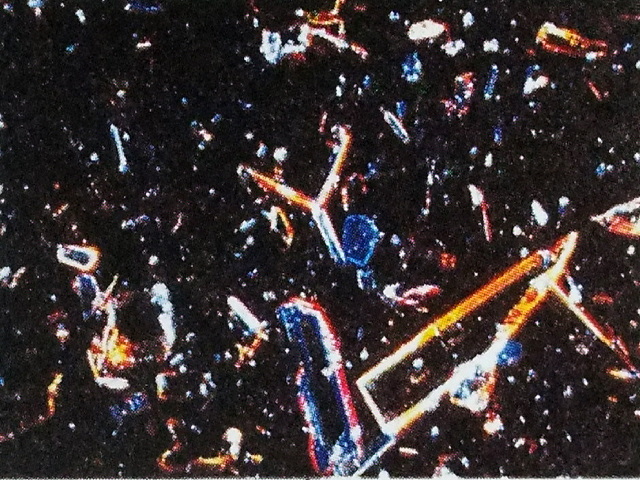
Walter C. McCrone, at McCrone Research Institute published detailed procedures for identifying asbestos by microscopic examination, and identifying which type of asbestos is in a material.
His text and microscopy courses taught at McCrone Research and subsequently at McCrone Institute provided methods for identifying fibrous and non-fibrous asbestos in a wide range of materials.[12]
Dr. McCrone's photograph of fibrous tremolite asbestos is illustrated at above left. Like many minerals and some other particles, asbestos, including tremolite asbestos, can occur in both fibrous (above left) and non-fibrous (below left) forms.
Current Vermiculite Mines & Companies Providing Vermiculite Insulation

Above: Chinese vermiculite from Leijie Trading Co.
Vermiculite mining operations are found world-wide but the largest currently operating vermiculite mining operations continue in
- Brazil,
- Northwestern China (illustration at left & cited below)
- Northeastern Transvaal, South Africa
- Eastern Appalachian mountain range in Virginia & South Carolina in the United States
- Zimbabwe
Some Current Producers and/or Vendors of Vermiculite Products
- Schundler Company, (purchased by Normiska USA in turn purchased by Normiska Canada in 2005). Schundler also produces Coralux Perlite.) [17]
- Queensland Vermiculite, 29 Antimony St., Carole Park 4300, Queensland Australia, Tel: 07-3271-5333, sold in 100L bags.
- China: Leijie Trade Co., Ltd., Shijiazhuang City, Hebei Province Xinhua China, Website www.hbeijie.com, illustrated at above left.
Contemporary Uses of Vermiculite Insulation
- Ceramic additives
- Commercial or industrial filters
- Concrete additive - lightweight concrete
- Dessicants
- Filters
- Fireproofing, spray-on
- Fill in hollow-core concrete masonry units or blocks
- Floor insulation or under-floor sound-insulation
- Heat resistant brake lining materials
- Swimming pool construction, mixed with portland cement (V+16 Pool Base)
- Gardening & horticulture (Perlite Insulation[16] or vermiculite) as a soil additive. (Perlite as an under-floor insulation and as an acoustical insulator is described by the Schundler Company[17]. Perlite as well as vermiculite from some sources do not contain asbestos.)
Research on Asbestos in Vermiculite & Vermiculite Insulation Asbestos Management
 Shown here: a plastic bag used to package Zonolite Attic Insulatin - Vermiculite insulation that is treated as presumed to contain asbestos; photo courtesy of InspectApedia reader Candace Morais (2023/12/27) and posted originally
at VERMICULITE HISTORY & PROPERTIES
- ATSDR, PUBLIC HEALTH ASSESSMENT Libby Asbestos NPL Site OU4: Screening Plant, Export Plant, Town of Libby, and Affected Libby Valley Residential and Commercial Properties Lincoln County, Montana EPA Facility ID: MT0009083840, ATSDR, retrieved 2023/12/27, original source: atsdr.cdc.gov/NEWS/libby-pha1.pdf
Excerpt from Summary:
Libby is the county seat of Lincoln County, in northwest Montana. Vermiculite was mined from “Zonolite Mountain” near Libby from the early 1920s until 1990 and was processed for export in and around the town of Libby.
The vermiculite mined in Libby is contaminated with amphibole asbestos fibers (Libby Asbestos, or LA). Mining and processing operations, as well as home use of Libby vermiculite products, resulted in the spreading of LA throughout the town.
Unusually high numbers of people in Libby have been diagnosed with asbestos-related respiratory disease; deaths from asbestos-related respiratory diseases are also elevated. Since 1999, the Environmental Protection Agency’s (EPA’s) Emergency Response Branch has been conducting sampling and removals to address the most highly contaminated areas in the Libby valley.
Since the proposal of the Libby Asbestos site to the National Priorities List (NPL), these activities have been transitioning over to the Superfund Branch for long-term cleanup. - ATSDR, EXPOSURE TO ASBESTOS-CONTAINING VERMICULITE FROM LIBBY, MONTANA, AT 28 PROCESSING SITES IN THE UNITED STATES [PDF] (2008) U.S. Department of Health and Human Services Agency for Toxic Substances and Disease Registry Division of Health Assessment and Consultation, Tel: 800-CDC-INFO (800-232-4636) E-mail: cdcinfo@cdc.gov Website: http://www.atsdr.cdc.gov.
- Canada, NWT, MANAGEMENT OF ASBESTOS IN ZONOLITE® - VERMICULITE INSULATION [PDF] Canadian Northwest Territories, Public Works & Services, PWS Asbestos Coordinator
Technical Support Services
Asset Management Division, Public Works and Services
S.M. Hodgson Building, 3rd Floor
Box 1320, Yellowknife, NT X1A 2L9
Tel: (867) 920-8835 or (867) 920-8088
Fax: (867) 873-0226 - retrieved 2023/12/27 original source: inf.gov.nt.ca/sites/inf/files/management_of_vermiculite_brochure.pdf
Excerpt: This document is to inform PWS staff about vermiculite loose fill thermal insulation and provide operational safety guidelines for use when vermiculite is present in a building.
Loose fill insulation is usually installed in attic spaces above ceilings, and occasionally in the sealed compartments between studs in wood frame construction or as fill in cement block construction. Vermiculite was also used in fireproofing materials, and as a lightweight aggregate in construction materials. - [7] Canada, VERMICULITE INSULATION CONTAINING, AMPHIBOLE ASBESTOS [PDF], Health Canada, September 2009, web search Jan 2011, source: http://www.hc-sc.gc.ca/hl-vs/iyh-vsv/prod/insulation-isolant-eng.php [copy on file as /hazmat/Vermiculite_Health_Canada.pdf] Vermiculite Insulation Containing Amphibole Asbestos - September 2009, Health Canada Quoting from the PDF document:
Some vermiculite insulation may contain amphibole asbestos fibres. These products can cause health risks if disturbed during maintenance, renovation or demolition.
However, there is currently no evidence of risk to your health if the insulation is sealed behind wallboards and floorboards, isolated in an attic, or otherwise kept from exposure to the interior environment. - US EPA PROTECT YOUR FAMILY FROM ASBESTOS-CONTAMINATED VERMICULITE INSULATION [PDF - converted to web page] (2013) - retrieved de-novo 2023/12/27, original source: epa.gov/asbestos/protect-your-family-asbestos-contaminated-vermiculite-insulation - or on request, a PDF copy is available from us Protect-Your-Family-from-Asbestos-Contaminated-Vermiculite-Insulation-EPA.php
Excerpt:
A mine near Libby, Montana, was the source of over 70 percent of all vermiculite sold in the United States from 1919 to 1990. There was also a deposit of asbestos at that mine, so the vermiculite from Libby was contaminated with asbestos.
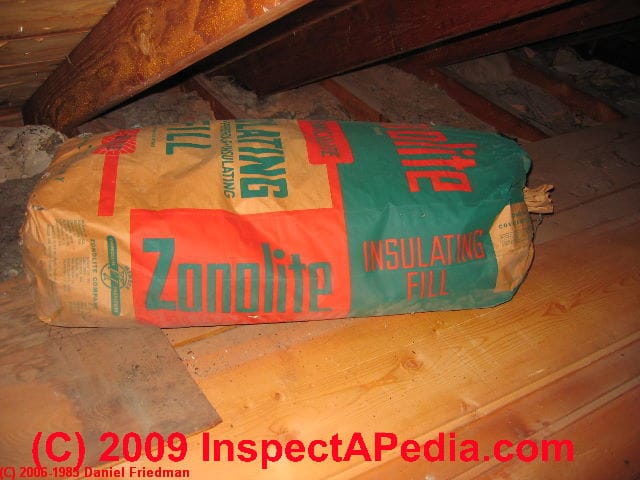
Vermiculite from Libby was used in the majority of vermiculite insulation in the United States and was often sold under the brand name Zonolite.
If you have vermiculite insulation in your home, you should assume this material may be contaminated with asbestos and be aware of steps you can take to protect yourself and your family from exposure to asbestos. - US EPA VERMICULITE: Protect Your Family from Asbestos-Contaminated Vermiculite Insulation, [PDF] U.S. EPA, older text on the same topic, U.S. 08/17/2010, original source: http://www.epa.gov/asbestos/pubs/verm.html [copy on file as hazmat/Vermiculite_US_EPA.pdf/ Current Best Practices for Vermiculite Attic Insulation - May 2003, U.S. EPA
Web search 01/20/2011, original source: http://epa.gov/asbestos/pubs/verm_questions.html - US EPA PROTEJA SU FAMILIA DEL AISLANTE DE VERMICULITA CONTAMINADO CON ASBESTOS [PDF] U.S. EPA HOJA INFORMATIVA web search 08/17/2010, original source http://www.epa.gov/asbestos/pubs/verm-ques-sp.pdf
- US EPA CURRENT BEST PRACTICES FOR VERMICULITE ATTIC INSULATION [PDF] May 2003, U.S. EPA
- US EPA US EPA ADVICE for VERMICULITE SAMPLING for ASBESTOS [PDF] (2004)
- US EPA ADVICE for VERMICULITE SAMPLING for ASBESTOS [PDF] (1982)
- U.S. EPA EPA's 2004 version of the Vermiculite Sampling & Testing for Asbestos Guide [PDF]
- ZAI Trust, The Zonolite Attic Insulation Trust ZAI, 317 Wingo Way, Suite 303, Mt. Pleasant, SC 29464 USA Tel: (844) ZAI-CALL Email: info@zaitrust.com Website: https://www.zonoliteatticinsulation.com/ web: zonoliteatticinsulation.com/S/General-Information
Excerpt: The ZAI Trust was created for the benefit of homeowners with the ZONOLITE brand of vermiculite attic insulation. Specifically, Trust funds are used to reimburse homeowners a portion of their cost to remove or contain Zonolite attic insulation .
In order to be eligible for reimbursement a claimant must be able to show:
That vermiculite is the Zonolite Brand. This is called the Product Identification (PID) requirement AND
How much was paid to have the vermiculite removed or contained. This is called the Expense Requirement.
ZAI CLAIM FORM & INSTRUCTIONS [PDF] - U.S. EPA (U.S. Environmental Protection Agency) 2006. Asbestos Contamination in Vermiculite. Vermiculite and its uses. As of 2018/07/12, NO LONGER AVAILABLE, previously available at: http://www.epa.gov/asbestos/pubs/verm.html#Uses.
- U.S. EPA, ASBESTOS IN YOUR HOME - U.S. EPA, Exposure Evaluation Division, Office of Toxic Substances, Office of Pesticides and Toxic Substances, U.S. Environmental Protection Agency, Washington,D.C. 20460>
- [5] U.S. EPA, Vermiculite: Protect Your Family from Asbestos-Contaminated Vermiculite Insulation, U.S. EPA, web search 08/17/2010, original source: http://www.epa.gov/asbestos/pubs/verm.html
- [18] Romano, Jay, "Coping With Suspect Insulation", The New York Times, 8 June 2003, p. 7
- [17] Schundler Company, Edison, NJ 732-287-2244 Web: schundler.com/underfloor.htm Email: info@schundler.com Schundler provides information about the application-use of both perlite and vermiculite insulation products.
VERMICULITE MSDS for Schundler's vermiculite product - [19] IS EPA "Hazardous Materials: EPA’s Assessment of Sites that May Have Received Asbestos-Contaminated Ore from Libby, Montana (GAO-09-7sp, March 2009), an E-supplement to GAO-09-6R - Koos Inc., 2000 DeKovan Avenue, Racine, Wisconsin", The U.S. Government Accounting Office, Special Publications, web search 5/8/12, original source: http://www.gao.gov/special.pubs/gao-09-7sp/file155.html
- [20] US EPA "Hazardous Materials: EPA’s Assessment of Sites that May Have Received Asbestos-Contaminated Ore from Libby, Montana (GAO-09-7sp, March 2009), an E-supplement to GAO-09-6R - Koos Inc., 2000 DeKovan Avenue, Racine, Wisconsin", The U.S. Government Accounting Office, Special Publications, web search 5/8/12, original source: Former exfoliation facility: http://www.gao.gov/special.pubs/gao-09-7sp/file154.html
- [10] W.R. Grace, "Zonolite Attic Insulation Safety Facts", W.R. Grace Corporation, web search 5/1/2012, original source: http://www.grace.com/about/ehs/libby/zonolite.aspx, [copy on file as /2 Environmental Hazards/Asbestos/Zonolite_Grace_Info.pdf ]
- [11] W.R. Grace, "Libby Timeline", W.R. Grace Corporation, web search 4/28/12, original source :http://www.grace.com/about/ehs/libby/timeline.aspx
[copy on file as [Libby_History_Grace.pdf] - [15] W.R. Grace "Financial Reorganization", W.R. Grace corporation, web search 5/8/11, original source: http://www.grace.com/About/Reorganization.aspx, [copy filed as /Grace_Financial_Reorg.pdf]
Contributor & Technical Review
- David Grudzinski, Advantage Home Inspections, ASHI cert # 249089, HUD cert# H-145, is a professional home inspector who contributes on various topics including structural matters. David Grudzinski, Cranston RI serving both Rhode Island and Eastern Connecticut can be reached at 401-935-6547 fax- 401-490-0607 or by email to Davidgrudzinski@aol.com. Mr. Grudzinski is a regular contributor to InspectAPedia.com
Identify Vermiculite Insulation - Photographs, Description, Properties
 This topic has moved
to HOW TO IDENTIFY VERMICULITE INSULATION - separate article
Watch out: while it is certainly possible to identify a material as vermiculite or vermiculite insulation by examining it with the naked eye or by examining photographs such as those on this page, one cannot determine whether or not vermiculite contains asbestos simply by looking at it with the naked eye nor by comparing photographs of the insulating material.
To absolutely identify asbestos content in vermiculite microscopic examination using polarized light (PLM) is necessary.
See ASBESTOS TESTING LAB LIST if you need to have an insulation sample tested for asbestos.
Vermiculite Insulation Identification Photographs
Moved to VERMICULITE IDENTIFICATION PHOTOGRAPHS
Watch out: vermiculite insulation was not only poured into attic floors but also into building wall cavities during insulation retrofit projects.
Particularly in older balloon-framed buildings, vermiculite could be poured from the attic right into wall cavities extending all the way to the building foundation top. Vermiculite was also often poured into hollow-core concrete block walls.
Munn & Steele Vermiculite Insulation, Siscoe Vermiculite Mines, & Mica-Fill Vermiculite Insulating Products
Moved to MUNN & STEELE VERMICULITE, MICA-FIL, Siscoe Vermiculite Mine
Unidentified Vermiculite Insulation Photographs
See UNIDENTIFIED (BRAND) VERMICULITE PHOTOGRAPHS
Vermiculite Insulation Identification Images from the US EPA & Other Sources
Moved to VERMICULITE IDENTIFICATION PHOTOGRAPHS (more)
Hazards from Incidental Exposure to Vermiculite
This topic is now
at VERMICULITE INSULATION INCIDENTAL EXPOSURE HAZARDS ?
Vermiculite & Vermiculite Mining & Uses
Uses of vermiculite were explored as early as 1824 by Webb, appearing the very next year in Robinson's catalog of American minerals. (Robinson 1825).
Please see details about the history of vermiculite
at HISTORY of the DISCOVERY & CHARACTERIZATION of VERMICULITE.
Properties of Vermiculite Insluation
Moved to a new article at VERMICULITE PROPERTIES
What to Do About Vermiculite Building Insulation
This topic has been moved.
See WHAT TO DO ABOUT VERMICULITE INSULATION
The best way to minimize your risk of amphibole asbestos exposure is to avoid disturbing vermiculite-based insulation in any way. If vermiculite-based insulation is contained and not exposed to the home or interior environment, it poses very little risk.
Zonolite Brand Vermiculite Insulation, ZAI (Zonolite Attic Insulation) Dust & Tremolite Asbestos Hazards
This discussion has moved to
ZONOLITE BRAND VERMICULITE INSULATION
Watch out: Depending on the mine from which this mineral-based insulation was obtained, vermiculite insulation may contain asbestos fibers (including tremolite asbestos) and could present a hazard in buildings, especially if disturbed during renovations.
As we discuss at our notes on other loose-fill insulations such as mineral wool or cellulose, any building insulated with loose-fill or spray-in insulation may benefit from the ability of these loose materials to fill gaps and openings more uniformly than might be found if sloppy workers are careless about installing insulating batts.
...
...
Continue reading at HOW TO IDENTIFY VERMICULITE INSULATION or select a topic from the closely-related articles below, or see the complete ARTICLE INDEX.
Or see VERMICULITE INSULATION FAQs - questions & answers posted originally at this page
Or see these
Recommended Articles
- ASBESTOS FIREPROOFING SPRAY-On Coatings - some containing vermiculite
- ASBESTOS STYROFOAM PANELS
- ASBESTOS TESTING LAB LIST
- INSULATION IDENTIFICATION GUIDE
- VERMICULITE INSULATION - home
- HOW TO IDENTIFY VERMICULITE INSULATION
- VERMICULITE HISTORY & PROPERTIES
- WHAT TO DO ABOUT VERMICULITE INSULATION
- ZONOLITE BRAND VERMIULITE INSULATION ZAI & CLAIMS
- MICA-FIL, MUNN & STEELE, CALIFORNIA, CANADA, & SISCO VERMICULITE ASBESTOS
- VERMICULITE INSULATION INCIDENTAL EXPOSURE HAZARDS ?
Suggested citation for this web page
VERMICULITE INSULATION at InspectApedia.com - online encyclopedia of building & environmental inspection, testing, diagnosis, repair, & problem prevention advice.
Or see this
INDEX to RELATED ARTICLES: ARTICLE INDEX to ASBESTOS HAZARDS
Or use the SEARCH BOX found below to Ask a Question or Search InspectApedia
Ask a Question or Search InspectApedia
Try the search box just below, or if you prefer, post a question or comment in the Comments box below and we will respond promptly.
Search the InspectApedia website
Note: appearance of your Comment below may be delayed: if your comment contains an image, photograph, web link, or text that looks to the software as if it might be a web link, your posting will appear after it has been approved by a moderator. Apologies for the delay.
Only one image can be added per comment but you can post as many comments, and therefore images, as you like.
You will not receive a notification when a response to your question has been posted.
Please bookmark this page to make it easy for you to check back for our response.
IF above you see "Comment Form is loading comments..." then COMMENT BOX - countable.ca / bawkbox.com IS NOT WORKING.
In any case you are welcome to send an email directly to us at InspectApedia.com at editor@inspectApedia.com
We'll reply to you directly. Please help us help you by noting, in your email, the URL of the InspectApedia page where you wanted to comment.
Citations & References
In addition to any citations in the article above, a full list is available on request.
- [1] Thanks to Gary Randolph, Ounce of Prevention Home Inspection, LLC Buffalo, NY, for attentive reading and editing suggestions. Mr. Randolph can be reached in Buffalo, NY, at (716) 636-3865 or email: gary@ouncehome.com, March 2007
- [2] Thanks for photographs of transite asbestos heating ducts, courtesy of Thomas Hauswirth, Managing Member of Beacon Fine Home Inspections, LLC and (in 2007) Vice President, Connecticut Association of Home InspectorsPh. 860-526-3355 Fax 860-526-2942 beaconinspections@sbcglobal.net, June 2007
- [3] Thanks to home inspector Dan Phillips, Advanced Home Inspections, at P.O. Box 1068 Olive Branch, MS 38654-1068 , (901) 229-0822 email: dan@midsouthahi.com 05/29/2010
- Basic Information about Asbestos, US EPA, web search 08/17/2010, original source: http://www.epa.gov/asbestos/pubs/help.html
- EPA Guidance for Controlling Asbestos-Containing Materials in buildings, NIAST, National Institute on Abatement Sciences & Technology, [republishing EPA public documents] 1985 ed., Exposure Evaluation Division, Office of Toxic Substances, Office of Pesticides and Toxic Substances, U.S. Environmental Protection Agency, Washington,D.C. 20460
- [16] The Perlite Institute, Inc., 4305 North Sixth Street Suite A Harrisburg, PA 17110, Tel: 717-238-9723, Fax: 717-238-9985, Email: info@perlite.org, Website: http://www.perlite.org/
- [13] Stanton, .F., et al., National Bureau of Standards Special Publication 506: 143-151
- [14] Pott, F., Staub-Reinhalf Luft 38, 486-490 (1978) cited by McCrone
- In addition to citations & references found in this article, see the research citations given at the end of the related articles found at our suggested
CONTINUE READING or RECOMMENDED ARTICLES.
- Carson, Dunlop & Associates Ltd., 120 Carlton Street Suite 407, Toronto ON M5A 4K2. Tel: (416) 964-9415 1-800-268-7070 Email: info@carsondunlop.com. Alan Carson is a past president of ASHI, the American Society of Home Inspectors.
Thanks to Alan Carson and Bob Dunlop, for permission for InspectAPedia to use text excerpts from The HOME REFERENCE BOOK - the Encyclopedia of Homes and to use illustrations from The ILLUSTRATED HOME .
Carson Dunlop Associates provides extensive home inspection education and report writing material. In gratitude we provide links to tsome Carson Dunlop Associates products and services.
 |
HOME | ABOUT | ASK a QUESTION | CONTACT | CONTENT USE POLICY | DESCRIPTION | POLICIES | PRIVACY | |
| © 2026 - 1985 Publisher InspectApedia.com - Daniel Friedman | |||||||||