
InspectAPedia® FREE Encyclopedia of Building & Environmental Construction, Diagnosis, Maintenance & Repair |
Question? Just ask us! InspectAPedia
|
 Asbestos Cement Transite Water & Sewer Pipes
Transite Pipe Hazards: Asbestos Ingestion

- POST a QUESTION or COMMENT about how to recognize cement asbestos transite water pipes, transite sewer piping, & transite pipe hazards
Transite Asbestos Cement Pipes:
This article assists in the recognition of transite pipe used for water pipes, and discusses potential hazards of this material when it is found in buildings.
This article explains the potential health hazards (asbestos exposure by ingestion) as well as practical problems (fragility, collapse, expense of replacement) of cement asbestos transite pipe water piping and we provide citations to authoritative studies of this question. Among topics of discussion here are Vinyl-lined Transite Asbestos Pipe Hazards.
Practical Hazards & Risks of Transite Water Supply Piping Mains & transite asbestos sewer piping. Safety hazards associated with transite pipe cement asbestos materials in buildings. How to recognize asbestos transite pipe materials in building chimneys, air ducts, water pipes.
Transite pipe was used for water mains as well as in some sewer and drain line applications. Similar transite (asbestos cement) pipes were used as exhaust flues or chimneys for gas fired heaters.
Page top: a Johns Manville Transite asbsestos pipe as advertise in Life, 20 Oct. 1958 [edited for clarity].
InspectAPedia tolerates no conflicts of interest. We have no relationship with advertisers, products, or services discussed at this website.
Guide to Health Hazards of Transite Pipe Cement-asbestos Water Piping
 Transite pipe or asbestos-cement pipes were used for water supply systems in some municipalities up into the 1970's in the U.S. and probably in other countries.
In some cities (Ellwood PA for example), the transite water mains were found to be unable to reliably withstand high water pressures (up to 225 psi in Ellwood according to one of our readers) and the pipes were easily broken.
Transite pipe photos here and below: Johns Manville™ transite (cement asbestos) pipe, contributed by an InspectApedia reader in 2017. (We don't know if this Johns Mansville pipe was a transite water line or a sewer line.)
[Click to enlarge any image]
The reader told us:
We recently purchased a house and a transite pipe was in the front yard. Yesterday someone left the road struck a fence and sent the transite pipe flying.
This exposed the pipes composition. I have attached images for your site if you wish to use them. The show exposed crocidolite fibers present in the matrix. - anonymous by private email 2017/10/08
Below: Johns Manville Transite® pipe being laid during installation of the San Diego Aquaduct carrying water to the city of San Diego (Jones 1955).

Johns-Manville Transite® asbestos water and sewer pipes included Transite, Blue Brute, Permastran, J-M asbestos-cement or "transite" water and sewer pipes of various sizes and properties, and other piping products, such as
Johns-Manville "Zeroseal" used at lap joints, Johns-Manville "Zerogloss" pipe coating, Johns-Manville "Zerotape" and "Zerotex" felted mieral wool pipe insulation tape. J-M transite epoxy-lined sewer pipe sections were joined using the company's "Ring-Tite" rubber sealing rings and were rated as able to carry 100 gallons/inch/mile/day of wastewater. - (Western City Magazine, 1966, Vol. 42 p. 19)
Asbestos fibers might be ingested from water supplied through transite water piping.
Transite piping deteriorates over time, releasing asbestos fibers from the interior of the pipe into the drinking water flowing through that conduit. The level of health risk from ingested asbestos fibers is uncertain and probably low.
An NIH report prepared by industry experts concluded:
The work group believes that the cancer risk associated with asbestos ingestion should not be perceived as one of the most pressing potential public health hazards facing the nation.
However, the work group does not believe that information was sufficient to assess the level of cancer risk associated with the ingestion and therefore, this potential hazard should not be discounted, and ingestion exposure to asbestos should be eliminated whenever possible.
Photo below: an 8-10" diameter transite asbestos pipe contributed by an InspectApedia reader and described as a "field drain".
Another study by Millette JR et als reported
 Cancer mortality for the population census tracts of Escambia County, FL, which use asbestos-cement (AC) pipe for public potable water distribution, was compared with cancer mortality data collected from census tracts in the same county where other types of piping materials are used.
An analysis of covariance was run to test for differences in standard mortality ratios for seven cancer sites among three potential asbestos exposure groups based on AC pipe usage.
Twelve variables representing nonexposure-related influences on disease rates were combined in four independent factors and used as covariates in these analyses.
No evidence for an association between the use of AC pipe for carrying drinking water and deaths due to gastrointestinal and related cancers was found. The limitations on the sensitivity of the analysis are discussed.
Also see:
- ASBESTOS DUCTS, HVAC - Guide to Identification of Asbestos Materials On or In Heating and Cooling Duct Work: carbon monoxide hazards of transite chimneys and vents
- BUILDING & FABRIC ASBESTOS CONTAMINATION by WATER - are building surfaces or clothing contaminated at hazardous levels when the water supply is high in asbestos fibers or particles?
- TRANSITE PIPE AIR DUCT ASBESTOS RISKS - Hazards of Asbestos-containing Transite Pipe HVAC Ducts: duct collapse, mold, radon, asbestos fiber release
- TRANSITE PIPE CHIMNEYS & FLUES - Guide to Identifying Asbestos Transite Chimneys & Flues & their Hazards in buildings
- TRANSITE PIPE WATER SUPPLY PIPING - Guide to Identifying Asbestos Cement Transite Water Pipes & their Hazards in buildings
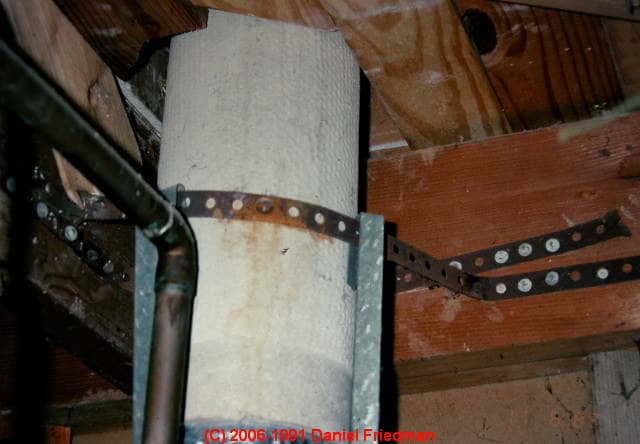 While an expert lab test using polarized light microscopy may be needed to identify the specific type of
asbestos fiber, or to identify the presence of asbestos in air dust or water samples, many asbestos-containing building products
not only are obvious and easy to recognize, but since there were not other look-alike products that were not asbestos, a visual identification of this material can be virtually a certainty in many cases.
While an expert lab test using polarized light microscopy may be needed to identify the specific type of
asbestos fiber, or to identify the presence of asbestos in air dust or water samples, many asbestos-containing building products
not only are obvious and easy to recognize, but since there were not other look-alike products that were not asbestos, a visual identification of this material can be virtually a certainty in many cases.
Links to U.S. government and other authoritative research and advice are included.
Vinyl-lined Transite Asbestos Pipe Hazards
A more immediate water quality hazard has been detected in some vinyl-lined transite water pipes - Tetrachloroethylene. A report on the Sandwich water district On Cape Cod in Massachusetts reported that
"PCE was detected in the distribution system at an annual average of 0.8 parts per billion, which is below the limit set by the U.S. Environmental Protection Agency (EPA).
This substance leaches into the water from vinyl lined transite water pipe. In order to address this problem, in 2002 approximately 8,500 feet of water mains were sealed with an epoxy coating resulting in a dramatic decrease in PCE levels. "
Practical Hazards & Risks of Transite Water Supply Piping Mains
 Photo: Johns Manville Transite® water pipe being laid during installation of the Happy Canyon Flumes. (Thompson 1955).
Leaks in transite water supply piping underground can result in substantial water losses in districts where this piping was used.
Locating transite water supply mains: We've been informed that excavators complain that its lack of metal makes locating transite water pipes difficult - one cannot use ordinary metal detectors.
Of course a buried pipe of non-metallic material might be located if it is possible to insert a sending probe inside its length but on a water main this procedure is impractical.
Contractors joke that they find transite pipe by using the metal bucket of a backhoe as a pipe detector.
Replacement costs for transite water supply piping: because of its age, leaks, fragility, and difficulty of finding transite cement asbestos water supply mains and water piping without also damaging it at the same time, owners of properties and communities served by cement asbestos water pipes (transite) can expect to face increasing costs to replace that piping.
Asbestos fiber release hazards during removal of demolition of transite piping are discussed
at TRANSITE PIPE CHIMNEYS & FLUES.
Incorrect spellings of transite piping or transite duct material that we've seen include transit pipe, transit ducts, Transide pipe, transide ducts, tranisite pipe, and transight pipe. "Transite" is the correct spelling.
Asbestos Cement / Transite Pipe Sewer Lines
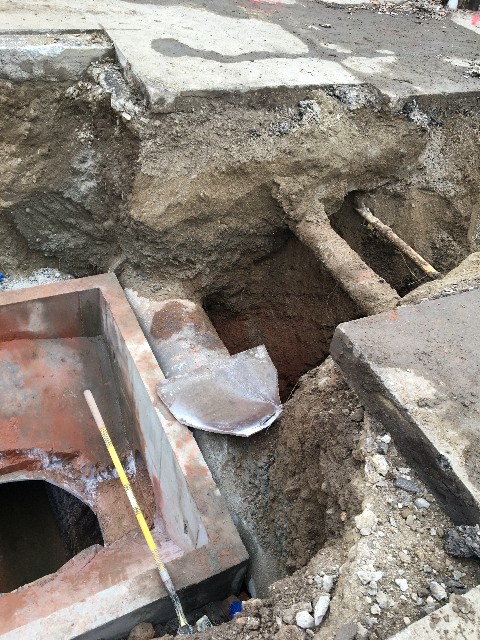
Question:
I was wondering if asbestos could have been used in a liner inside a brick sewer/storm combo in Indianapolis Indiana. - Anonymous by private email 2020/01/30
Reply:
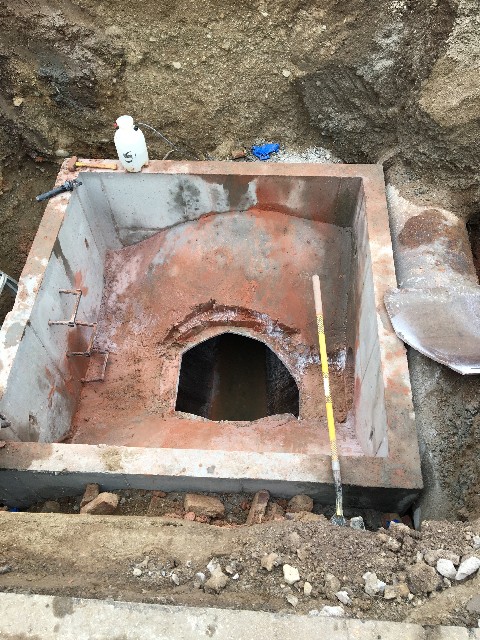
I can't say for sure that the liner in your photo is asbestos cement or transite.
Indeed Johns Manville transite sewer pipe or transite pipe for various uses was produced in diameters from 2" to 36".
Do you know the age of the sewer line?
That would be helpful.
Also Transite pipe may be smooth but often it has a screen-like mesh pattern on the exterior, and the material in your photo looks a bit thin. Still if it's not obviously plastic (e.g. PVC) and if it's brittle and cementious, it'd be reasonable to suspect Transite.
As a point of general information, in most jurisdictions there is no requirement to excavate and replace asbestos-cement sewer lines, though once that excavation occurs - perhaps for repair or modifiction, appropriate handling procedures should be followed.
Below: a reader's photo illustrating transite pipe used as an HVAC duct running parallel to a cast iron sewer line; leaks in the cast iron line sent sewer gases into the damaged transite duct.
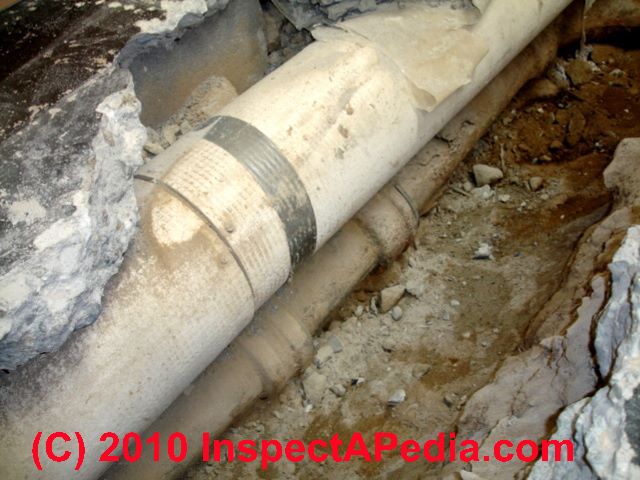
An alternative to replacing asbestos-cement or transite sewer lines is sewer line re-lining.
An example of a company offering sewer line re-lining products and tools suitable for re-lining transite or asbestos cement sewer lines
- Pipelining Supply Co., 2970 E. La Palma Ave., Ste. J – Anaheim, CA 92806 USA Phone 714-630-6311 / 1-888-3LINING (888-354-6464) Email: info@pipeliningsupply.com
See any of these asbestos-cement / transite pipe articles listed at MORE READING
ASBESTOS DUCTS, HVAC other sources of asbestos in HVAC duct systems.
CEMENT ASBESTOS PIPE MANUFACTURE
TRANSITE ASBESTOS CHIMNEYS, DUCTS, PIPES
TRANSITE PIPE AIR DUCT ASBESTOS RISK
TRANSITE WATER PIPE ASBESTOS RISKS
Asbestos-Cement Transite® Water & Sewer Pipes: leaks, history, hazards

Illustration: an example of identifying stamps on asbestos cement pipe installed in the East Bay Municipal Utility District in California (Bueno ca 2013)
- Bellagamba, Sergio, Federica Paglietti, Sergio Malinconico, Beatrice Conestabile della Staffa, Giuseppe
Bonifazi, Daniele Taddei, SAFE REMOVAL of UNDERGROUND ASBESTOS-CEMENT WATER PIPES [PDF] Proceedings of the 8th World Congress on New Technologies (NewTech'22)
Prague, Czech Republic– August 03-05, 2022
Paper No. ICEPR 099
DOI: 10.11159/icepr22.131
Abstract:
Today, there are many countries around the world that have banned the asbestos for its carcinogenic nature of inhalable fibres. Italy was among the first European countries to ban asbestos, with Law 257/1992, and was among the first to issue technical sector regulations for the protection of workers and living environments.
The technical characteristics of this substance, together with its low cost, led to the creation of different mixtures and the processing and production of over three thousand types of products containing asbestos with content varying from 10% to 99% in weight. These products included Asbestos Cement Pipes (ACPs), used for decades for civil and military purposes.
ACP are not in themselves a primary source of danger to public health when underground, intact and still in place, insofar as the main asbestos-related health risk is inhalation.
Cement asbestos pipes can however generate situations of risk when they are subject to removal or maintenance that involves their partial or total exposure to ambient air with the possible dispersion of fibres into the air.
The paper shows a systematic set of procedures and indications to be followed for the safe removal of underground pipes in ACM in order to ensure maximum protection of workers and the living environment surrounding the area of operations.
These procedures may be subject to periodic updating on the base of feedback following their application. These procedures were developed because of the need to provide precise guidelines of national reference, due to a lack of specific sector regulations. - Bueno,Rolando, P.E. ASBESTOS CEMENT PIPE CORROSION STUDY [PDF], (ca 2013) East Bay Municipal Utility District, 375 11th Street Oakland, CA 94607 USA, Tel:
1-866-403-2683 , Pipeline Infrastructure Division,
EBMUD, Tel:
510 287-7038 Email:
robueno@ebmud.com retrieved 2021/03/18 original source: https://ca-nv-awwa.org//canv/downloads/sessions/01/Session01_1630_Bueno.pdf
Note: the EBMUD serves 1.3 million people in a 331 square mile aera, and at the time of this study, contained 1,100 miles of asbestos-cement water supply piping to Alameda and Contra Costa counties in California. (Other water distribution piping in use in the district included steel, PVC, and cast iron pipe and a very small amount of HDPE pipe.)
- “Front Matter.” Journal (Water Pollution Control Federation), vol. 32, no. 2, 1960. JSTOR, www.jstor.org/stable/25034074. Accessed 1 Feb. 2020.
- Jones, J.P., The San Diego Aqueduct, The Reclamation Era [PDF] , May 1955 pp. 31-32. Jones served as regional director, Region 3, Boulder City, Nevada.
See the full set of articles at The Reclamation Era [PDF] - Johns-Manville Service to Industry: asbestos roofings, heat insulations, packings, electrical insulations, waterproofing, flooring, etc., [PDF] (1924) by Canadian Johns Manville Co, Inc. Retrieved 2020/02/01 original source: https://archive.org/details/JohnsManville0001/mode/2up [Warning this is a large, slow-loading PDF file]
- Thompson, Jesse R., "Facelifting at Ucomphagre", The Reclamation Era [PDF] , May 1955, pp. 33-35. Thompson served as Manager-Treasurer, Uncompahgre Valley Water Users' Association.
- U.S. EPA, Notice of Alternative Work Practice for Asbestos Cement Pipe Replacement [PDF] US Environmental Protection Agency, - retrieved 2020/02/01 original source: Notice of Alternative Work Practice for Asbestos Cement Pipe Replacement
Research on the Hazards of Ingesting (eating) Asbestos - Mixed Arguments, Risk Assessments
- Al-Adeeb, A. M., and M. A. Matti. "Leaching corrosion of asbestos cement pipes." International Journal of Cement Composites and Lightweight Concrete 6, no. 4 (1984): 233-240.
Abstract
This paper describes the leaching corrosion of asbestos cement pipes and its influence on their durability and failure in service. The chemical stability, and ultimately the durability, of cementitious products is related to the free lime content Ca(OH)2 present in the hydrated products and the aggressiveness of the surrounding media.
Free lime content of asbestos cement samples from new and used pipes, conducting fresh and brackish water has been measured and analysed. Special apparatus was fabricated to measure the permeability of the asbestos cement matrix to demonstrate the leaching phenomena.
The average free lime content of unused asbestos cement pipes was found to vary between 13.1% and 23.3% with an average value of 16.8%, while the free lime content of samples from burst pipes conducting fresh water varied between 3.5% and 13% with an average value of 8.7%.
On the other hand, samples from burst pipes carrying brackish water had a free lime content in the range of 11.5% and 20.7%.
It is concluded that leaching of free lime is taking place in fresh water pipes for the very soft water, affecting the porosity and permeability of the asbestos cement pipes; once leaching has progressed, it will lead to deterioration and eventual bursting under pressure. - Allen, Elizabeth M., Bruce H. Alexander, Richard F. MacLehose, Gurumurthy Ramachandran, and Jeffrey H. Mandel. "Mortality experience among Minnesota taconite mining industry workers." Occup Environ Med 71, no. 11 (2014): 744-749.
Abstract:
Objective To evaluate the mortality experience of Minnesota taconite mining industry workers.
Methods Mortality was evaluated between 1960 and 2010 in a cohort of Minnesota taconite mining workers employed by any of the seven companies in operation in 1983. Standardised mortality ratios (SMR) were estimated by comparing observed deaths in the cohort with expected frequencies in the Minnesota population. Standardised rate ratios (SRR) were estimated using an internal analysis to compare mortality by employment duration.
Results The cohort included 31 067 workers with at least 1 year of documented employment. Among those, there were 9094 deaths, of which 949 were from lung cancer, and 30 from mesothelioma. Mortality from all causes was greater than expected in the Minnesota population (SMR=1.04, 95% CI 1.02 to 1.04).
Mortality from lung cancer and mesothelioma was higher than expected with SMRs of 1.16 for lung cancer (95% CI 1.09 to 1.23) and 2.77 for mesothelioma (95% CI 1.87 to 3.96).
Other elevated SMRs included those for cardiovascular disease (SMR=1.10, 95% CI 1.06 to 1.14), specifically for hypertensive heart disease (SMR=1.81, 95% CI 1.39 to 2.33) and ischemic heart disease (SMR=1.11, 95% CI 1.07 to 1.16). Results of the SRR analysis did not show variation in risk by duration of employment.
Conclusions This study provides evidence that taconite workers may be at increased risk for mortality from lung cancer, mesothelioma, and some cardiovascular disease.
Occupational exposures during taconite mining operations may be associated with these increased risks, but non-occupational exposures may also be important contributors. - Berndt, Michael E., and William C. Brice. "The origins of public concern with taconite and human health: Reserve Mining and the asbestos case." Regulatory Toxicology and Pharmacology 52, no. 1 (2008): S31-S39.
Abstract:
Asbestos first became an issue to Minnesota’s iron industry when it was revealed that mineral fibers similar to those in Reserve Mining’s tailings were being found in drinking water for several communities that used Lake Superior as their primary water source. This discovery turned what had largely been an environmental court battle into a case concerning public health.
The courts listened to much conflicting and uncertain scientific testimony on the size and distribution of the mineral fibers and on the potential health effects imposed by them. In April 1974, the plant was ordered to shut down by a federal judge but the company quickly appealed the decision.
The appeals court granted a stay and ultimately ruled that the plant’s closure could not be justified based on the unknown health effects of the mineral fibers since the consequences of such an action would have immediate and severe social and economic impacts.
The plant was allowed to continue operation, but ordered to abate emissions to air around the plant and to switch to a land-based tailings disposal system. Much of the scientific uncertainty and public concern over mineral fibers in Minnesota’s taconite industry remain today.
- Cunningham, H. M., and R. D. Pontefract. "Asbestos fibres in beverages and drinking water." Nature 232, no. 5309 (1971): 332-333.
- Frumkin, Howard, and Jesse Berlin. "Asbestos Exposure and Gastrointestinal Malignancy Review and Meta‐Analysis." American journal of industrial medicine 14, no. 1 (1988): 79-95.
Abstract:
The epidemiologic literature linking asbestos exposure with gastrointestinal malignancy is reviewed. Problems in comparing studies are discussed, appropriate strategies for comparison are developed, and study results are pooled using a model which accounts for both intrastudy and interstudy variability.
Stratification of cohorts by dose reveals that significant asbestos exposure, as indicated by a lung cancer standardized mortality ratio (SMR) of at least 200, is associated with an elevated gastrointestinal cancer SMR for five or six end points examined. - Gross, Paul, Russell A. Harley, Layinka Margaret Swinburne, John MG Davis, and William B. Greene. "Ingested mineral fibers: Do they penetrate tissue or cause cancer?." Archives of Environmental Health: An International Journal 29, no. 6 (1974): 341-347.
Abstract:
Three different laboratories independently investigated the ability of ingested mineral fibers to penetrate tissues in rats. All concluded that there was no evidence of tissue penetration by ingested mineral fibers.
These experimental observations are supported by the findings in coal and hard-rock miners who swallow, during their lifetime, nearly 100 times the amount of dust that is stored in their lungs. The intestinal wall or mesenteric lymph nodes of these people show no evidence of storage of the ingested dust particles.
Animals fed asbestos over much of their lifetime and allowed to live to the age of cancer production, failed to provide evidence of a cancerogenic effect. - Hallenbeck, W. H., and C. S. Hesse. "A review of the health effects of ingested asbestos." Reviews on environmental health 2, no. 3 (1977): 157-166.
- Harries, P. G. "Asbestos hazards in naval dockyards." Annals of occupational hygiene 11, no. 2 (1968): 135-145.
Abstract:
Occupational studies indicate that a human health hazard may exist for ingested asbestos since the death rates due to digestive system cancers are elevated in asbestos workers.
This finding may be related to the swallowing of asbestos that was inhaled and cleared from the respiratory system via the respiratory clearance mechanism.
Published animal ingestion experiments have serious shortcomings in their design and execution which make their interpretation very difficult. Animal ingestion and human autopsy studies suggest that asbestos fibers may penetrate the digestive tract and migrate to other locations in the body.
A brief description is given of the types of asbestos materials, and their uses in shipbuilding and ship repairing in Naval Dockyards. An outline of the problems to be faced and a description of preventive methods is followed by a series of questions intended to stimulate practical solutions to the problems of using asbestos materials safely in the industry. - Langston, Nancy. "The Wisconsin Experiment." [PDF] Places Journal (2017). [Website article] retrieved 2017/08/12, original source: https://placesjournal.org/article/the-wisconsin-experiment/
Excerpt:
Asbestos fibers can also contaminate the water. Beginning in 1956, an enormous taconite processing facility owned by Reserve Mining Company began dumping tailings directly into Lake Superior. After decades of lawsuits, the operation was shut down, but not before dumping 400 million tons of waste. Asbestiform fibers were dispersed throughout a third of the lake, eventually reaching Duluth, where the drinking water had over 100 billion fibers per liter.
Editor's Note: see Levy (1976) & Sigurdson (1981, 1983) giving results of long term health effects of asbestos fibers in the drinking water of Duluth MN. - LeFevre, M. E., R. Hammer, and D. D. Joel. "Macrophages of the mammalian small intestine: a review." RES, J. Reticuloendothel. Soc.;(United States) 26, no. 5 (1979).
Abstract:
The present review resulted from questions concerning the fate in the intestine of ingested particulate pollutants such as asbestos and fly ash. These and other similar particulates are common contaminants of food and water, but little is known of the hazards associated with their ingestion. It is probable that they present some hazard if they penetrate the intestinal mucosa. In a recent study, fly ash from a coal-burning power plant was found to contain both organic and inorganic mutagens (34).
The dangers of asbestos ingestion have been widely discussed (20, 36a, 41, 56, 83, 100, 148, 172, 184), although the extent of asbestos penetration of the intestinal mucosa still uncertain (20, 69, 108, 181).
It seemed obvious that many of the particulate pollutants which penetrated the mucosal barrier would be phagocytized by macrophages residing in the lamina propria and that a study of the disposition of particulates within the gut wall should begin with a consideration of intestinal macrophages of lung, pertoneal cavity, spleen and liver have been discussed at length (25), little published work has dealt directly with the origin, abundance and activities of intestinal macrophages.
Nevertheless, considerable information on intestinal macrophages and their interactions with materials which reach them from the intestinal lumen is available in publications dealing primarily with other topics.
Such information is important in toxicologic studies as well as in studies of host defences to intestinal Ags. It is, therefore, appropriate to assemble and discuss findings on intestinal macrophages, even though at present more questions will be raised than can be answered. - Levy, Barry S., Eunice Sigurdson, Jack Mandel, Emaline Laudon, and John Pearson. "Investigating possible effects of asbestos in city water: surveillance of gastrointestinal cancer incidence in Duluth, Minnesota." American journal of epidemiology 103, no. 4 (1976): 362-368.
Abstract:
The recent discovery of over one million asbestos-like fibers per liter of Duluth tap water and the suggestive evidence of a link between certain gastrointestinal (GI) cancers and work exposure to asbestos fibers in the air prompted this study. GI cancer incidence data were gathered for Duluth in the same manner as data previously gathered for comparison cities, Minneapolis and St. Paul
Although some differences in GI cancer incidence occurred among the three cities in 1969–1971, there was no consistent pattern of statistically significant differences observed.
The number of GI cancers diagnosed in Duluth residents in 1972 was similar to that in each of the previous three years. This study represents the start of ongoing cancer surveillance in Duluth. - Logsdon, Gary S. ENGINEERING AND OPERATING APPROACHES FOR CONTROLLING ASBESTOS FIBERS IN DRINKING WATER [PDF] Environmental Health Perspectives 53 (1983): 169-176.
Abstract excerpts
Techniques are available to minimize the concentration of asbestos fibers in drinking water.
Filtration research conducted at locations on Lake Superior and in the Cascade Mountains in Washington has shown that amphibole and chrysotile fibers can be removed by granular media filtration.
Removal percentages can exceed 99% when the raw water is coagulated properly and the filtered water turbidity is 0.10 ntu (nephelometric turbidity units) or lower. ...
Operation and maintenance practices related to the distribution system, when AC water mains are in service, can influence the fiber count in tapwater. Main flushing can stir up sediment that accumulates in low-flow and dead-end areas, raising the fiber count.
If mains are tapped and the cuttings are not flushed away through the tapping machine, but are instead permitted to fall into the water main, the fiber count can be raised. - McMillan, Lilia M., Roy G. Stout, and Benjamin F. Willey. "Asbestos in raw and treated water: an electron microscopy study." Environmental Science & Technology 11, no. 4 (1977): 390-394.
- Olson, Harold L. "Asbestos in potable-water supplies." Journal-American Water Works Association 66, no. 9 (1974): 515-518.
Abstract:
Asbestos-cement pipe was developed in Italy approximately sixty years ago and its use rapidly spread around the world. The causes of the rapid acceptance are as follows: the pipe is resistant to corrosion, asbestos-cement pipe has a high enough strength to withstand high external forces, asbestos-cement pipe has contributed to high water quality, it is light weight and easy to install and has a permanently smooth wall so pumping costs are low.
Asbestos fiber is dangerous when inhaled but there is no evidence that asbestos from pipe endangers the health of humans. - Sigurdson, Eunice E. "Observations of cancer incidence surveillance in Duluth, Minnesota." Environmental health perspectives 53 (1983): 61.
Abstract:
In 1973, amphibole asbestos fibers were discovered in the municipal water supply of Duluth, Minnesota. The entire city population of approximately 100,000 was exposed from the late 1950s through 1976 at levels of 1-65 million fibers per liter of water.
Because of previous epidemiologic studies that linked mesothelioma, lung and gastrointestinal cancers to occupational exposure to asbestos, surveillance of cancer incidence in residents of Duluth was initiated to determine the health effect from ingestion of asbestos.
The methodology of the Third National Cancer Survey (TNCS) and SEER Program was used. Duluth 1969-1971 rates were compared with TNCS rates for the cities of Minneapolis and St. Paul during 1969-1971; Duluth rates during 1974-1976 are compared with Duluth 1969-1971; Duluth rates during 1979-1980 are compared with Duluth 1969-1971 and with Iowa SEER; and a table of the occurrence of malignant mesothelioma is presented.
Statistically significant excesses are observed in several primary sites in Duluth residents.
However, lung cancer in Duluth females is the only primary site considered also of biological significance.
The mesothelioma incidence rate is no more than expected. This paper also describes the problems of long-term surveillance of exposed populations considered at risk of environment cancer, the need for improved study methodologies and the use of federal records for follow up of exposed individuals. - Sigurdson, Eunice E., Barry S. Levy, Jack Mandel, Richard McHugh, Leonard J. Michienzi, Helen Jagger, and John Pearson. "Cancer morbidity investigations: lessons from the Duluth study of possible effects of asbestos in drinking water." Environmental research 25, no. 1 (1981): 50-61.
Abstract:
In 1973, 1 to 30 million asbestos-like fibers per liter of tap water were discovered in Duluth drinking water.
Previous studies had linked mesothelioma, lung, and gastrointestinal cancers with occupational exposure to asbestos, so surveillance of cancer morbidity in Duluth was initiated to investigate effects from ingestion of asbestos in drinking water.
Gastrointestinal and lung cancer incidence data for 1969–1974 were collected in the same manner as in the Minneapolis-St. Paul component of the Third National Cancer Survey; Duluth rates for 1969–1971 were compared with incidence rates for the cities of Minneapolis and St. Paul during the same time period; and Duluth rates for 1972–1974 were compared with Duluth rates for 1969–1971.
Duluth females and both sexes combined had statistically significantly higher rates of pancreatic cancer than in Minneapolis and St. Paul in 1969–1971. These rates subsequently decreased in 1972–1974 for both sexes combined in Duluth.
Duluth males and both sexes combined had similar excesses for gastrointestinal tract not specified in comparison with Minneapolis and St. Paul.
Duluth and Minneapolis cancer incidence rates yielded less-exaggerated differences between the two study areas compared with mortality rates. Resources required for morbidity surveillance are described. - Toft, Peter, and M. E. Meek. "Asbestos in drinking water: a Canadian view." Environmental health perspectives 53 (1983): 177.
Abstract:
For several years now, public health professionals have been faced with evaluating the potential hazards associated with the ingestion of asbestos in food and drinking water. In Canada, this is a subject of particular concern, because of the widespread occurrence of chrysotile asbestos in drinking water supplies.
The results of available Canadian monitoring and epidemiologic studies of asbestos in drinking water are reviewed and discussed in light of other published work.
It is concluded that the risk to health associated with the ingestion of asbestos, at the levels found in municipal drinking water supplies, is so small that it cannot be detected by currently available epidemiologic techniques. - US EPA GUIDELINES-FOR-ENHANCED-MANAGEMENT-OF-ASBESTOS-IN-WATER-AT-ORDERED-DEMOLITIONS-EPA-453-B-16-002A [PDF]
- Wedding, James B., Andrew R. McFarland, and Jack E. Cermak. "Large particle collection characteristics of ambient aerosol samplers." Environmental Science & Technology 11, no. 4 (1977): 387-390.
The page top photo of transite pipe that was used either as a water main or as part or a sewer line was contributed by reader Ricky and was posted originally
Asbestos Cement Pipe Testing
Question: hardness of asbestos cement pipe when new & now
2019/05/09 Anonymous
I’m Durometer testing outer casing of 8” size ACP pipe wanting to know approx. hardness when brand new?.. testing pipe #1 after 56 years in ground finding 75 to 85 on Durometer. Test pipe #2 finding 50 average. If you have a chart or recommendations can you forward? -- Anonymous by private email
Reply:
We found several references on tests of the condition of asbestos cement pipe, focusing on water and sewer mains. Those authors discuss several methods of AC pipe testing including hardness, but you'll want to look at the articles directly so that you can be sure that their hardness measurements compare to the methods that you are using as well as the pipe condition and application.
Properties of Asbestos Cement Pipe (& Other asbestos cement products)
- Al-Adeeb, A. M., and M. A. Matti. "Leaching corrosion of asbestos cement pipes." International Journal of Cement Composites and Lightweight Concrete 6, no. 4 (1984): 233-240.
- American WEIGHTS of ASBESTOS-CEMENT (A-C) Pipe, American [pipe], P.O. Box 2727 Birmingham, AL 35202 USA, Tel: 1-205-325-7701 retrieved 2021/03/18, original source: https://american-usa.com/products/valves-and-hydrants/ductile-iron-tapping-sleeves/series-2800-a-for-asbestos-cement-a-c-pipe/weights
- ASTM E2394, ASTM Standard Practice for Maintenance, Renovation and Repair of Installed Asbestos Cement Products, available from ASTM International, www.astm.org.
- Brown SK. Physical Properties of Asbestos-Cement Roof Sheeting after Long-term Exposure. J. Occup. Health Safety-AustNZ 1998, 14(2), 129-134.
- Chowdhury, Rudaba; Hu, Yafei; Wang, Dunling, CONDITION EVALUATION OF ASBESTOS CEMENT WATER MAINS [PDF] NRC Publications Archive retrieved 2019/05/09 original source: https://nrc-publications.canada.ca/eng/view/accepted/?id=c1f24ea1-3593-4796-93e2-3745fa48dfbf
Abstract:
Abstract: This paper focuses on the condition evaluation of asbestos cement (AC) pipe samples from three utilities located in different geographic regions and climatic zones in the USA and Canada. Various means of examination or testing were used to evaluate the condition of the samples.
These included visual inspection, hardness testing, phenolphthalein testing, crush testing, and scanning electron microscopy with energy dispersive spectroscopy (SEM/EDS). Climate and soil information was also collected for the areas where the three utilities are located to assess the external environments facing the AC pipes.
The condition evaluation results were correlated with the external soil characteristics and internal water quality data, collected through a survey, to identify factors contributing to the deterioration of the AC pipes belonging to these utilities. The paper also discusses the variation in the deterioration of the AC water mains from the three utilities. - Davis, Paul, Dhammika De Silva, David Marlow, Magnus Moglia, Scott Gould, and Stewart Burn. "Failure prediction and optimal scheduling of replacements in asbestos cement water pipes." Journal of Water Supply: Research and Technology-Aqua 57, no. 4 (2008): 239-252.
- Denison, Irving A., and Melvin Romanoff. "EFFECT OF EXPOSURE TO SOILS ON THE PROPERTIES OF ASBESTOS-CEMENT PIPE." [PDF] Journal of Research of the National Bureau of Standards 47, no. 5 (1951): 367.
Abstract excerpt:
This report summarizes the results of study made on two varieties of asbestos-cement pipe involving the exposure to 15 different soils for periods up to 11 years. The soils range from well-aerated types deficient in water soluble salts to very poorly aerated ones containing high concentrations of soluble material.
The effects of exposure to the soils on the mechanical and physical properties of asbestos-cement pipe are indicated by measurements of hydrostatic bursting pressure, crushing strength, water absorption … - Genever, Matt, Matthew Allan, Greg Menz, Steven Bos, and Mark Rawson. CASE STUDIES OF ASBESTOS WATER PIPE MANAGEMENT PRACTICE Australian Government Asbestos Safety and Eradication Agency, Australia (2017).
Abstract excerpt:
The fact that asbestos water pipes may be buried deep in the ground means that water authorities must balance repair and removal works with the needs of the community, seeking to minimise disruption caused by the removal or remediation of asbestos-cement water pipes.
Asbestos containing (AC) cement has been used extensively in Australia, and whilst no evidence suggests this creates a risk to drinking water, its ageing
nature means many of the AC pipes are likely to need remediation in the next ten to fifteen years.
The case studies in this report seek to highlight current practice on the management and removal of asbestos water pipes in Australia, including common methods considered by water authorities across the country.
Unlike other areas of asbestos management, asbestos water pipes present themselves visually less often than asbestos in buildings or uncovered in contaminated soils. Rather, aging asbestos water pipes fail and leak, requiring water authorities to take remedial action. - Ghirmay, Abiy Melles, ASBESTOS CEMENT PIPE CONDITION ASSESSMENT AND REMAINING SERVICE LIFE PREDICTION [PDF] (2016). University of Arkansas, Fayetteville Theses and Dissertations. 1744.
- Hu, Y., and D. W. Hubble. "Factors contributing to the failure of asbestos cement water mains." Canadian Journal of Civil Engineering 34, no. 5 (2007): 608-621.v
- Kanarek, Marty S., Paul M. Conforti, and Lorene A. Jackson. "Chrysotile asbestos fibers in drinking water from asbestos-cement pipe." Environmental Science & Technology 15, no. 8 (1981): 923-925.
- Logard, ASBESTOS CEMENT PIPE WEIGHT WITH or WITHOUT WATER [image] (2005) Logard, 201, Bishop street Portneuf (Québec) CANADA G0A 2Z0 Phone number : (418) 913-0992 Email: info@logard.com Website: http://www.logard.com retrieved 2021/03/18, original source: http://www.logard.com/en/Supports/weight.aspx
- McGinnis, C. A. "Johns-Manville." Sewage Works Journal (1941): 1061-1064.
Excerpts:
The weight of Tran site per foot is from 25 to 60 per cent less than that of other … This coupling consists of a Transite sleeve which is pulled over abutting ends of pipe, rolling into … Frequently, sewer lines are buried 20, 25 feet or more, and the earth loads bearing down on pipe at … - Meigs, J. Wister. ASSESSMENT OF STUDIES ON CANCER RISKS FROM ASBESTOS IN CONNECTICUT DRINKING WATER [PDF] Environmental Health Perspectives 53 (1983): 107-108.
- Stark, G.W., P.E., and R.S. Charlton, P.E., CLASS 150 ASBESTOS CEMENT (AC) WATERMAIN PIPE CONDITION EVALUATION DEEP BAY WATER DISTRICT [PDF], (2008), Levelton Consultants Ltd. # 150 - 12791 Clarke Place Richmond, B.C. V6V 2H9 Canada, prepared for The Deep Bay Waterworks District 5031 Mountainview Road RR1, Site 150, C 4 Bowser, British Columbia V0R 1G0
- Taylor Pipe Supports, PROPERTIES of CEMENT ASBESTOS PIPE [image] Taylor Co., 5305 John Lucas Dr., Burlington, Ontario Canada L7L 6A8 Tel: 1.800.263.8652 (Founded 1982) Email: linda@taylorpipesupports.ca Website: taylorpipesupports.ca/AC-Transite-pipe-data.php
- Wang, Dunling, Roy Cullimore, Yafei Hu, and Rudaba Chowdhury. "Biodeterioration of asbestos cement (AC) pipe in drinking water distribution systems." International biodeterioration & biodegradation 65, no. 6 (2011): 810-817.
- Webber, James S., James R. Covey, and Murray Vernon King. "Asbestos in drinking water supplied through grossly deteriorated A–C pipe." Journal‐American Water Works Association 81, no. 2 (1989): 80-85.
Abstract:
High concentrations of asbestos were found in the water supply system of Woodstock, N.Y., following a routine pipe-tapping operation in the fall of 1985. Analysis of a water sample collected 10 days after tapping showed asbestos concentrations in excess of 104 million fibers per litre (MFL).
The source of this asbestos was asbestos–cement (AC) pipe, which was so deteriorated that sections of pipe could be easily broken by hand. Although asbestos concentrations decreased rapidly as AC pipe was removed from the system, concentrations as high as 49 MFL were measured during the summer of 1986.
Throughout the sampling period, even when concentrations fell below 1 MFL, Woodstock water samples were characterized by fibers with much larger lengths, widths, and masses than those collected in nonproblem areas across New York state. - West Coast Pipe, THEORETICAL WEIGHTS PER LINEAR FOOT for CEMENT MORTAR COATING (of pipe] [Image], West Coast Pipe, 2180 N. Locust Ave.
Rialto, CA 92377 USA, Email: 2180 N. Locust Ave.
Rialto, CA 92377 USA, Tel: (909) 356-5670 Website: http://www.westcoastpipe.com/ CML/CMC Weight Charts, retrieved 2021/03/18 original source: http://www.westcoastpipe.com/charts_weights.html - Zavašnik, Janez, Andreja Šestan, and Srečo Škapin. "Degradation of asbestos–Reinforced water supply cement pipes after a long-term operation." Chemosphere 287 (2022): 131977.


![THEORETICAL WEIGHTS PER LINEAR FOOT for CEMENT MORTAR COATING (of pipe]](CML-CMC-Pipe-Weight-Charts-WestcoastPipe.jpg)
Reader Comments, Questions & Answers About The Article Above
Below you will find questions and answers previously posted on this page at its page bottom reader comment box.
Reader Q&A - also see RECOMMENDED ARTICLES & FAQs
On 2022-07-16 by InspectApedia-911 (mod) - possible transite asbestos septic line in northern Califdornia?
@Anonymously,
that does look like transite pipe. though the photo does NOT give a close-enough look for me to be certain.
I can't say anything about the likelihood of other pipes being the same material; I don't know what other pipes you're asking about.
Certainly it's true that in some communities both sewer lines and water mains used transite piping, as you will read above on this page.
But water piping inside of a single family home like that in your photo would more-likely have been galvanized iron or later copper or PVC.
On 2022-07-13 by Anonymously
Wondering if my septic line is asbestos. Installed 1966-1967 in Northern California.
And what would the likelihood be that other pipes are the same?

On 2019-11-05 by danjoefriedman (mod) - tnotest that asbestos in drinking water is unsafe
GW
Thank you for your opinion.
Take a look at the references and citations found at the end of any of these articles and you will see there's been an enormous amount of research on this question.
On 2019-11-03 by G W
Asbestos in drinking water: It is well known that asbestos gives Lung Cancer. This shown by mega million dollar law settlements. It is obvious that asbestos in our intestines etc is very unhealthy. This is like saying smoking is bad, but chewing tobacco is OK. A carcinogen is a carcinogen.
Proposed study on Asbestos Cement pipe: Take Colon cancer tumors and biopsy them for asbestos. Compare samples from patients with asbestos in drinking water to those without asbestos. Asbestos never burns.
So burn part of the sample and analyse the residue. Takes a electron microscope and special light to detect asbestos.
Previous studies are pretty weak. Like tobacco companies in the 1920s till 1965 saying smoking was OK
InspectApedia is really great!
...
Continue reading at CEMENT ASBESTOS PIPE MANUFACTURE or select a topic from the closely-related articles below, or see the complete ARTICLE INDEX.
Or see these
Recommended Articles
- ASBESTOS CEMENT PRODUCTS - topic home, where we include research on the chrysotile asbestos content & hazard of asbestos cement & transite products.
- ASBESTOS DUCTS, HVAC - Guide to Identification of Asbestos Materials On or In Heating and Cooling Duct Work: carbon monoxide hazards of transite chimneys and vents
- BUILDING & FABRIC ASBESTOS CONTAMINATION by WATER
- CEMENT ASBESTOS PIPE MANUFACTURE
- SLAB DUCTWORK
- TRANSITE ASBESTOS CHIMNEYS, DUCTS, PIPES
- TRANSITE PIPE AIR DUCT ASBESTOS RISK
- TRANSITE PIPE CHIMNEYS & FLUES - Guide to Identifying Asbestos Transite Chimneys & Flues & their Hazards in buildings
- TRANSITE PIPE WATER SUPPLY PIPING - Guide to Identifying Asbestos Cement Transite Water Pipes & their Hazards in buildings
- TRANSITE WATER SEWER PIPE ASBESTOS RISK
- Micro-Photographs of DUST from the World Trade Center COLLAPSE following the 9/11/01 attack.
Suggested citation for this web page
TRANSITE WATER & SEWER PIPE ASBESTOS RISK at InspectApedia.com - online encyclopedia of building & environmental inspection, testing, diagnosis, repair, & problem prevention advice.
Or see this
INDEX to RELATED ARTICLES: ARTICLE INDEX to ASBESTOS HAZARDS
Or use the SEARCH BOX found below to Ask a Question or Search InspectApedia
Ask a Question or Search InspectApedia
Try the search box just below, or if you prefer, post a question or comment in the Comments box below and we will respond promptly.
Search the InspectApedia website
Note: appearance of your Comment below may be delayed: if your comment contains an image, photograph, web link, or text that looks to the software as if it might be a web link, your posting will appear after it has been approved by a moderator. Apologies for the delay.
Only one image can be added per comment but you can post as many comments, and therefore images, as you like.
You will not receive a notification when a response to your question has been posted.
Please bookmark this page to make it easy for you to check back for our response.
Our Comment Box is provided by Countable Web Productions countable.ca
Citations & References
In addition to any citations in the article above, a full list is available on request.
- 12/2008: thanks to an anonymous reader DG, GE Infra, Transportation, for editorial comments and suggestions about transite water supply piping.
That reader commented:
Transite pipe was used in fresh water supply piping in some communities, and we have it in our subdivision, I remember playing on the pile of left over pipe (1970's). It was 4-6" dia. and was probably 1/2-1" thick, the ends looked to be belt sanded to a taper.
Recently I was talking with a digging contractor, he swears at the stuff, as it cannot be found (underground) with a metal detector, only the metal bucket of the excavator. He says the the Ellwood city (in western PA) water system ran it at about 225 psi, and just looking at it would break it. - Notes on the Sandwich water district, Cape Cod, MA, water quality report were obtained online at www.sandwichwater.com/sandwich-pg2-08-corrected.doc - 12/09/2008
- "Report on cancer risks associated with the ingestion of asbestos. DHHS Committee to Coordinate Environmental and Related Programs", Environmental Health Perspectives 1987 June; 72: 253-265. This article is available from NIH at pubmedcentral.nih.gov/articlerender.fcgi?artid=1474636 - the list of references for this study is extensive and quite useful.
- Nicholson, WJ. Human cancer risk from ingested asbestos: a problem of uncertainty. Environ Health Perspect. 1983 Nov;53:111–113
- Erdreich, LS. Comparing epidemiologic studies of ingested asbestos for use in risk assessment. Environ Health Perspect. 1983 Nov;53:99–104.
- Millette, JR; Craun, GF; Stober, JA; Kraemer, DF; Tousignant, HG; Hildago, E; Duboise, RL; Benedict, J. Epidemiology study of the use of asbestos-cement pipe for the distribution of drinking water in Escambia County, Florida. Environ Health Perspect. 1983 Nov;53:91–98. At PubMed via NIH www.ncbi.nlm.nih.gov/pubmed/6559131
- "Epidemiology study of the use of asbestos-cement pipe for the distribution of drinking water in Escambia County, Florida," Millette JR, Craun GF, Stober JA, Kraemer DF, Tousignant HG, Hildago E, Duboise RL, Benedict J., Environmental Health Perspectives, 1983 Nov; 53:91-8.
- In addition to citations & references found in this article, see the research citations given at the end of the related articles found at our suggested
CONTINUE READING or RECOMMENDED ARTICLES.
- Carson, Dunlop & Associates Ltd., 120 Carlton Street Suite 407, Toronto ON M5A 4K2. Tel: (416) 964-9415 1-800-268-7070 Email: info@carsondunlop.com. Alan Carson is a past president of ASHI, the American Society of Home Inspectors.
Thanks to Alan Carson and Bob Dunlop, for permission for InspectAPedia to use text excerpts from The HOME REFERENCE BOOK - the Encyclopedia of Homes and to use illustrations from The ILLUSTRATED HOME .
Carson Dunlop Associates provides extensive home inspection education and report writing material. In gratitude we provide links to tsome Carson Dunlop Associates products and services.
 | HOME | ABOUT | ASK a QUESTION | CONTACT | CONTENT USE POLICY | DESCRIPTION | POLICIES | PRIVACY | |
| © 2024 - 1985 Publisher InspectApedia.com - Daniel Friedman | |||||||||