
InspectAPedia® FREE Encyclopedia of Building & Environmental Construction, Diagnosis, Maintenance & Repair |
Question? Just ask us! InspectAPedia
|
 Basement Mold: How to Find and Test for Mold in Basements

- POST a QUESTION or COMMENT about how find, remove, and prevent mold contamination in building basements; where to look for both obvious and more "hidden" mold growth in basements
How to find & clean up basement mold contamination:
What should we do to test for mold in basements? Is inspecting more important than testing? What do we do to assure that basement mold contamination has been properly found, removed, and cured?
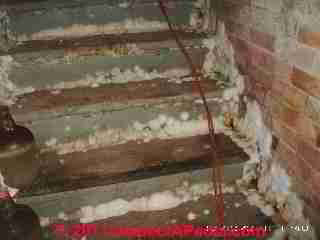
This document gives advice on how to find and deal with mold in building basements and in basement insulation. Our page top photo of very mature basement mold growth on entry stairs was provided by reader Chase Falke.
InspectAPedia tolerates no conflicts of interest. We have no relationship with advertisers, products, or services discussed at this website.
BASEMENT MOLD: finding the problem mold, allergens, or other particles in basements
 Checkpoints for finding problem mold contamination in basements
- Leak History: Examine the basement for its evidence of recurrent leaks and water entry.
- Finished Basement Organic surfaces: Look carefully at organic surfaces such as wood, drywall, and carpets in a finished basement:
- Walls: drywall, especially low on walls, in wet corners, behind furniture, and in areas of leaks from above
- Ceilings: drywall, especially in areas of leaks from above, such as under baths or kitchens, and at the walls below roof eaves
in cold climates where ice dam leaks may have sent water into wall cavities;
look at hot water heating baseboard locations for bleeder vents or other leak points - Ceilings: suspended ceilings: look on both sides of ceiling tiles for visible mold or leak stains; don't ignore possible mold in fiberglass-based ceiling tiles.
- Ceilings: inspect framing - the joists of floors above, and the exposed side of subflooring of the floor above. See our warning about mold growth on pine boards discussed at Attic inspections above.
- Floors: wall to wall carpeting is a very common mold and allergen reservoir.
Don't ignore possible reservoirs of high levels of mite fecals and pet dander including pets from prior owners. Look for other signs of pet presence in the building such as scratches on doors and trim.
Looking in the Un-Finished Basement for Mold
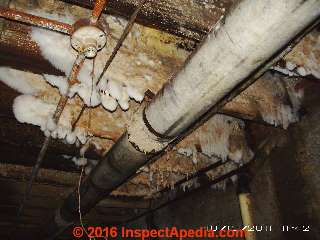
Below: a less-dramatic but far more-common example of mold growth on wood surfaces in a basement ceiling: mold has contaminated the ceiling joists - forming the floor joists of the building's first floor - as well as the plywood subflooring overhead.

The owner of the building above, an InspectApedia.com reader, reported a single-event leak that had happened many years before.
The moldy basement photo above shows several colors and probably several species of mold on the plywood subfloor overhead along with water stains on the floor joist, as viewed from the basement.
The photo below shows what looks like mold on the sides of a floor joist, though it could be something else: closer examination is needed.

However the photos tell us more: the plywood in the photo below has de-laminated, suggesting that the subfloor was quite wet and was left wet.

- Un-finished basement mold: Look carefully at organic surfaces in un-finished basements or behind or above finished surfaces. Our photo of mature mold growth on floor joists that form a basement ceiling was provided by reader Chase Falke.
- Look for evidence of prior basement water entry - mold is more likely to have grown on wetter surfaces first in a basement. Stains on the floor or remnants of cardboard boxes that were there, wet, and then removed, are important clues.
- Inspect the exposed sides of all framing, joists, girders, posts
- Inspect the exposed under-side of subflooring of the floor overhead. See our warning about mold growth on pine boards discussed at Attic inspections above.
- Inspect the back side of stairs, especially the lower treads and risers
- Don't assume that because there is no visible mold on surfaces that there is not a problem mold reservoir in exposed insulation.
- Basement contents
Watch out: be sure to inspect furniture and stored materials in a basement where mold is suspected, such as cardboard boxes and their contents and the under-side of furniture and game tables.
Often we find serious mold growth on the un-finished surfaces of wood objects, probably because the absence of a coating means that such surfaces take up more moisture than other sides of the same item.
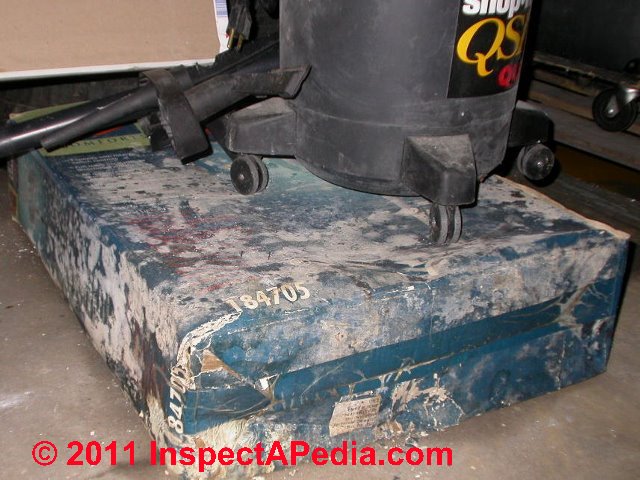
Above: a carefully-wrapped package as well as the plastic vacuum cleaner sitting atop it have both become quite mold-contaminated while stored in a damp basement.
How to Find Mold hidden in basement insulation or on basement contents
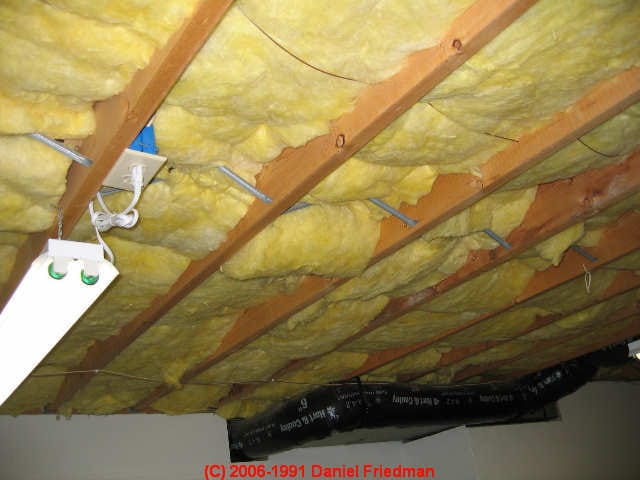
Watch out: Even when there is no visible mold, don't ignore exposed fiberglass insulation as a possible mold reservoir.
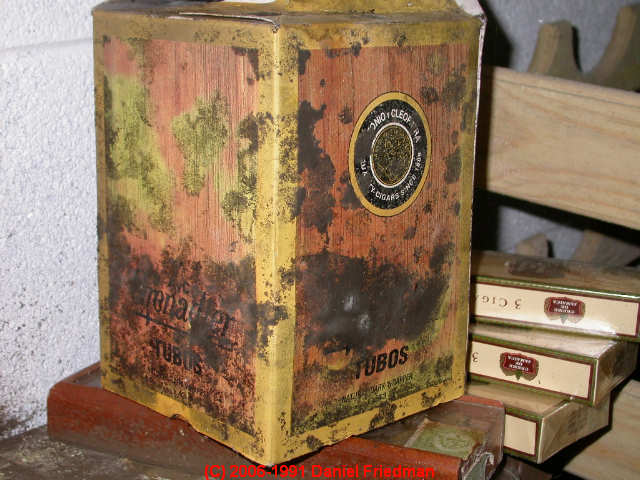
A basement which was previously moldy or wet, or a basement which stored a collection of moldy boxes [image] or cartons of moldy papers and files [image] may have been may have left behind a large mold reservoir in the basement fiberglass insulation and in settled dust.

In the first photo shown here the basement insulation looked clean to the naked eye, but a history of basement flooding led us to test the insulation.
We found high levels of Aspergillus contamination in this yellow fiberglass insulation which, to the naked eye, looked quite clean.
If there is visible mold on other basement surfaces, don't forget to also check the condition of basement insulation that your insurance company, mold consultant, or mold remediator may want to leave in place because it "looks clean".
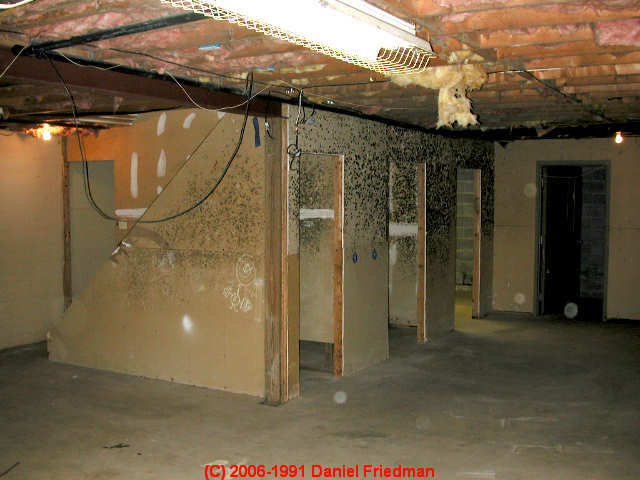
In the photograph shown above, not only was there extensive Stachybotrys chartarum contamination visible as "black mold" on the basement drywall, a special vacuum test of the fiberglass insulation in this basement ceiling disclosed high levels of Aspergillus versicolor, Aspergillus sp., & Penicillium sp..
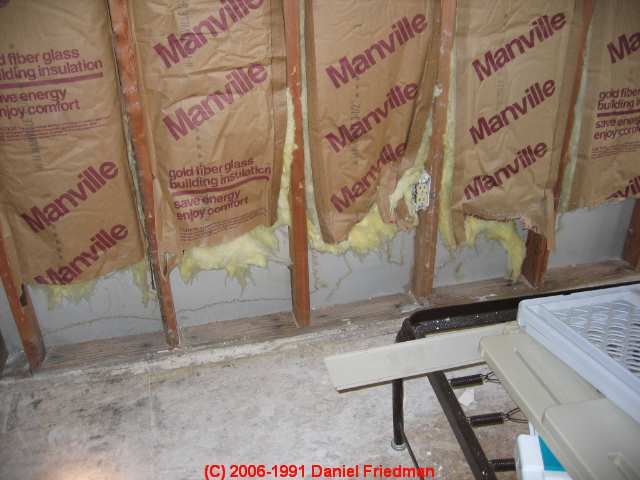
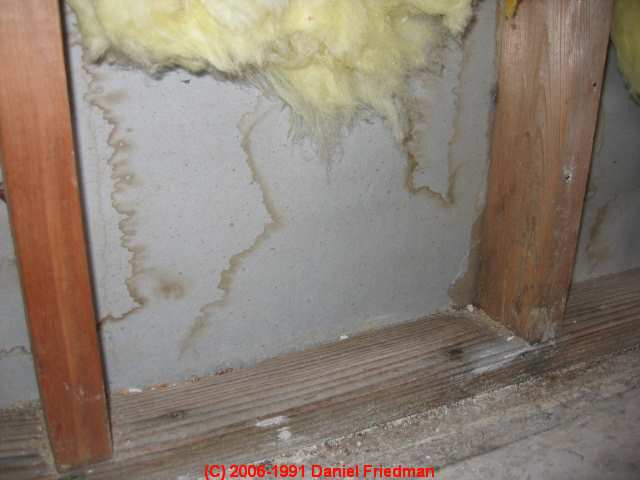
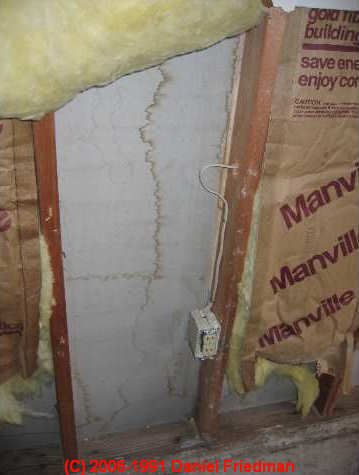
These three photos of fiberglass insulation, drywall, and a wall cavity which was cut open show the value of exploring building cavities where there may have been leaks from above, regardless of whether we're exploring in above-grade level living space or below-grade level basements.
A roof leak had wet these wall cavities, leading us to test the insulation for mold and to inspect further for moldy drywall. The photos also illustrate that luckily not every building leak into every building cavity is going to cause visible mold growth on the hidden surfaces of drywall.
Reader Comments, Questions & Answers About The Article Above
Below you will find questions and answers previously posted on this page at its page bottom reader comment box.
Reader Q&A - also see RECOMMENDED ARTICLES & FAQs
On 2021-03-12 by (mod) - marks along electrical wire mistaken for mold?
 @Vacmacs,
Sorry but when I try to enlarge your last photo to look at it carefully it's quite blurry and I can't make out a thing. I think we're looking at a blurry photo of an electrical wire.
It would be very unusual for mold growth to appear only along on electrical wire. Sometimes something that you think is new has actually been there all along but simply wasn't noticed before.
On 2021-03-14 by Vacmacs
@Vacmacs,
This was not near the wires I was posting the photo show you that this not near the wires . But it only allowed me on photo. I added the photo to this comnent so you could see the other blackening like stains on the joists.
Those previously shown were the my vwires and how in contrast the first post image is actually away from them and not at all placed through the holes lfor the laid purposely functional wires. The real concern is the black round spots and seemingly crawling upward black stains appearing throughout the basement.
Since first post there are more orange Tanish long and round ball shaped growths starting at floor and moving up the wall cracks in basement separate from numerous areas on joists turning up . These areas are black and seems to be spreading throughout rapidly.
Not sure if I originally mentioned second level has confirmed mold on plaster and white mold on my wood furniture and molding and doors. I am unable to actually make positive identification of the particular kind of white and black Funai Mold?
On 2021-03-14 - by (mod) -
@Vacmacs, your photo of dark stains on wood framing members could be a fungus or simply oxidation from weather exposure in the dark area of one of your floor joists (forming a ceiling);
but if so, it came in on the lumber at the time of construction; it's not likely to be an ongoing condition that might be blamed on indoor conditions of moisture.
Notice that none of the dark staining extends continuously off of one wood member to another wood material - such as from the joist to the plywood subfloor.
If mold were growing on the wood surfaces in that area you'd expect to see fungal growth that covered various surfaces and it would not stop at a hard edge where too wood members meet.
See other examples of this phenomenon at the top of this page inspectapedia.com/mold/Cosmetic_Mold.php - COSMETIC MOLD, RECOGNIZE
and also at inspectapedia.com/mold/Cosmetic_Black_Mold.php BLACK MOLD, HARMLESS
On 2021-03-12 by Vacmacs
Maybe this will help. Those were the unique growths. As mentioned, these appeared quite quickly. Did a full cleaning of the basement approximately 5 months ago. Nothing was visible at that point. The "questionable wire" was unattached and no wires for phone or electricity laid in this place.
Included other suspicious growth along with the wire layout for home. We built the house in 2005

On 2021-03-14 - by (mod) -
@vacmacs angel, your two photos below show a small-gauge electrical wire, not a mold nor fungus.
that is a wire, not a fungus.
If it is not and was never connected to any electrical device it might have been used as a tie or connection for materials during shipping or construction of the building.
On 2021-03-12 by vacmacs angel
additional photos to previous post about cellar

I have 3 of these in cellar attached to stringers. Appear to be wires at first glance but more are appearing.
Have a black mold on main floor on sheetrock behind fridge.
Can't find anyone in my area to identify.

On 2020-07-20 by Debbie
We have mold in our basement. It is on some of the wooden furniture and other places. I dont know if it is in the mattresses. Should we just get rid of the mattresses?
On 2020-05-11 - by (mod) -
Ellen
"High" aspercillius/penicillium found indoors could indeed suggest that there's hidden mold problem. Ask your inspector to examine the building exterior, interior, water and moisture sources, and to do a modest amount of invasive inspecting - cutting some small test openings, looking behind trim, etc., starting in the "most-suspect" location.
In the Article Index you might want to read our article about FINDING HIDDEN MOLD
On 2020-05-11 by Ellen H
Hello-I live in a newly constructed home, 1 1/2 years old. When we moved in the unfinished basement was dry and had no odors whatsoever. We had the basement finished about 9 months after we moved in. Ever since, there has been an odor to the air, and i have a strong reaction to what I believe is mold, burning nose and eyes, runny nose, cough. There are no visible signs of mold anywhere.
I called in a mold detection company who could also not find any visible signs, and the report came in negative on 2 of 3 tests, with the "positive" one measuring 3 outdoors and 10 indoors for the aspercillius/penicillium variety.
Basically he said the measurement wasn't enough to be a problem. The other issue is that since the basement has been finished, I had to get a dehumidifier, which fills completely (3L) within 24 hours, consistently, everyday. So, I am told there is no mold to speak of, yet I and my son have symptoms when down there, and the dehumidifier removed 3 L of moisture every day with ni visible signs of moisture. I would greatly appreciate any ideas, thoughts, opinions you can offer. Thank you so much in advance!!!
On 2019-11-20 by Basement Owner - ways to get rid of the basement odor.
Re-posting without dis-allowed advertising link
Basement Owner said:
There are several ways to get rid of the basement odor. But before investing in something to get rid of the odor, it is important to first understand what causes the odor. Basement odor is most often caused by mold and mildew. Basements are a haven for mold growth due to the warm and constant moisture. Mold releases VOCs (volatile organic compounds) that produce odor. The odor from mold generally smells musty.
Two effective ways to get rid of mold are an air purifier and an air freshener. We will discuss air fresheners because they are the most affordable option. Air fresheners do not completely eliminate the basement odor, but they will reduce it. In most cases, an air freshener will work so well that you cannot smell any musty odor. I suggest trying to use an air freshener first. If this does not work then use an air freshener in combination with an air purifier. These two devices will get the job done.
Moderator reply: odor fresheners do NOT get rid of an odor source; they cover it over;
Really? No that's not quite corret.
No air freshener product can ever actually remove an odor or odor source; what air fresheners do is release a pleasant smell into an area; that pleasant odor will make the space smell better. But whatever is emitting the original smell has not been removed.
After all, an odor source isn't some invisible item floating mid-air in a room or building; rather it's a physical object or source, of which there are many: dead animals in walls, open drain traps, or indoor mold contamination.
Watch out: covering-over an odor might actually be dangerous for building occupants. For example, if there is an indoor mold contamination problem, the airborne mold spores or the gases sometimes emitted by some molds under some conditions, also known as mold volatile organic compounds or MVOCs (that create that "moldy smell") are themselves dangerous for building occupants, particularly for the elderly, infants, asthmatics, people with mold allergies, or people with respiratory health issues.
Do not cover up mold smells.
Find and remove the mold and find and fix the reason it grew. An air freshener will not do that. Niether will an "air purifier" remove an actual indoor contaminant source any more than standing in the kitchen, waving your vacuum cleaner wand in the air can possibly remove mold-contaminated cardboard boxes in the basement of your home, carry them outside to the dumpster, nor clean off moldy surfaces.
Sorry, "Basement Owner" but your advice is not something that in our opinion makes one iota of sense. Just sayin'
On 2016-11-07 - by (mod) -
A flooded wall-to-wall carpet typically has to be replaced as you cannot dry it enough nor fast enough to prevent mold. I'd also check for wall in the lower wall cavities on a floor that ws floded.
No at home DIY test kit will be reliable in finding hidden mold and a "negative" result is particularly unreliable. An on site inspection is the place to start. Search InspectApedia.com for HOW TO FIND MOLD for help
On 2016-11-07 by Anonymous
We had a hot water heater leak all over the basement floors 2inches. Prior to this the baement was a dry area and this is a finished basement. The water was over 3/4 of the basement floors. Everything was wet that was on floor level in this area.
We cleaned it up and tried to dry out carpets with wet/dry vacuum and fans. We realized after months the smell was still bad. So we had the carpet and the padding replaced. The smell still has not gone away. We run a dehumidifier too. My office is in the basement so I sit down there all week pretty much. The door is closed on weekends and when I go down initially on Mondays the smell is not good.
For the last 2 fall and winter seasons I have had bad respiratory type colds, bronchitis, and nasal swelling. Not sure if related or not. I typically was very healthy with no allergies.
I have not seen any tell-tale signs of mold other than the odor. I guess we should pull off floor trip board and check drywall, etc.
I want to do an at-home test kit what do you recommend based on the info above?
Thanks for any help.
Jen
On 2016-05-21 by Anonymous
Is basement mold in a comer of paneling can be cleaned
On 2015-10-18 by Kathy
Is this basement mold dangerous
...
Continue reading at BASEMENT MOLD WATER IMPACT or select a topic from the closely-related articles below, or see the complete ARTICLE INDEX.
Or see these
Recommended Articles
- BASEMENT MOLD
- BASEMENT MOLD WATER IMPACT - movement of moisture (and mold) from a wet basement or crawl space up through the occupied building space and into a wet moldy building attic.
- CRAWLSPACE MOLD ADVICE
- HIDDEN MOLD, HOW TO FIND
- MOLD APPEARANCE - WHAT MOLD LOOKS LIKE
- MOLD in BUILDINGS - find mold and test for mold in buildings, how and where to collect mold samples
Suggested citation for this web page
BASEMENT MOLD at InspectApedia.com - online encyclopedia of building & environmental inspection, testing, diagnosis, repair, & problem prevention advice.
Or see this
INDEX to RELATED ARTICLES: ARTICLE INDEX to MOLD CONTAMINATION & REMEDIATION
Or use the SEARCH BOX found below to Ask a Question or Search InspectApedia
Ask a Question or Search InspectApedia
Questions & answers or comments about how find, remove, and prevent mold contamination in building basements; where to look for both obvious and more "hidden" mold growth in basements
Try the search box just below, or if you prefer, post a question or comment in the Comments box below and we will respond promptly.
Search the InspectApedia website
Note: appearance of your Comment below may be delayed: if your comment contains an image, photograph, web link, or text that looks to the software as if it might be a web link, your posting will appear after it has been approved by a moderator. Apologies for the delay.
Only one image can be added per comment but you can post as many comments, and therefore images, as you like.
You will not receive a notification when a response to your question has been posted.
Please bookmark this page to make it easy for you to check back for our response.
Our Comment Box is provided by Countable Web Productions countable.ca
Citations & References
In addition to any citations in the article above, a full list is available on request.
- Chase Falke, an InspectApedia reader and a building professional generously contributed photographs shown here of extensive white fungal growth in a building basement in Lima Ohio.
- Carson, Dunlop & Associates Ltd., 120 Carlton Street Suite 407, Toronto ON M5A 4K2. Tel: (416) 964-9415 1-800-268-7070 Email: info@carsondunlop.com. Alan Carson is a past president of ASHI, the American Society of Home Inspectors.
Thanks to Alan Carson and Bob Dunlop, for permission for InspectAPedia to use text excerpts from The HOME REFERENCE BOOK - the Encyclopedia of Homes and to use illustrations from The ILLUSTRATED HOME .
Carson Dunlop Associates provides extensive home inspection education and report writing material. In gratitude we provide links to tsome Carson Dunlop Associates products and services.
 | HOME | ABOUT | ASK a QUESTION | CONTACT | CONTENT USE POLICY | DESCRIPTION | POLICIES | PRIVACY | |
| © 2024 - 1985 Publisher InspectApedia.com - Daniel Friedman | |||||||||