
InspectAPedia® FREE Encyclopedia of Building & Environmental Construction, Diagnosis, Maintenance & Repair |
Question? Just ask us! InspectAPedia
|
 Must Dry Out Moldy Areas Before Completing Mold Cleanup
Mold remediation mistakes to avoid

- POST a QUESTION or COMMENT about proper building dryout and humidity control as part of mold remediation
This section of our article series on How to Clean Up or Get Rid of Mold discusses the importance of drying the surfaces to be cleaned.If an expensive mold remediation effort is begun before the moldy area has been dried and leaks stopped, it is likely that the cleanup cost will have been wasted as mold growth will simply recur.
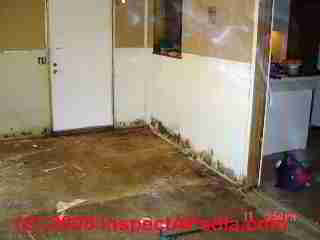
Our photo above shows a recently-flooded home in Jasper TX. You can see that the floor is still wet. Demolition of moldy materials can begin but mold cleanup can't be successfully completed before the building has first been dried.
InspectAPedia tolerates no conflicts of interest. We have no relationship with advertisers, products, or services discussed at this website.
Step 2 in Mold Cleanup Procedures: Dry the cleaned, previously moldy surface
No mold remediation project can be successfully completed unless:
- The causes of mold growth in the building have been eliminated - such as building leaks or moisture traps
- Wet and damp building surfaces and materials have been properly dried.
When can mold cleanup begin in a building?
Certain steps can begin immediately and in some cases are essential:
- The building must be safe to enter, structurally as well as regarding environmental hazards. If significant mold levels are present, appropriate protective clothing and equipment should be used.
- Establish containment to prevent unaffected building areas from cross-contamination. This step can be taken before any other work has begun on the building and should be done even if cleanup work is not to begin for some time. The sooner mold containment is established the greater the chance that the mold cleanup will not have to include cleaning of other, apparently unaffected, building areas.
- Stop any active building leaks and remove standing water
- Begin demolition: Demolition and removal of ruined, soaked, and obviously to-be-discarded building contents and building materials, such as wet carpeting, moldy drywall, soaked furniture, can begin as soon as practical.
- Dry out the building: the moisture level in interior wood surfaces needs to be well below 18% before cleaning and any final fungicidal sealing (if used) can be completed.
- Finish final cleaning: remove all loose demolition debris and complete the physical cleaning of all remaining surfaces.
- Check for ongoing leaks: don't close down a mold cleanup job if there are ongoing leaks - the cost and effort may be wasted as mold growth can recur quickly - in as little as 24-48 hours.
What we are emphasizing, however, is that while initial demolition and even some cleaning can begin before the building has been successfully dried and protected from further leaks, no mold remediation project can be completed under those conditions.
If the building remains wet, mold growth will recur on remaining building materials and surfaces.
How Dry do Things Have to be in a Building to Complete Mold Cleanup?
Let the cleaned lumber or plywood surface dry thoroughly. 18% moisture level or less in wood is usually acceptable; normally inside of a building that has been closed to weather and heated or air conditioned, moisture levels will be way below this point, perhaps at 2 to 6% in wood and in any remaining drywall.
When lumber surfaces have been washed or otherwise are wet, they should be dry (less than 18% moisture content) before further treatment.
For wood framing and sheathing surfaces which have been cleaned of problem mold, a simple contact probe system or Tramex moisture encounter system is adequate since wood surfaces are directly accessible
In more broad investigations we measure moisture in wood and drywall using either a pin-probe type moisture meter such as the Delmhorst™ model BD-7, the Tramex Compact™ or for impenetrable surfaces such as tiled walls and floors we use the Tramex moisture encounter which uses a pair of pads and an electrical signal to perform non-destructive moisture detection.
The Delmhorst moisture meter also offers sets of long pin probes which can penetrate a wood frame wall or ceiling to sense moisture within insulation or on the far side of that cavity.
We also use the Exergen infra-red scanner to find moisture based on variations in temperature. A study comparing the effectiveness of various moisture measuring tools in the detection of moisture in inaccessible building cavities and a comparison of use of these instruments, a bore scope, and direct visual inspection by test cuts has been completed.
Remember when measuring moisture that looking only in the center of a surface, such as 4 ft. up a drywall-covered partition, is not the full story.
Moisture may still be present at problem levels in slow-to dry areas including building wall and ceiling cavities and on drywall behind wood trim. Measure at the locations most-likely to still be wet, not the locations most-likely to be dry, if you're trying to avoid an indoor mold problem.
...
Continue reading at MOLD CLEANUP, LIMITATIONS or select a topic from the closely-related articles below, or see the complete ARTICLE INDEX.
Or see these
Recommended Articles
- MOLD ACTION GUIDE - WHAT TO DO ABOUT MOLD
- MOLD CLEANUP GUIDE- HOW TO GET RID OF MOLD - home
- MOLD CLEANUP - MISTAKES to AVOID
- MOLD CLEANUP, SAFETY WARNINGS
- INADEQUATE REMEDIATION PLAN
Suggested citation for this web page
MOLD CLEANUP, DRY THE MOLD-CLEANED SURFACE at InspectApedia.com - online encyclopedia of building & environmental inspection, testing, diagnosis, repair, & problem prevention advice.
Or see this
INDEX to RELATED ARTICLES: ARTICLE INDEX to MOLD CONTAMINATION & REMEDIATION
Or use the SEARCH BOX found below to Ask a Question or Search InspectApedia
Ask a Question or Search InspectApedia
Try the search box just below, or if you prefer, post a question or comment in the Comments box below and we will respond promptly.
Search the InspectApedia website
Note: appearance of your Comment below may be delayed: if your comment contains an image, photograph, web link, or text that looks to the software as if it might be a web link, your posting will appear after it has been approved by a moderator. Apologies for the delay.
Only one image can be added per comment but you can post as many comments, and therefore images, as you like.
You will not receive a notification when a response to your question has been posted.
Please bookmark this page to make it easy for you to check back for our response.
Our Comment Box is provided by Countable Web Productions countable.ca
Citations & References
In addition to any citations in the article above, a full list is available on request.
- In addition to citations & references found in this article, see the research citations given at the end of the related articles found at our suggested
CONTINUE READING or RECOMMENDED ARTICLES.
- Carson, Dunlop & Associates Ltd., 120 Carlton Street Suite 407, Toronto ON M5A 4K2. Tel: (416) 964-9415 1-800-268-7070 Email: info@carsondunlop.com. Alan Carson is a past president of ASHI, the American Society of Home Inspectors.
Thanks to Alan Carson and Bob Dunlop, for permission for InspectAPedia to use text excerpts from The HOME REFERENCE BOOK - the Encyclopedia of Homes and to use illustrations from The ILLUSTRATED HOME .
Carson Dunlop Associates provides extensive home inspection education and report writing material. In gratitude we provide links to tsome Carson Dunlop Associates products and services.
 | HOME | ABOUT | ASK a QUESTION | CONTACT | CONTENT USE POLICY | DESCRIPTION | POLICIES | PRIVACY | |
| © 2024 - 1985 Publisher InspectApedia.com - Daniel Friedman | |||||||||