
InspectAPedia® FREE Encyclopedia of Building & Environmental Construction, Diagnosis, Maintenance & Repair |
Question? Just ask us! InspectAPedia
|
 Limitations on Cleaning Mold
on Building Framing Lumber, Plywood Sheathing, or Furnishings
- POST a QUESTION or COMMENT about what mold can be removed, what moldy surfaces or items can be cleaned, and where mold cleaning or removal don't work or are impractical.
Limits of mold removal: this mold remediation article discusses the limitations of cleaning moldy building surfaces such as framing lumber or plywood sheathing.
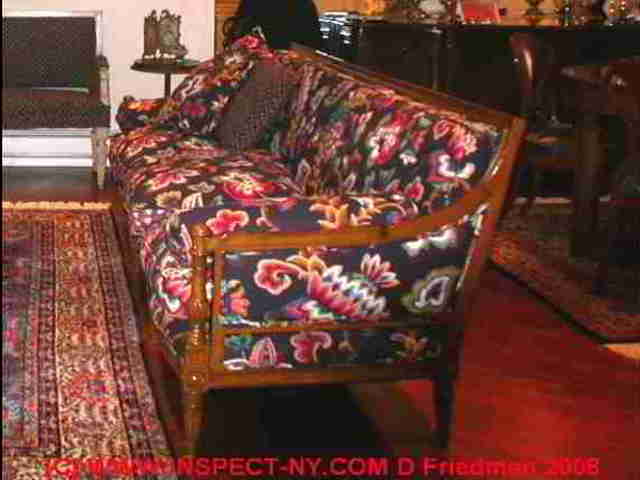
What about furniture that was in the building? If a heavy upholstered couch (photo above) was exposed to flooding it will be nearly impossible to fully clean; surface cleaning, even steam cleaning, combined with HEPA vacuuming, simply cannot pull mold growth from the couch interior.
A couch like the one shown in our photograph above and that is found to be contaminated probably needs to be stripped and reupholstered. In contrast, surface dust settling on an otherwise clean upholstered couch can be usually cleaned effectively using HEPA vacuuming techniques.
InspectAPedia tolerates no conflicts of interest. We have no relationship with advertisers, products, or services discussed at this website.
Mold Ceanup Job Limitations for Moldy Wood Surfaces
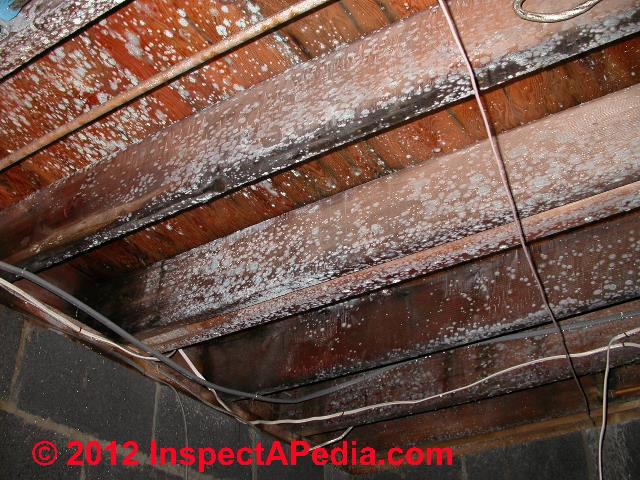 This article offers advice on cleaning mold found on surfaces of un-finished
wooden building materials such as framing lumber (rafters, floor joists, wall studs), and
building roof, wall, and floor sheathing such as plywood, tongue-and groove pine boards, and other structural wood surfaces
in buildings.
This article offers advice on cleaning mold found on surfaces of un-finished
wooden building materials such as framing lumber (rafters, floor joists, wall studs), and
building roof, wall, and floor sheathing such as plywood, tongue-and groove pine boards, and other structural wood surfaces
in buildings.
We discuss the pros and cons of using fungicidal sealants and bleach on wood surfaces and give sources and list types of those products. We also discuss common errors made when cleaning wood surfaces, such as relying on bleach or performing expensive and unnecessary cleaning on cosmetic black mold on wood surfaces.
The suggestions for mold cleanup of wood surfaces which are outlined below do not pertain to
- Cleaning or treating moldy lumber which is used outdoors and where airborne mold exposure to humans is most often less of a concern
- Cleaning wood surfaces which were previously finished with paint, stain, varnish, or similar coatings; usually these surfaces are simply washed or scrubbed clean and in some cases are re-coated with compatible paint, stain, varnish with or without adding a mildewcide or other chemical to retard future mold growth
These suggestions have not completed an extensive professional peer review - which is why they are being exposed here to invite commentary. Comments received so far indicate this is reasonable commonsense advice.
Some mold found on wood components in building interiors is likely to be of only cosmetic concern, such as Ceratocystis/Ophistoma sp. or "blue stain" molds.
Others may be more of a concern, particularly to occupants who are at particular risk of certain illnesses or immune system problems.
Allergenic/pathogenic molds often identified on construction materials exposed indoors include Penicillium sp., Aspergillus sp., Stachybotrys chartarum (previously Stachybotrys atra), and numerous other species.
Depending in part on the particular species, the presence of mold growing on building materials risks contamination in the living environment and possible mold-related illnesses.
This is true regardless of whether mold spores are merely allergenic (allergenic mold) or actually toxic (pathogenic mold) to humans, and regardless of whether or not mold spores present are viable (alive) or non-viable (dead). Where there is a concern regarding mold on building framing the following steps should be helpful at reducing the risk of future mold growth.
...
Continue reading at MOLD CLEANUP - MISTAKES to AVOID or select a topic from the closely-related articles below, or see the complete ARTICLE INDEX.
Or see these
Mold Cleanup Articles
- MOLD CLEANUP GUIDE- HOW TO GET RID OF MOLD
- CARPET MOLD / ODOR TESTS
- DISINFECTANTS, SANITIZERS, FUNGICIDAL-SEALANTS SOURCES
- FUNGICIDAL SEALANT USE GUIDE
- MOLD CLEANERS - WHAT TO USE
- MOLD CLEANUP with BLEACH
- MOLD CLEANUP, DRY THE MOLD-CLEANED SURFACE
- MOLD CLEANUP, LIMITATIONS
- MOLD CLEANUP - MISTAKES to AVOID
- MOLD CLEANUP, SAFETY WARNINGS
- MOLD CLEANUP - WOOD FRAMING & PLYWOOD
- MOLD CLEANUP - WOOD FLOORING
- MOLD & FUNGUS on WOOD SIDING: CLEAN & PREVENT
- MOLD REMOVAL, MEDIA BLASTING
- MOLD SANITIZER, SPRAY, BIOCIDE USE GUIDE
- OZONE MOLD KILL TREATMENT
- TRAPPED MOLD BETWEEN WOOD SURFACES
- MOLD CLEARANCE INSPECTIONS
Suggested citation for this web page
MOLD CLEANUP, LIMITATIONS at InspectApedia.com - online encyclopedia of building & environmental inspection, testing, diagnosis, repair, & problem prevention advice.
Or see this
INDEX to RELATED ARTICLES: ARTICLE INDEX to MOLD CONTAMINATION & REMEDIATION
Or use the SEARCH BOX found below to Ask a Question or Search InspectApedia
Ask a Question or Search InspectApedia
Try the search box just below, or if you prefer, post a question or comment in the Comments box below and we will respond promptly.
Search the InspectApedia website
Note: appearance of your Comment below may be delayed: if your comment contains an image, photograph, web link, or text that looks to the software as if it might be a web link, your posting will appear after it has been approved by a moderator. Apologies for the delay.
Only one image can be added per comment but you can post as many comments, and therefore images, as you like.
You will not receive a notification when a response to your question has been posted.
Please bookmark this page to make it easy for you to check back for our response.
Our Comment Box is provided by Countable Web Productions countable.ca
Citations & References
In addition to any citations in the article above, a full list is available on request.
- A BRIEF GUIDE to MOLD, MOISTURE, and YOUR HOME, [PDF] U.S. Environmental Protection Agency US EPA - includes basic advice for building owners, occupants, and mold cleanup operations. See http://www.epa.gov/mold/moldguide.htm
- Carson, Dunlop & Associates Ltd., 120 Carlton Street Suite 407, Toronto ON M5A 4K2. Tel: (416) 964-9415 1-800-268-7070 Email: info@carsondunlop.com. Alan Carson is a past president of ASHI, the American Society of Home Inspectors.
Thanks to Alan Carson and Bob Dunlop, for permission for InspectAPedia to use text excerpts from The HOME REFERENCE BOOK - the Encyclopedia of Homes and to use illustrations from The ILLUSTRATED HOME .
Carson Dunlop Associates provides extensive home inspection education and report writing material. In gratitude we provide links to tsome Carson Dunlop Associates products and services.
 | HOME | ABOUT | ASK a QUESTION | CONTACT | CONTENT USE POLICY | DESCRIPTION | POLICIES | PRIVACY | |
| © 2024 - 1985 Publisher InspectApedia.com - Daniel Friedman | |||||||||