
InspectAPedia® FREE Encyclopedia of Building & Environmental Construction, Diagnosis, Maintenance & Repair |
Question? Just ask us! InspectAPedia
|
 How to Test for Lead Contamination in Water
- POST a QUESTION or COMMENT about testing well water or drinking water for lead contamination
Water tests for lead contamination:
What drinking water contamination tests should you order? This article explains the general classes of water contaminants covered in a water test for lead.
There are several possible sources of lead in drinking water, including lead in ground water, lead contamination from municipal water piping, lead contamination from building water supply piping or fixtures, well contamination by lead from surface contamination due to lead paint chips, and insignificant lead contamination from lead in well pumps or faucet parts.
This website describes the types of water testing available, outlines common water test fees, describes the details of what parameters are included in various water test options, and gives advice to assist you in deciding what tests to order.
InspectAPedia tolerates no conflicts of interest. We have no relationship with advertisers, products, or services discussed at this website.
Lead Contamination from Water Supply Lines/Entry Mains, Lead Testing & Correcting Contamination from - Lead Pipe Problems/Advice
Depending on the duration and extent of lead-water contact, lead can enter the water supply if lead is present in supply piping or fixtures. Common sources of lead in water supply piping include older lead-bearing solder used on copper pipes, possible lead content in brass piping or fixtures, lead water supply piping (rare), and lead water supply entry main between a building and the public water main in the street (common in some areas).
Health hazards from lead content in water
Recently there was also a flurry of concern about lead contributed by brass in private well pumps. However the testing methods used for this latter topic misrepresented an exaggerated and frankly dubious risk. Finally, it is possible for lead to be found in private well water if lead contaminants have entered the local aquifer.
Action Level for Lead in Water - allowable lead limits
New York State Department of Health has set an action level of 0.015 mg/L of lead in a sample of water drawn from a tap used for drinking water after a 6-hour period of no water use.
Variations in Lead Level vs. Testing Methods
Lead levels will usually be quite high in water which has sat overnight in a lead line from street main to house.
Most lab tests indicate low lead levels in water from such lines after the test fixture has run until all standing water in the piping has been flushed out with fresh from the municipal supply mains in the street.
There are ambiguities in instructions offered by some municipalities about how to obtain a water sample for lead testing. The particulars of how the water sample is taken can make a big difference in the lead level obtained.
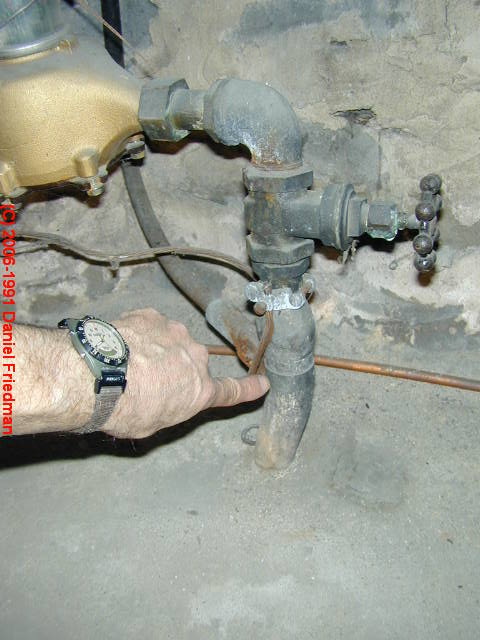
Our photo (below) shows how to recognize lead water supply piping between a building water shutoff valve (or water meter) and the water supply mains in the street. The author is pointing to the wide lead wipe joint connecting the lead water pipe to the bronze bottom of the water shutoff valve.
- The very first draw of lead test water from a faucet or plumbing fixture is measuring lead contributed by any lead-containing brass which is present in some faucets.
- "First draw" taken after a moment of flushing out the faucet to test for lead is taking water from the pipes near the fixture. Depending on pipe material and length, considerably more water might have to be taken before observing the water sample exposed to most lead uptake.
- First cold water after a night of no usage when testing for lead is likely to provide water that was sitting in the entry main from street to house. If this line is lead, the lead content of this sample will be quite high. Alternatively, if all piping were visible between the test fixture and water meter (rarely the case) one could calculate the volume of water necessary to flush to obtain a sample from the line to the street.
- A water sample taken after running the water for several minutes when performing a lead in water test (depending on length of piping in the house from street to fixture) is sampling the quality of water provided by the municipality. Some city plumbing officials have expressed the opinion that lead oxide build-up in pipes insulates against significant lead levels in water actively running through such lines.
Most local building codes do not require removal of lead, for example, the City of Poughkeepsie Building Codes do not require removal of residential lead supply lines (house to street). However eventually (usually after 40-60 years) these lines corrode, leak, and have to be replaced. Replacing the main supply from street to the water meter, when required, could involve significant expense.
People with concerns for the amount of lead in water should consult the local health department and should have their water tested for lead. Typical lab fees are $20. to $25. per sample plus the cost of hiring an independent consultant to collect and handle the water sample if you don't do it yourself.
Even if you are not concerned with testing for lead in water it would be wise to reduce possible lead intake by flushing any lead-containing piping before drinking such water. In addition, lead-in-water removal equipment is available from water treatment companies.
If you need to calculate the amount of water to run out of piping to be sure you are obtaining water from the street, that is, the volume of gallons of water inside of water piping, you need to know simply the length and diameter of water piping between the faucet where the water test is to be taken and the location whose water you want to test.
For example, let's say the water contained overnight in the water main in your street is what we want to test.
1/2" internal diameter water piping contains about 0.01 gallons per linear foot;
3/4" ID piping contains about 0.02 gallons per linear foot, and
1" water piping contains about 0.04 gallons per linear foot.
Just measure or estimate the number of linear feet of water piping of each diameter to perform this calculation.
Alternative worst-case lead in water test procedure
If we run water at a building tap until the water temperature first feels cold and immediately collect our water sample, we are most likely collecting and testing water that has been sitting in the water service piping between the building and the street water main.
See WELL FLOW RATE for a detailed explanation of how to calculate the volume of water inside of pipes.
Also see our review of a Home Test Kit for Lead in on building surfaces located at LEAD TEST KIT for HOME USE. The same company offers a lead-in-water test, as do local health departments and private water testing labs in most cities.
...
Continue reading at LEAD IN DRINKING WATER, HOW to REDUCE or select a topic from the closely-related articles below, or see the complete ARTICLE INDEX.
Or see these
Recommended Articles
- LEAD CONTAMINATION HAZARDS in the HOME - home
- LEAD PIPES in BUILDINGS
- LEAD PIPES in BUILDINGS
- LEAD in WATER, ACTION LEVELS
- WATER TREATMENT EQUIPMENT DISINFECTION
Suggested citation for this web page
LEAD CONTAMINATION in WATER, TEST at InspectApedia.com - online encyclopedia of building & environmental inspection, testing, diagnosis, repair, & problem prevention advice.
Or see this
INDEX to RELATED ARTICLES: ARTICLE INDEX to WATER TESTING
Or use the SEARCH BOX found below to Ask a Question or Search InspectApedia
Ask a Question or Search InspectApedia
Questions & answers or comments about testing well water or drinking water for lead contamination.
Try the search box just below, or if you prefer, post a question or comment in the Comments box below and we will respond promptly.
Search the InspectApedia website
Note: appearance of your Comment below may be delayed: if your comment contains an image, photograph, web link, or text that looks to the software as if it might be a web link, your posting will appear after it has been approved by a moderator. Apologies for the delay.
Only one image can be added per comment but you can post as many comments, and therefore images, as you like.
You will not receive a notification when a response to your question has been posted.
Please bookmark this page to make it easy for you to check back for our response.
Our Comment Box is provided by Countable Web Productions countable.ca
Citations & References
In addition to any citations in the article above, a full list is available on request.
- [1] Drinking Water from Household Wells - PDF, U.S. EPA, Original source last retrieved 2/13/2013, original source: http://www.epa.gov/privatewells/pdfs/household_wells.pdf
- [2] Salzman, James, Drinking Water: A History, Overlook (2012), ISBN-10: 1590207203, ISBN-13: 978-1590207208, Quoting product description:
In Drinking Water, Duke University professor and environmental policy expert James Salzman shows how drinking water highlights the most pressing issues of our time--from globalization and social justice to terrorism and climate change--and how humans have been wrestling with these problems for centuries. From the aqueducts of Rome to the revolutionary sewer system in nineteenth-century London to today’s state-of-the-art desalination plants, safety and scarcity of water have always been one of society’s most important functions. - [3] Soll, David, Empire of Water: An Environmental and Political History of the New York City Water Supply, Cornell University Press, (2013), ISBN-10: 0801449901, ISBN-13: 978-0801449901, Quoting: product review
"Empire of Water chronicles the fascinating story of New York City's water supply, which comes mostly from reservoirs in the Catskills and, remarkably, is unfiltered. That's because the city has spent billions of dollars and decades of effort working with residents, businesses, and governments in the Catskills to protect the reservoirs from pollution caused by runoff from roads, farms, and dairies. This meticulously researched and persuasively reasoned history explores the change in New York City’s attitude toward water, from indifference to profligate water waste and environmental pollution to stalwart champion of water conservation and protection. The best histories shed light on the past as they illuminate the present. Empire of Water is in this category. By protecting the ecosystem services provided by a pristine watershed in northern New York, the city avoided having to spend $8 billion to build a treatment plant. As we confront water shortages in the United States and across the world, Empire of Water teaches that business as usual—looking for new oases and relying on massive engineering solutions—no longer makes sense. We must acknowledge nature’s limits and work within them to secure a sustainable future for coming generations."—Robert Glennon, Regents’ Professor and Morris K. Udall Professor of Law and Public Policy, University of Arizona, author of Unquenchable: America's Water Crisis and What To Do About It - [4] Mithen, Steven, Thirst: Water and Power in the Ancient World, Harvard University Press (2012), ASIN: B00EDZ5OHC. Quoting product review at Amazon:
Water is an endangered resource, imperiled by population growth, mega-urbanization, and climate change. Scientists project that by 2050, freshwater shortages will affect 75 percent of the global population. Steven Mithen puts our current crisis in historical context by exploring 10,000 years of humankind’s management of water. Thirst offers cautionary tales of civilizations defeated by the challenges of water control, as well as inspirational stories about how technological ingenuity has sustained communities in hostile environments.
... Mithen blends archaeology, current science, and ancient literature to give us a rich new picture of how our ancestors lived. Since the Neolithic Revolution, people have recognized water as a commodity and source of economic power and have manipulated its flow. History abounds with examples of ambitious water management projects and hydraulic engineering—from the Sumerians, whose mastery of canal building and irrigation led to their status as the first civilization, to the Nabataeans, who created a watery paradise in the desert city of Petra, to the Khmer, who built a massive inland sea at Angkor, visible from space.
As we search for modern solutions to today’s water crises, from the American Southwest to China, Mithen also looks for lessons in the past. He suggests that we follow one of the most unheeded pieces of advice to come down from ancient times. In the words of Li Bing, whose waterworks have irrigated the Sichuan Basin since 256 bc, “Work with nature, not against it.” - [5] Pabich, Wendy J., Taking on Water: How One Water Expert Challenged Her Inner Hypocrite, Reduced Her Water Footprint (Without Sacrificing a Toasty Shower), and Found Nirvana, Sasquatch Books (2012), ASIN: B00EB0JTB6, Quoting Amazon product review:
When Wendy Pabich received a monthly water bill for 30,000 gallons (for a household of two people and one dog), she was chagrined. After all, she is an expert on sustainable water use. So she set out to make a change. Taking on Water is the story of the author's personal quest to extract and implement, from a dizzying soup of data and analysis, day-to-day solutions to reduce water use in her life. She sets out to examine the water footprint of the products she consumes, process her own wastewater onsite, revamp the water and energy systems in her home, and make appropriate choices in order to swim the swim. Part memoir, part investigation, part solution manual, the book is filled with ruminations on philosophy, science, facts, figures, and personal behavioral insights; metrics, both serious and humorous, to track progress; and guidelines for the general public for making small (or perhaps monumental) but important changes in their own lives. - Home Test Kit for Lead review of the performance of an inexpensive test kit for lead in water, sold in building supply stores and at other sources - kits are sold for both lead on surfaces and lead in water.
- Health hazards from lead content in water
- Action Level for Lead in Water - allowable lead limits
- Variations in Lead Level vs. Testing Methods
- How to Reduce Lead Contamination in Drinking Water: how to test & correction lead in drinking water
- Lead Contamination in Drinking Water: Testing & Correction - Advice.
- More Information on Lead and other Contaminants in Drinking Water, & Building Diagnostic Inspections and Repairs
- WATER PUMP REPAIR GUIDE an specific case offers an example of diagnosis of loss of water pressure, loss of water, and analyzes the actual repair cost
- Water pressure tank failures & water pump short cycling diagnosis and repair
- Drinking Water Contaminant Levels - Maximum Allowed
- Lead Contamination from Water Supply Lines/Entry Mains, Lead Testing & Correcting Contamination from - Lead Pipe Problems/Advice
- Lead Poisoning: Extreme Lead Poisoning Symptoms Suggested by Feb 2006 NY Times Article on Kosovo Roma Camps
- National Primary Drinking Water Regulations - The complete regulations regarding these contaminants available from the Code of Federal Regulations Website -(United States)
- Ohio State University article on the concentration of chlorine necessary to act as an effective disinfectant, and the effects of the water's pH and temperature: See http://ohioline.osu.edu/b795/b795_7.html for details.
- Our Stolen Future: Are We Threatening Our Fertility, Intelligence, and Survival?--A Scientific Detective Story, Theo Colborn, Dianne Dumanoski, John Peter Meyers. Plume-Penguin Publishing, 1997, ISBN 0-452-27414-1., ISBN13: 9780452274143. This book is a seminal work on endocrine disruptors (chemical contaminants having impact at extremely low levels in the environment).
Recommended by Daniel Friedman, this book is a critical update to the landmark Silent Spring by Rachel Carson and discusses the effects of minute trace amounts of chemical contaminants in the environment. The text "Identifies the various ways in which chemical pollutants in the environment are disrupting human reproductive patterns and causing such problems as birth defects, sexual abnormalities, and reproductive failure. Reprint. Tour. NYT."
Amazon.com Review: By O T (Ontario, BC) - 'Our Stolen Future' is a great introduction to one of the most important scientific discoveries in our time. Having recently completed a thesis project at university on Endocrine Disruptors, I have reviewed hundreds of papers on the subject. This book is a good clear overview of the scientific literature on EDs. The authors are experts - Theo Colborn is largely responsible for creating the field by bringing together diverse researchers so they could see the big picture of their work. Many of the principle investigators are interviewed and quoted at length on the way chemicals participate in and interfere with delicate hormonal systems in animals (including humans). The major accomplishment of the book is to make an easy-to-follow story out of complex research. Many resources are available to help you assess the reliability of this story, and the best thing to do if you have any doubts is read review articles in scientific journals (which are easier to understand than technical papers). The Physicians for Social Responsibility (PSR) have a guidebook for health-care professionals on Endocrine Disruptors, and the US EPA has many reports on the matter. Beware of people or websites who try to 'debunk' this book (or the science behind it) by simply declaring it false, flawed or disproven. There is far too much supporting research for so simple a refutation.
OPINION: Significant and discussed in this book is the observation that at certain critical points in the development of animals, presumably including humans, exposure to extremely low levels of endocrine disruptor chemicals (EDC's) (such as BPA - Bisphenol-A or BPA, Diethylstilbestrol - DES, dioxins, PCBs, and chemicals used in the production of certain cleansers, dyes, flame retardants, plastics, pesticides, white papers ) perhaps just a few molecules, or in the parts per trillion, is sufficient to cause disruption of the animal's development, including proper sex differentiation, or the lack of it that produced androgynous ducks unable to reproduce under such conditions.
A endocrine disruptor is a synthetic chemical compound that mimics natural hormones when it is taken into the body of a human or other animal. It "disrupts" the endocrine system by turning on or off normal chemical signals that in turn can affect normal hormone levels, bodily functions, and significantly, the development of embryos. Further, unlike naturally occurring hormones ingested, for example from plants (phytoestrogens), synthetically-generated hormones accumulate in the body and can have a half-life of decades or longer.
One significance of this finding includes the observation that an important medical effect that occurs with exposure to chemicals in extremely low concentrations means that experiments to test for correlations between chemical exposure and subsequent serious medical problems will be deeply flawed if, for example, the experimental design does not include testing for the presence of the chemical at extremely low levels. A related concern is that even if harmful effects from exposure to extremely low concentrations of an endocrine disruptor are occurring, teasing out and proving that relationship can be also extremely difficult. - Our recommended books about building & mechanical systems design, inspection, problem diagnosis, and repair, and about indoor environment and IAQ testing, diagnosis, and cleanup are at the InspectAPedia Bookstore. Also see our Book Reviews - InspectAPedia.
- Crystal Clear Supply provides portable ceramic water filter purifiers and portable reverse osmosis water treatment equipment - see http://www.crystalclearsupply.com/category_s/7.htm
- Handbook of Disinfectants and Antiseptics, Joseph M. Ascenzi (Editor), CRC, 1995, ISBN-10: 0824795245 ISBN-13: 978-0824795245 "The evaluation of chemical germicides predates the golden age of microbiology..." -
This well-focused, up-to-date reference details the current medical uses of antiseptics and disinfectants -- particularly in the control of hospital-acquired infections -- presenting methods for evaluating products to obtain regulatory approval and examining chemical, physical, and microbiological properties as well as the toxicology of the most widely used commercial chemicals. - In addition to citations & references found in this article, see the research citations given at the end of the related articles found at our suggested
CONTINUE READING or RECOMMENDED ARTICLES.
- Carson, Dunlop & Associates Ltd., 120 Carlton Street Suite 407, Toronto ON M5A 4K2. Tel: (416) 964-9415 1-800-268-7070 Email: info@carsondunlop.com. Alan Carson is a past president of ASHI, the American Society of Home Inspectors.
Thanks to Alan Carson and Bob Dunlop, for permission for InspectAPedia to use text excerpts from The HOME REFERENCE BOOK - the Encyclopedia of Homes and to use illustrations from The ILLUSTRATED HOME .
Carson Dunlop Associates provides extensive home inspection education and report writing material. In gratitude we provide links to tsome Carson Dunlop Associates products and services.
 | HOME | ABOUT | ASK a QUESTION | CONTACT | CONTENT USE POLICY | DESCRIPTION | POLICIES | PRIVACY | |
| © 2024 - 1985 Publisher InspectApedia.com - Daniel Friedman | |||||||||