
InspectAPedia® FREE Encyclopedia of Building & Environmental Construction, Diagnosis, Maintenance & Repair |
Question? Just ask us! InspectAPedia
|
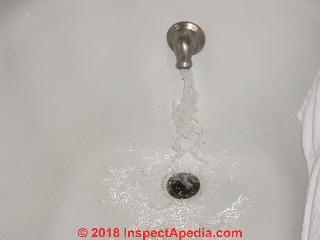 Diagnose & Repair Air Discharge at Faucets
or at Water Supply Piping / Fixtures
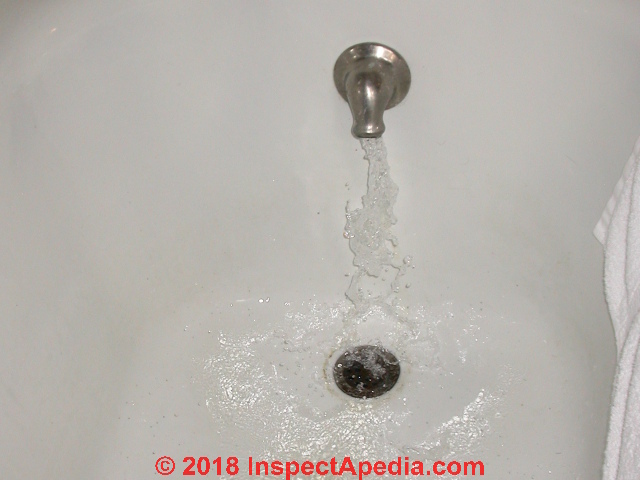
- POST a QUESTION or COMMENT about air discharge at plumbing fixtures and/or excess air in water pressure tanks or in well water systems
How to diagnose & fix air coming out of faucets:
This article describes the causes of air discharging from building water supply piping or plumbing fixtures or the sources of excess air in water pressure tanks, water supply piping, or other plumbing fixtures.
If air blasts out of your faucets or fixtures we explain what's going on, why it's a problem, and how to diagnose and fix the trouble.
Some air discharge or bubbling issues in building piping are not serious, while others could spell expensive trouble. We list the various causes of air discharge at faucets or shower heads and how to correct each one.
InspectAPedia tolerates no conflicts of interest. We have no relationship with advertisers, products, or services discussed at this website.
Causes of Air Discharge from Building Plumbing Fixtures
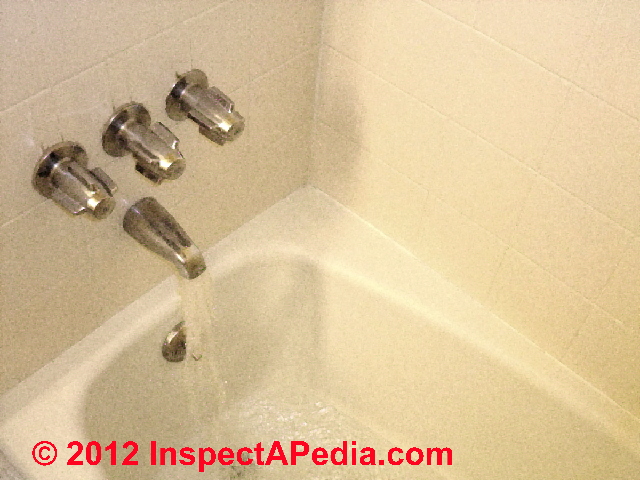 Air blasts or air bubbles coming from plumbing fixtures such as faucets, showers, or toilets may be a temporary problem that cures itself or it may be a sign of a deteriorating water well.
Here we list various causes of air in building water supply piping and fixtures to help in diagnosing and repairing this problem. We are going to cover the following:
Excess air in the water pressure tank or well piping system: causes and cures.
Significance of large bursts of air at faucets & Significance of fine white bubbles in water taken from a faucet.
Signs of loss of well water & Signs of well piping leaks. Signs of water pump failure.
Water pressure tank air volume control problems: How to restore lost air in a building water pressure tank.
What is a snifter valve used on a well water system and how do they work? Hidden and antique air volume control valves and features can explain well pump rapid cycling problems & air discharge troubles at faucets & fixtures.
[Click to enlarge any image]
Question: Why is air coming out of my faucets, what does it mean, and what can I do to diagnose and fix the problem?
For a couple months now we've had excessive air in our water lines, similar to after there has been a power outage and the water spurts out of the faucets. I'm trying to figure out a solution to our water issues.
We continuously have air in our water supply at all faucets, toilets, and showers; the air is intermittent, and spurts out while water is running, anywhere from immediately after faucet is turned on to a couple minutes later (in shower, for instance).
Flushing the toilet results in the pipes or toilet valve banging. we have a well that's 204' deep, and the submersible pump was replaced in July 2005 (five years ago).
Our water pressure tank is working fine, turning on/shutting off at 30/60.
After shutting off, with no water running, the pressure holds steady at 60. When the pressure tank is drawing water from the well, you can hear and feel the pipe from the well drawing in a lot of air from the well the cold water has the air problem much more than the hot water for whatever reason (please advise!), on two of our faucets with separate hot/cold handles, the cold water won't come out anymore.
Did the spurting of the air/water lodge mineral deposits in the valve or something to prevent cold water from coming out, but allowing hot water to flow?
the flow rate out of our faucets varies from normal at times to very low pressure we don't have a water treatment system we don't have a venturi valve that I know of (we bought the house 5 years ago) or that I can find
I don't know the static level or the recovery rate of the well, and with our air/water problem, I'm not confident that I'd get a good reading.
A licensed plumber came out yesterday (very kind, offered a free estimate) and looked at the pressure gauge on the pressure switch (between the incoming supply line from the well and the pressure tank) and concluded that it's something to do w our well or well pump.
He suggested that either the well may be running dry or that the screen may be clogged up. He suggested I get some friends and pull up the well pump and examine it. - T. C., Purcellville, VA
Answer:
From your description it sounds as if your well water level is dropping and the pump is sending a mix of water and air into the building piping. If that turns out to be the case, it might be possible to increase the well yield - a step less costly than drilling a deeper or new well.
But first take a look through the causes of air in building water piping that we describe just below. If the problem were simply a leak in the water piping between well and house, for example, that would be less costly to repair.
List of common causes of air in water, or air coming out of plumbing faucets and fixtures:
Consider that because under normal conditions building water supply piping and fixtures are pressurized with water, a leak or opening in a pipe or fixture would be expected to leak water out, not air in to the plumbing system. But there are some exceptions that we describe below.
Air blasts, or air sputtering out of plumbing faucets means there is air in the water supply system. Below we diagnose the most likely causes and thus the cures for this problem.
Article Series Contents
- AIR DISCHARGE at FAUCETS, FIXTURES
- AIR OVERCHARGE in PRESSURE TANK
- AIR DISCHARGE from HOT WATER - separate article
- BURST BLADDER in WATER TANK
- CHECK VALVE FAILURES
- LEAKS in WELL PIPING
- LOSS of WATER in the WELL
- DAMAGED WELL PUMP
- AIR VOLUME CONTROL DEFECT
- GASES in WELL WATER
- SNIFTER VALVE MALFUNCTION
- WATER SOFTENER CHECK VALVE STUCK
- WATER TREATMENT EQUIPMENT
- OTHER SOURCES of AIR in WATER PIPES
- AIR ELIMINATORS for POTABLE WATER SUPPLIES
Why Air Overcharge in the Water Pressure Tank Can Cause Air Discharge at Plumbing Fixtures
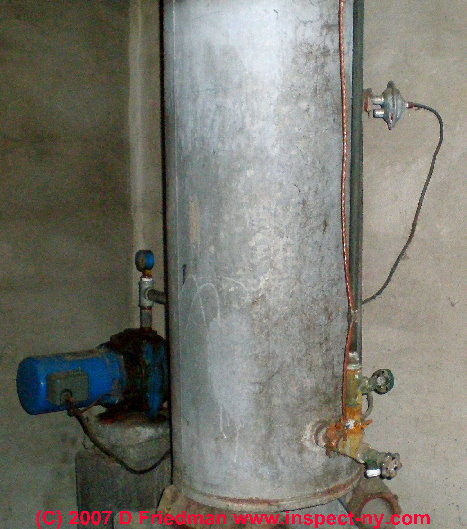
If in placing an air charge into a bladderless steel or fiberglass water pressure tank the tank is overcharged air may flow out of the tank, through piping and out of plumbing fixtures when water is turned on.
This condition only occurs if the tank is one that does not separate water from air using an in-tank bladder. In this case the problem is self-correcting, typically in just a few minutes of running water at each fixture, as excess air flows out of the tank, through piping, and out at fixtures.
As the water pump cycles back on and water is pushed back into the water tank, operations will resume normally.
For details see WATER TANK AIR, HOW TO ADD
and WATER TANK AIR HOW MUCH TO ADD.
Air Discharge from Hot Water Faucets
Watch out: if you find air discharging only from your hot water faucets a dangerous condition may be present: the hot water heating system may be too hot, risking scalding or even water heater explosion. Turn off power or fuel to the water heater itself and call a licensed plumber immediately.
See a complete list of diagnosis and cure details now found
at AIR DISCHARGE from HOT WATER
How a Burst Water Pressure Tank Bladder Can Cause Air Discharge at Plumbing Fixtures
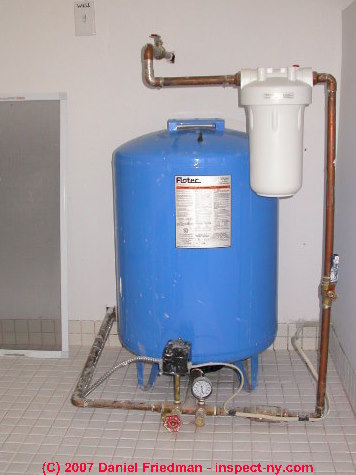
If a "captive air" bladder-type water pressure tank has a ruptured bladder, depending on the total air charge or pressure, air may be forced out of the pressure tank and through piping and fixtures as above. As with our first example, the air flow will be temporary.
But in this case the water pressure tank will become waterlogged and the water pump is likely to be short-cycling before long
See WATER PUMP SHORT CYCLING).
A new water pressure tank or a bladder replacement will be needed. We discuss captive-air water tank bladders, their maintenance, bursting, and repair,
at WATER TANK BLADDERS & CAPTIVE AIR.
How a Bad Check Valve can Cause Air Discharge at Plumbing Fixtures
A defective or improperly installed check valve on a private pump and well system can also cause air discharge from the building's faucets. A faulty check valve that allows water to drain back into the well causes negative pressure or "suction" that can draw air and contaminants into the well piping or into the well itself.
See details at CHECK VALVES, WATER SUPPLY, DRAINS, PUMPS.
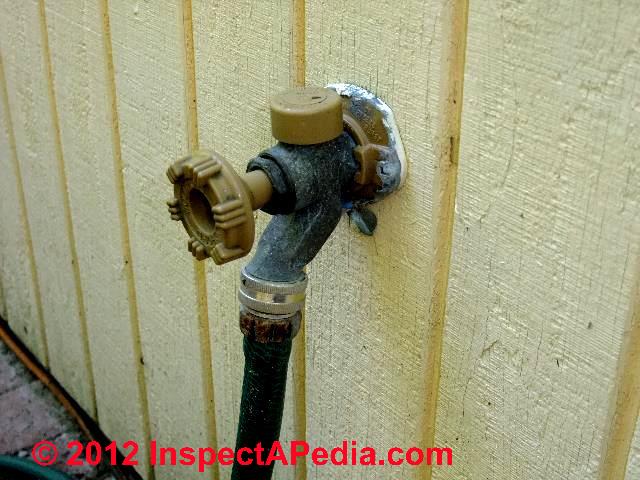
Watch out: when diagnosing the cause of air discharge from building faucets, it's easy to misdiagnose the cause: from inside the building the symptoms of a bad check valve (loss of prime, possibly air discharge at plumbing fixtures) can look a lot like a hole in the well piping, especially if the hole is in the pipe rising inside the well itself (also causing loss of prime, air at faucets) - as we discuss further just below.
A leaky sill cock check valve or backflow preventer (shown above) might also introduce air into building water pipes.
How Leaks in the Well Piping Can Cause Air Discharge at Plumbing Fixtures
 Experts note that when the pump shuts off, if there is a hole or leak in the well piping, the hole allows air into the well line; when the pump is running, water sprays out of the same hole, possibly adding to rust and debris in the well and the pumping of silty or dirty water into the building.
While water piping is under pressure and water leaks out rather than air leaking in, if we have the combination of lost water pressure (for example during an electrical power loss or a well system being shut down), and leaks in the well piping, as water drains backwards into the well air may be drawn into the water piping through piping leaks.
If the piping leak is inside the well casing where plenty of air is available, and if the well piping includes a defective (leaky) foot valve or check valve in the well, this cycle could repeat and building occupants may see recurrent air discharge from plumbing fixtures.
You may be able to diagnose this problem by turning off all water supply in the building and watching what happens to the water pressure gauge at the pressure tank.
If the water pressure falls slowly even when you are sure no water is running in the building, there is probably either a bad foot valve or check valve in the well, or a leak in the water piping between the well and the building. But watch out - water pressure gauges can be inaccurate or slow to respond to changes in water pressure -
see WATER PRESSURE GAUGE ACCURACY.
Air Leaks in well piping, connections, check valves, fittings, or even the pump itself: leaks anywhere between the well and the building can introduce air into the well piping and water supply system.
Air can leak into well piping anywhere between the top of water column in the well at the end of a pump cycle (that's somewhere below the top of the static head of the water column), and the water pressure tank: that includes both vertical and horizontal sections of well piping.
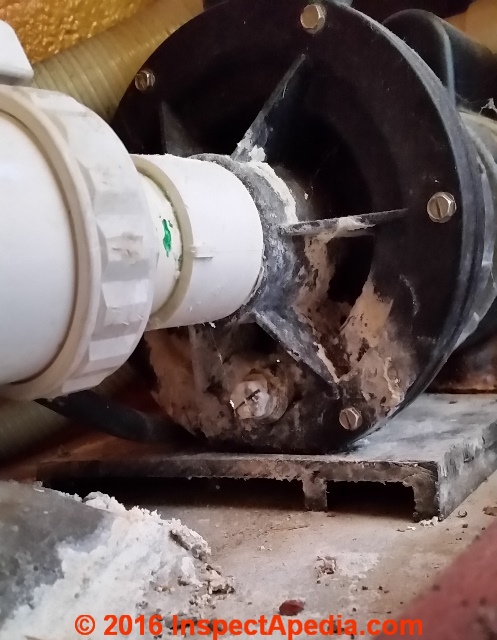
Leaks in well piping or at valves or check valves, at the pitless adapter o-rings, or even at the pump itself (shown above). A pinhole leak can be hard to track down, especially on the suction side of pumping systems where you won't see water leaks. Low water in a well that allows a pump to draw air also places a lot of air into the water supply system.
If there is a severe well piping leak or a water piping leak or running plumbing fixture in a building the well pump may begin to run continuously
- see WATER PUMP WONT STOP RUNNING.
Watch out: a hole or leak in a well pipe or a defective or improperly installed check valves on a private pump and well system can also cause air discharge from the building's faucets.
A faulty check valve that allows water to drain back into the well causes negative pressure or "suction" that can draw air and contaminants into the well piping or into the well itself. See details
at CHECK VALVES, WATER SUPPLY, DRAINS, PUMPS.
Experts note that when the pump shuts off, if there is a hole or leak in the well piping, the hole allows air into the well line; when the pump is running, water sprays out of the same hole, possibly adding to rust and debris in the well and the pumping of silty or dirty water into the building.
See WATER SUPPLY / DRAIN PIPE LEAK TYPES for details on diagnosing types of water piping leaks.
Also see PUMP PRIME, REPEATED LOSS of for additional diagnostic help with well piping and foot valve leaks.
How Loss of Water in the Well Can Cause Air Discharge at Plumbing Fixtures
A falling water table or decline in well recovery rate may cause the well pump to send a mixture of water and air into the well piping and building.
If this condition is occurring you might notice that the air discharge at plumbing fixtures is intermittent: when no water has been run overnight and the well has recovered, once existing in-piping air has blown out, the water flow may appear normal, without air discharge.
But as well water level drops and the well is slow in recovering, the air discharge problem will return. In sum, these well or well and pump conditions can cause air to be delivered by the well pump into the building's water supply piping:
If your well yield (how much water you can get out of the well) is inadequate water level in the well may drop low enough for air to enter a submersible (in well) pump or into the foot valve.
The combination of a too-small WELL DYNAMIC HEAD & STATIC HEAD DEFINITION (water reserve) in the well and a poor flow rate make this problem more likely. A well that has performed adequately in the past may no longer have an adequate yield for a variety of reasons: drought, a drop in the water table, drilling of new wells nearby, or yield loss due to mineral clogging of rock fissures that feed water to the well.
If the well pump is too large incapacity (pumping rate) for the well's safe yield then air may be drawn into the well pump and water piping when the pump drops water level in the well too low.
The safe yield for a well may change if the water table drops. Then, if the well pump output rate exceeds the safe yield for the well, air may be injected into the building water piping and the well pump may be damaged.
See inadequate WELL FLOW RATE for more information.
See WELL YIELD DEFINITION where we define safe well yield.
See WATER PRESSURE STOPS, RETURNS - for symptoms of loss of water in the well and slow well recovery rates.
See WATER PRESSURE LOSS DIAGNOSIS & REPAIR for our complete article series on diagnosing loss of water or water pressure at a building.
Defective or Damaged Well Pump Can Cause Air Discharge at Plumbing Fixtures
It is possible that a failing well pump may introduce air into the water supply piping system due to cavitation (a vacuum forming inside the well pump mechanism), causing dissolved gases to come out of solution.
Cavitation and air leaks into a water pump may be more likely with an above-ground jet pump and less likely with a submersible in-well pump that would be expected to be always submerged in water.
See WATER PUMP LIFE EXPECTANCY.
If a new well pump has been installed and is over-sized, the level of water in the well may be drawn down too rapidly when the pump is running, resulting in air entering the pump and being delivered to the building. This condition can also occur in times of drought or if your well is running dry.
Defective Air Volume Control Can Cause Air Discharge at Plumbing Fixtures
An air volume control device may be installed on some bladderless water tanks to attempt to keep the proper air charge in the water tank. If the air volume control is leaky or not working properly it may be overcharging the water tank with air.
If this is the case the air discharge from plumbing fixtures will be chronic.
See WATER TANK AIR VOLUME CONTROLS.
Gases in the Well and Water Supply Can Cause Air Discharge at Plumbing Fixtures
In some areas gases, including potentially dangerous explosive methane gas, may leak into the water supply and may be delivered into the building water piping from a well. Other gases often found in well water include radon, CO2 in some locations, and dissolved sulphur (that rotten egg smell).
Watch out: methane gas in well water is a pollutant and may be explosive. According to experts such as the New Hampshire Department of Environmental Services,
Methane at high concentration is explosive and thus there is a fire hazard if large amount of water with methane are used near an open flame in a closed space.
The presence of methane gas in water can be simplistically detected by agitating a small volume of water in a plastic container in an outdoor location and attempting to ignite the gas released. Have a neighbor present when you try this testing.
If you have such a well you should contact your local department of environmental services and your building department.
Lowering the settings of the pump’s start/stop switch and/or providing an air release vent on the water storage tank at the high point of the stored water might allow this “off gassing” to occur at a point other than your faucet. Since this is a natural condition, and no damage is caused, there is no need to take any particular action.
Dissolved gases may also be present in water but would not normally appear as bubbles or air blasts at a faucet. These include radon, carbon dioxide, hydrogen sulfide (rotten egg smell), or other gases from dissolved organic matter or chemicals.
But in some deep wells water at the well bottom, at higher pressure, may hold dissolved gases that convert to bubble form when water pressure is reduced to ambient air pressure at building faucets.
Changes in water temperature also affect the amount of gases that remain dissolved in water - warming water drives gases out of solution.
Test to Identify Methane Gas in the Water Supply
Other common gases found in water besides methane include CO2 and sulphur or dissolved sulphur.
Keech and Gaber describe how to collect a test sample for methane and also describe options for removing gases from water.
- Keech, Donald K., and Michael S. Gaber. "Methane in water wells." Water Well Journal 36, no. 2 (1982): 33-36. original source retrieved from drinknwaterplus.com/documents/Methane%20in%20Water%20Wells.pdf
Bad Snifter Valve or Drain-Back Valve Can Cause Air Discharge at Faucets
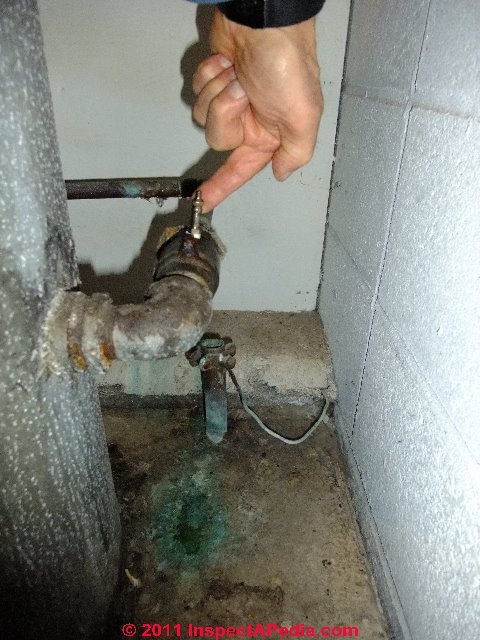
Snifter valves and drain-back systems used on submersible pump and well systems that use a bladderless water pressure tank (or whose bladderless water tank was replaced with an internal bladder water pressure tank) can push excess air into the water pressure tank.
Snifter valves & drain-back valves along with air volume control devices (AVCs) form a three-part air volume control system designed to
- allow water to drain out of well piping and back into the well at the end of a pump-on cycle and to
- maintaining the air charge in a well water pressure tank, thus also
- maintaining water pressure in the building between pump-on cycles
This system is used on deep wells and lake water supply systems for which the pressure tank does not use an internal bladder. The required air charge in the pressure tank is kept at the proper level by drawing some air into the well piping system at the end of each pump-on cycle.
The pump stops, water drains back down the well pipe into the well, air is drawn into the system at an above-ground air admittance valve, often by what looks like a tire valve or Schrader valve located on well piping close to the pressure tank.
In the photo I'm pointing to the air admittance valve part of a snifter valve system on a bladderless water pressure tank in a home in Two Harbors Minnesota.
The snifter valve (or any other air volume control device on a water pressure tank) can fail in either of two modes:
- It allows too much air into the system: air will be discharged at the faucets the next time water is used. That problem may have led you to this page.
- It allows too little air into the system: the water pressure tank will become water-logged (lose its air charge) and the well pump will begin short-cycling.
See WATER PUMP SHORT CYCLING - home
For more information start reading
at SNIFTER & DRAIN BACK VALVES and also see details
at DRAIN BACK & SNIFTER VALVE SYSTEM COMPONENTS
Watch out: If a bladderless water tank that used a snifter valve system is replaced with a new internal-bladder tank you may need to have a plumber pull the well piping to remove the (now no longer used) drain and vent found inside the well.
In the well an air-introducing check valve is installed above the top of the static head of the water column to add air to the bladderless water tank at each pump cycle.
Even if the bladderless water pressure tank was replaced with a new bladderless tank, if the snifter valve system was left in place but the excess air vent was not installed on the new tank (or is not working) you'll want to provide or repair these components.
Water Softener Check Valve Can Cause Air Discharge at Plumbing Fixtures
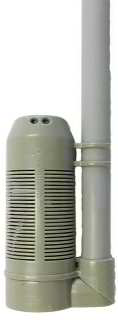 Question: why do we get air at our faucets after the water softener has gone through a regeneration cycle
2017/02/21 Quiggley said:
I have a Kenmore 625.393060 water softener and have the same problem of there being air in the water lines after a regeneration.
Typically, my first use of water after a regeneration is with a toilet flush in the morning. There is always a noticeable release of air in the water line as the toilet tank refills. What caused this?
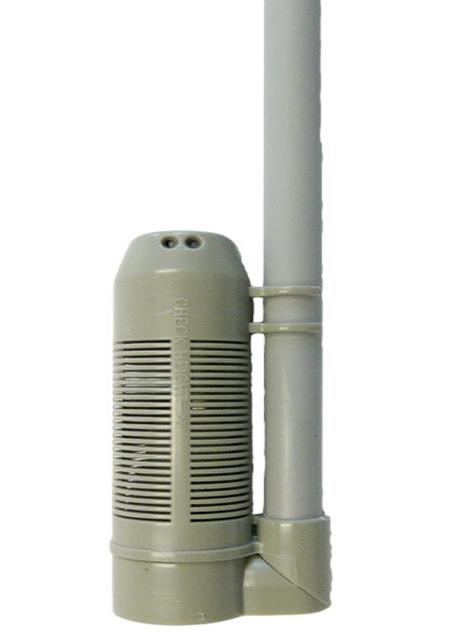
Image: a replacement water softener brine tube air check valve produced by Fleck and widely sold at plumbing suppliers as a repair or replacement check valve for many water softener brine tanks.
This question was posted originally
at WATER SOFTENER CLEANING & SANITIZING
Reply: look for a clogged check valve on the brine pick-up tube or a leak in the brine tube between softener and brine tank
Two common causes of air discharge at plumbing fixtures that is traced to the water softener are
- a pinhole leak in the brine tube between the softener and the brine tank
- a clogged air check valve on the bottom of the brine pick-up tube in the brine tank
A leak in the brine tank tubing can be the problem. As brine is returned to the softener during a regen cycle it may be accompanied by air that later shows up at building plumbing fixtures.
You should also pull out, inspect, and clean the brine pick-up tube in the brine tank. An air check valve located (usually) on the bottom of the brine pick-up tub is intended to prevent air from being drawn into the water softener from the brine tank.
At the end of the regen cycle the level of salty water in the brine tank falls low enough that a ball type check valve on the bottom of the brine pick-up tube drops to prevent air from being drawn out of the brine tank and into the softener.
Pull out the brine pickup tube and place the air check valve on its end into a jar of vinegar for a few hours or longer to dissolve mineral deposits including salt that may be causing it to jam. Some suppliers suggest using bleach - that makes little sense to me. Rinse the valve in fresh water and restore it into the brine tank.
If you have any doubt about the valve or if you can't convince yourself it's operating freely, just replace it. A widely-sold air check valve for brine tanks is the Fleck J-Tube 3/8 " X 34 " Long. This check valve can be trimmed, if needed, to fit your salt tank.
See WATER SOFTENER BRINE TANK AIR CHECK VALVE for details about this part.
At our FAQs for water softeners
at DIAGNOSE WATER SOFTENER PROBLEMS we also discuss air in the water system after a water softener regen cycle.
A less obvious cause of air discharge at fixtures may correlate with resin loss from the water softener - that's a problem in the softener itself, discussed in detail
at WATER SOFTENER RESIN LOSS - symptoms of resin loss from a water softener and how the problem may be repaired
Water Treatment Equipment Can Cause Air Discharge at Plumbing Fixtures
- Air Treatment of Water to Remove Impurities or Odors: Deliberate introduction of air into the water system is sometimes used to treat other water impurities such as sulphur (rotten egg smell) or iron. Some air-introduction contaminant oxidizing systems use a venturi to add air to water passing through the system in order to oxidize the dissolved iron into a filterable sediment.
Water treatment equipment can also inject air into a building water supply. Water treatment to remove odors or gases from the water supply may use venturi air injectors intended to remove iron, manganese, or odors. Properly installed these devices should not send air out of faucets. But the following conditions can cause air injector treatments to place excess air in the building water supply piping:
- A change in the water pump output rate may cause a mis-match between the air injection rate at the injection nozzle or venturi and the total water quantity being delivered to the building
- A change in water piping that fails to properly pitch water supply piping to an excess air relief valve
- A failure of the excess air relief valve to continue to release air - the valve may need cleaning or replacement
- An improper adjustment of the air-to-water ratio at the air injection nozzle or venturi. Your water treatment company technician can reduce the level of air injection to the minimum needed to remove the objectionable odor, iron, or manganese.
Other Sources of Air in Water Piping - Work on Municipal Water Mains or Private Well Piping
 We list the most-common sources of air in water supply systems starting
at AIR DISCHARGE at FAUCETS, FIXTURES
There may be other causes of air discharge from building water supply piping, including the ones we list below.
- Aerator devices at faucets: Faucet aerators can produce fine white bubbles in the water coming from a faucet simply due to the faucet aerator designed to prevent splashing.
You can test this source by temporarily removing the aerator. With the aerator removed, fill a glass or clear pitcher with cold water and separately with hot water to check for remaining air bubbles. - Temporary air introduction into municipal water supply piping when work is being performed on the water system. Usually such conditions are temporary. Ask your water company if there has been recent work on the water mains in your area.
Air Eliminators for Potable Water Supply Systems
This topic has moved to a separate article. Please see AIR ELIMINATORS for POTABLE WATER SUPPLIES
Reader Comments, Questions & Answers About The Article Above
Below you will find questions and answers previously posted on this page at its page bottom reader comment box.
Reader Q&A - also see RECOMMENDED ARTICLES & FAQs
On 2022-03-17 by Inspectapedia Com Moderator - make sure electric element in water heater is covered by water
@Bobby,
Sounds as if air in the water heater may be causing water to fail to cover the electric element - that'll burn out the element very quickly.
Look through the causes given on this page.
Also: are we sure it's air and not gas, say from a reaction between the heater anode and the water chemistry?
On 2022-03-17 by Bobby
I am on a well. Air is sputerring primarily from the hot water side of my sink faucet but very minor on cold water side. My heating element in the water heater keeps burning out. I have replaced 3 within a month. What kind of problem does this sound like to you?
On 2022-02-23 by Inspectapedia Com Moderator
@Miguel,
If that noisy toilet uses a power flush mechanism it may need adjustment. If it's a conventional flush toilet than I suspect the cause is one of those described above on this page.
On 2022-02-22 by Miguel
Every now and then air comes out of our toilet tank, making a flashing sound
On 2022-02-13 by Inspectapedia Com Moderator - be sure water line is winterized properly
@LEIGHTON,
If the problem is that the water line is freezing your options are to warm it with a heat tape or install an air pump system that refills the line with air to a level below the ice - at the end of each pump-on cycle.
A detailed illustrated explanation of how to protect your water supply line from freezing is in our article
WINTERIZE A BUILDING - home
On 2022-02-13 by LEIGHTON
We draw water from a dugout about 1500 feet from our house, we started drawing air thru intake line ab out 3 months ago. At that time we believed we had a pipe leak so we put in a new hose directly into the dugout witha new check valve. Since then our water draw has gotten worse with large amounts of air being pulled up suction line.
Went out chopped hole in ice found it was frozen into the ice so put weight on end of the line. Was better for about 3 weeks now getting worse by the day. Have to run water in thru intake pump from holding tank constantly for priming to pull any water. Will draw for a bit then large gulps of air then some water then air.
Since checkvalve is 5 feet under water I believe there is no way air could be sucked in thru the inlet, would it be possible that we are trying to draw water up to high for pump ? Water is a lower than normal due to drought in the area but has been this low before.
Has worked for last 35 years with no real problems. We are at a lose do you have any suggetions short of digging in a new line on things we can try to help figure this out.
On 2021-09-11 by inspectapedia.com.moderator
@Jodi,
thanks for that helpful follow-up;
I'd keep an eye on this system for a while;
If there is a leak in well piping or a leaky foot valve, adding a check valve at the pump can help slow down the loss of prime but you might still find that the system loses prime, particularly when the pump has been off for a longer period.
On 2021-09-08 by Jodi - adding check valve on the top of the pump fixed air discharge issue
@inspectapedia.com.moderator, I just wanted to give an update on our 'new well pump/air in the pipes' situation. This website has been a great resource and extremely helpful, so I thought I'd share our conclusion. The problem has been fixed - no more air in our pipes! *Relief*
Apparently, all it took was installing another check valve - on the top of the pump. (!!!) Wait, there wasn't a check valve on the top of the pump?! Nope. There is a check valve towards the top of the well (not sure how many feet up) but not one at the pump.
So, the well guy installed another check valve at the top of the pump and that fixed the problem. It's been a couple of weeks now and all is good. But c'mon well guy! I just feel like he should've known better.
That being said, installing a check valve is way better than drilling a new well. Whew.
On 2021-08-04 by inspectapedia.com.moderator
@Jodi,
Repair may be possible, it depends. Let's start by getting a thorough inspection so that we know exactly what's wrong.
On 2021-08-04 by Jodi
@inspectapedia.com.moderator,
Thank you so much for your prompt response! Everything I've read seems to point to a leak. Can a damaged well casing be fixed? Can the connector on the pump piping be replaced?
On 2021-08-03 by inspectapedia.com.moderator - air discharge and sand indicate a need for further inspection
@Jodi,
Before talking to your plumber again you might want to read through the common causes of air discharge at fixtures described on the page above.
I suspect it's likely that one of those is going to explain what you are seeing.
It's possible for example that pushing the piping through that tight spot of damaged well casing might cause a leak at a connector on the pump piping. Such a leak can leak water out and air in.
A well bore inspection by camera would be useful.
On 2021-08-03 by Jodi
We live in Michigan. Our house was built in 1999. We had to replace our well pump. It was a 2hp submersible pump. Our well is 205ft, we have plenty of water. We decided to upgrade to a new constant pressure well pump - 3 hp - mostly to have a better sprinkler system.
After installation, the well tech noted that he had trouble pulling up the old pump, said he ran into a "tight spot" in the well pipe. Then when installing the new pump, he had to push through the "tight spot". His thoughts were that the old pump was constantly running and could have "heated up" and changed the integrity of the well pipe. The well pipe is plastic.
He was still able to install the new pump - did all the checks and tests and we were good to go. The pressure is set to 70 psi. The next day, air was spitting out of every faucet, toilets were banging, the hose outside was coughing and spitting. We were also getting some sand. We have a water softener and iron filter.
Those were put in bypass and then eventually unplugged. Still no change. Still air in the pipes. Plumber said to run all the faucets until they stop sputtering. Did that, and they eventually stopped sputtering and things seemed fine. Waited a few hours, turned on a faucet and the whole spitting and sputtering starts all over again. Cold or hot, doesn't matter.
Get the well guy back out. He says he's going to raise the pump up 2ft above where that "tight spot" is - mentions the word cavitation. Raises the pump up. Does all the checks and tests. We still get a little bit of sand but the air worked itself out. That night the toilet banged. The following afternoon, faucets started spitting. Water softener and iron filter are still in bypass, never turned them back on.
Called the well guy again and asked him if that "tight spot" in the well pipe is the issue, causing air to get it. He says no, but seems to be stumped and now wants to check the water pressure tank. There is no change in the water pressure at all with the new pump - the water pressure is full force. And we have never had any issues with air in the pipes prior to installing the new pump.
Is it the well pipe/casing? Could the pump be too big? Can our pipes not handle this sort of pump? Why is this well guy so stumped? He came highly recommended.
Backing away from the faucet every time I turn it on is no way to live.
On 2021-04-27 by danjoefriedman (mod)
@Nigel Attwell,
Our most extensive list of common causes for air discharge at faucets is given on the page above.
Beyond that could be speculated that you have a slow or small leak in well piping that is allowing water out and air into your water lines overnight when the well is not infrequent use.
On 2021-04-26 by Nigel Attwell
Overnight, air builds in our system causing spluttering first thing in the morning in the toilet and faucets after the system has been idle.
We have a well pump and a newly installed pressure tank with bladder but the problem appeared to start after we had our well shocked.
Water pressure is fine.
On 2021-03-26 by danjoefriedman (mod) - weak water pressure may actually be a leak somewhere in well piping or pump
If you are seeing air discharge at plumbing fixtures, the solution to that problem is not a water pressure problem per-se but rather a leak somewhere in the well piping or pump that needs to be found and repaired. That diagnosis and fix are discussed above on this page.
If you do not have good water flow rate at fixtures ("weak water pressure") then we could try setting up the water pressure at the pressure control switch - discussed in several articles here in great detail; a good place to start diagnosing the problem is at
WATER PRESSURE TABLE 2: PUMP RUNS, WEAK or NO WATER PRESSURE
If you want to just increase the water pressure setting at your pressure control switch see WATER PRESSURE CONTROL SWITCH ADJUSTMENTS
Switch adjustment is within the ability of many homeowners but
Watch out: there is live voltage in the pressure control switch - if power is not turned off before opening the cover of the switch you could be shocked or killed.
So what's the difference?
In my experience usually if people are complaining about "weak water pressure" it's not a pressure control switch setting but rather clogged pipes or a well with a very low water in-flow rate.
If when you are not running water at all in the building and the pump has finished re-filling the water tank and the pump has turned-off, take a look at the pressure gauge.
If you see a water pressure at 40 psi or above, then there is no gripe about the pump's ability to deliver good pressure.
If then when you run water and the flow is weak, the problem isn't the underlying pressure switch setting, it's a clog or a water source problem as I mentioned above.
On 2021-03-26 by Anonymous
We have air system water well . We do not have good pressure into house. Do we need someone to come out or can you tell us how to set the correct presure?
On 2020-10-02 - by (mod) -
Not sure what's happening: check to see if your well pump is cycling on and off, trying to recover after having run the well out of water.
Turn OFF the water pump for a few hours to let the well recover, then turn it back on.
On 2020-10-01 by Bob Behrens
My son left the kitchen faucet running for a couple hours. Now I'm hearing occasional "thunks" in the pipes and sometimes vibrations that last several seconds and that increase in pitch from low to high. And the noises are while the water is NOT running
On 2020-09-27 - by (mod) -
Anon,
I can't give an absolute answer from the limited information in your question. But in general air bubbles in water or not harmful.
On 2020-09-27 by Anonymous
Our neighborhood had a main water pipe break and now when I fill my Brita pitcher with water it bubbles up all around it . I am concerned to drink our water
On 2020-09-14 - by (mod) - be sure you have clear diagnosis before spending your money
Linda
This sounds very expensive, and may be a case of the OPM problem (Other People's Money) discussed at https://inspectapedia.com/home_inspection/Other_Peoples_Money.php
I would want a clear diagnosis of the problem before throwing thousands of dollars at this. For example, you might get air discharge at fixtures simply because an air admittance valve or snifter valve (a small fitting) needs replacement.
Call someone else.
On 2020-09-14 by Linda Breeding
Have a blast of air first thing in morning had a plummer said it could be one of 3 things,1200 to replace tank and fittings ,1700 to replace tank fittings check valve , 3400 to replaceall the above plus tank,he said it had a small puddle.well, tank,pump 8yrs ago,I'm not dumb tank cost 159,it was 90 degrees humidity was 77%,it's under the house
,sent him down the road with a 59 dollar fee 60 dollars he didn't have change(Angies list). I checked for leaks,pump doesn't run all the time ,tank is is 32,pump comes on 35 ,goes to 50-55
On 2020-07-11 by Bobby
When we turn on faucets a rush of air makes a loud noise then water surges off and on
On 2020-07-11 - by (mod) -
Bobby,
In addition to checking out the diagnosis of unwanted air in the water system - (the article above on this page) - you might want to review the diagnostics at
WATER HAMMER NOISE DIAGNOSE & CURE
Let me know what you think and we'll take it from there.
On 2020-07-11 by Bobby Enfinger
When we turn on water in house it makes a pop and a air sound then it does it 3 or 4 times while it is running. It seems to be doing it more and more
On 2020-04-09 by Ricanne
Okay thank you so much I will have my son try that.
On 2020-04-08 by (mod)
I agree that a hissing sound suggests an air (or water) leak. When the pump is running, if there is an air leak INTO the pump system or housing you might see hissing but won't see bubbles - air is moving in, not out of the assembly. I'd try tightening what you can find to tighten, or re-making connections that use pipe dope or teflon tape and that are near the pump.
On 2020-04-08 by Ricanne
Aloha,I have checked all of the waterline for the house and can't find a water leak :( last year we had a problem with constant running and found that the inlet coupling was clogged got it cleaned up now there is a constant hissing sound which sounds like it's in the inlet side of the pump my son put soapy water on it and couldn't find any air leaks would that show something like that?
On 2020-04-07 - by (mod) -
With apologies that I can only make a wild guess with so little information, it sounds to me as if there is a leak in the piping for your system. That could be causing water to drain back at the end of a pump-on cycle and thus to cause a pump to cycle frequently.
On 2020-04-07 by Riacanne
We have an above ground catchment system,recently the pump has been going off and on about every minute we heard a hissing noise on the tank side of the pump.it sounds as though it's coming from the pipe but not really sure it is louder in that direction.the pressure gauge goes up to 40 or so when the pump kicks on but drops way down below 30 when it kicks off
On 2020-02-25 - by (mod) - causes of the air discharge problem
About on this page being list probable causes of the air discharge problem that you're describing.
Please take a look through those and then see if you can find a plumber I will admit that you have a problem and then do something about it
On 2020-02-25 by Zeba Salim
We have so much air in our pipes we are experiencing little to know water flow. If we get water flow, is slow and sluggish. The volume is so bad we struggle to shower, etc. We don't even have enough to wash dishes sometimes or it takes forever.
The water "oscillates" in the line. We get our water from the City. We put in a new hot water tank and if we open the hot water, we only get 50% of the hot water that we used to get - and that's on a good day.
We get plumbers in who say "they cannot see a problem" so they don't fix anything and we live in misery. Please help.
On 2020-01-04 - by (mod) - Air comes out of all fixtures with a vengeance
The article above on this page lists the most likely sources of air discharge at the faucet including the case that you described. I don't think that the temperature setting is the problem. We're likely there's a leak
On 2019-12-29 by John Harkness
Have lived in this house almost 30 yrs. Never air in potable water. 186' deep well. Had new boiler installed with boiler heated potable water.
Installer has adjusted temperature between potable water and hydronic heating system. Air comes out of all fixtures with a vengeance especially in the morning after not being used all night. Thank you for any advice. John
On 2018-12-17 - by (mod) -
Randy
Just to be clear, if when you open a faucet the pressure in the pressure tank doesn't drop, then the tank is not working - perhaps it's outlet is blocked or a valve is closed somewhere.
Leaks can be slow: I'd want to see what the system water pressure is when the pump turns on. If it's not below the CUT_IN then something's rotten in the state of WaterDenmark - perhaps a debris-clogged pressure control or debris clogged pressure gauge or both.
On 2018-12-15 by Randy
Thank you for your response, I have not quite address the situation yet.
I want to say that my pressure tank holds a strong 60 pounds of pressure continuously. And I observed it for 20 minutes with no loss .
So I'm ruling out a leak at least below the check valve. But thank you and you are correct I am becoming more of an expert than I ever wanted to be.
I will keep you posted
On 2018-12-14 - by (mod) - hard-to-find leaks in well piping
Randy
Thanks for the interesting question and great details.
I suspect you're more-expert than I at this point.
I've had annoying air leaks on plastic well piping and have approached it first adding a hose clamp and tightening every single fitting that I could access.
Seeing even a reduction if not complete stop in the air entry tells me I've got the right problem ID but still have a bad connector.
Your suspicion of the check valve makes sense but keep in mind it could be the pipe connections not the check valve itself.
The down-side of moving the check valve further from the well is that you lose the advantage it's giving you in the first place - that's why you had multiple check valves with the original pump - to reduce the backpressure load and tendency for water to flow back into the well, right?
But dropping the check valve to be under water is very clever in my OPINION since then even if there's a small leak, when the pump stops, as long as the check valve is still under water, you won't suck air into the piping.
(Remember that as your new superpump runs the static head or level of water in the casing will drop - just how far depends on the flow rate (inflow of water) into the well. So put the check valve far enough down that you think it will never be in air.
Please keep me posted on how that works.
On 2018-12-12 by Randy Sellers
Thanks for any and all responses. First of all I'd like to say I'm a do-it-yourself plumber. This is my second time replacing my well.
The first time 240 ft with a 1 horsepower deep well pump . And three check valves. 1 @50 foot above pump ,the other onehundred foot above check that check valve and then the third another 80' +/- above that valve.
Which that pump lasted me five years, I had to pull it three times to repair leaks at the check valves.
The check valves that was 50 foot above the pump literally had a hole blown into it, on the brass coupling. Tells me too much power?
Now my newest well, I put a 2 horsepower Schrader pump .I purchased a 300 foot length of pipe, black PVC .
I have a pump 227' ft down .with one pipe length. And only one check valve.
Aprox 15" below the top casing. Having read all kinds of opinions and a agreeing mostly with and older plumbers.
I have extremely good pressure, however I'm getting air in the system.
I believe the culprit is the check valve that is just below my well cap.
And it's the only check valve. Besides the one that is factory installed with pump.
I'm suspecting that's where my air is coming from. Reading many opinions and agreeing with most every one of them ,for one reason or the other.
My question is do I move the check valve closer to my holding tank.
Or drop it down approximately 75 to 100-foot so it will be under water. My well depth is 248 ft , my well point is 227' deep was approximately 177 ft of water on top. And I used the cotton rope with weight method. Thanks so much for any advice.......
Image lost -please re-post.
On 2018-09-28 4 - by (mod) - air leaks into piping from outside faucet?
Yes, under some unusual conditions (such as loss of building water pressure) if the outside faucet has been left open.
On 2018-09-28 by wdp
can a outside water faucet let air into the whole system and make sink and toilet spitt air
...
Continue reading at AIR ELIMINATORS for POTABLE WATER SUPPLIES or select a topic from the closely-related articles below, or see the complete ARTICLE INDEX.
Or see AIR DISCHARGE at FIXTURES FAQs - questions & answers about air sputtering at faucets or other plumbing fixtures and at their continuation at AIR DISCHARGE at FIXTURES FAQs-2
Or see these
Recommended Articles
- AIR DISCHARGE at FAUCETS, FIXTURES
- AIR ELIMINATORS for POTABLE WATER SUPPLIES
- AIR INLET VALVES
- AIR VOLUME CONTROLS, WATER TANK
- SNIFTER & DRAIN BACK VALVES
- WATER PUMP SHORT CYCLING
Suggested citation for this web page
AIR DISCHARGE at FAUCETS, FIXTURES at InspectApedia.com - online encyclopedia of building & environmental inspection, testing, diagnosis, repair, & problem prevention advice.
Or see this
INDEX to RELATED ARTICLES: ARTICLE INDEX to WATER SUPPLY, PUMPS TANKS WELLS
Or use the SEARCH BOX found below to Ask a Question or Search InspectApedia
Ask a Question or Search InspectApedia
Try the search box just below, or if you prefer, post a question or comment in the Comments box below and we will respond promptly.
Search the InspectApedia website
Note: appearance of your Comment below may be delayed: if your comment contains an image, photograph, web link, or text that looks to the software as if it might be a web link, your posting will appear after it has been approved by a moderator. Apologies for the delay.
Only one image can be added per comment but you can post as many comments, and therefore images, as you like.
You will not receive a notification when a response to your question has been posted.
Please bookmark this page to make it easy for you to check back for our response.
Our Comment Box is provided by Countable Web Productions countable.ca
Citations & References
In addition to any citations in the article above, a full list is available on request.
- Ben Langston, generously contributed the photographs of round disk-type air volume controls used at the top of this article.
- Alan Carson, Carson Dunlop, Associates, Toronto, has permitted our use of the well and water pump system used at the top of this and some other pages at our website.
- Thanks to - Tim Chambers, Purcellville, VA for discussing the causes and effects of air in a building's water supply piping - July 2010
- Air in Drinking Water, Environmental Fact Sheet, New Hampshire Department of Environmental Services, 29 Hazen Drive, Concord NH 03301 - web search 07/14/2010 original source: http://des.nh.gov/organization/commissioner/pip/factsheets
/dwgb/documents/dwgb-3-18.pdf
The purpose of this document is to identify possible explanations for fine white bubbles that are sometimes seen in drinking water immediately after the water is taken from a faucet. The condition is similar to effervescence. These bubbles disappear within approximately one minute after the water is drawn from the tap.
DES does not believe that there is a health significance to these air bubbles, however, they may create a safety risk as explained below. They may also indicate improper physical conditions in pumps, pipes, or other water system equipment. There are numerous possible explanations for these bubbles. - Our recommended books about building & mechanical systems design, inspection, problem diagnosis, and repair, and about indoor environment and IAQ testing, diagnosis, and cleanup are at the InspectAPedia Bookstore. Also see our Book Reviews - InspectAPedia.
- In addition to citations & references found in this article, see the research citations given at the end of the related articles found at our suggested
CONTINUE READING or RECOMMENDED ARTICLES.
- Carson, Dunlop & Associates Ltd., 120 Carlton Street Suite 407, Toronto ON M5A 4K2. Tel: (416) 964-9415 1-800-268-7070 Email: info@carsondunlop.com. Alan Carson is a past president of ASHI, the American Society of Home Inspectors.
Thanks to Alan Carson and Bob Dunlop, for permission for InspectAPedia to use text excerpts from The HOME REFERENCE BOOK - the Encyclopedia of Homes and to use illustrations from The ILLUSTRATED HOME .
Carson Dunlop Associates provides extensive home inspection education and report writing material. In gratitude we provide links to tsome Carson Dunlop Associates products and services.
 | HOME | ABOUT | ASK a QUESTION | CONTACT | CONTENT USE POLICY | DESCRIPTION | POLICIES | PRIVACY | |
| © 2024 - 1985 Publisher InspectApedia.com - Daniel Friedman | |||||||||