
InspectAPedia® FREE Encyclopedia of Building & Environmental Construction, Diagnosis, Maintenance & Repair |
Question? Just ask us! InspectAPedia
|
 Tests & Remedies for Arsenic in Drinking Water
- POST a QUESTION or COMMENT about tests for arsenic in drinking water and about how arsenic contaminants are removed from water
Arsenic in drinking water:
This article discusses the detection of arsenic in drinking water, sources of arsenic in water, arsenic exposure limits, and how to remove arsenic from drinking water.
Sources of arsenic in drinking water may be from natural occurrence of arsenic in soils and rock, or in some areas from industrial waste.
Because arsenic contaminants in drinking water cannot be tasted by the consumer, if your drinking water is coming from a private well and if there is particular risk of arsenic in your drinking water the water source should be tested.
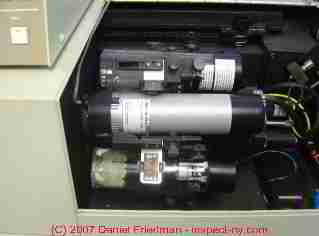
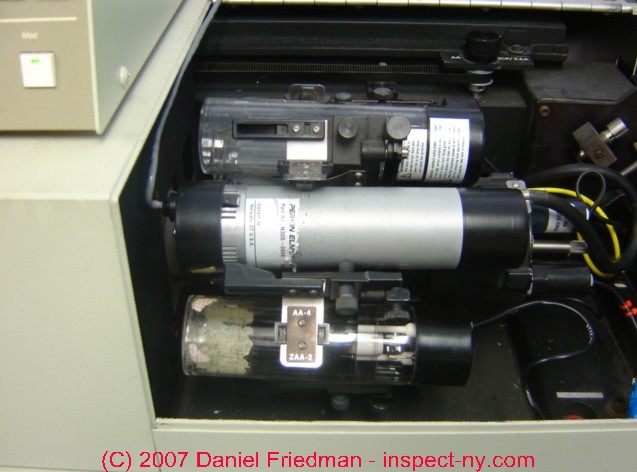
[Above we show a photograph of the arsenic test lamp used for detection of arsenic in drinking water - courtesy of Aquacheck Water Testing Laboratory].
InspectAPedia tolerates no conflicts of interest. We have no relationship with advertisers, products, or services discussed at this website.
Tests & Limits on Arsenic Contamination in Drinking Water
 The following data is derived from the US EPA and other sources cited in this article.
The U.S. EPA has set the arsenic standard for drinking water at .010 parts per million (10 parts per billion) to protect consumers served by public water systems from the effects of long-term, chronic exposure to arsenic.
That maximum contaminant level (MCL) for arsenic in drinking water for total arsenic level, regardless of whether the arsenic is in inorganic form.
Public water systems have been required to comply with this standard since January 23, 2006.
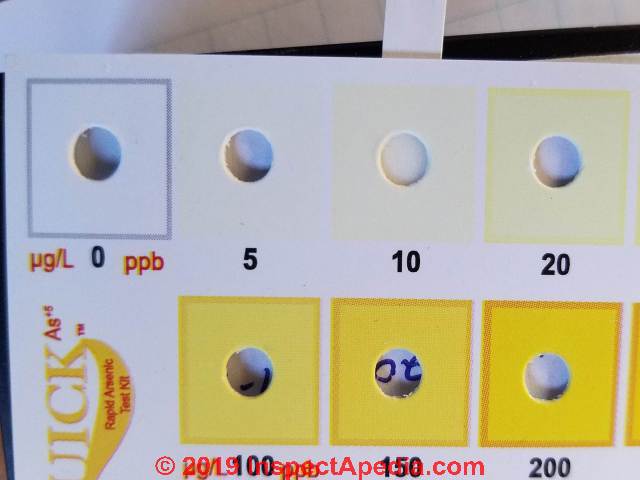
Shown here: our test of city drinking water in San Miguel de Allende, performed on 25 March 2019 using a Quick As Rapid Test™ provided by Industrial Test Systems found between 5 and 10 ppb of arsenic in the water supply.
[Click to en large any image]
Details of this test procedure and its results for several water sources are given separately
at ARSENIC in DRINKING WATER TEST
Table of Acceptable Limits or Arsenic in Common Drinking Water
Arsenic Limits in Drinking Water |
|||||
| Arsenic MCL |
ppb | ppm | µg/L | mg/L | Authority |
| Current MCL | 10 | 0.010 | 10 | 0.010 | U.S. EPA, WHO |
| Prior arsenic MCL: | 50 | 0.05 | US EPA 1975 to January, 22, 2001 | ||
| Arsenic MCL Goal | 0 | 0 | 0 | US EPA | |
Notes to the arsenic in water limits table above
mg/L = milligrams per liter
µg/L = micrograms per liter
1 µg/L = 1000 µg/L
MCL = Minimum [Acceptable] Contaminant Level
MCL Goal is a desired objective, where its achievement may be limited by current technology
ppb = parts per billion
ppm = parts per million
These MCL standards and goals are for public water supplies in the U.S.
See also WATER CONTAMINANT LEVELS & LIMITS for other water contaminant limits
Details about Arsenic Contamination in Water
Arsenic is a semi-metal element in the periodic table. It is odorless and tasteless. It enters drinking water supplies from natural deposits in the earth or from agricultural and industrial practices.
Human exposure to arsenic can cause both short and long term health effects. Short or acute effects can occur within hours or days of exposure. Long or chronic effects occur over many years.
Non-cancer effects can include thickening and discoloration of the skin, stomach pain, nausea, vomiting; diarrhea; numbness in hands and feet; partial paralysis; and blindness. Arsenic has been linked to cancer of the bladder, lungs, skin, kidney, nasal passages, liver, and prostate.
Non-cancer effects can include thickening and discoloration of the skin, stomach pain, nausea, vomiting; diarrhea; numbness in hands and feet; partial paralysis; and blindness. Arsenic has been linked to cancer of the bladder, lungs, skin, kidney, nasal passages, liver, and prostate. - updated 9/2010
EPA has set the arsenic standard for drinking water at .010 parts per million (10 parts per billion) to protect consumers served by public water systems from the effects of long-term, chronic exposure to arsenic.
Water systems must comply with this standard by January 23, 2006, providing additional protection to an estimated 13 million Americans. - updated 9/2010
Also see details about arsine gas poisoning
at ARSENIC HAZARDS at BUILDINGS & EXPOSURE HAZARDS for more about arsenic poisoning from this arsenic element in its gaseous form. A discussion of arsenic poisoning from Arsine Gas Exposure Hazards - Arsenic Hydride
If your drinking water is coming from a municipal supply, or from a privately-owned water company that has more than 15 service connections or serves 25 people more than 6 months of a year, the water company or municipality are required to regularly test for arsenic in your water and you should not need to order this test privately
Sources of Arsenic in Drinking Water
Arsenic occurs naturally in rocks and soil, water, air, and plants and animals. It can be further released into the environment through natural activities such as volcanic action, erosion of rocks and forest fires, or through human actions.
Approximately 90 percent of industrial arsenic in the U.S. is currently used as a wood preservative, but arsenic is also used in paints, dyes, metals, drugs, soaps and semi-conductors. High arsenic levels can also come from certain fertilizers and animal feeding operations. Industry practices such as copper smelting, mining and coal burning also contribute to arsenic in our environment.
Higher levels of arsenic tend to be found more in ground water sources than in surface water sources (i.e., lakes and rivers) of drinking water. The demand on ground water from municipal systems and private drinking water wells may cause water levels to drop and release arsenic from rock formations.
Compared to the rest of the United States, western states have more systems with arsenic levels greater than EPA’s standard of 10 parts per billion (ppb). Parts of the Midwest and New England have some systems whose current arsenic levels are greater than 10 ppb, but more systems with arsenic levels that range from 2-10 ppb.
While many systems may not have detected arsenic in their drinking water above 10 ppb, there may be geographic "hot spots" with systems that may have higher levels of arsenic than the predicted occurrence for that area.
Here is a local copy of the US EPA's Arsenic and Clarifications to Compliance and New Source Monitoring Rule: A Quick Reference Guide.
Arsenic exposure limits - maximum levels allowed in drinking water
The MCL, or maximum contaminant level had been set at 50 ppb (parts per billion) from 1975 until January, 22, 2001 when the new EPA (Environmental Protection Agency) level became 10 ppb.
Why lower the level five-fold? What did the EPA discover after studying arsenic to make them drop the level that much?
Effects of exposure to Arsenic
Watch out: Long term exposure to arsenic in drinking water has been linked to cancer of the bladder, lungs, skin, kidneys, liver, and prostate. Other non-carcinogenic effects may include cardiovascular, pulmonary, immunological, neurological, and endocrine (diabetes) disorders. Large doses of arsenic can be lethal and has been the "poison-dujour" for centuries!
Question & Answer About Symptoms of Arsenic Poisoning Due to Arsenic in Water
Question: How soon will arsenic poisoning symptoms go away?
I have a quick question about your article in regards to
arsenic
levels in well water. I am in the process of getting my water
tested
as my sons have had some of the symptoms of low level
exposure.
I immediately ceased drinking the well water and they are only drinking bottled water now. How soon would the symptoms go away if they were not drinking it anymore (for example stomach pain, nausea, etc).
I ceased all family drinking of my well water. As soon as I did, within 48 hours my 8 year old stopped complaining of stomach ache and nausea.
I just was wondering as I have been concerned since I couldn't find the source of my sons illness. -- Donna
Answer on Arsenic Poisoning from Well Water - Symptoms
Quoting from Asenic Contamination of Ground Water in Bangladesh, a Briefing Paper [PDF] an article on extreme arsenic poisoning from well water in Bangladesh, from the Ministry of Health and Family Welfare, Bangladesh
The use of arsenic free water may probably stop the deterioration of the symptoms but information of complete recovery is not yet known.
In any specific case of suspected arsenic poisoning such as your concern for your family, you need to discuss this question with your doctor who will no doubt want to perform tests, an examination, and assessment of your 8 year old's health.
Your physician will decide if tests are appropriate, and will advise you if arsenic poisoning is a candidate for possible causes of your son's complaint. Certainly the cessation of the complaint when he stopped drinking the water is suggestive, but without further work we don't know that the problem was arsenic or something else.
Knowing your son's health condition at start will surely be important in assessing whether additional steps are needed and what to expect.
Continuing from the article we cited above is more helpful information about arsenic poisoning from well water:
Arsenic contamination in groundwater is due to the various natural geological processes that exist in the geological environment.
The source of arsenic in sediments is mainly the parent rock materials from which it is derived. Arsenic associated with sediment particles can be a major source of arsenic contamination when particles are detached and carried as sediments during erosion.
Sediments can contain substantial amounts of total arsenic. During the formation of sedimentary rocks, arsenic is carried down by precipitation of iron hydroxides and sulphides. In a moist climate, arsenic sulphides are easily oxidized, become water-soluble, are washed out of the sediment particles by meteoric precipitation, and are transported with run off.
Arsenic undergoes reactions of oxidation -reduction, precipitation-dissolution, absorption- desorption, and organic and biochemical methylation. All of these reactions control mobilization and accumulation of arsenic in the environment.
A biotic reaction between arsenic species and the substrates on the species and the substrates on the sediment surface, as well as physical disturbance of sediments, all play very important roles in controlling the mobilization of arsenic.
In nature, arsenic bearing minerals undergo oxidation and release arsenic to water.
and IMPORTANT
Arsenicosis, a disease born by drinking arsenic contaminated water which can lead to a very painful death. Arsenite and arsenate are known as carcinogens and have an affinity to deposit in hair, nail, bone etc. Arsenic is found in high concentration in liver, spleen, kidney and lungs as well.
Toxic effects of arsenic involve these organs. Toxicity of arsenic depends on its accumulation in the body. The time taken to develop symptoms in the human depends on the exposure, body defense mechanism, nutritional status etc. It is thought that it may take 2-20 years to develop symptoms.
The arsenic poisoning from the contamination of ground water is very chronic in nature. Most of the time the victims do not complain of the above symptoms until they are detected through screening. The above symptoms are also very difficult to identify from other clinical conditions.
The present experience to identify the arsenic cases are by external manifestations specially with the presentation on the skin called melanosis (blackening of skin) and keratosis (hardening of palms and soles) with the history of consuming arsenic contaminated source water.
Gangrene of peripheral organs and ulceration due to toxic effect on the small blood vessels may also be found. Cancer of the skin along with cancer of some internal organs - liver, kidney, bladder is not uncommon. The stage of keratosis is known as potentially malignant.
It is also observed that even if a person having no manifestations after consuming contaminated water the chance of having cancer cannot be ruled out.
Notice and discuss with your doctor the health ministry's comment from above that
The time taken to develop symptoms in the human depends on the exposure, body defense mechanism, nutritional status etc. It is thought that it may take 2-20 years to develop symptoms.
Also see TOXIC GAS EXPOSURE EFFECTS for more about arsenic poisoning from this element in its gaseous form.
Arsenic exposure standards can be improved
Adopting the new, stricter standards will provide increased protection for over 54,000 community water systems - such are the type that serve small cities and towns, apartments, and mobile home parks. Also, over 20,000 systems that serve such institutions as schools, churches, and nursing homes also must have complied to the new regulations by January 23, 2006.
Geographic "hot spots" where Arsenic is Found in Drinking Water
In the laboratory, we analyze arsenic from all parts of the United States. Arsenic is more common in the U.S. in drinking water from wells in the Southwest and Western states. We find geographical "hot-spots" where arsenic turns up at higher levels. "Hot spots" of arsenic contamination might also be found in other states, particularly if it is coming from industrial contamination. It is not uncommon to find levels well over 100 ppb in some areas.
Arsenic is odorless and tasteless, so the only way for you to tell if your well or source water has arsenic in it is to have it analyzed by a laboratory certified for that parameter. To find a certified lab., you can check with your state health department or call the Safe Drinking Water Hotline at, 1-800-426-4791.
What To Do About Arsenic in Drinking Water
Scott Bradley, Aquacheck Water Testing Laboratory
Arsenic is a soft, semi-metallic element that is found naturally in our environment. We also see arsenic introduced through orchards, treated lumber, and certain industrial processes such as glassware and electronic components production.
How to remove arsenic from drinking water
Arsenic can be removed from water, but we need to take a closer look at the element itself.
Arsenic can come in two forms, or valences. One, is inorganic, the other organic. The EPA MCL of 10 ppb is based on total combined arsenic. One form, trivalent or AsIII is also known as arsenite.
The other form, pentavalent, or AsV is also known as arsenate. Most manufacturers produce filters that will remove pentavalent arsenic as long as the starting level is less than 300 ppb. Speciation can be performed to determine which forms you have and in what proportions, but as you read further, it is not really necessary to speciate.
Typically, the trivalent form is converted to pentavalent form using free chlorine or other similar oxidation chemical because AsV is easier to remove. As previously mentioned, have a certified lab give you the total arsenic number, then let a qualified and experienced treatment professional take care of the filtration.
Watch out: you cannot remove arsenic from drinking water by boiling the water nor will bleach nor other disinfection methods (like UV light) remove arsenic from water. Typical water filters will also not remove arsenic from water. In fact boiling water can actually increase the arsenic concentration.
Systems Used to Remove Arsenic From Drinking Water
- Distillation of water will remove arsenic -
see DISTILLATION for DRINKING WATER DISINFECTION - Nano-filtration (NF) systems can remove arsenic from water as we cite in references below
- Reverse osmosis (RO) systems can remove arsenic
see REVERSE OSMOSIS WATER TREATMENT - Iron-impregnated activated carbon filter/treatement systems and some Ion exchange systems (designed specifically for arsenic removal) can remove arsenic from water, including use of iron or natural iron ores, with limitations as reported in research (Chen 2007) and others we cite in references where you can find PDF files describing this process.
Because of their added cost, these arsenic removal water systems are typically installed in just one or a few places in buildings, such as at a kitchen sink or "point of use" of water (POU) where water is being drawn for drinking and cooking purposes.
Watch out: other membrane filtration systems such as Ultra filtration (UF) and Microfiltration (MF) are not all reliable methods to remove arsenic from water
Watch out: if you live in an area where arsenic has been found in drinking water you should have your drinking water or well water tested for arsenic contamination every year or every six months.
If arsenic is found, in addition to avoiding drinking that water without first passing it through an arsenic removal system, you should, with advice from the water test lab or your local health department, increase the frequency of well water testing.
Depending on where you live there may be state, provincial or other government testing labs who will test your drinking water for a free, or labs who will test the water for a fee.
Bathing or Swimming in Water High in Arsenic
Question: Safety of bathing in water containing arsenic?
2019-02-28 Christine said:
I recently found out my well water has over the Maxium levels of arsenic and fecal contaminates. Is it safe to take shower and bath, brush your teeth with this contaminated water. I’ve been doing this for 10 years now. No drinking it but bathing etc. could that be the cause of my strange illnesses?
Reply: arsenic absorption through skin usually low or rare
Thank you for an interesting question Christine.
I did a bit of looking for research on the hazard of arsenic absorption through the skin from arsenic-contaminated water;
Obviously individual risk would vary enormously based on a variety of factors that determine the level of exposure:
- arsenic level in the water
- water temperature
- exposure duration and frequency
- possibly individual skin differences
- possibly additional effects from breathing vapors of arsenic-tainted water
Absorption of arsenic at harmful levels occurs predominantly from ingestion from the small intestine, though minimal absorption occurs from skin contact and inhalation. (Ratnaike 2003)
The general opinion is that skin absorption of arsenic is generally very small (Hall 2002).
- Fatmi, Zafar, Iqbal Azam, Faiza Ahmed, Ambreen Kazi, Albert Bruce Gill, Muhmmad Masood Kadir, Mubashir Ahmed, Naseem Ara, Naveed Zafar Janjua, and Core Group for Arsenic Mitigation in Pakistan. "Health burden of skin lesions at low arsenic exposure through groundwater in Pakistan. Is river the source?." Environmental research 109, no. 5 (2009): 575-581.
Excerpt: Prevalence of skin lesions increases with cumulative arsenic exposure (dose) in drinking water and arsenic levels in urine. - Hall, Alan H. "Chronic arsenic poisoning." Toxicology letters 128, no. 1-3 (2002): 69-72.
- Macht, David I. "The absorption of drugs and poisons through the skin and mucous membranes." Journal of the American Medical Association 110, no. 6 (1938): 409-414.
- cites an unusual case of fatal arsenic poisoning through skin absorption of a spilled chemical (not well water) - Rahman, M. S., L. L. Hall, and M. F. Hughes. "In vitro percutaneous absorption of sodium arsenate in B6C3F1 mice." Toxicology in vitro 8, no. 3 (1994): 441-448.
- Ratnaike, Ranjit Nihal. "Acute and chronic arsenic toxicity." Postgraduate medical journal 79, no. 933 (2003): 391-396.
Abstract:
Arsenic toxicity is a global health problem affecting many millions of people. Contamination is caused by arsenic from natural geological sources leaching into aquifers, contaminating drinking water and may also occur from mining and other industrial processes. Arsenic is present as a contaminant in many traditional remedies.
Arsenic trioxide is now used to treat acute promyelocytic leukaemia.
Absorption occurs predominantly from ingestion from the small intestine, though minimal absorption occurs from skin contact and inhalation.
Arsenic exerts its toxicity by inactivating up to 200 enzymes, especially those involved in cellular energy pathways and DNA synthesis and repair.
Acute arsenic poisoning is associated initially with nausea, vomiting, abdominal pain, and severe diarrhoea. Encephalopathy and peripheral neuropathy are reported. Chronic arsenic toxicity results in multisystem disease. Arsenic is a well documented human carcinogen affecting numerous organs.
There are no evidence based treatment regimens to treat chronic arsenic poisoning but antioxidants have been advocated, though benefit is not proven. The focus of management is to reduce arsenic ingestion from drinking water and there is increasing emphasis on using alternative supplies of water. - Wester, Ronald C., Howard I. Maibach, Lena Sedik, Joseph Melendres, and Michael Wade. "In vivo and in vitro percutaneous absorption and skin decontamination of arsenic from water and soil." Fundamental and applied toxicology 20, no. 3 (1993): 336-340.
Abstract: The objective was to determine the percutaneous absorption of arsenic-73 as H3AsO4 from water and soil. Soil (Yolo County 65-California-57-8) was passed through 10-, 20-, and 48-mesh sieves. Soil retained by 80 mesh was mixed with radioactive arsenic-73 at a low (trace) leve of 0.0004 μg/cm2 (micrograms arsenic per square centimeter skin surface area) and a higher dose of 0.6 μg/cm2.
Water solutions of arsenic-73 at a low (trace) level of 0.000024 μg/cm2 and a higher dose of 2.1 μg/cm2 were prepared for comparative analysis. In vivo in Rhesus monkey a total of 80.1±6.7% (SD) intravenous arsenic-73 dose was recovered in urine over 7 days; the majority of the dose was excreted in the first day. With topical administration for 24 hr, absorption of the low dose from water was 6.4±3.9% and 2.0±1.2% from the high dose.
In vitro percutaneous absorption of the low dose from water with human skin resulted in 24-hr receptor fluid (phosphate-buffered saline) accumulation of 0.93±1.1% dose and skin concentration (after washing) of 0.98±0.96%.
Combining receptor fluid accumulation and skin concentration gave a combined amount of 1.9%, a value less than that in vivo (6.4%) in the Rhesus monkey. From soil, receptor fluid accumulation was 0.43±0.54% and skin concentration was 0.33±0.25%. Combining receptor fluid plus skin concentrations gave an absorption value of 0.8%, an amount less than that with in vivo absorption (4.5%) in the Rhesus.
These absorption values did not match current EPA default assumptions.
Washing with soap and water readily removed residual skin surface arsenic, both in vitro and in vivo.
The partition coefficient of arsenic in water to powdered human stratum corneum was 1.1×10⁴ and from water to soil it was 2.5×10⁴.
This relative similarity in arsenic binding to powdered human stratum corneum and soil may indicate why arsenic absorption was similar from water and soil.
This powdered human stratum corneum partition coefficient model may provide a facile method for such predictions. - Ouypornkochagorn, Sairoong, and Jörg Feldmann. "Dermal uptake of arsenic through human skin depends strongly on its speciation." Environmental science & technology 44, no. 10 (2010): 3972-3978.
Abstract:
The most common routes of arsenic exposure are ingestion and inhalation, whereas dermal uptake has been considered as a minor uptake route based on uptake experiments with arsenate. Here the kinetics of arsenite, dimethylarsinic acid (DMA(V)) and arsenosugar penetration through full thick human skin (from one volunteer) was determined using a Franz Cell design and compared to that of arsenate.
The accumulation in the epidermis and dermis was performed by using laser ablation ICP-MS as a bioimaging method, and the biotransformation reactions through the uptake experiment were monitored by hyphenated elemental mass spectrometry.
The penetration and accumulation of arsenic is strongly dependent on its speciation. While arsenosugars penetrated through the unbroken skin at a similar rate as arsenate, arsenite and DMA(V) were taken up percutaneously at a rate which was more than a factor of 29 and 59 higher than that of arsenate.
The dermal uptake route of arsenic has been underestimated in risk assessments where exposure to arsenite or DMA(V) would occur.
The accumulation potential of arsenosugars and DMA(V) was however minimal, whereas arsenate and arsenite accumulated in the epidermis and in the dermis.
No significant species transformations were observed. - Pontius, Frederick W., Kenneth G. Brown, and Chien‐Jen Chen. "Health implications of arsenic in drinking water." Journal‐American Water Works Association 86, no. 9 (1994): 52-63.
Arsenic in Drinking Water: References, Removal, Standards, Tests
- ARSENIC in DRINKING WATER TEST - detailed procedure, home test kit, described at InspectApedia.com
- Berg, Michael, Hong Con Tran, Thi Chuyen Nguyen, Hung Viet Pham, Roland Schertenleib, and Walter Giger. "Arsenic contamination of groundwater and drinking water in Vietnam: a human health threat." Environmental science & technology 35, no. 13 (2001): 2621-2626.
- Bradley, Scott Bradley, contributing author. Scott Bradley is Laboratory Director for Aquacheck Laboratory, Inc. PO Box 87 05151 1-800-263-9596.
A more brief version of this article appeared in Aquacheck Laboratory's Water Wisdom Tips and Newsletter, Issue # 6, 2007. www.Aquacheck-VT.com offers other water supply tips in its Water Wisdom section. The laboratory also provides water test kits and offers a free newsletter. The website author, D. Friedman has edited and added to the original material provided by Mr. Bradley. - Chen, Weifang, Robert Parette, Jiying Zou, Fred S. Cannon, and Brian A. Dempsey. "Arsenic removal by iron-modified activated carbon." Water research 41, no. 9 (2007): 1851-1858.
Abstract: Iron-impregnated activated carbons have been found to be very effective in arsenic removal. Oxyanionic arsenic species such as arsenate and arsenite adsorb at the iron oxyhydroxide surface by forming complexes with the surface sites. Our goal has been to load as much iron within the carbon pores as possible while also rendering as much of the iron to be available for sorbing arsenic.
Surface oxidation of carbon by HNO3/H2SO4 or by HNO3/KMnO4 increased the amount of iron that could be loaded to 7.6–8.0%; arsenic stayed below 10 ppb until 12,000 bed volumes during rapid small-scale tests (RSSCTs) using Rutland, MA groundwater (40–60 ppb arsenic, and pH of 7.6–8.0).
Boehm titrations showed that surface oxidation greatly increased the concentration of carboxylic and phenolic surface groups. Iron impregnation by precipitation or iron salt evaporation was also evaluated. Iron content was increased to 9–17% with internal iron-loading, and to 33.6% with both internal and external iron loading.
These iron-tailored carbons reached 25,000–34,000 bed volumes to 10 ppb arsenic breakthrough during RSSCTs. With the 33.6% iron loading, some iron peeled off. - Feeney, R. & Kounaves, S.P., 2000. On-site Analysis of Arsenic in Groundwater Using Microfabricated Gold Ultramicroelectrode Array. Analytical Chem., 72:10:2222.
- Huang, H.L. & Dasgupta, P.K., 1999. A Field-deployable Instrument for Measurement and Speciation of Arsenic in Potable Water. Analytica Chim. Acta, 380:1:12
- Hussam, A. et al, 1999. Evaluation of Arsine Generation in an Arsenic Field Kit. Envir. Sci. & Technol., 33:3686.
- Hussain , AZMI, Asenic Contamination of Ground Water in Bangladesh, a Briefing Paper [PDF] Dr. A Z M Iftikhar Hussain, Project Director,
Arsenic Contamination Mitigation Projects, Ministry of Health & Family Welfare, Government of the People's Republic of Bangladesh,NIPSOM Building, (Room NO 324), Mohakhali, Dhaka-1212
Bangladesh, E-mail: iftikhar@bdonline.com; Original source: physics department at Harvard University: http://www.physics.harvard.edu/~wilson/arsenic/countries/bangladesh/Minofhlth_bang.html - Jang Min, Weifang Chen, Jiying Zou, Fred S. Cannon, Brian Dempsey, "Arsenic Removal by Iron-Modified
Activated Carbon" [PDF], Water Research Foundation, retrieved 2017/03/26, original source: http://www.waterrf.org/publicreportlibrary/3158.pdf
Min Jang, Weifang Chen, Jiying Zou, Fred S. Cannon, and Brian A. Dempsey The Pennsylvania State University Department of Civil and Environmental Engineering 212 Sackett Engineering Building University Park, PA 16802 Jointly Sponsored by: Water Research Foundation 6666 West Quincy Avenue, Denver CO 80235-3098 and U.S. Department of Energy Washington, D.C. 20585-1290 Published by: WERC, a Consortium for Water Research Foundation Environmental Education and Technology Development at New Mexico State University - Katsoyiannis, Ioannis A., and Anastasios I. Zouboulis. "Removal of arsenic from contaminated water sources by sorption onto iron-oxide-coated polymeric materials." Water research 36, no. 20 (2002): 5141-5155.
- Kumar, P. Ratna, Sanjeev Chaudhari, Kartic C. Khilar, and S. P. Mahajan. "Removal of arsenic from water by electrocoagulation." Chemosphere 55, no. 9 (2004): 1245-1252.
- MI DEQ, ARSENIC in WELL WATER, GUIDANCE [PDF] Michigan DEQ, retrieved 2019/03/26, original source: https://www.michigan.gov/documents/deq/deq-wd-gws-wcu-arsenicwellwater_270592_7.pdf
- Mohan, Dinesh, and Charles U. Pittman. "Arsenic removal from water/wastewater using adsorbents—a critical review." Journal of Hazardous materials 142, no. 1 (2007): 1-53.
Arsenic's history in science, medicine and technology has been overshadowed by its notoriety as a poison in homicides.
Arsenic is viewed as being synonymous with toxicity. Dangerous arsenic concentrations in natural waters is now a worldwide problem and often referred to as a 20th–21st century calamity.
High arsenic concentrations have been reported recently from the USA, China, Chile, Bangladesh, Taiwan, Mexico, Argentina, Poland, Canada, Hungary, Japan and India.
Among 21 countries in different parts of the world affected by groundwater arsenic contamination, the largest population at risk is in Bangladesh followed by West Bengal in India. Existing overviews of arsenic removal include technologies that have traditionally been used (oxidation, precipitation/coagulation/membrane separation) with far less attention paid to adsorption.
No previous review is available where readers can get an overview of the sorption capacities of both available and developed sorbents used for arsenic remediation together with the traditional remediation methods.
We have incorporated most of the valuable available literature on arsenic remediation by adsorption (600 references). Existing purification methods for drinking water; wastewater; industrial effluents, and technological solutions for arsenic have been listed.
Arsenic sorption by commercially available carbons and other low-cost adsorbents are surveyed and critically reviewed and their sorption efficiencies are compared. Arsenic adsorption behavior in presence of other impurities has been discussed. Some commercially available adsorbents are also surveyed.
An extensive table summarizes the sorption capacities of various adsorbents. Some low-cost adsorbents are superior including treated slags, carbons developed from agricultural waste (char carbons and coconut husk carbons), biosorbents (immobilized biomass, orange juice residue), goethite and some commercial adsorbents, which include resins, gels, silica, treated silica tested for arsenic removal come out to be superior. Immobilized biomass adsorbents offered outstanding performances.
Desorption of arsenic followed by regeneration of sorbents has been discussed. Strong acids and bases seem to be the best desorbing agents to produce arsenic concentrates. Arsenic concentrate treatment and disposal obtained is briefly addressed. This issue is very important but much less discussed. - Rahman, M.M. et al, 2002. Effectiveness and Reliability of Field Test Kits: Are the Million Dollar Screening Projects Effective or Not? Envir. Sci. & Technol., 36:24:5385.
- Song, S., A. Lopez-Valdivieso, D. J. Hernandez-Campos, C. Peng, M. G. Monroy-Fernandez, and I. Razo-Soto. "Arsenic removal from high-arsenic water by enhanced coagulation with ferric ions and coarse calcite." Water Research 40, no. 2 (2006): 364-372.
Arsenic removal from high-arsenic water in a mine drainage system has been studied through an enhanced coagulation process with ferric ions and coarse calcite (38–74 μm) in this work. The experimental results have shown that arsenic-borne coagulates produced by coagulation with ferric ions alone were very fine, so micro-filtration (membrane as filter medium) was needed to remove the coagulates from water.
In the presence of coarse calcite, small arsenic-borne coagulates coated on coarse calcite surfaces, leading the settling rate of the coagulates to considerably increase.
The enhanced coagulation followed by conventional filtration (filter paper as filter medium) achieved a very high arsenic removal (over 99%) from high-arsenic water (5 mg/l arsenic concentration), producing a cleaned water with the residual arsenic concentration of 13 μg/l.
It has been found that the mechanism by which coarse calcite enhanced the coagulation of high-arsenic water might be due to attractive electrical double layer interaction between small arsenic-borne coagulates and calcite particles, which leads to non-existence of a potential energy barrier between the heterogeneous particles. - Spear, J. Mitchell, You "Mark" Zhou, Charles A. Cole, Yuffeng F. Xie, EVALUATION of ARSENIC FIELD TEST KITS FOR DRINKING WATER ANALYSIS [PDF] (2006) AWWA Journal, Decembrer 2006, 98:12 p. 97-105, retrieved 2019/03/27, original source: http://www.filterwater.com/docs/sensafe/awwa_arsenic_field_tests.pdf
Abstract: Seven arsenic field test kits were evaluated for their ability to detect arsenic III, V, and a combination of species, and their performance was compared with that of graphite furnace atomic absorption spectrophotometry.
Performance was evaluated for precision, accuracy, matrix effects, linearity, operator bias, and ease of use. Precision, determined by standard deviation, was relatively good for all test kits.
However, accuracy, as calculated using percent recoveries, varied greatly among the test kits.
Matrix effects were evaluated using known additions of sulfide and antimony in reagent water. Field samples were also tested at various arsenic concentrations to determine performance throughout the working range (linearity) of the test kits.
Results indicated that two of the seven field test kits met acceptable criteria of accuracy, precision, linearity, expense, and ease of use as defined by the authors.
Given the varied performance among the testing kits, the authors concluded that water professionals should be cautious in choosing field test kits for noncompliance analyses. - Uddin, Md Tamez, Md Salatul Islam Mozumder, A. Figoli, Md Akhtarul Islam, and E. Drioli. "Arsenic removal by conventional and membrane technology: An overview." (2007). [PDF]
Abstract
Presently used arsenic removal technology has been reviewed, pointing especially to the promise of membrane technologies as a practical means of purification. The membrane technologies include reverse osmosis (RO), nanofiltration (NF), ultrafiltration (UF) and microfiltration (MF).
Among them, the applications of the first two have proved to be reliable in removing arsenic from water. The influence of membrane materials, membrane type, operating conditions such as temperature, pressure, pH of the feed solution and feed concentration on arsenic removal efficiency by membrane technologies are discussed.
This paper also provides a comparison between conventional technologies and membrane technologies for arsenic removal and concludes that membrane technology is preferred for water treatments to meet the maximum contaminant limit (MCL) standard. - US CDC Arsenic and Drinking Water from Private Wells", [PDF] U.S. CDC, retrieved 2017/03/26, original source: https://www.cdc.gov/healthywater/drinking/private/wells/disease/arsenic.html
- US EPA DRINKING WATER STANDARD for ARSENIC [PDF] , retrieved 2019/03/26, original source: https://nepis.epa.gov/Exe/ZyPdf.cgi?Dockey=20001XXC.txt
- US EPA, TECHNICAL FACT SHEET: FINAL RULE for ARSENIC in DRINKING WATER [PDF] (2001) , retrieved 2019/03/26, original source:
- US EPA resources on arsenic in drinking water: see epa.gov/safewater/arsenic/index.html and the US EPA's private drinking water well safety website at - epa.gov/safewater/privatewells/index2.html
- US EPA, Arsenic and Clarifications to Compliance and New Source Monitoring Rule: A Quick Reference Guide [PDF] EPA 816-F-01-004, January 2001, US Environmental Protection Agency, web search 09/17/2010, original source: http://water.epa.gov/drink/info/arsenic/upload/2005_11_10_arsenic_quickguide.pdf
- US EPA CHEMICAL CONTAMINANT RULES https://www.epa.gov/dwreginfo/chemical-contaminant-rules
In 2001, EPA adopted a lower standard for arsenic in drinking water that applies to both community water systems and non-transient non-community water systems. The new arsenic standard of 10 parts per billion (ppb) replaces the old standard of 50 ppb. - WHO, ARSENIC CHEMICAL FACT SHEET [PDF] World Health Organization, retrieved 2019/03/26, https://www.who.int/water_sanitation_health/water-quality/guidelines/chemicals/arsenic-fs-new.pdf?ua=1
Excerpt:
Arsenic is found widely in Earth’s crust in oxidation states of –3, 0, +3 and +5, often as sulfides or metal arsenides or arsenates. In water, it is mostly present as arsenate (+5), but in anaerobic conditions, it is likely to be present as arsenite (+3).
It is usually present in natural waters at concentrations of less than 1–2 µg/l.
However, in waters, particularly groundwaters, where there are sulfide mineral deposits and sedimentary deposits deriving from volcanic rocks, the concentrations can be significantly elevated - WHO, ARSENIC KEY FACTS [PDF] World Health Organization, retrieved 2019/03/26, original source: https://www.who.int/en/news-room/fact-sheets/detail/arsenic
- Zhang, W., P. Singh, E. Paling, and S. Delides. "Arsenic removal from contaminated water by natural iron ores." Minerals engineering 17, no. 4 (2004): 517-524.
Harvard
Natural iron ores were tested as adsorbents for the removal of arsenic from contaminated water. Investigated parameters included pH, adsorbent dose, contact time, arsenic concentration and presence of interfering species. Iron ore containing mostly hematite was found to be very effective for arsenic adsorption.
As(V) was lowered from 1 mg/L to below 0.01 mg/L (US standard limit for drinking water) in the optimum pH range 4.5–6.5 by using a 5 g/L adsorbent dose. The experimental data fitted the first-order rate expression and Langmuir isotherm model.
The adsorption capacity was estimated to be 0.4 mg As(V)/g adsorbent. The presence of silicate and phosphate had significant negative effects on arsenic adsorption, while sulphate and chloride slightly enhanced.
The negative effect of silicate could be minimised by operating at a pH around 5. The interference of phosphate would necessitate the use of a relatively high dose of the adsorbent to achieve arsenic levels conforming to drinking water standards. The mechanisms of interference of silicate and phosphate on As(V) adsorption are also discussed. - Zhu, Huijie, Yongfeng Jia, Xing Wu, and He Wang. "Removal of arsenic from water by supported nano zero-valent iron on activated carbon." Journal of Hazardous Materials 172, no. 2 (2009): 1591-1596.
...
Continue reading at ARSENIC in DRINKING WATER TEST or select a topic from the closely-related articles below, or see the complete ARTICLE INDEX.
Also see these
Recommended Articles
- AIR QUALITY STUDY San Miguel de Allende
- ARSENIC HAZARDS at BUILDINGS for more about arsenic poisoning from this arsenic element in its gaseous form.
- DRINKING WATER CONTAMINANT LEVELS - MAXIMUM ALLOWED
- REVERSE OSMOSIS WATER TREATMENT
- WALLPAPER ARSENIC + MOLD POISONING from green-pigmented wallpaper using arsenic green in our index to mold-related illnesses
- WATER HARDNESS TEST San Miguel de Allende
- WATER QUALITY & QUANTITY San Miguel de Allende - Calidad y cantidad de agua en San Miguel de Allende, Guanajuato
- WATER TESTS for CONTAMINANTS - home
Suggested citation for this web page
ARSENIC in DRINKING WATER at InspectApedia.com - online encyclopedia of building & environmental inspection, testing, diagnosis, repair, & problem prevention advice.
Or see this
INDEX to RELATED ARTICLES: ARTICLE INDEX to WATER TESTING
Or use the SEARCH BOX found below to Ask a Question or Search InspectApedia
Ask a Question or Search InspectApedia
Questions & answers or comments about tests for arsenic in drinking water and about how arsenic contaminants are removed from water.
Try the search box just below, or if you prefer, post a question or comment in the Comments box below and we will respond promptly.
Search the InspectApedia website
Note: appearance of your Comment below may be delayed: if your comment contains an image, photograph, web link, or text that looks to the software as if it might be a web link, your posting will appear after it has been approved by a moderator. Apologies for the delay.
Only one image can be added per comment but you can post as many comments, and therefore images, as you like.
You will not receive a notification when a response to your question has been posted.
Please bookmark this page to make it easy for you to check back for our response.
Our Comment Box is provided by Countable Web Productions countable.ca
Citations & References
In addition to any citations in the article above, a full list is available on request.
- Thanks to reader Donna for discussing suspected arsenic poisoning from well water in the U.S. 4/28/2010
- Principles and Practice of Disinfection, Preservation and Sterilization (Hardcover)
by A. D. Russell (Editor), W. B. Hugo (Editor), G. A. J. Ayliffe (Editor), Blackwell Science, 2004. ISBN-10: 1405101997, ISBN-13: 978-1405101998.
This superb book is the best of its kind available and one that will undoubtedly be useful, if not essential, to workers in a variety of industries. Thirty-one distinguished specialists deal comprehensively with the subject matter indicated by the title ... The book is produced with care, is very readable with useful selected references at the end of each chapter and an excellent index. It is an essential source book for everyone interested in this field. For pharmacy undergraduates, it will complement the excellent text on pharmaceutical microbiology by two of the present editors.
The Pharmaceutical Journal: "This is an excellent book. It deals comprehensively and authoritatively with its subject with contributions from 31 distinguished specialists. There is a great deal to interest all those involved in hospital infection ... This book is exceptionally well laid out. There are well chosen references for each chapter and an excellent index. It is highly recommended." The Journal of Hospital Infection.:
"The editors and authors must be congratulated for this excellent treatise on nonantibiotic antimicrobial measures in hospitals and industry ... The publication is highly recommended to hospital and research personnel, especially to clinical microbiologists, infection-control and environmental-safety specialists, pharmacists, and dieticians."
New England Journal of Medicine: City Hospital, Birmingham, UK. Covers the many methods of the elimination or prevention of microbial growth. Provides an historical overview, descriptions of the types of antimicrobial agents, factors affecting efficacy, evaluation methods, and types of resistance. Features sterilization methods, and more. Previous edition: c1999. DNLM: Sterilization--methods. - In addition to citations & references found in this article, see the research citations given at the end of the related articles found at our suggested
CONTINUE READING or RECOMMENDED ARTICLES.
- Carson, Dunlop & Associates Ltd., 120 Carlton Street Suite 407, Toronto ON M5A 4K2. Tel: (416) 964-9415 1-800-268-7070 Email: info@carsondunlop.com. Alan Carson is a past president of ASHI, the American Society of Home Inspectors.
Thanks to Alan Carson and Bob Dunlop, for permission for InspectAPedia to use text excerpts from The HOME REFERENCE BOOK - the Encyclopedia of Homes and to use illustrations from The ILLUSTRATED HOME .
Carson Dunlop Associates provides extensive home inspection education and report writing material. In gratitude we provide links to tsome Carson Dunlop Associates products and services.
 | HOME | ABOUT | ASK a QUESTION | CONTACT | CONTENT USE POLICY | DESCRIPTION | POLICIES | PRIVACY | |
| © 2024 - 1985 Publisher InspectApedia.com - Daniel Friedman | |||||||||