InspectAPedia.com InspectAPedia®
 

Free Encyclopedia of Building & Environmental Inspection, Testing, Diagnosis, Repair

Ask a Question or Search InspectAPedia

  • HOME
  • AIR CONDITIONING
  • ELECTRICAL
  • EXTERIORS
  • HEATING
  • HOME INSPECTION
  • INTERIORS
  • PLUMBING
  • ROOFING
  • SEPTIC SYSTEMS
  • STRUCTURE
  • WATER SUPPLY
  • ENERGY SAVINGS
  • ENVIRONMENT
  • INDOOR AIR IAQ
  • INSULATION
  • MOLD INSPECT TEST REMOVE
  • NOISE
  • ODORS
  • SOLAR ENERGY
  • VENTILATION
  • EXPERTS DIRECTORY
  • CONTACT US


Mobile Phone/PDA website viewMobile View
WATER PUMPS, TANKS, TESTS, WELLS, REPAIRS

AIR DISCHARGE at FAUCETS, FIXTURES
AIR INLET VALVE, WATER TANK
AIR VOLUME CONTROLS, WATER TANK

BIOLOGICAL POLLUTANTS
Bisphenol-A, BPA

CHEMICAL CONTAMINANTS in WATER
CHECK VALVES
CHLORAMINE / CHLORINE Tests
CHLORINE IN DRINKING WATER
CHLORINE in WATER, HOW TO TEST FOR

CISTERNS

DEBRIS in WATER SUPPLY, Water Heater
DRINKING WATER TESTING

DRINKING WATER - EMERGENCY PURIFICATION
DRINKING WATER - EMERGENCY SOURCES

EPA GUIDE to WATER QUALITY

FHA WATER TESTS REQUIRED

FILTERS, WATER
FLOW CONTROL VALVES
FOOT VALVES, WELL PIPING

GALVANIC SCALE & METAL CORROSION
GREYWATER SYSTEMS

HARD WATER - SOFTENERS
HEAT TAPE USAGE GUIDE

LEAD POISONING HAZARDS GUIDE
Legionella Legionnaires' Disease

METHANE GAS SOURCES
MVOCs & MOLDY MUSTY ODORS
MSDS Material Safety Data Sheets
MUNICIPAL WATER PRESSURE IMPROVEMENTS

ODORS GASES SMELLS, DIAGNOSIS & CURE
ODORS IN WATER
OZONE HAZARDS

Pesticide Exposure Hazards

PIPING IN BUILDINGS, Clogs Leaks Types
PLASTIC CONTAINERS, TANKS, TYPES
PLUMBING SYSTEM ODORS
PRESSURE CONTROL SWITCH ADJUSTMENT

RADON HAZARD TESTS & MITIGATION

RELIEF VALVES - Water Tanks

REVERSE OSMOSIS CONCENTRATE DISPOSAL

SEWAGE PATHOGENS in SEPTIC SLUDGE
SEWER GAS ODORS

TANK TYPES: WATER, OIL, EXPANSION, ALL

VALVES, PLUMBING

WATER CONTAMINANT LEVELS
WATER FILTERS
WATER HAMMER NOISE DIAGNOSE & CURE

WATER HEATERS

WATER ODORS, CAUSE CURE

WATER PRESSURE & FLOW MEASUREMENT
WATER PRESSURE LOSS DIAGNOSIS & REPAIR
WATER PRESSURE REPAIR GUIDE - WELLS

WATER PUMPS, TANKS, TESTS, WELLS, REPAIRS
WATER PUMPS, TANKS, WELLS - BASICS

WATER PUMP CAPACITIES TYPES RATES GPM
WATER PUMP CONTROLS & SWITCHES
WATER PUMP PRESSURE CONTROL SWITCH
WATER PUMP TYPES & LIFE EXPECTANCY
WATER PUMP PRIMING PROCEDURE
WATER PUMP PROBLEM DIAGNOSTIC TABLE

WATER PUMP REPAIR GUIDE
WATER PUMP SHORT CYCLING
WATER PUMP WONT STOP RUNNING

WATER PURIFIERS

WATER QUALITY TESTS, CONTAMINANTS, TREATMENT
WATER QUANTITY IMPROVEMENT

WATER SHUTOFF VALVE LOCATION, USE
WATER SHUTOFF VALVE, WELL PUMP

WATER SOFTENERS & CONDITIONERS
WATER SOURCE ALTERNATIVES

WATER TANK: USES, TROUBLESHOOTING
WATER TANK AIR, HOW TO ADD
WATER TANK AIR INLET VALVE
WATER TANK AIR LOSS SIGNS
WATER TANK AIR VALVE REPAIRS
WATER TANK AIR VOLUME CONTROLS
WATER TANK BLADDERS & CAPTIVE AIR
WATER TANK CAPTIVE AIR vs TRADITIONAL WellMate

WATER TANK CONTROLS & SWITCHES
WATER TANK LIFE EXPECTANCY

WATER TANK PRESSURE CALCULATIONS
WATER TANK PRESSURE GAUGE
WATER TANK PRESSURE RELIEF VALVE

WATER TANK REPAIRS
WATER TANK REPLACEMENT

WATER TANK SAFETY
WATER TANK SIZE & VOLUME

WATER TANK TYPES: WATER, OIL, EXPANSION, ALL

WATER TESTS, CONTAMINANTS, TREATMENT
WATER TEST CHOICES & WATER TEST FEES
WATER TESTING GUIDE
WATER TEST INTERPRETATION

WATER TREATMENT EQUIPMENT CHOICES

WELL PUMP PRIMING PROCEDURE

WELLS CISTERNS & SPRINGS

WINTERIZE A BUILDING

More Information

How to Diagnose & Repair Building Water Pressure Regulators & Pressure Reducing Valves
InspectAPedia®  -    

  • Diagnosing a Bad Water Pressure Regulator at buildings connected to a municipal water supply
  • How to diagnose loss of water pressure or loss of water in a building
InspectAPedia offers impartial, unbiased advice without conflicts of interest. We will block advertisements which we discover or readers inform us are associated with bad business practices, false-advertising, or junk science. Our contact info is at InspectAPedia.com/Contact.htm.

This article describes Diagnosing a Bad Water Pressure Regulator - how to diagnose the loss of water pressure and the need for a replacement water pressure regulator. The process of water pressure problem diagnosis and the costs of the repair are explained.

Readers whose building is served by a private pump and well system should see WATER PUMP PRESSURE CONTROL.

Distinguishing between static water pressure, dynamic water pressure, and water flow rate can help diagnose water problems in a building. Here we explain these concepts and we describe how to measure water pressure and flow at a property where either municipal water supply or a private well and pump water supply is in use.

© Copyright 2012 InspectAPedia.com, All Rights Reserved. Information Accuracy & Bias Pledge is at below-left. Use page top links to major topics or use links at the left of each page to navigate within topics and documents at this website. Green links show where you are in a document series or at this website.

What is a Water Pressure Regulator or Pressure Reducing Valve, Where are They Installed, Why?

Water pressure regulators are devices that protect building plumbing systems from excessive water pressure damage by reducing incoming high water main pressure (that can be more than 150 psi in some communities) to a safe level (typically 50 psi) in the building.

Water pressure regulator control (C) Daniel FriedmanWhy are water pressure regulators installed on water supplies? Often municipal water supply pressure can run quite high, say over 80 psi and in some communities, more than 150 psi.

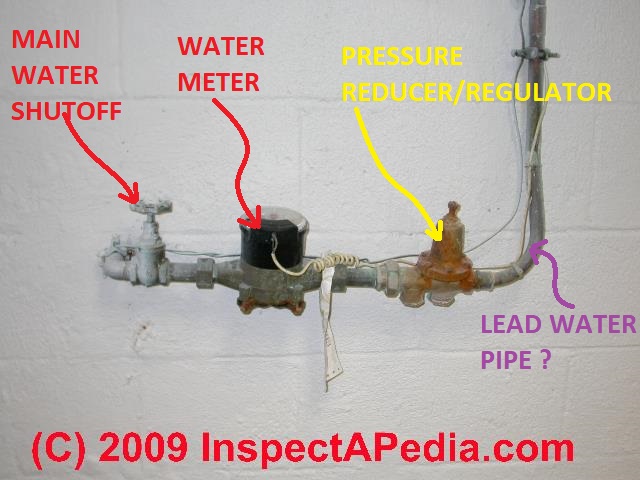
Our photo (left) shows typical incoming municipal water piping at a building. From left to right we see a main water shut off valve, a water meter (wires lead to an outdoor water meter reading device), a water pressure regulator, and water piping rising into the building.

This high pressure would cause leaks at many ordinary residential plumbing fixtures like sink and tub faucets or toilets. So the building may have a pressure regulator installed, usually right after the water meter where water enters the building.

Building Code Requirement for Pressure Reducing Valves

In fact most national and local plumbing codes require that a water pressure reducing valve should be installed at buildings where municipal water supply pressures (in the water main in the street) exceed 80 psi. Excessive water pressures can burst pipes, cause dripping faucets, and can even cause rupture and explosion of both cold water pressure tanks and hot water storage tanks.

Examples of Pressure Reducing Valves Used to Regulate Municipal Water Supply Pressure

According to Watts Corporation, a producer of water pressure reducing valves,

There are two types of water pressure reducing valves, direct acting and pilot operated. Both use globe or angle style bodies. Valves used on smaller piping diameter units are cast from brass; larger piping diameter units are made from ductile iron. Direct acting valves, the more popular type of a water pressure reducing valves, consist of globe-type bodies with a spring-loaded, heat-resistant diaphragm connected to the outlet of the valve that acts upon a spring. This spring holds a pre-set tension on the valve seat installed with a pressure equalizing mechanism for precise water pressure control.

Watts produces a Watts Governor 80™ used for this purpose, but other manufacturers also produce a wide variety of water pressure regulators.

For very high incoming water supply pressures, a two-stage serial reduction method is used: two pressure reducing regulating valves are installed in series. The first pressure reducing vave (for example a Watts Model U5B) reduces incoming water pressure to 150 psi, and the second valve reduces water pressure to 50 psi.

If your building already has a water pressure gauge installed, it may be defective or it may be set too high. The articles listed just below discuss how to adjust a water pressure regulator:

WATER PRESSURE REDUCER / REGULATOR
  What's a Water Pressure Regulator?
  WATER PRESSURE VARIATION CAUSES
  Diagnose Poor Municipal Water Pressure
  WATER PRESSURE REGULATOR ADJUSTMENT

Expansion tanks to relieve high water pressure:

An alternative to installing or changing a water pressure regulator when building water pressure is occasionally 80 psi or higher is the installation of an expansion tank to temporarily absorb that pressure increase. Proper use of an expansion tank can help avoid unnecessary opening of the pressure/temperature relief valve on a hot water heating tank or a hot water heating boiler.
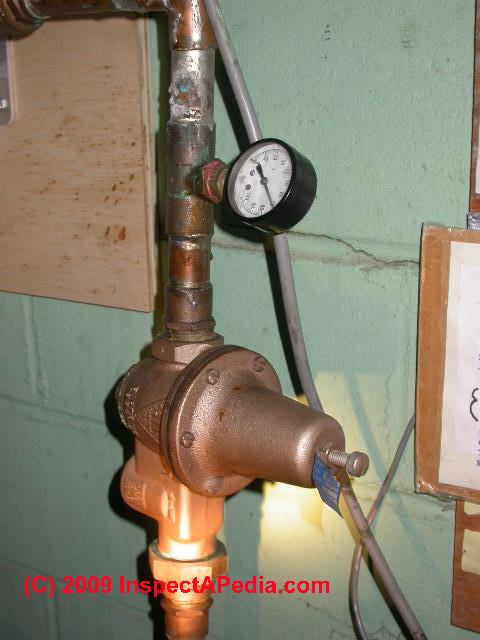
Water pressure regulator (C) Daniel Friedman

The water pressure regulator can be adjusted to improve building water pressure and thus flow, by loosening a lock nut on the regulator and screwing the adjustment screw up or down a few turns.

Our photo (left) shows the water pressure regulator (photo bottom) and the regulator screw and lock-nut.

Be careful not to set the building water pressure too high, as you'll cause leaks.

For details on adjusting a municipal water pressure regulator see How to Adjust the Water Pressure Regulator on Municipal Water Supply.

Watch out: don't set the water pressure reducing valve higher than necessary. Doing so wastes water and as we discuss at WATER PRESSURE TOO HIGH: DANGERS, setting water pressure too high can cause both plumbing problems and actual serious safety hazards at buildings.

Causes of Variation in Building Water Pressure

As we discuss in more detail at WATER PRESSURE VARIATION CAUSES, there are several causes of variation in building water pressure:

  1. Number of plumbing fixtures being run at once
  2. Variation in municipal water delivery pressure
  3. Variation in small community water systems and private well pump water delivery pressure Details are at PUMP PRESSURE CONTROL ADJUSTMENT.
  4. Water pipe diameter, length, elbows and bends: See Definition of Static Water Pressure and Definition of Dynamic Water Pressure.
  5. Clogged water pipes reduce water flow rate, not water pressure.
  6. Variations in building occupancy levels

How do we Diagnose Poor Municipal Water Pressure & Flow in a Building - 5 Key Checks

Key things to check when water pressure and flow are inadequate in a building served by municipal water supply are

  1. The condition of individual plumbing fixtures, faucets, valves, and controls. A clogged sink or shower strainer will cause bad water pressure at individual fixtures while others may flow freely. A plumbing shutoff valve that is partly closed or clogged with debris will cause bad water flow at that fixture.
  2. The incoming municipal supply pressure. The municipal water supply source may be delivering water at low pressure.
  3. The condition of water piping between the building and the street water main. An older water supply pipe connecting the building to the water main in the street may be small in diameter, clogged with minerals, rust, or debris, or it could be leaking underground.
  4. The condition of building water supply piping. Clogged pipes due to minerals or rust, small diameter piping, long piping

    For details about the above items, see MUNICIPAL WATER PRESSURE DIAGNOSIS
  5. The setting of the water pressure regulator at the building water meter or water shutoff valve. This topic is discussed just below.
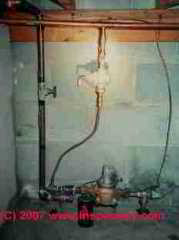
Photograph of a water pressure regulator on municipal water supply Bad water pressure regulator or bad pressure regulator adjustment: (poor municipal water pressure) if the building is connected to a municipal water supply there may be a water pressure regulator installed, usually close to the water meter or where the water supply pipe enters the building. Photos of water pressure regulators and diagnosis and adjustment advice are at WATER PRESSURE REDUCER / REGULATOR.

If the waer pressure control was set too low to start with or if there is a problem with the water pressure regulator, you may see an improvement in water pressure by diagnosing and adjusting or repairing this control.

If the loss of water pressure was sudden, it's not likely to be a problem the pressure regulator except in the less common cases of a blockage or failure in the regulator itself. In this photo our flashlight lights up a (rather amateurish looking) water pressure regulator installed on a municipal water supply.

You can see that a previous connection to the water meter was cut, left shut off (see that shutoff valve at the left hand vertical pipe - what happens if someone opens that valve?), and new fittings were installed to conduct incoming water to the building water supply piping.

The use of smaller diameter flexible copper tubing might restrict the incoming water flow, but the presence of a pressure regulator at all suggests that the incoming pressure may have been excessive. (Too high water pressure leads to fixture leaks.)

How to Adjust the Water Pressure Regulator or Pressure Reducing Valve on Municipal Water Supply

Details about how to adjust the building water pressure regulator or pressure reducing valve are found at WATER PRESSURE REGULATOR ADJUSTMENT. Excerpts are below.

We have already mentioned checking and adjusting the pressure control for the water pump on a private well system - just above. But what if the home does not have it's own well - what if the building is connected to a municipal water supply?

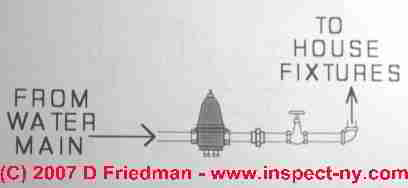
A water pressure regulator may be installed. See the illustration at the top of this page. A device, usually a few inches across and often shaped a bit like a bell, may be found installed at the water meter. The water meter is often installed where water pipes enter the building and the pressure regulator will be installed just after the water meter on the same pipe. You may see a screw secured by a lock-nut on the top of the meter or there may be another screw or knob that will permit the water pressure regulator to be adjusted to set the water pressure up or down in the building.

Which way to turn the water pressure regulator screw? On most pressure regulators, after loosening the lock-nut around the adjusting screw, turning the screw in will increase the water pressure. Don't overdo-it. Just a turn or two should make a difference. Keep track of the number of turns so that you can go back to where you started if necessary.

Sometimes the municipal water supply may itself be temporarily shut down or running at reduced flow. Check with your local water department or neighbors.

Increasing the building water pressure by adjusting the pressure regulator (or a pump pressure control switch) will not fix a poor water delivery rate from the source (municipal water main or local private water pump), but if the pressure was set too low to start with you may see an improvement by this adjustment. If your loss of water pressure or flow was sudden, it's not likely to be a problem with the pressure regulator except in the less common cases of a blockage or failure in the regulator itself.

Watch out: don't set the water pressure reducing valve higher than necessary. Doing so wastes water and as we discuss at WATER PRESSURE TOO HIGH: DANGERS, setting water pressure too high can cause both plumbing problems and actual serious safety hazards at buildings.

A Guide to Building Water Pressure by Adjusting or Repairing the Water Pump Pressure Control Switch on a Private Pump and Well Water Supply

For details about diagnosing poor well water pressure and flow, start at WELL WATER PRESSURE DIAGNOSIS or go directly to the individual items listed just below.

  • How to Adjust Water Pump Pressure: The detailed, step by step procedure for inspecting and adjusting the water pressure control switch is discussed in detail at ADJUST PUMP PRESSURE CONTROL.
  • Diagnosing Water Pump Short Cycling on and off: If your water pump is clicking on and off too often or quite rapidly see SHORT CYCLING.
  • Diagnosing Water Pressure Drops without explanation when the pump stops, see Water Pressure Falls Slowly, Erratic Pumping: bad pressure control switch, building water running or leak, bad pressure gauge, bad check valve, bad foot valve.
  • Diagnosing & Repairing Lost Air in the Water Tank: The problem of lost air in the water pressure tank along with how to correct that condition are discussed beginning at SIGNS OF AIR LOSS.
  • Diagnosing & Repairing a Water Pressure Control or Water Pump Control Switch: We discuss diagnosing and repairing a water pressure control switch that sticks "on" or "off" or simply won't operate, at water pump Pressure Switch Repairs.

Questions & Answers regarding this article

.

Ask a Question or Search InspectAPedia

HTML Comment Box is loading comments...

Share this Article      

...

Technical Reviewers & References

  • InspectAPedia.com® - Daniel Friedman - Publisher & Editor.
  • InspectAPedia Bookstore lists recommended books, organized by topic & available for purchase. Most of our articles also include a list of recommended books for the specific article topic as well as other references, and information sources.
  • Critique, contributions wanted: Contact Us to suggest corrections or additions to articles at this website, and if you wish, to receive online listing and credit as a contributor. Particular thanks are due to the many experts and also consumers who read and critique technical articles at InspectAPedia.com.
  • Additional technical contributors & reference sources for this article are listed below.

Use links just below or at the left of each page to navigate this document or to view other topics at this website. Green links show where you are in our document or website.

PLUMBING SYSTEM INSPECT DIAGNOSE REPAIR

APPLIANCE EFFICIENCY RATINGS
OIL TANKS
PLASTIC CONTAINERS, TANKS, TYPES
PLUMBING SYSTEM ODORS
PRESSURE CONTROL SWITCH ADJUSTMENT

RADON HAZARD TESTS & MITIGATION

RELIEF VALVES - Water Tanks

REVERSE OSMOSIS CONCENTRATE DISPOSAL

SEPTIC SYSTEM INSPECT DIAGNOSE REPAIR

WATER PRESSURE & FLOW MEASUREMENT
  WATER PRESSURE VARIATION CAUSES
  WATER PRESSURE TOO HIGH: DANGERS
  Definition of Static Water Pressure
  Definition of Dynamic Water Pressure
  Measure Municipal Water Pressure
  Measure Pump & Well Water Pressure
  WATER FLOW RATE MEASUREMENT
  HOT WATER PRESSURE EXPANSION RATE

WATER PRESSURE GAUGES
WATER PRESSURE GAUGE ACCURACY
WATER PRESSURE LOSS DIAGNOSIS & REPAIR
WATER PRESSURE PROBLEM DIAGNOSIS TABLE
MUNICIPAL WATER PRESSURE DIAGNOSIS
WELL WATER PRESSURE DIAGNOSIS
  Water Pressure Intermittent
  No Water Pressure
  Well Tank relation to Water Pressure
  Shaking the Water Tank?
  Water Pressure Bad at Some Fixtures
  Water Pressure Falls Slowly, Erratic Pumping
  Water Pressure Intermittent
  Water Pressure Tank Problems
  Water Pressure Tank Diagnosis
  Water pressure Later Returns "on its own"
  Water pipe clog diagnosis
  Water pipe clog repair guide
  WELL PIPING LEAK DIAGNOSIS
  Making the "right" repair
  WATER PRESSURE BOOSTER PUMP
WATER PRESSURE REDUCER / REGULATOR
  What's a Water Pressure Regulator?
  WATER PRESSURE VARIATION CAUSES
  Diagnose Poor Municipal Water Pressure
  Adjust Bad Pressure Regulator on Municipal Water
WATER PRESSURE REPAIRS & COSTS
  Questions about lost water pressure
  Right Repair to Pump & Tank?
  Well Pump & Tank Replacement Costs
  Reliability of Pump & Tank Repairs
WATER PUMPS, TANKS, WELLS - BASICS
WATER PUMP CAPACITIES TYPES RATES GPM
WATER PUMP CONTROLS & SWITCHES
  CHECK VALVES
  FLOW CONTROL VALVES
  FOOT VALVES, WELL PIPING
  RELIEF VALVES - Water Tanks
  MAIN WATER SHUTOFF VALVE
  WATER PUMP ELECTRICAL SWITCHES
  WATER PUMP PRESSURE CONTROL SWITCH
  WATER PUMP RELAY SWITCH
  CHECK VALVES
  WATER FILTERS
WATER PUMP PROBLEM DIAGNOSTIC TABLE

WATER PUMP REPAIR GUIDE
  AIR DISCHARGE at FAUCETS, FIXTURES
  CONTROLS & SWITCHES
  INTERMITTENT CYCLING WATER PUMPS
  WATER PRESSURE BOOSTER PUMP
  PUMP & TANK REPAIRS & COSTS
  SHORT CYCLING WATER PUMP
  SHORT CYCLING CAUSES
  SHORT CYCLING CAUSE: WELL PIPE LEAKS
  SHORT CYCLING DIAGNOSIS TABLE
  WATER PUMP ELECTRICAL SWITCHES
  WATER PUMP PRESSURE BOOSTER
  WATER PUMP PRESSURE CONTROL SWITCH
  WATER PUMP PRESSURE CONTROL ADJUSTMENT
  WATER PUMP PRESSURE CONTROL REPAIR
  WATER PUMP PRESSURE CONTROL REPLACE
  WATER PUMP PRIMING PROCEDURE
  WATER PUMP RELAY SWITCH
  WATER PUMP WONT STOP RUNNING
  Water Tank & Pump Costs
  WATER TANK AIR, HOW TO ADD
  WATER TANK PRESSURE GAUGE
WATER PUMP SAFETY
WATER PUMP SHORT CYCLING
WATER PUMP TYPES & LIFE EXPECTANCY
WATER PUMP SAFETY
WATER PUMP WONT STOP RUNNING
WATER SHUTOFF VALVE LOCATION, USE
WATER SHUTOFF VALVE, WELL PUMP

WATER SOFTENERS & CONDITIONERS
WATER SOURCE ALTERNATIVES
WATER SUPPLY & DRAIN PIPING
WATER TANK TYPES: WATER, OIL, EXPANSION, ALL
WATER TANK LIFE EXPECTANCY
WATER TANK PRESSURE CALCULATIONS
WATER TANK PRESSURE GAUGE

WATER TANK REPAIRS
  CONTROLS & SWITCHES on WATER TANKS
  INTERMITTENT CYCLING WATER PUMPS
  WATER TANK AIR, HOW TO ADD
  WATER TANK BLADDERS & CAPTIVE AIR
  WATER TANK REPLACEMENT
  WATER TANK BLADDER PRESSURE ADJUSTMENT
WATER TANK SIZE & VOLUME
WATER TESTING
WATER TREATMENT EQUIPMENT CHOICES
WATER USAGE TABLE

WELLS CISTERNS & SPRINGS
WELL LIFE EXPECTANCY
WELL PUMP TYPES & LIFE EXPECTANCY

  • Watts, 815 Chestnut Street, North Andover, MA, USA 01845-6098, web search 09/18/2010 original source: http://www.watts.com/pages/learnAbout/reducingValves.asp?catId=64

Water Supply & Drain Piping, Wells, Pumps, Water Supply Equipment

  • Access Water Energy, PO Box 2061, Moorabbin, VIC 3189, Australia, Tel: 1300 797 758, email: sales@accesswater.com.au Moorabbin Office: Kingston Trade Centre, 100 Cochranes Rd, Moorabbin, VIC 3189
    Australian supplier of: Greywater systems, Solar power to grid packages, Edwards solar systems, Vulcan compact solar systems, water & solar system pumps & controls, and a wide rage of above ground & under ground water storage tanks: concrete, steel, plastic, modular, and bladder storage tanks.
  • Cheating on water tests: Testing Water for Real Estate Transactions - make sure your water test is valid
  • Diagnosing Clogged Drains: Is it a blocked drain or the septic system? - A First Step for Homeowners
  • Drinking Water Contaminant Levels - Maximum Allowed
  • Drinking Water Supply, Contamination Levels, Water Testing Procedures
  • Drinking Water Testing Advice for home buyers home owners home inspectors
  • Interpreting Drinking Water Test Results and Correcting Unsatisfactory Water
  • Lead Contamination in Drinking Water: Testing & Correction - Advice (This Article)
  • Lead Testing & Correcting Contamination from Lead Water Supply Lines/Entry Mains - Lead Pipe Problems/Advice
  • Life Expectancy of Water Pumps - Well Pumps: how long should a water pump last? What affects pump life?
  • Life Expectancy of Wells & Water Tanks how long should a water well and its components last?
  • Plumbing Diagnosis & Repair: Water supply, drainage, septic systems, water testing, water contamination, defective plumbing materials & products.
  • Shock or Chlorinate a Well, How to - Procedure for Shocking a Well to (temporarily or maybe longer) "Correct" Bacterial Contamination
  • Smart Tank, Installation Instructions [ copy on file as /water/Smart_Tank_Flexcon.pdf ] - , Flexcon Industries, 300 Pond St., Randolph MA 02368, www.flexconind.com, Tel: 800-527-0030 - web search 07/24/2010, original source: http://www.flexconind.com/pdf/st_install.pdf
  • Typical Shallow Well One Line Jet Pump Installation [ copy on file as /water/Jet_Pump_Grove_Elect_Jet_Pumps_1.pdf ] - , Grove Electric, G&G Electric & Plumbing, 1900 NE 78th St., Suite 101, Vancouver WA 98665 www.grovelectric.com - web search -7/15/2010 original source: http://www.groverelectric.com/howto/38_Typical%20Jet%20Pump%20Installation.pdf
  • Typical Deep Well Two Line Jet Pump Installation [ copy on file as /water/Jet_Pump_Grove_Elect.pdf ] - , Grove Electric, G&G Electric & Plumbing, 1900 NE 78th St., Suite 101, Vancouver WA 98665 www.grovelectric.com - web search -7/15/2010 original source: http://www.groverelectric.com/howto/38_Typical%20Jet%20Pump%20Installation.pdf
  • Water Fact Sheet #3, Using Low-Yielding Wells [ copy on file as /water/Low_Yield_Wells_Penn_State.pdf ] - , Penn State College of Agricultural Sciences, Cooperative Extension, School of Forest Resources, web search 07/24/2010, original source: http://pubs.cas.psu.edu/FreePubs/pdfs/XH0002.pdf
  • Water pressure tanks - how to diagnose the need for air, how to add air, stop water pump short cycling to avoid damage - water storage water pressure tank safety.
  • Water pump and pressure tank repair diagnosis & cost an specific case offers an example of diagnosis of loss of water pressure, loss of water, and analyzes the actual repair cost
  • Water pressure tank failures & water pump short cycling diagnosis and repair
  • Water Supply & Drain Piping, water and drain pipe types, inspection, diagnosis, repairs, problem materials, clogging, etc.
  • Water Tests & Fees this water test fee schedule applies when testing is combined with other onsite building inspection services
  • Water Testing: background comments on classes of water contaminants, & links to home buyer advice about water testing, drinking water, water supply
  • Water Requirements, Home & Outdoor Living

Books & Articles on Building & Environmental Inspection, Testing, Diagnosis, & Repair

  • Our recommended books about building & mechanical systems design, inspection, problem diagnosis, and repair, and about indoor environment and IAQ testing, diagnosis, and cleanup are at the InspectAPedia Bookstore. Also see our Book Reviews - InspectAPedia.
    • Home Reference Book - Carson Dunlop The Home Reference Book - the Encyclopedia of Homes, Carson Dunlop & Associates, Toronto, Ontario, 2010, $69.00 U.S., is available from Carson Dunlop, and from the InspectAPedia bookstore. The 2010 edition of the Home Reference Book is a bound volume of more than 450 illustrated pages that assist home inspectors and home owners in the inspection and detection of problems on buildings. The text is intended as a reference guide to help building owners operate and maintain their home effectively. InspectAPedia.com ® author/editor Daniel Friedman is a contributing author. Field inspection worksheets are included at the back of the volume.
  • Crystal Clear Supply provides portable ceramic water filter purifiers and portable reverse osmosis water treatment equipment - see http://www.crystalclearsupply.com/category_s/7.htm
  • Handbook of Disinfectants and Antiseptics, Joseph M. Ascenzi (Editor), CRC, 1995, ISBN-10: 0824795245 ISBN-13: 978-0824795245 "The evaluation of chemical germicides predates the golden age of microbiology..." -
    This well-focused, up-to-date reference details the current medical uses of antiseptics and disinfectants -- particularly in the control of hospital-acquired infections -- presenting methods for evaluating products to obtain regulatory approval and examining chemical, physical, and microbiological properties as well as the toxicology of the most widely used commercial chemicals.
  • Potable Aqua® emergency drinking water germicidal tablets are produced by the Wisconsin Pharmacal Co., Jackson WI 53037. 800-558-6614 pharmacalway.com
  • Principles and Practice of Disinfection, Preservation and Sterilization (Hardcover)
    by A. D. Russell (Editor), W. B. Hugo (Editor), G. A. J. Ayliffe (Editor), Blackwell Science, 2004. ISBN-10: 1405101997, ISBN-13: 978-1405101998.
    "This superb book is the best of its kind available and one that will undoubtedly be useful, if not essential, to workers in a variety of industries. Thirty-one distinguished specialists deal comprehensively with the subject matter indicated by the title ... The book is produced with care, is very readable with useful selected references at the end of each chapter and an excellent index. It is an essential source book for everyone interested in this field. For pharmacy undergraduates, it will complement the excellent text on pharmaceutical microbiology by two of the present editors."
    The Pharmaceutical Journal: "This is an excellent book. It deals comprehensively and authoritatively with its subject with contributions from 31 distinguished specialists. There is a great deal to interest all those involved in hospital infection ... This book is exceptionally well laid out. There are well chosen references for each chapter and an excellent index. It is highly recommended." The Journal of Hospital Infection.: "The editors and authors must be congratulated for this excellent treatise on nonantibiotic antimicrobial measures in hospitals and industry ... The publication is highly recommended to hospital and research personnel, especially to clinical microbiologists, infection-control and environmental-safety specialists, pharmacists, and dieticians."
    New England Journal of Medicine: City Hospital, Birmingham, UK. Covers the many methods of the elimination or prevention of microbial growth. Provides an historical overview, descriptions of the types of antimicrobial agents, factors affecting efficacy, evaluation methods, and types of resistance. Features sterilization methods, and more. Previous edition: c1999. DNLM: Sterilization--methods.
  • U.S. Army Field Manual 21-10, Field Hygiene and Sanitation, 1988, web search 07/02/2010, original source: http://www.enlisted.info/field-manuals/fm-21-10-field-hygiene-and-sanitation.shtml
    The purpose of this manual is to assist individual soldiers, unit commanders, leaders and field sanitation teams in preventing disease and environmental injuries. The manual provides information on preventive medicine measures (PMM) to the individual soldier as well as essential information for the unit commander, unit leaders, and the unit field sanitation team on applying unit level PMM.
  • When Technology Fails, Matthew Stein, Chelsea Green Publisher, 2008,493 pages. ISBN-10: 1933392452 ISBN-13: 978-1933392455, "... how to find and sterilize water in the face of utility failure, as well as practical information for dealing with water-quality issues even when the public tap water is still flowing". Mr. Stein's website is www.whentechfails.com/
  • ...
Home About Us Accuracy Contact Us Content Use Policy Privacy Website Description © 2012 Copyright InspectAPedia.com