
InspectAPedia® FREE Encyclopedia of Building & Environmental Construction, Diagnosis, Maintenance & Repair |
Question? Just ask us! InspectAPedia
|
 Water Pressure Booster Pumps & Tanks
- POST a QUESTION or COMMENT about using booster pumps & tanks to improve water pressure at a building
How & why to choose & install a water pressure booster pump:
This article describes the use of water pressure boosting systems that add a pump and pressure tank to improve water pressure and flow, including improving water pressure & flow on the upper floors of tall buildings.
We explain what a booster pump system is, what components are needed to improve building water pressure, and how to decide if a booster pump or pump and pressure tank set-up is the right repair for bad water pressure in your building. In FAQs & Q&As at the end of this article we discuss adding booster pumps & tanks in series.
InspectAPedia tolerates no conflicts of interest. We have no relationship with advertisers, products, or services discussed at this website.
When and Why are Water Pressure Booster Systems Needed
Article Contents
Sketch at above left provided by courtesy of Carson Dunlop Associates a Toronto Home inspection, education & report writing tool firm.
Poor city water pressure:
Some community water supplies may provide only modest incoming water pressure, perhaps at 30 psi or even less. Some examples of low water pressure supply sources even where community or municipal water supply is provided are listed here.
Effect of building height on water pressure:
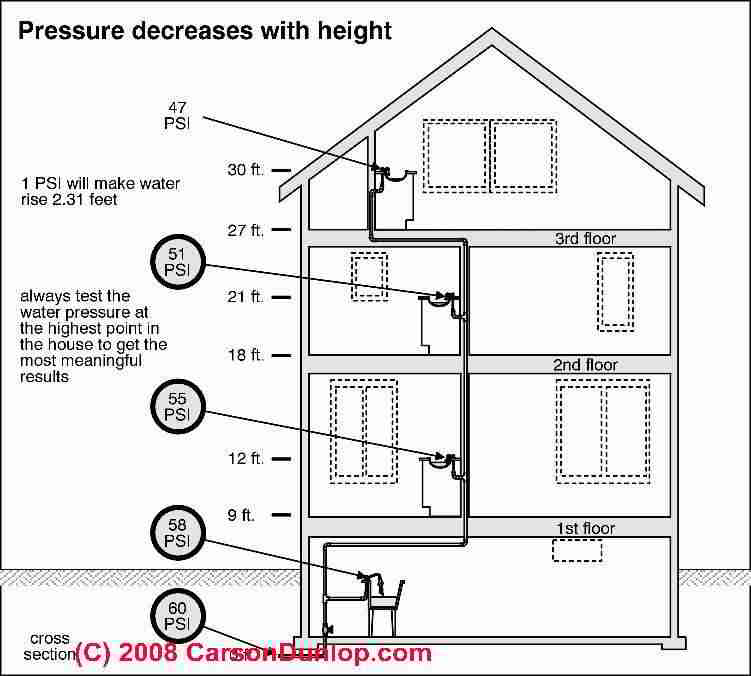
The Home Reference Book points out that Gravity is another source of pressure loss. Energy is required to push the water uphill. For every one foot we push water up, we lose 0.434 psi. Another way of saying this is that it takes one psi to move water up 2.31 feet.
A plumbing system will typically lose eight psi of water pressure in a two-story house, getting the water from the basement up to the second floor bathroom. With no water flowing, the static pressure at the street main may be 60 psi, but the static pressure at the second floor basin might be 51 psi. Houses that are above the street or have third story plumbing fixtures, have a pressure disadvantage.
[Click to enlarge any image]
Other Explanations of Poor Water Pressure where a Booster Pump & Pressure Tank May be Helpful
- Homes at the end of a water supply line:
Community water supply systems serving just a few or even many homes, but with some homes near the end of the system - Buildings located high above a water supply line:
or located far uphill from the pumping station receiving only modest incoming water pressure, perhaps less than 30 psi. - Tall residential properties requiring additional water pressure to serve upper floors.
For a tall home connected to a community water supply providing incoming water at only 30 psi, for example, the top floor may see 17 psi unless a booster pump and pressure tank are installed.
Very tall buildings such as skyscrapers and offices and multi-story apartment buildings are more likely to install a rooftop water supply tank which is fed by a pump from street level but which in turn provides water down through the building by gravity. - Gravity water systems:
Community water supply systems serving many homes but supplying water only during certain hours of the day, or only at very low pressure.
For example San Miguel de Allende, Mexico, with a population of about 100,000 people, is served by nine water wells and pumping stations. But water is delivered to most homes by gravity, and in some seasons, only at certain hours of the day. A photo of a rooftop water storage system of this type can be seen
at ROOFTOP WATER TANKS
- Problems with the water water service pipe connecting the home to city water mains
Even if a municipal water system gives good pressure and quantity, as the Carson Dunlop Home Reference Book points out, the city's own water shutoff valve outside but near the property line may also restrict flow or the supply line from the street to the house may be undersized, damaged or leaking.
Long runs of relatively small (1/2-inch diameter) pipe result in considerable pressure drop, especially with more than one fixture flowing.
Solutions include replacement with larger pipe or shortening the runs, but in some cases homeowners may try adding a local booster pump instead. - Adding plumbing fixtures
(a new bathroom, for example) without enlarging or adding pipes often leads to pressure complaints. A crimped, damaged or clogged pipe within the house will adversely affect pressure.
This is common with amateurish work. On a private system, a defective, undersized or poorly adjusted pump will result in poor pressure. Individual faucets may also be defective.
Homes on gravity water systems such as we describe in the San Miguel de Allende case usually install a rooftop water tank or cistern to which water is replenished periodically. The rooftop water cistern provides water to the local building whenever it is needed.
But some homes in such a community may because of their location or construction or because they have no high spot to place their water tank, have only very low water pressure.
What are the Components of a Water Pressure Boosting System
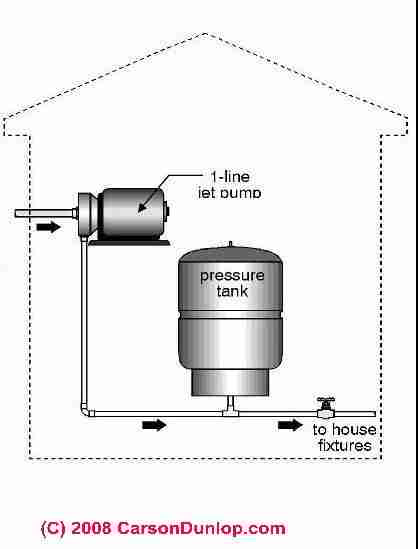
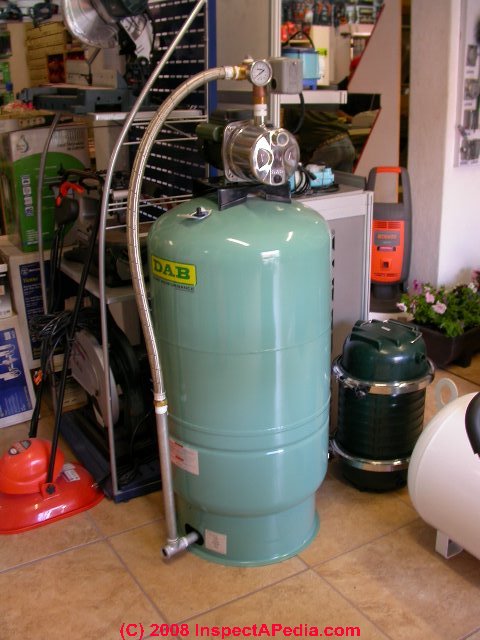
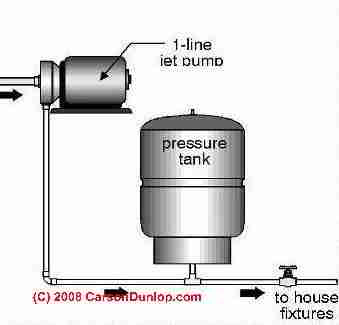
Our sketch, courtesy of Carson Dunlop Associates and edited by the author shows a simple one line jet-pump and pressure tank connected to the incoming water line in a building. Our photo at page top shows a typical water pressure booster pump and tank system for sale at Don Pedro's Ferreteria in San Miguel de Allende.
The incoming community water supply line which normally is fed through a pressure regulator and into building supply piping is first connected to a water pump, usually a 1-line jet pump. The pressure regulator control is not shown in this sketch.
The water pump is in turn connected to a pressure tank, possibly a large one to give a good high pressure water supply to the building.
As water is drawn into the home (someone turns on a faucet) the pressure tank feeds pump-boosted water pressure to the building, and as water pressure drops in the water tank, the jet pump draws more water from the community supply line, boosting its pressure into the pressure tank.
Typically the booster pump pressure control switch will be set to operate in the 30-50 psi range, providing good water pressure to the building.
In a private well water supply system this pump and tank combination may be connected directly to the well, that is, the incoming water line shown in the left of the sketch is connected to a foot valve immersed in the water well.
At WATER PUMP, ONE LINE JET we discuss one-line jet pumps in more detail.
At WATER PUMP CONTROLS & SWITCHES we discuss the pump pressure control switch and how it can be adjusted to provide higher water pressure.
What kind of water pressure booster pump do we need?

The reason that a typical residential property needs just a one-line jet pump to provide its water pressure boost is that there is already water arriving at the building under some pressure - the pump does not have to combine lift of the water from deep in the ground to high in the building.
Our photo of a pressure booster pump and tank system at left (and at page top) shows that stainless steel parts were used to enclose the pump parts: this system is designed for outdoor use in a non-freezing climate. You can see the pressure gauge and the gray box housing the pump pressure control switches above the stainless-steel covered pump assembly itself.
Tankless water pressure booster systems are discussed
at WATER PUMP VARIABLE FREQUENCY / VARIABLE SPEED DRIVE (VFDs)
Do we need a more powerful water pump or larger diameter water supply piping?

Some water pressure booster applications may require a more powerful pump than the type we discuss here, particularly if the anticipated water flow or usage rate in the building is high.
Carson Dunlop Associates's chart at left explains that in an individual plumbing system (that is, changing nothing but water flow rate), the water pressure observed at a fixture (and in the piping) will drop off significantly as the water flow rate increases.
This chart explains why the water pressure in your shower may fall off substantially during your bathing if someone else in the building flushes a toilet or turns on the dishwasher.
The chart also demonstrates that using larger diameter piping for the water supply in a building can significantly reduce the pressure drop when multiple fixtures are running at the same time.
Using a Booster Pump to Improve Water Pressure on the Upper Floor of a Building
When incoming water pressure at a building is low, a water pressure "booster pump" may be installed on upper building floors or on a building roof to provide improved water pressure for the occupants of upper building floors.
Sketch above courtesy of Carson Dunlop Associates, a Toronto home inspection firm.
If the incoming water pressure is from a municipal system and the building is just two or three floors high, the booster pump might be on ground level, as we described at the start of this article.
But if the incoming water pressure at a building is being provided by a well pump and water pressure tank system, and if the building is taller than three floors, the existing well pump may not be capable of delivering adequate water pressure nor adequate water floor to occupants of a fourth or higher floor.
Installing a Booster Pump for Water Pressure on the Fourth Floor of a Residential Building
 Beginning on the 4th floor of such a building, install an additional pressure tank next to the second pump.
The ground floor pump will send water into the incoming pipe connection of your 4th floor pump itself.
We are assuming that your 4th floor pump will be a 1-line jet pump - that is, a single pipe connects to the pump inlet port and a single pipe connects from the pump outlet to the inlet connection of a pressure tank.
Fourth floor cold water piping should be fed by the outlet connection on the pressure tank.
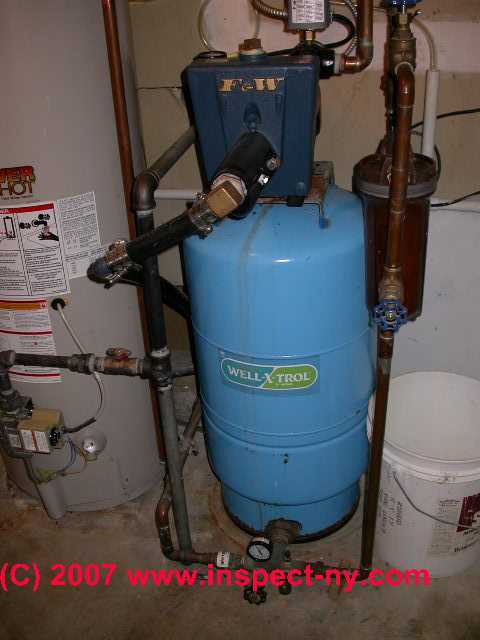
WATER PUMP, ONE LINE JET shows what a common 1-line jet pump looks like,
and WATER PUMP, ONE LINE JET OPERATION explains how one line jet pumps work.
In our one line jet pump photo (left) the black plastic pipe coming up from lower left is attached to the pump's inlet port where an internal check valve prevents water from siphoning back out of the pump and tank into the well when the pump shuts down.
At the top right of this pump you can just make out the water connection leaving the pump where it heads up into a copper pipe.
The 4th floor pump will turn on when the pressure switch connected to its 4th floor pressure tank senses pressure dropping below the cut-in point, and it will cut "off" when the 4th floor pump has boosted pressure in your 4th floor tank up to the cutout pressure.
We expect that given that the 4th floor pump will have always at least some incoming water pressure, though low, it should be able to add additional lift t boost the 4th floor pressure as you want.
The "lift" capacity of a water pump that is a one-line jet pump is a little under 10 meters - but that's without any incoming pressure to the pump from the one located on the 1st floor.
Thanks to Ahmed Hamza for discussing this topic.
Reader Comments, Questions & Answers About The Article Above
Below you will find questions and answers previously posted on this page at its page bottom reader comment box.
Reader Q&A - also see RECOMMENDED ARTICLES & FAQs
Question: can I just close the opening in my Aquastrong EDPmA 2-line jet pump to use it as a one-line water pressure booster pump?
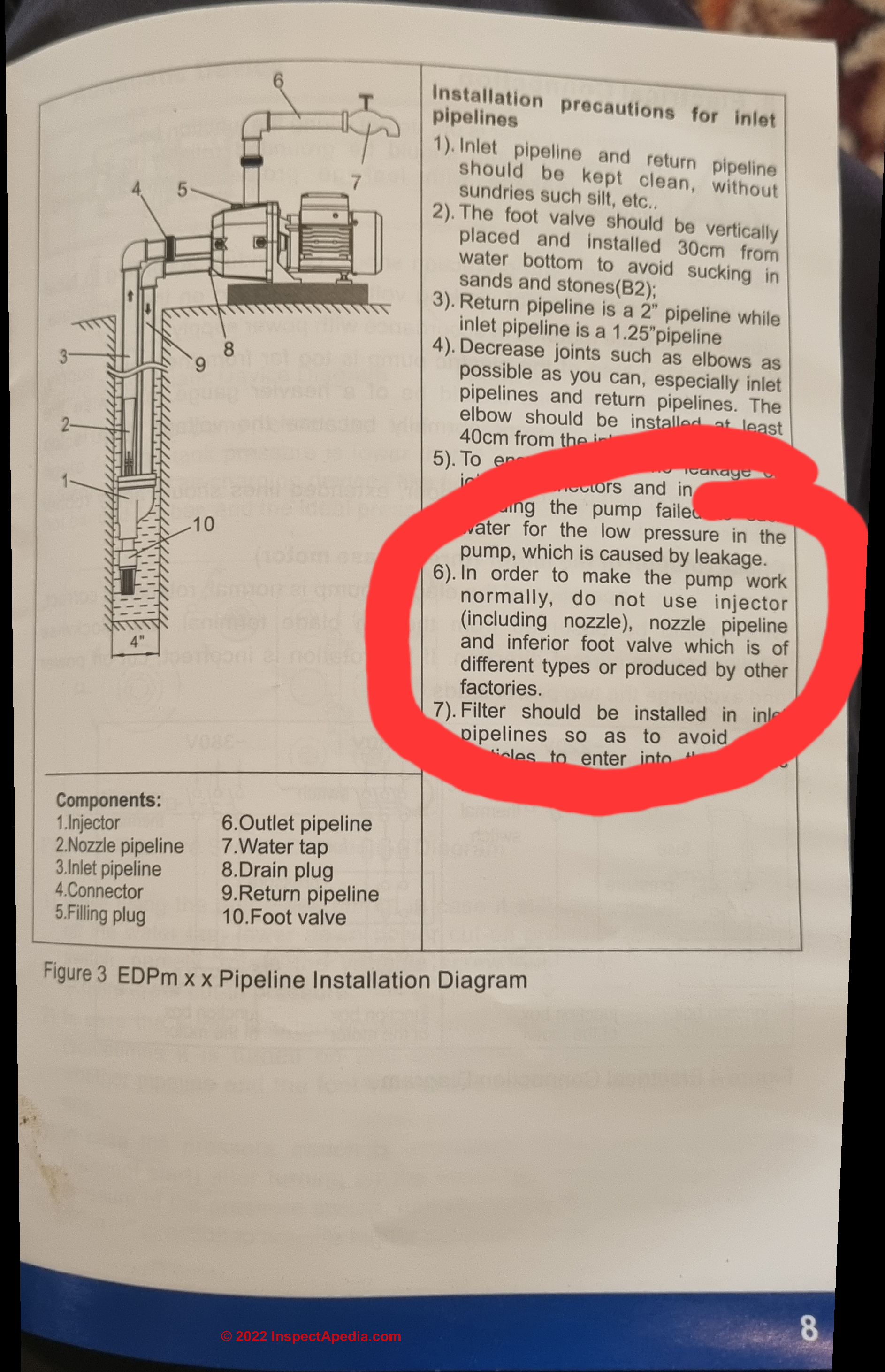
Hi I've recently purchased a Aquastrong jet pump edpm505 to draw water from water holding tank to provide better cold water pressure to my home and property, but it has a return pipeline
I'm wondering if this actually has to be fitted or if I can just seal this opening?
The installation guide doesn't go into this detail just looking for some advise. - Anonymous by private email 2022/11/16
Moderator reply: No. But some 2-line jet pumps are convertible
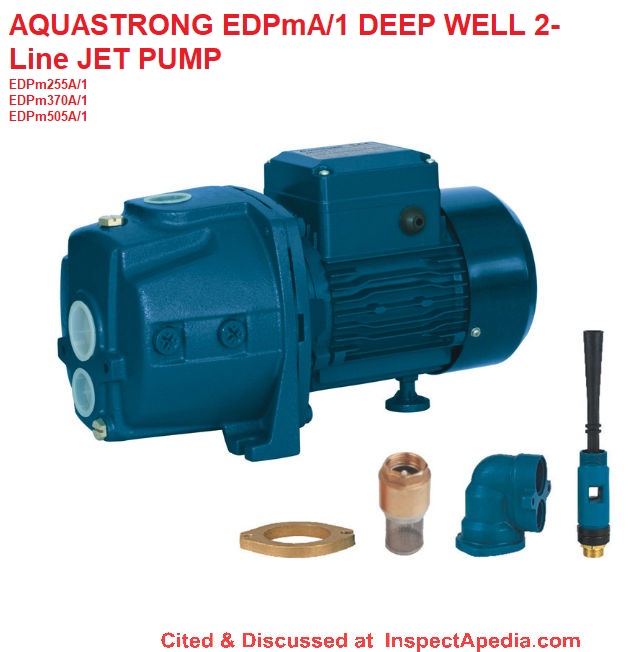
No, you can't just "seal" either of the openings of a two-line jet pump to use it as a one-line jet pump.
But some water pumps are convertible between the two types. To convert a 2-line jet pump to a one-line jet pump you'd have to remove the two-line jet pump impeller assembly entirely and bolt-on the one-line impeller assembly provided by the manufacturer - IF one is available - for that specific pump brand and model.
I looked at the Aquastrong pump you have purchased. It's described as a "deep well pump" meaning it's intended to be set up as a 2-line jet pump. Your model is the most powerful of the 3 in that pump line..
As an above-ground, in-line water pressure booster pump this isn't the right product for you - as I don't see any mention by the manufacturer that it can be converted for use as a 1-line jet pump in a booster application.
You should call the manufacturer to confirm that and if we're right, you'll want to return the pump.
About the pump you bought, the manufacturer says:
Aquastrong EDP self-priming pumps are designed for lifting water from depths greater than 9M,including cases with entrained air. They are recommended for domestic use including water distribution (as part of a pressure set), garden irrigation,etc.
The pumps must be installed in enclosed places,or at least protected against inclement weather. - 2022/11/20 http://aquastrong.it/index.php/Index/productinfo/id/69/?l=en-us
The Aquastrong pump manufacturer, in Italy, is
AQUASTRONG COMPANY LIMITED, Via Bramante 3520154 Milano Italy, Tel: +39 0294 759177 Fax: +39 0294 759177 Email: info@aquastrong.it
If you're in another country outside Italy, (we don't see a U.S. distributor listed for Aquastrong) contact the vendor from whom you bought the Aquastrong pump.
If I'm right that you already have a water system that includes well or other water source, pressure tank, and water pump, and you want to increase water pressure you should start by reviewing the advice at
WATER PRESSURE TOO LOW - where we explain how to diagnose and improve water pressure,
and then if indeed you need a water pressure booster pump, see
WATER PRESSURE BOOSTER PUMPS - you are on that page
We note that Aquastrong DOES manufacture booster pumps as well as solar-powered water pumps and many other models.
If your well is pumping from a shallow depth of 25 ft or less then it can be set up as a single line jet pump provided you use the correct parts. If you're pumping from depth then it needs to be a two line jet pump, also using the correct parts, which are different.
A one line jet pump uses an injector that's inside the pump and sends one line down the well.
Two line jet pumps will look like the one in the drawing on your page and in our photo below. You can read about jet pumps of both types starting
On 2021-06-23 by mak.church (mod)
@Julie Umecker,
Thank you.
We've worked hard on this material for decades, so I'm really grateful when a reader finds it useful and trustworthy.
We also welcome your photos, questions, criticism or suggestions.
On 2021-06-23 by Julie Umecker
@inspectapedia.com.moderator, @inspectapedia.com.moderator, Thank you.
On 2021-06-22 by inspectapedia.com.moderator (mod) - diagnosis and cure for pumps that seem to run for no apparent reason
@Julie Umecker,
Let's take a look at the diagnostics over at WATER PUMP INTERMITTENT CYCLING https://inspectapedia.com/water/Intermittent-Water-Pump-Cycling.php
where we discuss diagnosis and cure for pumps that seem to run for no apparent reason
On 2021-06-22 by Julie Umecker
A booster pump (Goulds v6P) in a 3.5-story building is cycling on and off frequently and pressure fluctuating between 64 PSI at rest and up to 68-70. We are no aware of any out of the ordinary call for water. And cycling is on going all day and night.
On 2021-03-05 - by (mod) -
Re-posting without dis-allowed link.
Robert · 33 minutes ago - said
Hello! Thanks for explaining different types of pumps. I agree that you want to consider the type of pump used first. I also dive into this direction.There is a link to my site
Moderator reply:
Thank you for your comments.
We do not permit posting of advertisements, external links, nor certain other content that our editors consider inappropriate. However we welcome website content correction, criticism, and content suggestions and we give credit and links pointing to the websites of our contributors.
Contributing content, criticism, corrections, photo images are great ways to receive a referral link from InspectAPedia.com at no cost, and we all benefit from the increased accuracy and content. Content contributors to InspectApedia.com can also provide their
link information using the form at InspectAPedia.com - Directory Listing & Link Exchange Instructions found at https://inspectapedia.com/Link_Exchange.htm
On 2020-11-29 - by (mod) - why two hot water expansion tanks?
Sure Rob,
It's possible that someone was seeing leakage at the relief valve on a water heater located higher in the building so added a close-by expansion tank.
Other than that they may be different generations of solutions to the same expansion and leak problem - we've seen this with old hot water heating systems (hydronic boilers for heating the building, not so much for domestic hot water)
Let's see a photo of that top floor expansion tank
and
do confirm that it's really piped to the potable or domestic hot water supply
On 2020-11-29 by Rob
after setting the tank pressure right on the outgoing pump line i found a second hot water expansion vessel on the top level.
Any idea why there would have 2x hot water expansion vessels one by the cylinders and one on the top story.?
Thanks, rob
On 2020-11-24 - by (mod) - 80 kpa pressure variation with a Lowara variable speed water pump
Check for a waterlogged pressure tank if your system uses a pressure tank.
Else check for debris clogging in the pressure sensor port of your VFD water pump.
The Lowara pump is a Xylem product.
See this
- Xylem LOWARA SMART PUMP RANGE Additional INSTALLATION OPERATION & MAINTENANCE INSTRUCTIONS [PDF] - retrieved 2022/11/17, original source: https://www.xylem.com/siteassets/brand/lowara/resources/manual/001080138en_d_04_2020_smart_pump_range.pdf
On 2020-11-23 by Rob
hi there,
i have a high rise apartment building with a lowara variable speed pump set and residents complaining about fluctuation on water pressure.
the fluctuation is about 80 kpa is this normal? if not what would be the course?
many thanks rob
On 2020-10-19 by (mod) - water pressure booster pump system for Beacon / Fishkill NY area
Richie;
Yeah we know the Beacon/Fishkill water service, having lived in the area since 1969.
I recently installed a water storage tank and delivery pump in a remote cabin; we looked very closely at every bit of equipment bought: tank material, pump material, even the material of garden hoses used to fill the tank, to be sure that every one of the was specifically rated as acceptable for potable water use.
Water pressure booster pump prices range from around $50 to $900. U.S.D.
At another system we installed a SCALA2 water pump that works with no pressure tank and that delivers water from a variable flow rate pump that is adjustable and that will speed up when more water is being drawn.
See details at WATER PUMP VARIABLE FREQUENCY / VARIABLE SPEED DRIVE (VFDs)
and
Also see MUNICIPAL WATER PRESSURE IMPROVEMENTS
Worth noting:
Illustrated just below, Pentair provides an "intelligent pressure control" the company's Intellidrive, a water pressure management system that works in conjuction with the home's well or water pressure booster pump to keep the building's water pressure constant regardless of variations in the level of usage.
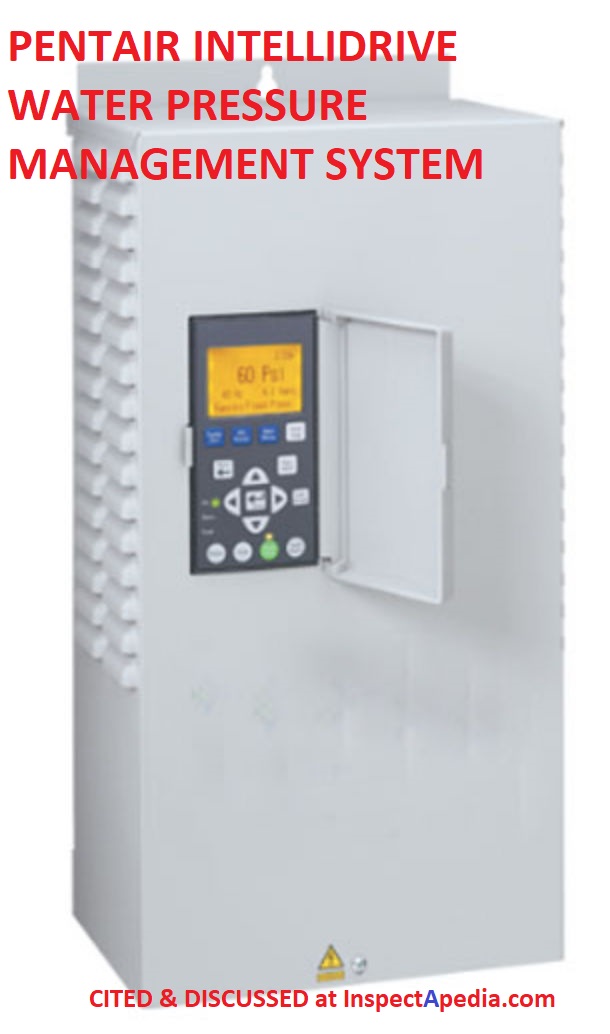
The company provides an Intellidrive controller in several product versions and models including the Intellidrive PID Variable Frequency Drive (shown here) and the PentairPentek XL Variable Frquency Drive as well as additional controllers.
In essence the controller allows a well pump to run at variable speeds to meet varying demands in water usage. Product information is at
- PENTEK INTELLIKIT HOME WATER MANAGEMENT SYSTEM CHOICES [PDF] (2012) Pentair, 293 Wright Street, Delavan, Wi 53115 USA Website: www.pentair.com Tel: 866-9 PenteK retrieved 2020/10/19, original source: https://www.pentair.com/content/dam/extranet/pentek/sell-sheets/intellikit-choices-well-system-sell-sheet.pdf#page=1
See also our description of the Scala 2 variable speed pump with its own internal variable speed and pressure controller
- WATER PUMP VARIABLE FREQUENCY / VARIABLE SPEED DRIVE (VFDs) - tankless water pressure booster pumps
On 2020-10-19 by Richie Cabo
I live in an area in Town of Fishkill where the water pressure is very poor. We are in the outskirts of the City of Beacon's water supply service area.
I need a water tank of about 100 gallons with a booster pump set up. But I am afraid to use the Water Worker set up because it's not allowed in California because it may cause lead or the toxins.
What system or company can I use which will give my family safe drinking water? My email is mrrichiecabo@gmail.com or 845-476-1660
On 2020-08-14 by (mod) - water pressure boosting system for homes in a community with poor water pressure
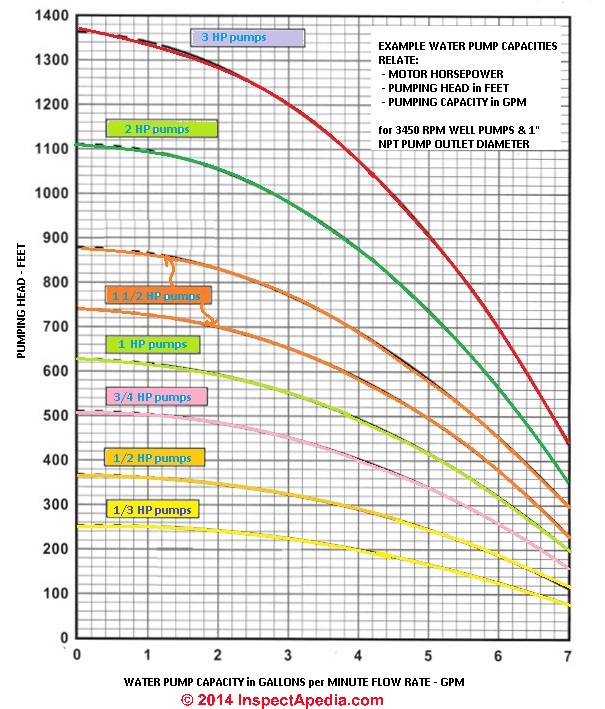 Thanks for an interesting problem and question, Hal.
The chart shown here relates water pump capacity or delivery rate or flow rate in GPA and is from our article:
WATER PUMP CAPACITIES TYPES RATES GPM
[Click to enlarge any image]
OPINION: Most authorities will accept the use of a double check-valve system to prevent any possible backflow out of a home water system into the muncipal system to protect the municipal system against that contamination source.
After all, in the event of a temporary loss of pressure in the municipal water system, water in homes with NO water pressure booster pumps can still back-flow into and contaminate the municipal system. So the thinking of only banning pressure boosters is a bit inconsistent.
That said, you need to deliver water at the required volume and pressure to 5 homes, so it's not just the pump capacity (5 x 5gpm + additional power to overcome distance, bends, elbows restrictions) but also a sufficient water storage volume, and thus the same backflow question will remain for the municipal system, and the same solutions apply.
What many communities do is install a raised water tank (serving each home, e.g. with rooftop water tanks) or serving a cluster of homes with a raised water tank.
Water is delivered into the tank from the supply source, often intermittently and at rather low volume and pressure, but at times of low community usage, and water flows out of the tank by gravity if the height is sufficient - no booster pump is needed.
Beyond that speculation, before one could actually specify exactly what pump you need you will want to have a complete plumbing system design.
That's because the effects of pipe diameter, number of elbows and bends and valves and other restrictions such as variations in lift or delivery heights for your water system also must be taken into account - data not given in your question.
Armed with that data you will see that every pump manufacturer gives tables of pump capacity in gpm that vary depending on the pump lift involved, and the manufacturer will state assumptions about piping effects.
See these recommended articles too
LARGE CAPACITY WATER STORAGE TANKS
On 2020-08-14 by Hal - state does not permit in-home water pressure booster pumps
Our state has a law that prohibits the use of in-home booster pumps because of the risk of cross-contaminating town water systems.
We have four homes with in-home booster pumps and one future building site that would need pressure assistance.
In order to comply with the law, we are in the process of designing a system that would allow us to get rid of the pumps in each residence.
How large of a pressure pump would we need to provide pressure to five residential meters?
On 2020-08- by (mod) - leak at fibreglass water pressure tank bottom, water also from tank top Schrader valve
 Bill
Bill
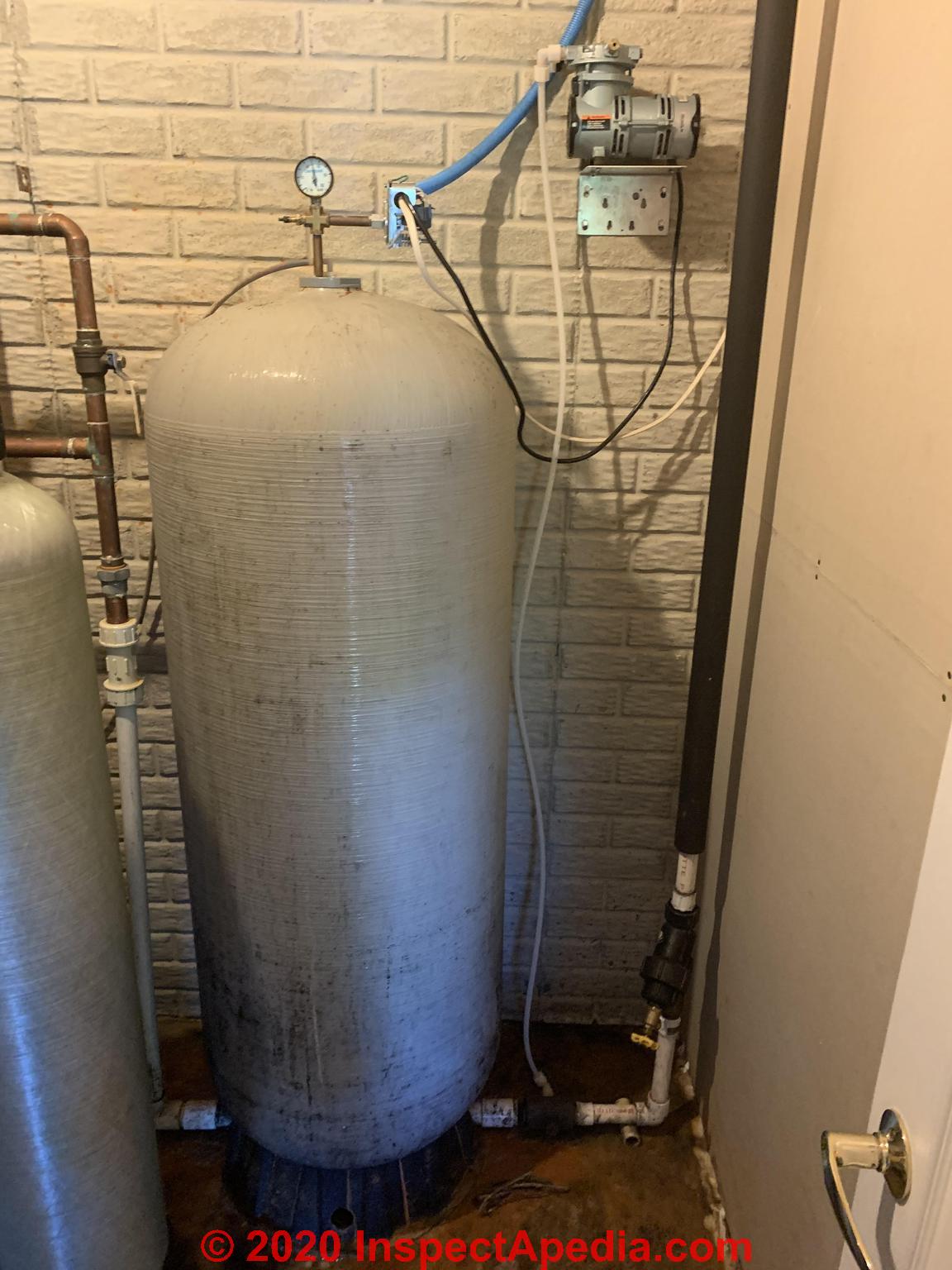
A leak at the tank bottom would be from a defective piping connection OR it could just be condensation; let's start diagnosing that leak by wiping the tank dry and watching it closely to see exactly where the leak occurs. Otherwise any repair advice anyone might give is too speculative to be very helpfu.
If water comes out of the air valve (Schrader valve) at the top of a water pressure tank AND if the tank uses an internal bladder, then the bladder has leaked - and failed.
But your tank may not use an internal bladder. Rather it's simply waterlogged. That would explain why opening the air vent or Schrader valve mounted on that gauge tee at the top of your water pressure tank squirts just water, no air.
Watch out: what's that little pump mounted on the wall above and to the right of the water tank. It looks like a pump intended to serve as an injector pump system to add disinfectant to a water supply system, but only 1 of the two tubes is attached to the little pump. The second tube that would bring disinfectant to the pump has been disconnected.
Also I notice that the wiring to your pressure control switch is unsafe: missing a strain relief at the switch side and missing the switch cover - shock hazards.
On 2020-08-12 by Bill - leaking pressure tank at the fitting at the bottom.
Hi I have a leaking pressure tank at the fitting at the bottom. There is a boost pump plumed into the wet side of the tank.
I checked the schrodier valve near the gauge at the top and water does come out of it.
Does this tank need replacing?
Please see the attached picture. Thanks
On 2020-07-25 by (mod) - Amtrol pressure tank and pump troubleshooting
Dee
Watch out: Excessive water pressure can burst a pressure tank, causing injury or worse to anybody who happens to be close-by. So if the pressure readings on your system exceed the tank's rated capacity the first and immediate step is to have your plumber lower the water pressure settings to a safe level.
See details
at WATER PRESSURE TOO HIGH: DANGERS
Other causes of leaks at a relief valve include water hammer, discussed separately
at WATER HAMMER NOISE DIAGNOSE & CURE
When a pump runs and won't stop the problem could be any of several such as loss of water in the well or simply a clogged pressure control switch.
See the diagnostic suggestions
at WATER PUMP WONT STOP RUNNING
It's normal to see water - in the form of condensation - on a water pressure tank; sometimes we insulate to reduce that issue;
But if the tank is badly rusted or already damaged and leaking it needs to be replaced.
Your Amtrol tank is already one that uses an internal bladder so that's not a feature to be added.
On 2020-07-25 by Dee - Amtrol pressure tank and pump problems
We are in residential neighhood. Our contractor had installed an Amtrol pressure tank and pump in the basement 10 yrs ago, - Several problems are occurring:
1) the relief valve at the pump/ tank assembly are discharging water, about 2-3 gallons over 4-5 d; I have not been able to observe the psi threshold and the water leak- I could see at 80 psi there was no discharge into the bucket,
2) sometimes the pump would run nonstop after people use water, and gets really hot, again no clear relation to psi gauge reading
3) there seems to be a large swing between the top and low pressure between the pumping, like 20 psi.
4) I see the Amtrol tank rusting at the bottom and leak water stains all around- I suspect it’s been leaking even before we started to put a bucket at its release outlet . So should I change out the whole system?
Do I need the Pressure bladder tank?
Or can I just use a pressure pump? What are the indications of adding a tank to the pump? Thanks
On 2020-05-28 - by (mod) - range of New Zealand topics at InspectApedia.com
 Thank you for the kind words, Robert.
We work hard to provide researched, unbiased information so I'm particularly grateful when a reader finds the effort useful.
We have a special respect for you Kiwis, having spent months on South Island and even further South on Stewart Island six years ago.
Photo: a reclusive Kiwi snuffling along for food during its night time foray near Stewart Island in 2014 - DF.
About coming to InspectApedia.com for pump issues, your questions and comments help us see where we need to correct or improve our information, so it's a win-win.
But please don't limit your questions to water pumps; by the page top menu and by the on-page search box that InspectApedia.com offers information across a wide range of building-related and indoor-environment concerns.
On our home page we explain that
InspectAPedia.com® - is a free online encyclopedia of building & environmental inspection, testing, diagnosis, repair, & problem prevention advice, covering all residential & light commercial building components, materials, & mechanical systems.
Whether your building is brand new or hundreds of years old there will be things to diagnose, fix, maintain, or indoor environment problems or air quality problems related to the building's condition.
On 2020-05-28 by Robert Hetges - InspectApedia.com supports Kiwis in New Zealand
Hi Dan really appreciate for your help and I will recommend and share inspectapedia highly knowledgeable approach.
This will be my go to for pump issues.
Here in new Zealand it's very hard to find people with this knowledge and as a plumber you never stop learning. Be in touch Rob
On 2020-05-27 2 - by (mod) - pump pressure has to accomodate tall buildings but tank air precharge is always set 2 psi below cut in
Yes but that's your pump output pressure to consider.
Either the pump pressure has to set sufficiently hight be able to push water to the highest point needed or in very tall buildings installers put a water tank high in or on the building or use stated pumps for different floors.
Watch out: The pressure tank, however, if charged higher than the pump cut-in pressure, will prevent the pump from ever turning on.
On 2020-05-27 by Robert hetges
So the hydrostatic pressure difference from the basement to the roof top where the air tank is installed (64m =640 kpa ) I don't need to consider?
Thx rob
On 2020-05-27 - by (mod) - how high to set the water pump air pre-charge pressure
Robert,
The water pressure tank air pre-charge pressure is always set 2 psi below the pump pressure control switch CUT-IN pressure.
In your pump cuts on at 30 psi the pre-charge pressure is set to 28.
Search inspectapedia.com for
WATER TANK AIR HOW MUCH TO ADD to read details
On 2020-05-27 by Robert hetges
Building height 64m
Hello,what pressure needs the air tank to be set, when the pumps are in the basement and the tank 15 story's up . What is the differential to the cut in pressure.
On 2020-05-26 - by (mod) - get better pressure and flow for sprinklers
David
Before investing in a booster pump system look into the largest diameter garden hose that you can buy. That will make a significant difference in the flow rate and will be enormously less expensive.
Then, yes, if still needed, you can install either a pressure-sensitive pump that does not require a pressure tank, or you can install a traditional pressure tank + booster pump.
On 2020-05-26 by David Clanton
I forgot to state that I am on the city water supply, not a well or other source.
I am looking for a water pressure booster pump. The rear exterior water faucet on my home puts out around 60psi when tested with a water pressure gauge.
The actual running pressure is lower. Using a 100-foot garden hose to connect to a lawn sprinkler the water pressure is so low that the sprinkler is able to only spray out a water jet maybe 10-15 feet.
I need a simple booster pump that I can position at the water faucet (standard position about 3 feet above ground) 110-115 volts with 3 prongs electrical plug I can plug-in nearby, Standard water hose in and out connections, auto on and off if possible.
Can I get by without a pressure tank? This booster pump would hopefully take the incoming 60psi and boost it to 110-120psi to increase the area being watered in my back yard.
I hope you can advise me. Specifics are difficult to find online.
On 2020-05-22 - by (mod) - gravity water supply piping distance
Thanks for the interesting question on gravity water supply piping distance, Ray.
I think that distance alone isn't the whole question of how far can you pipe water by gravity, it's also the change in elevation, the added resistance of fittings and elbows, and the pipe diameter.
Interestingly, as we discuss
at WELL WATER PRESSURE IMPROVEMENT
using larger diameter pipe for even a portion of a water piping system will improve "pressure" or flow rate of the water.
Adding 50 meters of level water piping from storage tank to house can work but I'd prefer to use 3/4" or even 1" water piping for the run. That will give a far easier input flow to your 1/2hp booster pump.
On 2020-05-22 by Ray - Is 50 meters too far to push the water with the pressure tank?
I currently have water coming from a mountain supply, gravity fed (750 meters) directly to my house thru a 3/4" pvc line that reduces to 1/2" at my property line. All is fine and plenty of pressure until the water stops for 2-5 days because of low supply.
I want to install a 1200 liter water storage tank that I will use the mountain supply to fill (gravity).
This will be located behind my garage. I will then run the output of the 1200 liter tank into the garage to pump/pressure tank. The pipe distance from the garage to the input of the single story house is about 50 meters and level, then to the taps.
Is 50 meters too far to push the water with the pressure tank? I'm planning on a 1/2 horse pump and 20 gal. pressure tank. Flow rate 3-4 gpm at most for up to 20 minutes at a time 3-4 times a day.
Will; this work or do i need larger motor/tank? Thank you. Ray in Philippines.
On 2019-04-02 - by (mod) - watering grass and trees
Yes you can do that. Keep in mind that we haven't addressed the flow rate capacity of the well; pumping out more water faster can exhaust a well with a poor recovery or flow rate.
On 2019-03-15 by Dan Allen
I have a well that I have been using to irrigate grass and trees. It can run two rainbirds easily.
I do not know the hp of the pump at the bottom of well. I am adding a house, about 100 yards from the well. I am concerned I may need more pressure. Can I add a booster pump and pressure tank close to the new house? There is already a small pressure tank in shed next to the well.
On 2018-10-30 - by (mod) - pump cycles on and off in 3 or 4 seconds
Brett
re your question about why your pump
During demand, the pump cycles on for 3-4 seconds and stops for 3-4 seconds,
That sounds as if you may be missing a pressure tank - on the system or there could be an obstruction in the outlet piping.
Here is what the pump manual tells us:
The Inline System needs a small pressure tank placed on the
pump outlet to maintain constant pressure. The tank supplies
water while the pump ramps up to speed and in circumstances
where only a small amount of water is required for a short period
of time. In addition, the tank prevents water hammer by acting
as a system buffer
This buffer also helps to prevent pressure spikes when there is a sudden change in demand. For 12 gpm (45 lpm) flow or greater, minimum pressure tank size is 4 gallons (15 L); for 12 gpm (45 lpm) flow, minimum pressure tank size is 2 gallons (7.5 L).
Pressure Tank Pre-charge (PSI)
The pressure tank pre-charge setting should be 70% of the system
pressure sensor setting as indicated in the preceeding table. - see the IO Manual table on page 3.
If you don't have the IO manual for your pump you can obtain one from
- Franklin Electric 9255 Coverdale Road, Fort Wayne, IN 46809
Tel: 260.824.2900 Fax: 260.824.2909
www.franklinwater.com
or at
FRANKLIN ELECTRIC INLINE SYSTEM CONSTANT PRESSURE SYSTEM OWNERS MANUAL [PDF] Little Giant Pumps, retrieved 2018/10/30, original source: http://littlegiant.com/media/130617/225883101.pdf
...
Continue reading at WATER PUMP VARIABLE FREQUENCY / VARIABLE SPEED DRIVE (VFDs) - tankless water pressure booster systems, or select a topic from the closely-related articles below, or see the complete ARTICLE INDEX.
Or see WATER PRESSURE BOOSTER PUMP FAQs - questions & answers about water pressure boosting pumps, tanks, systems - posted originally on this page.
Or see these
Recommended Articles
- GRUNDFOS SCALA 2 PUMP GUIDE - field reports on performance of a Scala2 booster pump
- WATER PRESSURE BOOSTER PUMP
- WATER PRESSURE LOSS DIAGNOSIS, MUNICIPAL
- WATER PRESSURE REDUCER / REGULATOR
- WATER PRESSURE TOO HIGH: DANGERS
- WATER PRESSURE TOO LOW
- WATER PRESSURE VARIATION CAUSES
- WATER PUMP CAPACITIES TYPES RATES GPM
- WATER PUMP CONTROLS & SWITCHES
- WATER PUMP VARIABLE FREQUENCY / VARIABLE SPEED DRIVE (VFDs) - tankless water pressure booster pumps
- WATER PUMP TYPES
- WATER PUMP & TANK I&O & REPAIR MANUALS
- WELL WATER PRESSURE IMPROVEMENT
Suggested citation for this web page
WATER PRESSURE BOOSTER PUMPS at InspectApedia.com - online encyclopedia of building & environmental inspection, testing, diagnosis, repair, & problem prevention advice.
Or see this
INDEX to RELATED ARTICLES: ARTICLE INDEX to WATER SUPPLY, PUMPS TANKS WELLS
Or use the SEARCH BOX found below to Ask a Question or Search InspectApedia
Ask a Question or Search InspectApedia
Try the search box just below, or if you prefer, post a question or comment in the Comments box below and we will respond promptly.
Search the InspectApedia website
Note: appearance of your Comment below may be delayed: if your comment contains an image, photograph, web link, or text that looks to the software as if it might be a web link, your posting will appear after it has been approved by a moderator. Apologies for the delay.
Only one image can be added per comment but you can post as many comments, and therefore images, as you like.
You will not receive a notification when a response to your question has been posted.
Please bookmark this page to make it easy for you to check back for our response.
Our Comment Box is provided by Countable Web Productions countable.ca
Citations & References
In addition to any citations in the article above, a full list is available on request.
- Mark Cramer Inspection Services Mark Cramer, Tampa Florida, Mr. Cramer is a past president of ASHI, the American Society of Home Inspectors and is a Florida home inspector and home inspection educator. Mr. Cramer serves on the ASHI Home Inspection Standards. Contact Mark Cramer at: 727-595-4211 mark@BestTampaInspector.com
- John Cranor [Website: /www.house-whisperer.com ] is an ASHI member and a home inspector (The House Whisperer) is located in Glen Allen, VA 23060. He is also a contributor to InspectApedia.com in several technical areas such as plumbing and appliances (dryer vents). Contact Mr. Cranor at 804-873-8534 or by Email: johncranor@verizon.net
- Thanks to reader Ahmed Hamza for discussing the use of water pressure booster pumps and the installation of water pumps in series to improve water pressure on upper building floors. Mr. Hamza is in Cairo, Egypt where although he is not a plumbing professional, he works work with Calpeda Pumps, an Italian company that produces a wide range of electric pumps, including self-priming pumps type NGM, single phase 230V. Calpeda S.p.A., Calpeda Group,
Via Roggia di Mezzo, 39 - 36050 Montorso Vicentino - Vicenza / Italy
Tel. + 39 0444 476 476 Fax. + 39 0444 476 477
E-mail: info@calpeda.it The company states:
"Calpeda, a company leader in electric pump industry, is part of an industrial group that embodies metal materials foundries, companies producers of submersible bore hole pumps, a company operating in spa bath and shower industry and an IT company." 02/04/2010 - Access Water Energy, PO Box 2061, Moorabbin, VIC 3189, Australia, Tel: 1300 797 758, email: sales@accesswater.com.au Website: http://www.accesswater.com.au/
Moorabbin Office: Kingston Trade Centre, 100 Cochranes Rd, Moorabbin, VIC 3189
Australian supplier of: Greywater systems, Solar power to grid packages, Edwards solar systems, Vulcan compact solar systems, water & solar system pumps & controls, and a wide rage of above ground & under ground water storage tanks: concrete, steel, plastic, modular, and bladder storage tanks. - Grove Electric, Typical Shallow Well One Line Jet Pump Installation [PDF], Grove Electric, G&G Electric & Plumbing, 1900 NE 78th St., Suite 101, Vancouver WA 98665 www.grovelectric.com - web search -7/15/2010 original source: http://www.groverelectric.com/howto/38_Typical%20Jet%20Pump%20Installation.pdf
- Grove Electric, Typical Deep Well Two Line Jet Pump Installation [PDF], Grove Electric, G&G Electric & Plumbing, 1900 NE 78th St., Suite 101, Vancouver WA 98665 www.grovelectric.com - web search -7/15/2010 original source: http://www.groverelectric.com/howto/38_Typical%20Jet%20Pump%20Installation.pdf
- HANS WATER PRESSURE BOOSTER PUMP SYSTEM [PDF] HANS Power & Water, LLC 38955 Hills Tech Drive Farmington Hills, MI 48331 Sales: (833)333-4267 Service: (888)986-4156 Web: hanspremiumwater.com
- In addition to citations & references found in this article, see the research citations given at the end of the related articles found at our suggested
CONTINUE READING or RECOMMENDED ARTICLES.
- Carson, Dunlop & Associates Ltd., 120 Carlton Street Suite 407, Toronto ON M5A 4K2. Tel: (416) 964-9415 1-800-268-7070 Email: info@carsondunlop.com. Alan Carson is a past president of ASHI, the American Society of Home Inspectors.
Thanks to Alan Carson and Bob Dunlop, for permission for InspectAPedia to use text excerpts from The HOME REFERENCE BOOK - the Encyclopedia of Homes and to use illustrations from The ILLUSTRATED HOME .
Carson Dunlop Associates provides extensive home inspection education and report writing material. In gratitude we provide links to tsome Carson Dunlop Associates products and services.
 | HOME | ABOUT | ASK a QUESTION | CONTACT | CONTENT USE POLICY | DESCRIPTION | POLICIES | PRIVACY | |
| © 2024 - 1985 Publisher InspectApedia.com - Daniel Friedman | |||||||||