
InspectAPedia® FREE Encyclopedia of Building & Environmental Construction, Diagnosis, Maintenance & Repair |
Question? Just ask us! InspectAPedia
|
 Tables of Required Well Clearances
Separation distances for Drilled Wells & for Dug Wells
- POST a QUESTION or COMMENT about the required clearance distance between wells, septic systems and other site features
Well clearances and distances to other site features:
What are the Distances Between Drinking Water Wells and Septic Systems, Treated Soils, Farm Buildings, & Other Site Features?
This document provides a table giving the required distances between wells and other site features which could affect drinking water quality - potential sources of well contamination. If a property takes its drinking water supply from a site where these distances are violated, or where there are other reasons to be concerned for water quality, the well water should be tested regularly.
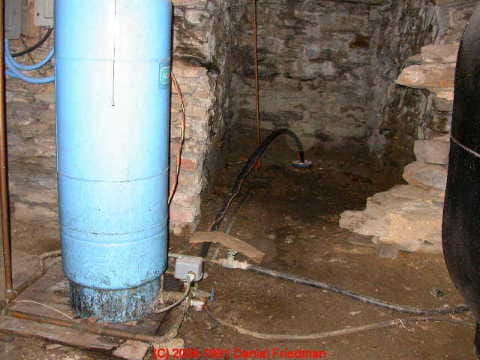
Our procedure is to perform an extensive broad-spectrum water test, depending on what we know about the property, its history, and its location. We're not only concerned for bacterial contamination - the common "water coliform test". Our page top photo shows a well located in the basement of a home. Is this OK?
InspectAPedia tolerates no conflicts of interest. We have no relationship with advertisers, products, or services discussed at this website.
Online Tables of Required Well Clearances to Site Features
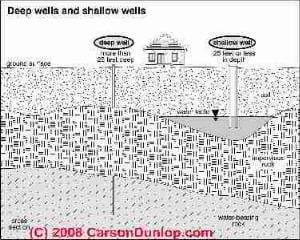 Below we provide tables of the minimum recommended distances between drinking water wells and just about anything else on or around a building site that could affect the well water.
In addition to considering the actual well clearances you observe at a property you should decide whether additional or specific water contamination tests are thus appropriate. Here are some examples of how well setback distances affect water testing advice.
Well sketch at left courtesy of Carson Dunlop Associates, a Toronto home inspection, education & report writing tool company [ carsondunlop.com ]. [Click to enlarge any image]
Water serving a farmhouse near an apple orchard might get extra testing for pesticides or fertilizers. Water at a property where fuels or heating oil were stored close to a well may need water testing for petroleum products.
Site features which risk well contamination include nearby cesspools, drywells (for gray water), soils which have been chemically treated, such as to provide a termite barrier, farm buildings, manure piles, livestock yards, silos, and fertilizer storage.
Consideration should also be given to surface water runoff from adjoining properties, orchards (pesticide-treated), highways and roads, or properties with above ground or buried storage tanks such as for heating oil, fuel oil, or farm and orchard chemicals.
The tables below give setback or clearance distance requirements between drinking water supply wells and septic systems, farm buildings, chemically-treated soils (such as for termites) and other property features which may affect drinking water quality. We provide setback tables for drilled or driven point wells and separately for dug wells.
Article Contents
- WELL CLEARANCE DISTANCES
- US-HUD/FHA, Canadian, & U.K. DRILLED WELL CLEARANCE DISTANCES
- U.S. EPA DRILLED WELL CLEARANCE DISTANCES
- DRIVEN POINT SAND POINT WELL CLEARANCE DISTANCES
- DUG WELL SEPARATION DISTANCES
- CISTERN CLEARANCE DISTANCES
- WELL SEPARATION DISTANCE QUESTIONS
- WELL SEPARATION CODES & STANDARDS
US-HUD/FHA, Canadian, & U.K. Drilled-Well Clearance Distances
Local soil and rock conditions can make these "rules of thumb" unreliable. See the U.S. "One and Two Family Dwelling Code, Section P-2510-Combined Seepage Pits and Disposal Fields," and Table P-2504, "Location of Sewage Disposal System." Other references are cited at the end of this table.
A separate table SEPTIC CLEARANCE DISTANCES gives the required distances between septic systems and other site features.
Drilled-Well Clearance Distances |
||
| US-HUD/FHA Distances from Well to: Note 1 below |
Minimum Horizontal Distance (feet) from Drinking Water Well to Potential Sources of Pollution | Supplemental Requirements*& Comments |
| Abandoned water well | 150 ft. | Presumption well was not filled & sealed Also see WELL ABANDONMENT PROCEDURE |
| Absorption field, Septic | 100 ft. | (SUP1)(*EP) [Old distance was 75] (may be modified based on local conditions) |
| Animal yards, barns, stables | 50 ft. - Waskom (2009) 100 ft. - Mass. Title 5 |
|
| Buildings | 3.25 m (11 ft.) from existing buildings 2 m from existing buildings |
Canada, Alberta Canada, Newfoundland, Labrador |
| Cesspool, leaching | 98 ft., 30 m., Canada, Alberta 30 m, Canada, Newfoundland, Labrador |
The installation of a leaching cesspool is no longer permitted in Canada nor in most U.S. Jurisdictions. It is, however, highly recommended that any newly constructed water well be located at least 30 m (100 ft.) from any existing leaching cesspool. |
| Chemically poisoned soil | 25 ft. | (SUP3) - can reduce to 15 ft in special circumstances given below |
| Chemical Storage | 100 ft. 30 m (98 ft.) from pesticide or fertilizer storage, Alberta Canada |
Waskom (2009) includes fertilizer, pesticide, chemical mixing or chemical loading sites Also see PESTICIDE CONTAMINATION TEST |
| CISTERNS | Properties served by cisterns are not acceptable for mortgage insurance. HOCs have the authority to consider waivers in areas where cisterns are typical. |
See notes below for link to key document |
| Commercial facilities/parking lots | 210 ft. | Example: mini-mart, gas station, grocery, strip mall |
| Composting, animal burial | 100 m (329 ft.) from dead animal burial or composting site, Canada, Alberta | |
| Contamination sources, other | 100 ft. | Minimum horizontal setback, CO state law & others |
| Drywell | [citations needed] | Handles graywater |
| Electrical power lines, overhead | 2 m (7 ft.) from overhead power lines if: - the line conductors are insulated or weatherproofed and the line is 750 volts or less, 6 m (20 ft.) from overhead power lines if the well: - has a PVC or non-conducting pipe pumping system - has well casing sections no greater than 7 m (23 ft.) in length 12 m (40 ft.) from overhead power lines for all other well constructions |
Alberta, Canada |
| Graveyard | 50 m (165 ft.) from the outer boundary of a graveyard | Alberta, Canada |
| Landfill | 450 m (1476 ft.) from any area where waste is or may be disposed of at a landfill | Alberta, Canada |
| Manure piles, stockpiles | 250 ft. Waskom (2009) 100 ft. Massachusetts 100 m (329 ft.) from a manure storage facility or manure collection area or livestock yard, Canada, Alberta 30 m (98 ft.) from manure or composting materials application, Canada, Alberta |
Also protect from runoff from manure, barns Also see BACTERIA TEST GUIDE |
| Manure spread on fields, agricultural | 75 m | Canada, Newfoundland, Labrador |
| Oil Tanks - above ground distance to well - U.S. | 5 ft. to property line, up to 275G, 10' from property line (larger tanks) - MA 8 ft. to well (oil tanks tanks smaller than 1500 gals) - WI 100' oil tank to well or water reservoir (larger oil storage tanks) - WI |
Oil storage tank setback or clearance distance requirements vary by U.S. state, Canadian Province, Other Countries (U.K. for example). The oil tank distance to well example data shown is for Wisconsin. The oil tank distance to property line data shown is for Massachusetts. |
| Oil storage tanks, underground or buried tanks, distance to well - U.S. | 25' to well (single family home) - WI 100' to well (other buildings) - WI |
Oil storage tank setback or clearance distance requirements vary by U.S. state, Canadian Province, Other Countries (U.K. for example). The example data shown is for Wisconsin. |
| Oil Tank Setbacks to Well - Canada | 5 meters (16.25') distance, oil tank to well, for new home residential construction, oil tanks 1200 liters or less - Canada 15 meters (48.75') distance, oil tank to well, for new home construction, oil tanks larger than 1200 liters - Canada |
Existing oil storage tanks and replacement oil storage tanks do not have to meet these oil tank-to-well distance requirements Also see OIL TANK CODES & STANDARDS - Detailed List |
| Oil Tank Clearance Distances - U.K. | 760mm from property boundary for tanks under 3400 Liters. Larger oil storage tanks must be no closer than 1.8 meters to the building. | |
| Other requirements | [citations needed] | (SUP2) - local health regulations also apply |
| Privy or Outhouse | 100 ft. 50 ft., 15m., Canada, Alberta |
Massachusetts Title 5 |
| Property line | 10 ft. | (*EP), Massachusetts Title 5 |
| Public / Private Roadway | 25 ft. 6.1 m (20 ft.) from the outer boundary of any road or public highway - Alberta, Canada |
|
| Public / Private Right-of-way | 15 ft. | |
| Pumphouse floor drain | 1 m from pumphouse floor drains | Canada, Newfoundland, Labrador |
| Seepage pit | 100 ft. [Old distance was 75] (may be modified based on local conditions) | (SUP1) - clearance may be increased or reduced depending on special circumstances given below |
| Septic tank | 50 ft. to drinking water well 10 m (33 ft.) from a watertight septic tank, Canada, Alberta 15m Canada, Newfoundland, Labrador 10 ft. to irrigation well |
Most sources including Massachusetts Title 5, Waskom (2009) Presumption: the septic tank is water-tight |
| Septic / Sewage Absorption pit | 100 ft. |
(SUP1) [Old distance was 75] (may be modified based on local conditions) Massachusetts Title 5 |
| Septic Absorption field Septic drain field, leachfield, soakaway beds, absorption beds | 100 ft. 15 m (50 ft.) from a sub-surface weeping tile effluent disposal field or evaporation
mound or an outdoor pit privy, Canada, Alberta |
(SUP1)(*EP) [Old distance was 75] (may be modified based on local conditions) Also see BACTERIA TEST GUIDE |
| Septic Absorption field to non-potable irrigation water well | 25 ft. | Applicable only to irrigation wells, Massachusetts Title 5 |
| Sewer line | 10 ft. if line has permanent watertight joints | Massachusetts Title 5 |
| Sewer line, other materials | 50 ft. | Massachusetts Title 5 |
| Sewage effluent discharge to surface | 50 m (165 ft.) from sewage effluent discharge to the ground surface, Canada, Alberta | |
| Sewage waste lagoon | 250 ft. 100 m (329 ft.) from a sewage lagoon, Canada, Alberta |
|
| Silage storage | 250 ft | Waskom (2009) |
| Silos, concrete | 50 ft. | Waskom (2009) |
| Storage tanks, underground fuel or pesticide | 250 ft. 50 m (165 ft.) from above-ground fuel storage tanks, Canada, Alberta |
Massachusetts |
| Trees | 40 ft. | See PLANTS & TREES OVER SEPTIC SYSTEMS |
| Waste dump, household | 250 ft. | Waskom (2009) Improperly-disposed-of waste chemicals, paints, lubricants, animal remains, cleaners, construction or demolition debris may be more harmful and may require greater setbacks depending also on terrain properties. |
| Water supply pipes/lines, pressurized, distance to waste disposal: | 10 ft. horizontally & 18" below water supply pipes | Pertains to pressurized water pipes from a municipal supply or from a well or water pump delivering potable water Massachusetts Title 5 Title 5 excerpt: It is suggested that the disposal facilities be installed at least 10 feet from and 18 inches below water supply lines. Wherever sewer lines must cross water supply lines, both pipes shall be constructed of class 150 pressure pipe and should be pressure tested to assure watertightness. |
| Wetlands, surface water | 25 ft. | Massachusetts |
Notes to the table above
WELL & SEPTIC SYSTEM CLEARANCE DISTANCES - TABLE NOTES:
Sources: See
WELL SETBACK CODES & STANDARDS - in this document
WELLS CISTERNS & SPRINGS - home
Distances from a drinking water well to the contamination sources above are in feet unless otherwise stated.
HUD distances to septic drainfield, and similar components changed from 75' to 100' prior to 10/2009 - thanks to a reader [anonymous by request].
1. Distance from source of pollution - proposed construction, US Dept. of Housing and Urban Development, FHA, Local acceptable standard No. 3, June 18, 1992, Ref. Hud Handbook 4910.1 Chg 1, Appendix K, Pg K-27
(SUP1) This clearance may be increased or decreased depending upon soil and rock penetrated by the well and aquifer conditions. The clearance may be increased in creviced limestone and permeable strata of gravel and sand.
The clearance may be reduced to 50 ft. only where the ground surface is effectively separated from the water bearing formation by an extensive, continuous and impervious strata of clay, hardpan, or rock. The well shall be constructed so as to prevent the entrance of surface water and contaminants.
(SUP2) The recommendations or requirements of the local health authority shall apply.
(SUP3) This clearance may be reduced to 15 feet only where the ground surface is effectively separated from the water bearing formation by an extensive, continuous and impervious strata of clay, hardpan, or rock.
(*EP) For Existing Properties. If the locality permits distance requirements less than those prescribed by FHA, the property may be considered eligible for a mortgage insured by FHA provided that the lender submits evidence in the case binder that the subject property is in compliance with the applicable local or state distance requirements and meets the conditions stated in Mortgagee Letter 2002-25.
These tables give typical required clearances for septic tank, soil absorption system (SAS), etc. but you will see that different authorities may recommend different distances.
These distances are for conventional onsite waste disposal systems which specify clearances presuming that effluent is being disposed-of after minimal treatment such as is received by a septic tank or cesspool. Advanced onsite wastewater treatment systems, such as those described by Jantrania and Gross (2006), permit substantial reduction in these clearances, depending on the level of treatment achieved.
U.S. Environmental Protection Agency EPA Drilled-Well Clearance Distances
US-EPA Clearance or Separation Distances from Water Well to: |
|||||
| Septic tanks | 50 ft. [This distance may not be acceptable by most local, state, and other agencies and probably needs updating - DJF] | ||||
| Septic leach fields | 50 [This is unlikely to be acceptable by most local, state, and other agencies and probably needs updating - DJF] | ||||
| Livestock yards | 50 [This is unlikely to be acceptable by most local, state, and other agencies and probably needs updating - DJF] | ||||
| Silos | 50 [This is unlikely to be acceptable by most local, state, and other agencies and probably needs updating - DJF] | ||||
| Petroleum Tanks | 100 | ||||
| Liquid Tight Manure Storage | 100 | ||||
| Pesticide & Fertilizer Storage & Handling |
100 | ||||
| Manure stacks | 250 | ||||
| Water supply piping to Septic Tank/Field | 10 | ||||
Notes to the Table Above
Distances are in feet unless otherwise stated
Sources:
EPA references above and for other EPA information see WELL CONSTRUCTION & MAINTENANCE
Also see WATER TESTS for CONTAMINANTS
Clearance Distances & Setbacks for Driven Point Wells
Minimum Clearance or Separation Distances from Sand Point / Driven Point Water Well |
|||||
| Site Feature | Distance to Driven Point Sand Point Well | ||||
| Animal yards | 50 ft. ft. Wisconsin DNR 100 ft. other sources. |
||||
| Clear water drain outlet (roof gutters, foundation drains) | 8 ft. | ||||
| Graveyard (nearest point) | 50 ft | ||||
| Lake, pond, or drainage ditch | 25 ft. | ||||
| Landfill | 1,200 ft. | ||||
| Municipal sewer, private sewer, storm sewer | 50 ft | ||||
| Septic tanks or sewage holding tank | 25 ft. Wisconsin DNR 50 ft |
||||
| Septic drainfield piping or trenches, nearest edge | 50 ft | ||||
| Sewer piping, cast iron, listed plastic | 8 ft. | ||||
| Sewer piping, other materials | 25 ft. | ||||
| Sewage or sludge treatment pond, storage, retention pond, sludge disposal area, spray irrigation, waste disposal site | 250 ft. | ||||
| Underground oil storage tank & tank piping, general use | 100 ft. | ||||
| Underground oil storage tank & tank piping, used for residential heating only | 25 ft. | ||||
Notes to the table above
Distances are in feet unless otherwise stated
Sources:
DRIVEN POINT WELLS - topic home
DRIVEN POINT (Sand-Point) WELLS, [PDF] Wisconsin Department of Natural Resources, PUB DG 022 2010 retrieved 2018/06/12, original source: https://dnr.wi.gov/files/PDF/pubs/DG/DG0022.pdf
Also see WATER TESTS for CONTAMINANTS
Clearance Distances & Setbacks for Dug Wells
Dug Well Clearance Distances & Setbacks |
|||||
| Septic tanks | 15 m | ||||
| Septic leach fields | 30 m | ||||
| Contaminants, all other potential | 30 m | ||||
| Manure spreadings on agricultural fields | 75 m | ||||
Notes to the table above
Sources:
HAND DUG WELL PROCEDURE - home
Canada: WELL AWARE [Well Guidelines] NEWFOUNDLAND & LABRADOR ENVIRONMENT CANADA, [PDF], retrieved 201803/06, original source: http://www.mae.gov.nl.ca/waterres/cycle/groundwater/well/well_aware_booklet.pdf
Common Well Questions & Answers
Is your well located on your property?
Individual Water Systems/Wells should be located on the subject property site. If not, they must be on an adjacent property, and evidence of water rights and recorded maintenance agreement must be provided for acceptance of the well as the primary source of water for an FHA insured property.
Is a Hand Dug or Driven Point Well Acceptable to HUD?
New wells must be drilled,
no less than 20 feet deep, and cased. Casing should be steel or other casing material that is durable, leak-proof, and acceptable to (either) the local health authority and (or) the trade or profession licensed to drill and repair wells in the local jurisdiction.
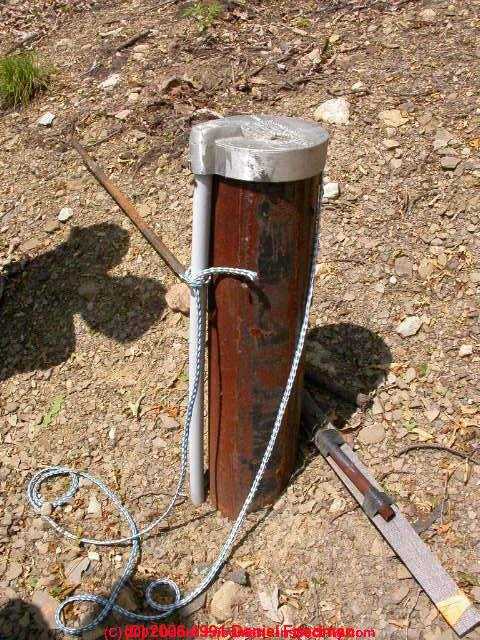
Additional information on new wells, pumps, and storage tanks construction information may be referenced from HUD Handbook 4910.1, Appendix K and 24CFR 200.926d(f) [DJF note: we removed the link to this CFR citation because it is not working at the HUD site; accurate link citation needed]
Is a Cistern an Acceptable Water Supply for HUD Financing?
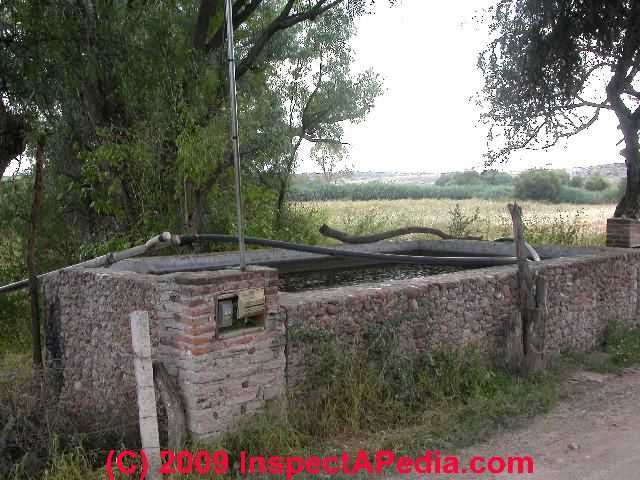
CISTERNS:HUD Handbook 4150.2 Section 3-6 indicates that properties served by cisterns are not acceptable for mortgage insurance.
However, the HOCs have the authority to consider waivers in areas where cisterns are typical.
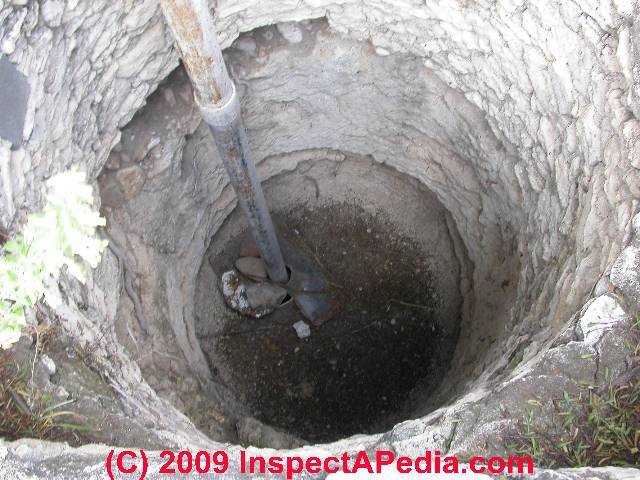
Our photo (above left) shows a hybrid system: this outdoor cistern is filled by pumping from an open casing in a drilled well that was inserted in the bottom of a dug well that went "dry" (photo, above right).
As will be apparent to readers, both the open top of this cistern and the open casing in the bottom of the dug well are sources of water contamination.
See CISTERNS, WATER STORAGE for more information about this water source.
Is Water Purification Equipment Required by or Acceptable to HUD for HUD Financing?
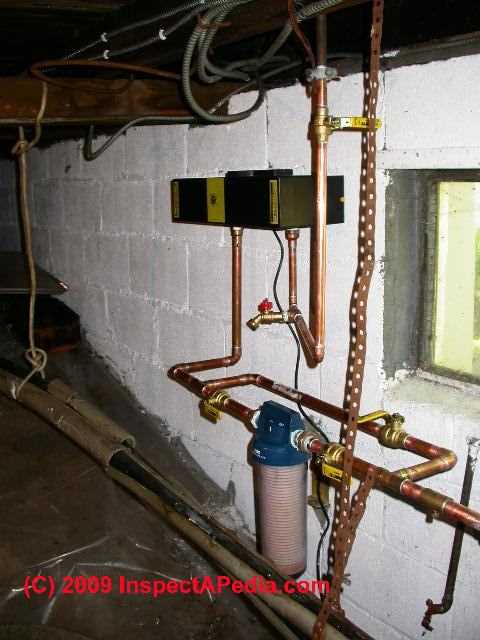
Individual Residential Water Purification Equipment - If a property is otherwise eligible for insurance but does not have access to a continuing supply of safe and potable water without the use of a water purification system, the requirements in Mortgagee Letter 1992-18 [PDF] must be satisfied.
Our photo (left) shows a UV light water treatment system installed to address low-level bacterial contamination in a private water supply.
See WATER TREATMENT EQUIPMENT CHOICES for details. The HUD letter states that effective 5 June 1992, [we quote key portions of the document]:
Effective immediately, the Department (HUD) will accept individual water purification units on all single family properties including both proposed and existing construction.
The Mortgagee Letter cited above sets forth the requirements for HUD acceptance of these individual water purification units. This Mortgagee Letter supersedes Mortgagee Letter 91-4 dated January 25, 1991.
B. CERTIFICATION BY LOCAL (or STATE) HEALTH AUTHORITY. A local
(or State) health authority certification must be submitted
to HUD which certifies the following:
1. That a "point-of-use" or "point-of-entry" water purification unit is operating on the property.
If "point-of-use" equipment is used, a water purification unit must be employed on each water supply source (inside and outside faucet) serving the property. (If a "point-of entry" system is used, a separate water supply system carrying untreated water for flushing toilets may be used);
2. That the water purification unit is sufficient to assure an uninterrupted supply of safe and potable water, adequate to meet household needs;
3. That the water supply, when treated by the water purification unit, meets the water quality standards of the local (or State) health authority.
If there are no local (or State) water quality standards, then water quality must meet the standards set by the Environmental Protection Agency (EPA), as prescribed in the National Primary Drinking Water requirements in 40 CFR Parts 141 and 142; and
4. That there exists a Plan that provides for the monitoring, servicing, maintenance, and replacement of the water purification equipment, and which meets the requirements listed in paragraph G below.
Water Well Setbacks & Clearance Distances Codes, References, Standards
- Additional distance information may be referenced from HUD Handbook 4910.1, Appendix K, 24CFR Sec. 200.926d [dead link removed by DJF, proper citation needed] & Mortgagee Letter 2002-25.
- Canada: ALBERTA, DESIGN & CONSTRUCITON of WATER WELLS [PDF], retrieved 2018/03/06, original source: http://www1.agric.gov.ab.ca/$department/deptdocs.nsf/all/wwg408/$file/waterwells_Module3.pdf?OpenElement
- Canada: FARM WATER WELL MANAGEMENT [PDF], Canada Agriculture & Agri-Food, retrieved 2018/03/06, original source: http://www.agr.gc.ca/eng/science-and-innovation/agricultural-practices/water/wells-and-groundwater/water-wells/farm-water-well-management/?id=1404484907267
- Canada: WELL AWARE [Well Guidelines] NEWFOUNDLAND & LABRADOR ENVIRONMENT CANADA, [PDF], retrieved 201803/06, original source: http://www.mae.gov.nl.ca/waterres/cycle/groundwater/well/well_aware_booklet.pdf
- DRIVEN POINT (Sand-Point) WELLS, [PDF] Wisconsin Department of Natural Resources, PUB DG 022 2010 retrieved 2018/06/12, original source: https://dnr.wi.gov/files/PDF/pubs/DG/DG0022.pdf
- FL FLORIDA CONTRACTORS GUIDE for WELL CONSTRUCTION - Northwest FL [PDF] Includes FL Chapter 62-521 WELL HEAD PROTECTION CODE (2012) that includes setback distances for wells in the Northwest Florida Water Management District, retrieved 2023/01/05 original source: https://www.nwfwater.com/content/download/7316/55085/ContractorPackage.pdf
- FL FLORIDA CONSUMER GUIDE for WELL CONSTRUCTION - Southwest FL [PDF] (2008) Southwest Florida Water Management District, retrieved 2023/01/05, original source: https://www.swfwmd.state.fl.us/sites/default/files/medias/documents/ConsumerGuideWellConstruction.pdf
Excerpt:
Locating a Private Water Well in Florida
A well should be located on the highest ground possible so that surface water will drain away from the well. Wells should be located in an area that will not pose a threat of contamination to the water resource, and will provide protection for the health, safety and welfare of the user.
Domestic wells must be located a minimum of seventy five (75) feet away from your septic tank system and a recommended twenty five (25) feet from a termite treated building slab.
Public supply wells must be located a minimum of 100 feet away from any septic tank if they serve facilities which generate less than two thousand (2000) gallons per day (gpd) of effluent, and a minimum of two hundred (200) feet away from any septic tank for public supply wells which generate more than 2000 gpd effluent flow.
The well casing is required to be at least one foot above land surface for domestic wells and all others, except public supply wells which are required to be a minimum of eighteen (18) inches above land surface.
In general, shallow wells that utilize the water table or sand aquifer are the most susceptible to contamination.
Deeper wells are, in general, less prone to contamination. However, the overlying subsurface material will be a major factor in this determination. - FL FLORIDA WELL CONSTRUCTION MANUAL [PDF] Monnitoring Well Design & Construction Guidance Manual, Florida Department of Enviornmental Protection, retrieved 2023/01/05, original source: https://floridadep.gov/sites/default/files/monitoring-well-manual-formatted-final_2.pdf
- FL Florida WELL SETBACK DISTANCES Regulations 62-610.471 [PDF] (2022)
- FL Florida CHAPTER 62-532 WATER WELL PERMITTING AND CONSTRUCTION REQUIREMENTS [PDF] Includes these active sections:
Part A Drinking Water Supply Wells Serving Public Water Systems or Bottled Water Plant Wells: setback distances, Pg. 582-2
Part B Drinking Water Supply Wells Serving Limited Use Commercial Public Water Systems and Limited Use Community Public Water Systems, Pg. 582-3
Part C Private Wells, Muiltifamily Wells, Pg. 582-4.
62-532.200 Definitions for Water Well Permitting and Construction
62-532.400 Permit for Water Well Construction, Repair, or Abandonment
62-532.410 Water Well Completion Report
62-532.420 Emergency Water Well Permits
62-532.430 Intent to Deny a Water Well Construction Permit
62-532.500 Water Well Construction Standards
62-532.510 Water Well Inspections
62-532.600 Enforcement of Water Well Permitting and Construction Requirements
62-532.610 Penalties for Violation of Water Well Permitting and Construction Requirements
Additional Florida well regulation authority links are provided by the state health department at
https://www.floridahealth.gov/environmental-health/drinking-water/well-construction.html
- FL FLORIDA WELL REGULATION AUTHORITY MAP [PDF]
- HUD Handbook 4150.1, Rev-1, Sec. 12-16 and 12-17 [PDF], and "Central Water and Sewage Systems",
- 4075.12 REV, 4150.2 Section 3-6 [NOTE: this pertains to public systems [PDF] and
- COMMUNITY central water and sewage systems [PDF] and not private installations- DJF] 24CFR 200.926(f) [Code of Federal Regulations, not a working link - DJF,
- CISTERNS - HUD Handbook 4150.2 Section 3-6 [PDF], indicates that properties served by cisterns are not acceptable for mortgage insurance. However, the HOCs have the authority to consider waivers in areas where cisterns are typical.
- Here is the main link to the U.S. Code of Federal Regulations [PDF] (CFR)]
- MASSACHUSETTS PRIVATE WELL GUIDELINES [PDF] (2017), retrieved 2018/03/06, original source: http://www.mass.gov/eea/docs/dep/water/laws/i-thru-z/prwellgd.pdf
This document also refers to Massachusetts Title 5 regulations for well setback. - Michigan, MINIMUM WELL ISOLATOIN DISTANCES [PDF] (1976) Michigan De4partment of Environment, Great Lakes & Energy, excerpted from Contamination Sources and Buildings, Part 127, Act 368, P.A. 1978 and Act 399, P.A. 1976, retrieved 2023/12/23, origianl source: https://www.michigan.gov/egle/-/media/ Project/Websites/egle/ Documents/Programs/DWEHD/ Water-Well-Construction/Minimum-Well-Isolation-Distances.pdf
Excerpt: The following lists sources of contamination and the well isolation distances required from those sources by state codes. The Michigan Department of Environment, Great Lakes, and Energy and local health departments have authority to issue deviations from these minimum isolation distances on a case by case basis. Criteria for issuance of deviations are set forth in R 325.1613 of the Rules for Part 127, and R 325.10809 of the Rules for Act 399. - New Hampshire requirements for reporting oil tank distances to water, property boundaries, etc. are at http://www.epa.gov/oust/directiv/apg45015.htm
- NORTH CAROLINA WELL CONSTRUCTION, REPAIR ABANDONMENT, SETBACKS, Lincoln County Board of Health [PDF] retrieved 2018/03/17, original source: http://www.lincolncounty.org/DocumentCenter/View/388
Mize, Wilson, NORTH CAROLINA'S PRIVATE DRINKING WATER WELL PROGRAM [PDF] presentation, retrieved 2018/03/17 original source http://www.gwpc.org/sites/default/files/event-sessions/Mize_Wilson-rsf.pdf - Waskom, Reagan M., Troy A. Bauder, COLORADO: PROTECTING YOUR PRIVATE WELL [PDF], (2009) Colorado State University Extension, Bulletin #XCM-179, retrieved 2018/03/06, original source: http://extension.colostate.edu/docs/pubs/crops/xcm179.pdf
Excerpt: Since wells are directly linked to groundwater, they can become contaminated if agricultural chemicals, runoff from animal enclosures, fuels, household wastes or other contaminants accidentally enter them.
Because of this, all rural residents should view their well as a vital asset that needs to be protected. This publication is intended to help you understand more about your water system and help you evaluate activities around the home, farm, or ranch that may contaminate wells and groundwater.
If you own a private well, it is your responsibility to ensure the water is safe for your family and animals to drink. - WISCONSIN oil tank setback or clearance distance requirements (PDF file) - original source: http://www.commerce.state.wi.us/ER/pdf/bst/ProgramLetters_PL/ER-BST-PL-SETBACKS.pdf
Reader Comments, Questions & Answers About The Article Above
Below you will find questions and answers previously posted on this page at its page bottom reader comment box.
Reader Q&A - also see RECOMMENDED ARTICLES & FAQs
On 2022-05-30 by InspectApedia (mod)
@Helen king,
As you'll see in the table above on this page, the well clearance distance is typically 10 feet from the property line. Your local health department or building authority has the final legal authority on what the requirements are for your location.
What city, county, state or province, and country are you in?
On 2022-05-29 by Helen king
My neighbor put his well 4 ft.from my property
On 2022-04-05 by Inspectapedia Com Moderator (mod) - What is a good distance to have between 2 irrigation wells?
@Mark,
Wow, that's a great question. Apologies but I can't answer it.
The distance between two water wells sufficient to avoid them interfering with one another is entirely dependent on
- the pumping rate out of the two wells
- the individual well recovery rates
- local soil conditions: type, e.g. sandiness of the soil, rock, sloping bedrock: factors that affect water movement of the aquifer through local soils
- the specific aquifer the two wells are tapping: how big is the aquifer?
We've certainly had complaints of well flow rates that declined when a neighbor drilled another well nearby, and in some areas of Mexico, where commercial agricultural companies have begun growing very large fields of crops in the last decade (State of Guanajuato near Los Rodriguez, for example), the new deep wells drilled by the companies so-dropped the local water table - at perhaps 9 feet per year, that the older smaller water wells serving the community went dry; everyone keeps drilling deeper.
You might ask local well drillers what they know about the aquifer in the area where you want your irrigation wells.
On 2022-04-05 by Mark
What is a good distance to have between 2 irrigation wells?
On 2022-02-02 by Inspectapedia Com Moderator (mod) - required distance from a public water system well and a retention pond
@DENNIS J PITRE,
I am GUESSING that you're asking for the distance between a private water well and a public water well - your local regulations may differ but in the U.S. the USDA-NRCS suggests
The standard isolation distances for these and other potential sources of contamination are 50 feet for private wells and 75 feet for Type III public wells.
- source:
FREQUENTLY ASKED QUESTIONS ABOUT SEPARATION DISTANCES BETWEEN WATER WELLS ON FARMS AND SOURCES OF CONTAMINATION [PDF] (2003) US Department of Agriculture, Natural Resource Conservation Service, State Offices Director: https://www.nrcs.usda.gov/wps/portal/nrcs/main/national/contact/states/ - retrieved 2022/02/02 original source: https://www.nrcs.usda.gov/Internet/FSE_DOCUMENTS/nrcs141p2_023988.pdf
The distance from a retention pond - is also a bit unclear: what kind of retention: surface runoff or a septic lagoon? I'm reluctant to assume.
Those distances are given in the tables above.
On 2022-02-02 by DENNIS J PITRE
Good morning, I am looking for information on the required distance from a public water system well and a retention pond for a residential complex, (townhouses).
It is located in Lafayette parish of Louisiana.
On 2021-12-16 by Inspectapedia Com Moderator (mod) - How close to a well can I build a swimming pool?
@Alessandro,
I haven't found an explicit building code citation pertaining to the clearance distance between a water supply well and a swimming pool;
And you haven't indicated if the pool is above-ground or in-ground which may be pertinent to the risks involved.
Start by checking with your local building officials. Let me know if they have an opinion as that will help other readers.
I would
- avoid heavy construction equipment driving so close to a well as to possibly damage the well casing or buried piping nearby
- consider the direction and management of discharge of wastewater from swimming pool cleaning, filter cleaning, or pool draining. A properly constructed well ought not accept surface runoff but still it'd be smart to discharge into an area draining away from the well.
Watch out: I'm guessing your client's property also uses a private onsite septic system: be sure to avoid those areas as well. We give separate clearance distances for septic to pool if that concern arises.
On 2021-12-16 by Alessandro
Hello, I am dealing with a well located in a private property in Ottawa Ontario Canada. Client would like to build a swimming pool. How close to a well can I build a swimming pool?How can I deal with it?
On 2021-12-08 by Harlie Fricker
@Inspectapedia Com Moderator,
Thank you so much for your very quick response. We will take your advice and pose this question to our local Heath Department. Unless they provide a response that precludes us from proceeding, as you suggest, we will likely go ahead and drill a well and do the appropriate testing.
On 2021-11-29 by Inspectapedia Com Moderator (mod) - what is the required clearance from an abandoned outhouse location?
@Harlie Fricker,
Thank you that's really helpful question and not one whose answer we have. I'll do some more research to see what I can find.
OPINION
The standards for clearances for Wells that I have found pertain to existing facilities not ones that were active in the past.
I don't think we're going to find an absolute answer in any event
because conditions are so variable.
For example in sandy soil an outhouse pit filled with excrement could be releasing coliform bacteria into the soil for quite some time.
The sewage waste is far more concentrated than what we be discharged into a septic drain field.
Ultimately you may simply drill a well and do the usual bacteria and potability testing.
Have you asked your local Health Department for an opinion?
Do keep us posted as what you learn will help other readers.
I tried researching this but didn't find authoritative research on the length of time required for human waste left in an abandoned outhouse to be considered sanitary. I think there are too many variables for a single right answer.
On 2021-11-29 by Harlie Fricker
Does a proposed location for a new well (to be used for drinking water) require a 50 foot setback from a spot that was once the location for an outhouse? The outhouse was removed and filled in with sand over 25 years ago. The entire one acre property has excellent drainage and is comprised almost entirely of sand (except the top foot or so that also includes many rocks and tree roots).
On 2021-10-11 by inspectapedia.com.moderator (mod)
@Wayne,
Take a look at the minimum requirements for clearance distances from anyone's well to their property line. I can't imagine how a neighbor could be permitted to drill a well immediately next to a spring on your property.
On 2021-10-09 by Wayne
My neighbor is going to drill a well next to my spring how far do they have to be had my spring 55 years never any trouble
On 2021-08-27 by inspectapedia.com.moderator (mod) - code requirement for minimum distance between a house and well?
@Scott,
Yes, as you'll see in the table on this page
Drilled-Well Clearance Distances
Varying by the country and perhaps state or province where you live.
On 2021-08-27 by Scott
Is there a code requirement for distance between a house and your well?
On 2021-08-13 by inspectapedia.com.moderator (mod) - maximum distance between a well and residence?
@Mike,
While the table above gives *minimum* well clearance distances, we don't give maximum well distances from a building, so thanks, you've asked a helpful question
I have never found a "maximum distance from building to well" given as a generic number.
Instead you'll find pump delivery rates for water in gpm as a feature first of the lift height: having to lift water higher means lower GPM that the well can deliver.
But you're right that for a long distance, hundreds of feet, you'll probably want both a more-powerful pump and possibly a bit larger well pipe to reduce the friction losses in the system. I think you'll not get to specific pipe size until the other numbers are known: well depth, lift height, number of elbows and bends, and total distances involved.
Also if you are sharing a well with multiple residences your plumber will need to sort out not just pipe size but pressure tank(s) and their locations and the pump control locations and types too.
On 2021-08-13 by Mike
Is there typically a standard for the maximum distance between a well and residence? Is the pipe between the 2 based on the distance since larger pipe means less pressure drop between the two? I am adding a mobile home on my lot and would like to hook it up to my existing well, but they arent very close.
On 2021-08-04 by inspectapedia.com.moderator (mod) - How close can an easement road be to a well.
@Roughshod,
You will find those distances, for several cases, in the table above titled "Drilled-Well Clearance Distances"
At least 15 ft.
On 2021-08-04 by Roughshod
How close can an easement road be to a well.
On 2020-11-22 by (mod)
I haven't seen a maximum well distance, though the pump lift capacity will set a limit or reduce the delivery rate if there are elevation changes involved and the restriction of elbows and pipe length alone may also limit flow.
On 2020-11-19 by Michelle
Question - Maximum distance from residential house to well? It's noted that it's typically 10 ft from property line set back, and 25 ft setback from public and private roads, but no mention to building site for main house. Also is there a way to calculate minimum water pressure if the depth of the well and distance of the house is known? What is the minimum allowable pressure for residential homes?
On 2020-11-14 by (mod) - required clearance distance between livestock and a drinking well - Arkansas well regulations & codes
D
A standard required clearance distance between livestock and a drinking well is 150 ft.
However some sites like the *current* CDC site gives "Livestock yards, Silos, Septic Leach Fields, 50 feet from well" - US CDC retrieved 2010/11/14 https://www.cdc.gov/healthywater/drinking/private/wells/location.html
which in my opinion is questionable since that's even closer than what codes would permit for a buried septic treatment system.
Keep in mind that no "rule of thumb" will work in all situations.
Variables like
- depth of your drinking water well
- soil properties - sandy vs. clay, ease of movement of groundwater towards the well from the surface
- terrain shape: slope and surface runoff drainage
- correctness of well installation including sealing around the casing in the ground and sealing or grouting of the well casing top as well as piping
all can make a significant difference in the chances that nearby livestock will contaminate your well
Also, in the well clearance distance table above see the table entry for
Manure piles, stockpiles
where you'll see what are considered reasonable distances from manure.
In any case if that were my well and I had to keep using it, and if local codes permit cattle grazing that close to a drinking water well, then I'd at the very least have the well water tested frequently so as to know if/when a treatment system is needed.
The ARKANSAS WELL CONSTRUCTION REGULATIONS [PDF] at https://inspectapedia.com/water/Arkansas-Well-Construction-Regulations.pdf retrieved 2020/11/14 and originally at https://www.sos.arkansas.gov/uploads/rulesRegs/Arkansas%20Register/2006/feb-2006/096.00.06-001.pdf
do not address your question. And the AWCC's page on well construction laws and rules is itself blank!
So I suggest checking with the
Arkansas Well Water Commission AWCC
1 Natural Resources Dr., Little Rock, AR 72205
Email info@agriculture.arkansas.gov
(501) 225-1598
On 2020-11-14 by d.ledoux - grazing cattle about 21 feet from drinking water well
My neighbor in Arkansas will start grazing cattle about 21 feet from drinking water well. Arkansas does not seem to have a setback requirement for this. What is the recommended minimum distance?
On 2019-12-26 by (mod)
Please take a look at the well clearance distances from property lines in the article above. Do let me know if that leaves you with any questions.
On 2019-12-25 by Mary Lyon
How close van my neighbor drill his well from mine?
On 2019-07-15 by (mod) - drain within 15 feet of my 30ft well.
Your well could be at risk. You need to review the plan with the municipal engineer. Let me know what she says.
On 2019-07-15 by Jean Gaunt
The municipality wants to place a drain within 15 feet of my 30ft well. Is this allowed or is there a minimum set back.
On 2018-09-13 by nbeckner
In locating a drilled water well, are there EPA/PA DEP setback requirements for distance of well from either wetlands or a natural stream, creek, or similar waterway?
On 2018-05-01 by (mod) -
Janice
at
TREES or SHRUBS OVER THE SEPTIC FIELD or TANK - https://inspectapedia.com/septic/Plant_Trees_Over_Septic_Fields.php you'll see advice that might make sense for wells too, though I think the risks are less since a well bore and well piping ought not be leaking water into the surrounding soil.
On 2018-04-30 by (mod) - Wells in most jurisdictions are at least 10 feet from the property line.
Wells in most jurisdictions are at least 10 feet from the property line. That would mean that your well and your neighbour's well would be at least 20 feet apart.
That distance might not prevent your neighbor's well from tapping right into your well's aquifer and water supply and thus reducing your well's flow rate.
Some onsite diagnosis of the reason for poor well flow would be where to start. What is the flow rate of your neighbor's well and how does that compare with yours.
On 2018-04-30 by rondbell@sbcglobal.net
How close can a neighbor drill a domestic well to my existing domestic well? My well water output is currently barely adequate.
On 2018-04-28 by Janice Davidson
Evergreens have been planted approx 10 and 20 ft away from our bored well. Should these be moved. Water was found at 40 ft. We have quite sandy soil.
On 2018-03-09 by (mod) -
South Carolina Well Distance Details posted from USC Law School http://www.law.sc.edu/pathfinder/coastal_development/wells/residential_ground_water.shtml
S.C. Code Regs. 30-15(F)(5). gives clearance distances also at www.scdhec.gov/Agency/docs/water-regs/r61-71.pdf but I have not been able to load that page.
Excerpts:
All individual residential wells must be located at the following minimum distances from the following potential sources of contamination:
Sewer Lines - 20 feet
Lakes, streams, surface-water bodies - 50 feet
Septic tank/tile fields - 50 feet
Animal feedlots, barns, stables - 50 feet
Waste disposal- land application sites - 100 feet
Waste treatment lagoons - 100 feet
Chemical, herbicide, pesticide and petroleum storage or handling sites - 100 feet
Landfills - 100 feet
Hazardous waste landfills/surface impoundments - 100 feet
Radioactive waste landfills - 100 feet
Property lines and buildings - 5 feet
S.C. Code Regs. 61-71(E)(1), available here.
If the following conditions exist the well's distance from a potential source of contamination must be changed after consultation with the South Carolina Department of Health and Environmental Control (DHEC):
Type I and IV wells that have less than 20 feet of casing;
Type I wells with fractured rock at the surface;
Type II or III wells without confining layers between the screened zone(s) and the ground surface;
Type IV wells with no confining layers overlying the open-hole limestone or the limestone is at a shallow depth;
Type V wells if they are in under water-table conditions.
On 2018-03-06 by (mod) -
John, about the one-horse enclosure distance to a well, see the table entries above for manure and animal stables.
You may need to clear your browser cache to see the new data as we just updated it today.
On 2018-03-06 by (mod) - well distance to horse enclosure
Mark
Thanks for the interesting question. I'm confident we won 't find a generic answer to your question as there are too many un-stated variables like
what is being farmed, what fertilizers or pesticides are being applied, what heavy equipment is being driven close to the well, risking damage to the well, how the well was constructed - dug well, drilled well with modern sealed steel casing, driven point well, soil properties, etc.
Generally the farmer needs to keep far sufficient distance that equipment driven near the well doesn't damage it.
Well siting considerations include a "safe" distance from the following:
(safe will be defined by applicable codes and standards such as those given in the article above on this page)
- abandoned wells of any type
- buildings
- equipment cleaning areas
- livestock and runoff from manure or livestock processing or stabling
- power lines
- roads and right of way passages
- silos, silage pits
- septic systems, tanks, drainfields
- fuel tanks, both above ground and underground
- cultivated fields (as we're discussing above)
- areas where there is storage of fuels, fertilizers, pesticides, other chemicals
- waste dumps
Detailed distances for these facilities are given in the tables in the article above
On 2018-03-06 by Mark P.
How close should a farmer be aloud to farm from a well .
On 2018-03-05 by John F.
What is a safe distance for an artesian well to be to a one horse enclosure 40 feet by 80 feet and slightly downhill to the well?
...
Continue reading at WELL LOCATION, HOW TO FIND or select a topic from the closely-related articles below, or see the complete ARTICLE INDEX.
Or see WELL CLEARANCE DISTANCE FAQs - questions & answers posted originally at this article.
Or see these
Recommended Articles
- PLANTS & TREES OVER SEPTIC SYSTEMS
- SEPTIC CLEARANCE DISTANCES
- SEPTIC DRAINFIELD LOCATION
- SEPTIC TANK DEPTH
- WELL CLEARANCE DISTANCES
- WELL CONSTRUCTION & MAINTENANCE - home
- WELL LOCATION, HOW TO FIND
- WELLS CISTERNS & SPRINGS - home
Suggested citation for this web page
WELL CLEARANCE DISTANCES at InspectApedia.com - online encyclopedia of building & environmental inspection, testing, diagnosis, repair, & problem prevention advice.
Or see this
INDEX to RELATED ARTICLES: ARTICLE INDEX to WATER SUPPLY, PUMPS TANKS WELLS
Or use the SEARCH BOX found below to Ask a Question or Search InspectApedia
Ask a Question or Search InspectApedia
Try the search box just below, or if you prefer, post a question or comment in the Comments box below and we will respond promptly.
Search the InspectApedia website
Note: appearance of your Comment below may be delayed: if your comment contains an image, photograph, web link, or text that looks to the software as if it might be a web link, your posting will appear after it has been approved by a moderator. Apologies for the delay.
Only one image can be added per comment but you can post as many comments, and therefore images, as you like.
You will not receive a notification when a response to your question has been posted.
Please bookmark this page to make it easy for you to check back for our response.
Our Comment Box is provided by Countable Web Productions countable.ca
Citations & References
In addition to any citations in the article above, a full list is available on request.
- Thanks to a reader [anonymous by request] (10/19/09) for pointing out updates to the US-HUD well clearance tables.
- Thanks to reader John Coppola for discussing the required distances for oil tanks to wells (02/01/2010) a
- Crystal Clear Supply provides portable ceramic water filter purifiers and portable reverse osmosis water treatment equipment - see http://www.crystalclearsupply.com/category_s/7.htm
- Handbook of Disinfectants and Antiseptics, Joseph M. Ascenzi (Editor), CRC, 1995, ISBN-10: 0824795245 ISBN-13: 978-0824795245 "The evaluation of chemical germicides predates the golden age of microbiology..." -
This well-focused, up-to-date reference details the current medical uses of antiseptics and disinfectants -- particularly in the control of hospital-acquired infections -- presenting methods for evaluating products to obtain regulatory approval and examining chemical, physical, and microbiological properties as well as the toxicology of the most widely used commercial chemicals. - Principles and Practice of Disinfection, Preservation and Sterilization (Hardcover)
by A. D. Russell (Editor), W. B. Hugo (Editor), G. A. J. Ayliffe (Editor), Blackwell Science, 2004. ISBN-10: 1405101997, ISBN-13: 978-1405101998.
"This superb book is the best of its kind available and one that will undoubtedly be useful, if not essential, to workers in a variety of industries. Thirty-one distinguished specialists deal comprehensively with the subject matter indicated by the title ... The book is produced with care, is very readable with useful selected references at the end of each chapter and an excellent index. It is an essential source book for everyone interested in this field. For pharmacy undergraduates, it will complement the excellent text on pharmaceutical microbiology by two of the present editors."
The Pharmaceutical Journal: "This is an excellent book. It deals comprehensively and authoritatively with its subject with contributions from 31 distinguished specialists. There is a great deal to interest all those involved in hospital infection ... This book is exceptionally well laid out. There are well chosen references for each chapter and an excellent index. It is highly recommended." The Journal of Hospital Infection.: "The editors and authors must be congratulated for this excellent treatise on nonantibiotic antimicrobial measures in hospitals and industry ... The publication is highly recommended to hospital and research personnel, especially to clinical microbiologists, infection-control and environmental-safety specialists, pharmacists, and dieticians."
New England Journal of Medicine: City Hospital, Birmingham, UK. Covers the many methods of the elimination or prevention of microbial growth. Provides an historical overview, descriptions of the types of antimicrobial agents, factors affecting efficacy, evaluation methods, and types of resistance. Features sterilization methods, and more. Previous edition: c1999. DNLM: Sterilization--methods. - U.S. Army Field Manual 21-10, Field Hygiene and Sanitation, 1988, web search 07/02/2010, original source: http://www.enlisted.info/field-manuals/fm-21-10-field-hygiene-and-sanitation.shtml
The purpose of this manual is to assist individual soldiers, unit commanders, leaders and field sanitation teams in preventing disease and environmental injuries. The manual provides information on preventive medicine measures (PMM) to the individual soldier as well as essential information for the unit commander, unit leaders, and the unit field sanitation team on applying unit level PMM. - In addition to citations & references found in this article, see the research citations given at the end of the related articles found at our suggested
CONTINUE READING or RECOMMENDED ARTICLES.
- Carson, Dunlop & Associates Ltd., 120 Carlton Street Suite 407, Toronto ON M5A 4K2. Tel: (416) 964-9415 1-800-268-7070 Email: info@carsondunlop.com. Alan Carson is a past president of ASHI, the American Society of Home Inspectors.
Thanks to Alan Carson and Bob Dunlop, for permission for InspectAPedia to use text excerpts from The HOME REFERENCE BOOK - the Encyclopedia of Homes and to use illustrations from The ILLUSTRATED HOME .
Carson Dunlop Associates provides extensive home inspection education and report writing material. In gratitude we provide links to tsome Carson Dunlop Associates products and services.
 | HOME | ABOUT | ASK a QUESTION | CONTACT | CONTENT USE POLICY | DESCRIPTION | POLICIES | PRIVACY | |
| © 2024 - 1985 Publisher InspectApedia.com - Daniel Friedman | |||||||||