
InspectAPedia® FREE Encyclopedia of Building & Environmental Construction, Diagnosis, Maintenance & Repair |
Question? Just ask us! InspectAPedia
|
 Water Tank Repair SNAFUs
How to Know if the Right Repair Was Performed to Fix Lost Water Pressure
- WATER PRESSURE REPAIR CORRECTLY? - CONTENTS: How to Make the Correct Water Tank or Pump Repair to Fix Lost Water Pressure. How to diagnose loss of water pressure or loss of water in a building. How to decide if water pump. replacement is needed. How to decide if water tank replacement is necessary -->
- POST a QUESTION or COMMENT about workmanship and adequacy of water pressure repair jobs
This article describes how to determine if you have made the correct water tank or pump repair to fix or bad lost water pressure.
The process of diagnosis and the costs of the repair are explained.
Consumer advice on saving money on well repair costs includes a review of the parts and labor costs of a typical well pump and pressure tank replacement case.
InspectAPedia tolerates no conflicts of interest. We have no relationship with advertisers, products, or services discussed at this website.
Did the well contractor make the "right" repair to the pump and pressure tank?

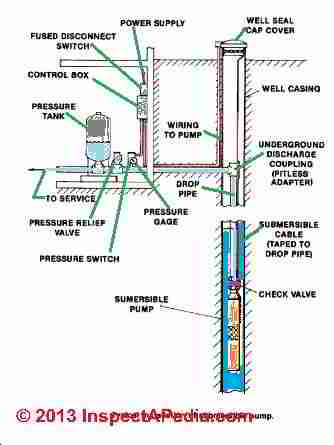
The illustration at left was provided courtesy of Carson Dunlop Associates, Inc., a Toronto, Ontario education, engineering & home inspection firm.
IF the tank and pump replacement have completely fixed the symptom you were having, then the contractor seems to have made the correct repair. However given the sequence that you describe, we understand from your email that you'd suspect that there was nothing wrong with the pressure tank and that the problem, all along, was the well pump.
If the contractor were skilled and diagnosed that a bad tank was hastening the demise of or even causing the demise of the well pump, it would be poor practice to replace only the pump. Good plumbing practice (or good practice in any diagnostic and repair procedure) is to identify the underlying cause of a problem so that the correct repair can be made.
While a more sophisticated analysis (perhaps using an ammeter to look at current on the pump circuit, for example), might have detected at the outset that it was the pump that needed replacing, it is very common in all trades for a repair person to first replace, among the possible causes of a problem, the items which are less costly and most accessible - in this case, the water pressure tank. (Presuming your pump is a submersible down in the well.)
Save and examine plumbing parts that were removed for replacement
Look at the water pressure tank that was removed - it may be possible to open it and confirm for yourself that the bladder was shot.
A water pump that has been removed can be tested on a test bench; in some cases it is economical to bring a pump to an electric motor repair shop for analysis and repair.
Why don't people do this? There are not enough such shops around, and second, people don't want to wait a week with no water while their pump is being repaired.
How to check on the success and reliability - the "prognosis" of a an expensive well pump and water pressure tank repair job
First of all, there should be no leaks, anywhere, on the equipment which was repaired. If something was left wet, wipe it off and check for leaks. We don't pay my plumber if s/he leaves her/his work leaking. We call the boss.
Second, everything worked-on should be working normally to your eye and ear.
An expert plumber or well contractor can check the operation of your system by a combination of observation and electrical testing, such as measuring the amperage draw on the well pump circuit during pump operation. If these parameters are in normal range you should be ok insofar as the equipment is concerned. Your repair person should have made these checks. Ask him or her.
If you have been in the home for several years you should have an idea whether or not you've had a history of the well running out of water. You can understand more about your well and how the well itself is performing by noting its technical statistics such as well depth, water level, pump depth, static head, and well flow rate - topics we discuss at this website. If it is determined that you have a low-yield well, there are several solutions besides just drilling a new well - itself a shot in the dark.
...
Continue reading at WELL PUMP / TANK REPAIR ADEQUACY or select a topic from the closely-related articles below, or see the complete ARTICLE INDEX.
Or see these
Recommended Articles
- NO WATER PRESSURE
- WATER PRESSURE LOSS DIAGNOSIS & REPAIR - home
- WATER PUMP CONTROLS & SWITCHES - home
- WATER PUMP REPAIR GUIDE - home
- WATER TANK: USES, TROUBLESHOOTING - home
- WELL WATER PRESSURE DIAGNOSIS - home
- WELL WATER PRESSURE IMPROVEMENT
Suggested citation for this web page
WATER PRESSURE REPAIR CORRECTLY? at InspectApedia.com - online encyclopedia of building & environmental inspection, testing, diagnosis, repair, & problem prevention advice.
Or see this
INDEX to RELATED ARTICLES: ARTICLE INDEX to WATER SUPPLY, PUMPS TANKS WELLS
Or use the SEARCH BOX found below to Ask a Question or Search InspectApedia
Ask a Question or Search InspectApedia
Try the search box just below, or if you prefer, post a question or comment in the Comments box below and we will respond promptly.
Search the InspectApedia website
Note: appearance of your Comment below may be delayed: if your comment contains an image, photograph, web link, or text that looks to the software as if it might be a web link, your posting will appear after it has been approved by a moderator. Apologies for the delay.
Only one image can be added per comment but you can post as many comments, and therefore images, as you like.
You will not receive a notification when a response to your question has been posted.
Please bookmark this page to make it easy for you to check back for our response.
Our Comment Box is provided by Countable Web Productions countable.ca
Citations & References
In addition to any citations in the article above, a full list is available on request.
- Mark Cramer Inspection Services Mark Cramer, Tampa Florida, Mr. Cramer is a past president of ASHI, the American Society of Home Inspectors and is a Florida home inspector and home inspection educator. Mr. Cramer serves on the ASHI Home Inspection Standards. Contact Mark Cramer at: 727-595-4211 mark@BestTampaInspector.com
- John Cranor [Website: /www.house-whisperer.com ] is an ASHI member and a home inspector (The House Whisperer) is located in Glen Allen, VA 23060. He is also a contributor to InspectApedia.com in several technical areas such as plumbing and appliances (dryer vents). Contact Mr. Cranor at 804-873-8534 or by Email: johncranor@verizon.net
- Access Water Energy, PO Box 2061, Moorabbin, VIC 3189, Australia, Tel: 1300 797 758, email: sales@accesswater.com.au Website: http://www.accesswater.com.au/
Moorabbin Office: Kingston Trade Centre, 100 Cochranes Rd, Moorabbin, VIC 3189
Australian supplier of: Greywater systems, Solar power to grid packages, Edwards solar systems, Vulcan compact solar systems, water & solar system pumps & controls, and a wide rage of above ground & under ground water storage tanks: concrete, steel, plastic, modular, and bladder storage tanks. - Grove Electric, Typical Shallow Well One Line Jet Pump Installation [PDF], Grove Electric, G&G Electric & Plumbing, 1900 NE 78th St., Suite 101, Vancouver WA 98665 www.grovelectric.com - web search -7/15/2010 original source: http://www.groverelectric.com/howto/38_Typical%20Jet%20Pump%20Installation.pdf
- Grove Electric, Typical Deep Well Two Line Jet Pump Installation [PDF], Grove Electric, G&G Electric & Plumbing, 1900 NE 78th St., Suite 101, Vancouver WA 98665 www.grovelectric.com - web search -7/15/2010 original source: http://www.groverelectric.com/howto/38_Typical%20Jet%20Pump%20Installation.pdf
- Water Fact Sheet #3, Using Low-Yielding Wells [ copy on file as /water/Low_Yield_Wells_Penn_State.pdf ] - , Penn State College of Agricultural Sciences, Cooperative Extension, School of Forest Resources, web search 07/24/2010, original source: http://pubs.cas.psu.edu/FreePubs/pdfs/XH0002.pdfmaterials, clogging, etc.
- Our recommended books about building & mechanical systems design, inspection, problem diagnosis, and repair, and about indoor environment and IAQ testing, diagnosis, and cleanup are at the InspectAPedia Bookstore. Also see our Book Reviews - InspectAPedia.
- In addition to citations & references found in this article, see the research citations given at the end of the related articles found at our suggested
CONTINUE READING or RECOMMENDED ARTICLES.
- Carson, Dunlop & Associates Ltd., 120 Carlton Street Suite 407, Toronto ON M5A 4K2. Tel: (416) 964-9415 1-800-268-7070 Email: info@carsondunlop.com. Alan Carson is a past president of ASHI, the American Society of Home Inspectors.
Thanks to Alan Carson and Bob Dunlop, for permission for InspectAPedia to use text excerpts from The HOME REFERENCE BOOK - the Encyclopedia of Homes and to use illustrations from The ILLUSTRATED HOME .
Carson Dunlop Associates provides extensive home inspection education and report writing material. In gratitude we provide links to tsome Carson Dunlop Associates products and services.
 | HOME | ABOUT | ASK a QUESTION | CONTACT | CONTENT USE POLICY | DESCRIPTION | POLICIES | PRIVACY | |
| © 2024 - 1985 Publisher InspectApedia.com - Daniel Friedman | |||||||||