
InspectAPedia® FREE Encyclopedia of Building & Environmental Construction, Diagnosis, Maintenance & Repair |
Question? Just ask us! InspectAPedia
|
 HUD letter Outlines FHA Repair, Inspection, & Water Testing Requirements
- POST a QUESTION or COMMENT about FHA & HUD water & well test requirements
HUD letter on water well test requirements. Here is the December 2005 US HUD letter outlining the current water testing requirements for people who are seeking FHA mortgage financing in the purchase of a home.
InspectAPedia tolerates no conflicts of interest. We have no relationship with advertisers, products, or services discussed at this website.
FHA & HUD Well Water Test Requirements - 2005 HUD LETTER
December 19, 2005
US HUD FHA MORTGAGEE LETTER 2005- ML-48
TO: ALL APPROVED MORTGAGEES & ALL APPROVED APPRAISERS
 FHA
Repair and Inspection Requirements for existing properties and revisions to FHA
Appraisal Protocol
FHA
Repair and Inspection Requirements for existing properties and revisions to FHA
Appraisal Protocol
In September 2005, the Federal Housing Administration (FHA) issued Mortgagee Letter 2005-34, which announced the adoption of four of Fannie Mae’s revised appraisal reporting forms as well as the release of Revised Appendix D of Handbook 4150.2, CHG-1.
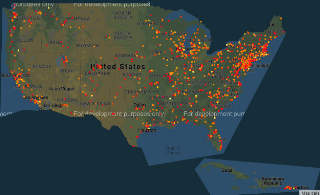
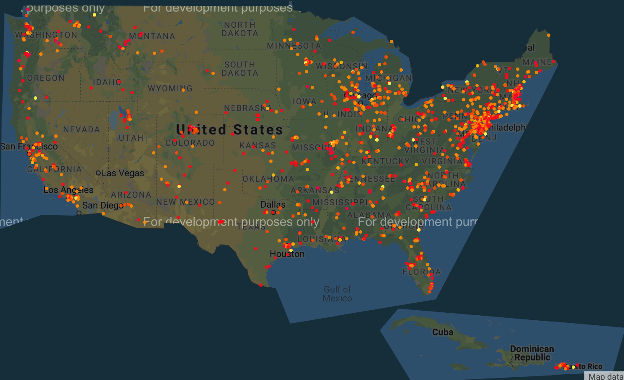
The map of US sites of contaminated waterways as shown here, discussed in more detail at WATER QUALITY TEST CHOICES & WATER TEST FEES
This Mortgagee Letter provides additional guidance regarding FHA’s repair and inspection requirements for existing properties and the use of the Fannie Mae appraisal reporting forms.
All appraisal guidance for new construction that serves as security for FHA-insured mortgages remains unchanged beyond the clarification in the Revised Appendix D that the appraiser may appraise a home that is under construction and that is 90% or more complete without benefit of plans and specifications.
In a continuing effort to reform and standardize its appraisal requirements, FHA has shifted from its historical emphasis on the repair of minor property deficiencies and now only requires repairs for those property conditions that rise above the level of cosmetic defects, minor defects or normal wear and tear.
FHA Roster Appraisers are reminded to report all readily observable property deficiencies, as well as any adverse conditions discovered performing the research involved in completing the appraisal, within the appraisal reporting form.
Lenders should use professional judgment and rely upon prudent underwriting practices in determining when a property condition poses a threat to the safety of an occupant and/or jeopardizes the soundness and structural integrity of the property, such that additional inspections and/or repairs are necessary.
Revisions to the appraisal reporting guidance contained in Chapters 2 and 3 of Handbook 4150.2, CHG-1 are limited to those described in this Mortgagee Letter and Mortgagee Letter 2005-34 and Revised Appendix D. The specific areas of guidance that are rescinded by this Mortgagee Letter are delineated below. FHA intends to retire and replace Handbook 4150.2, CHG-1 in the near future.
Repair Requirements
As stated in Revised Appendix D, FHA now permits an "as-is" appraisal for existing properties that serve as security for FHA-insured mortgages when minor property deficiencies, which generally result from deferred maintenance and normal wear and tear, do not affect the safety of the occupants or the security and soundness of the property.
FHA no longer requires repairs for these types of minor cosmetic deficiencies to bring a property into compliance with FHA Minimum Property Requirements.
Specifically, the guidance provided in Handbook 4150.2, CHG-1, Chapter 3, Paragraph 3-6, A-7 referencing all-weather road surfaces; Paragraph 3-6, A-8 referencing poor workmanship; Paragraph 3-6, A-11 referencing debris and trash in crawl space; Paragraph 3-6, A-16 referencing steps without a handrail; Paragraph 3-6, C referencing bare floors, badly soiled carpeting and cracked plaster and sheetrock is no longer applicable.
Additionally, the guidance provided in Handbook 4905.1, REV-1, Chapter 2, Paragraph 2-7, A-2 referencing all weather road surfaces; Paragraph 2-8 referencing poor workmanship and Paragraph 2-14, C referencing crawl spaces with debris and trash is no longer applicable.
Any reference to the Valuation Condition form (form HUD-92564-VC) and protocol for its completion contained in Handbook 4150.2 is no longer applicable as well.
Examples of minor property conditions that no longer require automatic repair for existing properties include, but are not limited to:
- Missing handrails
- Cracked or damaged exit doors that are otherwise operable
- Cracked window glass
- Defective paint surfaces in homes constructed post 1978
- Minor plumbing leaks (such as leaky faucets)
- Defective floor finish or covering (worn through the finish, badly soiled carpeting)
- Evidence of previous (non-active) Wood Destroying Insect/Organism damage where there is no evidence of un repaired structural damage
- Rotten or worn out counter tops
- Damaged plaster, sheetrock or other wall and ceiling materials in homes constructed post- 1978
- Poor workmanship
- Trip hazards (cracked or partially heaving sidewalks, poorly installed carpeting)
- Crawl space with debris and trash
- Lack of an all weather driveway surface
Examples of property conditions that may represent a risk to the health and safety of the occupants or the soundness of the property for which FHA will continue to require automatic repair for existing properties include, but are not limited to:
- Inadequate access/egress from bedrooms to exterior of home
- Leaking or worn out roofs (if 3 or more layers of shingles on leaking or worn out roof, all existing shingles must be removed before re-roofing)
- Evidence of structural problems (such as foundation damage caused by excessive settlement)
- Defective paint surfaces in homes constructed pre-1978
- Defective exterior paint surfaces in home constructed post-1978 where the finish is otherwise unprotected.
Lenders must review the appraisal to determine whether the appraiser has reported any property conditions that will affect the health and safety of the occupants or the security and the soundness of the property and must require immediate repair where the property condition poses a threat to these criteria.
Inspection Requirements
FHA no longer mandates automatic inspections for the following items and/or conditions in existing properties:
Wood Destroying Insects/Organisms: inspection required only if evidence of active infestation, mandated by the state or local jurisdiction, if customary to area, or at lender’s discretion
Well (individual water system): test or inspection required if mandated by state or local jurisdiction; if there is knowledge that well water may be contaminated; when the water supply relies upon a water purification system due to presence of contaminants; or when there is evidence of:
- Corrosion of pipes (plumbing)
- Areas of intensive agriculture within ¼ mile
- Coal mining or gas drilling operations within ¼ mile
- Dump, junkyard, landfill, factory, gas station, or dry cleaning operation within ¼ mile
- Unusually objectionable taste, smell or appearance of well water
(superceding the guidance in Mortgagee Letter 95-34 that requires well water testing in the absence of local or state regulations)
Septic: test or inspection required only if evidence of system failure, if mandated by state or local jurisdiction, if customary to the area, or at lender’s discretion
Flat and/or unobservable roof
Consequently, the guidance provided in Handbook 4150.2, Chapter 3, Paragraph 3-6, A-6 referencing mandatory termite inspections for any structure that is ground level and for any structure where wood touches the ground; Paragraph 3-6, A-5 referencing mandatory well and septic tests; and Paragraph 3-6, A-12 referencing mandatory inspections for a flat roof is no longer applicable.
Additionally, the guidance provided in Handbook 4905.1, REV-1, Chapter 2, Paragraph 2-5, B-1 referencing mandatory well water tests is no longer applicable. In cases where well tests are necessary, as described above, FHA’s existing testing standards outlined in Chapter 3, Paragraph 3-6, A-5a. of Handbook 4150.2 remain in effect and supercede Mortgagee Letter 95-34.
If the appraiser reports a potential property deficiency that may pose a threat to the safety of the occupants or the security and soundness of the property, the lender will require an inspection of the condition to determine whether repairs are necessary to mitigate or resolve the problem.
- Examples of conditions that will continue to require automatic inspections include, but are not limited to:
- Standing water against the foundation and/or excessively damp basements
- Hazardous materials on the site or within the improvements
- Faulty or defective mechanical systems (electrical, plumbing, or heating)
- Evidence of possible structural failure (e.g., settlement or bulging foundation wall)
Additional Changes to Appendix D, Valuation Protocol
As a result of these changes in FHA’s repair and inspection requirements for existing properties, Revised Appendix D of Handbook 4150.2, CHG-1 has been updated. The following pages in Revised Appendix D have been updated to reflect these changes: 2, 4, 19, 23, 27, 50, 55, 60, 85, 92, 112, 116 and 120. Revised Appendix D is attached to this Mortgagee Letter and will be available online at:
http://www.hudclips.org/cgi/index.cgi
Conditional Commitment Form
Mortgagee Letter 2005-34 instructed the mortgagee to provide a copy of the completed form HUD-92800.5B (Conditional Commitment Direct Endorsement Statement of Appraised Value) to the mortgagor at least five business days prior to loan closing. The five-business day delivery date prior to loan closing of the Conditional Commitment form is hereby rescinded and lenders are instructed to ensure that the mortgagor receives either a completed copy of HUD 92800.5B, or a copy of the completed appraisal report, at or before loan closing.
This Mortgagee Letter is effective for all appraisals performed on or after January 1, 2006.
If you have any questions regarding this Mortgagee Letter, please contact your local Home ownership Center (HOC) in Atlanta (888) 696-4687, Denver (800) 543-9378, Philadelphia (800) 440-8647, or Santa Ana (888) 827-5605.
Sincerely,
Brian
D. Montgomery
Assistant
Secretary for Housing
Federal
Housing Commissioner
Attachment
...
Continue reading at WATER TESTING ADVICE or select a topic from the closely-related articles below, or see the complete ARTICLE INDEX.
Or see these
Recommended Articles
- WATER QUALITY TEST CHOICES & WATER TEST FEES - how to decide what to test for in your water supply
Suggested citation for this web page
US FHA HUD WATER TESTING ADVICE at InspectApedia.com - online encyclopedia of building & environmental inspection, testing, diagnosis, repair, & problem prevention advice.
Or see this
INDEX to RELATED ARTICLES: ARTICLE INDEX to WATER TESTING
Or use the SEARCH BOX found below to Ask a Question or Search InspectApedia
Ask a Question or Search InspectApedia
Questions & answers or comments about FHA & HUD water & well test requirements .
Try the search box just below, or if you prefer, post a question or comment in the Comments box below and we will respond promptly.
Search the InspectApedia website
Note: appearance of your Comment below may be delayed: if your comment contains an image, photograph, web link, or text that looks to the software as if it might be a web link, your posting will appear after it has been approved by a moderator. Apologies for the delay.
Only one image can be added per comment but you can post as many comments, and therefore images, as you like.
You will not receive a notification when a response to your question has been posted.
Please bookmark this page to make it easy for you to check back for our response.
Our Comment Box is provided by Countable Web Productions countable.ca
Citations & References
In addition to any citations in the article above, a full list is available on request.
- [1] Drinking Water from Household Wells - PDF, U.S. EPA, Original source last retrieved 2/13/2013, original source: http://www.epa.gov/privatewells/pdfs/household_wells.pdf
- Website Contents and layout © 2010 Daniel Friedman, all rights reserved. The contents of the FHA document reproduced at this individual web page are a public document reproduced here in response to questions from readers who asked what are the current water test requirements for FHA mortgage applications?
- Access Water Energy, PO Box 2061, Moorabbin, VIC 3189, Australia, Tel: 1300 797 758, email: sales@accesswater.com.au Website: http://www.accesswater.com.au/
Moorabbin Office: Kingston Trade Centre, 100 Cochranes Rd, Moorabbin, VIC 3189
Australian supplier of: Greywater systems, Solar power to grid packages, Edwards solar systems, Vulcan compact solar systems, water & solar system pumps & controls, and a wide rage of above ground & under ground water storage tanks: concrete, steel, plastic, modular, and bladder storage tanks. - Grove Electric, Typical Shallow Well One Line Jet Pump Installation [PDF], Grove Electric, G&G Electric & Plumbing, 1900 NE 78th St., Suite 101, Vancouver WA 98665 www.grovelectric.com - web search -7/15/2010 original source: http://www.groverelectric.com/howto/38_Typical%20Jet%20Pump%20Installation.pdf
- Grove Electric, Typical Deep Well Two Line Jet Pump Installation [PDF], Grove Electric, G&G Electric & Plumbing, 1900 NE 78th St., Suite 101, Vancouver WA 98665 www.grovelectric.com - web search -7/15/2010 original source: http://www.groverelectric.com/howto/38_Typical%20Jet%20Pump%20Installation.pdf
- Our recommended books about building & mechanical systems design, inspection, problem diagnosis, and repair, and about indoor environment and IAQ testing, diagnosis, and cleanup are at the InspectAPedia Bookstore. Also see our Book Reviews - InspectAPedia.
- In addition to citations & references found in this article, see the research citations given at the end of the related articles found at our suggested
CONTINUE READING or RECOMMENDED ARTICLES.
- Carson, Dunlop & Associates Ltd., 120 Carlton Street Suite 407, Toronto ON M5A 4K2. Tel: (416) 964-9415 1-800-268-7070 Email: info@carsondunlop.com. Alan Carson is a past president of ASHI, the American Society of Home Inspectors.
Thanks to Alan Carson and Bob Dunlop, for permission for InspectAPedia to use text excerpts from The HOME REFERENCE BOOK - the Encyclopedia of Homes and to use illustrations from The ILLUSTRATED HOME .
Carson Dunlop Associates provides extensive home inspection education and report writing material. In gratitude we provide links to tsome Carson Dunlop Associates products and services.
 | HOME | ABOUT | ASK a QUESTION | CONTACT | CONTENT USE POLICY | DESCRIPTION | POLICIES | PRIVACY | |
| © 2024 - 1985 Publisher InspectApedia.com - Daniel Friedman | |||||||||