
InspectAPedia® FREE Encyclopedia of Building & Environmental Construction, Diagnosis, Maintenance & Repair |
Question? Just ask us! InspectAPedia
|
 Hand Dug Water Well Depth
When is the Well Deep Enough?
- POST a QUESTION or COMMENT & advice about the needed depth of dug wells & on Hand Dug Water Wells as a source of drinking water
This article series offers advice for Hand Dug Water Wells and the sanitation and maintenance concerns with this water supply type. This article describes the process of digging a well to provide usable water and the steps taken to make the well safe and sanitary.
InspectAPedia tolerates no conflicts of interest. We have no relationship with advertisers, products, or services discussed at this website.
The Dug Well at 11 Meters Deep - Deciding When Deep is Deep-Enough
Alvin Starkman M.A., LL.B., Casa Machaya, Oaxaca Bed and Breakfast.
This article describes the process of digging a well to provide usable water and the steps taken to make the well safe and sanitary. We include both technical advice and a description of the practical problems that one must encounter and overcome in providing usable water in an area where public water supply is absent or limited.
[Click to enlarge any image]
Readers should also review Hand Dug Wells what are they, can they be sanitary and safe?
Fermín lived up to billing, in short order digging down to over 11 meters. [In the U.S. and Canada most dug wells stop at about 10 meters or around 30 feet deep.]
It took over an hour every morning to pump out the water from the night before. Then Fermín disappeared. He just didn’t show up one Monday morning, and didn’t answer his cellular for a few days. Eventually he did respond, and advised that he’d return in two weeks. Five weeks later he was back, advising that we’d probably have to go another three meters down.
After three or four days of digging, Fermín told me that he would not be returning. He said that it was now taking him about two hours in the morning to pump out the water before he could begin digging, and that there was about five meters of water to be removed.
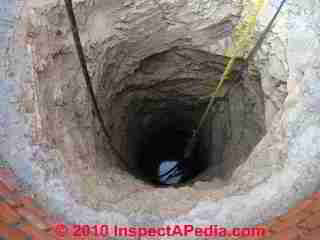
Our well photo (left) shows the rocky sides thorough which Fermín had been chiseling.
To Fermín that signified that the well would produce sufficient water for our requirements and that there was no need to dig further. To me that meant we had ourselves an honest pozero who could have continued (he didn’t have another job pending, since my friend had altered his plans regarding using Fermín in the foreseeable future), but let us know it wasn’t necessary for him to continue.
As is often the custom with trades in Oaxaca, a brief “discussion” ensured about how much we owed him (measuring his progress by lowering a stone attached to a rope to the bottom of the well, and then using a tape measure), followed by the friendly departure of Fermín & Son.
How Much Water Will our Dug Well Deliver?
Question: how many liters of water can the well produce in a 24-hour period
I'm at about 10 meters depth, well diameter about 1.4 meters. At 4 pm when the digger stops for the day (by hand hammering through rock with a mallet and chisel), he drains the water.
At 9 am the next day the well has 1.6 meters of water in it. I intend to complete digging further into the dry season. However, based on the above data, how many liters of water can the well produce in a 24 hour period?
By way of update, the pozero returned at about 11.15 meters, and said we'd need another three meters or so. Then a week later he said he's finished, that in the morning there is 5 meters of water and it takes two hours to pump it out, so for sure we don't need more.
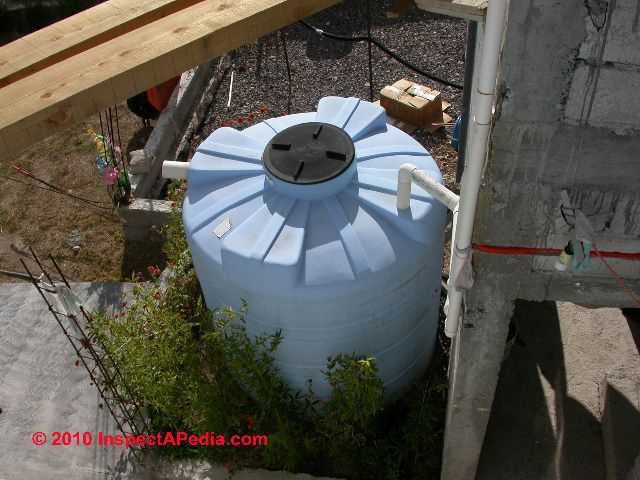
Our photo (left) shows a plastic water storage tank under construction in San Miguel de Allende, Mexico. Where a well flow rate is limited, water storage is often necessary to provide good water flow to the building served.
Answer: well water quantity is a rather easy calculation, if you have the data and know what the measurements mean
Most code compliance and health officials want to see 3-5 gallons per minute. You've got about 0.6 gpm. We would try to keep good potable water piping out of contact with other non potable piping - the concern is that events like loss of pump or pressure can back-contaminate between the two. Also, a submersible pump will be the most powerful way to lift water - depending on how high you need to raise it you might want that.
An accurate answer to th question of how much water is in a well needs to address both the static head or volume of water in a well when it is at rest and not in use (see Static Head of Water in the Well), as well as the flow rate or yield: the rate at which water flows into the well opening. This is also called the well recovery rate. Together these tell us how much water is actually available from a well -the WELL YIELD, SAFE LIMITS.
At WELL FLOW RATE we provide a detailed calculation of how much water we expect this dug well to yield, measured in gallons per day, per hour, or per minute of water flow. Excerpts from that article are just below:
Well Flow Rate = gph
The Well Flow Rate for a water well of any type is normally expressed in gallons per hour or gph that water enters the well from surrounding soils. We calculate a well's flow rate measured in gph by dividing the quantity of water in the well (we calculated that just above, right?) by the number of hours it took for that water to enter the well.
Well Flow Rate = Gallons / Hours - or gph, gallons per hour or water flow rate into the well, provided that no one is taking water out of the well during this same interval.
Mr. Starkman made it easy by telling us that the well was pumped dry at 4PM. He measured the water depth and well diameter and kept track of how much time had passed (17 hours).
From our well volume formulas above we know that starting with zero water, after 17 hours the well contained 650 gallons of water.
For this example, 650gallons / 17hours = 38 gallons per hour (gph) - this is the well flow rate for a 17 hour period for this particular well.
Converting the well flow rate in gph to flow rate in gallons per minute is important in matching the well pump rate to the well's safe yield.
Well Flow Rategpm = Well Flow Rategph / 60
For our dug well example, 38 gph / 60 = 0.63 gpm - this is the measured well flow rate in gallons per minute.
In this case that's a weak, marginal well flow rate - just over half a gallon per minute. In the U.S. most building or health departments who must approve a private well water supply when issuing a final certificate of occupancy for new construction want to see 3 to 5 gallons per minute or 3-5 gpm.
Watch out: if you install a pump whose pumping rate exceeds the well yield or flow rate, the pump may run dry and be damaged.
The risk of pump damage is greater in a well that has a small static head or in conditions under which the pump is left running for long periods so that the static head is likely to be exhausted. If you have this risk or this problem on a well, see the advice on protecting pumps given
Pumps & Controls: Moving Water from the Dug Well to Point of Use
 I have to work through decisions regarding pumping directly into our 17,000 liter cistern, or first into a smaller cistern and then up to the main one (in case we can drink it with or without treatment I wouldn't want to mix it with the unsanitary municipal water), or have "Y" tubing so I can divert into a smaller cistern whenever I want OR send it directly to the main cistern, etc.
Note on pumps: for pushing water from a dug well up a steep hill to point of use, you will probably want a pump with good lift capacity, such as a submersible unit, combined with a water pressure tank or additional water storage higher on the property.
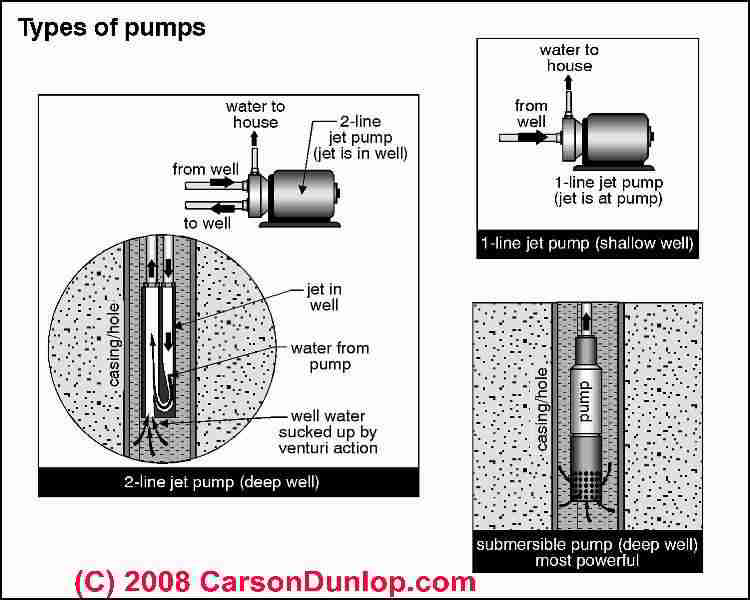
At left our sketch of a types of well water pumps is courtesy of Carson Dunlop Associates, a Toronto home inspection, education & report writing tool company [ carsondunlop.com ]. The drawing shows the key differences between a one line jet pump, two line jet pump, and a submersible water pump.
See WATER PUMP LIFE EXPECTANCY for a discussion of types of well pumps.
Also see WATER TREATMENT EQUIPMENT CHOICES for alternative methods of assuring that water from a dug well remains sanitary and potable, and see WATER PUMP LIFE EXPECTANCY for choices on methods for moving water from a dug well to storage tanks or to the point of use.
Hand Dug Well Construction Procedure
The links below provide the details of how to dig and construct a hand dug water well.
Reader Comments & Q&A
(Oct 3, 2017) kephas said:
how should a constructed instrument to measure water level increase be calibrated
Question: how far down will I have to dig to get water in a dug well that has been out of use?
(Aug 7, 2012) John said:
I Have an excisting dug well that my father in law use to pump water to his home, and had not been in use since 1990. i have recently dug 2 meters of sand and have hit clay at 10 and a half meters. am i getting close to water?
Reply:
John,
Unfortunately I can't say how close your hand dug well is to water. The geology and location of water varies enormously among different areas of the town, county, state, country, world. Even the thickness of the clay you've hit will vary. But 10 1/2 meters is quite deep - I would not be working at such a well without expert help and advice - the risk of a cave-in alone could kill you.
Best to ask some local well excavators or well drillers what their experience has been with finding water at what quantity at what depth in your immediate area. The well driller may try a test bore for you to determine just how much deeper the well would need to be to hit an adequate water supply.
Often in Mexico I've seen old dug wells into which a bored well was later sunk right through the bottom of the original dug well.
...
Continue reading at WELL ARCH: BUILDING or select a topic from the closely-related articles below, or see the complete ARTICLE INDEX.
Or see these
Recommended Articles
- HAND DUG WELLS - home
- HAND DUG WELL PROCEDURE
- SAFETY WARNINGS for WELL DIGGERS
- BUILD A HAND DUG WELL
- DECIDING TO DIG a WELL: QUESTIONS
- CHOOSE WELL LOCATION & DIGGING METHOD
- BEGIN DIGGING THE WELL
- SUSPEND DIGGING THE WELL: WET SEASON
- WELL RINGS: WHEN TO USE or OMIT
- DUG WELL DEPTH: HOW DEEP IS ENOUGH?
- DUG WELL WATER QUANTITY: HOW MUCH IS ENOUGH?
- WELL ARCH: BUILDING
- WELL SAFETY WALL & COVER
- DUG WELL POTABILITY TEST
- DUG WELL SANITATION PROTECTION
- HAND DUG WELL WATER in PHUKET
- STATIC HEAD of WATER in the WELL
- WELL YIELD DEFINITION
Suggested citation for this web page
DUG WELL DEPTH: HOW DEEP IS ENOUGH? at InspectApedia.com - online encyclopedia of building & environmental inspection, testing, diagnosis, repair, & problem prevention advice.
Or see this
INDEX to RELATED ARTICLES: ARTICLE INDEX to WATER SUPPLY, PUMPS TANKS WELLS & SPRINGS
Or use the SEARCH BOX found below to Ask a Question or Search InspectApedia
Ask a Question or Search InspectApedia
Try the search box just below, or if you prefer, post a question or comment in the Comments box below and we will respond promptly.
Search the InspectApedia website
Note: appearance of your Comment below may be delayed: if your comment contains an image, photograph, web link, or text that looks to the software as if it might be a web link, your posting will appear after it has been approved by a moderator. Apologies for the delay.
Only one image can be added per comment but you can post as many comments, and therefore images, as you like.
You will not receive a notification when a response to your question has been posted.
Please bookmark this page to make it easy for you to check back for our response.
Our Comment Box is provided by Countable Web Productions countable.ca
Citations & References
In addition to any citations in the article above, a full list is available on request.
- Alvin Starkman, Casa Machaya, Oaxaca Bed and Breakfast, Sierra Nevada 164, Col. Loma Linda, Oaxaca, Oaxaca 68024, Mexico, cel: 0449515057793, casa: (951) 1328203, For inquiries, rates and reservations, email Casa Machaya at oaxacadream@hotmail.com
Mr. Starkman is a retired Toronto attorney who operates the Casa Machaya bed and breakfast in Oaxaca Mexico. Mr. Starkman has written more than 90 articles about life and cultural traditions in Oaxaca, Mexico, and writes here about well digging from a lay person's perspective. This hand dug well procedure article describes the process of digging a well to provide usable water and the steps taken to make the well safe and sanitary. We include both technical advice and a description of the practical problems that one must encounter and overcome in providing usable water in an area where public water supply is absent or limited. |
Quoting:
Our Oaxaca bed and breakfast provides a spacious full level of our hillside home, with panoramic vistas, complete privacy, and all amenities. We’re both child and senior friendly. In fact if traveling with infants or young children, we’re pleased to offer the use of a quality crib with all accessories, high chair, car seat and stroller. Contact us for further details including babysitting.
Your Canadian hosts spent four years building their home using a Oaxacan architect so you’re assured of classic Mexican flare, color and design, yet with all the conveniences of home without any cultural surprises. Our traditional adobe-stone-brick construction, and our breezy location just above the city’s downtown area ensure moderate temperatures year-round. Awake to the sounds of rooster calls and typical music echoing across the valley, yet you’re only minutes from the zócalo, the heart of downtown Oaxaca with its art galleries, museums, colonial churches and restaurants. Our accommodations combine the service and comfort of a modern Oaxaca hotel, with the personal touch of a quaint country inn. - Carlos Soberman, San Miguel de Allendex, Mexico kindly contributed the photograph of flooding during the rainy season in Mexico. Februray 2010.
- "Comparison of large and small diameter wells", Natural Resources Management & Environment Department, Food and Agriculture Organization of the United Nations, FAO Corporate Document Repository - Self-Help Wells - see http://www.fao.org/docrep/X5567E/x5567e04.htm
- Hand pumps for wells, product sources:
- Dempster Industries is a contemporary manufacturer of hand pumps for shallow wells or hand dug wells. At http://www.dempsterinc.com/html/Handpump.html you can find Dempster Industries who can tell you exactly how to repair mechanical problems with your well pump. Here is the Dempster installation manual for a typical hand pump used on shallow wells or dug wells: http://www.dempsterinc.com/PDF%20FIles/Typical%20Hand%20Pump%20Installation.pdf
Water Supply & Drain Piping, Wells, Pumps, Water Supply Equipment
- Access Water Energy, PO Box 2061, Moorabbin, VIC 3189, Australia, Tel: 1300 797 758, email: sales@accesswater.com.au Website: http://www.accesswater.com.au/
Moorabbin Office: Kingston Trade Centre, 100 Cochranes Rd, Moorabbin, VIC 3189
Australian supplier of: Greywater systems, Solar power to grid packages, Edwards solar systems, Vulcan compact solar systems, water & solar system pumps & controls, and a wide rage of above ground & under ground water storage tanks: concrete, steel, plastic, modular, and bladder storage tanks. - Grove Electric, Typical Shallow Well One Line Jet Pump Installation [PDF], Grove Electric, G&G Electric & Plumbing, 1900 NE 78th St., Suite 101, Vancouver WA 98665 www.grovelectric.com - web search -7/15/2010 original source: http://www.groverelectric.com/howto/38_Typical%20Jet%20Pump%20Installation.pdf
- Grove Electric, Typical Deep Well Two Line Jet Pump Installation [PDF], Grove Electric, G&G Electric & Plumbing, 1900 NE 78th St., Suite 101, Vancouver WA 98665 www.grovelectric.com - web search -7/15/2010 original source: http://www.groverelectric.com/howto/38_Typical%20Jet%20Pump%20Installation.pdf
- Our recommended books about building & mechanical systems design, inspection, problem diagnosis, and repair, and about indoor environment and IAQ testing, diagnosis, and cleanup are at the InspectAPedia Bookstore. Also see our Book Reviews - InspectAPedia.
- In addition to citations & references found in this article, see the research citations given at the end of the related articles found at our suggested
CONTINUE READING or RECOMMENDED ARTICLES.
- Carson, Dunlop & Associates Ltd., 120 Carlton Street Suite 407, Toronto ON M5A 4K2. Tel: (416) 964-9415 1-800-268-7070 Email: info@carsondunlop.com. Alan Carson is a past president of ASHI, the American Society of Home Inspectors.
Thanks to Alan Carson and Bob Dunlop, for permission for InspectAPedia to use text excerpts from The HOME REFERENCE BOOK - the Encyclopedia of Homes and to use illustrations from The ILLUSTRATED HOME .
Carson Dunlop Associates provides extensive home inspection education and report writing material. In gratitude we provide links to tsome Carson Dunlop Associates products and services.
 | HOME | ABOUT | ASK a QUESTION | CONTACT | CONTENT USE POLICY | DESCRIPTION | POLICIES | PRIVACY | |
| © 2024 - 1985 Publisher InspectApedia.com - Daniel Friedman | |||||||||