
InspectAPedia® FREE Encyclopedia of Building & Environmental Construction, Diagnosis, Maintenance & Repair |
Question? Just ask us! InspectAPedia
|
 Suspending Digging a
Hand Dug Water Well in Wet Weather
Suspending Digging a
Hand Dug Water Well in Wet Weather
- POST a QUESTION or COMMENT about the procedure for digging & constructing hand-dug water wells
Digging a well by hand: suspend digging in wet weather.
This article describes the a consideration (wet weather and well digger safety) in process of digging a well to provide usable water and the steps taken to make the well safe and sanitary. We include both technical advice and a description of the practical problems that one must encounter and overcome in providing usable water in an area where public water supply is absent or limited.
InspectAPedia tolerates no conflicts of interest. We have no relationship with advertisers, products, or services discussed at this website.
Suspension of Well Digging in the Wet Season
 Alvin Starkman M.A., LL.B., Casa Machaya, Oaxaca Bed and Breakfast.
This article series offers advice for Hand Dug Water Wells and the sanitation and maintenance concerns with this water supply type.The article author, Alan Starkman is a retired Toronto attorney who operates the Casa Machaya bed and breakfast in Oaxaca Mexico. Mr. Starkman writes here about well digging from a lay person's perspective.
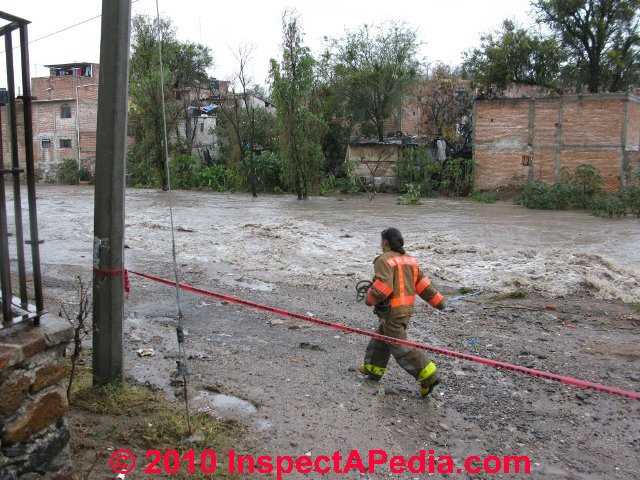
Photo at left courtesy of Carlos Soberman, San Miguel de Allende, Mexico
[Click to enlarge any image]
To Every Time, There is a Season: A Season to Dig, A Season to Suspend
In order to get a true reading of the volume of water one can expect to extract from a well, at the worst of times, the digging should proceed and certainly conclude as close to the end of the dry season as possible.
That’s when the water table is the lowest. Digging during the rainy season is more difficult (though the ground is softer), and certainly concluding the digging during or after the rainy season does not provide an accurate measure of the water one can expect to be able to obtain from the well when times are tough – very dry.
We had become both jaded, and admittedly a bit lax about the whole thing, nevertheless feeling a greater sense of urgency as the months passed. Media reports and advisories from ADOSAPACO, the water commission, contributed to our increasing anxiety.
Photo (above-left) courtesy of Carlos Soberman, San Miguel de Allende, Mexico.
We lamented our unfortunate experience to a neighbor. Amador had done odd jobs around the house for us, such as watering plants while we were away, weeding our garden and planting corn, beans and squash. He was trustworthy, to the point where we had called upon his wife and daughter to baby sit for guests in the house with young children.
Amador was a teacher. However, given teachers’ salaries, he was always open to working on projects which would enable him to make extra cash. Amador agreed to continue digging the well, on his own, for 3,000 pesos per meter. Sometimes one of his sons would accompany him. He had no experience, except that he knew how to descend and ascend a ladder, and use a hammer and chisel. His son would lift the broken stone in the bucket using the pulley, and if he wasn’t available, Amador would do it all himself.
Making a Dug Well Well Deeper
A friend finished digging a well a couple of years earlier, only to learn that he had not completed the work late enough in the dry season. He then had to dig a further three meters. Even after this additional work, he learned that there was not sufficient water for the needs of his family and workshop, even after having dug deeper.
It’s not uncommon for Oaxacans to have to dig down deeper every so often, as changes to the water table occur, for I would imagine a couple of main reasons; more wells having been dug close by, and climactic change. Another friend initially had a nine meter well, and now it’s 13 meters.
the Dug Well at Six Meters Deep - Will We Find Enough Water?
The 2009 rainy season was about to begin. Amador exclaimed at the conclusion of a weekend day that he felt humidity at one side of the well, now at about six meters. There had always been concerns: what if there isn’t water down there, or what if we have to go twenty meters. Amador assured us that what he felt wasn’t simply a consequence of the commencement of the rains. At the same time he asked us for more money, stating that it was becoming more difficult, and now dangerous, being down so deep, and with rain loosening the rock. I told him that I wasn’t prepared to pay more now, but when the project was finished I would bump up the pay retroactively from that point in time (number of meters), to 3,500 pesos.
We became more confident in Amador’s assessment that indeed there would be water, when one day he asked us to buy a pump, tubing and other accessories to get the water out of the well so as to enable him to continue digging. I ran out and bought everything Amador had requested, late that Saturday afternoon when the building material supply stores were getting ready to close.
So what if it cost another 4,000 pesos in equipment; we were in business; we had water, in our minds a gusher. And if the pump was only provisional in that eventually we would need a higher horsepower more efficient submersible apparatus, then so be it. And when Amador told us that the chisel points had been broken, of course we’d go back to the herrero, with pleasure, and have them forged again.
Amador worked into the beginning of the rainy season, until he stated he could no longer continue, but would return in three or four months to finish the job. We were at about eight meters, thrilled, and anxious to finish. Our thoughts began to turn to matters such as flow rate and ultimate depth we should go, water analysis, particulars of the pump we would have to install on a permanent basis, and electrical current for it, and several other issues which had been pointed out to us over the past couple of years.
Multiple Electrical Meters can Cut Electrical Bills
By chance, about this time, either fortunately or unfortunately we were having some major electrical work done around the house. In Mexico, you’re allowed to have more than one hydro meter for a single family home, to reduce your electricity costs. Our builder neglected to tell us this, and more importantly that for a large home, with only one meter, the cost would be significant because one pays a premium for electricity after a certain level of consumption. Our electrician, Maestro Ricardo was changing the wiring so as to accommodate five meters instead of only one. It’s akin to income splitting with one’s spouse or child to reduce the top marginal tax rate, but perfectly legal.
Maestro Ricardo was working away at dividing our electrical current into different circuits, when I asked him about the advisability of having a meter dedicated to the well pump and a couple of other outlets on our party terrace near the bottom of the hill. He thought it was a wise idea. He suggested a 220 volt outlet rather than 110, and proceeded to do the wiring for our well pump.
Continuing the Well Digging Project After the Rainy Season
Fermín, a Pozero Finishes Digging the Well in Loma Linda, Oaxaca
Amador never returned, even though he continues to be our neighbor. However a friend who had begun digging his own well recommended someone else for us, Fermín. He told me he would not need Fermín to finish his well until about May, 2010, and that we could use him until then, the driest part of the dry season.
That served us just fine. We met with Fermín and his son in early 2010, agreed to 3,500 pesos per meter, and a tentative start date. Fermín was the first actual “pozero,” or well digger, that we had used. He had dedicated himself to digging wells by hand for the past 17 years, and was teaching his son the trade.
“You’ll have to get these chisels sharpened again. They’re no good to me like they are. And don’t worry about the ladder. We don’t need it. I do need some thicker rope, though, and we might need more tubing if you’ll want to use the water we pump out to water all your fruit trees.”
Hand Dug Well Construction Procedure
The links below provide the details of how to dig and construct a hand dug water well
...
Continue reading at DUG WELL DEPTH: HOW DEEP IS ENOUGH? or select a topic from the closely-related articles below, or see the complete ARTICLE INDEX.
Or see these
Recommended Articles
- HAND DUG WELLS - home
- HAND DUG WELL PROCEDURE
- SAFETY WARNINGS for WELL DIGGERS
- BUILD A HAND DUG WELL
- DECIDING TO DIG a WELL: QUESTIONS
- CHOOSE WELL LOCATION & DIGGING METHOD
- BEGIN DIGGING THE WELL
- SUSPEND DIGGING THE WELL: WET SEASON
- WELL RINGS: WHEN TO USE or OMIT
- DUG WELL DEPTH: HOW DEEP IS ENOUGH?
- DUG WELL WATER QUANTITY: HOW MUCH IS ENOUGH?
- WELL ARCH: BUILDING
- WELL SAFETY WALL & COVER
- DUG WELL POTABILITY TEST
- DUG WELL SANITATION PROTECTION
- HAND DUG WELL WATER in PHUKET
Suggested citation for this web page
SUSPEND DIGGING THE WELL: WET SEASON at InspectApedia.com - online encyclopedia of building & environmental inspection, testing, diagnosis, repair, & problem prevention advice.
Or see this
INDEX to RELATED ARTICLES: ARTICLE INDEX to WATER SUPPLY, PUMPS TANKS WELLS & SPRINGS
Or use the SEARCH BOX found below to Ask a Question or Search InspectApedia
Ask a Question or Search InspectApedia
Questions & answers or comments about finding, using, diagnosing, repairing, or replacing water pressure gauges on private well systems.
Try the search box just below, or if you prefer, post a question or comment in the Comments box below and we will respond promptly.
Search the InspectApedia website
Note: appearance of your Comment below may be delayed: if your comment contains an image, photograph, web link, or text that looks to the software as if it might be a web link, your posting will appear after it has been approved by a moderator. Apologies for the delay.
Only one image can be added per comment but you can post as many comments, and therefore images, as you like.
You will not receive a notification when a response to your question has been posted.
Please bookmark this page to make it easy for you to check back for our response.
Our Comment Box is provided by Countable Web Productions countable.ca
Citations & References
In addition to any citations in the article above, a full list is available on request.
- Alvin Starkman, Casa Machaya, Oaxaca Bed and Breakfast, Sierra Nevada 164, Col. Loma Linda, Oaxaca, Oaxaca 68024, Mexico, cel: 0449515057793, casa: (951) 1328203, For inquiries, rates and reservations, email Casa Machaya at oaxacadream@hotmail.com
Mr. Starkman is a retired Toronto attorney who operates the Casa Machaya bed and breakfast in Oaxaca Mexico. Mr. Starkman has written more than 90 articles about life and cultural traditions in Oaxaca, Mexico, and writes here about well digging from a lay person's perspective. This hand dug well procedure article describes the process of digging a well to provide usable water and the steps taken to make the well safe and sanitary. We include both technical advice and a description of the practical problems that one must encounter and overcome in providing usable water in an area where public water supply is absent or limited. |
Quoting:
Our Oaxaca bed and breakfast provides a spacious full level of our hillside home, with panoramic vistas, complete privacy, and all amenities. We’re both child and senior friendly. In fact if traveling with infants or young children, we’re pleased to offer the use of a quality crib with all accessories, high chair, car seat and stroller. Contact us for further details including babysitting.
Your Canadian hosts spent four years building their home using a Oaxacan architect so you’re assured of classic Mexican flare, color and design, yet with all the conveniences of home without any cultural surprises. Our traditional adobe-stone-brick construction, and our breezy location just above the city’s downtown area ensure moderate temperatures year-round. Awake to the sounds of rooster calls and typical music echoing across the valley, yet you’re only minutes from the zócalo, the heart of downtown Oaxaca with its art galleries, museums, colonial churches and restaurants. Our accommodations combine the service and comfort of a modern Oaxaca hotel, with the personal touch of a quaint country inn.
- Mark Cramer Inspection Services Mark Cramer, Tampa Florida, Mr. Cramer is a past president of ASHI, the American Society of Home Inspectors and is a Florida home inspector and home inspection educator. Mr. Cramer serves on the ASHI Home Inspection Standards. Contact Mark Cramer at: 727-595-4211 mark@BestTampaInspector.com
- John Cranor [Website: /www.house-whisperer.com ] is an ASHI member and a home inspector (The House Whisperer) is located in Glen Allen, VA 23060. He is also a contributor to InspectApedia.com in several technical areas such as plumbing and appliances (dryer vents). Contact Mr. Cranor at 804-873-8534 or by Email: johncranor@verizon.net
- Carlos Soberman, San Miguel de Allendex, Mexico kindly contributed the photograph of flooding during the rainy season in Mexico. Februray 2010.
- "Comparison of large and small diameter wells", Natural Resources Management & Environment Department, Food and Agriculture Organization of the United Nations, FAO Corporate Document Repository - Self-Help Wells - see http://www.fao.org/docrep/X5567E/x5567e04.htm
- Hand pumps for wells, product sources:
- Dempster Industries is a contemporary manufacturer of hand pumps for shallow wells or hand dug wells. At http://www.dempsterinc.com/html/Handpump.html you can find Dempster Industries who can tell you exactly how to repair mechanical problems with your well pump. Here is the Dempster installation manual for a typical hand pump used on shallow wells or dug wells: http://www.dempsterinc.com/PDF%20FIles/Typical%20Hand%20Pump%20Installation.pdf
- Our recommended books about building & mechanical systems design, inspection, problem diagnosis, and repair, and about indoor environment and IAQ testing, diagnosis, and cleanup are at the InspectAPedia Bookstore. Also see our Book Reviews - InspectAPedia.
- In addition to citations & references found in this article, see the research citations given at the end of the related articles found at our suggested
CONTINUE READING or RECOMMENDED ARTICLES.
- Carson, Dunlop & Associates Ltd., 120 Carlton Street Suite 407, Toronto ON M5A 4K2. Tel: (416) 964-9415 1-800-268-7070 Email: info@carsondunlop.com. Alan Carson is a past president of ASHI, the American Society of Home Inspectors.
Thanks to Alan Carson and Bob Dunlop, for permission for InspectAPedia to use text excerpts from The HOME REFERENCE BOOK - the Encyclopedia of Homes and to use illustrations from The ILLUSTRATED HOME .
Carson Dunlop Associates provides extensive home inspection education and report writing material. In gratitude we provide links to tsome Carson Dunlop Associates products and services.
 | HOME | ABOUT | ASK a QUESTION | CONTACT | CONTENT USE POLICY | DESCRIPTION | POLICIES | PRIVACY | |
| © 2024 - 1985 Publisher InspectApedia.com - Daniel Friedman | |||||||||