
InspectAPedia® FREE Encyclopedia of Building & Environmental Construction, Diagnosis, Maintenance & Repair |
Question? Just ask us! InspectAPedia
|
 Diagnose & Repair Loss of Water Pressure from Municipal or Well Water Supply
- POST a QUESTION or COMMENT about troubleshooting total loss of water pressure in buildings
How to fix complete loss of water or water pressure/flow at a building:
This article describes how to diagnose the total loss of water pressure and the need for water control, tank, piping, water supply main pipe & valve, or water well repairs.
We discuss: Loss of municipal water pressure or flow - diagnostic guide. Loss of well water pressure or flow - diagnostic steps. How to diagnose loss of water pressure or loss of water in a building.
The process of diagnosis and the costs of the repair are explained. Consumer advice on saving money on well repair costs is given here and includes a review of the parts and labor costs of a typical well pump and pressure tank replacement case.
InspectAPedia tolerates no conflicts of interest. We have no relationship with advertisers, products, or services discussed at this website.
No Water Pressure or Flow? Diagnosis of Loss of Water Pressure which Does Not Recover on its Own
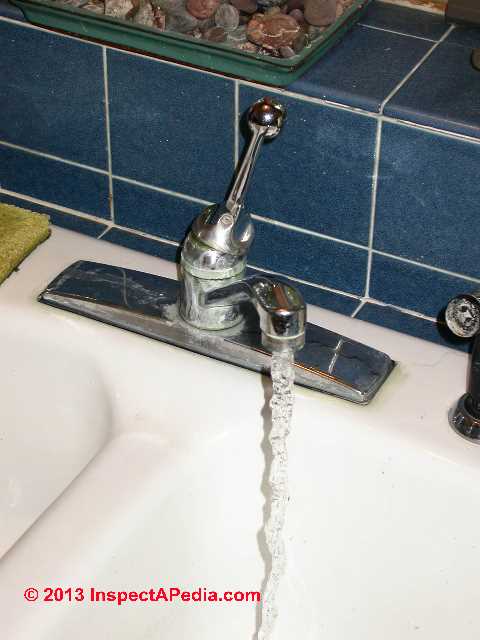
 Here we give basic diagnosis for cases where you lose water pressure and it does not recover. Water flow in the building simply stops dead.
By contrast with these "no water at all" causes, if water pressure in the building gets very low or stops but later recovers,
you have an intermittent or other water system problem and you should see a different diagnostic procedure found
at WATER PRESSURE INTERMITTENT LOSS
Guide to Repair of Lost Water Pressure for Homes Supplied by Municipal or Community Water
- Does water pressure come back on its own after some time has passed?
See WATER PRESSURE INTERMITTENT LOSS - Is the Main Water Valve on? Has someone shut off the main water valve? Has someone been messing with the water pressure regulator?
This is an adjustable water pressure which is often (not always) present on the piping at a municipal water supply pipe entry point ?
If you cannot find your main water shutoff valve see WATER SHUTOFF VALVE LOCATION - Has water been shut off in the neighborhood: is water off in your neighborhood. Sometimes work on the water mains leads to a shut down of all water in an area.
Check with your neighbors and your water department. - Is there a burst pipe? A pipe may be burst somewhere you don't see such as in a wall, crawl space, basement, or even outdoors.
Listen at your water pipes for the sound of running water. - Is there a frozen pipe? In freezing climates, even in a heated building a pipe might run through a cold location where freezing can stop water supply entirely or in a part of the building.
- Is there water pressure but the pressure and/or flow are poor?
- See WATER PRESSURE REDUCER / REGULATOR
- See BAD WATER PRESSURE CLOGGED PIPES and also WATER PIPE CLOG REPAIR
- See if a water filter is installed and check to see if it has become clogged.
See WATER FILTERS, HOME USE.
- See our detailed water pressure diagnostic list
at: WATER PRESSURE LOSS DIAGNOSIS & REPAIR
Guide to Repair of Lost Water Pressure for Homes Supplied by a Well
 If the building water supply stops and takes minutes to hours to recover, you may have problem with the well flow rate. But the problem of lost water supply and pressure could be
more mechanical: a bad well pump.
If the building water supply stops and takes minutes to hours to recover, you may have problem with the well flow rate. But the problem of lost water supply and pressure could be
more mechanical: a bad well pump.
The well pump, in turn, could have been damaged or hastened to the end of its life by a bad water pressure tank which has caused well pump short-cycling.
Short cycling of the pump motor can burn up the pump relay control.
First Check the Pump and Well Basics:
- Is electrical power on at the pump:
is power on for the water pump? Is the water pump running at all? Did lightning hit your pump or well? - Is the pump running?
If water pressure is below the pump CUT-IN pressure and the pump has power but doesn't turn on,
see WATER PUMP WON'T START - Is the water main turned off:
Has someone shut off the main water valve? - Is there a burst pipe?
A pipe may be burst somewhere you don't see such as in a wall, crawl space, basement, or even outdoors. Listen at your water pipes for the sound of running water. - Is there a frozen pipe?
In freezing climates, even in a heated building a pipe might run through a cold location where freezing can stop water supply entirely or in a part of the building. - See our detailed diagnostic list
at: WATER PRESSURE LOSS DIAGNOSIS & REPAIR - Well or water supply piping leaks:
If inside the well there is a leaky or broken water line rising from the well pump, the pump could run but deliver less or no water to the building. If this defect is present, the system will not recover to normal operation on its own.
For example, if a well piping connection in the well becomes totally disconnected or the pipe bursts this condition occurs. - Water pump failure or damage:
If the well pump keeps running and you have no water it is also possible that the pump itself is defective, such as having broken internal parts so that the motor runs but the pump does not move water.
But if the impeller blades in the pump are broken, the system would never recover. You'd have either no water or only very low pump output no matter what conditions in the well.
If the water pump keeps running and you have no water it is also possible that you have a problem with the well or well piping or foot valve in the well -- maybe. See contrasting cases after this list.
Watch out: Turn off the water pump
so that you don't burn out the motor. Some water pumps depend on having water inside the pumping mechanism to avoid wear or overheating.
Lost prime:
Your well pump might have lost its prime - if the the well pump is not actually down inside the well, it probably needs water inside the well casing to start things going.
See WELL PUMP PRIMING PROCEDURE.
A shallow well jet pump well line could have a bad foot valve (in the well) and so be losing prime. A leak in the well line can also lead to loss of prime.
See PUMP PRIME, REPEATED LOSS of for a discussion of well piping foot valves. - If the well pump keeps running and won't turn off, but you do have water pressure
in the home, possibly reduced water pressure, there could be several causes, but ultimately it means that either the pressure switch is not turning off the pump when it should, or the pump is not able to pump water pressure up to its cut-out setting.
A well pump pressure switch failure
can also cause the water pump to fail to turn off - say if someone has adjusted that control to ask the pump for higher pressure than it can achieve.
If no one has adjusted the pressure control switch, it could still be a problem if its pressure sensor is clogged with debris or if another problem is keeping it from turning off.
See STEP 6 below.
Well flow deteriorated:
This symptom may also occur if the well flow rate has deteriorated - that is, water is running from the ground into your well more slowly than your pump pumps it out.
You might see this especially if you have just installed a new, more powerful well pump on an older well that previously seemed just fine.
Or it may occur in dry weather or for other reasons such as nearby blasting that has changed the ground water level.
See WATER PRESSURE LOSS DIAGNOSIS & REPAIR
Well piping leak
This symptom may also occur if there is a leak in well piping between well and building - the well pump in the well may be working fine but not all of the water is reaching the building because it's leaking into the earth or back into the well.
See WATER PRESSURE LOSS DIAGNOSIS & REPAIR
and
See PUMP PRIME, REPEATED LOSS of for a discussion of well piping foot valves.
Well pump damage:
the well pump may be damaged itself, a broken impeller or an air leak - preventing it from reaching full pressure.
See WATER PRESSURE LOSS DIAGNOSIS & REPAIR - If the water pump has shut itself off
and the pump motor does not restart, the well pump may have tripped an internal or external overload switch, circuit breaker, or fuse.
Check the fuse or circuit breakers
supplying power to the water pump.
Check the pump motor reset button:
If the pump motor is accessible look on the motor for a red or yellow reset button that may have popped "up" indicating that the motor's overload protection circuit has activated.
When the pump motor cools you may be able to reset this button and the pump may run and deliver water but further diagnosis is needed as this problem will recur.
Check that the pressure control switch
is trying to turn on the pump - see the next step below.
Check the pump wiring and starter capacitor.
See JET PUMP TROUBLESHOOTING GUIDE for more tips for a well pump that won't start. - Problems with the well pump water pressure control switch:
such as sticking "on" or "off" or working irregularly may be diagnosed by these articles:- How to Adjust Water Pump Pressure:
The detailed, step by step procedure for inspecting and adjusting the water pressure control switch is discussed in detail
at WATER PRESSURE CONTROL SWITCH ADJUSTMENTS. - Diagnosing Water Pump Short Cycling on and off:
If your water pump is clicking on and off too often or quite rapidly
see SHORT CYCLING. - Diagnosing Water Pressure Drops
without explanation when the pump stops,
see WATER PRESSURE FALLS SLOWLY, ERRATIC PUMP: bad pressure control switch, building water running or leak, bad pressure gauge, bad check valve, bad foot valve. - Diagnosing & Repairing Lost Air in the Water Tank
The problem of lost air in the water pressure tank along with how to correct that condition are discussed beginning
at SIGNS OF AIR LOSS. - Diagnosing & Repairing a Water Pressure Control or Water Pump Control Switch
We discuss diagnosing and repairing a water pressure control switch that sticks "on" or "off" or simply won't operate,
at WATER PUMP PRESSURE SWITCH REPAIRS
- How to Adjust Water Pump Pressure:
- If the pump is inside the well
you can't see these conditions directly but an electrician or plumber can do some diagnosis from the building by noting the amperage draw on the pump circuit. - Problems with well casing or well flow and recovery -
loss of ground water and many other causes of loss of water are discussed at our comprehensive article:
WATER PRESSURE LOSS DIAGNOSIS & REPAIR - Problems with water treatment equipment can cause loss of water pressure or no water flow:
a completely clogged water filter, or a malfunction in water disinfection or other water treatment equipment can cause a reduction in water pressure or a complete stop in water flow in a building.
For example a UV ULTRAVIOLET LIGHT WATER TREATMENT system may include an automatic shut-off valve (a "normally closed solenoid") that turns off water flow in the building if the UV bulb burns out or falls too low in intensity.
Also see WATER FILTERS, HOME USE for details about clogged filters,
and see WATER TREATMENT EQUIPMENT CHOICES for our complete list of types of water treatment equipment. - Is there water pressure but the pressure and/or flow are poor?
- See WATER PRESSURE REDUCER / REGULATOR
- See BAD WATER PRESSURE CLOGGED PIPES & WATER PIPE CLOG REPAIR
- See WATER FILTERS, HOME USE if you have a water filter installed
- If water pressure is intermittent or varies in flow rate,
see WATER PRESSURE INTERMITTENT LOSS - See our detailed water pressure diagnostic list at:
WATER PRESSURE LOSS DIAGNOSIS & REPAIR
If the pump is running but you have no water pressure, or if your water is supplied by a municipal water system,
Reader Comments, Questions & Answers About The Article Above
Below you will find questions and answers previously posted on this page at its page bottom reader comment box.
Reader Q&A - also see RECOMMENDED ARTICLES & FAQs
On 2020-08-16 by Peggie Williams - good pressure at the tank, no pressure in the house
I have 50 lbs of water pressure at tanks above well. The house has minimal amount of pressure sporadically. sometimes great pressure other times cant take a shower? any suggestions
On 2020-08-16 by (mod)
I suspect that either your tank gauge is debris clogged and not reading pressure accurately or your pressure control switch itself is clogged and not turning on when it should - or both.
On 2020-08-10 by Linda Morgan - lost hot water at one tub
My hot water tap on the bath just stopped running hot water. It stopped for 3 weeks then it started running again. Every other tap hot and cold in the house was ok. One thing I noticed though was the dish washer had loads of debris like bits of plastic and orange peel. Stuff that looked like it had come out of the garbage and there was dirty cloudy water in the filters..... what's going on?
On 2020-08-11 - by (mod) -
Sounds like a hot water valve elbow or line clogged.
I have encountered this problem when the plastic dip tube in the water heater actually disintegrated, producing a lot of plastic debris that then flowed through and clogged portions of hot water system
On 2020-05-23 by Anonymous - no water pressure after doing plumbing work
We just had new lines put in upstairs and after turning water back on at the main we have NO water pressure I. The kitchen or in the downstairs toilet. What could cause that?
On 2020-05-23 - by (mod) -
Anon:
Let's check first for someone having closed a water valve that they forgot to re-open.
Follow the water pipes from the point of entry into the building, looking for shutoff valve (s). Be sure they are in the "open" position (turned counter-clockwise).
Let me know if you need more help.
On 2020-03-26 by Anonymous - water pressure OK, then it just stops
My water works fine and then it stops running all together what could be the problem
On 2020-03-26 - by (mod) -
Anon
Probably the problem is one of those listed in the checklist above on this page; could be a well running out of water or a pump control that sticks or ... something else.
On 2019-12-26 by tonya - how do we test the in-well pump?
how are you able to test a pump in the well we have power going to the pump we are unable to see the pressure gauge but I know that we had pressure in the hoses going to washer and hot water heater but we just all of a sudden lost water with no problems before hand .
On 2019-12-27 - by (mod) -
Tonya
There are some basic electrical tests that a trained service tech can do before pulling the pump out of the well. Those can check for
1. electrical wire damage such as a cut or open wire or wires shorted together or wires shorted to ground
2. pump current draw in Amps that can tell us that the motor is seized or that it is running dry (not under water)
On 2019-02-19 by Anonymous - pump switch keeps starting when voltage fluctuats
why the automatic water pump controller is starting frequently on every voltage fluctuation?
On 2019-02-19 - by (mod) -
Anon
Most likely the cause is one of those listed in the Diagnostics given under well pump short cycling that you will find in the ARTICLE INDEX just about
On 2018-12-18 by Jeff R - causes of drop in city water pressure
I have a 8 month old house and recently the water pressure has dropped significantly.
I assumed it was due to more houses being built in the area and more demand. i have turned the pressure regulator up but it has no affect, so i returned it to its original position. In conjunction with this, the city supplied water will just stop 100 percent for 5-20 seconds and then return.
Any ideas as who to talk to or where the problem may be would be helpful. Kindest regards, Jeff
On 2018-12-26 - by (mod) -
I would check with the city about the continuity of their delivery of water pressure. Stopping for a few seconds as you describe does not sound like a, Municipal Water Supply issue. Can you tell me if there's a booster pump anywhere in the delivery system ?
On 2018-05-01 by Tim Reeves - no water after installing new water heater
Turned the water main off in the crawl space to change hot water heater. Installed new heater turned the main back on and have no water coming back into the house. Any suggestions would be appreciated.
On 2018-05-01 - by (mod) -
Sounds as if there was a hidden problem such as a leaky well pipe or foot valve, so while pump was turned off you lost pump prime. See WELL PUMP PRIMING PROCEDURE
for one way to proceed. That article links to alternative pump priming methods.
...
Continue reading at WATER PRESSURE PROBLEM DIAGNOSIS TABLE or select a topic from the closely-related articles below, or see the complete ARTICLE INDEX.
Or see NO WATER PRESSURE DIAGNOSTIC FAQs - questions & answers posted originallly on this page
Or see these
Recommended Articles
- WATER PRESSURE BAD at SOME FIXTURES
- WATER PRESSURE FALLS BRIEFLY THEN STOPS
- WATER PRESSURE FALLS SLOWLY, ERRATIC PUMP
- WATER PRESSURE INTERMITTENT LOSS
- WATER PRESSURE LOSS DIAGNOSIS & REPAIR - home
- WATER PRESSURE TABLE 1: PUMP WON'T RUN, WON'T STOP, or CYCLES
- WATER PRESSURE TABLE 2: PUMP RUNS, WEAK or NO WATER PRESSURE
- WATER PRESSURE TABLE 3: PUMP RUNS, NO WATER or INSUFFICIENT WATER
- WATER PRESSURE STOPS, RETURNS
- WATER PUMP PRIMING PROCEDURE
- WATER PUMP WON'T START
- WATER PUMP WON'T STOP RUNNING
Suggested citation for this web page
NO WATER PRESSURE at InspectApedia.com - online encyclopedia of building & environmental inspection, testing, diagnosis, repair, & problem prevention advice.
Or see this
INDEX to RELATED ARTICLES: ARTICLE INDEX to WATER SUPPLY, PUMPS TANKS WELLS
Or use the SEARCH BOX found below to Ask a Question or Search InspectApedia
Ask a Question or Search InspectApedia
Try the search box just below, or if you prefer, post a question or comment in the Comments box below and we will respond promptly.
Search the InspectApedia website
Note: appearance of your Comment below may be delayed: if your comment contains an image, photograph, web link, or text that looks to the software as if it might be a web link, your posting will appear after it has been approved by a moderator. Apologies for the delay.
Only one image can be added per comment but you can post as many comments, and therefore images, as you like.
You will not receive a notification when a response to your question has been posted.
Please bookmark this page to make it easy for you to check back for our response.
Our Comment Box is provided by Countable Web Productions countable.ca
Citations & References
In addition to any citations in the article above, a full list is available on request.
- Access Water Energy, PO Box 2061, Moorabbin, VIC 3189, Australia, Tel: 1300 797 758, email: sales@accesswater.com.au Website: http://www.accesswater.com.au/
Moorabbin Office: Kingston Trade Centre, 100 Cochranes Rd, Moorabbin, VIC 3189
Australian supplier of: Greywater systems, Solar power to grid packages, Edwards solar systems, Vulcan compact solar systems, water & solar system pumps & controls, and a wide rage of above ground & under ground water storage tanks: concrete, steel, plastic, modular, and bladder storage tanks. - Typical Shallow Well One Line Jet Pump Installation, Grove Electric, G&G Electric & Plumbing, 1900 NE 78th St., Suite 101, Vancouver WA 98665 www.grovelectric.com - web search -7/15/2010 original source: http://www.groverelectric.com/howto/38_Typical%20Jet%20Pump%20Installation.pdf, [Copy on file as /water/Jet_Pump_Grove_Elect_Jet_Pumps.pdf ] -
- Typical Deep Well Two Line Jet Pump Installation, Grove Electric, G&G Electric & Plumbing, 1900 NE 78th St., Suite 101, Vancouver WA 98665 www.grovelectric.com - web search -7/15/2010 original source: http://www.groverelectric.com/howto/38_Typical%20Jet%20Pump%20Installation.pdf, [Copy on file as /water/Jet_Pump_Grove_Elect.pdf ] - Cooperative Extension, School of Forest Resources, web search 07/24/2010, original source: http://pubs.cas.psu.edu/FreePubs/pdfs/XH0002.pdf
- Our recommended books about building & mechanical systems design, inspection, problem diagnosis, and repair, and about indoor environment and IAQ testing, diagnosis, and cleanup are at the InspectAPedia Bookstore. Also see our Book Reviews - InspectAPedia.
- In addition to citations & references found in this article, see the research citations given at the end of the related articles found at our suggested
CONTINUE READING or RECOMMENDED ARTICLES.
- Carson, Dunlop & Associates Ltd., 120 Carlton Street Suite 407, Toronto ON M5A 4K2. Tel: (416) 964-9415 1-800-268-7070 Email: info@carsondunlop.com. Alan Carson is a past president of ASHI, the American Society of Home Inspectors.
Thanks to Alan Carson and Bob Dunlop, for permission for InspectAPedia to use text excerpts from The HOME REFERENCE BOOK - the Encyclopedia of Homes and to use illustrations from The ILLUSTRATED HOME .
Carson Dunlop Associates provides extensive home inspection education and report writing material. In gratitude we provide links to tsome Carson Dunlop Associates products and services.
 | HOME | ABOUT | ASK a QUESTION | CONTACT | CONTENT USE POLICY | DESCRIPTION | POLICIES | PRIVACY | |
| © 2024 - 1985 Publisher InspectApedia.com - Daniel Friedman | |||||||||