
InspectAPedia® FREE Encyclopedia of Building & Environmental Construction, Diagnosis, Maintenance & Repair |
Question? Just ask us! InspectAPedia
|
 Diagnose Weak Water Pressure or No Water Pressure
at Buildings
- POST a QUESTION or COMMENT on diagnosing and fixing poor water pressure or on running out of water completely - what to do if the well runs dry
Troubleshooting building water pressure problems:
How to fix bad water pressure or loss of water pressure in buildings: this article describes how and why to distinguish among intermittent water pressure loss, total water pressure loss, and poor water pressure or flow in a building.
We provide a list of the causes of poor water pressure, complete loss of water pressure, irregular loss of water pressure, or water pressure that cycles or comes and goes. For each type of water pressure problem we link to more detailed diagnosis and repair procedures.
We give diagnostic and repair procedures for both municipal water supply problems and well water supply problems.
InspectAPedia tolerates no conflicts of interest. We have no relationship with advertisers, products, or services discussed at this website.
How to diagnose poor water pressure or loss of water pressure
 The process of lost water pressure diagnosis in buildings and the costs of the water pressure problem repairs are explained by this extensive catalog of the various causes of weak or total loss of water pressure.
This advice on saving money on water supply repair costs includes a review of the parts and labor costs of a typical well pump and pressure tank replacement case.
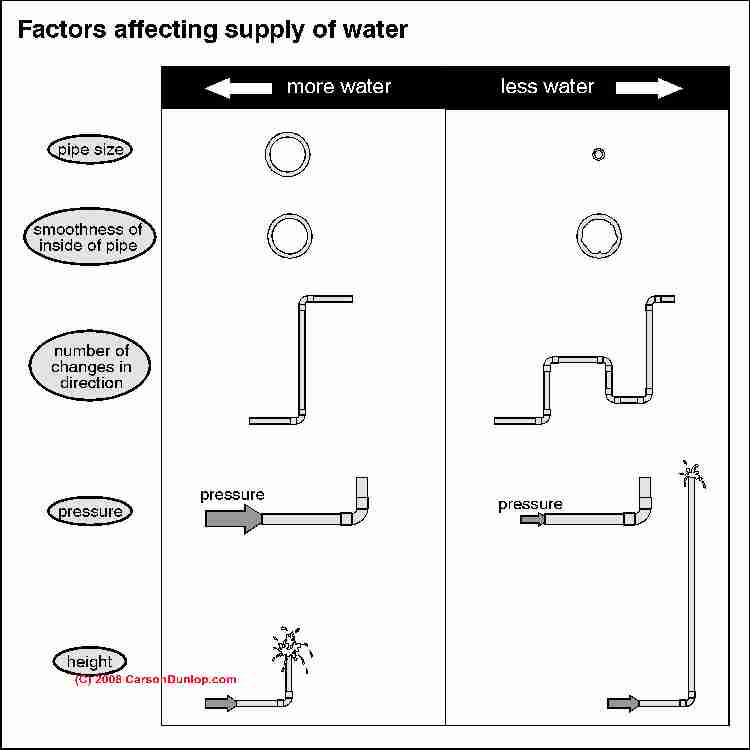
The page top sketch, courtesy of Carson Dunlop Associates, shows five factors that affect the water pressure and flow in a building. What the sketch has not included are water pressure, quantity, or flow problems that originate at the well, well pump, or water pressure tank. We discuss all of these here.
Below is our comprehensive guide to diagnosing bad water pressure. Our complete list of water pressure problem diagnosis & repair articles is at the end of this page.
If you have no water pressure at all, see NO WATER PRESSURE and see the other water pressure diagnostic articles listed just below.
- MUNICIPAL WATER PRESSURE DIAGNOSIS explains how to diagnose poor municipal or community water supply quantity or pressure
- WELL WATER PRESSURE DIAGNOSIS explains how to diagnose and correct poor private well water supply quantity or pressure.
Or see our more concise WATER PRESSURE PROBLEM DIAGNOSIS TABLE if you want a quick diagnosis by symptom without having to read much.
If your water pressure is intermittent, starts and stops, or varies in pressure,
See WATER PRESSURE INTERMITTENT LOSS and see the other water pressure diagnostic articles listed just below.
If there is some water pressure but the pressure and/or flow or water quantity are poor throughout the building see these diagnostic articles
Water supply piping problem?
See WATER PIPE CLOG DIAGNOSIS and
then
Keep in mind that if water is running elsewhere in the building (another shower, sink, dishwasher, clothes washer, garden hose, etc) then the water pressure you will observe at your location will usually be reduced.
If you have good cold water pressure but not enough hot water pressure
See HOT WATER PRESSURE IMPROVEMENT.
If you have good water pressure at some fixtures but not at others
You probably have a clog in building piping (such as due to mineral deposits, rust, or even excessive solder in new work), or mineral and debris clogged strainers at faucets and shower heads (check these first).
If your water system works for a while, but then you run out of water
and
See WELL YIELD IMPROVEMENT
Quick Guide to Diagnosing Poor Municipal Water Supply Pressure
 For our full article on diagnosing poor municipal water pressure
see MUNICIPAL WATER PRESSURE DIAGNOSIS. A summary giving excerpts of some bad city water pressure or flow diagnostic steps is just below.
Take These Extra Steps to Boost City Water Pressure & Flow at a Building: after first diagnosing the problem and ruling out the leaks, crimps, or repairs needed by the steps we have described above,
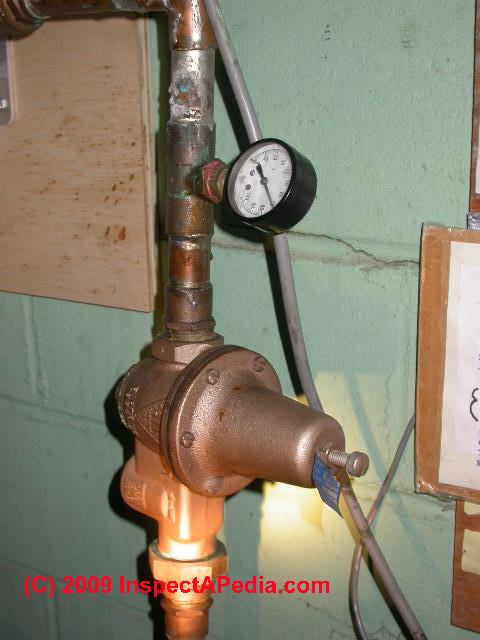
you can adjust the water pressure regulator, install a water pressure booster pump in the building, or install larger diameter water service or in building water supply piping.
Details are
at MUNICIPAL WATER PRESSURE IMPROVEMENTS.
- Double check that there is no burst pipe or leaks
in the building interior water piping - Check to see if there are leaks or crimps in the water supply pipe between the building and the city water main in the street,
and that there and no water running elsewhere before going on to more complicated water pressure diagnosis steps. - Listen for water supply service entry piping or water main leaks:
If your water is from a municipal supply and if you can turn off water right at the entry to your building, you can then listen to the piping - you may discover that there is an underground water main supply leak outside! - Check municipal water supply main pressure and flow:
Ask your plumber to measure the incoming water pressure and flow before the water pressure regulator,or with the pressure regulator set wide open. Since bad water pressure or flow can be a piping problem rather than a supply quantity problem, also
see PIPING in BUILDINGS, CLOGS, LEAKS, TYPES
and see PLASTIC PIPE LEAK CAUSES. - Water supply piping buried outdoors must be bedded in clean sand.
Where copper water supply pipes have been buried in gravel, contractors find that over time the gravel, perhaps moving by frost or water passage through the soil, actually works against the metal water piping to create multiple holes and leaks in the water main. - Poor incoming city water pressure from a community or municipal water supply?
How to boost water pressure in a building by installing a pressure booster pump and pressure tank for buildings whose incoming water pressure is too low or intermittent is discussed in detail
at WATER PRESSURE BOOSTER PUMP - Poor city water pressure due to building height?
How to boost water pressure in a building by installing a pressure booster pump and pressure tank for tall buildings is discussed
in detail at WATER PRESSURE BOOSTER PUMP - Poor municipal water pressure/flow history helps diagnose the cause.
Details are at MUNICIPAL WATER PRESSURE DIAGNOSIS. - Poor water pressure just at certain plumbing fixtures?
Poor cold water pressure, hot water pressure, or both hot and cold water pressure or flow that is observed just at some plumbing fixtures in a building while flow and quantity are good at others suggests that the water flow or pressure problems are local to certain runs of supply piping or to the specific fixtures.
Detailed examples of causes of poor water flow at just some fixtures are found
at MUNICIPAL WATER PRESSURE DIAGNOSIS. - Poor hot water pressure - weak flow:
If hot water pressure is noticeably worse than cold water pressure and flow, the problem may be due to sludge in the water heater or mineral-clogged piping or tankless coil clogging.
See HOT WATER PRESSURE IMPROVEMENT
Also see TANKLESS COILS
A water softener (WATER SOFTENERS & CONDITIONERS) won't fix mineral-clogged piping, but once that problem has been taken care of, it can prevent future clogs.
See CLOGGED SUPPLY PIPES, HOT WATER. - Shared city water supply line?
Carson Dunlop Associates Home Reference Book points out that in some cities multiple homes may share a single supply line.
Details are at MUNICIPAL WATER PRESSURE DIAGNOSIS. - Variations in building occupancy levels:
Where building demand for water flow varies widely, a single pressure reducing valve may not be able to handle the maximum water demand flow rate.
This condition occurs at buildings where there is a large water supply main to an apartment or office building whose water demand can vary enormously (0.5 gpm to 100 gpm) depending on the building occupants. Watts and other pressure reducing valve producers recommend a nice solution to this problem.
As we explain at WATER PRESSURE REDUCER / REGULATOR, parallel pressure reducing valves are sometimes installed to correct this difficulty.
Quick Guide to Diagnosing Poor Well Water or Pump Water Pressure or Flow
Our full diagnostic article for private well water pressure and flow problem diagnosis is at WELL WATER PRESSURE DIAGNOSIS.
Separately we also provide a WATER PRESSURE PROBLEM DIAGNOSIS TABLE in table format listing nearly every cause of water pressure loss or well pump problem identification, diagnosis, and repair.
If you don't care about diagnosing the well water pressure and flow problem and think it's time to move on to a simple solution
see WELL WATER PRESSURE IMPROVEMENT
The following articles pertain if you have a private well, pump, and tank system for your building or if your incoming community water supply pressure and flow are just too low to start with:
- Water Tank Problems?
See WATER PRESSURE TANK REPAIRS. Examples of water tank problems include poor water pressure or the well pump rapidly turning on and off (short cycling). - Water pump problems?
Examples of water pump problems include poor water pressure or no water pressure at all, or water pump won't start, won't stop, or fails to develop adequate water pressure. See - WATER PRESSURE CONTROL SWITCH ADJUSTMENTS - poor building water pressure or flow
- PUMP PRESSURE CONTROL REPAIR - pump is not delivering water at all, or pump won't start, pump won't stop, or water pressure is poor - see the diagnostic table
at ELECTRIC MOTOR OVERLOAD RESET SWITCH
and
see WATER PUMP ELECTRICAL SWITCHES - WATER PUMP RELAY SWITCH - submersible pump has stopped working, or won't start - for pumps that use a separate heavy duty relay switch in addition to the pressure control switch
- WATER PUMP PRIMING PROCEDURE - well pump keeps losing prime - pump runs but gives no water
- WATER PUMP PROTECTION SWITCH - your pressure control switch may shut down the pump and require manual re-setting
- WATER PUMPS & TANKS & WELLS - complete list of articles
- WATER PUMP CONTROLS & SWITCHES - complete list of well pump controls and switches, identification, diagnosis, repair.
- WATER PRESSURE GAUGE ACCURACY - maybe water pressure is fine and it's the gauge that's bad?
- Poor water pressure or no water pressure after an electrical power loss, lightning strike, or storm?
Water pressure may be lost entirely following a power loss or electrical storm or lightning strike. Check first for a blown fuse or tripped circuit breaker.
A lightning strike can also damage electrical wiring supplying a submersible pump, or it may damage the pump itself. - Water piping or well piping problems? If your water pump keeps losing prime,
a shallow well jet pump well line could have a bad foot valve in the well or there may be a bad check valve on well piping at or near the water tank or near the above-ground water pump and so be losing prime
See WELL PIPING FOOT VALVES
and
see CHECK VALVES, WATER SUPPLY, DRAINS, PUMPS
A leak in the well line piping itself can also lead to loss of prime.
See WELL PIPING LEAK DIAGNOSIS - Well Problems?
Do you run out of water or after running water for some interval water pressure and flow are poor?
Well problem diagnosis starts
at WELLS CISTERNS & SPRINGS.
Other indications of a well that is running dry include reduced water flow rather than complete stoppage of water flow, or the water may be dirty.
Before assuming that there is no water in the well, check to see if the water pump is working properly, including loss of pump
prime WATER PUMP PRIMING PROCEDURE
and a bad or leaky well piping foot valve
see WELL PIPING FOOT VALVES - Bad water pump or water tank pressure regulator control?
See WATER PRESSURE REDUCER / REGULATOR (not usually installed on private well and pump systems, often present on municipal water supply systems that use an in-building local water pump and pressure tank to boost pressure).
Before adjusting a well pump pressure control switch
details are at WATER PUMP PRESSURE CONTROL SWITCH,
changing building piping, or considering installing a water pressure booster pump
details are at WATER PRESSURE BOOSTER PUMP , it is essential to understand what the incoming water pressure is and exactly why the building water pressure is not satisfactory.
Start at the beginning of this article:
WATER PRESSURE LOSS DIAGNOSIS & REPAIR. Water pump pressure regulator switch diagnosis and repair steps include these:- How to Adjust Water Pump Pressure:
The detailed, step by step procedure for inspecting and adjusting the water pressure control switch is discussed in detail
at WATER PRESSURE CONTROL SWITCH ADJUSTMENTS. - Diagnosing Water Pump Short Cycling on and off:
If your water pump is clicking on and off too often or quite rapidly see SHORT CYCLING. - Diagnosing Water Pressure Drops
without explanation when the pump stops,
see WATER PRESSURE FALLS SLOWLY, ERRATIC PUMP: bad pressure control switch, building water running or leak, bad pressure gauge, bad check valve, bad foot valve. - Diagnosing & Repairing Lost Air in the Water Tank:
The problem of lost air in the water pressure tank along with how to correct that condition are discussed beginning at SIGNS OF AIR LOSS. - Diagnosing & Repairing a Water Pressure Control or Water Pump Control Switch:
We discuss diagnosing and repairing a water pressure control switch that sticks "on" or "off" or simply won't operate,
at WATER PUMP PRESSURE SWITCH REPAIRS
- How to Adjust Water Pump Pressure:
- Bad Hot Water Pressure?
See HOT WATER IMPROVEMENT especially if the building cold water pressure is acceptable but hot water pressure and flow are poor.
Accumulated debris in a water heater, and debris from a corroded or disintegrating hot water tank dip tube or hot water tank sacrificial anode can also block the hot water outlet opening, resulting in low hot water pressure in a building. - Bad cold or hot water pressure and flow just at certain plumbing fixtures? See our discussion
of POOR WATER PRESSURE JUST CERTAIN PLUMBING FIXTURES just above. - Bad water pressure & flow: clogged pipes due to mineral deposits, silt, solder blobs, sediment
collecting in elbows or in long horizontal runs, or even a damaged water control valve or faucet.
First check for differences in water pressure at different fixtures; remove fixture strainers, washing machine strainer, to see if water flow improves.
See BAD WATER PRESSURE CLOGGED PIPES
and
see WATER PIPE CLOG REPAIR for details. - Problems with water treatment equipment can cause loss of water pressure or no water flow:
a clogged water filter, water softener, or a malfunction in water disinfection or other water treatment equipment can cause a reduction in water pressure or even a complete stop in water flow in a building.
Iron sediment or even dirt and silt can collect in water treatment equipment such as a water softener or water conditioner resin tank, causing poor building water pressure.
See WATER SOFTENER CLEANING & SANITIZING.
Reader Comments, Questions & Answers About The Article Above
Below you will find questions and answers previously posted on this page at its page bottom reader comment box.
Reader Q&A - also see RECOMMENDED ARTICLES & FAQs
On 2021-04-19 by (mod) - rust clogging or insufficient priming of the well pump mean no water
@Cal,
The foot valve or ejector or tailpiece could be damaged by sediment or rust, yes;
Watch out: don't leave a pump running dry or it may be damaged and need repair or replacement . TURN IT OFF RIGHT AWAY.
In the ARTICLE INDEX review our procedures for priming the pump to be sure you've followed that properly.
Rust on the outside of the well casing doesn't affect the water; severe rust inside the well casing ought not affect the well water as long as the point of water pick-up in the well is several feet above the bottom of the well,
but you may want to have the well casing inspected to be sure that it's not so damaged as to need repair.
On 2021-03-29 by Cal
I have a few questions about a recently replaced well pump, but I need to provide some back story before asking.
I recently had my old deep well water pump die, possibly because it was over 30 yrs old, but maybe from some other cause. So I replaced the old pump and ejector with a new pump and ejector set. As I was doing this I noticed the deep well pipe was rusting considerably and particles of rust were present in the well water and the piping.
I decided to try and continue the replacement anyway, because I have no idea how to deal with the well casing rusting. I made sure all the connections were as tight as possible and the venturi tube was in place, lowered the assembly back down the well, hooked up the pump inside the house, and set the pressure tank to the correct pressure. I also installed a pressure regulator on top of the new pump. I primed the pump and can hear it running but water pressure has never gotten above 5-10psi, and the water I have gotten from the pump has been a bit rusty.
Now my questions are: how likely is it that the ejector is clogged/ bad from the rust, and any suggestions on testing/dealing with that? Also, one connection appeared to be leaking a very very small amount of water, and could that be enough to result in essentially 0 water pressure?
Thanks
On 2021-04-19 by (mod) - how to completely drain a water pressure tank
@vernetta lawson,
To completely drain a water pressure tank you would
1. turn off power to the pump
2. open faucets to drain pressure from the system
3. connect a hose to the tank drain valve at or near the bottom of the pressure tank
Note that it can take some time for a tank to drain when there is no air inlet to allow air to replace the water draining out;
If the tank uses an internal bladder it should drain completely but we might need to temporarily pressurise the tank to 1 or 2 psi above the original pump cut-in pressure.
Watch out: don't over-pressurize a water tank or it can burst, flooding the building and injuring or (rarely) even kill someone.
If the tank is an older bladderless water tank often there's an air valve or relief valve at or near the top of the tank that can be temporarily opened to speed water tank draining.
On 2021-01-31 by vernetta lawson
How do you get all water out of tank
On 2020-07-20 by (mod)
@ryan,
When water pressure was previously good I suspect not the pipe diameter per-se but perhaps clogging, or a loss of flow rate into the well itself.
See the diagnostic suggestions at WATER PRESSURE TABLE 2: PUMP RUNS, WEAK or NO WATER PRESSURE https://inspectapedia.com/water/Water_Pressure_Table_2.php
On 2020-07-20 by ryan
we have a well pump that after about 2 minutes the water pressure drops so low that you can't hardly even take a shower. The piping coming out of the ground is only 1".
Seems small for enough flow. However this house was built in 1960 and I'm sure this hasn't been the problem for all these years. It takes about 15 min to fill up a washing machine. Any ideas? Brand new pump and pressure tank. Piggy back style
On 2020-06-22 by (mod)
@Jill,
As like most people you use the word "water pressure" to describe how strongly water flows from the tap (really that's its flow rate), I think your reduced water flow rate problem may be due to
- the use of smaller-diameter pex tubing than the original copper or other metal pipes it replaced; I was tricked by a disappointing Poughkeepsie plumber (now pretty much out of business) when to save himself a few bucks on a fixed-cost-bid plumbing job he used 1/2" PEX everywhere, in both heating and water supply piping, resulting in a pathetic flow rate and trouble heating the addition he plumbed.
Longer runs with more bends and elbows means that the effect of smaller-diameter pipes is even more extreme.
If that's your case you can possibly improve matters by boosting the pump cut/in cut/out pressures.
- it's also possible that there is a completely different cause of poor water "pressure" - one of those listed above on this page.
Please take a look and let me know what questions remain.
On 2020-06-22 by Jill
I have a vacation mountain home fed by a community system. Water from a spring is pumped up the mountain to a cistern that supplies water for 8 homes below it. My house is at the top of the hill and closest to the cistern, but still below it. The water pressure has never been high, but after having the home's plumbing replaced with PEX and changing fixtures the water pressure is VERY low, especially in the kitchen sink tap furthest from the water inlet. The new plumbing all appears to be installed correctly, and there are no leaks in it.
The whole system appears quite old, and I am beginning to think leaks in the community supply lines from the cistern to the other homes must have leaks, and no one else is affected as much because they are much lower than me and would have more pressure. Does this sound like a reasonable explanation? Do buried lines typically develop leaks over time? I do not notice a difference in water pressure whether other folks are there using water or not. Is there a standard way that I could work with the association to test the theory? (It is quite remote and have had difficulty finding professional help.)
Thank you for any suggestions you can share!
On 2020-05-03 - by (mod) -
@Tom,
The Well-x-trol is a water pressure tank that simply evens the flow of water in the building so as to keep the pump from cycling on and off too rapidly.
It has nothing at all to do with hot water pressure.
If your hot water pressure (flow rate of hot water at the tap) has been getting weaker, AND if it's just the hot water not both hot and cold, then see
HOT WATER PRESSURE IMPROVEMENT https://inspectapedia.com/plumbing/Hot_Water_Pressure_Improvement.php
for how to diagnose and fix the trouble
On 2020-05-03 by Tom
How do you turn up your hot water on the well x trol?
On 2019-11-18 - by (mod) -
@Jona, ask your plumber to check the pressure settings at the pump pressure control switch; it's possible that a new 20/40 psi switch was installed, replacing an older 30/50 (cut-in pressure/cut-out pressure) pump pressure control.
On 2019-11-18 by Jona
We have a well that supplies two homes. We just changed out our pressure tank. We have less water pressure than when we started
On 2019-04-20 - by (mod) -
Al
I think you are describing a deep well (i.e. deeper than 27ft) using a 2-line jet pump with a venturi in the well at the bottom of the well piping and a jet pump above ground.
If there are no leaky check valves you'd know that you've filled the well piping (presumably through a prime opening in the jet pump impeller casing) by noticing that as you pour water into that opening and into the impeller chamber it no longer disappears - the chamber simply fills to the top and stays there.
You're right that it can be difficult to prime a well pipe IF the check valves in the system including in the well are leaky - as then water poured into the piping leaks out into the well and it's difficult to prime the pump.
A temporary solution is to prime the pump using an external source like a garden hose from a neighbour or to pour water like mad into the prime opening and turn on the pump to see if it can draw water and maintain flow.
If those problems of water and prime loss are recurrent you'll need to replace the leaky check valves.
On 2019-01-02 by Al
I have a deep well setup
Two questions
1. how do I know when my pump is full including the suction line.
2. Will the water leak down the return/pressure line.
Please send answers to hammond4713@gmail.com
Thank you
On 2017-05-15 by (mod) - low water pressure and pump cycling on and off
Ty
I don't think increasing the pressure control switch setting (search InspectApedia.com using the search box on this page for PRESSURE CONTROL SWITCH ADJUSTMENT) will help in this case: if the pump and water supply were able to deliver more water pressure they'd do so. More likely there is a problem with the pump or the well has lost water.
So instead, take a look at the article above on this page to see the common causes and cures.
Take a look at that information, then don't hesitate to ask further questions and I'll do my best.
Daniel
On 2017-05-14 2 by tybird
pump is only holding 15 lbs.of pressure and going on and off often. how do raise pressure setting?
...
Continue reading at WATER PRESSURE PROBLEM DIAGNOSIS TABLE or select a topic from the closely-related articles below, or see the complete ARTICLE INDEX.
Or see WATER PRESSURE LOSS DIAGNOSIS FAQs - questions & answers about water pressure problems posted originally at the end of this page.
Or see these
Recommended Articles
- CLOGGED SUPPLY PIPES, HOT WATER
- MUNICIPAL WATER PRESSURE DIAGNOSIS
- NO WATER PRESSURE
- POOR MUNICIPAL WATER PRESSURE or FLOW RATE
- POOR WELL WATER PRESSURE or FLOW RATE
- WATER FILTERS, HOME USE
- WATER PRESSURE BAD at SOME FIXTURES
- WATER PRESSURE GAUGE
- WATER PRESSURE MEASUREMENT
- WATER PRESSURE TABLE 1: PUMP WON'T RUN, WON'T STOP, or CYCLES
- WATER PRESSURE TABLE 2: PUMP RUNS, WEAK or NO WATER PRESSURE
- WATER PRESSURE TABLE 3: PUMP RUNS, NO WATER or INSUFFICIENT WATER
- WATER PRESSURE REDUCER / REGULATOR
- WATER PRESSURE TOO LOW
- WATER PRESSURE VARIATION CAUSES
- WATER PUMP CAPACITIES TYPES RATES GPM
- WATER PUMP CONTROLS & SWITCHES - home
- WELL WATER PRESSURE IMPROVEMENT
Suggested citation for this web page
WATER PRESSURE LOSS DIAGNOSIS & REPAIR at InspectApedia.com - online encyclopedia of building & environmental inspection, testing, diagnosis, repair, & problem prevention advice.
Or see this
INDEX to RELATED ARTICLES: ARTICLE INDEX to WATER SUPPLY, PUMPS TANKS WELLS
Or use the SEARCH BOX found below to Ask a Question or Search InspectApedia
Ask a Question or Search InspectApedia
Questions & Answers on diagnosing and fixing poor water pressure or on running out of water completely - what to do if the well runs dry.
Try the search box just below, or if you prefer, post a question or comment in the Comments box below and we will respond promptly.
Search the InspectApedia website
Note: appearance of your Comment below may be delayed: if your comment contains an image, photograph, web link, or text that looks to the software as if it might be a web link, your posting will appear after it has been approved by a moderator. Apologies for the delay.
Only one image can be added per comment but you can post as many comments, and therefore images, as you like.
You will not receive a notification when a response to your question has been posted.
Please bookmark this page to make it easy for you to check back for our response.
Our Comment Box is provided by Countable Web Productions countable.ca
Citations & References
In addition to any citations in the article above, a full list is available on request.
- Mark Cramer Inspection Services Mark Cramer, Tampa Florida, Mr. Cramer is a past president of ASHI, the American Society of Home Inspectors and is a Florida home inspector and home inspection educator. Mr. Cramer serves on the ASHI Home Inspection Standards. Contact Mark Cramer at: 727-595-4211 mark@BestTampaInspector.com
- John Cranor [Website: /www.house-whisperer.com ] is an ASHI member and a home inspector (The House Whisperer) is located in Glen Allen, VA 23060. He is also a contributor to InspectApedia.com in several technical areas such as plumbing and appliances (dryer vents). Contact Mr. Cranor at 804-873-8534 or by Email: johncranor@verizon.net
- Thanks to Jeneral Sewer Service - George - 845-297-2285, a New York Hudson Valley drain and sewer cleaning and de-clogging expert for technical details and consulting on drain clog diagnosis and repair, including proper use of the Kinetic Water Ram for drain clearing - 3/14/2009
- Thanks to our reader, Carole Cimitile, 2/17/2009, for reminding us that small problems like faucet o-rings, clogged faucet strainers and similar local plumbing fixture defects can have a big impact on hot water flow, cold water flow, or both hot and cold water flow and pressure problems.
- Thanks to reader EK Woodard, Boise State University, Boise ID, for assistance in diagnosing poor water pressure following an electrical power loss. 3/14/2010
- Betta-Flo JET PUMP INSTALLATION MANUAL [PDF], National Pump Co., LLC., includes helpful well pump troubleshooting tips as well as basic jet pump installation details. Web search 07/24/2010, original source: http://www.nationalpumpcompany.com/Documents/OIM/Betta%20Flo%20IOM%20Jet%20Pump.pdf
- WATER PUMP REPAIR GUIDE an specific case offers an example of diagnosis of loss of water pressure, loss of water, and analyzes the actual repair cost
- Water pressure tank failures & water pump short cycling diagnosis and repair
- Our recommended books about building & mechanical systems design, inspection, problem diagnosis, and repair, and about indoor environment and IAQ testing, diagnosis, and cleanup are at the InspectAPedia Bookstore. Also see our Book Reviews - InspectAPedia.
- In addition to citations & references found in this article, see the research citations given at the end of the related articles found at our suggested
CONTINUE READING or RECOMMENDED ARTICLES.
- Carson, Dunlop & Associates Ltd., 120 Carlton Street Suite 407, Toronto ON M5A 4K2. Tel: (416) 964-9415 1-800-268-7070 Email: info@carsondunlop.com. Alan Carson is a past president of ASHI, the American Society of Home Inspectors.
Thanks to Alan Carson and Bob Dunlop, for permission for InspectAPedia to use text excerpts from The HOME REFERENCE BOOK - the Encyclopedia of Homes and to use illustrations from The ILLUSTRATED HOME .
Carson Dunlop Associates provides extensive home inspection education and report writing material. In gratitude we provide links to tsome Carson Dunlop Associates products and services.
 | HOME | ABOUT | ASK a QUESTION | CONTACT | CONTENT USE POLICY | DESCRIPTION | POLICIES | PRIVACY | |
| © 2024 - 1985 Publisher InspectApedia.com - Daniel Friedman | |||||||||