
InspectAPedia® FREE Encyclopedia of Building & Environmental Construction, Diagnosis, Maintenance & Repair |
Question? Just ask us! InspectAPedia
|
 Accuracy of Air & Water Pressure Gauges - how to get an accurate pressure reading
What causes variation in water pressure readings at a building?
- POST a QUESTION or COMMENT about water pressure gauges and their accuracy
Water pressure gauges:
This article describes how to select and use an air or water pressure gauge to obtain accurate pressure readings, and what causes inaccurate water tank pressure gauge readings.
We explain how water gauges may become stuck or inaccurate and we suggest ways to test and repair misbehaving water pressure gauges.
InspectAPedia tolerates no conflicts of interest. We have no relationship with advertisers, products, or services discussed at this website.
How to Read Water Tank Pressure or any Pressure Gauge Accurately
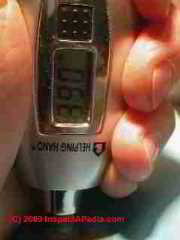
 The page top photo shows the author testing the air pressure in a Well-X-Trol bladder type well tank.
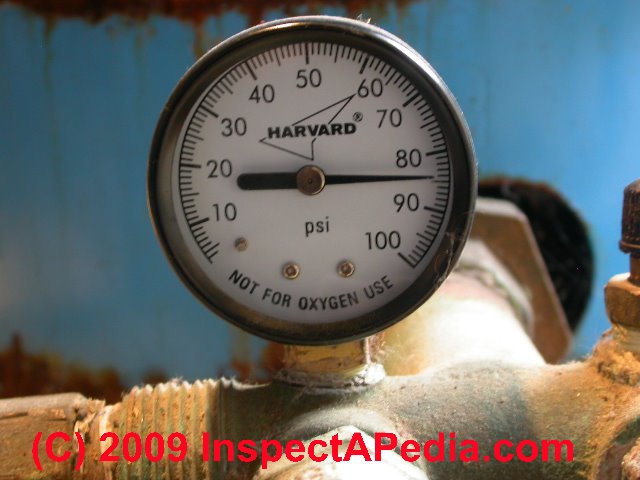
Here we show a pressure gauge reading 84 psi - something is probably wrong with this system.
This water pressure gauge is installed at the tank tee located at the bottom of a water pressure tank.
Watch out: If water pressure is really this high (that is if the gauge were not defective) we're risking plumbing leaks or even a dangerous burst water tank.
A bursting water pressure tank can do worse than flood your building. In New Paltz New York a plumber, leaning over a pressure tank while performing his work, was killed when the submersible pump pressure control failed, over-pressurizing the water tank and causing it to burst.
[Click to enlarge any image]
A water pressure gauge that reads higher or lower pressure than makes sense, or a pressure that doesn't agree with an indpendent measurement of water pressure in the system may simply be clogged with debris or broken internally.
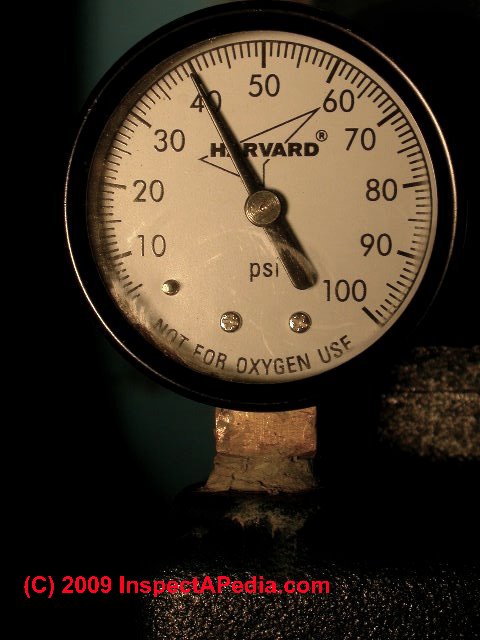
Below we show a typical residential pressure gauge at typical well-system shut-off pressure of 40 psi.
This gauge (by the same manufacturer as the gauge aboce) installed on the same water system, but located on the water pump itself. It is reading accurately.
Stuck Water Pressure Gauges
For digital pressure gauges such as the one we demonstrate in photos in this article , gauge accuracy and our ability to read the pressure gauge accurately may not be a concern.
The left hand pressure gauge is "stuck" at a high pressure, probably from rust or debris entering the gauge bottom port.
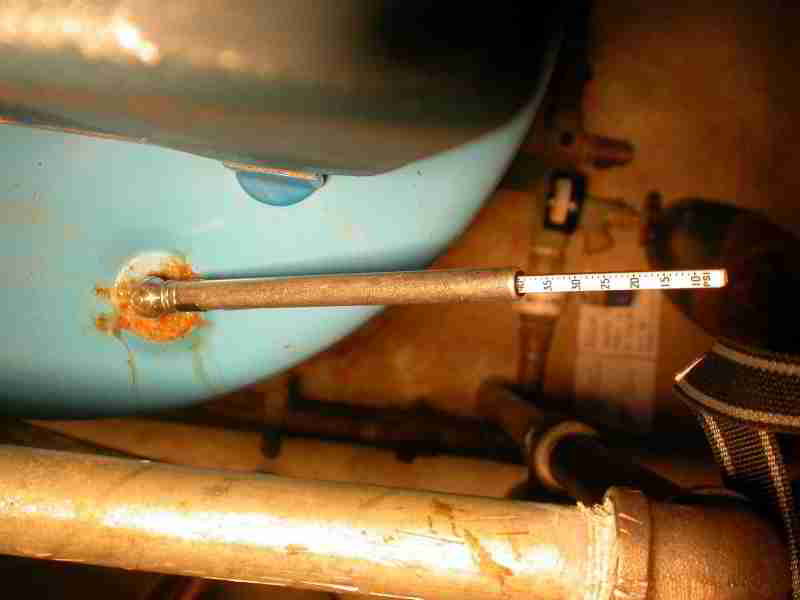
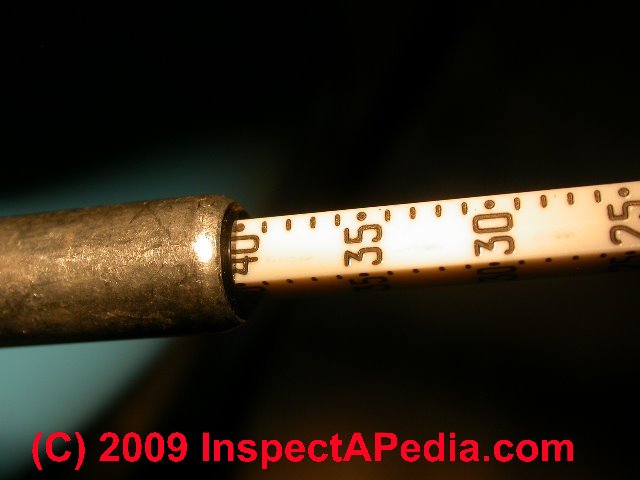
But for dial-type pressure gauges or for "stick type" tire gauges (photos above left and right) use an indexed stick that protrudes from the gauge bottom. The accuracy with which a gauge reports and you can read pressure varies.
We don't trust stick-type pressure gauges for accuracy. Dirt on the sliding indicator gauge, age, loss of lubricant, quality of manufacture (on some units, not all), and errors in reading the gauge all lead to errors, sometimes substantial errors.
Choose a Pressure Gauge With the Proper Operating Pressure Range
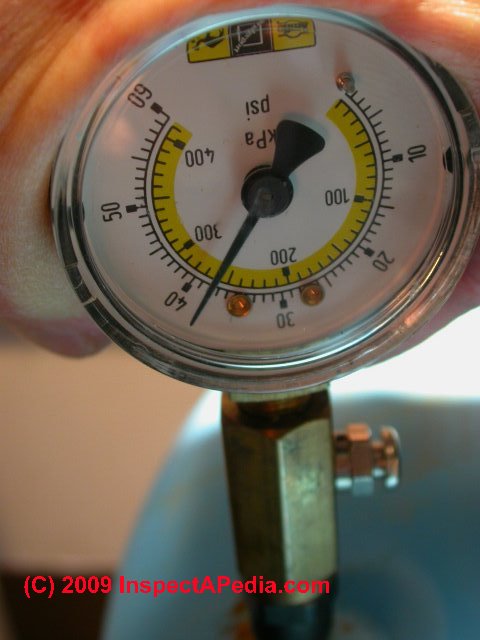 For the most accurate pressure readings when using any pressure gauge for any purpose, select a pressure gauge whose operating range is only slightly larger than the actual operating pressure range of the equipment you are testing.
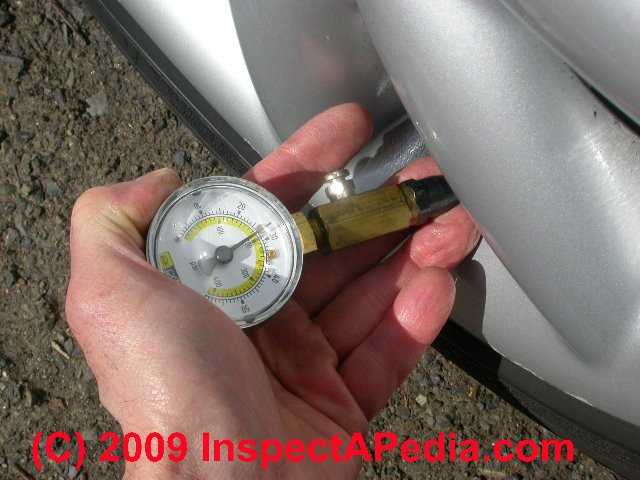
For example, if you are testing pressures on a water system that operates between 0 psig and 50 psig, a pressure gauge that handles pressures from 0 to 60 psi (photo at left) will be more accurate (and easier to read) than a pressure gauge whose display handles pressures from 0 psi to 500 psi.
The gauge we show here will keep the pressure reading on its dial until you press the button on the side of the gauge (lower right in photo) - making it a bit easier to obtain a pressure reading in tight quarters.
Be sure to read the correct scale on your pressure gauge if it has more than one set of markings.
In our photo the outer white scale from 0-60 is in psi while the inner scale in yellow is marked in kiloPascals.
To convert kPa or Kilopascals to pounds per square inch or PSI use this simple formula: Kilopascals x 0.1450 = PSI or pounds/square inch
Diagnose Jumpy or Erratic Water Pressure Gauge Readings
Question:
I have an additional observation with regards to my well water system. I noticed last weekend when I was filling an above ground pool that the gauge at the well water pump was going as high as 20psi and then bouncing down to 0psi and then back to 20psi.
The gauge was very jumpy. Is it possible that the well pump, although the well pump sounds like it is pumping properly, could possibly be flawed?
The pressure tank was recently replaced due to a ruptured bladder. I have no Idea how long it was working that way for I purchased the house in October of 2009. I still believe that I have a pressure problem.
I filled a pool so I do not think I have a water quantity problem. Could you please advice as to your thoughts on this issue? - Thanks, Tony
Reply:
Water pressure gauges can be jumpy due to a partly clogged gauge or gauge piping, defective gauge. A pump cycling on and off would not explain pressure reading varying between 0 and 20 unless your pressure gauge was not turning on the pump until pressure reached 0 - that'd be unusual.
If you check water pressure and flow independently from the jumpy gauge you'll know what's going on and can then home in on the gauge if that's the problem. See the suggestions below for checking on the actual water pressure in a plumbing system and on comparing the system pressure and pump behavior to the gauge behavior.
Other causes of odd pressure gauge behavior include an intermittent blockage at a water pressure tank such as a sticking water or air bladder.
But a problem in the well, pump, tank, piping that is causing a pressure variation or fluctuation would be expected to also affect the pump pressure control switch and turn the pump on and off accordingly. So it's reasonable, from your description to check on the system pressure independently of the jumpy water pressure gauge.
Ways to Check Water Pressure, Pump Pressure Controls, Water Pump Operation Against Gauge Pressure
Use an independent air pressure gauge or water pressure gauge and measure water pressure at
- The air valve or schrader valve on the pressure tank when the pump is at the cut-in point and cut-out point
- A water pressure gauge mounted at a convenient hose bib or washing machine water hose hookup
Try replacing the questionable water pressure gauge with a new one. Be sure that the mounting pipe or orifice where the gauge is installed is not blocked with sediment or debris.
Check Water Tank Pressure Using an Independent Pressure Gauge
Our photos just below show the author using a digital tire pressure gauge to measure the air pressure in a bladder-type water pressure tank or well tank.
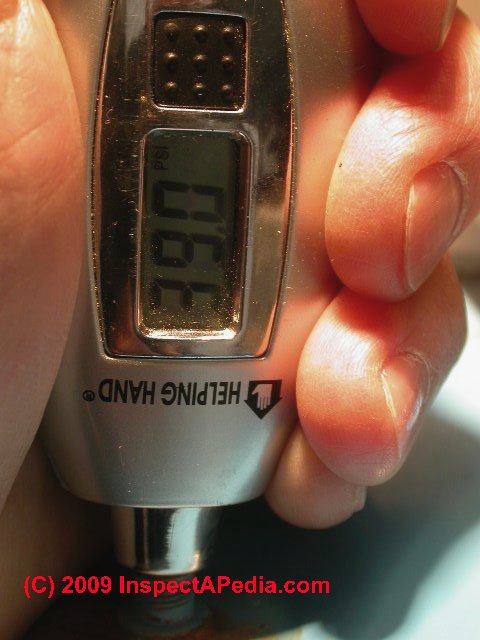
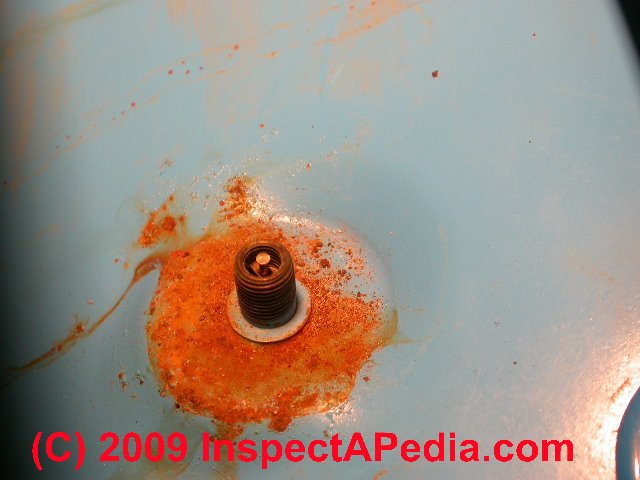
Check the air pressure in the water tank by using an accurate air pressure gauge (such as a dial type or digital tire pressure gauge) to measure the air pressure at the schrader valve on the water tank.
The tank pressure should be within 10% of the original factory water tank pressure setting. Our photo (above left) shows the water tank air inlet valve on the top of our Well-X-Trol well tank. We removed the cap and label for the photo.
Our photos, below, show these same pressure gauges in use to measure air pressure in an automobile tire - a Mini Cooper run-flat tire that needs to be kept accurately at the proper air pressure. Be sure to press the gauge orifice down firmly and straight onto the air valve.
Regardless of whether you are checking pressure in a vehicle tire or a home water system well tank, holding the gauge askew will cause air to be lost out of the pressurized container.
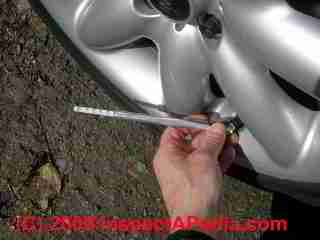
Causes of False Water Tank Pressure Gauge Readings - too high or too low
While normally water pressure gauges do a great job and are reasonably accurate, on a water tank a water pressure gauge can give very inaccurate pressure readings, especially if it's pressure intake port, a small diameter hole, or the small pipe on which it's mounted are debris clogged.
If your water supply contains sediment or debris, or if the water is high in iron or mineral content, this blockage becomes more likely.
False High Water Pressure Indications
Water under pressure has entered the gauge at the high-end of the pump on cycle, but its exit is blocked or slowed by blocking debris at the gauge.
So when actual water system pressure falls (water is drawn out of the system, pressure drops typically 20 psi before the pressure switch turns the pump back on), the gauge continues to read higher than actual pressure.
False Low Water Pressure Indications
The system water pressure has fallen, perhaps to just below the pump cut-in pressure, and stays there long enough for the pressure gauge to slowly bleed its own higher pressure water out through a partly blocked opening.
The indicated pressure on the gauge falls to some low level, in some cases even near zero
Additional water is drawn from the system, the pressure drops just enough more that the pressure control switch turns on the pump and system water pressure rises up to the cut-off or cut-out water pressure.
But the gauge continues to read a false "low" because incoming water to its sensor port is blocked by debris.
Note that these debris blockage conditions that cause false high or low water pressure indications on a water pressure gauge are the same conditions that can occur at a water pump pressure switch, causing it to misbehave as well.
A water pressure gauge can also indicate incorrect pressure simply because the gauge is inaccurate (this is not precisely calibrated lab-grade equipment) or because the gauge has become damaged.
Remedy - How to Correct A Water Pressure Gauge that Reads too High or Too Low
The well pump is turned off, pressure is drained from the system (you do not have to let all of the water out of the tank, just be prepared for a little spillage).
Then the new water pressure gauge is prepared for installation (make sure the gauge bottom threads match those of the old unit being replaced as diameters vary from 1/4" to 1/2").
...
Continue reading at WATER PRESSURE GAUGE INSTALLATION or select a topic from the closely-related articles below, or see the complete ARTICLE INDEX.
Or see WATER PRESSURE GAUGE ACCURACY FAQs - questions and answers posted originally on this page.
Or see these
Recommended Articles
- GAUGES, HYDRONIC BOILER
- GAUGES, STEAM BOILER
- WATER PRESSURE FALLS BRIEFLY THEN STOPS - after the pump turns off pressure falls a few psi
- WATER TANK PRESSURE GAUGE
- WATER PRESSURE GAUGE ACCURACY
- WATER PRESSURE GAUGE INSTALLATION
- WATER PRESSURE LOSS DIAGNOSIS & REPAIR - home
- WATER PRESSURE MEASUREMENT to buy or make your own portable water pressure measurement gauge
- WATER PUMP SHORT CYCLING - home
Suggested citation for this web page
WATER PRESSURE GAUGE ACCURACY at InspectApedia.com - online encyclopedia of building & environmental inspection, testing, diagnosis, repair, & problem prevention advice.
Or see this
INDEX to RELATED ARTICLES: ARTICLE INDEX to WATER SUPPLY, PUMPS TANKS WELLS
Or use the SEARCH BOX found below to Ask a Question or Search InspectApedia
Ask a Question or Search InspectApedia
Try the search box just below, or if you prefer, post a question or comment in the Comments box below and we will respond promptly.
Search the InspectApedia website
Note: appearance of your Comment below may be delayed: if your comment contains an image, photograph, web link, or text that looks to the software as if it might be a web link, your posting will appear after it has been approved by a moderator. Apologies for the delay.
Only one image can be added per comment but you can post as many comments, and therefore images, as you like.
You will not receive a notification when a response to your question has been posted.
Please bookmark this page to make it easy for you to check back for our response.
Our Comment Box is provided by Countable Web Productions countable.ca
Citations & References
In addition to any citations in the article above, a full list is available on request.
- In addition to citations & references found in this article, see the research citations given at the end of the related articles found at our suggested
CONTINUE READING or RECOMMENDED ARTICLES.
- Carson, Dunlop & Associates Ltd., 120 Carlton Street Suite 407, Toronto ON M5A 4K2. Tel: (416) 964-9415 1-800-268-7070 Email: info@carsondunlop.com. Alan Carson is a past president of ASHI, the American Society of Home Inspectors.
Thanks to Alan Carson and Bob Dunlop, for permission for InspectAPedia to use text excerpts from The HOME REFERENCE BOOK - the Encyclopedia of Homes and to use illustrations from The ILLUSTRATED HOME .
Carson Dunlop Associates provides extensive home inspection education and report writing material. In gratitude we provide links to tsome Carson Dunlop Associates products and services.
 | HOME | ABOUT | ASK a QUESTION | CONTACT | CONTENT USE POLICY | DESCRIPTION | POLICIES | PRIVACY | |
| © 2024 - 1985 Publisher InspectApedia.com - Daniel Friedman | |||||||||