
InspectAPedia® FREE Encyclopedia of Building & Environmental Construction, Diagnosis, Maintenance & Repair |
Question? Just ask us! InspectAPedia
|
 Diagnose & Repair Poor Water Pressure / Lost Well Water Pressure
- POST a QUESTION or COMMENT about how to troubleshoot bad water pressure or no water pressure at all for private well & pump & water tank systems
Private well water problem diagnosis:
How to diagnose poor well water pressure or total loss of water pressure: this article explains how and why to distinguish among intermittent water pressure loss, total water pressure loss, and poor water pressure or flow in a building.
We give diagnostic and repair procedures for both municipal water supply problems and well water supply problems.
The process of diagnosis and the costs of the repair are explained. Consumer advice on saving money on water supply repair costs includes a review of the parts and labor costs of a typical well pump and pressure tank replacement case.
InspectAPedia tolerates no conflicts of interest. We have no relationship with advertisers, products, or services discussed at this website.
How to Diagnose & Correct Poor Well Water or Pump Water Pressure or Flow
 The following articles pertain if you have a private well, pump, and tank system for your building or if your incoming community water supply pressure and flow are just too low to start with:
- Water Tank Problems?
See WATER PRESSURE TANK REPAIRS. Examples of water tank problems include poor water pressure or the well pump rapidly turning on and off (short cycling). - Water pump problems?
Examples of water pump problems include poor water pressure or no water pressure at all. See - WATER PRESSURE CONTROL SWITCH ADJUSTMENTS - poor building water pressure or flow
- PUMP PRESSURE CONTROL REPAIR - pump is not delivering water at all or water pressure is poor
- WATER PUMP RELAY SWITCH - submersible pump has stopped working
- WATER PUMP PRIMING PROCEDURE - well pump keeps losing prime - pump runs but gives no water
- WATER PUMPS & TANKS & WELLS - complete list of articles
- WATER PUMP CONTROLS & SWITCHES - complete list of well pump controls and switches, identification, diagnosis, repair
- WATER PRESSURE GAUGE ACCURACY - maybe water pressure is fine and it's the gauge that's bad?
- AIR DISCHARGE at FAUCETS, FIXTURES - air is coming out of faucets: is the problem with the pump, piping, or the well itself?
- Poor water pressure or no water pressure after an electrical power loss, lightning strike, or storm?
Water pressure may be lost entirely following a power loss or electrical storm or lightning strike.
Check first for a blown fuse or tripped circuit breaker. A lightning strike can also damage electrical wiring supplying a submersible pump, or it may damage the pump itself.
And less common, a total power failure can sometimes expose a latent problem in the system such as a failing pressure tank bladder or well foot valve.
But always look for the most direct explanation first rather than the more complicated one. So if water pressure fails after electrical power has been lost but then returned, start by looking for an electrical problem.
Watch out: a power surge or lightning strike can on rare occasions trip just half of an un-linked 240-Volt circuit breaker or blow just one of the pair of fuses powering a 240-volt electrical circuit, leaving a pump that runs, but barely, developing only minimal water pressure, or a pump that runs not at all.
An electrician or an experienced well and pump installer can diagnose these conditions by testing the well pump circuit itself, but before calling an expert, just check the fuses and circuit breakers. Thanks to reader EK Woodard for these details.
See details at NO WATER PRESSURE - Water piping or well piping problems between building and well?
If your water pump keeps losing prime, a shallow well jet pump well line could have a bad foot valve - in the well
WELL PIPING FOOT VALVES or there may be a bad check valve on well piping at or near the water tank
or near the above-ground water pump
CHECK VALVES, WATER SUPPLY, DRAINS, PUMPS and so be losing prime.
A leak in the well line piping itself can also lead to loss of prime or to air entry into the piping system
AIR DISCHARGE at FAUCETS, FIXTURES - air comes out at faucets or fixtures - Well Problems?
Do you run out of water or after running water for some interval water pressure and flow are poor? Well problem diagnosis starts
at WELLS CISTERNS & SPRINGS. Leaks in well piping either inside the well itself or between the building and the well bottom can also mean reduced water flow, quantity, and pressure in the building.
See WELL PIPING LEAK DIAGNOSIS.
Before assuming that there is no water in the well, check to see if the water pump is working properly, including loss of pump prime and
a bad or leaky well piping foot valve
See more details at
WATER PUMP PRIMING PROCEDURE
WELL PIPING FOOT VALVES
AIR DISCHARGE at FAUCETS, FIXTURES can also indicate a failing well.
Also see WELL YIELD, SAFE LIMITS
Readers whose wells simply run out of water should
see WELL FLOW TEST PROCEDURE
and see WELL YIELD IMPROVEMENT
And see the diagnostics at NO WATER PRESSURE  Bad water pump or water tank pressure regulator control?
See WATER PRESSURE REDUCER / REGULATOR (not usually installed on private well and pump systems, often present on municipal water supply systems that use an in-building local water pump and pressure tank to boost pressure).
Before adjusting a well pump pressure control switch
WATER PUMP PRESSURE CONTROL SWITCH, changing building piping, or considering installing a water pressure booster pump
WATER PRESSURE BOOSTER PUMP, it is essential to understand what the incoming water pressure is and exactly why the building water pressure is not satisfactory.
Start at the beginning of this article:
WATER PRESSURE LOSS DIAGNOSIS & REPAIR.
Water pump pressure regulator switch diagnosis and repair steps include these:- How to Adjust Water Pump Pressure:
The detailed, step by step procedure for inspecting and adjusting the water pressure control switch is discussed in detail
at WATER PRESSURE CONTROL SWITCH ADJUSTMENTS. - Diagnosing Water Pump Short Cycling on and off:
If your water pump is clicking on and off too often or quite rapidly
see SHORT CYCLING well or water pumps. - Diagnosing Water Pressure Drops without explanation when the pump stops,
see WATER PRESSURE FALLS SLOWLY, ERRATIC PUMP: bad pressure control switch, building water running or leak, bad pressure gauge, bad check valve, bad foot valve. - Diagnosing & Repairing Lost Air in the Water Tank:
The problem of lost air in the water pressure tank along with how to correct that condition are discussed beginning
at SIGNS OF AIR LOSS in the pressure tank. - Diagnosing & Repairing a Water Pressure Control or Water Pump Control Switch:
We discuss diagnosing and repairing a water pressure control switch that sticks "on" or "off" or simply won't operate,
at WATER PUMP PRESSURE SWITCH REPAIRS
- How to Adjust Water Pump Pressure:
- Bad cold or hot water pressure and flow just at certain plumbing fixtures?
See our discussion
of POOR WATER PRESSURE at JUST SOME FIXTURES 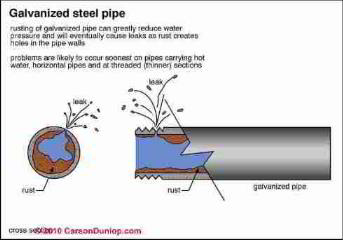 Poor water pressure due to clogged building supply piping?
Even municipal water supplied in some communities can be "hard" or high in mineral content, iron content, or other ingredients that lead to clogged water piping.
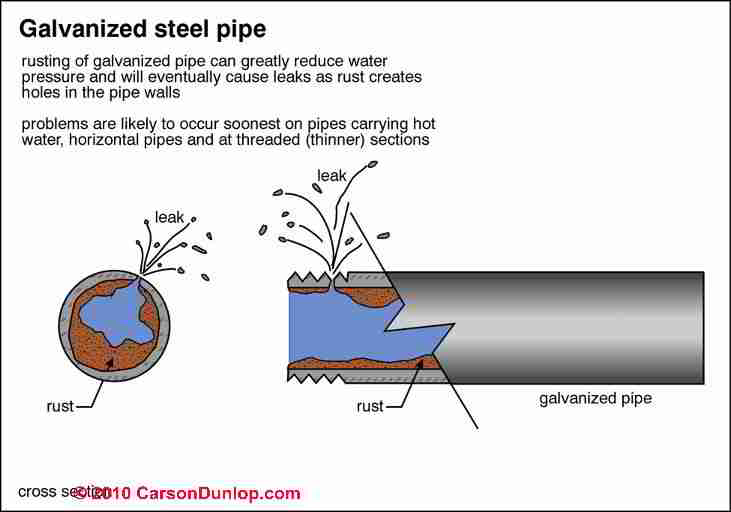
Our sketch (left) courtesy of Carson Dunlop Associates, shows how rust can clog steel water supply piping.
If incoming water pressure is high - say over 40 psi, but water pressure falls off almost immediately when you open a faucet and remains poor, there may be a clog somewhere in your piping system, or worse, in most of it. This condition usually develops over a long time - years - and does not change suddenly on its own.
Readers should also see WATER PIPE CLOG DIAGNOSIS
and WATER PIPE CLOG REPAIR.
Also see WATER PRESSURE LOSS DIAGNOSIS & REPAIR in a building
and see MUNICIPAL WATER PRESSURE DIAGNOSIS
or WELL WATER PRESSURE DIAGNOSIS where we describe the effects of clogged piping on water flow and offer remedies for this problem.
If only hot water pressure and flow are poor, also
see CLOGGED SUPPLY PIPES, HOT WATER.- Small diameter building water supply piping also limits water flow rate:
Even if the municipal water supply pressure is good.
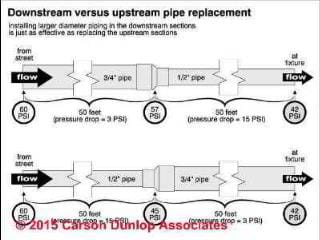
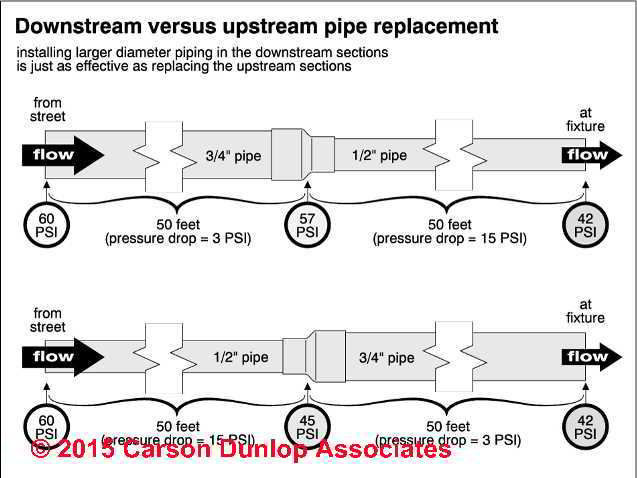
A building using 1/2" diameter piping, especially if the incoming water pressure is modest, or if the building has extensive lengths of water supply piping, perhaps combined with many elbows and tees, will suffer reduced water flow at its fixtures.
A common "fix" for poor building water "pressure" (really flow) where the piping is blamed, is to install larger diameter water supply piping wherever the piping is readily accessible, such as in a basement or crawl area.
As the sketch at left, courtesy of Carson Dunlop Associates shows, installing larger diameter water supply piping helps regardless of where in the piping sequence it is installed - so you don't have to rip out all of the building water piping to make this water flow rate improvement.
Since bad water pressure or flow can be a piping problem rather than a supply quantity problem, also
see PIPING in BUILDINGS, CLOGS, LEAKS, TYPES. - Poor hot water pressure, acceptable cold water pressure at all fixtures? OR poor cold water pressure, acceptable hot pressure at all fixtures?
This condition often indicates clogging in the hot water piping or if a tankless coil is used to make hot water, clogging there.
See CLOGGED SUPPLY PIPES, HOT WATER. Bad Hot Water Pressure?
See HOT WATER IMPROVEMENT especially if the building cold water pressure is acceptable but hot water pressure and flow are poor.
Accumulated debris in a water heater, and debris from a corroded or disintegrating hot water tank dip tube or hot water tank sacrificial anode can also block the hot water outlet opening, resulting in low hot water pressure in a building.
See CLOGGED SUPPLY PIPES, COLD WATER - Bad Cold Water Pressure? blockage in just cold water supply piping - Poor water pressure just at certain plumbing fixtures?
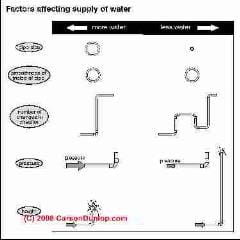
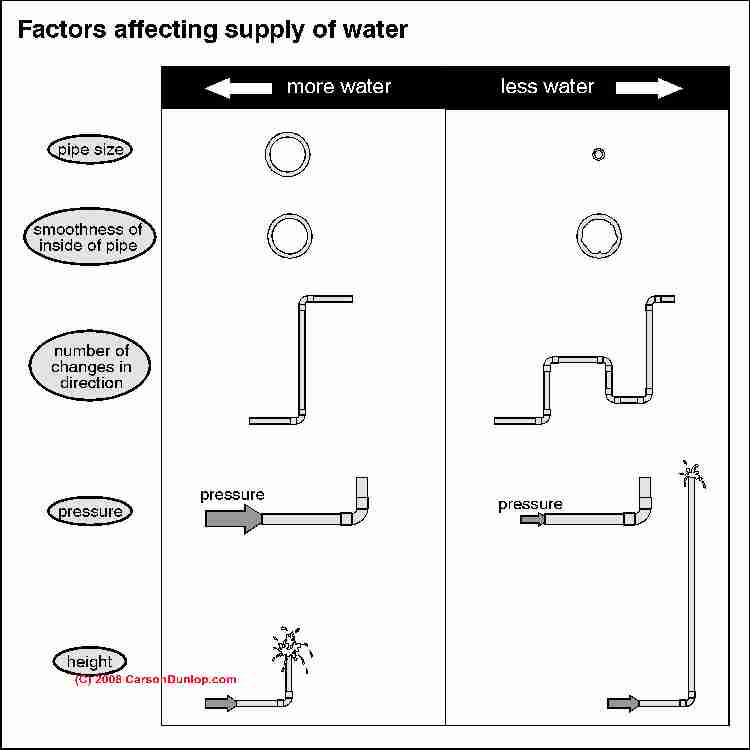
Poor cold water pressure, hot water pressure, or both hot and cold water pressure or flow that is observed just at some plumbing fixtures in a building while flow and quantity are good at others suggests that the water flow or pressure problems are local to certain runs of supply piping or to the specific fixtures.
The sketch at left, courtesy of Carson Dunlop Associates, shows five factors that affect the water pressure and flow in a building. Check the following first:- Clogged aerator or strainer on sink faucets -
clogging by dirt, debris, corrosion, can significantly reduce both hot and cold water flow at a sink where the strainer needs cleaning or replacement.
Unscrew the strainer from the faucet and turn on the water - if the fixture pressure or flow is much better you've probably found the problem.
Look at the aerator/strainer: inspect it, clean it, perhaps soaking it overnight in vinegar to remove corrosion and mineral build-up, or just install a new aerator/strainer. - Broken O-Rings on individual faucets -
can clog the faucet internals and prevent good water flow. If just hot water or just cold water flow is weak at an individual fixture you or your plumber should check for and repair any damaged faucet parts. - Clogs in individual plumbing pipes, valves, elbows -
can occur during construction if copper pipe soldering is not performed properly.
Pushing too much solder into a copper pipe joint can result in weak flow and reduced pressure at all of the fixtures downstream from that fitting, even if the rest of the piping system is in good condition.
You may need help from a plumber to diagnose this problem, but if your water supply piping is not clogging from mineral deposits throughout, and if flow and pressure are bad just at some fixtures, this could be the problem.
Of course if an installer makes this soldering error on copper pipe joints near the beginning of a water supply piping system in a building, all of the fixtures downstream from that point will be affected, possibly all of the fixtures in the building. If mineral clogging might be a problem in the pipes in your building,
see WATER PIPE CLOG DIAGNOSIS
and
see CLOGGED SUPPLY PIPES, COLD WATER
and
see CLOGGED SUPPLY PIPES, HOT WATER
- Clogged aerator or strainer on sink faucets -
- Problems with water treatment equipment can cause loss of water pressure or no water flow:
a clogged water filter, or a malfunction in water disinfection or other water treatment equipment can cause a reduction in water pressure or even a complete stop in water flow in a building.
Also, a water treatment system that uses air injection to remove odors or gases can cause
AIR DISCHARGE at FAUCETS, FIXTURES
Here is an example of a drop in water pressure that may be due to water filter clogging:
Question: We have a well in our home. Can you tell me what to do if we have a lot of black debris that is in our water filter system?
We think this could be why we have poor water pressure. Is there such a thing as a build up of soot or debris that we need to do something to clean the lines?
Answer: Try changing the water filter cartridge. If the problem is eliminated, the filter was clogged.
If a lot of debris has been getting past the water filter, or if the water filter was a late addition to a home that has had a long history of using debris-laden water, pipes, fittings, faucet strainers, and shower heads may be clogged and may need to be cleaned or replaced.
See WATER FILTERS, HOME USE for details about clogged filters, and
see WATER TREATMENT EQUIPMENT CHOICES for our complete list of types of water treatment equipment. - Need a booster pump?
Remote well pumps & pressure tanks, multiple buildings, tall buildings with poor water pressure on upper floors can benefit by a second pump and pressure tank at the upper floors or remote location.
Adding a booster pump can improve building water pressure where the private pump and well system can't get enough pressure or quantity or where the building height impacts water pressure on its upper floors.
See WATER PRESSURE BOOSTER PUMP for details.
Reader Comments, Questions & Answers About The Article Above
Below you will find questions and answers previously posted on this page at its page bottom reader comment box.
Reader Q&A - also see RECOMMENDED ARTICLES & FAQs
On 2023-04-02 by (mod) - diagnose why cold water pressure is poor but Hot OK
Please find our discussion and your photos now
at CLOGGED SUPPLY PIPES, COLD WATER
On 2023-04-02 by john m - significant drop in cold water flow, hot water flow is fine
I am on a well with a whole house sediment filter. Recently, I started seeing a drop in flow only on the cold side. Running a single faucet is fine but opening another faucet or flushing a toilet causes a significant drop in flow.
I don't see the same problem on the hot side. The well pump seems OK, turn on-turn off are still at the proper pressure settings. Well reservoir tank pressure is set to 4 PSI below well pump turn on pressure.
My guess is that I have an obstruction somewhere in the cold water distribution. The house is plumbed with CPVC. Any advice on locating an obstruction? Any other possibilities?
On 2023-01-16 by Marja
@InspectApedia Publisher, Thank you
On 2023-01-14 by InspectApedia Publisher (mod) - is pressure tank too far from pressure control switch?
@Marja,
I don't know any details of your system so my guesses may be way off, but
- the pressure tank needs to be close to the pressure control switch that turns the pump on and off
- in a typical pump and well water system the pump develops pressure to push water through the piping. You might have to prime the pump or prime well pipes between pump and well, but you wouldn't need to "prime" water pipes on the outlet side of the pump - between pump and your outbuilding.
So if you put water into that line I expect that the water you got back out was just the water you put in.
I'd start by getting an experienced plumber on site to straighten out your water pressure tank, pump control, and then to let us know what else was needed.
On 2023-01-14 y Marja - water pressure lost after plumber moved the pressure tank
A person moved our basement air pressure tank to a higher location and also moved our hot water tank. That is when we lost pressure to the outbuilding. He said he could fixed it from the inside but left and never came back.
Yes, I should have mentioned that before. We primed the outbuilding line with a garden hose and got lots of water. When we shut off valve and opened the valve again we had no water again.
Out house waterline has not been affected at all. Problems with outbuilding line only.
The secondary line is 6 ft under ground. I do not know how to check for a damaged line.
On 2023-01-12 y InspectApedia Publisher (mod) - when priming the pump doesn't work
@Marja,
I need a more-complete understanding to try to come up with a useful answer.
Why are we "priming" the 100 ft. remote line to the outbuilding?
Do you have water everywhere else on the same system, just not at the outbuilding?
Have you checked for a broken or damaged or clogged 100 yard pipe (that's a rather long run) between the pump and the point of use?
On 2023-01-12 by Marja
We have 190' well. Added a 100 yard line to an outbuilding that worked fine for years.
It is just a line with a shutoff valve in shed. It stopped bringing up water.
We can prime it but it doesn't hold water once valve is shut off. What changed?
On 2022-03-25 by Inspectapedia Com Moderator (mod) - types of water pressure control switch failures
@Richard,
Possible, of course, though we don't have any scholarly data on pressure control switch reset control failure rates.
Most of the controls switch problems are
- burned or pitted contacts
- improper adjustment
- underlying well problems like low water, poor recovery rate, waterlogged pressure tank leading to - short cycling pump adding to contact wear
- debris clogging of the switch sensor port
On 2022-03-25 by Richard - confirmed bad pressure switch
@Inspectapedia Com Moderator, so had an hour to spare and removed contacts from the auto (no lever) switch and replaced them with a new set I found at local hardware store, re-installed auto (no lever) switch, we can flush toilet - run tap and shower and the switch kick on at 40psi no hesitation and off at 60 psi.
I'm wondering if the lever style switch i purchased might have been faulty??
On 2022-03-24 by Inspectapedia Com Moderator (mod) - pump kicks off too often or too soon
@Richard,
If I've got this right, the "Auto" version of a pressure control switch should be one that doesn't have to be manually re-set if the switch turns off the pump when the pump seems to be drawing air rather than water.
Give me the brand and switch model so I can be sure we're on the same page.
Your comment
I can run shower, sinks and toilet separately but now cannot flush and run sink at same time without pump switch kicking off
OFF sounds as if the pump is sucking air from the well and the switch turns it off to avoid damaging the pump.
So there may be a problem of loss of well-water (flow or recovery rate have reduced) or a leak in well piping;
Take a look at AIR DISCHARGE at FAUCETS, FIXTURES
and at
WATER PUMP PROTECTION SWITCH
and in the Article Index you'll find other diagnostic articles such as how to check the flow rate of your well and its recovery rate.
On 2022-03-24 by Richard
I had an automatic pressure switch (40/60) with bladder at 38psi (empty) about a week ago had no water checked volts/amps and capacitor (typical me being an electrician LOL) all good, cleaned contacts and unit worked for a few days,
quit again so purchased another pressure switch manual start one as no auto ones available. I also replace short brass pipe to switch and installed new switch and turned it on then checked setting for 40/60 all good.
Now here is the strange thing I can run shower, sinks and toilet separately but now cannot flush and run sink at same time without pump switch kicking off.
Sat at tank and watched as my wife operated sink and toilet , ran sink 1st pressure went to 40 kicked on and then kicked off at 60 so both together pressure got to 40 heard something like a sucking sound and switch kicked to off position.
Have I missed a step, should I switch back to an auto type switch ? any insight with be appreciated.
On 2021-09-23 by inspectapedia.com.moderator (mod) - debris clogged pressure control switch
@Andrew L,
The most common cause I find for problems like the one you described is debris clogging of the sensor port on a pressure control switch.
On 2021-09-22 by Andrew L - pressure doesn't drop on gauge, but actual falls to 5 psi
200' well with 60gpm water flow, column 15 feet from top;14gpm pump with one inch line 170' down replaced 6 months ago; 100 yards to house twenty feet elevation, 86t treasure tank, 7gpm air injection filter and salt, new 40-60 pressure switch clean pipe stem works house perfectly.
30 yards from well head 1" line tees fifty yards to tee into barn, three hydrants on trunk line full pressure inside barn are two hydrants w/full pressure .3/4 line tees between two barn hydrants into tack room with 5gpm air filter system plus second 86t tank for volume.
Here is the barn problem: pressure gauge outgoing side of filter over night reaches 90lbs.
Turning on a filtered 3/4 inch water line to fill buckets running 15 minutes will drop pressure to five pounds and a trickle. Shut off the line pressure goes to 30 and holds until demand and will drop to 5 pounds; replaced the gauge!
I have checked the house gauge and pressure switch when barn is five pounds pressure is holding steady 40-60 and not dropping off to fill barn needs. Replaced the tank in barn ( bad bladder), with both pressure tanks drained of water air pressure is 38 at house and 30 at barn.
Here is the question: what could cause the pressure to drop off to five pounds or cause it to rise to 90 and second not recovering and staying anywhere near 40-60?
On 2020-10-05 by danjoefriedman (mod) - measuring pressure via garden hose?
Greg
How are you measuring water pressure? Always by the same independent gauge? And always at the same point in the water pump on-cycle?
If so the pressure will normally be the same everywhere if no water is running anywhere in the system AND if there are no leaks.
On 2020-10-05 by Greg B.
Point in time drop in well pressure (60-40 lb). Pressure tank bladder checks OK. I isolated and checked different runs of the system for constrictions - all read and hold 40 lb. I checked pressure at the well head and it holds 85+ lb.
Finally I ran a 50ft. garden hose from the well head and checked the pressure at the end of the hose - 40 lb. What gives?
On 2020-07-14 - by (mod) - what happens when we leave water running for much too long?
Audrey
From what I can read in your note, we have the following concerns:
We surely would agree that if you've given the well plenty of time to recover its water and you still have poor or no water pressure then most likely there's something feels wrong.
It's not the most common but one possibility is this: On occasion we can exhaust a well and it does not recover - for example the water table has dropped. To continue this digression I've seen that happen in Mexico when a large factory farm moved into an area where they were small farms. The factory farm pump so much water and drop the aquifer so far that the local Wells all simply with dry. You can drive down the highway and see all the dead trees.
It's also the case that you could still have a leak or water running somewhere that you haven't found
But the most likely explanation is the running your pump continuously for a very long time may have damaged the pump impeller or motor so the pump simply can't deliver water under is fishing pressure. On occasion the impeller can be cleaned cleared or repaired. Or the problem could be with the pump motor itself.
See also WATER PUMP SHORT CYCLE STOP VALVE
On 2020-07-14 by Audrey
OK, this is my problem. Woke up on 4th of July with very low water pressure. Could not find a leak. Shut off power to well and called a well man. Did a pressure test at the wellhead and said pressure was slowly rising but struggling from a possible leak. Fast forward, found a hose to the end of the property got turned on and ran all night from around 7 pm to 10 am.
Pressure came back up and cycled like it should. Well man said to let it rest for a couple of hours. Actually let it rest for a couple of days. Before all this, had great water pressure, could run a full washer and water pressure would be up. Now, water slows down to a trickle when filling the washing machine.
I don't know how old the pump, or pressure tank is, was here when I moved here 13 years ago. New pressure switch approximately 5 years ago. Tank is under house and can't exactly reach it to check the tank. When you take a shower now, you can feel the water pressure kick on which it didn't do previously.
Meaning, I can feel the well kick on because water pressure goes back up. I can hear the pressure switch short cycling, which I never did before. I can by pass all of this if it's the tank. I have a new setup, which includes a CSV (cycle stop valve) and a new small bladder tank. I just need to know if it's my pump. Like I said, don't know the age of it.
The well guy who was here cost me $300 for the hour and a half he was here on the holiday. If it is the pump, need to find a reasonable well company that isn't going to charge me 5K to change the pump. Any help would be appreciated. Thanks
On 2020-06-17 - by (mod) - pressure not increasing in the water tank
Said
Here are a few things to check.
First let's see if the tank happens to be waterlogged or filled with water.
If a tank is very light and easily moved it's probably not but if it's heavy and you can't juggle it even the least bit it may be filled with water and have lost its air charge.
Next if the tank was working normally before your new pump and is not accepting water now it's possible that a valve between the pump outlet and the tank has been locked closed.
I know y'all though we've discussed this with pressure tanks that use an internal bladder and we've set the bladder can become stuck to itself it's also possible that there can be a debris clock or blockage of the inlet to a non bladder type pressure tank such as yours.
When you say that the tank is not receiving any water, is there an air valve on the tank itself that you can use to check the pressure in the tank at that time?
On 2020-06-17 by
New pump water is flowing but tank not getting pressure straight tank not a bladder
On 2020-06-02 - by (mod) - can't get water pressure above 17 psi
Anon
Let's start with the diagnostics in the ARTICLE INDEX under
PUMP WONT STOP RUNNING
On 2020-06-01 by Anonymous
two line system, new pump and jet. no links, holds pressure but will only pump up 17 lbs of pressure
On 2020-05-13 - by (mod) - pressure falls off when running water
Geoff
I'll be glad to assist;
Let's start with a step through the diagnostics at WATER PUMP WONT STOP RUNNING https://inspectapedia.com/plumbing/Pump_Runs_On.php
as that offers a more-orderly and more-complete set of diagnostic steps than if I try to invent that information again from memory.
Please take a look, let me know what you think, try some of the basic diagnostics like checking voltage and checking pump operation and looking for leaks, and looking at the actual water level and flow rate in the well, and the depth of the static head in the well, and we'll continue from there.
On 2020-05-13 by Geoff Gee.
Hi I need help, I live in the Philippines, and currently because of the Virus, very very difficult to find help, and parts, really at anytime, however as an Engineer and a DIY retired person, I had to tackle the problem myself.
For a few months we had been experiencing continual running pump which would not reach max pressure, so after a few very high Electrical bills I decided to tackle the problem.
System Single line deep well system horizontal 1hp pump, 2" main line pipe with single line inside, before I started I had no idea the diameter of the inside pipe, or what was on the end, check valve of Jet foot valve, after I started to work I found out it was 1" internal steel Pipe, and I think only a check valve, as we never got it out of the hole, because of the Leather washers, which as you know it is almost impossible to remove those once installed, mind unless you can tell me a way to do it.
My diagnostics to my original problem, showed either a problem on the pump, or foot valve/check valve.
Before I started the whole system in the house was checked, everything in the house worked good, no leaks, pressure ok. So I decided to take it apart,
Pump had a cracked blade in the pump, also very cheap pump, so I decided to pull the pipe, very very very difficult, as I think you will agree,those dam leather washers, after two days I finally got the pipe out, but lost the Foot Valve/check valve.
FYI I welded an extension to the pipe, and knocked the valve down into the well.
I replaced the Pipe with 11/4" PVC pipe with a Packer Jet foot valve, and a Gould 1HP J10+ Pump, very expensive by Philippine standards.
Now here is my problem pump works good, goes to 40/50psi no problems, holds its pressure good, But everything in the house and the garden, turn on for example the shower, tons of pressure, works good but slowly the pressure drops off, turn the shower off, wait a few minutes and try again works good, so go out to the pump, check the pressure, its good 43psi, run the garden facet, which is beside the pump house, starts great lots of pressure, but like the shower slowly looses pressure,
BUT the tank is still holding at about 20/30psi, if you let it run long enough it will go down to about 5/10psi, close the facet, and quickly goes to 40+psi.and switches off, and holds.
Any ideas???
On 2020-04-23 - by (mod) -
Brian
The most common problems will be
- loss of prime - leaky check valve
- a leak anywhere in the piping
- you are trying to lift water more than 25 ft.
On 2020-04-22 07:28:44.179430 by Brian
Just installed a new shallow well pump. I have no footvalve but a check valve between well & suction.
I cannot seem to get water up to the valve - prime the pump.
Help! Thanks :)
On 2020-01-04 - by (mod) -
If the elevations are all the same then the difference is more likely to be due to clogged pipes or a partly closed valve or clogged elbow in piping.
On 2019-12-30 by Anonymous
My water pressure in the kitchen is great but my end of the house the toilet sink or shower none work however on the other end of house it's fine.. it's like the pipes on my end don't even try to draw any water..Pls help
On 2019-11-17 - by (mod) - effect on water pressure when old galvanized iron pipes are clogged
Jeff:
Indeed it's usually bills old galvanized pipes that are the ones that are most clogged, with both rust and scale. It would be interesting to see photos of what you're working on and if you cut one of those old pipes and 1/2 let's take a look at and photograph the cross-section so we can see just what it looks like.
Our full conversation is now found at WELL WATER PRESSSURE DIAGNOSIS FAQs-3
https://inspectapedia.com/water/Private-Well-Pressure-Diagnosis-FAQs3.php
On 2019-11-17 by Jeff
Thanks, Both hot and cold flow rate are about the same.
I’m getting around 20 GPM at the softener (almost filled a 4 Gal bucket in 11 seconds), and replaced everything up to the split to the WH. The steel pipes were pretty clear, so no change.
Since I first posted this, one run in the house has gotten even worse, so I’m replacing everything in that run with pex over the next few days. It’s rather a mess in a crawl space, with pvc, galvanized, and a little bit of pex.
On2017-03-05 by (mod)
See PRIVATE WELL PRESSURE DIAGNOSIS - above on this page - for help diagnosing weak or no water pressure, as there could be any of several causes.
On2017-03-04 by Daniel Solomon
The pump power is weak, as the sound justifies and no water is pumped up.
...
Continue reading at WELL WATER PRESSURE IMPROVEMENT - steps to improve water pressure & flow from a private well water supply, or select a topic from the closely-related articles below, or see the complete ARTICLE INDEX.
Or see WELL WATER PRESSSURE DIAGNOSIS FAQs questions & answers about troubleshooting bad well water pressure posted originally at the end of this page.
Or see these
Recommended Articles
- WATER FLOW RATE CALCULATE or MEASURE - how much water is delivered at a plumbing fixture
- WATER PRESSURE MEASUREMENT
- WATER PUMP CAPACITIES TYPES RATES GPM
- WATER PUMP DRAWDOWN VOLUME & TIME
- WATER QUANTITY IMPROVEMENT
- WELL CLEANING & RESTORATION by GLYCOLIC ACID
- WELL FLOW RATE - how much water can the well deliver
- WELL FLOW TEST for WATER QUANTITY - how to test the well
- WELL LIFE EXPECTANCY - how long will the well last?
- WELL PIPING TAIL PIECE
- WELL YIELD DEFINITION - required well yield & safe well yield
- WELL YIELD IMPROVEMENT - get more water
- WELL YIELD, SAFE LIMITS - safe total well yield, causes of flow rate change
- WELL WATER PRESSURE DIAGNOSIS
Suggested citation for this web page
WELL WATER PRESSURE DIAGNOSIS at InspectApedia.com - online encyclopedia of building & environmental inspection, testing, diagnosis, repair, & problem prevention advice.
Or see this
INDEX to RELATED ARTICLES: ARTICLE INDEX to WATER SUPPLY, PUMPS TANKS WELLS
Or use the SEARCH BOX found below to Ask a Question or Search InspectApedia
Ask a Question or Search InspectApedia
Questions & answers or comments about how to troubleshoot bad water pressure or no water pressure at all for private well & pump & water tank systems.
Try the search box just below, or if you prefer, post a question or comment in the Comments box below and we will respond promptly.
Search the InspectApedia website
Note: appearance of your Comment below may be delayed: if your comment contains an image, photograph, web link, or text that looks to the software as if it might be a web link, your posting will appear after it has been approved by a moderator. Apologies for the delay.
Only one image can be added per comment but you can post as many comments, and therefore images, as you like.
You will not receive a notification when a response to your question has been posted.
Please bookmark this page to make it easy for you to check back for our response.
Our Comment Box is provided by Countable Web Productions countable.ca
Citations & References
In addition to any citations in the article above, a full list is available on request.
- Thanks to Jeneral Sewer Service - George - 845-297-2285, a New York Hudson Valley drain and sewer cleaning and de-clogging expert for technical details and consulting on drain clog diagnosis and repair, including proper use of the Kinetic Water Ram for drain clearing - 3/14/2009
- Thanks to our reader, Carole Cimitile, 2/17/2009, for reminding us that small problems like faucet o-rings, clogged faucet strainers and similar local plumbing fixture defects can have a big impact on hot water flow, cold water flow, or both hot and cold water flow and pressure problems.
- Thanks to reader EK Woodard, Boise State University, Boise ID, for assistance in diagnosing poor water pressure following an electrical power loss. 3/14/2010
- In addition to citations & references found in this article, see the research citations given at the end of the related articles found at our suggested
CONTINUE READING or RECOMMENDED ARTICLES.
- Carson, Dunlop & Associates Ltd., 120 Carlton Street Suite 407, Toronto ON M5A 4K2. Tel: (416) 964-9415 1-800-268-7070 Email: info@carsondunlop.com. Alan Carson is a past president of ASHI, the American Society of Home Inspectors.
Thanks to Alan Carson and Bob Dunlop, for permission for InspectAPedia to use text excerpts from The HOME REFERENCE BOOK - the Encyclopedia of Homes and to use illustrations from The ILLUSTRATED HOME .
Carson Dunlop Associates provides extensive home inspection education and report writing material. In gratitude we provide links to tsome Carson Dunlop Associates products and services.
 | HOME | ABOUT | ASK a QUESTION | CONTACT | CONTENT USE POLICY | DESCRIPTION | POLICIES | PRIVACY | |
| © 2024 - 1985 Publisher InspectApedia.com - Daniel Friedman | |||||||||