 Common Causes of Water Pump Short Cycling
- POST a QUESTION or COMMENT about how to diagnose and repair short-cycling well pumps: what are the causes of well pump short cycling.
Causes of & cures for water pump short cycling on and off:
This article explains how to diagnose all of the various causes of well pump short cycling - what causes the well pump to run too often or to turn on and off too rapidly.
By understanding the cause of too frequent water pump on/off cycling, we also point to the necessary repair.
InspectAPedia tolerates no conflicts of interest. We have no relationship with advertisers, products, or services discussed at this website.
- Daniel Friedman, Publisher/Editor/Author - See WHO ARE WE?
Common Causes of Well Pump Short Cycling: how to diagnose & fix well pumps turning on and off too often
Short cycling of a water pump which is defined at SHORT CYCLING WATER PUMP means that the water pump or "well pump" turns on and off too rapidly or too frequently when water is being run in the building.
If this is the problem with your water pump, this article (below) describes the most common causes of this problem.
The most-common cause of pump short-cycling is loss of air in the water pressure tank.
This is the topic discussed at length below, and corrective steps are detailed. However there could be other, less common plumbing problems that cause this symptom. Before "fixing" a problem, it's useful to identify the correct problem, lest we waste time, effort, and money.
Article Contents
This article describes the most likely water pump short cycle causes include the following, listed more or less in the order of probability:
- WATER TANK AIR CHARGE LOST
- WATER PUMP PRESSURE CONTROL SWITCH
- WATER PUMP WIRING REPAIR - separate article
- WATER FILTER CLOGGED
- WATER SUPPLY PIPING BLOCKED
- WATER TANK AIR OVERCHARGED
- WATER TANK BLADDER DAMAGED
- WATER TANK BLADDER STUCK to ITSELF
- WATER TANK LEAKS
- WATER TANK LOCATION DISTANCE & SWITCH CHATTER
- WATER TANK or TANK TEE FROZEN
- WELL PIPING / CHECK VALVE / FOOT VALVE
- WELL PIPE LEAKS - separate article
- OTHER CAUSES of WATER PUMP SHORT CYCLING
Our complete diagnostic list of all known causes, diagnostic steps, and repair procedures for well pump short cycling is
at WATER PUMP SHORT CYCLING DIAGNOSIS TABLE
...
Loss of Air Charge in the Water Tank as a Cause of Well Pump Short Cycling
Loss of air in the water tank.
Loss of sufficient air charge in the water tank is perhaps the most common cause of water pump short cycling, and is a particularly common problem with older non-bladder type water pressure tanks or with newer bladder type water tanks if the bladder has become damaged.
The remedy for a water tank that has lost its air charge is pretty easy and is discussed in great detail at
- WATER TANK AIR LOSS SIGNS - how to figure out if your water tank has lost its air charge
- WATER TANK AIR, HOW TO ADD - how to restore lost air in the water tank, starting
...
Water Pump Pressure Control Switch Problems as a Cause of Well Pump Short Cycling
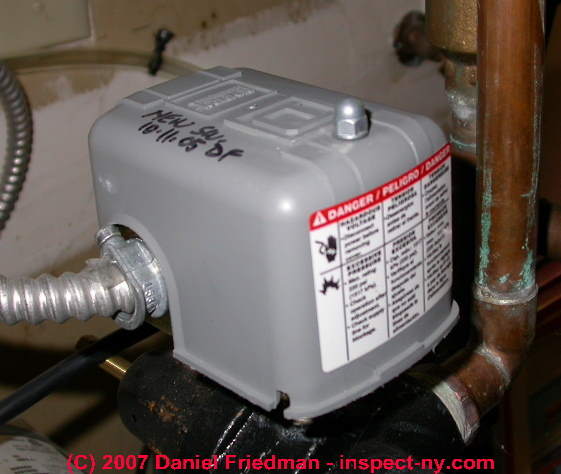
A defective water pressure control switch.
Switch contacts can burn up, or the opening into the switch
which senses the water pressure in the system can become clogged with sediment or debris.
This usually
shows up as failure of the pump switch to turn on or off at all, rather than short cycling. But the switch could be damaged or improperly adjusted, causing "short water pump cycling."
Technical note: Clogging of the Water Pump Pressure Control Switch.
If your water has a high level of silt, debris, or minerals, it's possible
that the tubing or piping connecting the pump pressure switch to the pump or water piping, or the pump switch bottom orifice through which the pressure switch senses the water pressure in the system has become clogged.
The small diameter of this tubing and still smaller diameter of the pump switch orifice makes clogging easy if your well water is high in sediment or minerals.
A clogged water pump pressure control switch will often fail to turn on the well pump at all, even though the pressure in the system has dropped
below the water pump "cut in" pressure.
Reader Jeff Crosby reported an example of this pressure switch clog problem:
[When our well pump kept short cycling and I was unable to get the well pump pressure control switch to work properly, ...] I ended up calling the pump service company to come over. There was an extreme amount of mineral buildup inside the pump where the copper tubing initially comes out to travel to the pressure switch. I thought about checking that out but did not know how funny.
There has always been an awl sitting on the pump base for the longest time. One of their maintenance guys left it there long ago. Now I know why - ever since that date when they come do their yearly check up they knock out this sediment [using the awl to open the tubing so that the pressure switch can accurately sense the water pressure in the system]. -- Jeff Crosby
On rare occasions we can tap on the well pump control switch and it will begin working again, but not for long, and not reliably.
Another water pressure control switch failure is the rupture of a rubber disk or "bladder" inside the switch itself. If you detect or suspect a defective pressure control switch, try replacing it with a new one.
We see a similar problem affecting water pressure gauges on private water systems: debris or mineral deposits can clog the pressure sensing orifice on the water pressure gauge, causing it to fail to respond at all, or to respond inaccurately to changes in water pressure.
When we find a clogged water pump pressure switch or the tubing connected to it, or a clogged water pressure gauge, we replace those items. A well pump pressure gauge that does not respond to pressure changes is potentially unsafe as it could lead to excessive pressurization of the water tank and building piping.
...
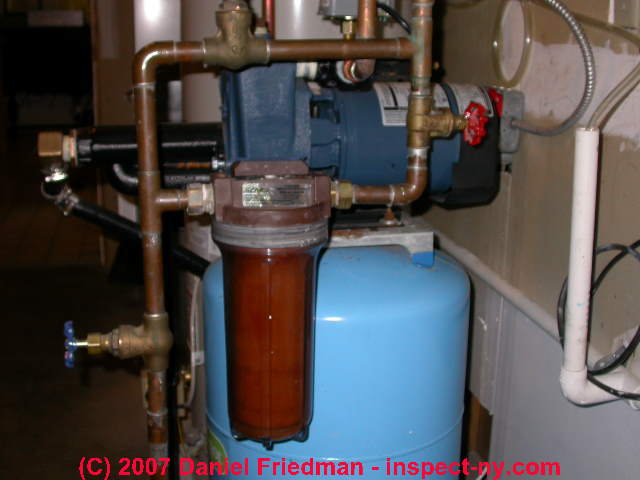
Clogged Water Filter as a Cause of Well Pump Short Cycling
A clogged water filter.
A clogged water filter can block water flow between a pump and water tank or between a water tank and the rest of the building.
Try changing the water filter by installing a new cartridge; temporary diagnosis can be made by simply removing a suspect water filter cartridge from its canister entirely.
I've also seen a clogged
water filter cause water pump short cycling, with a rapid "on-off" pump cycle (which is bad for the pump and
pump relay switch.)
Tips for diagnosing water filters as a cause of well pump short cycling:
If your water filter has a bypass valve, try opening that valve to see if the short cycling stops.
If there is no bypass valve for your water filter, turn off the pump and valves around the water filter, then remove the water filter cartridge and reassemble the unit. If the short cycling problem stops you probably had a clogged water filter.
Replace the water filter cartridge.
- Technical note:
the same clay, silt, or other debris that clogs a water filter can clog up the pressure sensing opening in the bottom of a pump pressure control switch, as we discussed just above. So if you are looking for a clogged filter, if changing the water filter does not correct a problem with the water pump cycling operation, also consider a possibly clogged pump pressure switch.
...
Blocked Water supply Piping as a Cause of Well Pump Short Cycling
A blockage in the water supply piping.
For example, a clogged or nearly clogged water filter can cause the pump control to cycle on and off rapidly. This is because the blockage causes water pressure (between the pump and the filter) to rise very rapidly when the pump turns on.
A water supply pipe can become clogged by rust or mineral scale and, less often, by silt or other debris.
If such a blockage is causing water pump short cycling you may also see poor water pressure or pulsing water pressure throughout the building, and the blockage is probably close to the pump itself.
Watch out: Without some detective work it can be difficult to distinguish between a clogged or blocked water supply pipe and a dirty or clogged water filter (discussed above).
Before starting to disassemble water piping check first for the presence of a water filter on your system and if one is present, be sure that a new, clean filter has been installed.
The author once replaced a pump control switch only to discover that the real problem was a clogged filter, so check this item if you have filter(s) installed on the system.
If there is no water filter, or the water filter is absolutely-new but the pump is short cycling rapidly, there could be a blockage at a nearby control valve or elbow or other pipe connection.
Often the plumber will cut open or dis-assemble piping immediately down-stream from the water pump outlet, looking for visual evidence of silt, scale, or if iron or galvanized steel pipes are present, the plumber will look for rust clogging.
...
Overcharged Air in Water Pressure Tank as a Cause of Well Pump Short Cycling
Air & Water pressure in the water system are the same
"PSI" of pressure here (pounds per square inch) is the system pressure, regardless of whether you're measuring the pressure of air pressure (at the top of the pressure tank) or water pressure (at the bottom of the water tank or elsewhere on the building water supply piping system).
If you see water pressure of 50 psi on the water tank's pressure gauge, then both the water and the air in the tank are at 50 psi.
When you measure water pressure at a gauge on the water piping or at the tank outlet tee, you'll still see the same 50 psi that you'd see if you held a tire air pressure gauge on the water tank's air-inlet valve at or near the top of the water tank.
Too much air in the water pressure tank - overcharging causes pump short cycling:
If a well pump pressure control switch is set to cut on at 30 psi and off
at 50 psi, at the cutoff point the water tank is empty (a bladder type captive air tank) or nearly empty (a traditional water tank)
of water, and the air pressure in the tank is about at 30 psi.
At that pressure, the pressure switch closes, turning the well pump on and the pump then re-pressurizes the tank with incoming water, until
the tank pressure of both air (in the tank) and water (in the tank and in the building water piping) increases to the pump cut-off point of 50 psi.
If someone puts too much air in a conventional water tank (overcharging), the excess air usually simply blows out of a nearby faucet the next time the water is run, and the system will correct itself.
If someone overcharges a captive air water tank the excess air can't escape. The air is trapped inside of the tank and is physically kept separate from the water - it can't get out.
- Overcharging when water tank is full:
If the previous air charge was set to 50 psi and the system was working normally, and you've now put in a little more than 50 psi, and if you did this deed when the water tank was full or close to full (the pump has pumped up to its shutoff point) you've increased the volume of the air above the water-bladder and therefore decreased the volume of water that will be in the tank on future run cycles.
This reduced water volume in the tank will shorten the pump on-cycle and depending on how much air you put in, it could give a very short pump-on cycle or cause pump "short cycling". - Overcharging when water tank is empty:
If you pumped just over 50 psi into the air portion of the tank above the water bladder when the pump was turned off and the water tank was empty it will be like having no water/pressure tank on the system at all.
When you open a faucet, the pressure in the system immediately drops to close to zero, the pump comes on immediately, and because water is not very compressible, the pump cuts off almost immediately, unless you are running lots of water so fast out of the piping that the pump can't catch up to its cutoff point.
In that case the pump will run continuously until you turn off the water, then the pump will shut off right away. - Overcharging can damage a water tank:
Watch out: safety warning - overcharging can damage or even break the bladder in a captive air type water tank, converting it to a (short-lived, poor performing) more traditional bladder-less system.
The water bladder might also be damaged if water pump pressure is set too high though both of these don't seem highly likely.
Watch out: overcharging a water tank with very high air pressure is very dangerous and could cause a water tank to burst, causing severe injury. Don't rely on the presence of the relief valve. - Effects of ambient air temperature:
Ambient air temperature's effect on water tank and pump control operation is not normally any concern whatsoever, but in the off chance that your water tank is installed in an unusually hot or cold location, you'll want to review the mathematics.
To calculate exactly how much difference a given air pressure or air volume change makes inside a water tank is presented in our companion
article WATER TANK PRESSURE CALCULATIONS - Adding air when previous charge was too small:
If the previous air charge in the water tank above the water bladder was too small in volume and the pump was short cycling, adding more air to the water tank would increase the draw-down time or water volume taken out of the system before the pump has to come back on.
This would reduce rather than increase pump short cycling. - How to correct an improperly charged water tank:
If your water tank has been overcharged and is a bladder type, you'll probably have to turn off the pump, let all the water out of the tank, and then reset the air charge to the factory-specified pressure for your pump system - probably a little under 20 psi for a 20-40 water pump system or a little under 30 psi for a 30-50 water pump control system.
The procedures for properly charging a water tank with air are discussed in complete detail
at WATER TANK AIR, HOW TO ADD
If your water tank was over-charged with air and is the type that does not use an internal bladder, the excess air will normally exit through the building water supply piping when water is run by building occupants.
See AIR DISCHARGE at FAUCETS, FIXTURES
...
Damaged Water Tank Bladder as a Cause of Well Pump Short Cycling
A water tank bladder stuck to itself won't admit water into the tank
it sounded so weird we didn't believe it at first, but a reader explained
that the water-containing bladder in their WellXTrol™ type water tank had collapsed and become stuck on itself.
The effect of a water tank air bladder that has collapsed and adhered to itself was that the water pressure tank would accept only a very small volume of water before the stuck-up bladder would reach the pump shut-off pressure. The bladder was replaced and things got back to normal.
Details are at WATER TANK BLADDER STUCK to ITSELF
A water tank bladder that is perforated, torn, or ruptured loses air charge and the tank becomes water-logged
If your water pressure tank has a ruptured or torn or leaky bladder that can cause short cycling of the water pump, you might "get by" temporarily by forcing air into the water tank - sometimes this works until you can get a new bladder installed or until you install a new water tank entirely.
But sometimes adding air to the water tank with a torn or ruptured bladder won't work - that suggests that the bladder has become adhered to itself inside the water tank.
The symptoms in both of these cases will be the same as described
...
Water Tank Frozen - cause of Well Pump Short Cycling
Reader Comment: frozen water pressure tank traced to cause of well pump short cycling
Your site was very helpful for information on "short cycling" of a water well pressure sensor switch and pump relay. However, none of the listed causes matched my issue, so I wanted to relate what I discovered.
After a very cold night (approx -25F), we had some freeze-up and ruptured pipes in the system. I thawed everything and replaced the broken pieces, but the well pump was short cycling, clicking on and off.
I knew there had to be an obstruction in the supply line leading to the pressure switch, but I had thawed the line thoroughly. In a moment of insight, I realized that there might be ice in the pressure tank itself, so I shined a halogen work light on it for a few hours, and that solved the problem.
Thanks again for the information your site provides. It really helped. - E.T. 12/18/2013
Reply: consider some freeze-proofing steps to prevent recurrence of a frozen water tank & piping
While it is common for water supply pipes to freeze at one or more cold spots in a home during very cold weather, it is more unusual for a water pressure tank itself to freeze up - though I could imagine that if pipes are frozen around the pressure tank, the pressure tank outlet tee itself might also freeze solid - causing well pump short cycling.
If your freeze-up occurred because the whole building lost heat for a time during very cold weather I can understand a more broad range of frozen plumbing pipes, valves, tees, and even a pressure tank or toilet tank (which sometimes will also burst when frozen).
If the freeze-up of the pressure tank that you cite occurred when your home had not actually lost heat, I'd look at some freeze-protection steps to prevent a recurrence.
The first choice is finding and sealing drafts, next adding insulation, and third, in some difficult spots adding a heat source. We have seen successful freeze protection in well pits with just the addition of the small amount of heat provided by a 75W incandescent light bulb hung close to the piping and pressure tank.
...
Water Tank Leaks as a Cause of Well Pump Short Cycling
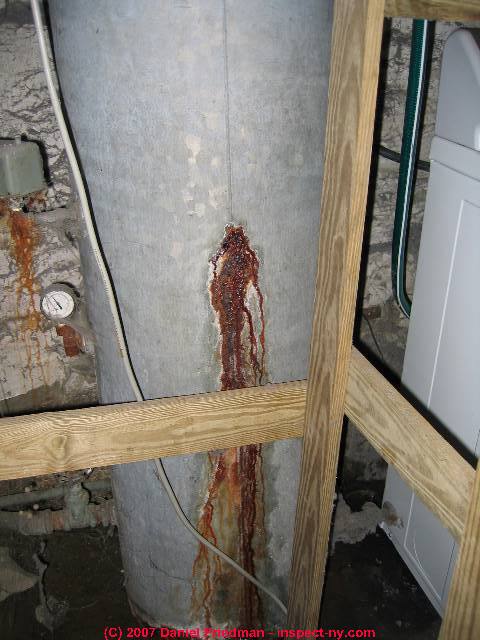
- An air leak at a rust-perforated, leaking water tank
can lose the air charge in the water tank along with the leaking water.
See BLADDERLESS STEEL WATER Storage/Pressure Tanks for photos and text describing how this happens and how you might spot an intermittent air leak from a faulty water storage tank.
- A water leak somewhere else in the system,
causing tank pressure to drop too rapidly regardless of actual water use. An example might be a hidden plumbing leak in the building, or a leak in the water line between the well and building, or a leak in the piping within the well itself.
If the system has this defect you'll hear the pump coming on and off periodically even when (as far as you know) no plumbing fixture is running in the building.
If the leak is severe, the pump may run continuously or nearly so.
See WELL PIPING LEAK DIAGNOSIS - Before digging up well lines
one should check for a running toilet - the most common leak which is missed in buildings. In humid climates, a running toilet can often be spotted by the constant presence of condensation on the outside of the toilet tank.
Since some running toilets can be hard to spot, we use septic dye, or sometimes just food coloring, in the toilet water tank to prove that the tank is leaking into the bowl below. - Well piping foot valve leaks:
in some cases a defective foot valve in the well can cause water to drain back out of the building system into the well, dropping pressure in the water tank and causing the pump to run mysteriously.
The "foot valve" is an anti-siphon device intended to hold water in the pipe that rises up inside the well after the pump has shut off.
If the foot valve is damaged you'll need a plumber to pull the well line and replace the valve. The foot valve itself is an inexpensive part but pulling the well line can be costly. On the author's well, the foot valve lasts typically about 20 years. - Water pressure tank located too far from the pressure control switch:
if you place the water pressure tank too far from the pump pressure switch, or at a different elevation from the pressure switch, the pressure switch control may not operate properly. Here is what Amtrol™ says about tank location:The Well-X-Trol should be installed as close as possible to the pressure switch. This will reduce the adverse effects of added friction loss and pressure switch bouncing, and the difference in elevation between WELL-X-TROL and switch.
Really most pressure tanks will work if placed almost anywhere.
But if you have a problem such as pressure switch bouncing (the switch turning the pump on and off rapidly at the start or end of a pumping cycle) you can relocate the pressure switch to the new larger tank and run a longer wire to the pump or pump control relay.
Other causes of pressure switch bounce and well pump short cycling are discussed in this same document.
Be sure to see our separate diagnostic guide Table to well pump short cycling in table form
...
Well Water Piping or Check Valve/Foot Valve Leaks as a Cause of Water Pump Short Cycling On and Off
At CHECK VALVES, WATER SUPPLY, DRAINS, PUMPS
and
at AIR DISCHARGE at FAUCETS, FIXTURES we describe two sorts of leaks in the well piping system that can let air (and contaminants) into the well piping:
- a leaky check valve
(this includes a leaky or stuck foot valve in the well). See - a leak or hole in the well piping
that leaks air into the pipe when the pump stops and leaks water out of the well pipe when the pump is running.
See WELL PIPING LEAK DIAGNOSIS - See SHORT CYCLING CAUSE: WELL PIPE LEAKS for a case report and photos of steps taken to trace well pump short cycling to well piping leaks, where the leaks were located, how they were found, how the well piping leaks were repaired.
If there is a hole in the well piping anywhere between the bottom of the well and the water tank itself, water squirting out of this hole during every pump-on cycle tends to enlarge the hole over time.
When the water loss at this leak is great enough, the well pump has to run longer to reach the pump control cut-off pressure, and at the same time, water running back out through this same hole drains pressure and water from the system, causing the pump to have to run more often.
If the leak in the well pipe is below the water level inside the well you will still have water and water pressure loss back through the leak when the pump stops, but you probably won't find air entering the well piping.
Watch out: If the well piping leak is severe enough, the well pump may run continuously - a problem you'll notice quickly if the well pump is inside the building. But if the pump is an in-well submersible unit, it may be running continuously without anyone noticing it - until the pump fails.
...
7 Other Causes of Water Pump Frequent Cycling On and Off
- Bad water pressure tank location:
Locating the water pressure tank too far from or on a different level from the pressure control switch can cause pressure control switch bouncing and extremely-rapid water pump on-off cycling at the start or end of a water pump operating cycle.
See WATER PUMP PRESSURE CONTROL SWITCH CHATTER
See also WATER TANK LOCATION GUIDE
- Water-logged internal-bladder type pressure tank with a pinhole leak
in the bladder may cause pump short cycling but may not squirt water at the pressure tank air valve.
See PINHOLE LEAKS in WATER TANK BLADDER - Blocked pipe, valve closed, valve partly closed, valve broken, pipe obstructed:
particularly if the water pump is short-cycling very rapidly (seconds between on-off or less) we look for other water flow blockages between the pump outlet and the pressure tank or building point of use plumbing fixtures.
We included a common example of this problem
at WATER FILTER CLOGGED.
Similar blockages in the water system that can cause pump short cycling include:- Pipe obstruction:
a water pipe that has been bent, crimped. driven-over, or that has become obstructed internally from debris, rust, corrosion - Solder blobs:
new plumbing work that involved pipe soldering: too much solder pushed into a pipe joint has almost closed the pipe flow opening - Valve closed:
if a plumbing valve is closed or nearly closed, the result can be very rapid pump short cycling. Don't forget to check not just for a closed plumbing water valve but also for valves that may be damaged or blocked internally such as the separation of the gate from valve stem in a gate valve.
10 Aug 2015 Dave said:
My water pump is cycling on and off,every 2-3 sec. when a tap is opened. I have replaced the switch with a 20-40 psi switch and checked that the pressure tank ( bladder type ) has 18 psi in it.. any ideas would be helpful. Tks
Reply: Dave:
I'd be looking for an obstruction such as a nearly closed or blocked valve.
But even better, watch the pressure switch. It's possible that water is not entering the tank or that your tank is waterlogged and includes a pressure gauge that's stuck, giving a false reading.
Gently rock the tank (don't break any connections) and you can usually tell if it's empty (it'll be light), and similarly, if no water is entering the tank, its pressure and temperature and weight won't change.
Reader Follow-up: Thank you I checked the gate valve and found the gate had come off the stem. I replaced it with a ball valve, No more problems. I will be telling my friends about this site. - Thanks to reader Dave for this reminder, 11 Aug 2011
- Pipe obstruction:
- Water pressure regulator / flow meter damaged:
(uncommon) on a system that includes a pressure regulator at the water supply system outlet.
Blockages might occur in other devices such as at a water flow meter. - Improper water pressure tank draining & re-fill
might also cause pump short cycling following a water or plumbing or water tank repair attempt.Using a plumbing fixture during a power outage?
Reader M.L. offered these comments [edited for clarity and brevity].I've searched your site for reasons why pressure is lost in a system if, during a power failure, a fixture is used somewhere in the house; in my case, a toilet. I came across it being mentioned on one of your pages, but no solutions or options offered.
After searching other sites, I drained and flushed my pressure tank; only to now have short cycling issues start with the pump. I found your page dealing with "causes for short cycling & solutions". It did not, however, mention the symptoms I was experiencing.
I located a video dealing with changing a pressure switch. In it, mention was made as how to properly drain and fill the expansion tank. and what happens if you don't do it right.
As your site comes up quite a bit when a Google search is made dealing with this, please allow me to submit the following for you to add to your "causes for short cycling" page.
When the pressure tank is drained, either for work (replacing gauge or switch) and likely even for the recommended regular (annual) maintenance to drain dirt build-up (which apparently reduces the possibility of the base of the tank prematurely rusting out) It is necessary to also drain the air pressure in the tank.
This will allow all of the water to drain. If this is not done, water will still remain in the tank.
The reader comment above is not quite correct. In fact the air pressure in the tank is what pushes water out of the pressure tank during the draining process. However you might need to check that the proper air charge is in the tank when it is returned to service.
And if a tank has become waterlogged, there is no air to push water out of the tank. In that case you'll need to open an air inlet (perhaps at the tank air charge valve) to drain water from the pressure tank. - Editor.
See WATER TANK DRAIN VALVE - Editor
Moderator Reply: Loss of pump prime does not cause well pump short cycling.
Thank you for the notes, M.L. we include them here with some clarifying comments and technical corrections. Working together makes us smarter.
The most common cause of lost water pressure after a power failure is loss of pump prime which in turn was caused by a leaky check valve or foot valve or occasionally by a leak elsewhere in the system sufficient to drain water out of the pump and piping near the above-ground 1-line or 2-line jet pump.
(This problem with these causes won't show up with a submersible pump because that unit is underwater, in the well: it can't "lose prime".)
When the jet pump is turned on again, its impeller is spinning in air, not water, and it can't develop enough suction to pull water out of the well.
Watch out: Loss of prime will leave the pump running constantly with no water delivered - shut off the pump immediately to avoid ruining it.
Please see PUMP PRIME, REPEATED LOSS of for a description of that problem and
please see PRIME the PUMP, HOW to get things going again.
Then to fix the underlying problem
see FOOT VALVES
Reader continues:
When the tank is filled with water again, it will appear to fill regularly up to about 30 lbs. at which point the needle on the pressure gauge rapidly shoots up to 50 - 55 lbs. and the pump shuts off.
When water is first run, there seems to be proper water pressure at the taps, but this drops off very fast, and the pump begins to short cycle.
This is because of the water still in the tank and the apparent air-lock this has created.
When the tank was refilled (without having had all the pressurized air drained) the pressure tank did not properly fill and only the house lines were pressurized. When the tap was open this causes the pressure to rapidly drop, causing the short cycling.
Turn well pump back on and allow to refill with water (gauge should now fill slowly and steadily to set cut off point).
Open supply line tap to house.
To confirm proper operation and no more short cycling, open tap in sink and monitor gauge. All should operate properly now.
Based on the number of similar questions regarding this situation I came across while searching for answers, I'm sure this will come in handy. - M.L. 6 Dec 2014
Moderator reply: signs of a water-logged pressure tank, not "air lock"
Not quite correct: this is not an air lock problem but rather a sign of a water-logged pressure tank.
That can occur because someone thought they had properly drained the tank and inserted the proper air charge when in fact they have not done so. To get the proper air charge in the tank we need either to drain it completely by gravity or we need to pump air into the tank.
See WATER TANK AIR, HOW TO ADD - Editor
To avoid this: Turn off supply valve to house, after pressure tank. Drain tank. Drain air pressure from tank. Re-pressurize tank.
Clarifying: you won't need to "drain air pressure from the water tank": if you drain the tank completely you'll also allow any air pressure above ambient to blow out of the tank drain.
There may be some confusion between a bladderless water pressure tank and tanks that include an internal bladder keeping water and air separate. In case someone has over-charged the air pre-charge in an internal bladder type tank you'll need to release the excess air through the tank's air valve.
Set the water pressure tank air pre-charge pressure to 2 psi below the pump control switch CUT-IN pressure and you'll be OK. - Editor
- Pressure control switch chattering or contact bounce -
very rapid on-off cycling of the pump, usually at the start or end of a pump cycle.
See details at WATER PUMP PRESSURE CONTROL SWITCH CHATTER - Ask your plumber,
as this expert may know other causes and remedies that we have not identified in this article series.
Short cycling of a water pump (which is discussed in this article) means that the water pump turns on and off too rapidly or too frequently when water is being run in the building. We also provide a complete
SHORT CYCLING DIAGNOSIS TABLE that lists all possible causes of well pump rapid cycling on and off.
If you are not sure what "water pump short cycling" means or how it is recognized, see
A chattering pressure control switch problem occurs when the pressure control switch turns on and off extremely rapidly, at intervals of seconds or less, usually at the start or end of a well or water pump-on cycle.
The causes of & cures for pressure switch chatter are explained
at WATER PUMP PRESSURE CONTROL SWITCH CHATTER
Intermittent water pump cycling which is discussed at
INTERMITTENT WATER PUMP CYCLING means that when no water is running, the water pump comes on for no apparent reason.
Loss of water pressure means that the pressure with which water enters a plumbing fixture has become too slow, or is sometimes too slow or weak in water flow rate, or water flow may stop entirely.
Reader Comments, Questions & Answers About The Article Above
Below you will find questions and answers previously posted on this page at its page bottom reader comment box.
Reader Q&A - also see RECOMMENDED ARTICLES & FAQs
New 1hp submersible pump still short cycles
So I have a brand new 1hp submersible pump, new 20/40 switch, and a new 20 gallon bladder tank and the pump still short cycles.
If I take the switch off, the water flows out the entry and when I switch and remove the task to see water flowing there, I have water as well.
I used to have a 5 gallon tank and 1/2hp pump. Can someone explain what reason things are not working? I'm stumped and beyond frustrated.
To add, when short cycling, it's doing it every second and the pump is banging all over the place. On 2022-08-25 by Tee M.
by InspectApedia-911 (mod) - what to check first
@Tee M.,
1. be sure that the tank's air pre-charge is correct and was set with no pressure on the system
2. be sure there's no partly closed valve blocking water flowing into the tank
3. then look through the short cycle causes at WATER PUMP SHORT CYCLING CAUSES and let me know if you still have trouble.
Water pump short cycles rapidly even when I turned off the line into the pressure tank - water flows backwards into the well when the pump is off
My water pump also started switching on and off rapidly. So to diagnose I shut the hose going into the tank and it kept doing it. So i thought the foot valve is the problem.
With the lines all open like regular use shut the pump off if the water pressure in the house now reverses and flows back down the well then the foot valve is not doing it's job of stopping it (you can hear the water flowing through the lines to the pump rapidly).
think my fix is leaving the valve alone at the bottom of the well and installing the new in line one just before the pump so it will not drain back down into the well. It's just a 1 way flow control valve and as long as there's no holes or leaks no air will get into the system. On 2022-03-02 by Anonymous
by Inspectapedia Com Moderator - water system may have both a waterlogged pressure tank and a bad foot valve or check valve
@Anonymous,
If your well is a shallow one - 27' or less deep, then installing a check valve at the pump can help stop loss of prime.
Loss of prime - water draining back down the well - could indeed explain frequent pump cycling on-and-off, because at the pump shuts off water running back into the well drops water pressure at the pump control until the pump turns back on again.
BUT I do not agree that loss of prime alone would cause very rapid on-off cycling of the pump.
That would be caused by a waterlogged pressure tank or one of the other problems listed above on this page.
So your water system may have both a waterlogged pressure tank and a bad foot valve.
Water pump made odd noise and quit; new pump doesn't reach cutoff
Hi, we had a Grundfos JPSA water pump with a Welmate WM-9 pressure tank for our catchment system which has worked fine for 15 years. A few days ago the pump made a strange noise and stopped. There was an electrical smell. It tried to come back on but not right noise, so we shut her down.
Bought a new pump updated same model JP PS . Installed the same. Drained the tank pressure was down to 18, filled it to 28 ( we have 30 -50). Replaced check valve while we were at it tho didnt appear to be a problem, no apparent leaks anywhere.
We primed the pump and turned the power back on. The pump ran for 30 secs, water at highest point in house ran with reasonable pressure for 3 minutes then to a dribble, pump came back on again for only 30 secs.
We let it go for 3 times then shut down. While the pump was on the pressure gauge only hovered between 25 and 30 and never got to its shut off of 50.
We have checked everything and cant find a reason why it is not working. We carefully adjusted the pressure switch shut off , turning it 8 full turns but this only achieved a 2 psi gain upon next startup instead of the expected 10. so we returned it to factory preset.
Could it be the bladder in the tank, even though it still reads 28psi after all this? Please help, this is driving us nuts! On 2022-01-31 by Libby
by Inspectapedia Com Moderator - noises from Grundfos JPSA water pump w Wellmate WM-9 pressure tank
@Libbykripps,
This doesn't sound like a water pump short cycling problem, the subject above on this page.
It does sound as if there is either a loss of water in the well or a leak in well piping.See the diagnostics at WATER TANK NOISE DIAGNOSIS
Here are a few other diagnostic comments:
Bladder tank not taking water? If the problem were the bladder tank that might cause well pump short cycling (rapid on-off) but not "an electrical smell". You don't have short-cycling so I don't think this is the issue.
Pump noise, then pump stopped: could be pump sucking air - meaning the well is dry or there's a leak in well piping. A pump protection switch could be shutting off the pump if the well is running dry, but that wouldn't explain the electrical smell.
Pump or switch made a bad electrical smell: If you have a burning electrical smell at the pump there is an electrical problem or failure at the control switch, wiring, or at the pump itself.
Further inspection and testing of the pump and wiring and switch is in order.
The water pump keeps tripping on remaining for about 10 to 12 seconds
OK heres my problem the water pump is feeding about 12 apartments my pump is pulling the water from the tanks to feed the apartments
the lady called me tell me the pump was not cutting of so I figured out the problem and it was a check valve so I changed it it worked well for about 2weeks
den she call me and say a line was leaking so I cut of the tanks and the pump but wen I cut the line I got back a big flow of water coming from the feeding line dat feeding the buildings
so I went up to the road and cut of de valve on the main wen I fix the leak now the pump keeps tripping on remaining for about 10 to 12 seconds and cutting off it doing dat for about 5 mins and den cut it stops but as soon as someone uses the water it starts all over again On 2021-10-13 by Darren Boodram
Repair Advice by Inspectapedia Com Moderator -
@Darren Boodram,
Rapid on-off pump cycling usually means that there is a water-logged pressure tank that has lost its air charge.
Then any water use, such as a leak or someone running water will star that short-cycling.
I sometimes also see rapid on-off cycling when flow is constricted, such as by a clogged water filter or a mostly-closed valve.
New kitchen sink faucet causes pump short cycling?
Hello. Ever since I changed out the kitchen faucet the water pump/tank short cycles. Had no problems before changing the faucet. There is no short cycling when running water in any other faucet or the toilet. I am afraid the short cycling is harmful to the pump. Please help. On 2021-07-27 by Marshall B.
by danjoefriedman (mod) - diagnostic suggestions
@Marshall B.,
As a diagnostic step:
Does this faucet permit water to flow faster than any other plumbing fixture? What about at tub spouts?
Is there a removable strainer on the faucet? If so, remove it - that gives a less constricted water flow. Then turn on cold full blast and tell me if the short cycling continues.
And
Have you checked the air charge in the pressure tank?Did you turn off power to your pump when you were installing the new faucet? If so and IF there is a well pipe or foot valve or check valve leak, the pump may have partially lost prime.
by Marshall B.
@danjoefriedman, Actually I believe the new faucet runs slower with less volume than the previous faucet. I believe the new one, having a removable, pull out spray wand instead of a stand alone spray wand, may be a low flow to save water.
Being in the country with our own well I don't need to save water. I looked around and found most kitchen faucets are now water savers.
As stated, ALL other (including tub/shower) faucets do not short cycle the pump. ONLY the new kitchen faucet. I will see if l can take the wand apart and remove the screen.
by Inspectapedia Com Moderator - only 1 faucet is causing pump short cycling
@Marshall B.,
Let me know what happens when you remove the strainer.
The reason I am suggesting we investigate that clue first is that I have certainly found occasions in which pump with a sensitive pressure control with short cycle when the water was not being run fast enough.
It's a bit of an odd case and it usually occurs when we're using a pressure-sensitive water pump without a separate water pressure tank.
Why does my well pump short cycle when running the shower but not when filling the pool or running the irrigation system?
Hi, I have a very simple pump with a pressure switch - no expansion tank. The pump supplies our whole house with water coming from a 1 500 litre storage tank, which holds the water that our borehole supplies.
When we have showers, the pump cycles off every 15 seconds or so and after about 5 seconds, kicks back in again – this is very easy to sense when standing under the shower, feeling significant differences in the water pressure – but when I’m filling the pool or the irrigation is on, the pump doesn’t cycle at all.
Any direction as to where I should be looking to eradicate this pump cycling issue when we use the showers?
Many thanks in advance – much appreciated. On 2021-05-27 by Dave Jennens
Repair Advice by danjoefriedman (mod) -
@Dave Jennens,
Thank you, that's a helpful question I'd re-state as:
Why does my well pump short cycle when running the shower but not when filling the pool or running the irrigation system?
Answer: the water flow rate is so fast when filling the pool or running the irrigation system that the pump never reaches its CUT OFF pressure, so it runs continuously.
When running the shower, the pump can deliver water a bit faster than your shower head's flow through rate lets out, so the pump gets ahead of the demand and is able to re-fill the water pressure tank, reach the CUT OFF pressure and turn off.
The reason the pump cuts on again so quickly will be one of the causes of pump short cycling listed above on this page, so please take a look as those causes and cures, starting with
Waterlogged pressure tank that has lost its air charge.
These articles also explain how to fix the problem.
Keep me posted.
Sta-Rite jet pump is cycling on about every 8 minutes.
My Sta-Rite jet pump is cycling on about every 8 minutes. I can watch the pressure gauge at the pump go down to 35 psi and kick on unitl 55 and shut off. I have the output valve a few feet after the air tank shut off. I've already replaced the Sense line to pressure switch which had a leak.
Replaced foot valve and Pipe cup seals by foot valve, and casing adapter seal.
Acts like a leak in the casing or pipe in the well. No sign of any external water leaks anywhere. Could the air tank do this even without showing any leaks? What else could it be? On 2021-04-24 by Jamie
by (mod) - Water pressure falls / Sta-Rite pump runs when nobody is running water - this isn't "short cycling", it's a leak or water running somewhere
@Jamie,
take a look at
WATER PUMP INTERMITTENT CYCLING - pump seems to run occasionally for no reason
as I think that's a good diagnostic procedure for the case you describe.
I understand you've replaced some parts including the foot valve, but from what you describe there has got to be either water running somewhere we've not found
or
a leak in well piping that's letting pressure out of the building - into the ground or back into the well.
KolerFlo Booster Pump short cycles when no water is running - no pressure tank
I have a KolerFlo Booster Pump which I have installed in my home. As I understand its use, the pump in the automatic position will cycle on when water use is activated and shut off when all use is over. My pump will continue to cycle on and off when there is no water usage. Why? On 2021-02-03 by joe S
by (mod) -
I would check for a dirt or debris on a diaphragm or control switch that's managing the pump. I suspect if we look in the manual for your pump you'll see that as one of the diagnostic suggestions when the pump is short cycling
Then review the diagnosis and repair procedure at WATER PUMP INTERMITTENT CYCLING - pump seems to run occasionally for no reason
Pump short cycles once a second - not responding to water pressure
My 20 gal. Pressure tank dropped to ~15lb.
Drained system, replenished 28lb of air,
Put new pressure switch (30-50)
No moisture comes out of schrader valve.
Water fills about 1/3 of tank . (not water logged).
Short cycles ~ once a second (fast) up to ~ 0 to 100psi to 0 etc.
IF I manually hold contacts closed (enable pump)for 30 seconds I can bring pressure up to ~ 40lb
45 seconds ~ 50-60lbs. etc.
there is no air or water leak - pressure holds constant indefinitely.
However, pressure doesn't go up slowly ; while filling tank water pressure is max (100psi or more).
How many seconds I manually hold pressure switch contacts closed (enable pump) , I determine ~ water pressure .
After 6 months I've mastered this technique , but wish I didn't have to..
I found it safest & easiest to turn off well pump & wait for pressure to dramatically drop & then manually bring it
up to pressure where it holds steady.
Causes ? Bladder failed in unconventional way
Old pressure switch wasn't very old & just a bad, new pressure switch..
NOTE: (when pressurizing system) 1st time I shut off valve for water to house therefore only had about 5 feet of plumbing pipe involved in & around pressure tank. RESULT - short cycled
2nd time , I opened water valve to house & a faucet in the kitchen -RESULT - short cycled.
BIG QUESTION? why is water pressure maxed out (100+psi) & not going up gradually when
pump is manually enabled .As I said, it's time in seconds I enable pump,how I gauge ~ desired pressure.
VERY STRONG SUSPICION - TANK, as it is over 26 years old .
But everything indicates it's working properly - not water logged holds air & water pressure it appears tank is only filling with about 5-6 gallons of water (20 gallon tank).
With over 5 decades of troubleshooting oil burners to computers to my cars & this & that, I'm use to zeroing in on the specific bad component. I,m going to reconfigure the tank location so it's a bit more involved than direct replacement .
BASICALLY I'm asking - is there something I'm missing . I'm going with the switch then tank - only because switch is easier.
But I feel the tank is more likely (in spite of it looking like it's working correctly - which could be misleading.
Great Trouble shooting site - thank you DAZED & CONFUSED.On 2020-04-28
by RICH H
Advice by (mod) - look for clogged tubing bringing pressure to the pump switch
Could the tube or pipe nipple bringing pressure to the sensor on the switch be clogged
Short cycling water pump traced to leaky water pressure tank - air lost
I have had short cycle problems for some time. Mine is a 21 gal tank and the pump mounts to a bracket on top the tank.
I made up a paste solution of soap and used a sponge to wipe the soap all over my tank. We saw bubbles from 1 of the TIG welds on the bracket welded to the top of the tank.
We re-welded the bracket and it it's been 5 weeks now with no short cycle and no lose of air. Before the repair I was draining this tank every 2 days to let air back in. (non bladder)On 2019-03-06 by Robert W
by (mod) - air leak at tank weld leads to short cycling pump
Robert
Thank you for posting this cause of well pump short cycling - loss of air from a pressure tank at a weld. It's not a cause I have heard reported before, so it will certainly be helpful to other readers.
Nice going on the diagnostics.
...
Continue reading at WATER PUMP SHORT CYCLING DIAGNOSIS TABLE or select a topic from the closely-related articles below, or see the complete ARTICLE INDEX.
Or see WATER PUMP SHORT CYCLING CAUSE FAQs - diagnostic questions help understand the causes of well pump switch cycling on and off quickly
Or see these
Recommended Articles
- WATER PUMP INTERMITTENT CYCLING - pump seems to run occasionally for no reason
- WATER PUMP SHORT CYCLING - pump turns on & off too frequently
- WATER PUMP WIRING REPAIR
- WATER TANK AIR, HOW TO ADD
- WELL PIPE LEAKS
Suggested citation for this web page
WATER PUMP SHORT CYCLING CAUSES at InspectApedia.com - online encyclopedia of building & environmental inspection, testing, diagnosis, repair, & problem prevention advice.
Or see this
INDEX to RELATED ARTICLES: ARTICLE INDEX to WATER SUPPLY, PUMPS TANKS WELLS
Or use the SEARCH BOX found below to Ask a Question or Search InspectApedia
Ask a Question or Search InspectApedia
Share this article:Ask a Question or Search the InspectApedia website using the box just below.
Need to make a private comment? Email editor@inspectApedia.com. We welcome email with your website content critique, corrections, suggestions or questions. Email is monitored daily but our workload may prevent an immediate reply. For immediate results, we hope you'll first try asking your question using the search box just above.
Citations & References
In addition to any citations in the article above, a full list is available on request.
- Thanks to reader Wayne Ouellette for discussing water tank replacement needs May 2010
- Pumptrol® Pressure Switch Adjustment, Square D, Schneider Electric Corporation, 8001 Knightdale Blvd., Knightdale< NC 27545 1-888-778-2733 - Square D Technical Library, web search 07/24/2010 original source: http://ecatalog.squared.com/techlib/docdetail.cfm?oid=09008926800a93be
- 9013 Pumptrol® Commercial Pressure Switches Type F and 9013 Commercial Pressure Switches Type G, Catalog, SquareD, Schneider Electric Industries SAS, Schneider Electric Industries SAS, web search 02/23/2011, original source:
http://ecatalog.squared.com/pubs/Machine Control/
Pressure-Float-Vacuum Switches/Pressure Switches-Water and Air/9013CT9701.pdf
Square D is a brand of Schneider Electric. - Class 9013 Square D Commercial Pressure Switches: Water Pump Pressure Control Switch Class 9013, Type F, G, Manual, Square D Company, 8001 Highway 64 East, Knightdale, NC 27545-9023, USA, (919) 266-3671, www.squared.com,
web search 02/24/2011, original source: stevenengineering.com/tech_support/PDFs/45COM.pdf. Quoting:
The Type FSG, FYG, FRG - PUMPTROL® Water Pump Pressure Switches are used to control Water Pump Pressure Switches are used to control
electrically driven water pumps and have the following features:- The Type FSG is the standard water pump switch, suitable for all types of pumps: jets, submersible,
reciprocating, etc. - The Type FYG is designed to meet higher horsepower and pressure requirements.
- The Type FRG is reverse acting: the contacts open on falling pressure.
All are diaphragm actuated.
The Type G - PUMPTROL® Commercial/Light Industrial Pressure Switch is used to control electrically driven water pumps and air compressors. It has higher electrical ratings for direct control of motors in pump and compressor applications. The Type G switch is diaphragm actuated and has contacts that open on rising pressure. - The Type FSG is the standard water pump switch, suitable for all types of pumps: jets, submersible,
- Flexcon, SMART TANK INSTALLATION INSTRUCTIONS [PDF], Flexcon Industries, 300 Pond St., Randolph MA 02368, www.flexconind.com, Tel: 800-527-0030 - web search 07/24/2010, original soonind.com/pdf/st_install.pdf
- Grove Electric, Typical Shallow Well One Line Jet Pump Installation [PDF], Grove Electric, G&G Electric & Plumbing, 1900 NE 78th St., Suite 101, Vancouver WA 98665 www.grovelectric.com - web search -7/15/2010 original source: http://www.groverelectric.com/howto/38_Typical%20Jet%20Pump%20Installation.pdf
- Grove Electric, Typical Deep Well Two Line Jet Pump Installation [PDF], Grove Electric, G&G Electric & Plumbing, 1900 NE 78th St., Suite 101, Vancouver WA 98665 www.grovelectric.com - web search -7/15/2010 original source: http://www.groverelectric.com/howto/38_Typical%20Jet%20Pump%20Installation.pdf
- In addition to citations & references found in this article, see the research citations given at the end of the related articles found at our suggested
CONTINUE READING or RECOMMENDED ARTICLES.
- Carson, Dunlop & Associates Ltd., 120 Carlton Street Suite 407, Toronto ON M5A 4K2. Tel: (416) 964-9415 1-800-268-7070 Email: info@carsondunlop.com. Alan Carson is a past president of ASHI, the American Society of Home Inspectors.
Thanks to Alan Carson and Bob Dunlop, for permission for InspectAPedia to use text excerpts from The HOME REFERENCE BOOK - the Encyclopedia of Homes and to use illustrations from The ILLUSTRATED HOME .
Carson Dunlop Associates provides extensive home inspection education and report writing material. In gratitude we provide links to tsome Carson Dunlop Associates products and services.
 |
HOME | ABOUT | ASK a QUESTION | CONTACT | CONTENT USE POLICY | DESCRIPTION | POLICIES | PRIVACY | |
| © 2026 - 1985 Publisher InspectApedia.com - Daniel Friedman | |||||||||