
InspectAPedia® FREE Encyclopedia of Building & Environmental Construction, Diagnosis, Maintenance & Repair |
Question? Just ask us! InspectAPedia
|
 Use of Springs for Drinking Water
How to protect the sanitation of spring water & how to improve spring yield
- POST a QUESTION or COMMENT about using springwater for drinking water
Drinking spring water?
This article describes using springs for drinking water and explains issues with spring water sanitation.
We provide advice about what to do when things go wrong with a drinking water spring, and we discuss the differences between a spring and a seep, spring and a dug well, and a spring and other types of water sources. .
InspectAPedia tolerates no conflicts of interest. We have no relationship with advertisers, products, or services discussed at this website.
Springs as a Water Supply
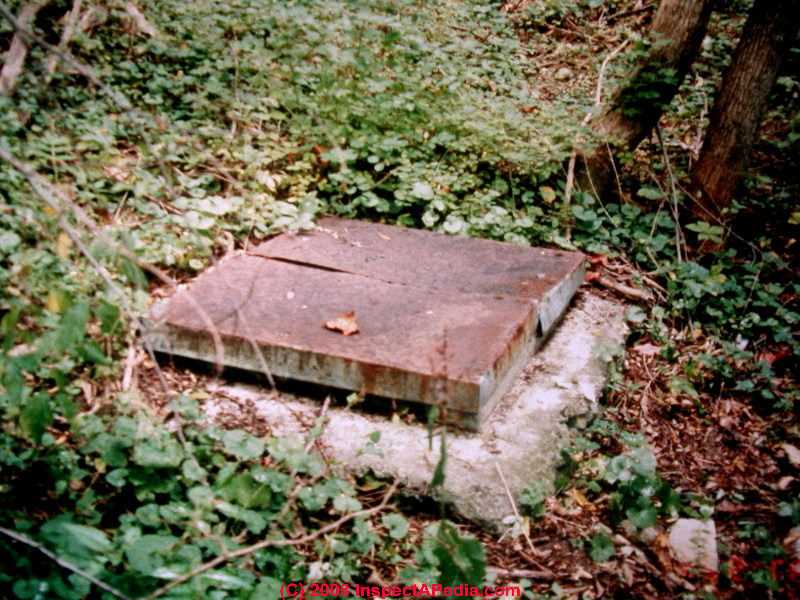 Open water springs, and similar containers have been used for centuries to
supply water to buildings. But currently in most parts of the world open surface water supplies are at risk of being un-sanitary - not safe to drink without further treatment.
Open water springs, and similar containers have been used for centuries to
supply water to buildings. But currently in most parts of the world open surface water supplies are at risk of being un-sanitary - not safe to drink without further treatment.
Here we discuss details of how springs serve as a water supply, what are the risks of springwater contamination, and what is done about that concern.
Definition of Water Spring & Spring Water
A spring or water spring is a water source originating underground but flowing to the ground surface.
Definition of Spring Eye
The spring eye is the actual source of springwater, often buried, sometimes exposed by excavation; the eye of a spring has, historically, been found by observing water running across the ground in an area up-hill from any obvious surface water source like a stream; the explorer follows the water uphill and finds a point at which water appears to be collecting or "bubbling" up from below.
Definition of Spring Box
A protective enclosure that may be around the spring eye, or down-hill from it, intended to keep the spring-water clean by keeping out animals, surface-runoff, and debris.
How do spring water supply systems typically work to deliver water to a building.
A spring box or spring house is constructed around the spring to try to keep out leaves, debris, and animals or other surface contaminants. Water from the spring may simply be hand-dipped out or water may be piped to a holding tank or directly to a building.
If the water tank is located higher than the building it serves the water supply can be fed by gravity.
If the open water tank is in the building or below it the water may be moved to the point of use by a hand pump or an electrical pump.
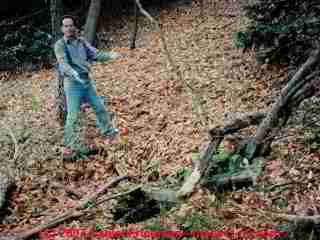
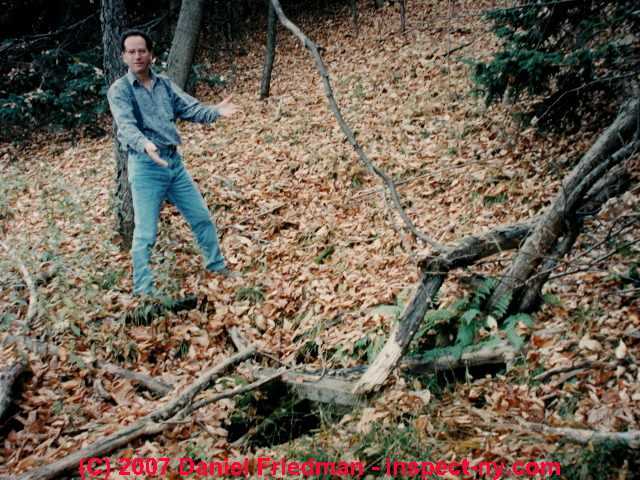
In the page top photograph my client and I had found the water supply for his home: a spring-fed in-ground cistern located uphill from the house and fed to the house by gravity.
Take a look at the condition of the spring: open to surface runoff and debris. It is not possible to assure that such a water supply is directly-potable.
What's Risky if not Downright Wrong Using a Spring to Supply Drinking Water ?
Spring water can be delicious and clean if it is in a protected location. But most residential springs serving homes are not so carefully designed.
Springs and cisterns that are open to groundwater runoff like these are unlikely to provide sanitary drinking water since they are easily contaminated by surface runoff. Where building security and personal security are a special concern, the water source needs to be protected from tampering; in these cases a spring could be deliberately contaminated or poisoned.
In the pictures of springs used as a home water supply shown above, the cover is unsafe or missing completely, and the springs remain vulnerable to surface contaminants such as animal waste, pesticides, fertilizers, or other surface chemicals. Even if a water spring passes a bacterial test we have these remaining concerns:
- Other chemicals or contaminants may be present
- The spring is so easily contaminated from surface water that we can't be sure that it will remain as a sanitary water source.
Sanitation Advice for Springs as a Drinking Water Source - Spring Water Contamination
 OPINION: As we discuss at HAND DUG WELLS, 100 years ago or more surface water found in dug wells and springs was often of high quality and potable - at least in some areas of the world.
Currently it is difficult to keep a ground water spring or seep sanitary
- a typical residential water-source spring is open to both surface runoff and ground water runoff.
When the author was a boy, our water was taken from a cool surface spring at our home in Dunnsville, Virginia.
In the photo my mom was giving me a bath in 1945. Behind her is the open door to our outhouse.
The spring house was located down-hill and to the right of that outhouse - and is not quite in view.
Really? Yes. This was not the best arrangement but the distance from spring to privy was, apparently, sufficient.
Dad, helped by Ivory Washington, built a wood-roofed concrete enclosure to keep nearby surface runoff out of the spring. He also built a roof over the enclosure, so that to obtain water we had to dip it out of the springhouse.
Later we added a small pump to send the springwater to our house (below).
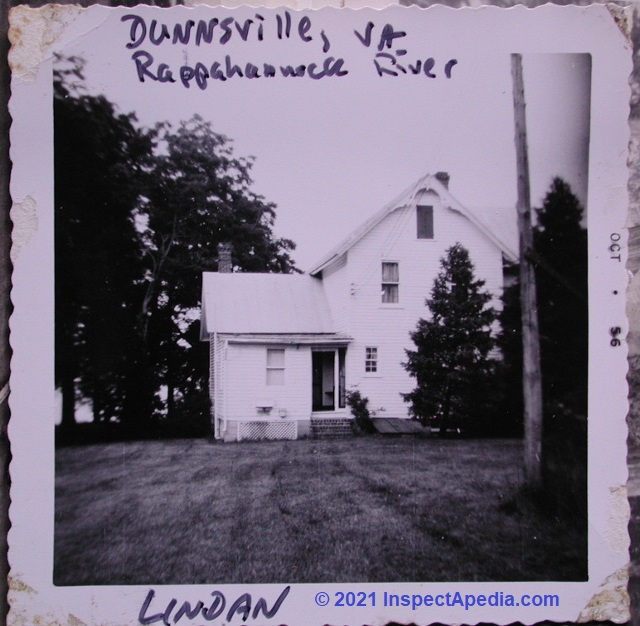
Water rose in the concrete enclosure, filling it to overflowing.
We also kept our watermelons and Dad's 6-packs of beer cool by tossing them into the springhouse. On summer evenings skunks patrolled around the spring, perhaps after the beer. Peering downhill towards the springhouse we'd see a parade of vertical skunk-tails protruding above the Virginia honeysuckle that surrounded the spring.
The spring enclosure, combined with his observation that water was constantly rising to the surface of the spring from an underground source gave Dad confidence in the water quality.
I doubt Dad ever had our springwater tested. The spring was several hundred feet from the neighboring farm (a strawberry patch) though down-hill from it and its runoff.

We kids drank a lot of soda and often Tom Collins mixer filched from the bar in our parent's converted-barn. Water for the adults was, perhaps, sanitized by the addition of alcohol in various formulations suggested by my grandfather Louis (photo above, with Teal, my mom).
Below: a typical spring-box and roof covering a spring-fed water supply.
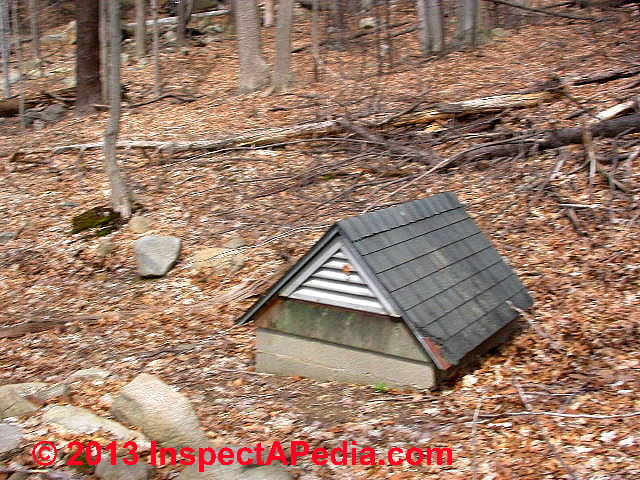 Today it is very difficult to find sanitary drinking water where surface runoff and shallow subsurface water enter the water supply such as that provided by a residential spring or hand dug well.
The combination of increased population density, proximity of springs to agricultural runoff or highway runoff, and increased use of pesticides and other chemicals expose springwater to greater risk than was present in Dunnsville in the 1940s.
This is also true for other types shallow wells such
and even drilled wells protected by a well casing in some cases.
Commercially sold bottled spring water is a different matter and is expected to be sanitary and thus safe to drink. Keep in mind that bottled water sold as "spring water" is typically not only taken from a protected source, but it is also constantly tested by the bottled water producer, and in at least some instances bottled spring water may also be sanitized or treated as well.
Watch out: Shocking a spring water source in an attempt to "fix" a bacteria problem in its drinking water is almost certainly unreliable.
However you can read the sanitizing formula and procedure
at WELL CHLORINATION & SHOCKING
You can shock the spring at its source - a momentary sanitizing step for spring water that is not durable, but if you are not going to drill a modern sanitary well (costly), in order to assure safe potable drinking water you will probably need to install water treatment equipment to sanitize the water - after testing to see what contaminants besides bacteria are present.
Details are at BACTERIA LEVELS in WATER, INTERPRETATION
Reader Question: spring water does not pass the water test
(Oct 10, 2014) Anonymous said:
we have a spring fed pipe coming into our house and the drinking water will not pass the water test what can we do please help
Reply:
Check that the spring water is properly protected from surface runoff.
Watch out: Shocking a spring water source in an attempt to "fix" a bacteria problem in its drinking water is unreliable.
You can shock the spring at its source - a momentary sanitizing step for spring water that is not durable, but if you are not going to drill a modern sanitary well (costly), in order to assure safe potable drinking water you will probably need to install water treatment equipment to sanitize the water - after testing to see what contaminants besides bacteria ) are present.
Chances are you'll need to add a water treatment system. First have the water tested on a broader basis than just bacteria so that your test lab can give good advice about what treatment is needed.
Spring Water Source Definitions: Seeps, Springs, Drilled Wells & Dug Wells - What's the Difference?
 What is the Difference Between a Spring and a Seep as a Water Source?
Question: how I can tell the difference between a spring and a seep?
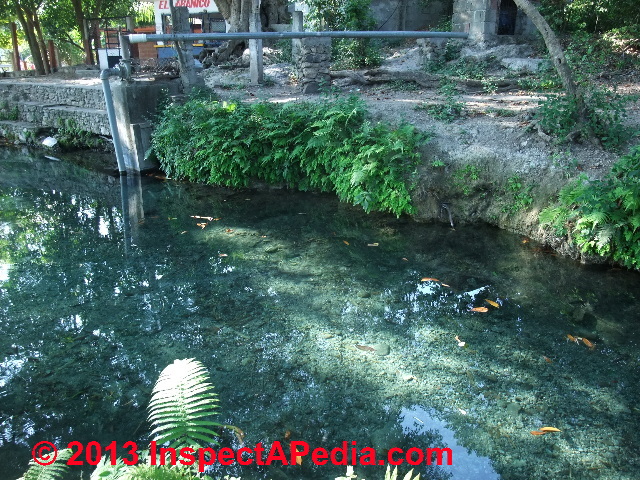
Photo at left: a seep or spring water source in Jalpan, Mexico. Unprotected from surface runoff, this water source supplies a tourist spa, restaurant, as well as local residents.
I was wondering if you could tell me how I can tell the difference between a spring and a seep? What do I look for. I have what looks like the start of a small steam on my property.
It is very small and moving slowly and there are a bunch of heavy rocks near by so I can't tell exactly where it is coming from. Someone had put a well on the property but apparently it is unusable according to the realtor. - J.S.
Reply:
A "seep" is essentially the same thing as a spring - both are sources of water at or near ground surface.
People use the word "seep" when the flow rate is small, and more importantly, to imply that the water arriving at the point where it is collected has passed through a length of soil near the ground surface, or perhaps even on the surface such as under leaves and moss. Neither source is reliably sanitary for drinking water in most U.S. locations.
To make use of seep water for watering grass or something similar:
- You will want to do some exploring to see if you can follow the water course back on the ground surface to a source such as a rock face or rock field.
- The closer you can construct a water collecting cistern to the seep water source the less unsanitary surface materials will affect the water supply.
- Keep your cost down by keeping things simple: if the property has enough slope from seep and cistern location to point of use you may use a gravity piping system. See our warnings just below.
If you are planning to make use of seep water for more than watering the grass,
you'll almost certainly need to install a water treatment / purification system before it could be safe to drink. Before choosing a water treatment system for your seep water here are some things to consider:
- If the total flow rate of the seep is quite low - as is usually the case - the water supply quantity may not justify purchasing and installing collection cistern, pump, piping, and water treatment equipment that would be necessary.
- Seep water supplies are often seasonal - you may have no water in the seep during dry weather.
What's the difference between a spring and a dug well and a drilled well?
Question: I am looking at a home that has its water supply in the basement floor. How do I know if its a cistern or a well?

I have a question, I am looking at a home that has its water supply in the basement floor.
How do I know if its a cistern or a well? I mean...
The water is in the basement of an old house , I'm thinking mid 1800s , the hole is covered with a metal plate.
When we lifted it up the water was moving.
There is a tank used for wells and the pump is also mounted by the tank. Is it possible it is the original water supply way back, and a well was added later? - R.H.
Reply: Photos comparing a cistern, dug well, and drilled well, all sometimes found under or close to buildings
Our photo (above, by your question) is what you see when looking down into a hand dug well that was constructed of stone walls, later sealed with mortar.
A dug well can vary enormously in width depending on the number of people who are to depend on it and thus the amount of water people want it to hold in reserve.
But in North America, typically a dug well is less than 10 feet in diameter. Depths of hand dug wells vary, deeper being scarier and more dangerous to dig.
Hand dug wells are described in detail
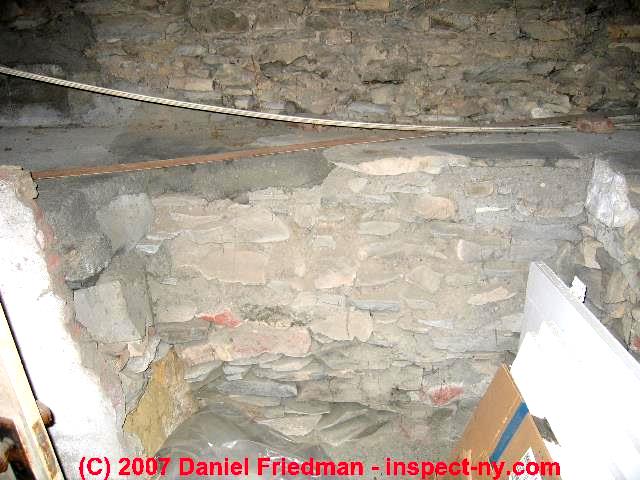 Cisterns: At left is a typical cistern that was constructed in the basement of a re-1900 home in the Northeastern U.S. A cistern is basically just a water holding tank. So you would see something sending water into it. Like roof downspouts.
Historically cisterns were dug outside of structures, covered and sealed against unsanitary surface runoff, and were or still are today filled by directing rainwater from building roofs into the cistern. A cistern might also be supplied with springwater routed through pipes or an aqueduct.
Typically a cistern will be more shallow than a hand dug well, and larger in cross sectional dimensions so that it can hold a large reservoir of water from another source. For details
Wells in basements: We discuss basement wells in more detail
(in our article about the different types of wells) In contrast with cisterns (tanks that hold water from another source), a well well gets its water from the earth, typically by water seeping through soils (shallow wells) or rock fissures (deeper wells) into either a dug opening in the earth or one that has been drilled.
Depending on the well diameter and depth, it may also store a useful volume of water (a large static head) or it may store very little volume of water, relying instead on a fast flow-rate of water into the well when water is being taken out of it. In a basement most likely a well is hand dug - as you'd not normally be able to get a well drilling rig to drill down through the house itself.
Just below are photographs of different well water sources that are sometimes found inside of a building: From left to right,
Left: my clients opening a cover over a dug well in a basement floor. That well was not in use but was a hazard. Center: an antique well pump mounted right on top of a steel well casing for a shallow well that was originally immediately outside the building wall in a well pit, later enclosed as an extension poking out from the basement wall and thus "under the house".
Right: a drilled well in a steel casing enclosed in an extension through the basement foundation wall, also open to the basement.
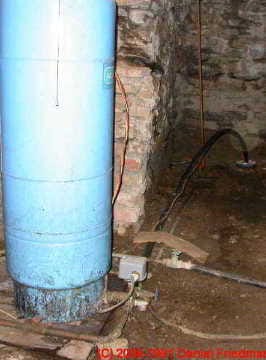
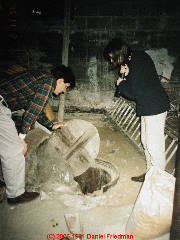

From your question you are probably describing a "dug well" or a "constructed spring" It would be unusual but not impossible for someone to build a house over a spring. More often in older homes people dug a cistern or even a dug well in the basement of the home. In neither case can you trust that the water supply is or will remain sanitary.
As you saw water "moving" I infer that you saw groundwater entering the well from one of the source types I described above.
Of course it's possible that what you saw is really just a cistern - in which case the flow of water coming into the cistern could be from a spring, a remotely dug or drilled well, roof runoff, a nearby stream, or other source that is either uphill and drains into the cistern by gravity, or is fed by a pump.
You'd need to explore the water source and property to figure that out.
At the top of this page is a photo of an access to a spring that we found hundreds of feet away from the home that it served. Water bubbled up into the spring, collected in a concrete chamber that had been built around the spring, and flowed out through a hole near the top of the spring enclosure wall where it entered a pipe that flowed by gravity to a holding cistern in the house itself.
From there originally a hand pump drew water into a kitchen sink - later that pump was replaced by a local electric pump and a pressure tank.
Details of dug wells are
Here are some basics:
From a practical sense, if it's a dug well it's shallow - less than 25 ft deep. (Measure your well dimensions including the height of the water column, total well depth, diameter, and I can say more. If it's a spring it might be more shallow. But in both cases your water supply depends on ground water seeping into the well or spring opening.
And you're pumping it out using probably a shallow well one line jet pump. (If you see TWO pipes running from your pump into the well it's a deep well jet pump and it would hardly be likely to be dug.)
If you are going to rely on this water supply for drinking you'll
- probably need (I would insist on) a treatment system to assure that the water remains sanitary and potable between tests
- not want to bet on the water quantity being adequate
And yes, typically a dug well originally provided water by bucket and rope, later by hand pump, and later by an electrical pump and pressure tank.
Research on Springs & Spring Water & Springwater Potability / Safety
- See additional citations at the page bottom TECHNICAL REVIEWERS & REFERENCES section
- Bischofberger, Thomas, S. K. Cha, R. Schmitt, Bärbel König, and W. Schmift-Lorenz. "The bacterial flora of non-carbonated, natural mineral water from the springs to reservoir and glass and plastic bottles." International Journal of Food Microbiology 11, no. 1 (1990): 51-71.
Abstract:
Quantitative and qualitative determinations of the bacterial flora of non-carbonated natural mineral water at the most important steps during bottling at a large water source yielded the following results: (i) Colony counts (on 1 :10 diluted plate count agar, incubated at 20°C for 14 days) for water of the five springs and the mixed water were less than 1 to 4 cfu ml−1.
The Gram-negative bacterial flora (n = 50 isolates) showed a very different but constant spring specific species distributions with predominance of either eutrophic fluorescent pseudomonads, oligotrophic non-fluorescent pseudomonads or oligotrophic yellow bacteria. (ii) In the reservoir and immediately after bottling the counts were in the range of 10 cfu m1−1. But nearly 30% of the species of the spring water were no longer detectable and there was a significant increase of Gram-positive bacteria. (iii) After 1 week of storage at 2°C colony counts of more than 105 cfu ml−1 were found in plastic bottles, but only about 104 cfu ml−1 in glass bottles Besides, a very distinct change of the composition of the microflora occurred. In glass bottles slow-growing oligotrophic non-fluorescent pseudomonads, yellow bacteria and Acinetobacter predominated. In plastic bottles fast-growing eutrophic and mesotrophic fluorescent pseudomonads, Flexibacter and Acinebacter were dominating.
In mineral water, bottled into thoroughly cleaned glass bottles, colony counts of more than 105 cfu ml−1 were found within 4 days. In bottles, cleaned mechanically as usual, the increase was significantly slower with a maximum of only 5 × 10³ cfu ml−1 after 8 days. The results of inoculation experiments in sterile filtered mineral and distilled water led to the suggestion that the difference between the two types of bottles is caused firstly by an inhibition of growth due to residues of cleaning detergents in the glass bottles. Growth promotion by dissolved organic substances in the plastic bottles only played a minor role.
After repairing of the pump at a depth of 300 m in a warm mineral water spring, the colony counts at 20, 37 and 42°C on 1: 10 diluted and normal plate count agar increased beyond the limits required by the EC directive for mineral water stored a month. Then colony counts decreased slowly and reached the initial level after 1 year, except for the colony counts 1 : 10 diluted agar at 20°C which stabilized at a relatively high number and a significant alteration of the microflora. Before the repair of the pump, the flora consisted exclusively of non-fluorescent pseudomonads, whereas non-motile and motile yellow bacteria were found afterwards. - Daghara, Azza, Issam A. Al-Khatib, and Maher Al-Jabari. "Quality of drinking water from springs in Palestine: west Bank as a case study." Journal of environmental and public health 2019 (2019).
- Edberg, Stephen C., Henri Leclerc, and John Robertson. "Natural Protection of Spring and Well Drinking Water Against Surface Microbial Contamination. II. Indicators and Monitoring. Parameters for Parasites." Critical reviews in microbiology 23, no. 2 (1997): 179-206.
- Kirschner, Alexander KT, Michael Atteneder, Angelika Schmidhuber, Sonja Knetsch, Andreas H. Farnleitner, and Regina Sommer. "Holy springs and holy water: underestimated sources of illness?." Journal of water and health 10, no. 3 (2012): 349-357.
- Krometis, Leigh‐Anne, Hannah Patton, Austin Wozniak, and Emily Sarver. "Water Scavenging from roadside springs in Appalachia." Journal of Contemporary Water Research & Education 166, no. 1 (2019): 46-56.
- Nicol, Keith. "A pilot study into the use of springs for drinking water in Western and Central Newfoundland, Canada." Water Practice and Technology 4, no. 3 (2009).
Abstract:
Dissatisfaction with tap water has gradually grown over time and in many places in Canada bottled water and various tap water filtering systems have become increasingly popular. In Newfoundland, road side springs are another popular alternative drinking water supply, yet the Provincial Government does not test or treat this water.
This study examines 18 communities in Western Newfoundland to determine why people don't drink tap water, the frequency of use of road side springs, and the bacteriological safety of a sampling of road side springs. The results indicate that the main reason for not drinking tap water was that it was perceived to be unsafe.
But springs were used by 23 % of those surveyed and these springs were found to contain E. coli and/or coliforms 43 % of the time.
By comparison, tap water testing by Newfoundland Environmental Health Officers found that between 5-6% of the community water supplies in Western and Central Newfoundland recorded the presence of coliform and/or E. Coli in 2007. - Silsbee, David G., and Gary L. Larson. "Bacterial water quality: springs and streams in the Great Smoky Mountains National Park." Environmental Management 6, no. 4 (1982): 353-359.
Abstract:
Water samples from streams and springs in the Great Smoky Mountains National Park were analyzed for fecal coliform, fecal streptococcus, and total coliform bacteria. Levels of bacteria were found to be highly variable but related to elevation, time of year, type of water source, and water level of the streams. Visitors did not seem to be major contributors to bacterial contamination.
Levels of fecal coliform and total coliform in most water samples were unsuitable for drinking without treatment. Tennessee state standards for body contact recreation (swimming and wading) were exceeded in a few samples but none from streams suitable for swimming. As a result of these findings, park managers increased efforts to inform visitors of the need to treat drinking water and removed improvements at backcountry springs which tended to give the springs the image of safe, maintained water sources. - Swistock, Bryan, James Clark, Susan Boser, Diane Oleson, Amy Galford, Gary Micsky, and Mark Madden. "Issues associated with the use of untreated roadside springs as a source of drinking water." Journal of Contemporary Water Research & Education 156, no. 1 (2015): 78-85.
- USGS, SPRINGS and the WATER CYCLE [PDF] USGS Water Science School, retrieved 2021/06/27 original source: https://www.usgs.gov/special-topic/water-science-school/science/springs-and-water-cycle?qt-science_center_objects=0#qt-science_center_objects
Excerpt: A spring is a water resource formed when the side of a hill, a valley bottom or other excavation intersects a flowing body of groundwater at or below the local water table, below which the subsurface material is saturated with water.
A spring is the result of an aquifer being filled to the point that the water overflows onto the land surface.
[Springs] range in size from intermittent seeps, which flow only after much rain, to huge pools flowing hundreds of millions of gallons daily.
Reader Comments, Questions & Answers About The Article Above
Below you will find questions and answers previously posted on this page at its page bottom reader comment box.
Reader Q&A - also see RECOMMENDED ARTICLES & FAQs
Question: how to improve our spring-fed water system
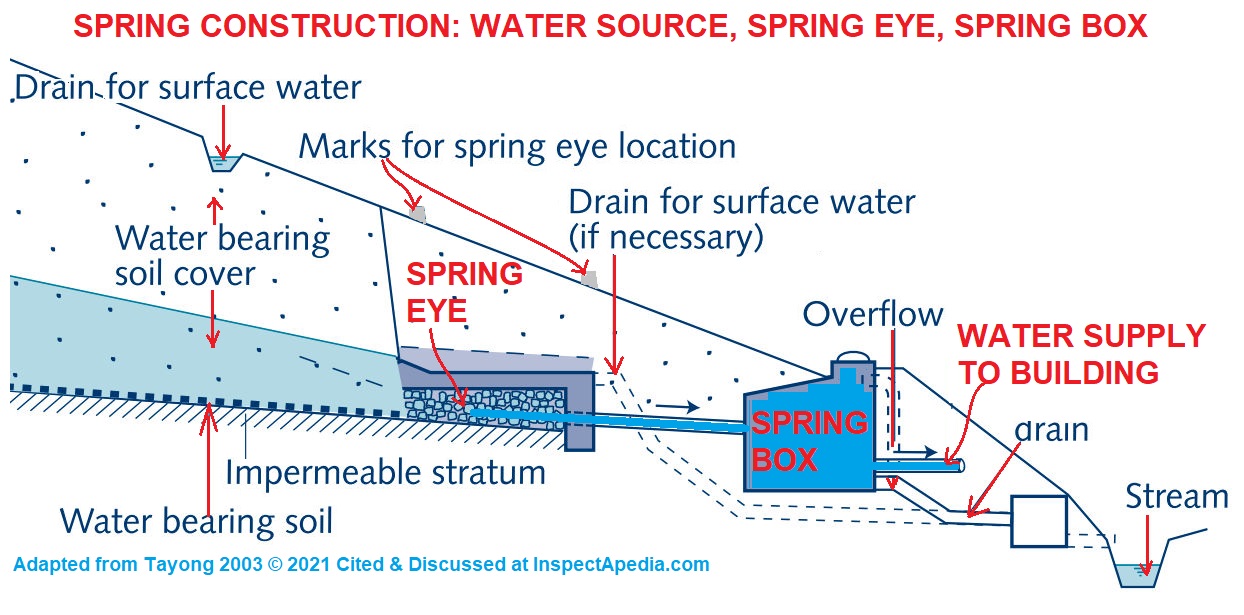 Illustration: excepted from "SPRING WATER TAPPING." [PDF] Andrew Tayong, 2003, cited in detail below. We recommend this work as a clear, understandable primer on spring water, its sources, properties, uses.
We saw your very interesting set of articles online. Do you have any knowledge of someone in east TN who could help us improve our spring fed water system?
Thanking you in advance for your reply. - Anonymous by private email 2021/06/19
Moderator reply:
SPRING YIELD IMPROVEMENT contains new material I've added for you.
It will be helpful to know more specifics about your spring, construction, location, surrounding terrain and to see photos of the spring area, terrain, spring-box, and also to have an idea of the water use requirements.
Knowing the underground hydrology is of course critical to understanding your spring's actual water source as well as what water spring yield you can expect.
On 2020-10-30 - by (mod) -
how to protect plastic spring water tank from freezingGary:
Having recently added a water storage tank in a northern cabin that can be exposed to freezing I gave a lot of thought to this worry about freeze damage to the tank and to its piping.
We found that because of the geometry of the tank and its location we could not get every drop of water out of the tank when winterizing the building.
We did, however, take care to route all of our (PEX) water piping to slope 1/8" to 1/4" or more down to drainage points so that we could, with confidence, drain all of the piping so as not to worry about freeze damage to a valve, control, pump, or elbow or union.
That leaves us with about an inch of water in the bottom of a large plastic potable water tank.
I figure that a small volume of water, even freezing solid, won't break a large water tank, but it does mean that on returning the cabin to service in cold weather may face a thawing delay.
For your tank, if you can drain it and leave its drain open so that any last condensation or droplets are removed you've done the best to avoid frost damage.
Watch out: however any plastic tank, whether for water or wastewater or sewage, when left empty, is rather light and can move around easily if the tank is not anchored in place.
An example is given at OIL or SEPTIC TANKS FLOATING UP
On 2020-10-29 by Gary
I just purchased a Cabin with Gravity fed water. The Container is Round Plastic holding 1000 gallons and is up the hill from the cabin about 30 feet high and around 75 feet away.
It is spring fed and has an outlet line that is 1.5" and a shut off and On to drain this tank.
I do not know what I need to do this cold weather, do I drain the entire tank and leave the drain open to drain incoming water from the spring or do I drain it all the way out and then shut off the drain and slowly let it fill up?
I do not want to crack the container
Please help me understand what I need to do?
Thanks,
On 2020-09-26 - by (mod) -
Gordon:
I don't have the full picture, but in general if we know that the water source is full but water's not showing up at its destination I figure a hose or pipe is blocked or disconnected or improperly-connected, or your water pressure booster pump itself is not working.
A leak somewhere in the piping can let water out and also can let air in to the piping system.
The pressure tank is there to keep the pump from short cycling, but the tank alone would not normally explain why you're not seeing water flow.
On 2020-09-26 by gordon spencer hazens notch campground - I have a spring water system.
I have a spring water system. The water flows down to the house [about 70 ft. of head] the water flows through a 1 inch pipe and into a pump connected to a well pressure tank. While doing a septic leach test we had to run water into the tank to test the leach field.
After 1 hour the flow from the spring stopped and gurggled air. I went up to the spring and it was full. The hose we were using to run water into the septic was screwed on to one of the valves we use for the washing machine.
What can be done to correct this problem; The water supply is more than enough for the test what would cause air in the system which stops the flow
On 2020-05-10 - by (mod) -
Let's start by asking the neighbor to stop the ou r pump overnight, let the soribg and springhouse recover, and see hiw much water fills the spring hiuse.
That will tell us if the neighbor's usage is overwhelming the spring flow rate.
On 2020-05-09 by sherry
we have a dug well on the hill, that taps into a spring.. 2 houses draw off this water source. the neighbors house is closer to the well, [uphill] and needs a pump to draw it in.. our house is lower and is gravity fed..
recently our water began spewing air and then our water stopped altogether. the neighbors has not.
When lifting the cover, we see the water in the "well" seems low.. but the stream still bubbles up and is flowing fast.
we have a pump in our basement that kicks in to draw the water up to the main floor..
So - any ideas where our problem could be?
[we call the well experts, they say it's an excavation problem. having a hard time finding any advice on WHO to look to, for help]
pandemic & i don't have a drop of water.. erm
On 2020-01-10 - by (mod) - Is there mercury in Poland Spring Bottled Water?
Excepting an occasional scandal Lauren, I would not expect there to be mercury in bottled water.
I have seen some angry websites claiming that Poland Spring water is
1. not from a spring
2. contains toxins including mercury
Bottom line: I have not found credible reports of toxic contaminants in Nestle's Poland Spring water. There IS, however, a lawsuit involving the company and its water, principally because the water isn't necessarily from a spring and is in fact disinfected water.
"Per the lawsuit, the brand sells about 1 billion gallons of water to 13 million Americans every year. ... It argues that even though consumers aren't drinking contaminated water, since Nestlé disinfects its water, Poland Spring perpetuates a deceptive image, especially on its packaging." - Lieber, Chavie, VOx.com, at https://www.vox.com/the-goods/2019/4/3/18292549/poland-spring-water-nestle-lawsuit-spring-water
I would look for an authoritative source such as a competent water test of Poland Spring bottled water, performed by an independent, certified water testing lab who have no conflict of interest.
You can see Poland Spring's own PUBLIC WATER TEST RESULT for 2018 [PDF] here provided by Nestle - retrieved 2020/01/10 original source: https://www.nestle-watersna.com/sites/g/files/pydnoa606/files/asset-library/documents/ps_eng.pdf
An seach of the US FDA website for FDA notices or recalls using the phrase "Poland Spring Water" finds
https://www.fda.gov/media/129753/download
that contains this FOIA request:
A letter sent in August 2012 by the FDA to Nestle Waters, pertaining to its Poland Spring brand and whether the product should be labeled `purified` or `spring.` - Any and all responses sent by Nestle Waters to the FDA`s letter
2019-3841 CONSUMER REPORTS A letter sent in August 2012 by the FDA to Nestle Waters, pertaining to its Poland Spring brand and whether the product should be labeled `purified` or `spring.` - Any and all responses sent by Nestle Waters to the FDA`s letter
On 2020-01-10 by lauren
Is there mercury in lets say Poland Spring Bottled Water?
On 2018-12-01 - by (mod) - treatment for acidic spring water
Sarah
I'm glad you find the material useful as we work hard on it.
It's not clear from your note but I hope you understand the bacteria would not be the only concern in Spring Water.
Anything that's on the surface such as fertilizers or pesticides could be found in the water. So you may want to have some more comprehensive testing performed. Talk to your water test lab about what test you should choose based on what you know about your property and common contaminants in the area.
On 2018-11-30 by Sarah
We have had good luck by getting our water tested by several licensed water treatment companies. After determining the spring water is acidic, we installed an acid neutralizer, and UV system to kill bacteria, and two large filters.
The two cisterns/springboxes in the woods had several frogs, a tree root, and an old bleach bottle from a previous owners attempt at "shocking" so we knew we needed to do something as we have young children.
The water tastes better now and is more clear. Farm is from early 1800s, and the spring appears to be coming from the base of a tree (no immortality noted like Tuck Everlasting).
This article is helpful as there's not much info on springs. Thanks!
Drinking Water Spring Protection: Spring Boxes
This topic has moved to SPRING BOX BUILD, REPAIR
How to Improve a Spring or Increase the Yield of a Spring as Water Source
This topic has moved to
...
Continue reading at SPRING BOX BUILD, REPAIR or select a topic from the closely-related articles below, or see the complete ARTICLE INDEX.
Or see SPRINGS as WATER SUPPLY FAQs - questions & answers about springwater posted originally at the end of this article
Or see these
Recommended Articles
- BACTERIA LEVELS in WATER, INTERPRETATION
- CONTAMINANT CLASSES, in WATER & links to home buyer advice about water testing, drinking water, water supply
- SPRINGS as WATER SUPPLY
- SPRING BOX CONSTRUCTION
- SPRING BOX REPAIR
- SPRING YIELD IMPROVEMENT
- WATER TREATMENT EQUIPMENT CHOICES - home
- WELLS CISTERNS & SPRINGS - home
Suggested citation for this web page
SPRINGS as WATER SUPPLY at InspectApedia.com - online encyclopedia of building & environmental inspection, testing, diagnosis, repair, & problem prevention advice.
Or see this
INDEX to RELATED ARTICLES: ARTICLE INDEX to WATER SUPPLY, PUMPS TANKS WELLS & SPRINGS
Or use the SEARCH BOX found below to Ask a Question or Search InspectApedia
Ask a Question or Search InspectApedia
Try the search box just below, or if you prefer, post a question or comment in the Comments box below and we will respond promptly.
Search the InspectApedia website
Note: appearance of your Comment below may be delayed: if your comment contains an image, photograph, web link, or text that looks to the software as if it might be a web link, your posting will appear after it has been approved by a moderator. Apologies for the delay.
Only one image can be added per comment but you can post as many comments, and therefore images, as you like.
You will not receive a notification when a response to your question has been posted.
Please bookmark this page to make it easy for you to check back for our response.
Our Comment Box is provided by Countable Web Productions countable.ca
Citations & References
In addition to any citations in the article above, a full list is available on request.
- [1] Debra Lynn Dodd, "What are the Best Nontoxic Caulks?", Mother Earth Living, http://www.motherearthliving.com/home- products/what-are-the-best-nontoxic-caulks.aspx, retrieved 4/3/2013
- [2] DAP Inc., "Alex Plus Clear Caulk MSDS Material Data Safety Sheet", http://www.dap.com/docs/msds/00010019002_english.pdf retrieved 4/3/2013, copy on file as DAP_Acrylic_Latex_Alex_Plus_Caulk_MSDS.pdf.
DAP Inc., 2400 Boston Street Suite 200, Baltimore MD 21224, Tel: 888-327-8477 (non-emergency matters). Excerpt:
Emergency Overview: A white to off-white paste product with a very slight ammonia odor. WARNING! May cause eye, skin, nose, throat and respiratory tract irritation. May cause eye or skin irritation. Harmful if swallowed or absorbed through the skin. This product contains ethylene glycol. - [3] Dow Corning, "Dow Corning® 790 Silicone Building Sealant, Gray, MSDS Material Data Safety Sheet", retrieved 4/3/2013, copy on file as Dow_Silicone_Sealant_790_MSDS.pdf, Dow Corning Corporation, South Saginaw Road, Midland MI 48636, Customer Service: 989-496-6000; Emergency Telephone: 989-496-5900.
- [4] AFMSafecoat, No company address provided by their website! Telephone: 800-239-0321, Email: info@afmsafecoat.com, Website: http://www.afmsafecoat.com/.
From the product MSDS [on file as Safecoat_gmeycr7130 Caulking Compund msds 2008.pdf] the company is identified as American Formulating & Manufacturing, 3251 Third Ave., San Diego CA 92103, Tel: 619-239-0321. - [5] "Nano-tech sunscreen presents potential health risk". ABC News. December 18, 2008. http://www.abc.net.au/news/stories/2008/12/18/2450030.htm [Wikipedia retrieved 4/3/13]
- [6] Will Hart, "Protective Structures For Springs: Spring Box Design, Construction and Maintenance", Will Hart M.S. Candidate School of Forest Resources & Environmental Science Master’s International Program Michigan Technological University www.cee.mtu.edu/peacecorps. [PDF copy]. 2003 for the requirements of CE 5993 Field Engineering in the Developing World. Following citations are from this source:
- [7] Protecting Springs- An Alternative to Springboxes. Prepared by Brian Skinner and Rod Shaw for the Water Engineering and Development Center (WEDC), Loughborough University, Leicestershire
- [8] Cairncross, S and Feachem, RG. Environmental Health Engineering in the Tropics: An Introductory Text, 2nd Edition. John and Wiley Sons, Chichester, 1983.
- [9] Fernando, Vijita. Energy and Environment Technology Source Books: Water Supply. Intermediate Technologies, London, 1996.
- [10] Hanson, B.D. Water and Sanitation Technologies: A Trainers Manual. Peace Corps, March, 1985.
- [11] Water Engineering and Development Center (WEDC). The Worth of Water: Techni
- [12] Niskanen, Matthew, "The Design, Construction, and Maintenance of a Gravity-Fed Water System in the Dominican Republic," Department of Civil & Environmental Engineering, Michigan Technological University, Houghton, MI, 2003
- [13] Water for The World technical notes can be found at www.lifewater.org
- Crystal Clear Supply provides portable ceramic water filter purifiers and portable reverse osmosis water treatment equipment - see http://www.crystalclearsupply.com/category_s/7.htm
- Handbook of Disinfectants and Antiseptics, Joseph M. Ascenzi (Editor), CRC, 1995, ISBN-10: 0824795245 ISBN-13: 978-0824795245 "The evaluation of chemical germicides predates the golden age of microbiology..." -
This well-focused, up-to-date reference details the current medical uses of antiseptics and disinfectants -- particularly in the control of hospital-acquired infections -- presenting methods for evaluating products to obtain regulatory approval and examining chemical, physical, and microbiological properties as well as the toxicology of the most widely used commercial chemicals. - Potable Aqua® emergency drinking water germicidal tablets are produced by the Wisconsin Pharmacal Co., Jackson WI 53037. 800-558-6614 pharmacalway.com
- Principles and Practice of Disinfection, Preservation and Sterilization (Hardcover)
by A. D. Russell (Editor), W. B. Hugo (Editor), G. A. J. Ayliffe (Editor), Blackwell Science, 2004. ISBN-10: 1405101997, ISBN-13: 978-1405101998.
"This superb book is the best of its kind available and one that will undoubtedly be useful, if not essential, to workers in a variety of industries. Thirty-one distinguished specialists deal comprehensively with the subject matter indicated by the title ... The book is produced with care, is very readable with useful selected references at the end of each chapter and an excellent index. It is an essential source book for everyone interested in this field. For pharmacy undergraduates, it will complement the excellent text on pharmaceutical microbiology by two of the present editors."
The Pharmaceutical Journal: "This is an excellent book. It deals comprehensively and authoritatively with its subject with contributions from 31 distinguished specialists. There is a great deal to interest all those involved in hospital infection ... This book is exceptionally well laid out. There are well chosen references for each chapter and an excellent index. It is highly recommended." The Journal of Hospital Infection.: "The editors and authors must be congratulated for this excellent treatise on nonantibiotic antimicrobial measures in hospitals and industry ... The publication is highly recommended to hospital and research personnel, especially to clinical microbiologists, infection-control and environmental-safety specialists, pharmacists, and dieticians."
New England Journal of Medicine: City Hospital, Birmingham, UK. Covers the many methods of the elimination or prevention of microbial growth. Provides an historical overview, descriptions of the types of antimicrobial agents, factors affecting efficacy, evaluation methods, and types of resistance. Features sterilization methods, and more. Previous edition: c1999. DNLM: Sterilization--methods. - U.S. Army Field Manual 21-10, Field Hygiene and Sanitation, 1988, web search 07/02/2010, original source: http://www.enlisted.info/field-manuals/fm-21-10-field-hygiene-and-sanitation.shtml
The purpose of this manual is to assist individual soldiers, unit commanders, leaders and field sanitation teams in preventing disease and environmental injuries. The manual provides information on preventive medicine measures (PMM) to the individual soldier as well as essential information for the unit commander, unit leaders, and the unit field sanitation team on applying unit level PMM. - When Technology Fails, Matthew Stein, Chelsea Green Publisher, 2008,493 pages. ISBN-10: 1933392452 ISBN-13: 978-1933392455, "... how to find and sterilize water in the face of utility failure, as well as practical information for dealing with water-quality issues even when the public tap water is still flowing". Mr. Stein's website is www.whentechfails.com/
- In addition to citations & references found in this article, see the research citations given at the end of the related articles found at our suggested
CONTINUE READING or RECOMMENDED ARTICLES.
- Carson, Dunlop & Associates Ltd., 120 Carlton Street Suite 407, Toronto ON M5A 4K2. Tel: (416) 964-9415 1-800-268-7070 Email: info@carsondunlop.com. Alan Carson is a past president of ASHI, the American Society of Home Inspectors.
Thanks to Alan Carson and Bob Dunlop, for permission for InspectAPedia to use text excerpts from The HOME REFERENCE BOOK - the Encyclopedia of Homes and to use illustrations from The ILLUSTRATED HOME .
Carson Dunlop Associates provides extensive home inspection education and report writing material. In gratitude we provide links to tsome Carson Dunlop Associates products and services.
 | HOME | ABOUT | ASK a QUESTION | CONTACT | CONTENT USE POLICY | DESCRIPTION | POLICIES | PRIVACY | |
| © 2024 - 1985 Publisher InspectApedia.com - Daniel Friedman | |||||||||