
InspectAPedia® FREE Encyclopedia of Building & Environmental Construction, Diagnosis, Maintenance & Repair |
Question? Just ask us! InspectAPedia
|
 How to Find, Diagnose, Adjust or Repair the Water Pump Pressure Control Switch
- POST a QUESTION or COMMENT about well pump pressure contr ol switch inspection, adjustment, installation, diagnosis, & repair or replacement
Well pump pressure control switch adjustment: This article describes How to Find & Adjust or Repair or Replace the Water Pump Pressure Control, what it looks like, where it is usually connected.
If you need to adjust water pressure at a building served by a private pump and well system, or if your well pump is acting badly, this pressure control switch may need adjustment or repair/replacement.
InspectAPedia tolerates no conflicts of interest. We have no relationship with advertisers, products, or services discussed at this website.
WATER PUMP PRESSURE CONTROL SWITCH INSTRUCTIONS
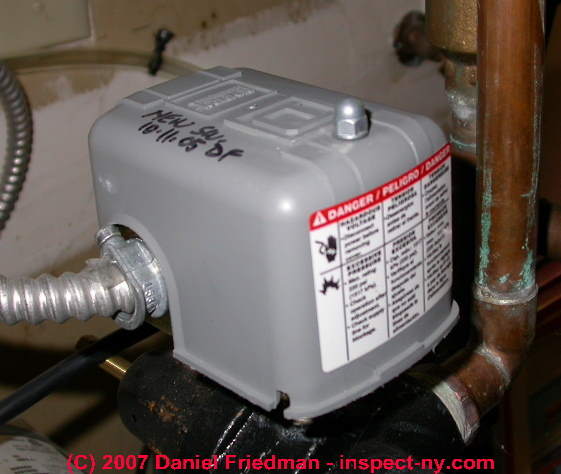 This is a typical Water Pump Pressure Control Switch,
normally found mounted on piping at the water pressure tank
such as in this Square D Pumptrol® Switch PHOTO where you see a small gray-covered box with electrical wires coming in (power) and out (to pump) of it.
This is a typical Water Pump Pressure Control Switch,
normally found mounted on piping at the water pressure tank
such as in this Square D Pumptrol® Switch PHOTO where you see a small gray-covered box with electrical wires coming in (power) and out (to pump) of it.
The pump pressure control switch, by being connected
to the actual water piping in the building, senses the water pressure and when necessary, turns the water pump on.
The water pump pressure control switch either turns on the water pump directly, or (particularly when
a submersible water pump is in use), this switch may operate a physically separate (usually wall-mounted) heavier-duty
pump relay which turns on the water pump itself.
Well Pumps Controlled Directly by the Pressure Control Switch - when is a separate relay switch needed?
The well pump pressure control switch type shown here can be used to control well pumps wired either for 120V or 240V power supply, up to 15-amps. This switch serves both above ground jet pumps and smaller horsepower submersible well pumps.
For larger horsepower submersible well pumps that draw greater than 15A current, as we mentioned above, a separate heavy duty (higher ampacity capacity) pump relay switch is used to turn on and off the pump motor.
The pump pressure control switch senses changes in water pressure in the system and according to its cut-in/cut-out setting, that device in turn operates
the WATER PUMP RELAY SWITCH which in turn operates the well pump.
A Guide to Building Water Pressure by Adjusting or Repairing the Water Pump Pressure Control Switch
- How to Adjust Water Pump Pressure: The detailed, step by step procedure for inspecting and adjusting the water pressure control switch is
discussed in detail
at WATER PRESSURE CONTROL SWITCH ADJUSTMENTS.
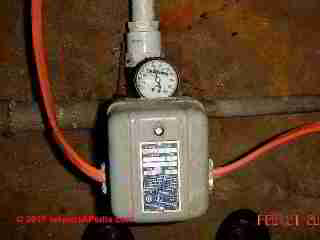
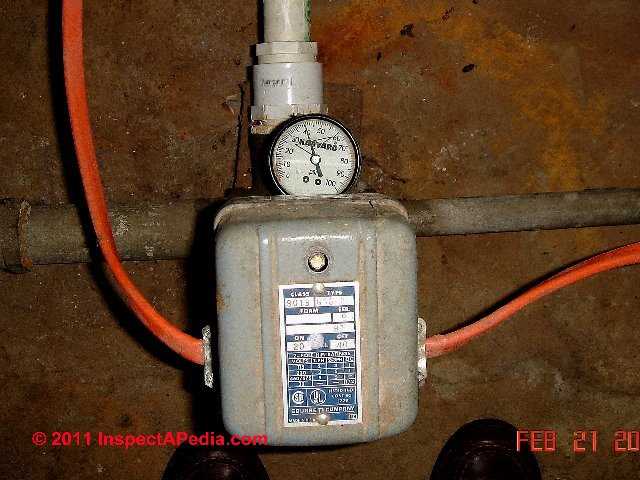
Our photo (left) shows a commercial type Square D 9013 Pumptrol® pressure control switch. Courtesy of reader J.H. - Diagnosing Water Pump Short Cycling on and off: If your water pump is clicking on and off too often or quite rapidly
see SHORT CYCLING. - Diagnosing Water Pressure Drops without explanation when the pump stops,
see WATER PRESSURE FALLS SLOWLY, ERRATIC PUMP: bad pressure control switch, building water running or leak, bad pressure gauge, bad check valve, bad foot valve. - Diagnosing & Repairing Lost Air in the Water Tank: The problem of lost air in the water pressure tank along with how to correct that condition are discussed
beginning
at SIGNS OF AIR LOSS. - Diagnosing & Repairing a Water Pressure Control or Water Pump Control Switch: We discuss diagnosing and repairing a water pressure control switch that sticks "on" or "off" or simply won't operate,
at WATER PUMP PRESSURE SWITCH REPAIRS
If the water pump "short cycle" is very short, clicking on and off, there could be a shortage of air in the water tank,
or there could be a problem with the pump control pressure switch itself, or even a dirty and clogged water filter [photo] if one is installed on the system. Dirty water filters
and other causes of rapid water pump on-off cycling
are discussed
at CAUSES OF SHORT CYCLING.
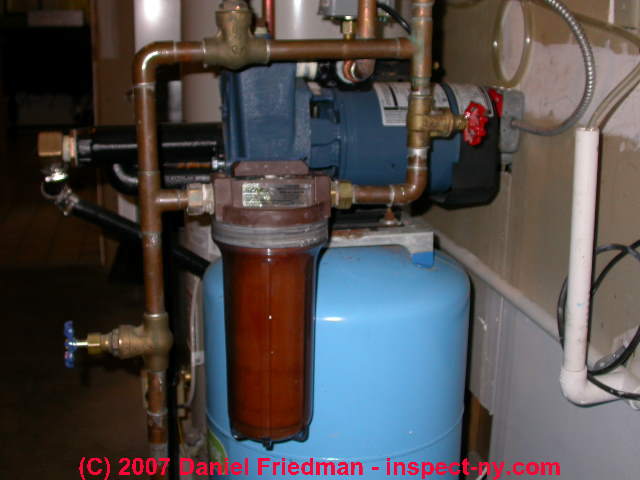
These water pump short cycling problems happen with both in-building jet pumps and with in-well submersible pumps. It's trickier to notice a short cycling submersible pump since you won't hear the pump motor, but you will hear the pump relay clicking on and off, or you can see the water pressure gauge cycling up and down rapidly.
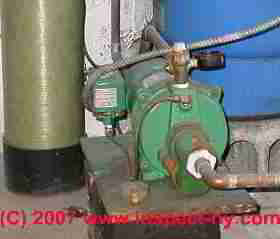
This photo shows a green-painted pressure control switch, mounted on the left side of the one line jet pump. You can see a copper tube that runs from the bottom of the pump pressure control switch bottom over to a fitting at the top center of the face of the jet pump.
[Click to enlarge this or any photo]
This tube is sensing system water pressure inside of the pump housing. The bottom of the pump (or water) pressure switch contains a rubber diaphragm that is pushed on by water pressure conducted to it through this tube. The diaphragm in turn operates the pump relay that turns the water pump on and off.
If the water supply is high in sediment often sediment will clog the pressure sensing opening at the bottom of the pressure control. We've tried cleaning out this orifice but it's never proven to be a lasting repair. If your pump pressure switch stops responding to changes in water pressure it probably needs to be replaced.
A defective water pressure control switch. Switch contacts can burn-up, or the opening into the switch
which senses the water pressure in the system can become clogged with sediment or debris.
This usually
shows up as failure of the pump switch to turn on or off at all, rather than short cycling. But the switch could be damaged or improperly adjusted, causing "short water pump cycling."
Details about this switch are
at WATER PUMP PRESSURE CONTROL SWITCH
Water Pump Pressure Control Switch Tubing Problems
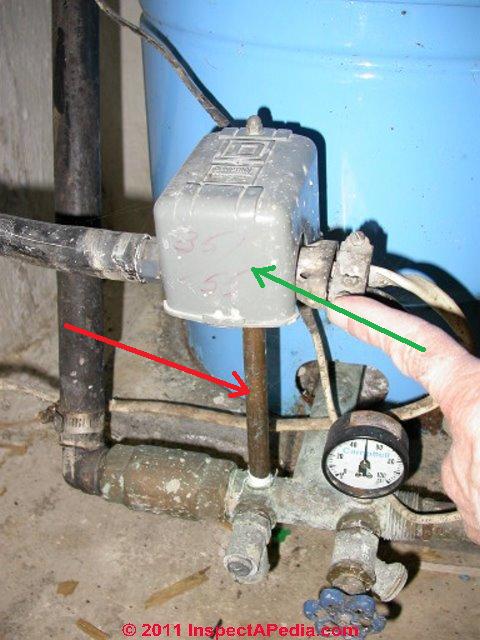
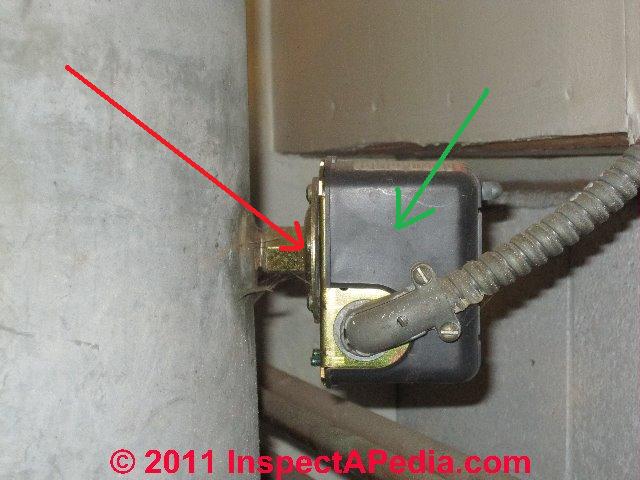
Technical note: Clogging of the Water Pump Pressure Control Switch if your water has a high level of silt, debris, or minerals, it's possible that the tubing or piping connecting the pump pressure switch to the pump or water piping (red arrow in photo at left), or the pump switch bottom orifice through which the pressure switch senses the water pressure in the system has become clogged.
The small diameter of this tubing and still smaller diameter of the pump switch orifice makes clogging easy if your well water is high in sediment or minerals.
A clogged water pump pressure control switch (green arrow in photo at left) will often fail to turn on the well pump at all, even though the pressure in the system has dropped
below the water pump "cut in" pressure. Reader Jeff Crosby reported an example of this pressure switch clog problem:
[When our well pump kept short cycling and I was unable to get the well pump pressure control switch to work properly, ...] I ended up calling the pump service company to come over. There was an extreme amount of mineral buildup inside the pump where the copper tubing initially comes out to travel to the pressure switch.
I thought about checking that out but did not know how funny. There has always been an awl sitting on the pump base for the longest time.
One of their maintenance guys left it there long ago. Now I know why - ever since that date when they come do their yearly check up they knock out this sediment [using the awl to open the tubing so that the pressure switch can accurately sense the water pressure in the system]. -- Jeff Crosby
On rare occasions we can tap on the well pump control switch and it will begin working again, but not for long, and not reliably. Another water pressure control switch failure is the rupture of a rubber disk or "bladder" inside the switch itself. If you detect or suspect a defective pressure control switch, try replacing it with a new one.
We see a similar problem affecting water pressure gauges on private water systems: debris or mineral deposits can clog the pressure sensing orifice on the water pressure gauge, causing it to fail to respond at all, or to respond inaccurately to changes in water pressure.
When we find a clogged water pump pressure switch or the tubing connected to it, or a clogged water pressure gauge, we replace those items. A well pump pressure gauge that does not respond to pressure changes is potentially unsafe as it could lead to excessive pressurization of the water tank and building piping.
Watch out: some pump pressure control switches may mount directly to a water pressure tank without an obvious 1/8" or 1/4" ID mounting tube. In our pressure switch photo at left the red arrow points to the mounting base for the pressure control switch and you'll see that this control was screwed right into the water tank at a threaded tapping.
But the pressure sensing membrane found on the bottom (or in this case on the left side in our photo) of the pressure control switch can still become damaged or the orifice that admits water (and pressure) is easily clogged. The effect of debris clogging at a water pump pressure control switch is the same regardless of whether or not a longer mounting tube is used to mount the switch to the water system.
Reader Question: we don't have the money to hire someone - how do we do pump switch adjustment ourselves
We dont have the money to hire some one to do this it is the well itself so how do i do it ourselves - Mike 7/29/12
Reply:
Mike:
Try reviewing the article above where the details of the water pump pressure control switch adjustment are described; if your switch does not match the one described then you just need to know the switch brand and model in order to go to the manufacturer to obtain the exact adjustment instructions.
Watch out: messing with a pump pressure control switch exposes live electrical connections - you can be killed if you touch live wires. Another catastrophe to avoid is setting the pressure too high, causing leaks or worse, a burst water tank that could injure anyone nearby.
How to increase both the water pump pressure control cut-in and cut-out pressure
Reader question:
I have a square d control. It cuts off at 40 psi and goes down to 20 psi before it comes back on which is to low when I am using one sprinkler. I want it to come on at 30 psi. I can't understand how to do that looking your directions. Pls help - John 5/19/11
Reply:
How to increase the water pump pressure control cut-in and cut-out pressure:
Take a look again at the instructions above that indicate which nut to turn in which direction to increase the well pump cut-in pressure (that's your 20 psi number) and cut-out pressure (that's your 40 psi number). You should be able to raise the cut-in pressure to 30 psi and you will probably want to raise the cut out pressure to 50 psi, provided that your pump can actually reach that number.
If the pump keeps running forever even AFTER you have turned off the water, then it is not capable of reaching 50 psi and you'll have to lower that setting to avoid burning up the water pump.
If the instructions are still too complicated to follow then you would be best off asking a plumber to change the settings for you. Just be sure the person you hire is familiar with well pump pressure control switches.
How to Identify the Brand or Model of Water Pressure Control Switch
Take a look at the embossed design (such as a Square-D) or look for label text as illustrated below.
Reader Question: Can you identify the manufacturer of this water pump pressure control switch on a mobile home?
Your site has been so (extremely) helpful. Thank you for the information.
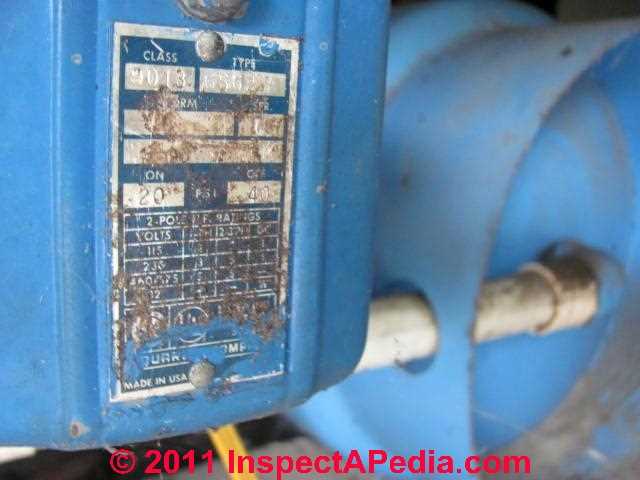
I am wondering if you, being familiar with water pump systems, know the manufacturer of this Pressure Control Switch? Only a few letters are readable (at the bottom), but I am hoping it is enough. - J.X.
Reply: Looks like a Square-D pressure control switch
Perhaps we can identify this pump pressure control switch from several things that are legible on the switch tag:
From the yellow wire in the photo bottom, most likely this is a 120V switch; so even though we know it's serving a mobile home it's not a 12V device. (Some mobile homes and motor homes use 12V pumps for managing their water supply.)
Second, the layout of the data tag and the remaining letters at the bottom of that tag look a lot like "SQUARE D COMPANY. You can just make out the letters ".... QUAR ..." that's a compelling argument for Square D.
[Click any of our images to see an enlarged, detailed version. ]
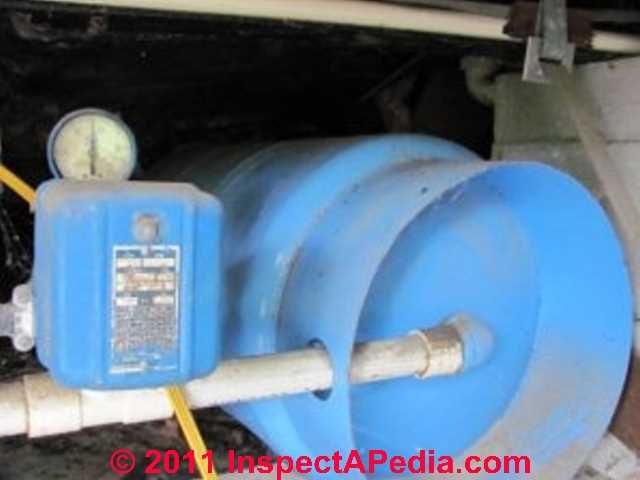
Finally, if you look at the switch cover you might see a "D" with a rectangle embossed around it, or best yet, you might see the company name and details on a label stuck to the interior of the switch cover.
In any event from the data tag on the switch, a standard 120V/240V pressure control switch made by Square D or similar manufacturers should be just fine if you need a replacement.
You might turn off electrical power, remove the control switch, and take it to your local plumbing supplier for a match. To remove the switch you may need to plug the piping where the switch senses water pressure or drain water pressure from the system.
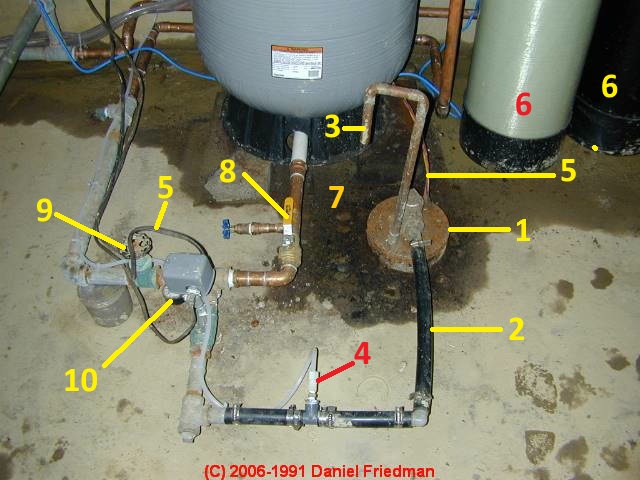
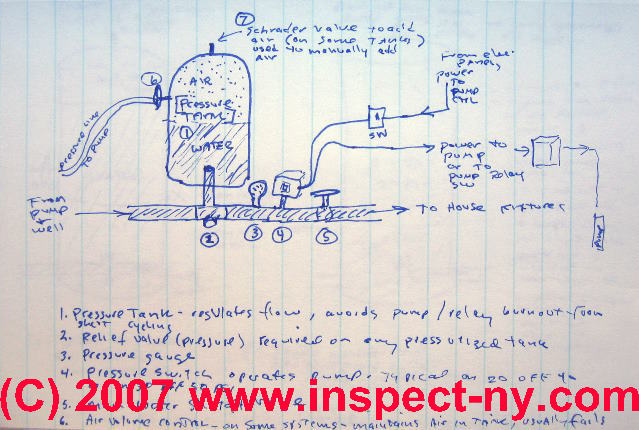
In the sketch above the pump pressure control switch is item #4 - we show this switch in more details in photographs provided in this article series.
Pressure Control Switch Guides
- SQUARE D PUMPTROL 9013 TROUBLESHOOTING [PDF] guide from Schneider Electric, Schneider Electric - North America, 2641 Sumner Boulevard, Raleigh, NC 27616 USA, Tel: 800-468-5342 www.us.squared.com www.us.telemecanique.com Tel: Square D product support group, 888-SquareD
- SQUARE D PUMPTROL 9013 WIRING & ADJUSTMENT [PDF]
- SQUARE D Pumptrol 9013 PRESSURE CONTROL INSTALLATION [PDF] retrieved 2018/02/14, original source: https://www.homedepot.com/catalog/pdfImages/c4/c45d9a6c-4498-438b-962f-9e546d196127.pdf
- WATER PRESSURE REGULATOR ADJUSTMENT - If your building water supply is from a municipal water main rather than a private well
- WATER PUMP PROTECTION SWITCH - automatically or manually-reset cut-offs that protect the pump in event of low water pressure or rapid pump cycling
- WATER PUMP REPAIR GUIDE an specific case which offers an example of diagnosis of loss of water pressure, loss of water, and analyzes the actual repair cost.
...
Continue reading at WATER PRESSURE CONTROL SWITCH ADJUSTMENTS or select a topic from the closely-related articles below, or see the complete ARTICLE INDEX.
Or see WATER PUMP PRESSURE CONTROL SWITCH FAQs - questions & answers posted originally on this page
Or see these
Recommended Articles
- WATER PRESSURE LOSS DIAGNOSIS & REPAIR
- WATER PUMP INTERMITTENT CYCLING - pump runs occasionally for no reason
- WATER PUMP PRESSURE CONTROL SWITCH - installation, adjustment, troubleshooting & repair of well or water pump control switches.
- WATER PUMP PRESSURE SWITCH NOISES - clicks, hums, buzzes at the pressure control
- WATER PUMP PRESSURE SWITCH REPAIRS - home
- WATER PUMP RELAY SWITCH - 240V pump switch
- WATER PUMP REPAIR GUIDE - home
- WATER PUMP SHORT CYCLING - pump turns on & off too frequently
- WATER PUMP WIRING REPAIR
- WATER TANK AIR, HOW TO ADD
- WELL PIPE LEAKS
Suggested citation for this web page
WATER PUMP PRESSURE CONTROL SWITCH at InspectApedia.com - online encyclopedia of building & environmental inspection, testing, diagnosis, repair, & problem prevention advice.
Or see this
INDEX to RELATED ARTICLES: ARTICLE INDEX to WATER SUPPLY, PUMPS TANKS WELLS
Or use the SEARCH BOX found below to Ask a Question or Search InspectApedia
Ask a Question or Search InspectApedia
Try the search box just below, or if you prefer, post a question or comment in the Comments box below and we will respond promptly.
Search the InspectApedia website
Note: appearance of your Comment below may be delayed: if your comment contains an image, photograph, web link, or text that looks to the software as if it might be a web link, your posting will appear after it has been approved by a moderator. Apologies for the delay.
Only one image can be added per comment but you can post as many comments, and therefore images, as you like.
You will not receive a notification when a response to your question has been posted.
Please bookmark this page to make it easy for you to check back for our response.
Our Comment Box is provided by Countable Web Productions countable.ca
Citations & References
In addition to any citations in the article above, a full list is available on request.
- Pumptrol® Pressure Switch Adjustment, Square D, Schneider Electric Corporation, 8001 Knightdale Blvd., Knightdale< NC 27545 1-888-778-2733 - Square D Technical Library, web search 07/24/2010 original source: http://ecatalog.squared.com/techlib/docdetail.cfm?oid=09008926800a93be
- 9013 Pumptrol® Commercial Pressure Switches Type F and 9013 Commercial Pressure Switches Type G, Catalog, SquareD, Schneider Electric Industries SAS, Schneider Electric Industries SAS, web search 02/23/2011, original source:
http://ecatalog.squared.com/pubs/Machine Control/
Pressure-Float-Vacuum Switches/Pressure Switches-Water and Air/9013CT9701.pdf
Square D is a brand of Schneider Electric. - Class 9013 Square D Commercial Pressure Switches: Water Pump Pressure Control Switch Class 9013, Type F, G, Manual, Square D Company, 8001 Highway 64 East, Knightdale, NC 27545-9023, USA, (919) 266-3671, www.squared.com,
web search 02/24/2011, original source: stevenengineering.com/tech_support/PDFs/45COM.pdf. Quoting:
The Type FSG, FYG, FRG - PUMPTROL® Water Pump Pressure Switches are used to control Water Pump Pressure Switches are used to control
electrically driven water pumps and have the following features:- The Type FSG is the standard water pump switch, suitable for all types of pumps: jets, submersible,
reciprocating, etc. - The Type FYG is designed to meet higher horsepower and pressure requirements.
- The Type FRG is reverse acting: the contacts open on falling pressure.
All are diaphragm actuated.
The Type G - PUMPTROL® Commercial/Light Industrial Pressure Switch is used to control electrically driven water pumps and air compressors. It has higher electrical ratings for direct control of motors in pump and compressor applications. The Type G switch is diaphragm actuated and has contacts that open on rising pressure. - The Type FSG is the standard water pump switch, suitable for all types of pumps: jets, submersible,
- Thanks to reader J.H. for describing his process of tracking down well pump short cycling to a well piping leak - February 2011.
- Access Water Energy, PO Box 2061, Moorabbin, VIC 3189, Australia, Tel: 1300 797 758, email: sales@accesswater.com.au Website: http://www.accesswater.com.au/
Moorabbin Office: Kingston Trade Centre, 100 Cochranes Rd, Moorabbin, VIC 3189
Australian supplier of: Greywater systems, Solar power to grid packages, Edwards solar systems, Vulcan compact solar systems, water & solar system pumps & controls, and a wide rage of above ground & under ground water storage tanks: concrete, steel, plastic, modular, and bladder storage tanks. - Grove Electric, Typical Shallow Well One Line Jet Pump Installation [PDF], Grove Electric, G&G Electric & Plumbing, 1900 NE 78th St., Suite 101, Vancouver WA 98665 www.grovelectric.com - web search -7/15/2010 original source: http://www.groverelectric.com/howto/38_Typical%20Jet%20Pump%20Installation.pdf
- Grove Electric, Typical Deep Well Two Line Jet Pump Installation [PDF], Grove Electric, G&G Electric & Plumbing, 1900 NE 78th St., Suite 101, Vancouver WA 98665 www.grovelectric.com - web search -7/15/2010 original source: http://www.groverelectric.com/howto/38_Typical%20Jet%20Pump%20Installation.pdf
- Our recommended books about building & mechanical systems design, inspection, problem diagnosis, and repair, and about indoor environment and IAQ testing, diagnosis, and cleanup are at the InspectAPedia Bookstore. Also see our Book Reviews - InspectAPedia.
- In addition to citations & references found in this article, see the research citations given at the end of the related articles found at our suggested
CONTINUE READING or RECOMMENDED ARTICLES.
- Carson, Dunlop & Associates Ltd., 120 Carlton Street Suite 407, Toronto ON M5A 4K2. Tel: (416) 964-9415 1-800-268-7070 Email: info@carsondunlop.com. Alan Carson is a past president of ASHI, the American Society of Home Inspectors.
Thanks to Alan Carson and Bob Dunlop, for permission for InspectAPedia to use text excerpts from The HOME REFERENCE BOOK - the Encyclopedia of Homes and to use illustrations from The ILLUSTRATED HOME .
Carson Dunlop Associates provides extensive home inspection education and report writing material. In gratitude we provide links to tsome Carson Dunlop Associates products and services.
 | HOME | ABOUT | ASK a QUESTION | CONTACT | CONTENT USE POLICY | DESCRIPTION | POLICIES | PRIVACY | |
| © 2024 - 1985 Publisher InspectApedia.com - Daniel Friedman | |||||||||