
InspectAPedia® FREE Encyclopedia of Building & Environmental Construction, Diagnosis, Maintenance & Repair |
Question? Just ask us! InspectAPedia
|
 Cisterns for Drinking Water Storage
- POST a QUESTION or COMMENT about using cisterns for drinking water
Water storage cisterns: types, properties, maintenance, & use. We describe rainwater collection systems and the diversion of rainwater into a storage cistern. We also discuss the acceptability of cistern water supply for HUD financed properties.
This article series describes the use of cisterns as a drinking water supply source including rooftop cisterns, attic cisterns, ground-level and below-ground-level water storage cisterns.
InspectAPedia tolerates no conflicts of interest. We have no relationship with advertisers, products, or services discussed at this website.
Cisterns and How to use them for Drinking Water Storage
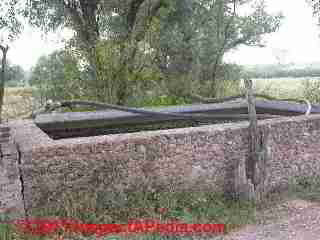
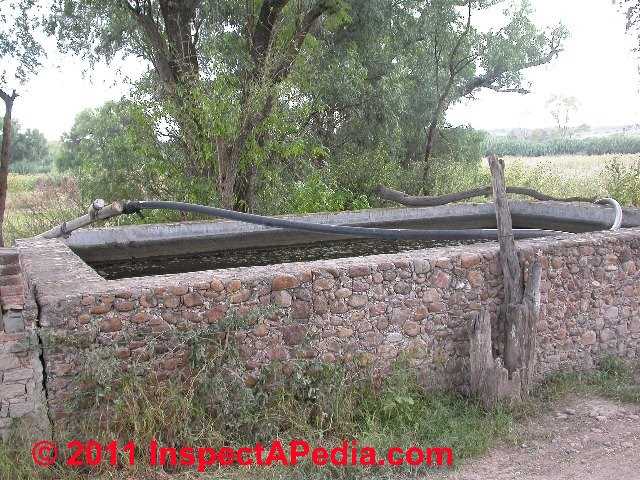
 A cistern is basically a water reservoir of any kind which is used to accumulate and store water for future use.
Cisterns are usually constructed close to the building which will use their water, sometimes even inside it.
[Click to enlarge any image]
Water enters a cistern from an external source such as rainwater from a rooftop, pumped water from a spring or other supply, or even by delivery by water truck.
Water from a cistern is typically pumped out by hand, drained by gravity, or it may be pumped by an electric pump such as a one line jet pump.
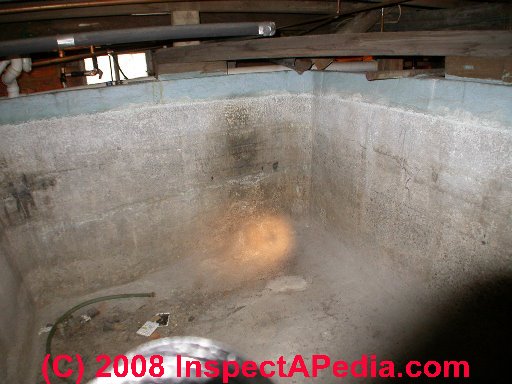
Interestingly in the cistern shown at above left the owner broke through into the cistern from the basement and drilled a modern steel casing well right in the bottom of the cistern - some of the new equipment is also visible.
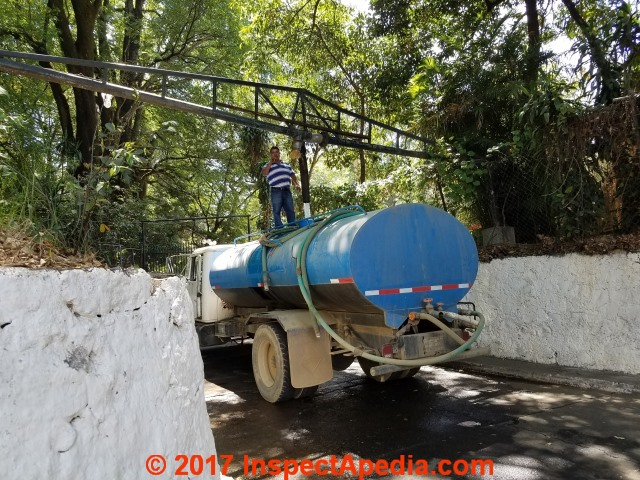 Cisterns to store water for drinking or agricultural purposes are widely used in dry areas where rainwater runoff may be stored for future use.
However all water storage cisterns that are to be used for drinking or potable water supplies are at risk of contamination either from external sources or from bacterial growth during the water storage interval.
Cisterns may be located inside or outside of a building, and may be above ground or below ground level. Our photograph of a concrete cistern (above left) was taken in the basement of a 1920's home in New York state.
A water pump and probably a water pressure tank will be needed for ground-level or below-ground-level water storage cisterns.
Details about repairing water pumps & storage tanks are
at WATER PUMPS, TANKS, DIAGNOSTICS
For repairing leaks in cisterns also
see CAULKS, NONTOXIC
Our photo (above) shows a water truck or pipa being filled from the Uruapan water source, the Mantantial Yerba Buena.
In Mexico and many other countries, when rainwater or another water source is not available the local cistern(s) may be filled by such water deliveries.
Attic Cisterns & Water Pressure Tanks
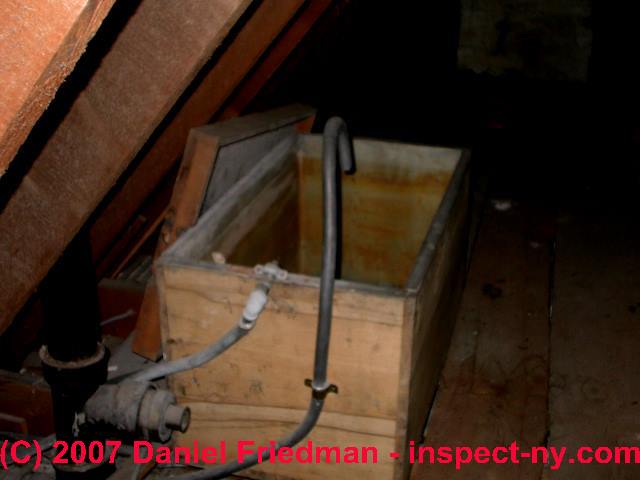
Cisterns in attics are an open-type water storage reservoir or a water pressure boosting system similar in function to rooftop cisterns and water storage tanks.
A cistern was generally placed where it could be fed by gravity from roof or surface runoff, but any indoor open topped reservoir of water could be called a cistern.
Attic Cisterns or water tanks are installed in some buildings to perform the same function as rooftop-mounted water tanks.
Other smaller attic containers that look like a water reservoir may have been just an expansion tank for the heating boiler system.
Also see ATTIC & ANTIQUE EXPANSION TANKS, HEATING used with some older hot water heating systems.
Basement & Indoor Cisterns in Older Homes
The basement cistern shown below is located below a pre-1900 home in New York.
Later owners broke open a passage into the basement cistern and now use it for storage. This cistern was originally filled by downspouts directing roof runoff into the basement.
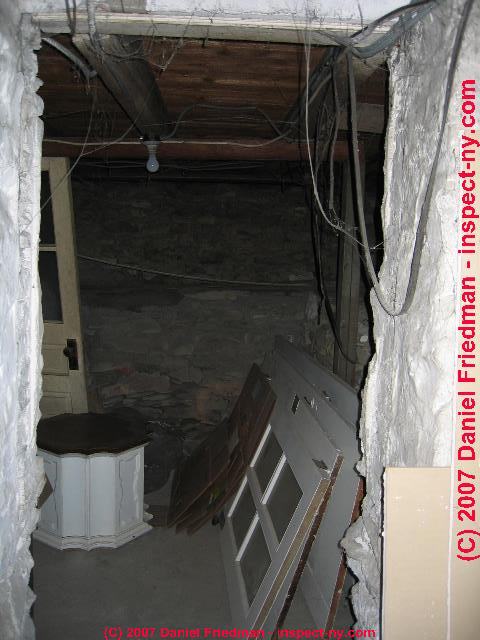
In the U.S. cisterns were often located in the basement of a (pre-1900) home.
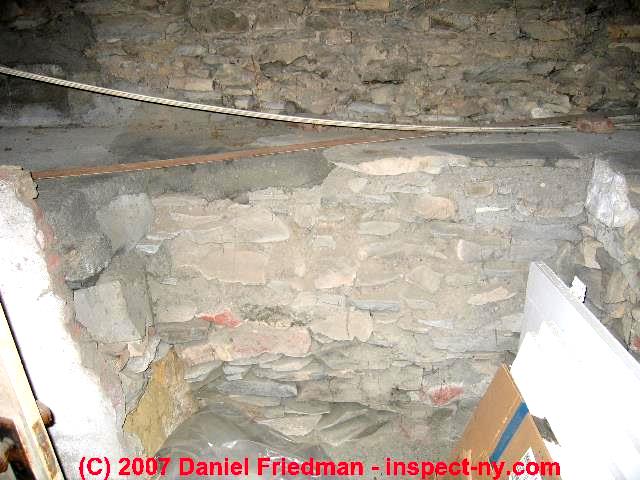
The cisterns shown here were built abutting the home foundation wall, probably filled by roof drainage and downspouts, and were later abandoned.
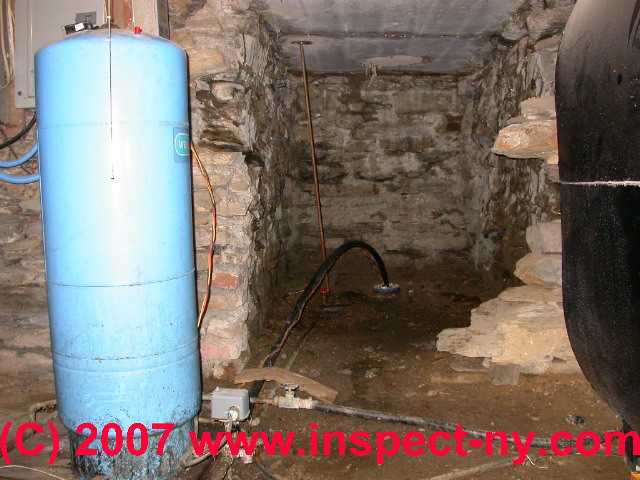
In the photo above you can see that the building owners later drilled a well in the floor of what probably was a cistern and broke through the foundation wall to give ready access to the rest of the home's basement.
Finding Abandoned Cisterns
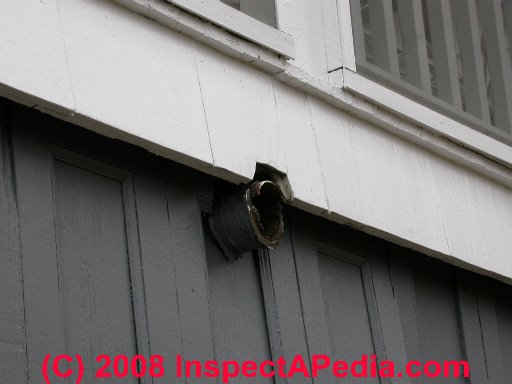 Cisterns inside older buildings can be tricky to spot - the cistern may have been partly demolished, such as in photos shown above, or the cistern may be a walled structure whose top is just below the joists of the building's first floor, as we see in the photos just below.
A tip that led to our discovery of this cistern was an unexplained drainpipe protruding to outside through a building wall.
We traced the drain to a nearly-hidden basement cistern where it handled cistern overflow.
Watch out: an abandoned cistern, like any abandoned tank or excavation at a property, may be unsafe or a child hazard.
In a seasonally damp climate such as New York, an in-use basement cistern would certainly be a likely source of unwanted building moisture
Open Water Tanks Indoors Form Mini-Cisterns for Spring-Fed Water Supplies
An open indoor water tank (photos below) can also function as an intermediate limited-quantity water storage tank or in effect a "mini cistern" that stores local water for a building fed by gravity from an up-hill spring or artesian well.
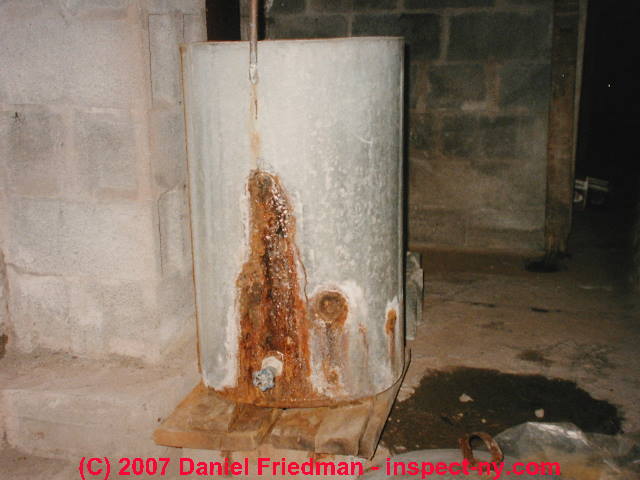
At some locations there is an up-hill or rooftop water source which is fed into the building entirely by gravity. The open top water tank in these photos used a simple float valve to let water into this storage tank.
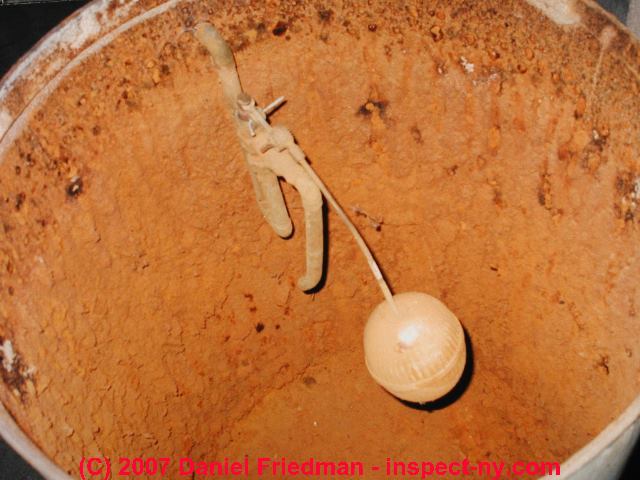
Where such intermediate storage tanks, perhaps fed by an uphill spring, were located in the upper floors of a building they fed water to building piping where it could flow by gravity when a water tap was opened.
Our photographs show that this indoor water tank has rusted-through and is no longer functional, but the float assembly (photo above-right) makes clear how the tank worked.
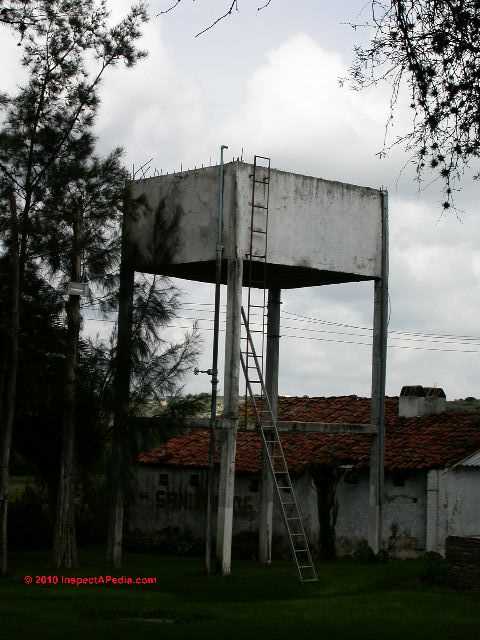
Free-standing Water Tanks Function as Large Cisterns at or Close to Ground Level
Here we show two types of freestanding above-ground water storage tanks, at the Taboada Hot Springs (Guanajuato, Mexico, photo at left), and in Dutchess County, NY (photo below right).
Rainwater Storage Tanks & Cisterns

Outdoor Cisterns and water storage tanks, are often located in the basement or courtyard of buildings where they collect rainwater for future use.
In arid areas such as the U.S. Southwest and parts of Mexico, very large cisterns are often placed in a courtyard where they collect rainwater for use during the dry season.
We prefer the ground-level water storage cistern shown below to the more traditional below-ground cisterns because the above-ground or on-ground rainwater tank can at least avoid contamination from surface water runoff that otherwise can enter a below-ground cistern.
In a seasonally damp climate such as New York, an in-use basement cistern would certainly be a likely source of unwanted building moisture and would thus be a risk for problematic mold growth.
In arid areas such as the U.S. Southwest and parts of Mexico, very large cisterns are often placed in a courtyard where they collect rainwater for use during the dry season.
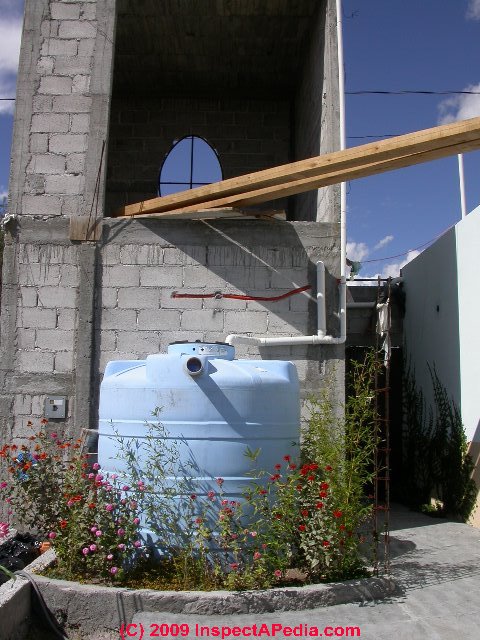
The above-ground water cistern storage tank shown in our photo (left) is located in Mexico and is discussed in more detail
at PASSIVE SOLAR HOME, LOW COST.
Rainwater
for the plastic tank cistern shown at left is collected from a
NER-flat rooftop [photo] and channeled to a large fiberglass holding tank - the blue tank in our photograph, (above left).
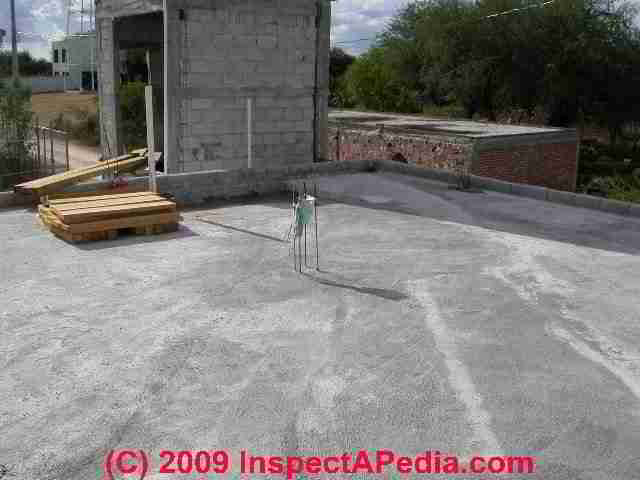
Piping also permits directing water into this tank from a drilled-well-fed
CISTERN located atop the concrete block tower [photo].
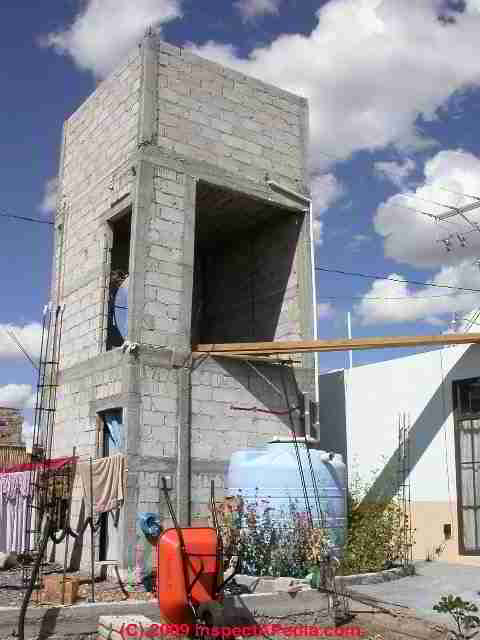
The tower's height provides water pressure to the building. Currently water is taken out of the bottom of this tank by a simple tank drain valve and hose attachment; to supply this water upwards to the building plumbing fixtures or perhaps to the cistern, a small electric pump will be installed.
At CISTERN & RAINWATER COLLECTION SYSTEMSwe describe a larger capacity rooftop rainwater collection system.
Traditional Water Storage Cistern, Rainwater Collection & Graywater Re-Use
 In text and photographs now found in a separate article
at CISTERN & RAINWATER COLLECTION SYSTEMSwe describe a rooftop rainwater collection system that sends clean roof runoff into a very large masonry cistern built below a home in Guanajuato, Mexico.
A pump located in the cistern delivers water up to the building's various plumbing fixtures.
This thoughtful rainwater catchment system in active use in a dry climate includes several interesting design features including the ability to have rain provide a rooftop dust flush before rainwater is diverted into the cistern and an extensive graywater collection system (orange arrows shown on the gray barrel at below left) that in parallel to the cistern conserves graywater for application to gardens and trees on the site.
A simple ball valve connected to the graywater container permits connection of a hose to direct graywater to where it is to be applied on nearby garden or trees.
More about graywater re-use systems is
Advice for Using Cisterns for Water Supply
- Safety:
be sure the cistern is of sound construction and that it is safely covered or protected from someone falling into the cistern or from a child climbing into it.
Also see details at WATER TANK SAFETY. - Direct roof runoff,
not surface runoff, into the cistern. Some clever roof runoff management systems direct the first roof runoff onto the ground, permitting dust and debris from the roof surface to be disposed-of before the remaining roof runoff is directed into the cistern for water storage.
Other water sources may be used to supply cisterns, including even local or municipal water supplies. In this case the cistern is being used as a backup or off-peak water supply source. - Do not assume that water stored in a cistern is potable
prior to filtering and treatment. The water should be tested for contaminants before used for drinking; it's fine to use cistern water for watering plants or lawns if that water usage is suitable and permitted by other conditions. - Do not install an open, un-covered cistern in a building
where moisture from the cistern could cause a mold or rot problem. - Plastic Water Storage Tank Health & Safety:
some water storage tanks are made of plastic polyethylene terephthalate aka PET. PET plastic water tanks may be a health risk to consumers: Commentary published in Environmental Health Perspectives in April 2010 suggested that PET might yield endocrine disruptors under conditions of common use and recommended research on this topic.
Proposed mechanisms include leaching of phthalates as well as leaching of antimony.[14] Other authors have published evidence indicating that it is quite unlikely that PET yields endocrine disruptors.[15] - Web search 6/27/2010 Wikipedia.
We discuss how to identify the type of plastic used in a water tank and the health and safety of different types of plastic tanks in detail at
- Provide access to the cistern
for inspection and cleaning
Also see CLEANING & DINSINFECTING WATER CISTERNS AFTER FLOODS & HEAVY RAINS [PDF] U.S. CDC - Pumps for cisterns:
if you intend to rely on an electrical pump to move water from the cistern to its point of use during bad weather and possible power outage your pump will need a backup source of electricity.
See PUMP, WATER PRESSURE BOOSTING - SPRINGS as WATER SUPPLY what are they, can they be sanitary and safe?
 ...
...
Attic Cisterns or water tanks
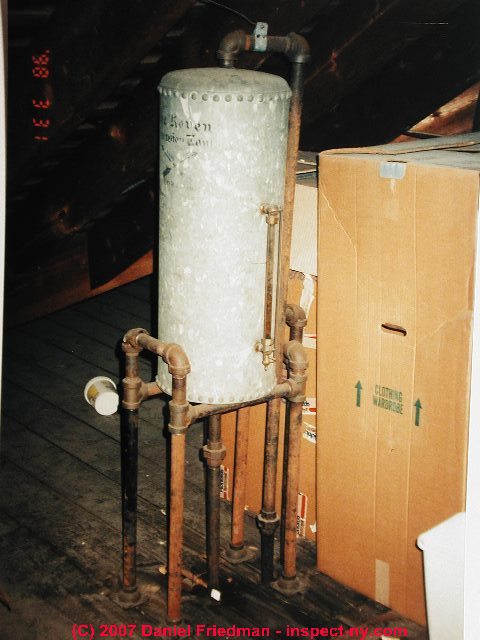
are installed in some buildings to perform the same function as rooftop-mounted water tanks. This little attic reservoir (above left) was found in the Justin Morrill historic home.
Attic expansion tanks and pressure relief systems
Don't confuse an old heating system attic-mounted expansion tank (above right) for a water tank however. These are not potable water storage systems.
The heating system expansion tank will be connected to the heating system radiators or basement boiler and may have a simple overflow pipe to permit excessive water (or system pressure) to spill outside.
Heating systems with this equipment installed may not have a modern pressure and temperature relief valve.
Attic expansion tank systems used on heating boilers are potentially less safe than installing a relief valve right on the boiler, since the attic-located pressure relief system is located so remote from the heating boiler.
Is a Cistern an Acceptable Water Supply for HUD Financing?
 ...
...
Cisterns and HUD financing: HUD Handbook 4150.2 Section 3-6 indicates that properties served by cisterns are not acceptable for mortgage insurance. However, the HOCs have the authority to consider waivers in areas where cisterns are typical.
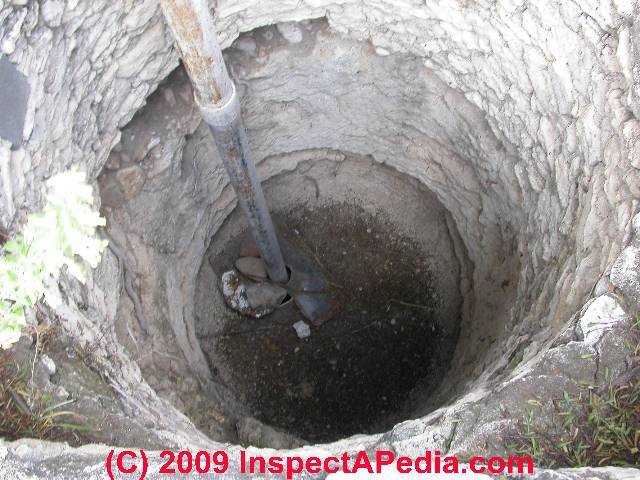
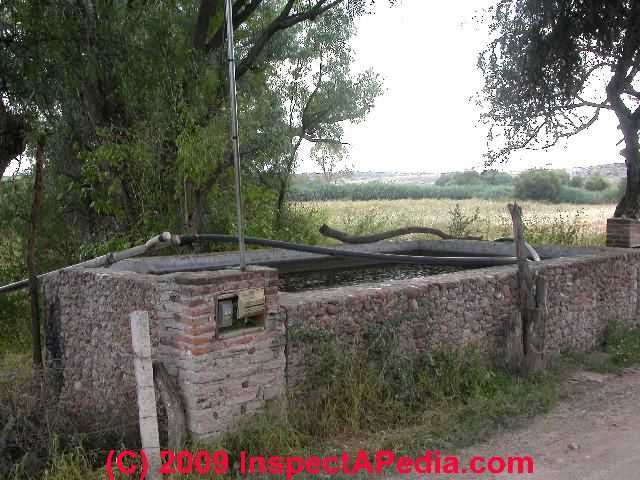
Our photos shows a hybrid system: this outdoor cistern is filled by pumping from an open casing in a drilled well that was inserted in the bottom of a dug well that went "dry".
Water Storage Cistern Research
- Ali, A., T. Oweis, A. B. Salkini, and S. El-Naggar. "Rainwater cisterns: traditional technologies for dry areas." ICARDA, Aleppo, Syria. iv (2009).
- Artiola, Janick F., Channah Rock, and Gary Fix. WATER STORAGE TANK DISINFECTION, TESTING, AND MAINTENANCE [PDF] (2012). College of Agriculture and Life Sciences, University of Arizona
(Tucson, AZ) retrieved 2021/02/03 original source: https://repository.arizona.edu/bitstream/handle/10150/255333/az1586-2012.pdf?sequence=1
Excerpts:
The translucent material of these tanks will also allow sunlight to penetrate and can facilitate the growth of algae inside the tank.
Warm water favors corrosion (Fig. 3), scale formation, and the growth of algae and other microorganisms. - Barber, Richard, and Sean Barber. "Storage tank containing a black polyethylene inner layer." U.S. Patent 9,016,498, issued April 28, 2015.
Abstract
Black polyethylene storage tanks are an inexpensive and effective way to store water and simultaneously inhibit algae growth. However, based on other considerations, it may be desirable to use a storage tank with a non-black color.
By producing a polyethylene water storage tank with a black inner layer and a non-black outer layer, the desire to inhibit algae growth and the desire to have a non-black exterior can both be met. - Eisner, Neil. METHOD FOR INHIBITING ALGAE GROWTH IN WATER TANKS AND APPARATUS THEREFOR [PDF] U.S. Patent 7,118,700, issued October 10, 2006.
Abstract
A method of inhibiting the growth of algae and like organisms in plastic water tanks exposed to sunlight comprises providing an outer tank surface operative to reflect off a substantial portion of sunlight that hits the tank off the outer tank surface; and providing an opaque inner tank layer operative to substantially prevent sunlight passing through the outer tank surface from entering an interior of the tank.
A two layer tank is provided comprising a light colored outer layer and a dark sun-blocking inner layer, and is conveniently made by a rotational molding process. - Gnadlinger, Johann. "Technical presentation of various types of cistern built in the rural communities of the semi-arid region of Brazil." In 9th IRCSA Conf. 1999.
- Gnadlinger, Joao. "Lime—the great sealer: constructing low-cost, sub-surface rainwater tanks in Brazil." Waterlines 14, no. 2 (1995): 11-14.
- Gould, John E. "The Fourth International Rainwater Cistern Systems Conference." Waterlines 8, no. 2 (1989): 31-31.
- Gould, John E. "The Rain-water Cistern Systems Conference in Thailand." Waterlines 6, no. 2 (1987): 12-13.
- GRAF CARAT 1700 GALLON CISTERN SPECIFICATIONS SHEET [PDF] includes drawings of the product
- GRAF CARAT 1700 GALLON CISTERN INSTALLATION & MAINTENANCE [PDF] includes drawings of the product
- Kleyn, Hendrik. "Plated polymeric fuel tank." U.S. Patent 5,547,096, issued August 20, 1996.
- Lin, Shiue-lian, Shuo-ting Hung, Lu-pei Hu, Po-hsun Chang, Hong-ming Lin, and Ching Chuan Lin. "Composite for inhibiting algae growth and use therof." U.S. Patent 7,381,686, issued June 3, 2008.
- Linkous, Clovis A., Glenda J. Carter, David B. Locuson, Anthony J. Ouellette, Darlene K. Slattery, and Lisa A. Smitha. "Photocatalytic inhibition of algae growth using TiO2, WO3, and cocatalyst modifications." Environmental Science & Technology 34, no. 22 (2000): 4754-4758.
- Nadhem, Zainab Fouad, Akeel Kazim Alwan, Manar Ahmed Ehmud, Shatha Ali Shafiq, Ahmed Aidan Al-Hussien, Hayder Jasim Mohammad, Jaafar Sadeq Murtadha, and Ghania Ayaal. "The Effect of Using Zeta Potential to Prevent Biofilm from water Tanks." International Journal of Innovation and Applied Studies 12, no. 3 (2015): 552.
- Rigby, Robert Alexander. "Algae growth control." U.S. Patent 4,065,386, issued December 27, 1977.
- Suleiman, M. A., and R. J. Solomon. "Effect of stocking on the growth and survival of Clarias gariepinus grown in plastic tanks." Direct Res. J. Vet. Med. Anim. Sci 2, no. 3 (2017): 82-92.
- Wang, Wuncheng. EFFECT OF TURBIDITY ON ALGAL GROWTH [PDF] Circular no. 121 (1974). U. Illinois
- See additional citations & research
at CISTERN & RAINWATER COLLECTION SYSTEMS
at the page bottomReferences or Citations
Reader Comments, Questions & Answers About The Article Above
Below you will find questions and answers previously posted on this page at its page bottom reader comment box.
Reader Q&A - also see RECOMMENDED ARTICLES & FAQs
On 2021-02-03 by (mod) - Plastic water tank / cistern colour affects algae growth
 David,
Thank you for the comment; the claim that plastic tank color affects algae growth is interesting and not intuitive to everyone.
Some quick research to understand your supposition: white or cleaer plastic tank material supports algae growth and black does not as it blocks UV, supports your view, as I'll cite at
CISTERN & WATER TANK RESEARCH & MANUALS
There are of course other factors affecting algae growth in water tanks including the water temperature and water source and quality including dust and other contaminants (Wuncheng 1974).
And because black tanks absorb more heat from sunlight, the black tank colour cuts both ways: impeding sunlight penetration but increasing warmth. For that reason some of the patents we see combine a heat reflective outer tank colour with an black or dark inner layer to block light.
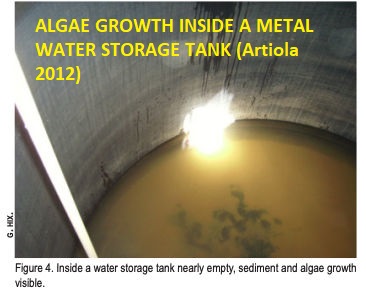 Nutrients in some water supplies, particularly phosphate and nitrate alsoencourage algae growth. (Artiola 2012).
Photo of algae growth inside of a metal water storage tank is excerpted from (Artiola 2012) and illustrates that even with just a little light penetration into a water tank or cistern, other conditions may promote algae growth.
Thank you for taking the time to post your comment; I'll be sure to keep it with the article.
More about algae growth on or in buildings and at building exteriors is found
at ALGAE & MOLD STAINS on EXTERIORS
On 2021-02-03 by David - Green or Black outdoor tanks help prevent algae growth.
Plastic Tank color matters, I did not see that adequately responded to.
Green or Black outdoor tanks help prevent algae growth. A white or clear tank supports algae growth as it does not block the UV rays.
On 2020-12-24 by (mod) - when the water level reaches below the half way we get air in the taps
Chris
Most-likely there is an air leak at the filter canister assembly. Sometimes the air discharge in a system like yours (pumping water supply from a cistern) only appears when the pump has to work harder because the water level has dropped, so the pump is working harder to provide the necessary lift.
Other possibilities are less likely as the problem appeared after you changed the filter, but include leaks at the pump itself or anywhere in the piping system.
Details are at AIR DISCHARGE at FAUCETS, FIXTURES
On 2020-12-24 by Chris
I just recently moved into a house with a below grade cistern. This is my first experience with a cistern so know only the basics. We don’t collect any rainwater run off only rely on a truck to deliver potable municipal water. The previous owner installed a filter on the intake side of the pressure pump which I replaced the cartridge with a activated carbon filter for smell and chlorine.
My question is: It seems that when the water level reaches below the half way we get air in the taps, even the toilet tank burbles after flushing. It also only started after I replaced the filter cartridge, could this be the reason? Or do I have other possible issues?
On 2020-10-17 by (mod) - sealing leaks in an underground metal cistern
We discussed this Flex Seal contamination question recently with a reader (was it you on another page?) and noted that nothing in the intended uses listed by the manufacturer included contact with potable water;
So it was probably a mistake, as you suggests.
I'm reluctant to bet your health on a speculative answer to this problem; if I were considering a sealant repair I'd talk with the tank or cistern manufacturer to see what they recommend as well as with the manufacturer of any sealant I was considering using.
Do that first so we don't start just throwing money at this only to discover it would have been cheaper to replace the cistern.
On 2020-10-17 by Valerie Gegelman
I have an underground metal cistern. It started leaking out of the bottom. My Son in law poured a bunch of Flex Seal into it. The water coming out of the faucit started smelling like plastic and foamed.
I did some research and found Flex Seal can cause Cancer and reproductive problems. I have 2 young grandsons and am very concerned. I am afraid to give them baths with the water or even have them brush their teeth with it. We r thinking of putting concrete over the Flex Seal and sealing it with Damtite. Do u have any suggestions?
On 2020-07-20 - by (mod) -
Amanda
Thank you for helpful question about using a cistern.
In technically correct language, sistering is simply a watertight container.
So if you have a pump in the container that sends water out to a point-of-use that's not going to get water into the container and you need a water source.
That water source might be a separate pump or other water lifting mechanisms such as a hydraulic water ran to bring water up from a creek into the cistern
On 2020-07-17 by Amanda
I have a cistern on my property and I have water rights to the creek behind the property.
There is an electrical pump at the cistern tank that allows me to hook it up to a garden hose.
However, I am not sure if I need a second pump to put in the creek in order to add more water to the cistern.
Anybody have a suggestion?
Thanks!
Amanda Jean
On 2020-03-20 - by (mod) -
Jan:
Thanks for an interesting and helpful question: how to make roof-runoff rainwater collection potable - safe to drink.
The minimum treatment needed to make roof runoff potable would be
1. a fine particulate filter to remove any dust or physical debris
2. a sanitization or disinfection process such as chlorination or UV treatment
There can be additional hazards in roof runoff and in water that is stored in a cistern including:
- chemical contaminants that depend on the roof covering (lead, for example)
- algae growth inside the cistern
- surface or groundwater contaminants that leak into a cistern such as nitrites and nitrates or pesticides
Therefore it is important to inspect and understand the entire roof runoff collection and cistern storage materials, condition, and details, and it may be useful to have a representative sample of the stored cistern-water tested by your local water test lab.
Beyond testing for bacteria level, algae and sedimentary debris, based on the building materials involved in the whole collection system as well as conditions in your local environment, the lab may recommend additional specific tests.
For purchasing water treatment equipment, your local plumbing supplier as well as local water treatment companies can provide and install filters, UV or other disinfection systems, etc.
But before installing equipment selected arbitrarily, you need to know what contaminants are in or are at risk of being in the water.
On 2020-03-20 by Jan
I have a cistern that collects roof runoff, and uses an electric pump to move the water through a filter to the hose bibs. How do I use this water for drinking? What water tests are needed, and where do I purchase them?
On 2019-02-05 by kevin
suggestions for water storage
On 2018-10-29 - by (mod) -
Most likely he will need to install a pump and pressure tank and controls to deliver the water from the cistern, if I assume that it is below ground. Beware that the water may not be sanitary for drinking.
On 2018-10-29 by Michelle Taylor
I just bought a house with a cistern in it. How do I get the water to start out from the cistern?
On 2018-10-18 - by (mod) -
Terry,
My general opinion is no, the color of a plastic cistern is not critical to its use.
There are a few more subtle considerations:
1 The plastic color might tell you something about its chemistry, thus addressing questions about leaching chemicals into your drinking water, and also telling you about the plastic's resistance to UV deterioration when exposed to sunlight - thus the tank life.
2 The plastic color affects the solar heat gain for an above-ground or rooftop plastic cistern. Black or other dark colors tend to warm the water more than light or white colors - if anyone cares.
3. The plastic color (actually its composition) could be important to compare with its intended use. For example there may be specific plastics designed for underground use and others designed for above ground and sunlight-exposed use. Factors include strength, resistance to cave-in (below ground) vs. UV resistance and again, tank life.
Shown below my comment is a Norwesco underground cistern.

Also see this
- Norwesco UNDERGROUND CISTERN INSTALLATION MANUAL [PDF] Norwesco Inc. 4365 Steiner Street P.O. Box 439 St. Bonifacius, MN 55375-0439 TEL. (800) 328-3420 FAX (800) 874-2371 www.norwesco.com
Norwesco produces plastic / fiberglass tanks used in a variety of applications including cisterns and septic tanks.
As will be apparent to readers, both the open top of this cistern and the open casing in the bottom of the dug well are sources of water contamination.
See WELL CLEARANCE DISTANCES for more information about cisterns, well and water source clearances from potential pollutant sources, and possible exceptions that can permit use of cisterns for drinking water supply.
On 2018-10-18 by Terry
Does it matter what color the plastic is for a cistern? I hAVE A WHITE ONE THAT IS ABOVE GROUND. Any problems with that?
...
Continue reading at CISTERN & RAINWATER COLLECTION SYSTEMS or select a topic from the closely-related articles below, or see the complete ARTICLE INDEX.
Or see CISTERN FAQs - questions & answers posted originally on this page.
Or see these
Recommended Articles
- CAULKS, NONTOXIC
- CISTERNS, WATER STORAGE - home
- ATTIC CISTERNS
- BASEMENT CISTERNS
- CISTERN & RAINWATER COLLECTION SYSTEMS
- CISTERN USE ADVICE
- GRAVITY FEED TANKS
- FREESTANDING WATER TANKS
- LARGE CAPACITY WATER STORAGE TANKS
- ODORS IN WATER
- PLASTIC RECYCLING CODES, TANKS, TYPES
- RAINWATER STORAGE CISTERNS
- HUD FINANCE & CISTERNS
- ROOFTOP WATER TANKS
- WATER TANK CLEANING CODES STANDARDS
- WATER TANK DRAIN VALVE
- WATER TANK LOCATION GUIDE
- WATER TANK SIZE & VOLUME
- WATER TOWERS
Suggested citation for this web page
CISTERNS, WATER STORAGE at InspectApedia.com - online encyclopedia of building & environmental inspection, testing, diagnosis, repair, & problem prevention advice.
Or see this
INDEX to RELATED ARTICLES: ARTICLE INDEX to WATER SUPPLY, PUMPS TANKS WELLS
Or use the SEARCH BOX found below to Ask a Question or Search InspectApedia
Ask a Question or Search InspectApedia
Try the search box just below, or if you prefer, post a question or comment in the Comments box below and we will respond promptly.
Search the InspectApedia website
Note: appearance of your Comment below may be delayed: if your comment contains an image, photograph, web link, or text that looks to the software as if it might be a web link, your posting will appear after it has been approved by a moderator. Apologies for the delay.
Only one image can be added per comment but you can post as many comments, and therefore images, as you like.
You will not receive a notification when a response to your question has been posted.
Please bookmark this page to make it easy for you to check back for our response.
Our Comment Box is provided by Countable Web Productions countable.ca
Citations & References
In addition to any citations in the article above, a full list is available on request.
- HU, Wen-wu, Ping JIANG, Wei-zhong AI, and Song-ling SUN. "Research on wireless farming cistern control system based on self-study mechanism [J]." Electronic Design Engineering 4 (2010): 003.
- Ikebuchi, Shuichi, and Seiji Furukawa. "Feasibility Analysis of Rain Water Cistern Systems as an Urban Water Supply Source." In Proc. Rain Water Cistern Systems Conf, pp. 118-127. 1982.
- Irwin, Ross W., and Ross W. Irwin. "Cistern for domestic water use." Canadian agricultural engineering 19, no. 1 (1977): 12.
- Isquith, Irwin R., and Harvey Winters. "The microbial analysis of domestic cistern water in the US Virgin Islands." Desalination 66 (1987): 415-421.
- Isquith, Irwin R., Harvey Winters, and Agreement No. Microbial Analysis of Domestic Cistern Water in the US Virgin Islands. Water Resources Research Center, College of the Virgin Islands, 1981.
- Jian, Tu. "A Brief Talk On Cistern Design." Forestry Science and Technology Information 3 (2007): 045.
- Krämer, S. "Improving the Construction of Cisterns in Yemen and the Cistern Water Quality." Fachhochsschule Giessen Friedberg, University of Applied Sciences (2003).
- König, Klaus W., and Dietmar Sperfeld. "Rainwater harvesting—A global issue matures." Sustain. Water Manag 1 (2007): 31-35.
- Lye, Dennis J. "Microbiology of rainwater cistern systems: A review: (Cistern, Rainwater, Microorganisms)." Journal of Environmental Science & Health Part A 27, no. 8 (1992): 2123-2166.
- McGeever, B., and T. H. Thomas. Underground storage of rainwater for domestic use; including construction details of a low-cost cistern and pumps. Working Paper 49, DTU, Warwick University, UK, 1997.
- Memarian, Gholam Hossein. "introducing Some Aspects Of Iranian Vernacular Architecture: Construction Of Abanbar Or Underground Cistern." Journal of Architecture and Urban Planning (2009).
- Olem, Harvey, and Paul M. Berthouex. "Acidic deposition and cistern drinking water supplies." Environmental science & technology 23, no. 3 (1989): 333-340.
- Petersen, Andrew. "The archaeology of the Syrian and Iraqi Hajj routes." World Archaeology 26, no. 1 (1994): 47-56.
- Shao-bing, L. I. U. "Design and Construction of Cistern Roofing [J]." Journal of Hunan Urban Constructin College 4 (2000): 009.
- Solomon, Hossana, and Henry H. Smith. "Effectiveness of Mandatory Law of Cistern Construction for Rainwater Harvesting on Supply and Demand of Public Water in US Virgin Islands." In Seventh Caribbean Islands Water Resources Congress, p. 75. 2007.
- Thomas, T. H., and B. McGeever. "Underground Storage of Rainwatewr for Domestic Use (Including Construction Details of a Low-Cost Cistern and Pumps)." (1997).
- Vincent, Linden. The politics of water scarcity: irrigation and water supply in the mountains of the Yemen Republic. Overseas Development Institute, 1990.
- Wahlin, L. "The family cistern: 3,000 years of household water collection in Jordan." In Ethnic Encounter and Culture Change. Papers from the Third Nordic Conference on Middle Eastern Studies, Joensuu, Finland, pp. 19-22. 1995.
- Xiaozu, Yartg Zhijie Su. "Calculation of Rectangular Cistern on Winkler Elastic Foundation [J]." Special Structures 2 (2006): 011.
- Yi, Li. "A Talk On The Design of The Control of Water Level in Underground Cistern." Fujian Architecture & Construction 3 (2002): 038.
- Young, Edward S., and William E. Sharpe. "Atmospheric deposition and roof-catchment cistern water quality." Journal of environmental quality 13, no. 1 (1984): 38-43.
- Our recommended books about building & mechanical systems design, inspection, problem diagnosis, and repair, and about indoor environment and IAQ testing, diagnosis, and cleanup are at the InspectAPedia Bookstore. Also see our Book Reviews - InspectAPedia.
- In addition to citations & references found in this article, see the research citations given at the end of the related articles found at our suggested
CONTINUE READING or RECOMMENDED ARTICLES.
- Carson, Dunlop & Associates Ltd., 120 Carlton Street Suite 407, Toronto ON M5A 4K2. Tel: (416) 964-9415 1-800-268-7070 Email: info@carsondunlop.com. Alan Carson is a past president of ASHI, the American Society of Home Inspectors.
Thanks to Alan Carson and Bob Dunlop, for permission for InspectAPedia to use text excerpts from The HOME REFERENCE BOOK - the Encyclopedia of Homes and to use illustrations from The ILLUSTRATED HOME .
Carson Dunlop Associates provides extensive home inspection education and report writing material. In gratitude we provide links to tsome Carson Dunlop Associates products and services.
 | HOME | ABOUT | ASK a QUESTION | CONTACT | CONTENT USE POLICY | DESCRIPTION | POLICIES | PRIVACY | |
| © 2024 - 1985 Publisher InspectApedia.com - Daniel Friedman | |||||||||