
InspectAPedia® FREE Encyclopedia of Building & Environmental Construction, Diagnosis, Maintenance & Repair |
Question? Just ask us! InspectAPedia
|
 How to Identify & Cure Odors in Drinking Water
- POST a QUESTION or COMMENT about tracking down unidentified odors or smells in household water supply
Water odors & smells:
This article discusses how to identify, diagnose, and cure common odors that may be present in drinking water. We explain how to get rid of or treat stinks, smells, rotten egg odor, sulphur odors in water.
Also described here: How to diagnose the cause of rotten egg sulphur odors in drinking water. What are other common odors in drinking water and what causes them? Health risks associated with some water odors?
How to get rid of other odors in drinking water. Bacteria including iron-bacteria can produce diesel or fuel oil smells in the water, cucumber smells, and even sewage odors in the water supply.
We also discuss which of these odors may warn of unsanitary conditions.
InspectAPedia tolerates no conflicts of interest. We have no relationship with advertisers, products, or services discussed at this website.
"Honey - the Water Smells Funny!" - what are the causes of odors in drinking water?
Although water as a pure compound, H2O, is colorless and odorless, contact with the earth's minerals and our distribution pipes may impart some flavor and odor characteristics.
The Threshold Odor Test Method
A subjective analysis called the Threshold Odor Test, number 2150b. in Standard Methods for the Examination of Water and Wastewater, 19th ed., can give us an idea of the strength of the odor as compared to controls of varying degree of odor concentration.
But how do you interpret what the underlying problem is when your water has a peculiar odor? Just below is a list of articles giving greater detail about the most-common sources of odors in water. At the end of this article you'll find a complete list of water smell & odor diagnosis and correctiion articles.
Cucumber Odors in Water
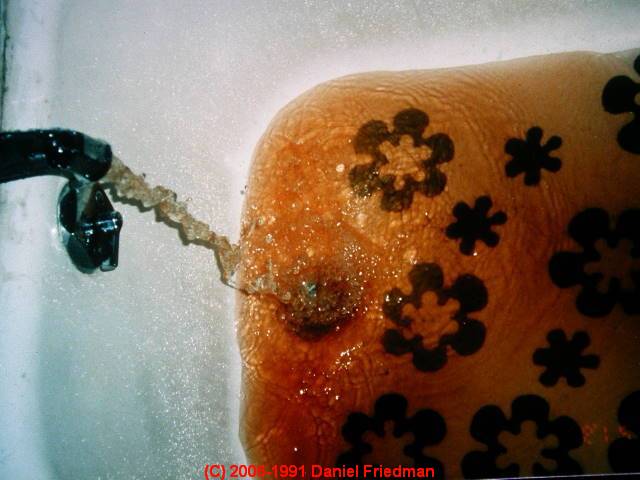
- See see RED STAINS from WATER SUPPLY where we discuss the effects of iron and iron loving bacteria in a water system. Look for orange slime as well as odors of cucumbers, sewage, or fuel oil in the water.
Diesel Fuel Odors in Water
- See WATER STAINING CONTAMINANTS where we discuss iron-loving bacteria in the water supply that are able to produce a fuel oil or diesel smell in water.
Methane Odors in Water
Methane from natural sources, from coal mining activities, and possibly from other mining or oil drillling activities can explain the presence of significant, even dangerous levels of methane in well water supplies.
- See METHANE GAS SOURCES - possible sources of methane gas in or around buildings? Methane gas (and methane gas production chemicals) in drinking water wells
Sewage Odors in Water
In addition to possible sewage contamination of a well from a nearby failed septic system,
- See HYDROGEN SULFIDE GAS
- See WATER STAINING CONTAMINANTS where we discuss iron-loving bacteria in the water supply. These bacteria can produce a "sewage" odor or even a "cucumber odor".
Sulphur Odors in Water
Some odors are a little more insidious and require a bit of background knowledge to deal with them effectively. If your source water runs through an area where naturally occurring sulfur is present, some sulfur may dissolve into the water. We provide a diagnostic procedure to track down the source of sulphur smells in water just below.
Some of this dissolved sulfur turns to the gas, hydrogen sulfide, and this can give the water a rotten egg type smelly odor.
Sulphur odors can also be caused by a failing hot water heater component, or by certain bacteria in the building plumbing system, conditions we also discuss below.
- See AIR DISCHARGE from HOT WATER - various causes of air discharge and smells at the hot water outlets
- See ANODES & DIP TUBES on WATER HEATERS - a failing water heater or water cylinder anode can produce hydrogen sulfide gas (sulphur smells) in the hot water cylinder and in the building water supply.
- See AIR DISCHARGE from HOT WATER - bubbles, air discharge or odors at hot watrer outlets may be a water heater anode problem, or something else.
- See WATER ODOR DIAGNOSIS - SULPHUR - How to get rid of or treat stinks, smells, rotten egg odor, sulphur odors in water. How to diagnose the cause of rotten egg sulphur odors in drinking water. What are other common odors in drinking water and what causes them? Health risks associated with some water odors? How to get rid of other odors in drinking water
- See SULPHUR & SEWER GAS SMELL SOURCES for detailed list of sewer and sulphur gas odor sources
- See HYDROGEN SULFIDE GAS for a discussion of both sources of sulphur-like smells and the hazards of this gas, including explosion and sewer gas hazards.
- See WATER STAINING CONTAMINANTS for an explanation of how iron and manganese bacteria in a water supply system piping or tanks or heaters and water tanks can produce odors including sewage-like smells.
- See WELL WATER CONTAMINANT SOURCES for an explanation of how sulphur smells in water can also occur in rivers, lakes, streams, ponds, and can be caused by anoxia and algae which in turn may be caused by high nitrogen from agricultural runoff - a condition we discuss
at
UV & Xenon Light Water Disinfection Equipment Odors
Question: petroleum smell in water after installing UV disinfection system
We installed a UV system in residential home. Water source is well water. The water now has a petroleum type odor - even after several days of running the water.
I did see 2 comments re : odor in the FAQ from Oct 2015 but there was no response as to possible cause. Those were from ships.
Can you advise? - Anonymous by private email, 2018/01/26
Reply: sources of petroleum smell in water do not include UV light itself
UV - ultraviolet light - disinfection would not itself be an odor source. It is simply a light bulb shining light on water to try to kill many species of bacteria that pass by.
If your well has a petroleum odor I suspect it's originating elsewhere - petroleum (heating oil, gasoline, motor oil) would not not be used in the operation nor installation of a UV light water treatment system.
A diagnostic step would be to collect a water sample upstream from the UV light system or right at the well. Have that tested for petroleum products/residues (as those are found in some well water sources).
Also see WATER STAINING CONTAMINANTS where you will see an explanation that iron-loving bacteria in the water supply are able to produce a fuel oil or diesel smell in water.
Note that a UV water disinfection system will not reduce the iron level in your water.
In contrast with U&V light disinfection, Xenon light disinfection has suffered from some ozone-odor complaints. But ozone would smell more like an "electrical" odor not petroleum.
Other Odors in Water
- See WELL WATER CONTAMINANT SOURCES - what are the common sources of water pollutants and contaminants?
Watch Out: Many serious problems (bacteria, heavy metals, nitrates, radon, and many chemicals) can only be found by laboratory testing of water.
Diagnostic Questions About Odors in Water
Reader Comments, Questions & Answers About The Article Above
Below you will find questions and answers previously posted on this page at its page bottom reader comment box.
Reader Q&A - also see RECOMMENDED ARTICLES & FAQs
On 2021-02-07 - by (mod) -
John that's strange indeed. I've installed and used UV lights without any such odor issue related to the light. I would give a call to the manufacturer to ask if they have any advice - and please do tell me what you're told.
By the way, while we want all the bacteria "dead" if there is a too-high level of bacterial contamination or if the water flow is too fast thorugh a UV light, treatment will not be effective, nor will a light remove any other contaminants that might be in water such as chemicals or other odor sources.
On 2021-02-07 by John A
After installing a ultraviolet light on my RO filtration system (after the filter). Our well water stinks like burnt rubber. When I turn off the power to the UV light the stink if gone. I can't even use the UV light. What a waste for us. I do want all the bacteria dead, but the smell is really strong
On 2019-12-11 - by (mod) -
Conc
Let's start by taking a look at the number in the triangle logo found usually on the bottom of your water bottles. What numnber is that? That will tell us the type of plastic used. Some plastics can impart a taste or odor to water.
Next let's look at the data: where where the bottles made. Some suppliers may be using variable plastics that sometimes smell; I've certainly found that to be the case when buying and using polyethylene sheeting.
On 2019-12-04 by Concerned mother of almost 5 (I'm pregnant)
My husband bought new water bottles that I cleaned extensively with hot soapy water. We just got connected to the community well, because our well went dry. I notice after water sat over night in the reusable water bottle that there was a strong rubbery and lemon peel like smell and taste in the water.
When using a glass cup the smell and taste were more faint coming from our filtered refrigerator. And slightly more noticeable I'm water coming from a 3 gallon filtered y tank contacted to our system, and most pronounced from the water faucet itself. What causes rubber and lemon peel smell and taste in your water?
On 2019-06-09 by (mod) - local sewer systems was overloaded with calcium salts f
Thank you for an interesting question. I've been doing some research but still need to find an authoritative source for an answer. I'll post you or what I find.
On 2019-06-04 by Jim G
The local sewer systems was overloaded with calcium salts from our water softeners so they made us change to potassium. My hot water began to smell because of the potassium salt reacting with the sacrificial anode.I removed the anode by cutting the sacrificial rod off the plug. is there an anode material that I can use which will not smell with the potassium salt in my water softener?
On 2018-08-02 by (mod) - after installed a UVA water disinfection filter noticed a chemical smell
Richard
Thank you for an important comment and concern. If the iron content in your water is more than 0.3 mg/L when the water hits the UV light the system will be in trouble.
It sounds as if the UV cannot handle the level of bacteria, combined with high iron content in the water;
If water is high in anything that obscures the light (UV systems use a light not a filter) such as sediment will prevent the light from being effective. On the successful installations I've inspected or installed the UV light was always placed last in the series of water treatment, filters, softeners, etc. for just this reason.
Perhaps installing an iron treatment/removal system upstream from the UV light will solve the problem.
Viqua and other sources note that high iron content in water is a problem for UV treatment - excerpt:
The ideal water quality for UV disinfection is:
Turbidity < 1ntu (turbidity units)
suspended solids < 10mg/l
colour – none
total iron < 0.3 mg/l
manganese < 0.05 mg/l
hardness <7 gpg (120 ppm)
On 2018-08-01 by Richard Puckett
I installed a UVA water disinfection filter and within 48 hours I noticed a chemical smell -- perhaps the "petroleum" smell others have reported. I note that elsewhere on this page "... iron-loving bacteria in the water supply are able to produce a fuel oil or diesel smell in water."
My well water is very hard and is rich in iron-loving bacteria. I speculate that the UVA light is interacting with the iron bacteria and that they are in the presence of the UVA exuding whatever chemical yields that smell.
On 2018-07-11 by chester
I was told by a person owning a drilling company if a person smells sulfur the drill hit a coal bed...
if the water smells like onions its cyanide that the drill hit..
I was told this years after going to Mexico and the water smelled of onions and I got sick by using ice in my drinks..
On 2018-02-18 - by (mod) -
Comc.,
Probably not, if the water colour was from iron in your water supply, and provided your child didn't drink the bathwater, but I really don't know. After all we don't know what was in your water.
Most likely it's a iron contaminant, but of course it could be something else.
If you can obtain a sample of your water supply particularly when it is colored but even if it is not, and take that to a water testing lab, you could have them screen for common harmful material such as bacteria and or contaminants found in the water supply in your area, as well as iron.
On 2018-02-18 y Concerned...
Was running a bath for my 3 year old while she was in the tub and suddenly the water started running bright yellow and had an odor... Is she going to be affectd any way?
On 2017-11-24 - by (mod) -
Ed
Before adding a water treatment system or even considering changing your well, it seems to me it would be a good move to have your well water tested to let you know what the conditions are.
Question: My client complains of a "certain smell" in her water but she can't identify it
I've got a client whose weekend home I inspected in 2005. They now have two young children and she's complaining about a "certain" smell in her water. She can't identify the smell.
Rotten eggs? No. Oily? No. Chemical? No.
But she smells it on herself and on her children after a bath or shower and says her skin fees dry after a shower.
Another twist. They've got two wells. They switch from one to the other when one gets dry. This home is in Ancramdale, NY 12503, Columbia County. Pretty rural. Lots of farming and sheep farming, I think.
The client wants me to test both wells. But I'm not confident that any generic water tests will do the job in this case.
I've looked at both of your articles:
and WATER SMELLS or ODORS, OTHER
I've looked at these two pages and I've got Smith Lab's price sheet in front of me and I think I'm in over my head.
I mean, this could cost them over $1,000 in lab fees alone for the two wells.
Any suggestions? - Arlene Puentes, ASHI
(Mar 16, 2015) Zyiah said:
My water smells funny
Reply: Starting Point for Chasing Down Unidentified Odors in the Water Supply
- Most home inspectors, even men and women who include water testing in their services, to not consider tests for unspecified odors in water as within their scope, and indeed ASHI and other inspection standards exclude these tricky environmental questions.
- But you can recommend that your client consult with at least two independent water treatment companies. In her area she can contact Hudson Valley Water Resources - Russ Chapman.
While it's our OPINION that water treatment companies indeed do want to sell water treatment equipment, still they won't make up things that are not there, and they will often agree to inspect a client's water treatment equipment and test her water at no fee. - Also, local water testing laboratories, folks who process a large volume of water samples from their neighborhood, often can tell you (or your client) whether or not they've had odor complaints from other homeowners in the same neighborhood.
- Your client might also check these other possibilities:
- A more comprehensive starting point for tracking down smells in household water begins
at ODORS IN WATER. - There could be odors coming from a source other than water. She should consult our odor track down approach beginning
at ODORS GASES SMELLS, DIAGNOSIS & CURE, where we consider all common sources of odors in buildings, including water and other systems. - Check the soaps, gels, shampoos, lotions in use because sometimes they may have a role in these complaints
Who smells the odors?
- Individual sense of smell varies widely. But if only one person observes an odor or other environmental complaint, some further investigation in an additional direction (besides the building and its neighborhood and its mechanical systems) could be helpful.
- Watch out: in some cases, particularly where there were health or aging concerns involved, sometimes these complaints are psychogenic in origin, or on occasion a person might have a health related problem that affects odors and skin sensations. Your client is not elderly, so aging-related health and odor complaints probably wouldn't apply.
But if she is the only person observing the odor complaint, it's worth an effort to sort out this question: - Is the individual observing these odors because s/he has a particularly sensitive sense of smell, or could there be an underlying health or neurological problem that has not been recognized.
If there is even the slightest possibility of the second alternative, the client ought to check with her primary care physician and with that doctor, decide if a referral to a suitable neurologist is in order.
Watch out: methane odors in a building water supply can be explosive (METHANE GAS SOURCES)
Scott Bradley, Aquacheck Water Testing Laboratory contributed content to this article.
On 2012-12-13 by Paul again
Problem: -- Bacteria - Rotten Egg Smell in your Hot Side of your Water Heater
When the bacterium enters a domestic water system it can find an ideal host environment of warm water temperatures (105-115°F), stagnant water areas (storage tanks and dead-end piping legs) and ample food sources (sediment, scale, deposits and biofilm). Under these conditions can rapidly colonize, forming higher concentrations that can pose the public health threat of Disease.
There are many methods of controlling colonization of bacteria. However, a widely accepted and preferred method is to maintain the hot water system storage temperature continually at or above 140°F. Unfortunately, the elevated temperature necessary to minimize the growth of and kill bacteria has the potential to cause serious thermal shock and scalding injuries . Solution: - Watts Thermostatic Mixing Valves maintain and limit the mixed hot water to a desirable, selectable temperature allowing for the storage of domestic hot water at the higher temperatures necessary to reduce the risk of growth in the system.
On 2012-12-13 by Paul
install a mixing valve on the output of your water heater, and turn up the water heater to 140 F and adjust the mixing valve output temp to 120 F, give it 1 week to kill the bugs in the water heater, and then you should be Done with the problem
On 2012-10-20 by Mike G
There are lead mines in this town, and a whole heard of Scotish Highlanders cows walking through the center where there is a major brook they walk through. a whole host of possible problems, and when its not raining the water runs slowly throughy the area causing a slow moving swamp enviroment
On 2012-08-24 by Heather Marsh
I smell this rotten egg smell in the bathroom downstairs when someone is taking a shower in the bathroom above. We have a septic system. What type of contractor do I contact to remedy this?
On 2012-08-24 by LABANI KUMAR ROHIDAS
It helped me a lot 2 prepare the note
On 2012-08-11 by Anonymous
Check for sulphur, bacteria, and consider one of the treatment methods discussed here
On 2012-08-11 by cheryl
what do I do if smell A rotten fishey smell in my tap water?
On 2012-07-01 by Heather
after installing a sink in the upstairs of the house with metal pipes, the water gives off an odd smell= possibly like old plastic and is stronger if the water hasnt been run for a day. All the other sinks/baths in the house do not have this problem. Im lost as to what it could be or how to go about fixing it
...
Continue reading at WATER ODOR DIAGNOSIS - SULPHUR or select a topic from the closely-related articles below, or see the complete ARTICLE INDEX.
Or see WATER ODOR FAQs - questions & answers about smells in water that were posted originally at this page.
Or see these
Recommended Articles
- WATER ODORS, CAUSE CURE - home
- ANODES & DIP TUBES on WATER HEATERS
- CHLORINE SOURCES in DRINKING WATER
- CHLORINATION WELL SHOCKING PROCEDURE
- WATER SOFTENER ADJUSTMENT & CONTROLS
- WATER SOFTENER CLEANING & SANITIZING
- WATER ODOR DIAGNOSIS - SULPHUR
- WATER ODOR TREATMENTS, CURES - SULPHUR
- WATER SMELLS or ODORS, OTHER
- WATER POLLUTANT SOURCES
- WATER STAINING CONTAMINANTS
- WATER POLLUTANT SOURCES
- WATER TESTS for CONTAMINANTS
Suggested citation for this web page
WATER ODORS, CAUSE CURE at InspectApedia.com - online encyclopedia of building & environmental inspection, testing, diagnosis, repair, & problem prevention advice.
Or see this
INDEX to RELATED ARTICLES: ARTICLE INDEX to BUILDING ODOR DIAGNOSIS & CURE
Or use the SEARCH BOX found below to Ask a Question or Search InspectApedia
Ask a Question or Search InspectApedia
Try the search box just below, or if you prefer, post a question or comment in the Comments box below and we will respond promptly.
Search the InspectApedia website
Note: appearance of your Comment below may be delayed: if your comment contains an image, photograph, web link, or text that looks to the software as if it might be a web link, your posting will appear after it has been approved by a moderator. Apologies for the delay.
Only one image can be added per comment but you can post as many comments, and therefore images, as you like.
You will not receive a notification when a response to your question has been posted.
Please bookmark this page to make it easy for you to check back for our response.
Our Comment Box is provided by Countable Web Productions countable.ca
Citations & References
In addition to any citations in the article above, a full list is available on request.
- Scott Bradley, author. Scott Bradley is Laboratory Director for Aquacheck Laboratory, Inc. PO Box 87 05151 1-800-263-9596. A more brief version of this article appeared in Aquacheck Laboratory's Water Wisdom Tips and Newsletter, Issue # 6, 2007. www.Aquacheck-VT.com offers other water supply tips in its Water Wisdom section. The laboratory also provides water test kits and offers a free newsletter.
- Thanks to Arlene Puentes for the photograph of a toilet tank with sulphur bacteria and debris showing as black goop. Arlene Puentes, a licensed home inspector, educator, and building failures researcher in Kingston, NY. Photographs © Arlene Puentes 2006 All Rights Reserved. Text © Daniel Friedman Arlene Puentes 2008 All Rights Reserved
- Arlene Puentes [Website: www.octoberhome.com ] , an ASHI member and a licensed home inspector in Kingston, NY, and has served on ASHI national committees as well as HVASHI Chapter President. Ms. Puentes can be contacted at ap@octoberhome.com
- Our recommended books about building & mechanical systems design, inspection, problem diagnosis, and repair, and about indoor environment and IAQ testing, diagnosis, and cleanup are at the InspectAPedia Bookstore. Also see our Book Reviews - InspectAPedia.
- Crystal Clear Supply provides portable ceramic water filter purifiers and portable reverse osmosis water treatment equipment - see http://www.crystalclearsupply.com/category_s/7.htm
- Handbook of Disinfectants and Antiseptics, Joseph M. Ascenzi (Editor), CRC, 1995, ISBN-10: 0824795245 ISBN-13: 978-0824795245 "The evaluation of chemical germicides predates the golden age of microbiology..." -
This well-focused, up-to-date reference details the current medical uses of antiseptics and disinfectants -- particularly in the control of hospital-acquired infections -- presenting methods for evaluating products to obtain regulatory approval and examining chemical, physical, and microbiological properties as well as the toxicology of the most widely used commercial chemicals. - Principles and Practice of Disinfection, Preservation and Sterilization (Hardcover)
by A. D. Russell (Editor), W. B. Hugo (Editor), G. A. J. Ayliffe (Editor), Blackwell Science, 2004. ISBN-10: 1405101997, ISBN-13: 978-1405101998.
"This superb book is the best of its kind available and one that will undoubtedly be useful, if not essential, to workers in a variety of industries. Thirty-one distinguished specialists deal comprehensively with the subject matter indicated by the title ... The book is produced with care, is very readable with useful selected references at the end of each chapter and an excellent index. It is an essential source book for everyone interested in this field. For pharmacy undergraduates, it will complement the excellent text on pharmaceutical microbiology by two of the present editors."
The Pharmaceutical Journal: "This is an excellent book. It deals comprehensively and authoritatively with its subject with contributions from 31 distinguished specialists. There is a great deal to interest all those involved in hospital infection ... This book is exceptionally well laid out. There are well chosen references for each chapter and an excellent index. It is highly recommended." The Journal of Hospital Infection.: "The editors and authors must be congratulated for this excellent treatise on nonantibiotic antimicrobial measures in hospitals and industry ... The publication is highly recommended to hospital and research personnel, especially to clinical microbiologists, infection-control and environmental-safety specialists, pharmacists, and dieticians."
New England Journal of Medicine: City Hospital, Birmingham, UK. Covers the many methods of the elimination or prevention of microbial growth. Provides an historical overview, descriptions of the types of antimicrobial agents, factors affecting efficacy, evaluation methods, and types of resistance. Features sterilization methods, and more. Previous edition: c1999. DNLM: Sterilization--methods. - In addition to citations & references found in this article, see the research citations given at the end of the related articles found at our suggested
CONTINUE READING or RECOMMENDED ARTICLES.
- Carson, Dunlop & Associates Ltd., 120 Carlton Street Suite 407, Toronto ON M5A 4K2. Tel: (416) 964-9415 1-800-268-7070 Email: info@carsondunlop.com. Alan Carson is a past president of ASHI, the American Society of Home Inspectors.
Thanks to Alan Carson and Bob Dunlop, for permission for InspectAPedia to use text excerpts from The HOME REFERENCE BOOK - the Encyclopedia of Homes and to use illustrations from The ILLUSTRATED HOME .
Carson Dunlop Associates provides extensive home inspection education and report writing material. In gratitude we provide links to tsome Carson Dunlop Associates products and services.
 | HOME | ABOUT | ASK a QUESTION | CONTACT | CONTENT USE POLICY | DESCRIPTION | POLICIES | PRIVACY | |
| © 2024 - 1985 Publisher InspectApedia.com - Daniel Friedman | |||||||||