
InspectAPedia® FREE Encyclopedia of Building & Environmental Construction, Diagnosis, Maintenance & Repair |
Question? Just ask us! InspectAPedia
|
 Water Pump Pressure Control Switch
Adjustment Nuts
Water Pump Pressure Control Switch
Adjustment Nuts
Directions to turn the large & small adjustment nuts
- POST a QUESTION or COMMENT about Setting the Water Pump Pressure Switch and Improving Water Pressure
How to adjust the pump pressure control switch using the Square-D Pumptrol™ as an example:
This article describes how to adjust building water pressure by setting the water pump cut-in and cut-out pressure on the well water pump pressure control switch. We explain which adjustment nuts to turn and in which direction to change pump cut-in pressure or cut-our pressure settings.
This article series also includes information on how to adjust building municipal or community water pressure at a building.
InspectAPedia tolerates no conflicts of interest. We have no relationship with advertisers, products, or services discussed at this website.
Water Well Pump Pressure Control Switch Adjustment: how to set the water pump cut-in and cut-out pressures
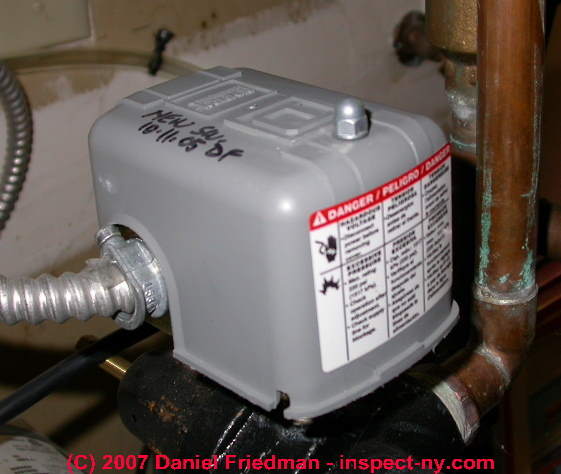
Here we are discussing setting the water pressures at which a water pump will turn on (to get more water) and off (to stop pumping water from the water source into the water tank).
Water pumps use a pressure control that specifies the pump cut-in (turn on) and cut-out (turn off) water pressures.
[Click to enlarge any image]
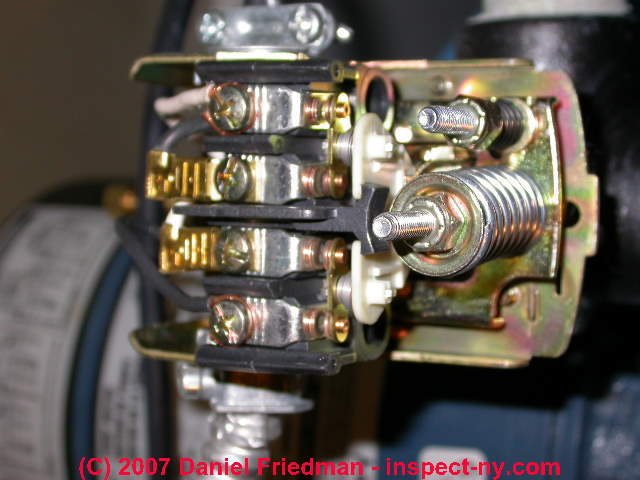
Watch out: SAFETY WARNING OF FATAL SHOCK HAZARD: if you remove the cover of the pump pressure control switch you can get access to the two nuts that adjust the operating pressures of the water pump.
But watch out! There are also live electrical contacts exposed in this area. If you touch them, especially being near water piping, there is a serious risk of death by electrocution.
Watch what you touch, or have a professional plumber or electrician do this job for you.
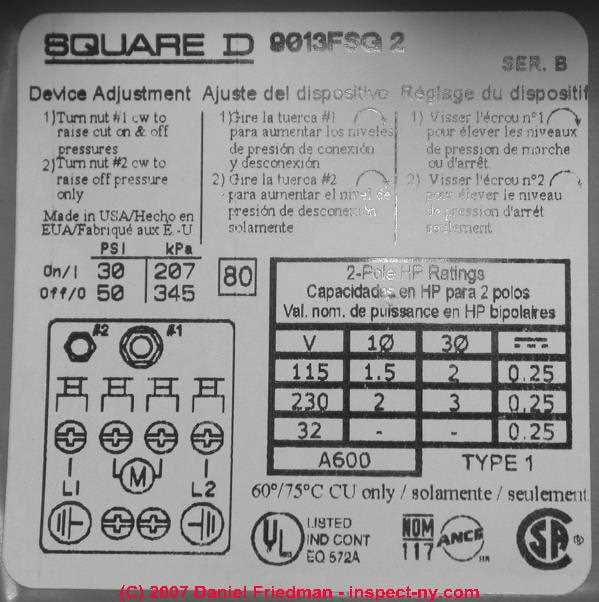
Watch out: Pump pressure control switch adjustments are summarized inside the cover of many pressure switches, as shown in our photo at left.
Which Way to Turn the Nuts on the Water Pressure Control Switch
Complete details of what these adjustment nuts do and which way to turn them are found in our separate, more-detailed article
at WATER PRESSURE CONTROL SWITCH ADJUSTMENTS
First Diagnose the Water Pump Problem Correctly Before Messing With the Pressure Switch Control Nut Settings
But before messing with the pressure control switch an accurate diagnosis of what's wrong might be useful.
If the water pump apparent "short cycle" is say 1-3 minutes this may be all your system can provide. If however something has changed, and the pump used to run longer, say 2-5 minutes, I suspect loss of air in the pressure tank or an internal problem in the tank (like a hole in the bladder if it's a "captive air" pressure tank).
The problem of lost air in the water pressure tank along with how to correct that condition are discussed
beginning
If the "short cycle" is very short, clicking on and off,
there could be a different problem with the pump control pressure switch or with a dirty, clogged water filter if one is installed on the system.
Dirty water filters as a source of rapid pump on-off cycling
are discussed
If you want to set up the cut-out pressure on your pump control, while leaving the "cut-in" down
where it is, you'll also get a longer "off" cycle, but if you set the cut-out pressure too high, the pump will just run forever since it can't reach that high pressure. This is easy to figure out since if you set it too high the pump will just keep running.
(Then turn it off electrically and set the cutout pressure a bit lower.) [This adjustment is only available on pressure control switches that have two adjustment nuts: Range and Differential]. Details are
at WATER PRESSURE CONTROL SWITCH ADJUSTMENTS
In sum, it might be possible to improve this condition by adjusting the pump control
which sets the cut-in water pressure (to start the water pump) and the cut-out water pressure (to stop the pump).
Usually this isn't going to help with pump short cycling but adjusting the water pump can give a longer on-cycle for the pump and it can increase the water system pressure up to a point.
If you ask the pump for more pressure than it can deliver it will simply keep running without ever reaching the cut-out pressure you've specified.
If your pump short-cycling behavior has recently gotten worse, don't try to fix it by adjusting the pump pressures, go on to look at other problems like loss of the air charge in the water tank or a defective or clogged pump control or water filter.
The article links below explain exactly how to set the water pump pressure switch, where the adjustments are located (the large and small nut found under the switch cover), which way to turn the nuts to increase or decrease the pump cut-in and cut-out pressures, and other pressure switch troubleshooting and repair procedures.
Which NUT the Pressure Control Switch Does What? Range & Differential Adjustment on a Water Pressure Control Switch
The (LARGER) RANGE Adjustment nut
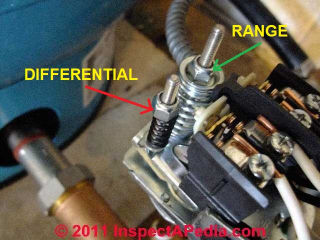
The larger nut (green arrow) on the larger spring in the pump pressure switch: changes cut-in AND cut-out simultaneously moving them both up (higher pressure) or down (lower pressure).
This is the range adjustment nut.
[Click to enlarge any image].
It has the practical effect of raising or lowering the operating pressure range of the switch. So if your switch was running at 20/40 (on at 20 psi off at 40 psi), and you tighten this nut 3 1/2 turns, you'll increase both numbers so that the switch will now operate at 30/50 (on at 30 psi and off at 50 psi).
Usually the larger nut in the pump pressure control switch (green arrow in our photo at left) adjusts the pump cut-on ("cut-in") AND pump cut-off pressures simultaneously. This is the left-hand spring (and nut) in our photo and is pointed-to by the green arrow.
That means that whatever the gap is between the cut-on pressure and the cut-off pressure, that gap is maintained, but the entire operating range of the pump is raised or lowered.
Turning the large nut clockwise RAISES BOTH the cut-on and cut-off pressures. So turning the large nut clockwise shifts the whole operating pressure range of the pump UP to HIGHER pressures.
Conversely, turning the large nut counter-clockwise will lower the whole pump operating range. This is the simplest adjustment to make.
Photo (above left) courtesy of a reader.
Help in identifying the range and differential nuts
- The range nut
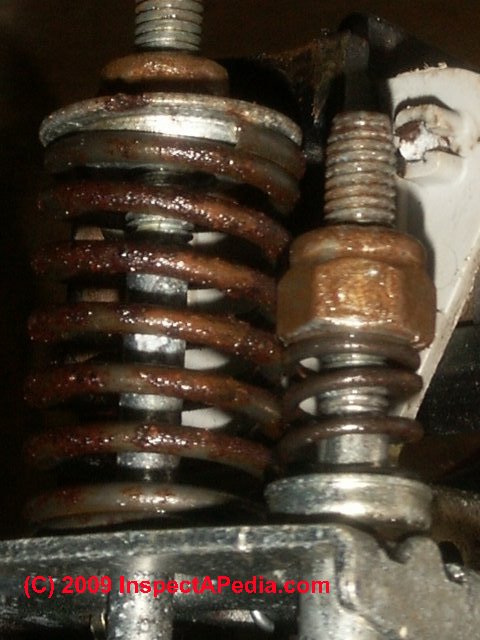
has a larger diameter spring - this shifts the whole operating pressure, CUT-IN / CUT-OU, up or down - The differential setting adjustment nut
is on the smaller diameter spring - this increases or decreases the difference between CUT-IN and CUT-OUT pressures - The differential setting nut is usually on a shorter spring - it will be "lower" or further down in the pressure control switch. You will see this in our photo above.
- Some pressure control switches have only the range adjustment nut and no differential nut.
- In modern pressure control switches both nuts are typically sized to be turned with a 3/8" nut driver or socket
Effect of Turns on the Larger Pressure Range Adjustment Nut
Here is an example of Range Nut Adjustment Settings & the Number of Turns Required, using the Square-D Pumptrol Class 9013F and G Pressure Switches as an example:
Pressure Switch Range Nut Adjustments: Range Changes vs Number of Turns of the Nut |
||
| Original Range Nut Pressure Setting Cut-in / Cut-Out Pressure in PSI |
Number of Range Nut Clockwise Turns |
New Range Nut Pressure Setting Cut-in / Cut-Out Pressure in PSI |
| 20 / 40 psi | 3 1/2 turns | 30 / 50 psi |
| 20 / 40 psi | 8 to 8 1/2 turns | 40 / 60 psi |
| 30 / 50 psi | 3 1/2 turns | 40 / 60 psi |
Notes to the table above
Adapted from : "Preventive Maintenance and Troubleshooting Guidelines for Class 9013F and 9013G Pressure Switches" (2007), Original source: Schneider Electric USA 8001 Knightdale Boulevard Knightdale, NC 27545 USA 1-888-SquareD (1-888-778-2733) www.us.SquareD.com
Schneider Electric offers technical assistance for their Pumptrol product line: Schneider Electric Pumptrol Product Line 8001 Knightdale Boulevard Knightdale, NC 27545-9023 e-mail: control.support@us.schneider-electric.com Telephone: 1-888-SquareD (1-888-778-2733)
Watch out: Electrical equipment should be serviced only by qualified electrical maintenance personnel.
No responsibility is assumed by Square D [ nor by InspectApedia.com ] for any consequences arising out of the use of this material. - Pumptrol Pressure Switch Installation & Wiring Instructions (2010), retrieved 1 April 2015, Schneider Electric USA 8001 Knightdale Blvd. Knightdale, NC 27545 1-888-SquareD (1-888-778-2733) www.us.SquareD.com
PUMP PRESSURE SWITCH STANDARD (PSI) SETTINGS contains instructions for restoring a typical pressure control switch to factory settings
Pump Pressure Switch Pumptrol™ Nut Adjustment Sequence
Watch out: Schneider Electric, the manufacturer of the Square-D Pumptrol pressure control switch warns that
when adjusting the pressure control settings it is important to make the adjustment in the proper sequence:
- adjust the RANGE nut FIRST,
- then adjust the DIFFERENTIAL nut SECOND.
- Pumptrol Pressure Switch Installation & Wiring Instructions (2010), retrieved 1 April 2015, Schneider Electric USA
8001 Knightdale Blvd.
Knightdale, NC 27545
1-888-SquareD
(1-888-778-2733)
www.us.SquareD.com
Example Pump Pressure Switch Adjustment Instructions from Square-D Pressure Control
Understanding how pump pressure control switches work and which way to turn which of the two nuts in the control can be confusing.
On a Square-D Pumptrol™ 9013FSF-2 pump pressure switch, for example, Square D tells us that we
- Turn the Large Range Nut #1
(green arrow at right in our photo, the larger spring and nut) clockwise (to the right or "down") to raise [both] cut-on and cut-off pressures. This is "tightening the nut down" against the spring. ("Rightie-tightie, leftie-loosie" as Mara Gieseke says to her kids). Thanks to reader Rise for this clarification.
In other words, adjusting the pressure on this spring shifts the whole operating range of the switch up or down, but keeps the difference between cut-in and cut-out the same, whatever it happens to be (typically it's about 20 psi from the factory.)
Which Way do I turn the Larger Range Nut on the Pressure Control Switch
- If you want the pump to turn ON (cut-in) sooner,
that is, at a higher water pressure, turn the nut clockwise or "tighter". This shifts the whole operating pressure range of the pump control (and thus the water pump) up to higher cut-in and cut-out pressures.
If you want the water pump to turn ON (cut-in) later,
that is, at a lower water pressure, turn the nut counterclockwise or "looser". This shifts the operating range to lower cut-in and cut-out pressures.
The gap between cut-in and cut-out pressures remains the same when you adjust the range nut. It is the smaller differential nut that can change that gap as we explain in this article.
Remember to adjust the larger RANGE nut first, then adjust the smaller DIFFERNTIAL nut.
Watch out: be sure to check the adjustment instructions for your particular pressure control switch and to follow the manufacturer's instructions. Shown below are the instructions for a Type 9013-series Square D Pumptrol. This particular switch was the Square-D Pumptrol 9013FSG ( for which a contact replacement kit is available: Catalog No. 9998PC241). The switch label instructions say:
- Turn Nut #1 CW (clockwise or "down" or tighter) to raise cut on & off pressures.
- Turn Nut #2 CW (clockwise or "down" or tighter) to raise off pressure only. - Op. Cit.
Reader Q&A on Adjusting the Pump Pressure Control Switch Range Nut
Question: Set the pump switch pressure Range: I'd like to get the cut-on at 60 and cut-off at 70.
I just rebuilt a Sta-Rite water pump (JBMG-41S)(2hp).
It had never been serviced and had alot of iron build-up. The shaft had seized. After cleaning it out and putting new seals, it was still able to run ok so I reinstalled it. Then it seemed there was a problem with the pressure switch
. I cleaned out the pipes connecting to it and cleaned the switch itself but I wasn't able to get to a setting that wasn't cycling too quickly. I then looked at the air pressure in the pressure tank.
This system is installed in an old 6 floor apartment building. The city supply is about 45psi I wanted to get a cut-on pressure of about 55psi and a cut-off at about 75. The pressure tank (Challenger pc266r - 85 gallon) turned out to be over-charged.
I'm not sure what the pressure was at but it was over 60psi. I let out the air until it got to around 51. Now, cut-on pressure was around 55 and the pump was staying on for around 10 minutes before it reached 70psi but even with the differential nut unscrewed all the way I couldn't get the pump to turn off at 75psi.
I finally unscrewed the main nut and the pump went off but now the cut-on pressure was slightly lower.
I'd like to get the cut-on at 60 and cut-off at 70.
Help appreciated. - Ben 4/9/12
Reply:
Ben, please take another look at the details in the article above about adjusting the pump pressure control switch. You'll see that the two adjustments (on switches that have two) do not operate independently, so changing one can require fine tuning the other.
The larger nut shifts the whole cut-in/cut-out pressure range up or down, while the smaller nut changes the width of that range - the differential between cut in and cut out.
On 2016-10-13 by Nick Square D pumptrol 20/40 has a problem
My Square D pumptrol 20/40 has a problem and I cant seem to figure it out.the cut in range wont go above 20psi but my cut out range is set for 60psi. Resulting in a noticeable change in water pressure when running water. What problem could I be experiencing?
Effect of Turning The (Smaller) Differential Adjustment Nut
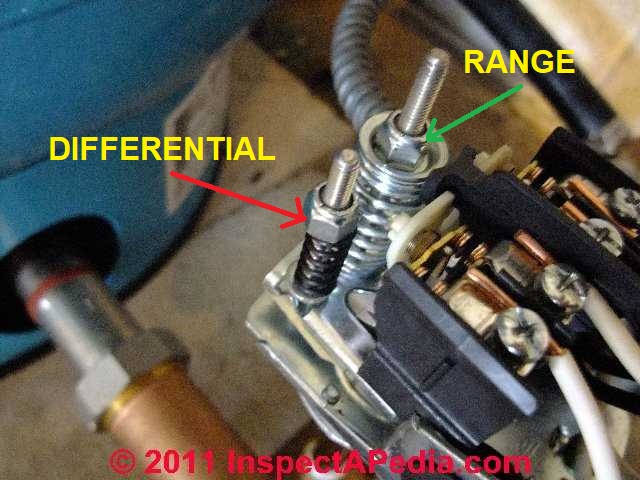 The smaller nut (red arrow) atop the smaller spring in the pump pressure switch: changes the differential between cut-in and cut-out pressure.
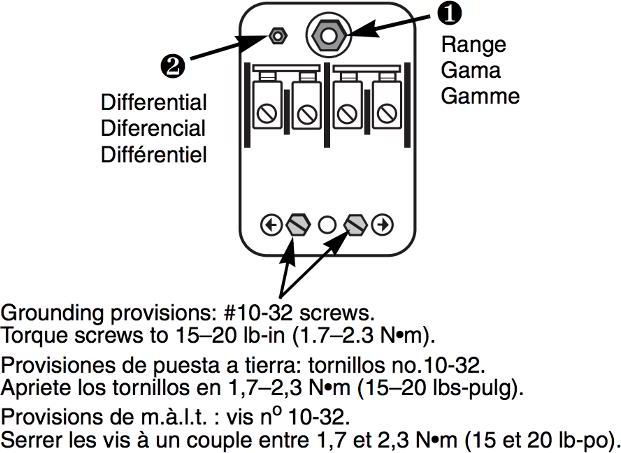
The the pressure differential adjustment nut (and spring) in our photos - and sketches is pointed to by the red arrow.
The differential adjustment nut has the practical effect of raising or lowering the cut OFF pressure only. This in effect, widens the gap or pressure differential between cut-in and cut-off pressures. Or as the manufacturer puts it:
Adjusting the differential changes the cut-out setting. The cut-in does not change. - Op. Cit.
Which nut to turn in the pump pressure switch control, and which direction to turn it, are usually visible on a label inside the pressure switch cover.
Above we show photos of a common Square D water pump pressure control switch (Schneider Electric)
and
below is an example of the label with pump control adjustment details.
Which Way do I turn the Smaller (Differential) Nut on the Pressure Control Switch?
 ...
... 
Watch out: we have found some other web articles whose authors are confused about this switch and who did not identify the Range Nut (the larger of the two) and the Differential adjustment nut (the smaller) correctly.
Here we follow the pressure control switch manufacturer's instructions and parts identification and adjustment procedures.
- Turn the Small Differential Nut #2 (red arrow in our photos & schematics above, the smaller spring and nut) clockwise to raise the cut-out pressure.
If you want the water pump to turn OFF (cut out or cut-off) at a higher water pressure, turn this nut clockwise or "tighter".
If you want the water pump to turn OFF (cut out or cut-off) at a lower water pressure, turn this nut counter clockwise or "looser"
Here is why the small nut is called the "Differential"
Adjusting the pressure on this spring shifts just the pump cut-out pressure up (clockwise) or down (counter-clockwise).
But as readers Don Travis has pointed out, it's a bit more complicated than this.
On at least some pressure control switch models, the small nut on the pressure control switch increases (turn down or tighten) or decreases (turn up or loosen) the differential between the cut-off and cut-on points on the switch.
In other words, If you leave the large nut alone and change the smaller one, you increase the gap between pump cut-in and pump cut-out pressures. A larger gap between cut-in (cut on pressure) and cut-out (cut off pressure) means you will run water longer in the building before the water pump is turned on.
Watch out: After adjusting nut#2 you may need to check the actual operating water pressures in your system and adjust nut#1 to be sure that you are not pushing the cut-out (upper pressure) so high that the water pump never turns off (dangerous).
Smaller (Differential) Nut on Pressure Switch Completely Loose

Photo above: a completely-loosened differential adjustment nut on a pressure control switch, courtesy of reader Moby.
Or in a contrary case if you completely loosen the smaller nut #2 (differential adjustment) - as we see in Moby's photo above, the pump differential between cut-in pressure and cut-out pressure is very small the water pump may short cycle on and off rapidly when water is being run in the building.
Especially if the well pump is a submersible (hidden and silent down inside the actual well) you may not realize that the pump motor is not shutting off.
Watch out: This can burst a pipe, burst a water tank, cause in-building leaks (especially at pressures over 70 psi), or burn up the well pump. You may be best to leave this adjustment screw alone.
In sum, the "Range" nut shifts the whole operating range of the pressure control up or down, but keeps the gap between cut-in and cut-out the same.
The "Differential" nut widens or narrows the gap between the cut-in and cut-out pressures.
But messing with the gap also shifts the operating pressure of the control so you may have to re-visit the range - or leave this nut alone.
Watch out: also, as the manufacturer (Schneider Electric for Square D Pumptrol wiring connections) warns:
Electrical equipment
should be serviced only
by qualified electrical
maintenance personnel.
No responsibility is assumed by Square D [ nor by InspectApedia.com ] for any consequences arising out of the use of this material. - Pumptrol Pressure Switch Installation & Wiring Instructions (2010), retrieved 1 April 2015, Schneider Electric USA 8001 Knightdale Blvd. Knightdale, NC 27545 1-888-SquareD (1-888-778-2733) www.us.SquareD.com
What if my Pressure Control Switch has Only One Adjustment Nut?
Yes. Some pump pressure control switches such as Schneider Electric's Square D Pumptrol™ Types FTG and FHG have only a range adjustment nut.
There is no differential adjustment.
Just follow the adjustment instructions for the large Nut 1 marked in green and described as RANGE nut in the article above.
How to increase the well pump cut-in pressure without setting the cut-out pressure too high
Reader asked: We have a well and have been experiencing intermittent low water pressure.
I checked the pump and it cuts in at 25 PSI and cuts off at 65 PSI. But the diagram on the inside of the pump switch cover indicates that it should be cutting in at 40 PSI and out at 60 PSI. It has a maximum PSI of 80.
How do I get the well pump to cut in at 40 PSI instead of 25 PSI? I believe this would give us adequate water pressure at all times.
According to the information on your website adjusting the mainspring will change both the cut in and cut off pressures and adjusting the differential will adjust only the cut off pressure. Apparently, there is no way to adjust only the cut in pressure? Thanks for your help. - L.W.
Reply: Here is how to change the cut-in pressure without pushing the cut-out pressure too high
A competent onsite inspection by an expert usually finds additional clues that help accurately diagnose a water pressure or pump problem.
And your cause of inadequate water pressure might be due to more than just the static pressure capability of the pump. For example, the pump's maximum flow rate in gpm could be inadequate, or you could have a partly closed water valve or clogged water pipe. Put another way, many homes that operate between 30 and 50 psi have very good water pressure and flow rate at the fixtures.
So if you don't there may be another problem besides the pressure switch settings.
That said, here are some things to consider:
Most pump pressure controls are tricky to adjust in the way you mentioned, but you should be able to set the cut-in to a higher number and then adjust the cut-in - cut-out pressure differential to keep the cut-out pressure from being too high. That will cause your well pump to turn sooner when you start running water (and will cycle it more often, a factor in pump wear).
At PUMP PRESSURE CONTROL ADJUSTMENT we explain that the smaller nut on the pump control switch adjusts the differential or gap between cut in and cut out and the larger nut raises the cut-in pressure (as well as cut off).
In other words you can set the cut in pressure higher and then narrow the differential so that the cut-off pressure is not dangerously high or above what the pump can reach.
Watch out: don't run the water pressure control with too narrow a differential between the cut-in and cut-out or the pump may just sit there short-cycling until you burn up the motor. If your pump is staying on for less than 30 seconds (I prefer longer), you may be heading for trouble.
Watch out: setting the cut-out water pressure too high can cause the pump to never turn off or at high pressures you may find leaks at fixtures. And high water pressure that exceeds the rated water tank pressure can burst the tank - a very dangerous event. Also make sure your pressure tank has a relief valve installed.
Finally, I suspect that after you have increased the pump cut-in or cut-on pressure to a higher number, say 30 psi, if you will find that this does not fix your water pressure problem.
The fact that your low water pressure is intermittent might in fact point to a problem with the well flow rate itself.
See WELL YIELD DEFINITION.
Once the well pump turns on and presuming you are running water continuously, especially if more than one fixture is running, you may see that your pump runs continuously until you turn the water off. If this is the case, it's not the starting water pressure setting that is at fault, it's the pump or piping or well that is limiting the water flow rate.
If I'm right that means that the water flow rate through the system, from well through pump and pipes, elbows, valves, etc. is just not enough, and further diagnosis is in order.
Follow-up and Water Pressure Problem Solved:
Looks like I will call a plumber. I adjusted the mainspring to raise the cut-in/cut-out range but there was no change.
The water pump switch was faulty and had to be replaced. Also the line going into the water tank was clogged and had to be rodded out. Working fine now.
The homeowner attempted to adjust the pressure control switch for the water pump. When he turned the adjusting nut the water pump behavior and water pressure did not change. That observation led to calling a plumber who replaced the pressure control switch - which solved the water pressure problem.
Reader Comments, Questions & Answers About The Article Above
Below you will find questions and answers previously posted on this page at its page bottom reader comment box.
Reader Q&A - also see RECOMMENDED ARTICLES & FAQs
How to increase the water pump pressure control cut-in and cut-out pressure
Question: I have a square d control. It cuts off at 40 psi and goes down to 20 psi before it comes back on which is to low when I am using one sprinkler
I want it to come on at 30 psi. I can't understand how to do that looking your directions. Pls help - John 5/19/11
Reply:
How to increase the water pump pressure control cut-in and cut-out pressure:
Take a look again at the instructions above that indicate which nut to turn in which direction to increase the well pump cut-in pressure (that's your 20 psi number) and cut-out pressure (that's your 40 psi number).
You should be able to raise the cut-in pressure to 30 psi and you will probably want to raise the cut out pressure to 50 psi, provided that your pump can actually reach that number. If the pump keeps running forever even AFTER you have turned off the water, then it is not capable of reaching 50 psi and you'll have to lower that setting to avoid burning up the water pump.
If the instructions are still too complicated to follow then you would be best off asking a plumber to change the settings for you. Just be sure the person you hire is familiar with well pump pressure control switches.
Question: I'd like to get the cut-on at 60 and cut-off at 70.
I just rebuilt a Sta-Rite water pump (JBMG-41S)(2hp).
It had never been serviced and had alot of iron build-up. The shaft had seized. After cleaning it out and putting new seals, it was still able to run ok so I reinstalled it. Then it seemed there was a problem with the pressure switch
. I cleaned out the pipes connecting to it and cleaned the switch itself but I wasn't able to get to a setting that wasn't cycling too quickly. I then looked at the air pressure in the pressure tank.
This system is installed in an old 6 floor apartment building. The city supply is about 45psi I wanted to get a cut-on pressure of about 55psi and a cut-off at about 75. The pressure tank (Challenger pc266r - 85 gallon) turned out to be over-charged.
I'm not sure what the pressure was at but it was over 60psi. I let out the air until it got to around 51. Now, cut-on pressure was around 55 and the pump was staying on for around 10 minutes before it reached 70psi but even with the differential nut unscrewed all the way I couldn't get the pump to turn off at 75psi.
I finally unscrewed the main nut and the pump went off but now the cut-on pressure was slightly lower.
I'd like to get the cut-on at 60 and cut-off at 70.
Help appreciated. - Ben 4/9/12
Reply:
Ben, please take another look at the details in the article above about adjusting the pump pressure control switch. You'll see that the two adjustments (on switches that have two) do not operate independently, so changing one can require fine tuning the other.
The larger nut shifts the whole cut-in/cut-out pressure range up or down, while the smaller nut changes the width of that range - the differential between cut in and cut out.
Question: Square D pressure switch set 30-50, can I eliminate the low pressure cut-in?
I Have suare D switch 30-50 lb. with low pressure shut off. It causes me a lot of trouble when I fill large livestock tanks,can I modify the switch to eliminate the low pressure shut off feature or must i replace the switch. thanks - Mike Jones 8/22/11
Reply:
Mike,
I'm not sure what trouble you're having with the pressure control switch, and that those details might be diagnostic.
If the pump is short cycling that's usually a pressure tank problem not a switch problem.
If the switch is burning up while staying "on" you might need to go to a two-switch system in which the Square-D switch switches on a heavy duty relay that turns on and off the pump.
On 2021-02-07 - by (mod) -
Sediment in the tank won't change building water pressure - that's created by the pump; but sediment in the tank may be a clue to other sediment clogs throughout the plumbing system.
On 2021-02-07 by WelcomedRain
Oof... Thanks... Since I draining the tank (when testing the air pressure in the tank, cut-in/cut-out pressure, etc.), the flow has definitely decreased. I'm thinking maybe tank sediment is to blame but could just be an exasperation of the flow issue that started the investigation. Thanks again.
On 2021-02-06 - by (mod) -
Normal people would call that weak water pressure but in fact since your pump is able to pump up to 62 PSI It's actually a flow problem. If the problem is the same for both hot and cold then there may be clogs in the cold supply to the building. If a hot water is significantly weaker than cold and we expect mineral scale to be the problem
On 2021-02-06 by WelcomedRain
Thanks very much. That is helpful. Since the general flow is weak at all fixtures, it seems not to be valve-fixture specific unless the prior owner reduced them all (I'll check that next).
Mostly, when I flush the toilet or have water running anywhere in the house, the other fixtures have especially weak flow. Thanks again.
On 2021-02-06 - by (mod) -
Welcomed
You can leave the pressure switch where it is if that works ok for you, but then you'd set the tank air pre-charge to 38 psi.
The procedure is at WATER TANK AIR, HOW TO ADD
It's causing a pump to cycle on and off rapidly that is most wearing; as long as the pump has no trouble reaching the cut-off pressure then it's ok to use the higher pressure setting.
But let's don't mix pressure and flow; if the actual flow rate at fixtures is weak then it could be that there are clogs in the piping system or a valve partly closed, or the well flow rate could be limited.
On 2021-02-06 by WelcomedRain
I purchased my home in May and it has low water pressure. The well's tank air pressure is currently 28psi.
Pump controls say the switch should be set to 30psi cut-in / 50psi cut-out (pump 3/4 hp); but the actual cut-in is set to 40psi and cut-out at 62psi.
To address the low pressure, should I reduce the settings back to the 30/50psi or increase the tank pressure to 38psi?
Would the differential (28psi tank pressure vs cut in psi set to 40) cause low water pressure? Will the switch settings being increased by 10psi (cut-in and cut-out) eventually cause an issue with the pump's or the tank's longevity? Thanks!
On 2021-01-27 - by (mod) -
That makes me suspect debris clogging of the pressure control switch or the tube that feeds water pressure to its sensor. Replace the switch and clean the tub or pipe.
On 2021-01-27 by cdl
Our residential well is possibly 700' deep. Pump control relay set 40/60. Usually works fine.
Problem: Pressure gauge sometimes continues slow rise after pump relay cuts out at 60psi. Over the course of three minutes after cutoff (verified by looking at relay contacts),
water pressure reading rises to 85 psi, and is correspondingly very high at faucets. Air valve at Welltrol pressure tank reads 87 psi air pressure.
Possible Cause : static head pressure from standing column after rain? Other causes? Fixes?
On 2020-11-02 - by (mod) - When I smacked the switch it would turn off however.
Kathy,
Usually when a pump will not turn off and cannot reach the cut-off pressure set on the pressure control switch the problem is not the switch but rather that the pump and water supply are not able to deliver that pressure. That's particularly true if you're cut off pressure is at a normal level of a say 40 or 50 psi.
Your comment "When I smacked the switch it would turn off however." suggests that the pressure control could be debris clogged. You should have that control replaced.
I am only able to speculate as I'm not on the scene possible that you are what are you straight exceeded the wills flow rate so the pump in fact simply couldn't get enough water to send into the pressure tank to reach the cut-off pressure. When you then leave the pump off for a time that gives your well a chance to recover and that in turn might allow the pump to operate normally.
So why don't you do an experiment letting the pump system rest for several hours or longer when it's misbehaving.
Then turn it back on to reach a cut off pressure I suspect the problem is in your well and the well flow rate and it would just be a waste of ex's time and energy to change switch.
On 2020-11-02 by Kathy
Just replaced a 30/50 switch because the 1 hp jet pump could not get above 37 and would not turn off. The pump, tank and pipe with foot valve are 1 year old. No problems until a few days ago, would not shut off. I was manually turning the pump on and off at the breaker. I am a senior lady living alone.
When I smacked the switch it would turn off however. Then the next day, it made it to 50 and turned off by itself. Yay! Fixed? No, a few hours later stuck at 37. My ex installed a new switch yesterday.
Adjusted the tank by a couple pounds (to 28) and it came on at 30 and off at 50. Only once though.
Now it is back to 30/37. No leaks, pressure stable unless using water. Ex wants to install a 20/40 switch. I don’t understand what this could be?
One day it pumps up to 50 and then only 37 with no stopping. This new switch doesn’t turn off when I try and flip the contacts either. I have to use the breaker to turn it off. Help!
On 2020-09-25 - by (mod) -
Francis
You can change the pressure control switch adjustments eze explained in the article above on this page.
Please take a look and let me know if that leaves you with any questions.
On 2020-09-24 by Francis
How do you increase the pressure on a well pump
On 2020-09-25 - by (mod) -
Francis
You can change the pressure control switch adjustments explained in WATER PRESSURE CONTROL SWITCH ADJUSTMENTS
Please take a look and let me know if that leaves you with any questions.
On 2020-09-24 by Francis
How do you increase the pressure on a well pump
On 2020-07-12 by (mod)
Robert: a water pressure gauge installed literally anywhere on the water supply system will tell you the water pressure. Note that the pressure reading will vary but will be at its maximum when you are not running water and when the water pump has just turned itself off. Usually we install such a gauge right at the water tank.
See details at WATER PRESSURE GAUGE
On 2020-08-14 by Robert v joy
How do I know what the pressure is set at
On 2020-07-12 - by (mod) -
Yes, Dick,
That's exactly right. Set the pressure, then, to 2 psi below the pump control CUT IN pressure.
On 2020-07-12 by dick
i emtied my galvenized presser tank. before i refill it , do i pressure it first?
On 2020-05-28 - by (mod) -
Thank you for the question, Cythia.
Please see the diagnosis and repair suggestions found at
SHORT CYCLING WATER PUMP
and then don't hesitate to ask follow-up questions.
On 2020-05-28 by Cynthia monroe
Y does my above ground household jet pump keep short cycling. I just replaced pressure switch. No leaks.
On 2020-05-02 - by (mod) -
Rich
We need to try to diagnose what's wrong before proposing a fix. I don't know whether the problem is with your poop is damaged and can't reach higher pressure or there's a leak in well piping or the will flow rate since they can't accommodate the pump.
In the ARTICLE INDEX you'd find these two articles that will help you diagnose and fix a pressure switch that can't reach the cut-off pressure that you have set to 50 psi.
- WATER PRESSURE TABLE 2: PUMP RUNS, WEAK or NO WATER PRESSURE
- WATER PRESSURE TABLE 3: PUMP RUNS, NO WATER or INSUFFICIENT WATER
Take a look at those diagnostics for a pump that cannot reach the cut-off pressure. Tell me what you think and continue to post questions or progress and we will take it from there.
On 2020-05-02 by Rich
Have a new square d well pressure switch 40/60 and and a sta rite snd 3/4 hp pump. Cannot get pressure over 50 lbs cutoff and cut in at 35. Moved the big but two turns clockwise and pump won't shut off untill I turn big nut back two turns. Replaced foot valve two years ago and that's when my pressure drop to 50 lbs. Gauge holds steady so I don't think I have a leak. How can I get more pressure?
On 2020-01-06 - by (mod) -
Anon
You wouldn't use a "Reducing valve" at the pump; normally the water pressure boosting pump either has an adjustable output pressure right at the pump or if it's a conventional pump and pressure tank the pump pressure control switch sets the pressure range by turning the pump on and off appropriately.
On 2020-01-06 by Anonymous
The water pressure in our house is weak, I need an extra pressure Im thinking of buying a pump, but another problem is too high pressure. Can i connect a reducing valve to the pump? Is there an effect int the pump?
On 2020-01-06 by Leah
Water pressure reducing valve can be connected to a water pump? Can it damaged the pump?
On 2018-12-18 by Greg
Weird issue, water pressure was fairly constant in house until 5-6 days ago, then sudden drop off.
Had someone out to repair and said the galvanized line to the pressure switch was clogged and was replaced. Water is back to normal except in the morning when pressure is again low and we used to be able to shower and run the laundry machine at the same time but now the shower pressure is too low when the washer is running.
Also seems to be low after no water usage overnight but then improves after we start using it. Any tips or advice?
On 2018-11-01 - by (mod) -
Why the water pump doesn't cut off?Madhu
The diagnostic and repair suggestions at WATER PUMP WONT STOP RUNNING will answer your question most-usefully.
On 2018-11-01 by Madhu
Why the pump doesn't cut off?
On 2018-10-15 - by (mod) -
Perhaps clogged pipes or shower heads
On 2018-10-15 by Dave Rai
I have a well water at my home. The pressure in the tank reads 50 when pump cuts out and 30 when starts. It seems to work fine. But there is very low pressure in my showers in both bathrooms. What is the problem?
Question: Genesis pressure control switch pressure adjustment
I've got a switch that seems to have been made by Genesis (but no maker data, no part number, etc.; that's just the name on the cover box) of my Panamanian pressurized residential system.
Turn-on was around 19psi by the gauge, off at 45 (which drifts down to 41.5 during the first minute after the pump shuts off, then stays stable).
I tried both adjustment nuts, separately, and while a half-turn clockwise will get the left-hand nut (the big Range one) took the cutoff to 49psi, nothing seems to move the turn-on pressure up.
I'd like to be able to bring that up to about 25psi, because much below this the boiler (pass-thru, 7 liter tank inside) won't kick on and stay on.
Was a half to a full turn just not enough to get that switch's attention? It's only a two year old switch. - notonyourtintype - 7/19/11
Reply:
Noton... I'd like to see some sharp photos of y our switch - you can send pix to the CONTACT link found at the left or bottom of our website pages.
The operating pressure range you describe is common: roughly on at 20 off at 40 psi.
The gauge behavior you describe could be due to a partial blockage of the gauge mounting pipe or gauge bottom with debris, slowing down the passage of pressurized water into and out of the gauge bottom.
Try tapping the gauge too - remember these water pressure gauges are not precise.
Most water pressure gauges work about the same way - if yours looks like the examples I show above, you should be able to review and follow the pressure gauge adjustment procedures found above on this page.
Turning the nut just a half turn, depending on which nut, may not have registered, or it may take some tapping or a few pump cycles for you to see the effect.
On 2022-05-05 by Inspectapedia Com Moderator - pump cuts out but won't cut in again
@Ed,
That actually sounds to me like a corroded or damaged pressure control switch. Have you tried replacing it?
On 2022-05-05 by Ed
My pump runs and cots out okay but will then not cut in again. If you unplug the pump then open the cover and press the contacts together then reconnect it to the electricity then pum runs until it cuts out but doesn't cut in again.
what does this mean?
On 2022-03-01 by Inspectapedia Com Moderator
@Christopher Beitel,
You may have set the pressure CUT OUT to a higher level than the pump can achieve.
You should try restoring the factory settings.
WATER PUMP PUMP PRESSURE SWITCH STANDARD (PSI) SETTINGS
Also see
WATER PUMP WONT STOP RUNNING
On 2022-02-28 by Christopher Beitel
I raised my well pumps water pressure but now the pump won’t shut off. Help.
On 2021-10-31 by inspectapedia.com.moderator - how to restore pressure control switch to factory settings
@philip hannem,
Go to
PUMP PRESSURE SWITCH STANDARD (PSI) SETTINGS - contains instructions for restoring a typical pressure control switch to factory settings
On 2021-10-30 by philip hannem
thanks for your answer, but the factory setting is 40-60, but I am unable to achieve this. Can either get 20-50, or 30-60, cause the gap won't change with the differential nut setting.
On 2021-10-30 by inspectapedia.com.moderator
@philip hannem,
It probably means that at least one of the two adjustment nuts on the pressure control switch has been loosened or tightened so far that the other nut has no effect on the switch behaviour. I'd return the switch to factory settings and start over.
On 2021-10-30 by philip hannem
what does it mean if the differential nut does not raise or lower the high presure cut off and the gap stays the same?
In my case I noticed decreased presure in the shower, and saw that the difference between the two readings was about thirty instead of twenty, so I attempted to turn the small nut to the left to bring the gap near 20, and then was going to raise the over all preasure with the big nut if it still was not adaquate, but the small nut does not change the cut out preasure no matter how far I turn it.
The big nut, however, does do exactly what it is supposed to, raises both at the same time. This however did not solve my problem. I checked and adjusted the preasure tank preasure, and nothing has changed.
On 2021-10-13 by inspectapedia.com.moderator
@GERALD,
The article above explains how to make pressure control switch adjustments more completely and accurately than if I try to make it up again here.
However I advise you not to try to set your pump to the numbers that you give as having such a small difference between cut in and cut out means with your pump will short-cycle so rapidly that you may burn up the pump motor.
Is it possible for you to install a larger water pressure tank? That would help the problem that you describe.
On 2021-10-13 by GERALD
My pump is set at 20-40 cut-in/cut-off and it is only a 24 liter tank. (I am in the mountains of Panama) Because of this the pressure at the shower is up and down and not consistent. And with a point of use heater, the temperature is not consistent.
How to I adjust the range to 28-40?
On 2021-10-04 by inspectapedia.com.moderator
@hank,
Please review the possible sources and solutions (and the related links included) to poor water pressure found here:
DIAGNOSE AND REPAIR POOR WATER PRESSURE
On 2021-10-04 by hank
I tried resetting the pressure switch and still low pressure in the house. What do i do.
On 2021-07-17 by inspectapedia.com.moderator (mod) - steps for checking why new pressure switch doesn't work
@Frank McDaniel,
If you know how to do safe electrical work (else you can be shocked or killed)
- check for power delivered to the control
- check that the control is wired according to the manufacturer's instructions
- check that system pressure has been relieved (run water) until the pressure gauge shows you at or below the pressure control CUT-IN pressure
On 2021-07-17 by Frank McDaniel
I put a new one on and it's not working
On 2021-06-05 by mak.church (mod) - how to change pressure control switch for private or municipal water supply
@John Opoku Agyemang,
You are on a page discussing adjusting water pump pressure by changing the settings on the pressure control switch - IF your water supply is by pump and well-water OR if your building uses a pressure booster pump controlled by a switch like the ones shown above, then you're in the right place. Read the above and if it's unclear, please let us know.
BUT
If your water is supplied by a municipal or community supply, that is, not by private well or pressure pump, then you will want to read
WATER PRESSURE REGULATOR ADJUSTMENT
On 2021-06-05 John Opoku Agyemang
Please, if you the pressure is 6 bar and you want to reduce to 3 bar what can i do to get 3 bar?
On 2021-02-15 - by (mod) -
No AlLoosening the range nut brings the pressure control switch operating range down to lower pressures (see the table above on this page).
To bring the pressure RANGE UP you would tighten the range nut - that lifts both cut-in and cut-out to a higher pressure.
On 2021-02-15 by Alasdair
If I wanted to have my pump cut in at a higher pressure and cut off and the current pressure, I assume that I would 1) loosen the small range nut to bring down the range and then 2) tighten the large nut to bring the cut off to the current pressure?
On 2020-09-30 - by (mod) - what voltage should I see at the pump pressure switch contacts?
Pat:Some submersible pumps run on higher voltage powered by a separate control relay. The pressure control switch turns the relay on and off, and the relay operates the pump.
Obviously I don't know what you've got installed. Is there a second relay box?
Watch out: if you're not experienced with electrical testing you could be shocked or killed - take care.
The air bleeding procedure you describe could mean that the pump itself is air bound or has low water in the well or that there is a snifter valve assembly that's not working properly on your well.
Take a look at SNIFTER VALVES in the ARTICLE INDEX.
On 2020-09-30 by Pat
As of yesterday after I turned off irrigation that the well would run-on, not pressurizing the pressure tank to 60psi and then cutting out.
I have a 250' deep well, I do not know which brand pump is below, it is a 3 wire 240vac type pump though.
When I have the AC breaker closed for the well, and take power readings within the well pump controller, the primary voltage coming from the pressure switch is 248vac, however, when I take a voltage reading at Red & Black of the well pump motor, the voltage is 320vac?!
At this point, I have made sure there are no house side leaks.
Each time I restore power to the well, I have to depress the Schrader valve (on the check valve on the pump inlet side of the check valve) until air ceases and water begins squirting.
When I have the AC breaker opened (no power to well) and place my ear to the 1.25" pipe coming up from the well head, I hear a hiss, and likewise during this scenario, the pressure at the pressure tank slowly drops down ... would this be the check valve just up=line from the point I am listening to the pipe?
Thank you
Comment: clarifying the differential nut adjustment range
7 March 2015 Andy said:
Near the top of this article, it says: 'Watch out! If you loosen this nut too much you can set the cut-off pressure below the cut-on pressure and the pump will turn on and run forever (or until it burns up.)'
This doesn't make sense. If you back the differential nut off 'too much', all that means is that the differential will be at its minimum which might cause short cycling. Shortcycling at the well pump is of course damaging too, but the pump can't fail to shut off if the main spring is set anywhere near the standard and all other things are normal. What am I not getting here?
Reply:
Thank you Andy, you're right and we deleted the confusing text. We appreciate your careful eye and can use all the editing help we can get.
After adjusting nut #2, the smaller nut that in most of these controls adjusts the differential between cut-in and cut-out we kept this warning
Watch out: After adjusting nut #2 you may need to check the actual operating water pressures in your system and adjust nut #1 to be sure that you are not pushing the cut-out (upper pressure) so high that the water pump never turns off (dangerous).
As your comment points out, an additional caveat could be added: don't set the differential between cut-in and cut-out too close or the pump will short-cycle.
A different error would be to set the Nut #1, the larger adjustment, cut-out pressure too high. That's a common mistake that some folks make in trying to get the highest water pressure possible in their building. The result could indeed be a pump that never shuts off and that burns up.
On 2020-09-21 - by (mod) - how to get the pressure switch back to factory settings
John
You may need to return the switch to original factory settings as, speaking from experience, it's easy to turn the large or small adjustment nuts until you lose track of where you started and the switch will not work properly.
At PUMP PRESSURE CONTROL ADJUSTMENT we explain that
the smaller nut on the pump control switch adjusts the differential or gap between cut in and cut out
and
the larger nut raises the cut-in pressure (as well as cut off).
The 25/55 settings you seek might be outside the range adjusted by the smaller nut. But you can try adjusting the switch as follows.
I would try going back to the original settings given in a table above on this page.
If that takes you to a 20/40 psi range then you can turn the larger "range nut" about 1 1/2 turns clockwise to make the new operating range 25/45 CUT-IN/CUT-OUT psi.
Watch out: Take care that if you set the CUT OUT higher than your pump and well can deliver then the pump will not shut off (and you'll burn it up)
Next you can adjust the smaller "Differential" nut CLOCKWISE (Tighter) to cause the pump to turn OFF at a higher pressure. So tightening the small nut (NOT loosening it) should raise the CUT-OFF pressure - you might get that up to 55 psi.
On 2020-09-21 by John
We have a Square D pressure switch on our well pump. Cut in is 25 PSI. and cut off is 55 PSI. At this time, the nut on the small spring backed all the way off. Cut in @ 30 PSI is ideal, but I do not want to raise the Cut off PSI anymore which is what happens when I turn down the big spring. Any thoughts?
Thank you.
On 2020-01-09 by (mod) - Don't feel bad about having fouled up your pressure control switch
Mike,
Don't feel bad about having fouled up your pressure control switch and having trouble getting back to the original factory settings. It's a problem that most of us who have worked on any volume of equipment have encountered at one time or another, including me.
Take a look in the article above and below this article subheading
Effect of Nut Turns on Range Adjustment
You will find a table that gives the typical original or factory settings or number of turns on the adjustment screws so that should help you out. Let me know.
On 2020-01-09 by Mike
Hi all! I've got a problem with the differential. Is there an easy way to get that back to a 20 spread? I was fiddling for far too long with it trying to increase my water pressure. Now, the differential is backed all the way off the spring. I can't get it back to the factory setting 40-60. Thanks!
On 2020-01-04 by (mod) -
Eric
A place to start is by turning off the water between the pump and tank and the rest of the building. If you're sure that valve is closed in the system continues to lose pressure than the leak is either in the pump itself or in the well piping between building and well or in the well itself, such as a bad foot fail
On 2019-12-29 by Eric
My problem is i can not hold water pressure which leads me to think theres a leak..i have replaced pressure switch set on 30-50..new gauge and pressure release valve while i was at it...my pump cycles thru pressure drops to 30 kicks on shuts off at 50..but doesnt stay on 50..check everywhere for leaks can not find one...how do i determine if something down in the well itself is leaking?
On 2019-12-02 by (mod) -
Well yeah I've snarled up a switch or two back in the day, too, Scott.
It can be confusing because you have two adjustment nuts but the spring tensions interact.
I would try going back to the original settings given in a table above on this page.
If the pump is turning on at just under 50 psi that sounds considerably too high to me; Normal cut-in is either 20 psi on a 20/40 switch or 30 psi on a 30/50 switch from the factory.
The tank pre-charge air pressure - with the pump off and all pressure relieved at a water tap - would be around 2 psi below the cut-in pressure.
On 2019-12-02 y scottreed4250
I have a Well-Xtrol WX203 tank and a PumpTrol switch model 9013FSG2. About 20 yrs. old. Submersible pump. Everything professionally installed by well driller. Set for 20-40 psi operation. Have a short-cycling problem.
First checked air pressure in an empty tank. That was zero. Guess a slow leak over 20 years. No water at Schrader valve so no bladder leak, right?
Pressurized the tank when empty to 38 psi. Now trying to get a 20 psi operating range 40-60 psi between cycles to no avail. The issues:
1) tall nut is set to 60 psi. Short nut is as low as it can go, No spring tension at all and still can't get back to 40 psi. It cycles on a little less than 50 psi so still have a short cycle and a 10 psi operating range.
2) I shut power and house supply off to drain tank again and check my charge to see if it remains constant. It doesn't. After drained it reads 55 psi when I originally charged it to 38 psi. Where did the extra pressure/air come from?
3) When I drain the tank to perform a pressure check, I get little if any water from the tank, which would explain why my cycle sucks. Geez, the 203 is pretty big tank. Why little if any water in there?
4) When I drain water from the tank after everything shut off, the water pressure gauge just drops to zero with no flow.
I would expect a gradual drop on the garage as water flows out. Not so.
I'm running out of ideas. Tempted to replace the switch. But I don't see how that is going to put more water in the tank.
On 2019-02-07 by (mod) -
Karl there are some excellent diagnostics found in the ARTICLE INDEX near the end of the article on this page - on AIR DISCHARGE AT FIXTURES
On 2019-01-28 by Karl
Hello, I seem to have lots of air in my water pump system and it’s not a big system and I’ve check everywhere for a possible leak and there isn’t one to be found. Pressure tank reads the proper pressure as well. Would adjusting the nuts on the pressure switch help with this or is there something else wrong with my system?
Recently we had our pipes freeze and this problem occurred after removing the ice and it took 3 days to get the pump up and running again.
I’m afraid to tamper with it too much seeing how we went 3 days with no water at all already but the air is getting worse and I find it looses pressure and kicks in more often when no water is even running
On 2019-01-22 by (mod) -
Phem
A power outage can damage a pressure switch, pump wiring, or even the pump itself.
Your electrician will check first to see if you have a 240V pump that's getting just 120V or that's getting low voltage.
That's followed by some current draw (amps) checks to see if the pump motor is shot - which as I say can happen from a power surge.
Don't bother trying to change the pressure switch settings. Those are adjustable screws or nuts that would NOT have been changed by a power outage nor surge.
You could try first replacing the entire pressure control switch AND making sure that there is no clog in the tube or pipe that communicates water pressure to the switch. But frankly if the pump is heating up it sounds as if either the pump is running dry (no water, causing damage) or it's already damaged.
On 2019-01-21 y Phemelo
my pump was working well before the recent power outage, when the power returned the following day the cut in and cut out settings on the pump had changed and instead they are way lower such that the water literally stops flowing in the house before the pump kicks in.
Also the pump runs longer and has started heating up. please advise before i start tempering with the settings which i believe should be ok.
On 2018-10-16 by (mod) -
Dick
Did you try the adjustment suggestions in the article WATER PRESSURE CONTROL SWITCH ADJUSTMENTS ? That's my best advice.
On 2018-10-16 by Dick
Pumptrol Square "D" Pressure Switch;
Cuts on at 20 and off at 80. The cut-off is OK but the cut-on needs to be 40 or 50.
How do I fix thlis....? ick...
...
Continue reading at PUMP PRESSURE SWITCH STANDARD (PSI) SETTINGS or select a topic from the closely-related articles below, or see the complete ARTICLE INDEX.
Or see PRESSURE SWITCH NUT ADJUSTMENT FAQs - questions & answers about this article
Or see WATER PUMP PRESSURE CONTROL ADJUSTMENT FAQs - reader questions about the pressure control switch and its function
Or see these
Recommended Articles
- WATER PRESSURE CONTROL SWITCH ADJUSTMENTS - home for water pump pressure control switch
- WATER PUMP PRESSURE SWITCH DIFFERENTIAL NUT ADJUSTMENT
- WATER PUMP PRESSURE SWITCH RANGE NUT ADJUSTMENT
- WATER PUMP PRESSURE SWITCH SAFETY
- WATER PUMP PUMP PRESSURE SWITCH STANDARD (PSI) SETTINGS
- WATER PUMP PRESSURE SWITCH MAXIMUM PRESSURE SETTING
- WATER PUMP PRESSURE SWITCH SETTINGS TOO HIGH
- WATER PUMP PRESSURE SWITCH INSTALLATION MANUALS
- WATER PUMP SHORT CYCLING - home
- WATER PUMP WON'T START - no water pressure
- WATER PUMP WONT STOP RUNNING - pump just keeps running
- WATER TANK AIR PRESSURE ADJUSTMENT
Suggested citation for this web page
WATER PRESSURE CONTROL SWITCH ADJUSTMENTS at InspectApedia.com - online encyclopedia of building & environmental inspection, testing, diagnosis, repair, & problem prevention advice.
Or see this
INDEX to RELATED ARTICLES: ARTICLE INDEX to WATER SUPPLY, PUMPS TANKS WELLS
Or use the SEARCH BOX found below to Ask a Question or Search InspectApedia
Ask a Question or Search InspectApedia
Try the search box just below, or if you prefer, post a question or comment in the Comments box below and we will respond promptly.
Search the InspectApedia website
Note: appearance of your Comment below may be delayed: if your comment contains an image, photograph, web link, or text that looks to the software as if it might be a web link, your posting will appear after it has been approved by a moderator. Apologies for the delay.
Only one image can be added per comment but you can post as many comments, and therefore images, as you like.
You will not receive a notification when a response to your question has been posted.
Please bookmark this page to make it easy for you to check back for our response.
Our Comment Box is provided by Countable Web Productions countable.ca
Citations & References
In addition to any citations in the article above, a full list is available on request.
- Thank you to Jason Gapco at Education Solutions for careful editing and text suggestions, 12/2008
- Thank you to Steven Prior, a reader, for questions leading to our clarification of the function of the large and small pump pressure control switch springs, and for his photograph of the pump switch springs, 3/23/2009
- Thanks to reader Rise for pointing out that turning a nut clockwise means "to the right" or to the "more tight" position in the convention of how most threaded devices work. Nov 2009.
- Thanks to reader Don Travis for discussing water pump adjustment details - July 2010
- Pumptrol™ Pressure Switch Adjustment, Square D, Schneider Electric Corporation, 8001 Knightdale Blvd., Knightdale< NC 27545 1-888-778-2733 - Square D Technical Library, web search 07/24/2010 original source: http://ecatalog.squared.com/techlib/docdetail.cfm?oid=09008926800a93be
- Our recommended books about building & mechanical systems design, inspection, problem diagnosis, and repair, and about indoor environment and IAQ testing, diagnosis, and cleanup are at the InspectAPedia Bookstore. Also see our Book Reviews - InspectAPedia.
- In addition to citations & references found in this article, see the research citations given at the end of the related articles found at our suggested
CONTINUE READING or RECOMMENDED ARTICLES.
- Carson, Dunlop & Associates Ltd., 120 Carlton Street Suite 407, Toronto ON M5A 4K2. Tel: (416) 964-9415 1-800-268-7070 Email: info@carsondunlop.com. Alan Carson is a past president of ASHI, the American Society of Home Inspectors.
Thanks to Alan Carson and Bob Dunlop, for permission for InspectAPedia to use text excerpts from The HOME REFERENCE BOOK - the Encyclopedia of Homes and to use illustrations from The ILLUSTRATED HOME .
Carson Dunlop Associates provides extensive home inspection education and report writing material. In gratitude we provide links to tsome Carson Dunlop Associates products and services.
 | HOME | ABOUT | ASK a QUESTION | CONTACT | CONTENT USE POLICY | DESCRIPTION | POLICIES | PRIVACY | |
| © 2024 - 1985 Publisher InspectApedia.com - Daniel Friedman | |||||||||