
InspectAPedia® FREE Encyclopedia of Building & Environmental Construction, Diagnosis, Maintenance & Repair |
Question? Just ask us! InspectAPedia
|
 Intermittent Water Pump Cycling
When No Water is Running, Diagnose & Cure
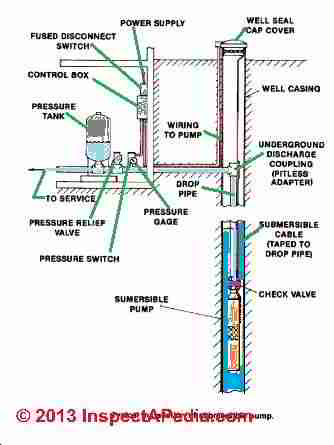
- POST a QUESTION or COMMENT about diagnosing and correcting intermittent well pump cycling on and off when no water is being used in the building
How to diagnose, find and fix the cause of intermittent or irregular well pump cycling on and off:
This article explains how to diagnose & repair water pump intermittent cycling - the water pump comes on when no water is being run in the building. Intermittent water pump cycling means that the water pump comes on for no apparent reason.
We discuss: Well pump & water tank off-use cycling or water pump turning on-and-off: diagnosis & repair procedures. SHORT CYCLE vs INTRMITTENT CYCLE:
Comparison of Intermittent Well Pump Cycling with a Short-Cycling Water Pump Problem or with Lost Water Pressure. INTERMITTENT CYCLING REPAIRS: How To Fix Water Pump Intermittent Cycling.
InspectAPedia tolerates no conflicts of interest. We have no relationship with advertisers, products, or services discussed at this website.
What is Intermittent Water Pump Cycling, What Causes It, and How is it Corrected?
 Reader Question: (Nov 16, 2014) Jay said:
My bladder tank kicks on every like 30 seconds and runs for about five minutes then kicks off and then about 20 seconds later it repeats itself? Any suggestions on what I should try or do?
Intermittent water pump cycling which we explain here means that the water pump comes on for no apparent reason - that is, you are unaware of any water running in the building. (When water is running in a building served by a private well and water tank and pump system it is normal for the water pump to cycle on and off to deliver water to the building.)
So here we are not talking about "short cycling" in which the water pump turns on and off too frequently when water is being run in the building. However, some of the causes of "short cycling" might also lie behind "intermittent pump cycling".See SHORT CYCLING WATER PUMPS
Here are the more likely causes of the water pump coming on at odd times when you're not (aware of) running any water. You may want to investigate these possible causes roughly in the order they are listed below.
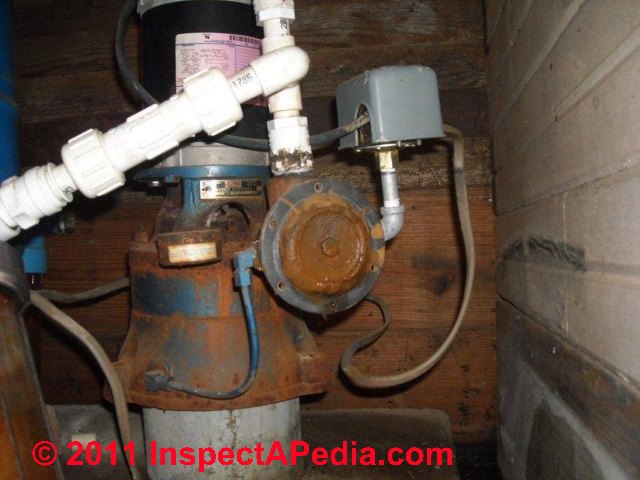
[Click to enlarge any image] Shown in the photo: a rusted, leaky air volume control on a water pump.
- Running Toilets:
A toilet somewhere in the building is running - this can be VERY hard to spot - unless you are meticulous.
I've tried wiping the toilet bowl interior to make it dry and then feeling it later for wetness above the water line, or watching the water in the toilet bowl for ripples, or placing a little septic dye or food coloring in the toilet tank to see if it appears in the bowl below, or, simplest, simply turning off all toilets at their supply valve to see if the pump cycling goes away.
A leaky flush valve or a leaky fill valve in a toilet causes this problem.
See TOILET RUNS CONTINUOUSLY for diagnosis & repair of running toilets. - Leaky Plumbing Fixtures:
A plumbing fixture such as a sink, tub, shower, or clothes washer is leaking slowly
- such as a faucet or shower head dripping into the fixture (where you can see it) or worse, dripping into a hidden building cavity such as a wall or ceiling cavity (where water stains eventually show up below) or into a floor or crawl space (where you may not see the leak).
See LEAK TYPES, WATER SUPPLY or DRAIN PIPES - Leaking Water Tanks:
An air leak at the water pressure tank, above the water line in the tank,
(or a water leak from the water pressure tank) can cause the tank to slowly lose air and the water pump to cycle on.
This is possible with both traditional steel water tanks and with modern captive-air bladder type tanks (water is in a separate bladder inside the tank).
Older water tanks which have an air volume control (which rarely work) are designed to automagically add air to the water tank as needed, so if the AVC is working and if there is a little air leak on the tank somewhere (often you can spot a rusty pinhole leak), this condition could continue for a while before being diagnosed.
We discuss leaks in water tanks and temporary repairs
at WATER TANK REPAIR PROCEDURES - Leaky check valve or foot valve:
A check valve at the pump or a foot valve in the well at the bottom of the water pipe could be failing and leaking,
sending water backwards from the pressure tank, through the water pump, and back into the well. This can eventually lead to loss of pump prime and loss of all water supply as is discussed at our website.
See CHECK VALVES, WATER SUPPLY, DRAINS, PUMPS
and
see FOOT VALVES, WELL PIPING for diagnosis & repair procedures. -
 Leaks in well piping:
A water leak in the well piping between the building and the well
or even inside the well could also cause a back-flow of water from building to well and lead to pump cycling on and off.
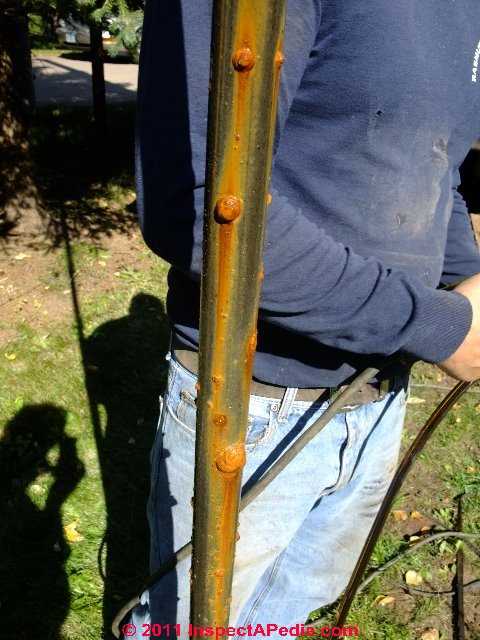
Leaks in well piping can occur at connectors such as those used on plastic water piping, or well piping leaks may be due to corrosion and perforation of older galvanized steel well piping - shown in our photo at left.
See WELL PIPING LEAK DIAGNOSIS for details.
Jeremy Rasmussen (Rasmussen Well Drilling, Inc.) points out that galvanized steel well piping is particularly prone to corrosion and leak perforation in the section of well piping that is repeatedly wet then exposed to air during the normal draw down cycle of water inside the well casing at each pump cycle.
The galvanized iron well piping shown was on a 180 foot deep well in Two Harbors MN. We elected to leave the corroded piping in place until leaks or pump problems justified its replacement.
Because of the trouble and cost of pulling deep well piping, Rasmussen recommends that when pipe replacement is needed, the well pump, air vent (if present) and other in-well equipment should all be replaced at the same time. - Leaky snifter valve:
Some submersible-pump wells served by an older bladderless pressure tank introduce make-up air into the pressure tank through a snifter valve found on the well pipe riser inside the well
. If the snifter valve, a type of one-way (air in no water out) check valve should become leaky it might allow water to leak backwards out of the well piping, dropping pressure in the water system, especially if this fault is combined with a leaky check valve elsewhere in the well piping system.
See SNIFTER & DRAIN BACK VALVES - Defective Pressure Control Switch:
A defective pump pressure control might, in theory cause this intermittent cycling but in more than 30 years of practice I've not found this to occur. - Clogged water pressure tank inlet:
A partial blockage of the water entry passage into a water pressure tank
or water storage tank can cause intermittent well pump cycling. Clogging may be due to mineral, silt, or other debris, or it may be due to a damaged water pressure tank bladder.
When no water is being used in the building and the pump has cycled off at a pressure higher than that contained inside the water pressure tank, higher-pressurized water from the building plumbing system can slowly back-feed water into the pressure tank.
When that back-feed drops building water pressure below the pump switch cut-in pressure the water pump cycles.
This intermittent well pump cycle will continue until the water pressure tank has also been pressurized to above the pump cut-in cycle. Thanks to reader K.K. for this tip 8/43/2014 and who wrote
We had intermittent pump cycling, when no water was running, the pressure gauge would hold for 2-3 minutes then drop to cut in.
We checked the pressure vessel pressure, it was a little low, pumped it up with no result. Turned off various stop cocks to isolate any leaks no change.
So isolated it to the pressure vessel itself, presumed the bag was damaged, not quite burst but leaking. On removal of the pressure vessel today we found that the inlet was clogged with sediment, only the size of a small straw was allowing water in.
The bag is perfectly intact. We have very high iron and manganese content and have a filtration system after the pump.
Contrasting Intermittent Well Pump Cycling with a Short-Cycling Water Pump Problem or with Lost Water Pressure
Short cycling of a water pump means that the water pump turns on and off too rapidly or too frequently when water is being run in the building.
If this is the problem with your water pump,
see WATER PUMP SHORT CYCLING CAUSES.
and this water tank or control repair article:
WATER TANK REPAIRS: DIAGNOSE SHORT CYCLING WATER PUMP
Loss of water pressure means that the pressure with which water enters a plumbing fixture has become too slow, or is sometimes too slow or weak in water flow rate, or water flow may stop entirely.
See WATER PRESSURE LOSS DIAGNOSIS & REPAIR
Reader Question: well pump chatter: hesitating water pump
(Mar 27, 2015) tammie said:
my pump kicks on then as it shuts off it hesitates 4 or 5 times and the bladder is not filled does this with and without water running
Reply:
Sounds like a clogged water filter, pipe, closed valve, or a bladder stuck to itself in the pressure tank.
Occasionally burned pump contacts, loose wiring, or even a debris -clogged pressure switch could be at fault but usually the trouble is that the pump can't send water out into the pressure tank or building fast enough: a blockage is making it reach cutoff pressure almost immediately - seconds or less after it starts.
Watch the pressure gauge: that may help you see the problem I describe.
Question: pump runs for no reason
(June 17, 2015) Gil said:
New water pump installed recently. Concerned because pump will turn on for no reason approx. 3 to 4 times a day and run for 10 to 15 seconds. Is this normal?
(June 27, 2015) Ron said:
Our water pump was just recently replaced a year ago, however for the last few days it has been acting wierd as in
-weird intermitten clicking or banging in the piplines
-the banging occurs only after flushing the downstairs toilet
-and to me it seems like the water pressure is at 3/4 of usual strenth
However today the banging and vibrations happened more frequenty and after using any of the downstair plumbing, also the noise was louder. There is a big storm passing through the area here in Lansdale,Pa and at first I attributed that to the frequent breaker short ciruiting, however the only breaker that needs to be reset is the well pump one.
...
And now the pump no longer works it is a brand new pump and just recently intalled, flipping the breaker causes a thump and cuts the breaker back to off again. Also the orignal pump also went bad during a storm is thier any correlation there? Need to pick someone's brain.
Also any suggestion for any local (Lansdale, PA) reputable well repair men obviouslt the last guys failed to get the job done.
(July 16, 2015) Chris said:
This year at my cottage, I installed a new 3/4 hp pump and a new Hanflo foot valve. My pressure tank is an old galvanized steel, air over water tank.
The pump cycles every 12 minutes for 2 minutes, like clockwork, when no water is running. I have shut off all the valves downstream from the pressure tank, so I think it is either the tank or the foot valve or both? Is it normal for a pump to run so regularly? By the way it is also very hot to the touch.
(Sept 2, 2015) Carl said:
I have a well on our farm house with a 44 gal. WelTrol tank. Yesterday it started short cycling when no water was being used.
The tank feels like it is completely full of water. I can't shake it and tapping it anywhere, even at the very top, sounds solid, no metal ring like a healthy tank sounds.
It cycles on and off every five (5) seconds. It runs up to about 80 cuts off then back on again at 50 and all that takes 5 seconds or so. I'm guessing the bladder has completely failed.
The tank was installed in 1992. So that makes it 23 years old. A new pump was installed about ten years ago and the tank was fine then. I'm out in the country and it will take a day or two to get a new tank. If I add air to the tank will that let me limp by for a day or two?
Or should I let some irrigation sprinklers run (they're plumbed right off the main supply coming from the pump, and that would keep the pump running during the day until we can replace the tank.
I thought I had noticed in the last week or so that the pump was coming on a little too often but I assumed someone was using water and didn't take the time to check it out. Any help would be appreciated. Thank you. Carl in South Carolina
(Oct 22, 2015) David said:
I have a 3/4 horse pump submergable pump just put it in yesterday it come on for 3to 4 minits and then it stops pumping for 3to 5 minits what could it be
(Dec 4, 2015) james clark said:
I can shut off pump water before it gets to tank and pump stays off? I have no leaks, when i put pressure on tank pump cuts on and off every min. I have 28lb on tank at pump cut off at 30lb
b. what is my problem?
Reply:
Gil the article above poses some possible causes of the condition of "pump turns on for no reason"
Ron: short cycling or rapid cycling can trip a circuit breaker or even burn out a pump pressure control switch or pump motor.
Ron I'd look at two InspectApedia articles on
- well pump short cycling
and
- water hammer
(try the search feature)
David:
If the pump is running out of water or otherwise overheating that may be the cause.
James:
Check your air gauge, check actual tank pressure, and most important check for a waterlogged tank. That sounds like the trouble.
How To Fix Water Pump Intermittent Cycling
Review the list of intermittent well pump cycling provided just above and fix that cause
To correct the problem of water pumps coming on when there is no apparent reason, we need to find which of the causes listed above is occurring. Look for problems like those listed earlier in this article and fix them.
Look for other hidden causes of well pump cycling
IF that does not cure mysterious well pump cycling when you believe no one is running water in the building, look for more hidden causes such as a hidden leak in water supply piping or well piping underground.
The most common causes of hidden causes of intermittent pump cycling:
- water is running somewhere in the building without notice, such as a running toilet
- a leaky check valve or foot valve at the water pump or in the well
- a leak in well piping somewhere between the bottom of the well and the pressure tank in the building
Multiple faults or causes of well pump cycling on and off?
Remember that though it's not common, on occasion more than one water pump cycling fault could be present. Each of the possible causes listed above is also discussed as a diagnosis and repair topic at this website.
Examples of how a Leaky Check Valve or Foot Valve can Cause Intermittent Water Pump Cycling
Question: Intermittent running of our well tank, tank replaced, bad foot valve?
I have a similar issue. First we experienced intermittent running of our well tank. The tank would run when we were not calling for water.
We had the tank replaced and upgraded from 20 gallons to 35 gallons. Our pressure switch is set at 30/50 psi. We were told that the valve(??) was bad because water did not shoot out and air was sucked back in when the tank was replaced. Since having the tank replaced, the psi still decreases when we're not running water. In addition a new problem has started.
Our water slows down and then stops completely for about 15 seconds during various times of the day (showers, washing dishes, etc.) and the water will spit at times (running faucets or when the toilet fills up). We verified that we have no leaks in or around the house. Our pump is submersible. Thank you very much. - Tara
Sorry, I have to make a correction. Our pressure switch is set at 40/60 psi. Thanks. - Tara
Reply: a bad foot valve can cause intermittent well pump and tank running and loss of well prime
Tara:
I'm not sure what "valve" you were told was bad. Perhaps a foot valve or check valve?
A bad check valve or foot valve can lead to loss of pump prime and thus loss of water pressure. While that cause and symptom are not usually intermittent but rather a hard failure, a slow leak in a check valve or foot valve could show on occasion up as intermittent water pressure loss.
That is, if water is being run frequently and the leaky valve is a slow leak, the pump may retain enough water to not lose prime (assuming we're talking about an above-ground well pump here). But when water is left off for a longer period and the slow leak has time to lose more water from the pump, piping, and even pressure tank, one could lose water pressure.
The fact that you replaced the water tank and are not running water but still see a loss of water pressure read on the gauge at the tank is a strong suggestion that you have either
- a leaky check valve or foot valve
- a leak in well piping somewhere between the bottom of the well and the pressure tank in the building.
WELL PIPING LEAK DIAGNOSIS
When your well pump is submersible (yours), you won't experience loss of prime (the pump is under water and always can prime itself). But you can see air in the well piping and water tank system and loss of water pressure as we've both described.
The "spitting" you describe at faucets or at a toilet can be caused by air entering the well piping through the same leak that in other pressure conditions lets water leak out.
I think it's time to have a plumber or well expert investigate the well piping for leaks.
Follow-up from Tara: I am struggling to understand why our water stops and spits now after having the tank and valve replaced
Thank you for your reply. Our invoice states that the "check valve" was replaced. I do know that it is the valve that is very close to the well tank. Are the terms "check valve" and "foot valve" interchangeable for the same valve or are they two separate valves? As I am understanding it, I think the check valve is visible and near the tank; the foot valve is below the ground at the bottom of the submersible pump.
I am struggling to understand why our water stops and spits now after having the tank and valve replaced when we did not have this problem prior to the new tank and valve. Just tonight I have noticed a hissing sound coming from the well tank that I did not previously hear.
Our plumber is on vacation this week. I am trying to educate myself as much as possible before next week. I'm concerned about assuming the problem is the foot valve and pulling up the pump as our plumber seems to want to do. I would think that if the the foot valve was leaking we would have had the loss of water all along. Thank you very much.
Comment:
Tara a check valve may be at an above ground pump or at the bottom of the well (where it's better called a foot valve.) If the worker did not pull the well piping they didn't replace a foot valve.
See WELL PIPING CHECK VALVES
and the separate
article WELL PIPING FOOT VALVES for details.
I don't know what's hissing (air, water, or a control or an air volume control). I hope you'll tell us what the plumber says about that hissing - it's important in helping other readers.
About your earlier comment and my reply: if you are not running water but still see a loss of water pressure read on the gauge at the tank is a strong suggestion that you have one of the problems we list above - or
see How To Fix Water Pump Intermittent Cycling in this article.
Also, we have often seen that any work on a well, pump, piping, tank and water tank system can disclose other marginal components or problems that were not obvious earlier.
For example just stirring up dirt and debris in the well or well piping can cause clogging of the water pressure sensor switch leading to odd water pressure behavior, or clogging of a water filter leading to loss of pressure.
And both old water types on occasion a new bladder-type water pressure tank can suffer from a bladder that sticks to itself, preventing water from entering or leaving the pressure tank.
See WATER PRESSURE TANKS, BLADDER TYPE.
Watch out: besides a bad check valve or foot valve, a leaky pipe anywhere between the bottom of the well and the building interior can also lead to intermittent water pump cycling.
See WELL PIPING LEAK DIAGNOSIS or select a topic from the closely-related articles below, or see the complete ARTICLE INDEX.
Reader Question: OK to shut off a well pump to stop intermittent cycling on and off?
(Dec 24, 2015) Kent said:
Our pump is intermittently cycling we have no water running and can not find any leaking faucets, toilets... the pressure gauge is not moving (pegged out)where should we start? Will turning the pump off create more problems ?
Reply:
Don't turn off the pump as you may lose prime. Do review the article above. Let me know if questions remain.
(Dec 25, 2015) kent said:
Did turn pump off but back on now. Turned water off to house and it still intermittently cycles. Now have dirty water. Where to start. Other then calling nplumber
Reply:
Kent, in the article above I list common causes of intermittent pump cycling: these are the things to look for yourself; a running toilet can be hard to spot: try turning them off.
Question: intermittent cycle of the pump stops when I turn off water to the house
1 Jan 2016
Val said:
Intermittent cycling stops when I shut water to house off. No appliances leaking. Do you think it's piping under the house?
Reply:
Val that was a smart diagnostic move - turning off water into the house. As the intermittent pump cycling stopped we can guess that indeed the problem is on the house side of the shutoff valve.
I would look
first for a running toilet - that can be subtle and hard to spot so try shutting off the water supply to individual toilets for a while.
second for a leak in supply piping somewhere that you can't see - such as under the house, so if there are shutoff valves that let you turn off some sections of supply piping that may help you track that down
Val said:
I know that a leak is not acceptable but measured time between cycles and it took about 30 min to empty 20 gallon pressure tank.
I can do a lot but going under the house is not one of them (not that it matters but female)! Would I be able to wait until business day next week? Thank you for responding so fast :)
No toilet leaking. Used food dye.
Reply:
Val:
I'm guessing your home is built over a hard-to-access crawl area; I'm in a tough spot trying to guess about how much damage an unattended leak is going to cause for a building I can't see. If it were my house I'd try to look into the space, even if just with a flashlight from a crawl space entry.
If I saw water wetting heating or electrical components I'd want to turn water off and call for urgent repair help - for safety.
If I thought water were running into walls or ceilings I'd want to turn off water to stop costly soaking of building components that are going to require demolition to repair:
Otherwise I would be OK with waiting for a less costly service call after the new Year.
Val said:
It's a mobile home so very creepy under there. I checked walls around around appliances faucets and showers. Did not find any damp spots. I understand you can give me an opinion on it. Is there a way that I can calculate the loss of water aside from the simple 20 gallons/30 min? Just worried about pump.
Reply:
OK. Good going.
Ok to wait;
When you do have someone inspect below to find and fix the leak, be sure that they also check to see if the insulating blanket or body wrap under your mobile home was soaked. If it was you'll want that removed, the under-floor dried, and then new insulation installed - to prevent a costly mold contamination problem.
Water Pump On-Off Cycling Rates & Water Draw-Down Times
So is your well pump short-cycling? Intermittent cycling? Or is something else wrong? Or are there two things wrong?
In response to this reader question: Pump clicks ON for 2 minutes then is OFF for 7 minutes regularly. No water is being run. Is this normal?
We have moved this discussion to a new article. A.L. and other readers, please
see WATER PUMP DRAWDOWN VOLUME & TIME
Summing up intermittent pump operation compared with short cycling well pumps
- Intermittent well or water pump operation
If a pump is running for no apparent reason and we're not running water in the building (or we think we're not running water), then
I call this WATER PUMP INTERMITTENT CYCLING.
The time between pump-on cycles will depend on how fast water is leaving the system and might be anywhere from "pump won't stop running at all" (though other problems can cause that too) to "pump runs once in the middle of the night". - Short Cycling water pumps
Very short pump-on cycles followed by short pump-off cycles is caused by a water-logged pressure tank (lost air charge) combined with a rapid use of water in the building or by a significant water piping leak somewhere.
See WATER PUMP SHORT CYCLING. These cycles are typically under 30 seconds. - Chattering well pumps
Extremely-short pump on/off cycling or pump chattering is usually caused by a blockage at the pump or water system output, like a clogged debris filter. This on-off cycling rate will typically be a second or less. - Continuous pump operation
: if the pump won't stop running the cause may be simply a high water usage rate that exceeds the pump or well's capacity to deliver water or there may be a leak or a bad control.
See WATER PUMP WONT STOP RUNNING - Pump speed varies during operation
This may be normal if your pump is a variable frequency drive pump or is controlled by a VFD controller.
See VARIABLE FREQUENCY / VARIABLE SPEED DRIVE WELL PUMPS (VFDs)
Reader Comments, Questions & Answers About The Article Above
Below you will find questions and answers previously posted on this page at its page bottom reader comment box.
Reader Q&A - also see RECOMMENDED ARTICLES & FAQs
On 2023-09-29 by Jared
@InspectApedia DF, Thank you for your replies. I will keep investigating
On 2023-09-27 by InspectApedia DF (mod) - is it possible to lose pressure as air out of a system backwards without having a leak in a pipe
@Jared,
If pressure in the water system is dropping, I don't assume it's air pressure in your tank that's being lost UNLESS you can actually close off the tank from any other plumbing connections and then see both a pressure drop and no water leakage.
Rather, water leaking or running anywhere in the system will cause a pressure drop.
OR your gauge itself is faulty and is sticking at a high pressure then falling. As it's quick, easy, inexpensive, try replacing the pressure gauge .
On 2023-09-26 by Jared
@InspectApedia tried all that an as its a closed system being feed via the mains I can see the water reading. Can not use water all day long and the meter reader does not change yet the pump loses pressure and cycles.
None of the system is underground except for a few feet of pipe which is barely underground, so definitely no water leaking from the system - as mentioned this doesn't happen when isolating the water before the behind the pump so 100% no leaks in the house or running toilets - solved those issues years ago.
So the question therefore is, is it actually possible to lose pressure as air out of a system backwards without having a leak in a pipe.
On 2023-09-26 by InspectApedia Publisher - Intermittent cycling due to loss of pressure
@Jared,
If you're losing pressure then either there's water running somewhere in the building, such as a running toilet that may not be obvious, or there's a leak somewhere else. Often we can isolate the problem by turning off water supply selectively either to parts of the building or between the building and the water pressure tank. For example if you turn off all water leaving the water pressure tank and the pressure still drops then the leak is probably on the well or water supply side.
On 2023-09-25 by Jared
Firstly thanks for all the different replies and various potential solutions, however I have still not found a potential answer to my specific problem.
Problem - Intermittent cycling due to loss of pressure.
System - Mains feeding an above ground folding tank, then back into the house via a bladder style pump to increase the pressure - with multiple cut off valves to isolate the tank and pump in order to run off the mains in the winter.
Test 1 - watching the meter reader for water being lost in the closed system - No additional water goes through the mains counter in an hour period with an average of 4-5 extra pump cycles during the hour.
Test 2 - Isolate the pump on both sides. Pressure dropping stops - tentative conclusion air from the to pump not escaping through a faulty bladder valve.
Test 3 - Open the house side of the pump. Pressure remains steady, no drop. tentative conclusion, system is pressurized and no leaks for pressure to escape
Test 4 - Close the house side and open the incoming tank side. Pressure now drops at steady rate. Isolating further down the line stops it again. When placing my ear to the pipes close to the pump or any isolation valve and opening slowly I can hear a faint hissing sound which I can only assume is air escaping - my logical assumption is therefore I should see some bubbles coming up from the bottom of the tank, however I cannot detect any air coming back into the tank - at least none is visible.
Assumption, but not sure. Something is wrong with the pump allowing pressure to go in the opposite direction back to the holding tank - but no clue as to what the part would be called or how to fix it.
As there is no change in the over amount of water in the system over an extended period of time I cannot see how this would be a leak plus this has been happening now for months and based on how often it cycles without any water running I would expect our backyard to resemble a lake.
Any thoughts at all on why a pump would lose pressure and hear the reverse pipes with the sound of air or at the very least fluid flowing the wrong way and not show any obvious signs of where it is going would be very welcome.
Thanks in advance
Jared
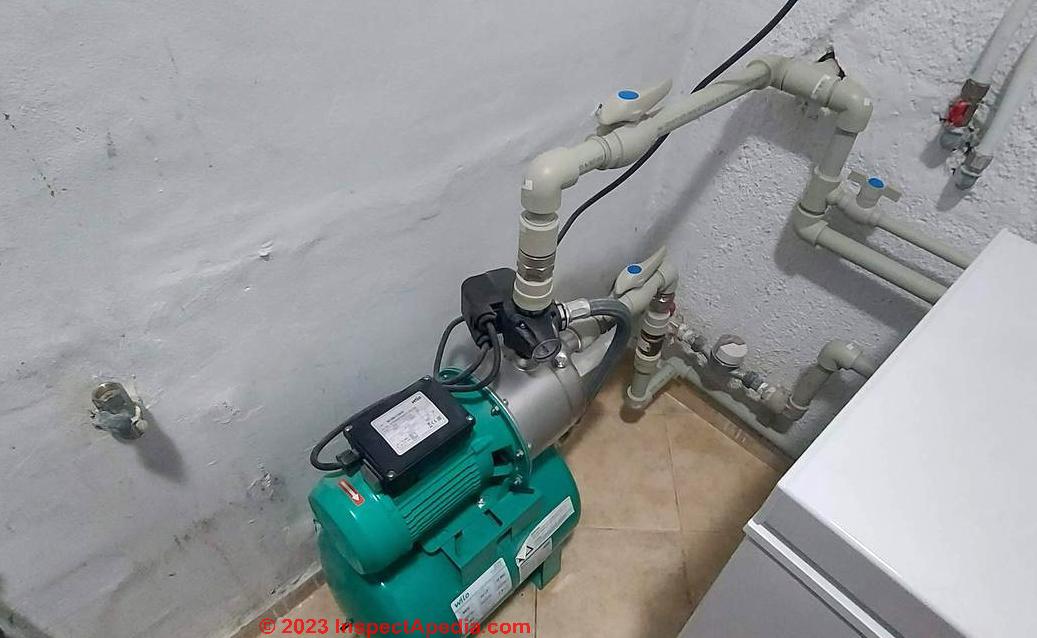
On 2023-04-03 by InspectApedia Editor
@Nancy,
About that remarkable inverted "U" in the water line, there is no functional reason for that loop in that location.
Unless there is something I can't see, like a "Tee" connection that's also feeding another water line somewhere, the piping in your photo looks as if someone thought they couldn't raise up the light-coloured water line to make an easy connection to the in-house piping.
Ask your plumber if she can simplify that connection as doing so will remove some unnecessary elbows and may slightly improve water flow.
On 2023-04-03 by InspectApedia Editor - why the pipe would be looped prior to entering the pressure tank?
@Nancy,
About? What. You are calling pressure testing? I think you really mean water flow rate period pressure which is only measured when no water is running is not going to be affected by a clock or debris.
Is pressure will of course fall in the System when there is a leak.
About the piping loop, I need to see a photo to understand the question.
On 2023-04-03 by Nancy
@InspectApedia Editor , still clearing snow and awaiting a well guy.
Do you know why the pipe would be looped prior to entering the pressure tank?
Also, it was recommended to me that once the well guy comes out, the pressure on the well outlet should be tested BEFORE the pump is pulled, in order to protect a true pressure reading.
The concern was stated that if you pull the pump and change the check valve, debris could affect the pressure reading at the outlet. I am not sure I am understanding this correctly. Thoughts?
On 2023-03-31 by InspectApedia Editor
@Nancy,
Thanks for the follow-up. Let us know what you find, as that will also help other readers facing the same intermittent pump-on problem.
On 2023-03-31 by Nancy
@InspectApedia Editor , thank you. I spoke to my well guy who also believed it could be a check valve or leak at the top well connection. We have to get the 10 ft of snow off the the wellhead before he can look at it. It may be awhile, but I will share an update.
On 2023-03-31 by InspectApedia Editor
@Nancy,
Sure.
So if we are certain that everything in the house is turned off then we don't think there's a running toilet or a leak in a water supply pipe: because you saw the water pressure continue to fall.
There could be an air leak at the pump itself but the most common cause of the problem you describe is a leaky foot valve - at the bottom of your well piping.
The other possibility is a leak anywhere in the well piping between house and well.
But since we don't want to start by digging up the pipes, most well and plumbing experts would at this point replace the foot valve.
On the page above please take a look at the diagnostic steps starting at step #4.
Keep me posted
Df
On 2023-03-30 by Nancy
@InspectApedia Editor , I inspected the house thoroughly and found no evidence of water leaks. I turned off the partial main shut off along with every fixture valve, including the toilets which did not show evidence of leaking.
The gauge dropped 1 psi an hour for the first 3 hours, then 5 psi during the 4th hour. I have observed previous, fluctuating losses, varying from 1 psi an hour 10+ in an hour. Would that point more to a specific cause?
On 2023-03-30 by InspectApedia Editor - what would cause a fluctuating psi loss with no pressure loss in the house?
@Nancy,
Thanks for the question. Here are some tips for tracking down the cause of intermittent pump cycling when you don't have a main water shut-off valve
1. If there is indeed no single main water shut-off, you can still determine if you have a subtle leak at one of your plumbing fixtures by turning off water at each of those fixtures at its individual shut-off valve.
2. Check each toilet carefully to be sure it's not running. A toilet flush valve that's leaky can be a subtle problem as the leak can be slow and even intermittent.
Details are at https://inspectapedia.com/plumbing/Toilet_Runs.php TOILET RUNS CONTINUOUSLY
3. It's unlikely but possible that there is another water leak on the house side of your pump and pressure tank, such as a leak in a crawl space or even in a building cavity: usually we can detect those by looking for wet areas (in the crawlspace or in ceilings or walls near the route of water piping).
4. When you're reasonably confident that there is no leak in house water supply piping and no running toilet, the finger of blame points to either a leak in well piping or a leaky check valve or foot valve.
Take a look at the additional diagnostic suggestions above on this page and please let us know what success you have or what further questions you have.
Also:
For a home that does not have a single water shut-off valve that turns off ALL water to the house, ultimately you're going to want a plumber to install such a valve. Almost always that's pretty easy: a main house water shutoff valve would be installed right at the pump/water pressure tank at the outlet from the water pressure tank that feeds the building.
If some of your plumbing fixtures have no individual shutoff valves then when you're having plumbing work done, have those installed.
On 2023-03-30 by Nancy
The last week I have been losing a varying degree of psi when water is not being used, resulting in intermittent pump cycling. The loss is sometimes 1 psi an hour and sometimes 10 psi an hour.
I discovered the house shutoff only shuts off some of the fixture, so I cannot completely isolate the house from the well. I do not see any leaks inside. Outside everything is about 4 ft down.
Any suggestions of what would cause a fluctuating psi loss with no pressure loss in the house?
On 2023-02-18 by InspectApedia Editor - how to diagnose weak water pressure
@Tracy,
As a start, take a look at Table 3 at this page
DIAGNOSE WEAK WATER PRESSURE WATER
where we give a long list of diagnostic steps and possible repairs depending on your issue. A clog or debris can happen in a number of places along your water system from well to faucet and you may need to check all of them.
I don't know what is happening for sure with your system so suggest starting with those diagnostic steps.
You also mention the bleach smell and that your water contains sulphur. See more about that process here
WATER TREATMENT EQUIPMENT DISINFECTION PROCEDURES
Watch out: if the well source water contains hydrogen sulfide (H2S), when preparing a well disinfection solution you must allow the water to aerate so the H2S dissipates, otherwise the acid formed will cause an immediate release of H2S gas from the water, which poses a serious health risk.
Keep us posted and let us know if you have additional questions.
On 2023-02-18 by Tracy
Our water pressure tank was kicking on and off increasing our electric bill. Fist plumber said air need to be put in our water tank. That seemed to work and he also put in a filter (not a carbon one) because my new washer was reading IE (pressure error).
Everything seemed OK except 3 weeks later our water was spitting and our toilets were clunking. My husband checked the filter and it was loaded with silt... tons. We called our well guy who told us to drain /flush the water pump.
He saw the filter full of silt and said it was normal and just change the filter. He also said the water from the hose we had hooked up to drain the water pump was clear and so just change the filter.
Still days later the faucets and the toilets were still brown and full of silt. And the water pump was kicking on and off again. Another plumber came out and changed the check valve and cut the plastic pipe in the well by 3 feet to help lift the pump up a little.
He told us to throw some blue bleach (we diluted it with water) down the well, run the hose until we smell bleach.... then down the well to mix it and then run water in the house.
Let it sit for 6 to 12 hours and flush from the outside faucet so it doesn't end up in the septic. We did all that and the water still has the grim that settles in the toilet but according to what i read, it can take time to clear up.
But now days later I go to use the water and I'm only now smelling the bleach smell. This is almost 4 days later. And this morning doing laundry the water stopped after 3 minutes of trying to fill washing machine.
I stopped it. Waited 5 minutes and the water works briefly but runs out again. Too a shower 10 minutes and ran out of water again. Both cold and hot. Called the plumber who is on vacation and he thinks it might be some pump pressure contol?
HELP... We have a lot of minerals in our water as well as sulfur but we always had this ...never had any water issues for 15 years since we bought the home new.
One final thing... our plumber had us do some tests to see if we had a leak or a running toilet but the test my husband did was negative
On 2022-12-29 by InspectApedia Publisher - pump cycling may be due to water leak
@Hugh,
That sounds as if there's water running somewhere or a leak in well piping or a leaky check valve or foot valve - but be sure to step through the common intermittent pump cycling causes given above on this page as that's a more-complete list.
On 2022-12-29 by Hugh
Pump comes on for about 10 seconds, turns off and then back on after 40 seconds. No known causes from inside house. Small dripping at pixies prior to holding tank, would that cause a pressure loss to cause the cycling?
On 2022-11-16 by InspectApedia (Editor) - how would one know if the jet assembly needs replacement
@Anonymous by private email,
What a lot of trouble! Sorry for all that.
I can't reliably diagnose this problem by text.
I'd have to see not only the parts involved, but I'd also probably find more needed information about the well and installation if I were on-site.
But in general, IF the pump was run dry for very long, that can damage an impeller or pump bearing.
If the pump runs intermittently when you're not using water, Please first see the diagnostics above on this page.
About the cracked part that was replaced: that sounds perfectly-correct to have done.
We're left having to trust the honesty of the plumber about replacing other parts.
Certainly it's fair to ask, politely, "Can you show me the damage or help me understand why this (other) part needs replacement?"
Keep in mind that for an older well and pump system, often the plumber will replace ALL doubtful parts rather than face the cost of having to pull the well and foot valve and jet and tailpiece all over again later when those parts fail - having suffered a customer who's ticked off and demands "Why didn't you replace those the first time?"
But a pump that runs "on its own" every 2-4 minutes "with no taps open" certainly needs to be fixed to protect the pump from failure, the well from running dry, and the septic drainfield from flooding damage.
Hissing from the well casing MIGHT be air entering the well through a vent as water level drops in the well.
About the parts of your jet pump for a two-line system, see:
WATER PUMP, TWO LINE JET
On 2022-11-16 by Anonymous by private email (mod)
Re-posted by mod from private email
Anonymous asked:
Thank you for your informative website.
Can you tell me how one would know if the jet assembly ( deep well, two pipes) needed replacing? The pump was functional prior to service call, delivering water, but was running 2 to 4 min (randomly with no taps open) a few times a day. Also, a hissing sound had begun coming from the well casing, which prompted my call for service.
I called a plumbing service to check it, as I had had a problem 14 years prior, with pump running continuous. That was found to be a broken nylon fitting on the bottom outlet of the jet assembly. The plumber at that time simply replaced the broken fitting, but cautioned me that the other fitting on the top was still the old nylon, so if a similar problem occurred in the future, look there first. At that time, 2008, we replaced the entire pump as well.
A plumbing service pulled the pipes, and it was clear the nylon fitting on top of the jet assembly was cracked. The plumber stated, " this part, (indicated the jet assembly) is all broken up, you need a new one." I could easily see the crack in the nylon fitting. I agreed to let him replace the assembly, assuming he knew what he was doing.
He had trouble getting the pipes back into the well, then was unable to prime the pump, (didn't t know how) so I showed him. Once primed, (I didnt watch him priming it, so dont know how that went) the pump made bad sounds, delivered no water, so he ended up pulling the pipes again. He worked for 2 hours under a tent, something to do with the pit valve, I am guessing; based on the location where he set up the tent, and knowing the length of the pipes.
My question is, did I even need the 250$ jet assembly? How would you know if that part were bad? It seems likely the crack in the nylon fitting was causing the hissing, though, as stated, the pump was delivering water, just running intermittently, as stated above.
It appeared to me that the Plumber was inexperienced. The company waited nearly 3 weeks to decide how to bill me, then hit me with a 1200$ bill. My pump acts no different today than before he came, except there is no hissing. Still intermittent running, but I think with less frequency. I do note a worsening slow leak at the washer hook up, which could account for that. A leaking toilet valve was present prior to all this, but that was addressed before they came, so, I thought before winter came, I should have the well pipes checked.
I am currently battling with a virus, can't get much done, haven't fixed the washer leak yet, so I can't yet rule that out as a cause for the intermittent running.
I don't mind paying for necessary services and parts, but don't want to pay for an inexperienced plumbers mistakes.
I am a retired person on disability, with limited resources. Before I agree to a fee and pay these people, I am hoping to have a better understanding of what went on.
Also, since that work was done, I am getting a lot of leaf debris in the aerators on all taps, At first it was enough stop the tap altogether. Hoping it didn't, doesn't affect my boiler.
Thank you, any information you can provide is greatly appreciated.
On 2022-11-04 by InspectApedia (Editor) - fix the cause of a problem before adding on more devices
@George,
I like cycle stop valves, too, George, but it is a fundamental axiom of plumbing repair that it's usually best to diagnose and fix the cause of a problem than to add-on more devices to try to make it go away.
Take a look at the causes of water pump short cycling given above on this page as that may be useful.
On 2022-11-03 by George
After suffering cycling. I started by putting a stop valve on both sides of the pump. they're cheap to buy. first close outlet, if still cycling close inlet. If cycling continues the fault is with the pump or switching system.
After that, follow whichever pipework brings on the cycling, if on the house end, look for stop valves in the system, turn them off starting with the one furthest from the supply and work your way back checking each time for a cure. If there are no valves, either install some or cut the pipe and fix an end stop (having a connector to put in afterwards) Hopefully you will find the fault.
If on the inlet, leaks in the pipe work tend to give air visible in a clear inlet filter just before the pump. After that I'm afraid well pumps are out with my expertise!
I hope this helps
On 2022-10-23 by InspectApedia (Editor)
@Anonymous
Let's start by stepping through the causes found above on this page. Let me know if those work for you or if you have further questions.
On 2022-10-23 by Anonymous by private email (mod)
Have a 40/60 switch and it might happen 2 times a day or 50 and might not happen for 2-3 days. When it turns on at 40lbs it’ll run for maybe 10-15 and kinda like trip out and the pressure switch shuts off. You don’t know it does it unless you’re watching the switch and gauge or you go and have no water.
All you have to do is turn the pressure switch off then on and it fixes it every time. Shut off and turn back on. It’s like it turns on and there’s no water but just shut it off and turn the switch back on and it works. Might do it all day or not for a few days.
Been going on for 10 months. Had three different switches on it and pressure tank does not leak. Pump is 5.5 years old. Thank you
- Anon
On 2022-10-03 by InspectApedia-911 (mod)
@Brenda,
If you really mean that the pump is running continuously and never stopping then you want to see the diagnostics at this page:
https://inspectapedia.com/water/Water_Pressure_Table.php
On 2022-10-02 by Brenda
My new Dab water pump runs constantly, when no water is being used
On 2022-08-27 by InspectApedia-911 (mod) - water pump recycling every 8 minutes
@Myron Gary Peebles,
Good move. Sounds like there is a leaky check valve or pipe on the well side of your new check valve.
Watch for air discharge at plumbing fixtures.
On 2022-08-27 by Myron Gary Peebles
My water pump (old submersible) was recycling every 8 minutes (pressure tank is relatively new) with no obvious fixture leakage in the house, I decided to install a $27 check valve on the in-coming line ahead or the pressure tank and pressure switch. Problem solved!
On 2022-06-15 by InspectApedia-911 (mod) - Gould pump starts clanging at intervals of three minutes
@Margaret Leonardi,
Thanks that's a really interesting question. I don't think we've ever had a report of a water pump making a clanging noise. Is it possible that the noise you're hearing is actually water hammer and banging or rattling metal water pipes?
Also significant to report that the pump is making noise when no water is being run.
Water pump turns on intermittently when the water is being used it's probably one of the causes given a bummer this page. So to diagnose the cause of the pump turning on you should read the article above and compare those causes with your installation. For example a leak back into the well can cause intermittent pump operation: a failed foot valve.
As for the "clanging" pump noise, as I said, the cause may be water hammer occurring because the pump is shutting on and off rapidly - short cycling. Indeed that, in turn, is an argument for checking the water pressure tank to be sure it hasn't lost its charge.
See also
SHORT CYCLING WATER PUMPS - pump cycles on and off rapidly when water is being run
On 2022-06-15 by Margaret Leonardi
I have a Gould pump that was installed in 1985. The well is only used for my sprinkler system, I have city water for my home. The pump starts clanging at intervals of three minutes, approximately 35 clangs,. It stops then does the same thing when three minutes are up. There is no watering when this occurs.
Had someone come and add air to the tank. It stopped for a month or so but started up gradually like just one clang every 7 minutes. Now it’s back to the first aforementioned schedule. The gauge has dropped slightly from where it was when the air was out in the tank.
On 2022-05-04 by Inspectapedia Com Moderator - Why would my tank's pressure drop so quickly?
@Dave Thurston,
It sounds to me as if a check valve or foot valve in the well has failed.
On 2022-05-04 by Dave Thurston
My well shut off today and I replaced the switch after I determined it was not working. After installing the new switch the pressure went to 50psi and the pump turned off. The pressure dropped fairly quickly to 30 at which time it came back on and filled to 50.
It then dropped back to 30 without any water being used and then did not come back on again and quickly dropped to 0. I reset again and the same thing happened.
Why would my tanks pressure drop so quickly without and water being used. I checked the bladder pressure and it was 27.2psi
On 2022-02-18 by Inspectapedia Com Moderator (mod) - pump will cycle about every five minutes
@D. Case,
Did you turn off the water supply on the building side of your water pressure tank and pump and then turn on the pump and it continues to cycle a reasonable guess is that there's a leak in the well piping or at the water tank itself.
If that doesn't happen but the pump cycles repeatedly when you turn on the water into the house then you have water running somewhere in the building, such as a running toilet Or a hidden leak in water piping.
On 2022-02-18 by D. Case
water is shut off after the pressure tank everything seems fine. As soon as you turn on the water going to the house the pump will cycle about every five mins. We can't find leaks at the toilet or anyplace else we have checked everything?
On 2021-05-22 by (mod) - find the leak causing periodic pump cycling
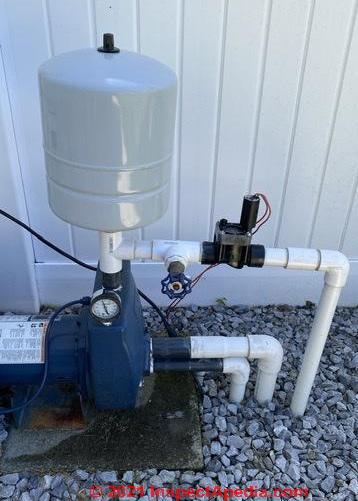 @Marc,
Yes, if a leather cup seal is allowing water to drain back into the well from the pressure tank that could cause intermittent well pump cycling.
Intermittent cycling such as you have described will be probably caused by one of the problems listed above on this page.
They have in common is water leaking headed back into the well or out somewhere that drops pressure in the system overtime try adding a ball valve or gate valve and if that doesn't stop the leak you may need to replace those leather seals.
Really? "leather cup seals" ? I'd be grateful for some details you might ask your plumber about what and where those are found; I don't find leather seals in use in modern deep wells using a jet pump.
While your plumber was probably being quite frank, saying "they all do that" isn't necessarily accurate nor would I live with a water pump that just ran intermittently " for no reason".
I'd find and fix the leak.
In your photo (shown above) your pump is set up as a two-line jet pump capable of pumping from a deep well, using (usually) a foot valve and venturi at the water-pick-up end of the well piping. That's not a "suction" set-up. A "suction" system would be a one-line jet pump capable of lifting water from depths no greater than 27 ft.
Take a look at our description of your type of Sta-Rite water pump found in
WATER PUMP & TANK I&O & REPAIR MANUALS
and
WATER PUMP PRESSURE SWITCH MANUALS for pump controls.
Incidentally the deep well submersible schematic that you posted (just below), presumably from your Sta-Rite pump manual, do not describe the above-ground two-line jet pump in your photo where we see the blue jet pump, white PVC pipes operating the well (from the pump face) and a third white PVC water pipe bearing the electronic shutoff valve you mention, apparently controlling water flow out of the system.
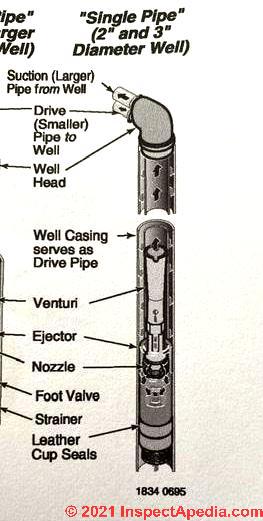
On 2021-05-21 by Anonymous - leaky leather cup seals at well using Pentair Sta-Rite SLE-L pump
I have a deep well pump (Pentair Sta-riteSLE-L). It has a suction and drive pipe at the pump and converts to a single pipe at the well head.
At the bottom of the well, the single pipe has leather cup seals vs a foot valve. I have intermittent cycling on and off at about 5 times an hour with no water running (supplies water to irrigation system).
My pump installer said this is normal with leather cup seals. Is this accurate? He also replaced the ball valve that turned water off/on to the irrigation system with with an electronic valve. Could this be a possible point of leakage?
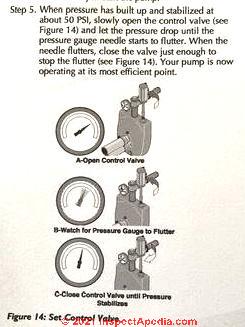
Lastly, when I last primed the pump, I followed the instructions to set the control valve (see photo). I had the control valve on the pump opened about half way. He said that the control valve should be completely open. Is this correct?
He then raised the cut on/off from 40/60 to about 45/65 and didn’t add pressure to the pressure tank (bladder type).
Could this also be why I’m having intermittent cycling?
Thank you!
Below:
How to find the Optimum setting of the Control Valve on a Pentair Sta-Rite SLE-L water pump
On 2021-03-02 - by (mod) - intermittent loss of pressure - pump doesn't respond
@Richard Jones,Could be a debris clogged pressure control: watch what happens: if the pressure drops below the CUT-IN pressure (40 psi) and the pump doesn't turn on, I'd replace the pressure control switch.
On 2021-03-02 by Richard Jones
Running into strange issue deep well pump pressure switch is 40/60 bladder tank set at 38psi, no cycling can go for days then loose water pressure and have to reset pressure switch
. As i said can run for day even take dishwasher and washing machine at same time, this just started a week ago im thing replace pressure switch with an auto one instead of manual start any advice?
On 2021-02-26 - by (mod) - 2 common causes of the periodic loss of water pressure
@Dennis,2 common causes of the periodic loss of water pressure that you describe are a debris clogged pressure control switch and of course of well that is running out of water and is protected by a pump protection switch or control.
On 2021-02-26 by Dennis
Water on in shower running well, good pressure...then water stops...2-4 minutes....then water starts up and all is good again. This happens throughout the house at various times during day.
Any thoughts on my problem. Somedays better than others.
On 2021-01-20 - by (mod) - water pump tank cycles on every hour;
Fernando
So we know there's a leak somewhere even if it's not obvious. Some suggestions for diagnosing that are in the article above. Keep in mind your Leaf could be outside of the building such as in the well piping or in a check valve or foot valve in the well.
Please find your question and my detailed reply now at the Reader Q&A section near the bottom of the article above on this page. You may need to clear or refresh your browser cache to see the updated page. We welcome your further photos, comments, questions.
On 2021-01-19 by fernando
water pump tank cycles on every hour; Loses 10 lbs of pressure per hour. when there are no leaks or water being used
On 2021-01-20 by (mod) - water pump tank cycles on every hour;
So we know there's a leak somewhere even if it's not obvious. Some suggestions for diagnosing that are in the article above. Keep in mind your Leaf could be outside of the building such as in the well piping or in a check valve or foot valve in the well.
On 2021-01-19vby fernando
water pump tank cycles on every hour; Loses 10 lbs of pressure per hour. when there are no leaks or water being used
On 2021-01-16 by (mod) - Why does my well water pump keeps running
Rodney the probable causes for a pump that keeps running and won't shut off are listed in
this diagnostic table:
WATER PRESSURE TABLE 3: PUMP RUNS, NO WATER or INSUFFICIENT WATER - water pump diagnosis
Please take a look there and ask for further help if you need.
On 2021-01-16 by Rodney
Why does my well water pump keeps running, will not turn off. I have to make it stop. Is it not primed right or a leak somewhere?
On 2020-12-07 - by (mod) -
You are describing what is most likely a well with low flow rate into the well and a small static head. You simply running out of water in the well cat provided that's enough. When you wake you'll give me time for the well to recover. In the article index you'll find an article on increasing well-heeled that may help.
On 2020-12-07 by Katie
We have a well water pump. If anyone takes along enough shower the water slows and stops. The pump then has to get restarted. Then water comes back fine. It happens every time around the same time. Any thoughts?
On 2020-11-24 by duane
my 2008 sebring 2.7 liter eng , I have replaced my rateater . replaced my thermos
t
a
t is my water pump bad ? water comes out the
b
o
t
ton my car
On 2020-10-01 - by (mod) -
Tarun
If you are describing a water pump that is not intended to be submerged you should not turn it on. There are 2 risks. One is that someone could be shocked or electrocuted. The other is that wet motor parts and bearings will simply burn up a motor and destroy the pump.
On 2020-10-01 by Tarun kumar
Water pump in the well remained underwater over night. Can we switch on for pumping or not
On 2020-09-28 - by (mod) -
Larry
We're talking about a submersible well pump, right?
The pump is turned on and off by a pressure control switch.
IF there's a leak anywhere, or a running toilet using water, those are examples of things that cause the pump to run when you don't expect it to do so.
Please review the various causes of your pump starting up without water use as they're outlined above on this page, and
don't hesitate to ask if you have further questions or suggestions.
On 2020-09-28 by Larry
why does my submersible pump keep starting without water use?
On 2020-09-28 - by (mod) -
why does my submersible pump keep starting without water use?Larry
We're talking about a submersible well pump, right?
The pump is turned on and off by a pressure control switch.
IF there's a leak anywhere, or a running toilet using water, those are examples of things that cause the pump to run when you don't expect it to do so.
Please review the various causes of your pump starting up without water use as they're outlined above on this page, and
don't hesitate to ask if you have further questions or suggestions.
On 2020-09-28 by Larry
why does my submersible pump keep starting without water use?
On 2020-05-22 by (mod)
Bruce
Most-likely one of the items listed above on this page will explain what I call "intermittent" pump cycling - the pump turns on at intervals for no apparent reason and when we think there's no water running in in the building.
Please take a look.
On 2020-05-18 by Bruce and Sharon O'Dowd
My water pump turns on and off even when everything is turned off. What would cause this?
On 2020-04-30 by (mod)
Probably one of the causes listed above on this page
On 2020-04-30 by david kailah
good day i have a goulds water pump and automatically cimes on every 3 minutes
On 2019-12-30 by JA
Pump comes on about every minute. So visible water running. Already changed the foot valve and it was working fine for a couple of days. Ran the bath water and now it is back to running about every minute. Again no apparent water running.
On 2019-07-14 by (mod) - well pump is cycling approximately the same time every night.
Try turning water into the house off. The continued cycling would point to a bad foot valve.
Or check to see if a water softener or water treatment system is cycling through a regeneration
Or look for some other timer or clock controlled device that uses water
On 2019-07-12 by Bob H
Our well pump is cycling approximately the same time every night. At about mid-night it comes on for about 2-3 minutes then goes off for a minute. This repeats this cycle until about 1:20 a.m. There is no water running - no irrigation, no leaking toilets, etc.
Now I understand this might be an intermittent or short cycling, but I'm wondering why is it happening at the same time of night. It does not happen during the day unless there is water being used. Any suggestions?
On 2019-03-29 by (mod)
Short cycling - rapid on-off cycling is NOT the same as "intermittent" pump on-off cycling at odd intervals or at periods when no water is being run.
If your pump seems to run for no reason but intermittently - that is it will turn off but then runs again - the diagnostics above on this page are what you should read.
Continuous pump operation: if the pump won't stop running the cause may be simply a high water usage rate that exceeds the pump or well's capacity to deliver water or there may be a leak or a bad control.
See WATER PUMP WONT STOP RUNNING
On 2019-03-28 by Anonymous
@kay,
Yes constant we turn it off when not in use
On2016-01-03 by (mod) - pump that chatters at the pressure shut-off end of the cycle
George
A pump that chatters at the pressure shut-off end of the cycle may have
- a burned or damaged pressure switch
- be set to a pressure too close to the pump's upper limit of pressure pumping ability
- something else I've not thought of;
more about this problem can be found above on this page and by searching InspectApedia.com for INTERMITTENT PUMP CYCLING FAQs
On2016-01-01 by george
Once my pressure hits its high it starts clicking off and on ?
...
Continue reading at FOOT VALVES, WELL PIPING or select a topic from the closely-related articles below, or see the complete ARTICLE INDEX.
Or see INTERMITTENT WATER PUMP CYCLING FAQs - diagnostic questions and answers for a water pump that seems to run for no reason.
Or see these
Recommended Articles
- WATER PUMP REPAIR GUIDE - home
- FOOT VALVES, WELL PIPING - check valve in the well
- NO WATER PRESSURE - no water at all
- PUMP PRIME, REPEATED LOSS of - pump loses prime, no water pressure
- SHORT CYCLING WATER PUMPS - pump cycles on and off rapidly when water is being run
- WATER PRESSURE TABLE 1: PUMP WON'T RUN, WON'T STOP, or CYCLES - water pump diagnosis
- WATER TANK AIR, HOW TO ADD - add air to the pressure tank to stop short-cycling pumps
- WATER PUMP DRAWDOWN VOLUME & TIME - typical volumes and times between pump cycles depend on well tank size, pressure settings, and other factors
- WATER PUMP INTERMITTENT CYCLING - pump cycles on and off at odd times or for no apparent reason
- WATER PUMP NOISE DIAGNOSIS
- WATER PUMP PRESSURE CONTROL REPAIR - diagnose, fix, replace the pressure control switch
- WATER PUMP PRIMING PROCEDURE - how to prime the pump
- WATER PRESSURE INTERMITTENT LOSS - occasional loss of water pressure
- WATER PUMP WONT STOP RUNNING - pump runs continuously, never shuts off or can't reach shut-off pressure
Suggested citation for this web page
WATER PUMP INTERMITTENT CYCLING at InspectApedia.com - online encyclopedia of building & environmental inspection, testing, diagnosis, repair, & problem prevention advice.
Or see this
INDEX to RELATED ARTICLES: ARTICLE INDEX to WATER SUPPLY, PUMPS TANKS WELLS
Or use the SEARCH BOX found below to Ask a Question or Search InspectApedia
Ask a Question or Search InspectApedia
Try the search box just below, or if you prefer, post a question or comment in the Comments box below and we will respond promptly.
Search the InspectApedia website
Note: appearance of your Comment below may be delayed: if your comment contains an image, photograph, web link, or text that looks to the software as if it might be a web link, your posting will appear after it has been approved by a moderator. Apologies for the delay.
Only one image can be added per comment but you can post as many comments, and therefore images, as you like.
You will not receive a notification when a response to your question has been posted.
Please bookmark this page to make it easy for you to check back for our response.
Our Comment Box is provided by Countable Web Productions countable.ca
Citations & References
In addition to any citations in the article above, a full list is available on request.
- Rasmussen Well Drilling, Inc., 1793 Hwy 61, Two Harbors MN. Jeremy Rasmussen provides third generation well drilling and plumbing services on the North Shore of Lake Superior. Photos by DJF. Tel 218-834-3387. Email: rasmussenwell@frontier.com
Quoting: We serve the north Shore – Lake, Cook, St. Louis, Carlton and Pine counties, including Duluth, Grand Marais, Clouqet, Carlton, Finland, Isabella, Silver Bay, Grand Portage, Saginaw, and everywhere in Northeastern Minnesota. - Flexcon, SMART TANK INSTALLATION INSTRUCTIONS [PDF], Flexcon Industries, 300 Pond St., Randolph MA 02368, www.flexconind.com, Tel: 800-527-0030 - web search 07/24/2010, original soonind.com/pdf/st_install.pdf
- Grove Electric, Typical Shallow Well One Line Jet Pump Installation [PDF], Grove Electric, G&G Electric & Plumbing, 1900 NE 78th St., Suite 101, Vancouver WA 98665 www.grovelectric.com - web search -7/15/2010 original source: http://www.groverelectric.com/howto/38_Typical%20Jet%20Pump%20Installation.pdf
- Grove Electric, Typical Deep Well Two Line Jet Pump Installation [PDF], Grove Electric, G&G Electric & Plumbing, 1900 NE 78th St., Suite 101, Vancouver WA 98665 www.grovelectric.com - web search -7/15/2010 original source: http://www.groverelectric.com/howto/38_Typical%20Jet%20Pump%20Installation.pdf
- In addition to citations & references found in this article, see the research citations given at the end of the related articles found at our suggested
CONTINUE READING or RECOMMENDED ARTICLES.
- Carson, Dunlop & Associates Ltd., 120 Carlton Street Suite 407, Toronto ON M5A 4K2. Tel: (416) 964-9415 1-800-268-7070 Email: info@carsondunlop.com. Alan Carson is a past president of ASHI, the American Society of Home Inspectors.
Thanks to Alan Carson and Bob Dunlop, for permission for InspectAPedia to use text excerpts from The HOME REFERENCE BOOK - the Encyclopedia of Homes and to use illustrations from The ILLUSTRATED HOME .
Carson Dunlop Associates provides extensive home inspection education and report writing material. In gratitude we provide links to tsome Carson Dunlop Associates products and services.
 | HOME | ABOUT | ASK a QUESTION | CONTACT | CONTENT USE POLICY | DESCRIPTION | POLICIES | PRIVACY | |
| © 2024 - 1985 Publisher InspectApedia.com - Daniel Friedman | |||||||||