InspectAPedia.com InspectAPedia®
Google
InspectAPedia
 

Free Encyclopedia of Building & Environmental Inspection, Testing, Diagnosis, Repair

Ask a Question or Search InspectAPedia

  • HOME
  • AIR CONDITIONING
  • DAMAGE ASSESSMENT
  • ELECTRICAL
  • EXTERIORS
  • HEATING
  • HOME INSPECTION
  • INTERIORS
  • PLUMBING
  • ROOFING
  • SEPTIC SYSTEMS
  • STRUCTURE
  • WATER SUPPLY
  • ENERGY SAVINGS
  • ENVIRONMENT
  • INDOOR AIR IAQ
  • INSULATION
  • MOLD INSPECT TEST REMOVE
  • NOISE
  • ODORS
  • SOLAR ENERGY
  • VENTILATION
  • EXPERTS DIRECTORY
  • CONTACT US


InspectAPedia ® Home

WATER PUMPS, TANKS, TESTS, WELLS, REPAIRS

FILTERS, WATER
GREYWATER SYSTEMS

WATER CONTAMINANT LEVELS
WATER FILTERS
WATER HAMMER NOISE DIAGNOSE & CURE
WATER HEATERS
WATER ODORS, CAUSE CURE
WATER PUMP REPAIR GUIDE
WATER PRESSURE LOSS DIAGNOSIS & REPAIR
WATER PUMP SHORT CYCLING
WATER PURIFIERS
WATER SOFTENERS & CONDITIONERS
WATER TANK REPAIR PROCEDURES
WATER TANK: USES, TROUBLESHOOTING
WATER TESTS, CONTAMINANTS, TREATMENT
WATER TREATMENT EQUIPMENT CHOICES
WELLS CISTERNS & SPRINGS
WELL FLOW RATE
WELL WATER PRESSURE DIAGNOSIS
WELL YIELD IMPROVEMENT
WINTERIZE A BUILDING

More Information

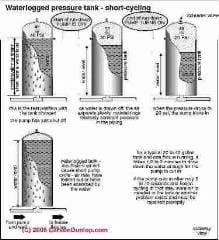
Waterlogged water pressure tank schematic (C) Carson Dunlop How to Add Air to a Water Pressure Tank
     

  • WATER TANK AIR, HOW TO ADD - How to add air to a water pressure tank
    • How to check, repair, or use the air volume control to keep proper air charge in a water pressure tank
    • How to restore lost air in a building water pressure tank
    • Water tank air volume controls, what they are, how they work - AVCs
  • WATER TANK AIR VOLUME CONTROLS - separate article
  • WATER TANK AIR ADD AT AIR VALVE - separate article
  • WATER TANK AIR ADD BY DRAINING - separate article
  • WATER TANK AIR HOW MUCH TO ADD - separate article
  • WATER TANK AIR HOW OFTEN TO ADD - separate article
  • WATER TANK AIR INLET VALVE - separate article
  • WATER TANK AIR LOSS SIGNS - separate article
  • WATER TANK AIR VALVE REPAIRS - separate article
  • WATER TANK AIR VOLUME CONTROLS - separate article
  • SNIFTER VALVES - separate article
  • Questions & answers on the procedures for adding air to a water pressure tank using one of three easy methods - how to stop well pump short cycling.
  • References

Click to Show or Hide Related Topics

  • WATER PRESSURE LOSS DIAGNOSIS & REPAIR - home
  • AIR DISCHARGE at FAUCETS, FIXTURES
  • AIR VOLUME CONTROLS, WATER TANK
  • COSTS: WATER PUMP & TANK
  • MUNICIPAL WATER PRESSURE DIAGNOSIS
  • MUNICIPAL WATER PRESSURE IMPROVEMENTS
  • WATER PRESSURE GAUGE
  • WATER PRESSURE & FLOW MEASUREMENT
  • WATER PRESSURE PROBLEM DIAGNOSIS TABLE
  • WATER PRESSURE DIAGNOSIS
  • WATER PRESSURE REDUCER / REGULATOR
  • WATER PUMP ELECTRICAL SWITCHES
  • WATER PUMP PRESSURE CONTROL ADJUSTMENT
  • WATER PUMP PRIMING PROCEDURE
  • WATER PUMP REPAIR GUIDE - home
  • WATER PUMP PROBLEM DIAGNOSTIC TABLE
  • WATER PUMP CAPACITIES TYPES RATES GPM
  • WATER PUMP CONTROLS & SWITCHES
  • WATER PUMP INTERMITTENT CYCLING
  • WATER PUMP SHORT CYCLING
  • WATER PUMP WONT STOP RUNNING
  • WATER PUMPS, TANKS, TESTS, WELLS, REPAIRS - home
  • WATER SUPPLY & DRAIN PIPING - home
  • WATER TANK: USES, TROUBLESHOOTING - home
    • WATER TANK DIAGNOSIS & REPAIR
    • CISTERNS
    • FIBERGLASS WATER TANKS, BLADDERLESS
    • ROOFTOP WATER TANKS
    • STEEL WATER TANKS, BLADDERLESS
    • WATER TANK AIR INLET VALVE
    • WATER TANK AIR VALVE REPAIRS
    • WATER TANK AIR LOSS SIGNS
    • WATER TANK AIR, HOW TO ADD
    • WATER TANK BLADDERS
    • WATER TANK PRESSURE ADJUSTMENT
    • WATER TANK DRAIN VALVE
    • WATER TANK PRESSURE CALCULATIONS
    • WATER TANK PRESSURE RELIEF VALVE
    • WATER TANK vs WATER PRESSURE
    • WATER TANK REPAIR PROCEDURES
    • WATER TANK REPLACEMENT
    • WATER TANK SAFETY
    • WATER TANK SIZE & VOLUME
  • WELL FLOW RATE & WELL PIPING LEAK DIAGNOSIS
InspectAPedia tolerates no conflicts of interest. We have no relationship with advertisers, products, or services discussed at this website.

This article describes how to add air to a building water pressure tank and it reviews the function and repair of water tank air volume controls or snifter valves in a building water supply system where a private well is the water source. Quite often a short-cycling well pump problem can be traced to loss of the air charge in the water pressure tank. This article describes three alternative methods for fixing that problem.

Green links show where you are. © Copyright 2013 InspectAPedia.com, All Rights Reserved. Author Daniel Friedman.

How to Add Air to a Water Pressure Tank
There are fancier methods than those described below but here are three simple methods for fixing a waterlogged water pressure tank, of which the second two work well for easy replacement of air lost from a water storage or pressure tank.

  1. Use or repair the water tank air volume control, if one is installed - details about different types of air volume controls (jet pumps) and snifter valves (submersible well pumps) are at WATER TANK AIR VOLUME CONTROLS
  2. Use the water tank air inlet valve or tire valve or "schrader valve" to pump air into the tank - details are at WATER TANK AIR ADD AT AIR VALVE
  3. Drain the water tank using a garden hose and allow air to enter the tank - details are at WATER TANK AIR ADD BY DRAINING

Other water tank problems such as air leaks, water leaks, or a damaged or burst air bladder, or pressure control switch problems can also make a water system behave improperly. See the links listed at Related Topics or start at WATER TANK REPAIRS for these.

Below we provide a short summary of these methods for adding air to a water tank, and we provide links to in-depth detailed procedures.

1: AIR VOLUME CONTROLS - Method 1: air-volume controls on water tanks
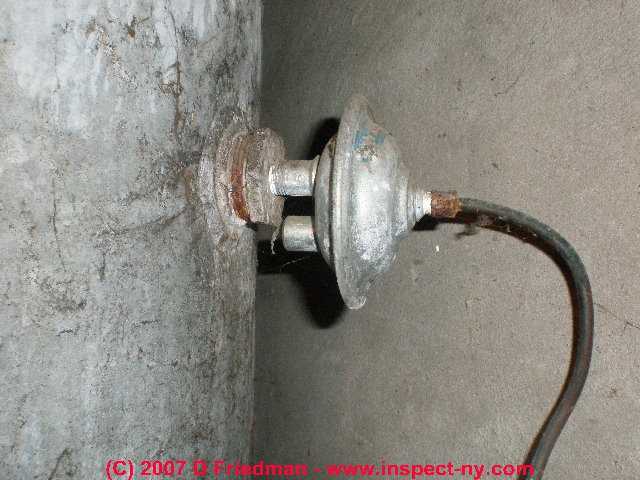
Photograph of a water pressure tank air volume control

An "automatic" air volume control (AVC) device (on jet pump well systems) or a snifter valve (on submersible pump well systems) may be installed on the water pressure tank if it's an older, bladderless steel tank.

The AVC or snifter valve is intended to automatically put a little bit of replacement air into the tank from time to time as water pressure cycles up and down, that is, each time that the water pump runs.

This device on older water systems often stops working.

One choice is to get the air volume control working again by cleaning and fixing any leaks - details are at WATER TANK AIR ADD AT AIR VALVE.

Another choice is to remove the air volume control and plug its fittings if it is leaking, and use one of the other water tank air charge methods described in these articles.

If your water tank air charge is being lost too rapidly, your water tank may have an air leak that can be fixed. Or you may need to replace the tank.

2: Use the water tank air inlet valve or tire valve or "schrader valve" to pump air into the tank

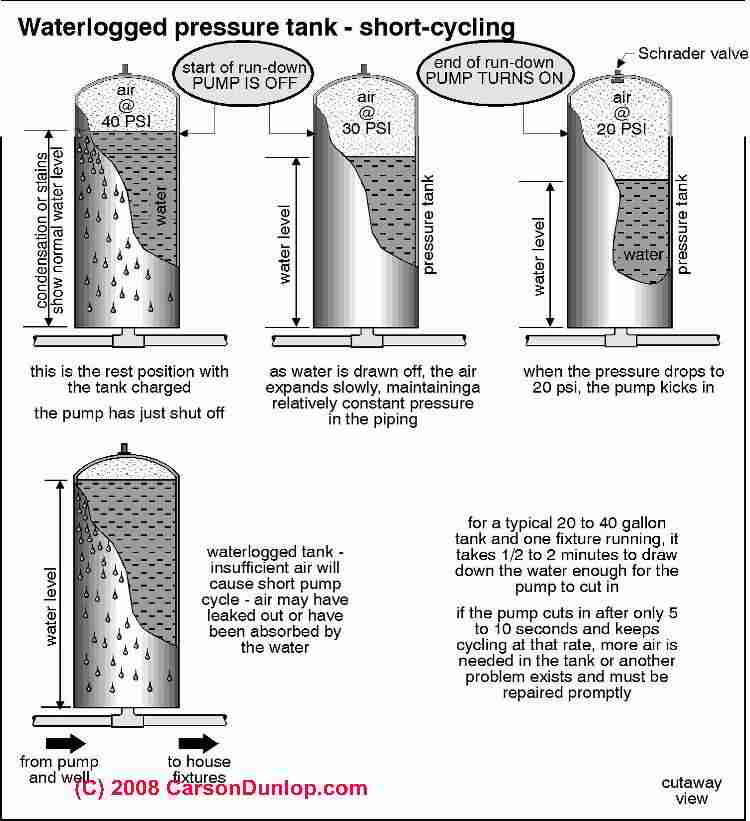
Photograph of a water pressure tank air valve


An air valve may be found on the water tank, on piping near the tank or water pump, or at the water tank outlet tee as shown in our photo at left.

Using a bicycle pump one can add air to the water tank.

Step by step details for adding air to a water pressure tank by using the air inlet valve are found at WATER TANK AIR ADD AT AIR VALVE and water tank air valves are also described at WATER TANK AIR INLET VALVE.

3: Drain the water tank using a garden hose and allow air to enter the tank

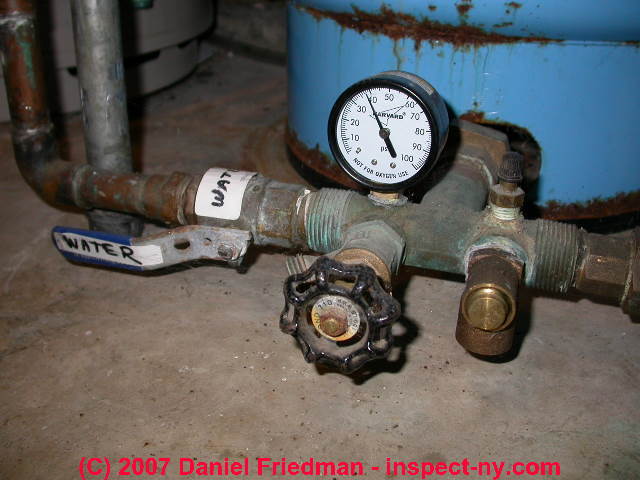
Photograph of a water pressure tank control valve


A simple method for recharging the air in a water pressure tank is to turn off the pump, attach a garden hose to the tank drain, open the hose, drain the tank completely, and then let the pump re-fill the tank.

Opening a nearby faucet or valve will speed the drain process and may help let air into the water tank.

Details are at WATER TANK AIR ADD BY DRAINING

Other water tank problems such as air leaks, water leaks, or a damaged or burst air bladder, or pressure control switch problems can also make a water system behave improperly. See the links listed at Related Topics or start at WATER TANK REPAIRS for these.

More about how we get air into the water pressure tank to avoid well pump short cycling
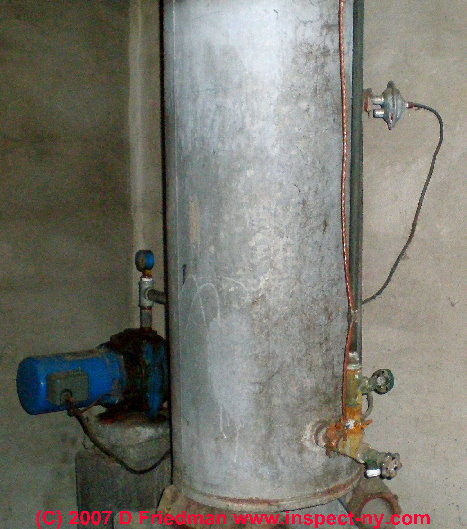
Photograph of a water pressure tank air volume control

Air volume controls are found normally only on older type bladderless steel water tanks (photo at left) and not on bladder type captive air water tanks. Therefore the procedures describe here are intended for conventional non-bladder type water pressure tanks such as the water tank shown in our photo (left). We explain these valves and how they work, are repaired, replaced, or abandoned, in our article: AIR VOLUME CONTROLS, WATER TANK

If your well tank is a "captive air" or bladder type pressure tank such as the Well-X-Trol™ series see WATER TANK BLADDER PRESSURE ADJUSTMENT.

Bladder type or captive-air water pressure tanks and their repairs are described at WATER TANK TYPES and at WATER TANKS HOW THEY WORK.

Readers of this document should also see Water pump and pressure tank repair diagnosis & cost an specific case which offers an example of diagnosis of loss of water pressure, loss of water, and analyzes the actual repair cost. The illustration at page top is courtesy of Carson Dunlop, Inc. in Toronto.

WATER PUMP CONTROLS & SWITCHES contains advice on how to adjust water pressure and water pump cut-in and cut-out pressures.

...


Frequently Asked Questions (FAQs) about how to add air back to a water pressure tank

Question: Do you need to shut off all faucets when putting air into the water pressure tank?

After draining the system and turning off the well pump, when you re-inflate the water tank to pressure, do you shut off all the faucets again to recharge the tank? Or should the water tank hold air pressure even with the faucets open? - Takafoomi

Thank you Dan for the quick response. I do have a blue pressure tank with a bladder. Upon draining the system, there was not enough air pressure to register on the tire gauge. My Square D, a 30/50, seems to be cycling a fair amount more than it should be as of late. I suspect that the bladder isn't holding a charge of air very well based on what I've read. I just want to see if I can get it to hold some air to be certain before I explore replacing the tank.. which is about 10 yrs old.

Reply: Don't fix an internal-bladder water tank just by draining it. You might need to shut off water into the home when adding air to a water tank.

With an internal bladder tank typically the starting pressure with no water in the tank is 2 psi below the pump pressure control switch cut-in pressure.

If the bladder is leaking you'll need to replace it or the entire tank/bladder assembly.
A ruptured bladder tank can behave oddly, including refusing to let water in or out of the tank depending on how the tank bladder collapses. And the pressure tank will begin to act like a bladderless-unit - consuming air over time even if a proper air charge is put into the tank.

Draining tanks or adding air to water tanks with internal bladder

If your water pressure tank uses an internal bladder you would not be fixing a waterlogged tank by draining it - so the discussion below only pertains to a bladderless water tank. Water tanks that use an internal bladder are discussed at WATER TANK BLADDERS & CAPTIVE AIR.

Draining tanks or adding air to water tanks that do not use an internal bladder

If you are using the complete tank drain down so that the tank is fully empty, then you won't be pumping ANY air into the water tank; rather, starting with a tank fully empty of water and at local normal air pressure will be enough. Details of that procedure are at WATER TANK AIR ADD BY DRAINING.

If you are adding air to a water tank by pumping air into the system, details of that process are at WATER TANK AIR ADD AT AIR VALVE.

In that case, if the air valve is mounted right on the water tank you don't need to close off water lines into the building, because air will be going right into the tank.

If the air inlet valve is mounted on building piping such as at the tank tee at the bottom of the bladderless water tank, it will usually but not always work to just pump air in at that point - much of the air will flow into the water tank. But in this case it's best to turn off the main water valve where the line exits the pressure tank and would otherwise send water into the residence. Then place the air charge into the tank.

For bladderless water tanks, don't worry if during the air pumping process some air enters the water piping in the direction of the well. That air will be pushed up into the water tank the next time the well pump cycles on. In fact that's just how snifter valves (discussed at AIR VOLUME CONTROLS, WATER TANK) work.

Question: Why is the pressure in our water tank increasing and why won't the pressure switch kick on at low pressure?

The air pressure in the pressure tank goes from 28 psi to 40 psi in just a couple of days and as a result the switch wont kick on at low pressure . any ideas on why it would take on pressure - Anon.

Reply: Check for air leaking into the system, keeping the water tank pressure abnormally high

First make sure that the pressure you are reading is air pressure, not simply system pressure. Inside a water pressure tank, both air and water in the system will (nearly) always be at the same pressure.

If your water tank is one that does not use an internal bladder and if your well pump system is picking up air (for example from a leak in the well piping or a low-flow well) then the system could be sending a water-air mix at pump output pressure into the water pressure tank where air, naturally remaining above the water in the tank, is accumulating.

If your water tank is an internal-bladder type that was installed to replace a bladderless water tank AND if your well pump is a submersible unit (located inside the well) it is possible that air is entering the water tank bladder (where it does not belong) because the water tank installer failed to remove the snifter valve and in-well air drain valve/air inlet valve that were previously used to maintain the air charge in the bladderless water tank. Details about snifter valves are at AIR VOLUME CONTROLS, WATER TANK.

Or it's something else we haven't thought of. Let us know what you find, it will help other readers.

Question: Filling a swimming pool from the well resulted in low then lost water pressure - what might be wrong?

yes, awesome site with tons of info. my issue, 2 days ago i helped my blind neighbor fill his approximately 5,000 gallon pool... the next day he had low water pressure. then the following day just dribbles. according to him, 2 months ago with another issue with a burst pipe, he had somehow, bleed the air from his tank. today i will be checking that pressure. it sounds like he may have burst the bladder or burned the submersible pump.
any other tips or possibilities you can recommend? tyvm JOHN - bullweenkle

PS:

Little update... this morning we drained the tank. then checked psi, it is at 15 psi. tried to put in the 3 more lbs.. didn't take any, it seamed. did about 20 pumps from a bicycle pump.. no difference in pressure.
also after turning power back on, only heard a little hum. no water coming in. my worst thought, pump went bad?

Reply: problems that can occur when filling a swimming pool from a private well and pump system

Bullweenkle

Often when we fill a pool from a private well that process puts a lot of stress on the equipment and on the well itself. It's possible that the overtaxed well ran out of water; usually when that happens the well can recover in 24 hours, though there could be an exception, especially if it's a very deep well with a large static head and a very low original flow rate.

In a bladderless water tank air gets absorbed into the water over time - running water continuously for a short time ought not to deplete the air; If as you suggest, this is a water tank with a bladder, then indeed a burst bladder would keep water from entering the system.

But I end with the same worry as you - that the well pump has been damaged by running for such a continuous period. In sum, after a day of recovery time for the well there ought to be water in the well itself. Even with a burst bladder or saturated water pressure tank (no air charge), if the pump turned on and was running, you'd see some water pressure and flow in the home So either there is no power going to the pump (bad pump switch, bad pump relay, disconnected wiring, power off) or the pump is not pumping.

Check that hum you report. If the pump is in the well (a submersible), you wouldn't hear any pump noise when the pump is running. If the pump is above ground, then if it's humming and not pumping, that's pretty clear that the motor is not starting or the pump is jammed or an impeller is damaged.

If you confirm that there is power to the pump and my above summary is correct, it's time to pull the pump out of the well for an inspection and test.

Follow-Up from bullweenkle:

man your good... there was no hum.... the pump was replaced yesterday at a cost of 1200$. it was put in 1961. was old anyway. BTW, 1st changed out the pressure switch. old also. ty John

Question: Sporadic water pressure, fast, then slow, pump cuts on and off every few seconds

I have a Well-X=Trol pressure tank. I have water in house, but it is sporadic, running fast, then slow, & pump cuts on & off every few seconds. There is water coming from the air valve when you push that. So I assume it is water-logged. Can I cut the power off, drain the tank, & turn it back on, let it fill, & it will add the air by itself? Please guide me so I can get this fixed. thanks - Gena Sager

Reply: the most common cause of well pump cutting on and off rapidly is lost air charge in the water pressure tank.

Gena, typically if you see water pressure varying significantly it's "fast" when the pump is on and "slow" when the pump is off and you're running off of the pressure tank delivery. Water out of the air valve suggests the tank is water logged, as you guessed too. Yes you can turn off power, drain the tank entirely, let it just fill with air by gravity, then close it up and turn the pump back on. (Watch out for losing pump prime). Details on how to do this are at WATER TANK AIR ADD BY DRAINING

A clogged water filter can also cause the pump to cycle on and off rapidly.

Question: when water is turned on, after a couple of seconds, it begins to surge and pulses harder and softer after that. Well pump pressure jumps to about 65 psi in about 5 seconds then the pump shuts off

I love this website and appreciate the good work you are doing. I am trying to diagnose a problem with my well. I have looked through your site and I’m not sure I saw a problem quite like this one. The symptom is when water is turned on, after a couple of seconds, it begins to surge and pulses harder and softer after that. I live in Sacramento, have an outdoor well and tank which is 220 gallons, galvanized steel, and I believe to be bladderless. I have the pressure switch set to 40 -60 psi.

When I watch the water pressure gauge, when the water is turned on, it goes down to 40 in about 7 seconds, the pump kicks in and it jumps up to about 65 psi in about 5 seconds and shuts off. It continues this cycle continuously while the faucet remains on. After reading your website, I was hoping I had a waterlogged tank. I shut off the power, opened the hose bib.

The tank emptied pretty fast, but kept gurgling with little bits of water coming out every so often. I shut the bib off, restarted the pump and it did the same thing. It doesn’t seem to be filling the tank. Any ideas on how to proceed?

Thanks! - Max

Reply: Sounds like a waterlogged pressure tank.

Max,

Your description sounds like a water-logged pressure tank. Your observation that when you opened the hose bib "The tank emptied pretty fast, but kept gurgling with little bits of water coming out every so often." might mean that the tank was not really emptying at the hose bib. Rather the first water that came out was that which was under pressure.

After that, the full tank was dribbling water slowly out of the hose bib as intermittently a little bubble of air found its way back into the tank to thus allow a little more water to escape. That gurgling dribbling at the hose bib may be another clue indicating a waterlogged pressure tank.

How to recognize a waterlogged pressure tank and diagnose a short cycling well pump

Under the article named WATER PUMP REPAIR GUIDE (links at Related Topics ) beginning with the article titled SHORT CYCLING WATER PUMP, you'll see some articles on the causes and cure of short cycling on-and-off of the water pump, which is usually the explanation for water pressure surging and pulsing as you describe.

One cause of the rapid pressure drop you are citing ("it goes down to 40 in about 7 seconds") is a waterlogged water pressure tank - a tank that has lost its air charge - which may be why you're reading this article. The air in the water pressure tank acts as a giant spring to smooth the delivery of water to the plumbing system. When the air is lost or the air volume is too small, there's no spring. Because water is not very compressible, the pump comes on, rapidly reaches cutoff pressure, then cuts off. A result is rapid cycling on and off of the pump, and pulsing water pressure in the building.

Three methods for fixing a waterlogged pressure tank:

You're on this same investigation path, but it sounds as if you did not successfully add air to the tank. Just draining out some water, especially at first, is just draining out water that was under pressure. You need to get air into the tank using one of the methods we describe in this article (above). See these procedures for adding air at the water pressure tank:

    WATER TANK AIR VOLUME CONTROLS
    WATER TANK AIR ADD AT AIR VALVE
    WATER TANK AIR ADD BY DRAINING

Also you might need to take a look at

    WATER TANK AIR HOW MUCH TO ADD
    WATER TANK AIR HOW OFTEN TO ADD

I've also seen this rapidly short-cycling water pump symptom when a water filter on the system is clogged or dirty. Because the well pump can't force water through the filter fast enough to keep up with flow in the building, it can cause the pump to cycle on and off quickly, causing water pressure to behave similarly.

Of course there could be other causes, so after you've read the articles I've suggested,

1. post a comment or question here if you have specific questions that remain

2. let us know what you find, as what you learn will help other readers.

Reader Follow-Up: short cycling well pump fixed by adding air at the pressure tank

I can't thank you enough for your website and quick response! I wanted to write you back and let you know the outcome of my little well issue.

The surging water I described appears to have been caused by what you describe as “Well pump short cycling.” After reading (more carefully) your article: Well Pump Short Cycling: How to diagnose “Water Pump Short Cycling” and restore Air in a Building Water Tank [see this article at SHORT CYCLING WATER PUMP] and your response, I was hopeful that the cause was a waterlogged tank. I read your step by step instructions and it worked beautifully.

Opening up nearby hose bibs and the schrader valve helped the water drain more quickly, but it still took several hours to drain the tank.

Before I tried this, the tank was draining so slowly and gurgling, I didn’t think it was still full of water. It has been nearly a week the well is working perfectly now. Not only did you save me some money, but more importantly, fixing it myself was good for my self esteem. Thanks again!

Comment-DF:

Max, reading over your notes I add the observation that your 220 gallon water tank is larger than common in-building residential tanks (30-50 gallons) and may be an indicator that your well itself has a limited flow rate or water delivery capacity. When we have a well of limited flow, a solution (other than drilling a new well) is to install a very large water storage tank and allow the pump to fill the tank at a slow rate that doesn't exceed the flow rate of the well. That assures the building always has plenty of water.

A worry, however, is that the slower the flow rate of a well, the higher the risk that it eventually stops completely. If you should need to investigate the well flow rate further, take a look at

How Much Water is In the Well? or the well flow rate test procedures at How to Test Well Water Quantity and see How to Get More Water From a Well for help in increasing the well yield or flow rate. These and related articles are found at Related Topics under WELLS CISTERNS & SPRINGS

Question: My well pump is cycling on and off and water is not entering the holding tank. How do I pressurize it?

I need help. My well is cycling and the holding tank is not filling up with water. How do I pressurize it? There is a pressure valve on the pump. But I cant seem to locate a valve stem anywhere. HELP~!! - Tammy

Reply:

Tammy, there are three approaches to re-charging the air in a water pressure tank - please read about them in the article above. If your tank doesn't have an air valve you can recharge it by draining.

Use or repair the water tank air volume control, if one is installed - details are at WATER TANK AIR VOLUME CONTROLS
Use the water tank air inlet valve or tire valve or "schrader valve" to pump air into the tank - details are at WATER TANK AIR ADD AT AIR VALVE
Drain the water tank using a garden hose and allow air to enter the tank - details are at WATER TANK AIR ADD BY DRAINING

Question: Submersible well pump growling noise during water tank recharge, vibration.

I have a heavy growl when the well pump (submerged) recharges the well tank. I can feel the vibration in the hard plastic pipe from the pump; and, it telegraphs throughout the home's copper pipes. I used the gravity method to drain the tank. Pressure gage read 34psi when completely drained.

When pump switch turned back on, pressure immediately jumped to 38; and, when tank allowed to run down, low-pressure switch kicked in at 38psi. This did not resolve the growl/vibration issue. But, when checked the Schroeder valve after performing above procedure, noted that tank pressure at valve is 44.5psi. Should I relieve the pressure at the Schroeder valve with the tank full, or empty? Should it be lowered to 36psi? If I still have the growl/vibration problem, could my submerged pump be wearing out? - Ron

Reply: Check for a stuck bladder in a bladder-type water pressure tank

Ron, before changing the tank pre-charge pressure, see if your tank bladder is sticking to itself. A well driller recently suggested to us that he tries freeing up a stuck internal tank bladder by briefly and just one time, holding the pressure switch relay down to force the pump to a higher pressure TEMPORARILY.

Watch out: - don't push the water tank pressure up past or even close to the rated tank pressure or you may burst the tank and worse, be injured.

Question: I need to add air to my water pressure tank but I don't want to read all these instructions - what's a quick summary?

Thanks so much for all the great work - but for purposes of actually adding air to my tank, I have to say it may be both too much and too little! Have cycled through several of the pages and page/links and still never found out step by step how to add air to my tank!

Do I drain it first?... leave what valves open and what closed? Power on or off? Use my compressor after dropping pressure to the cut off point or just below or 0, or fill air pressure with the tank already full and pressurized..? what levels do I stop and start adding air with my compressor? Again... your tremendous efforts are really appreciated, but finding the answer I need is just too confusing, for me anyway.

Reply: Quick overview of adding air to the water pressure tank

  • Mike, the article above lists three methods for adding air to a waterlogged water pressure tank:

    1. install, use, fix, replace if needed the air volume control - details are at WATER TANK AIR VOLUME CONTROLS

    2. pump air into the tank through an existing air valve (schrader valve) - details are at WATER TANK AIR ADD AT AIR VALVE

    3. drain all water out of the tank and allow air to enter it manually. - details are at WATER TANK AIR ADD BY DRAINING

    At each of those three procedures outlined above, you will find a link to a detailed step by step process for doing exactly what's required. Please look again at a procedure that seems best for you and ask any specific questions that remain and I'll be both grateful for the question and glad to add what detail may be missing.

    In general: turn the pump off when following any of the procedures.
  • When adding air by an pump and air valve, the starting pressure and point in the pump on-off cycle doesn't matter, nor does the amount of water in the tank. However especially if pumping in air by hand, it's easier to do so if the water pressure tank is near the bottom or lower pressure of its operating cycle. For that reason we might turn power off and drain water and pressure out of the tank at a nearby plumbing fixture, until the gauge is at or even below the normal pump cut-on pressure. But it would be better to choose one of the 3 approaches I list above and read the instructions there.
  • Just add a few psi, run the pump, observe the increased draw-down cycle time, and when it's reasonable, stop adding air.

Question: When I shut off water at the pressure tank the tank pressure keeps dropping anyway. Do I need a new pressure tank?

I am losing pressure at my well pressure gage with the water shut off leaving the water tank I put in 30 psi in the top of the tank and in 45 min its reading zero time for a new pressure tank ? thanks Karl

Reply: Check for a leaky check valve or foot valve, at the pump, on the well piping, or at the well bottom; also check for well piping leak.

Karl the water pressure tank could have a leak in itself, in which case you'd hear air hissing out or see water leaking out of the tank. But with the main water valve shut off (closed) between the pressure tank and the rest of the building, if pressure in the water tank continues to fall, the most common cause is a leaky check valve or foot valve. Depending on the pump type, there may be a check valve right in the end of the well pump (an above-ground one line jet pump) or the equivalent check valve may be at the end of the well piping (submersible pump and 2-line jet pumps).

The check valve or foot valve keeps water and pressure from leaking backwards out of the pressure tank and back down into the well when the pump stops running. If this valve is leaky you'll lose water tank pressure (and water) back into the well and eventually an aboveground pump will lose prime and you'll lose all water pressure.

A second cause of this same symptom can be a leak in the well piping itself, anywhere between the water pressure tank and the bottom of the well;

Ask a Question or Search InspectApedia

Questions & answers on the procedures for adding air to a water pressure tank using one of three easy methods - how to stop well pump short cycling.

Ask a Question or Enter Search Terms in the InspectApedia search box just below.

Technical Reviewers & References

Related Topics, found near the top of this page suggest articles closely related to this one.

  • Ben Langston, generously contributed the photographs of round disk-type air volume controls used at the top of this article.
  • Alan Carson, Carson Dunlop, Associates, Toronto, has permitted our use of the well and water pump system used at the top of this and some other pages at our website.
  • ...

Books & Articles on Building & Environmental Inspection, Testing, Diagnosis, & Repair

  • Our recommended books about building & mechanical systems design, inspection, problem diagnosis, and repair, and about indoor environment and IAQ testing, diagnosis, and cleanup are at the InspectAPedia Bookstore. Also see our Book Reviews - InspectAPedia.
  • Home Reference Book - Carson DunlopThe Home Reference Book - the Encyclopedia of Homes, Carson Dunlop & Associates, Toronto, Ontario, 25th Ed., 2012, is a bound volume of more than 450 illustrated pages that assist home inspectors and home owners in the inspection and detection of problems on buildings. The text is intended as a reference guide to help building owners operate and maintain their home effectively. Field inspection worksheets are included at the back of the volume. Special Offer: For a 10% discount on any number of copies of the Home Reference Book purchased as a single order. Enter INSPECTAHRB in the order payment page "Promo/Redemption" space. InspectAPedia.com editor Daniel Friedman is a contributing author.

    Or choose the The Home Reference eBook for PCs, Macs, Kindle, iPad, iPhone, or Android Smart Phones. Special Offer: For a 5% discount on any number of copies of the Home Reference eBook purchased as a single order. Enter INSPECTAEHRB in the order payment page "Promo/Redemption" space.

  • GO TO Carson Dunlop's Home Study Course Information - How to Become a Home Inspector: Carson Dunlop's nationally recognized Home Study Course, selected by ASHI the American Society of Home Inspectors and other professionals and associations. This website author is a contributor to this course.
  • GO TO Carson Dunlop's Home Study Course Information - How to Become a Home Inspector: Carson Dunlop's nationally recognized Home Study Course, selected by ASHI the American Society of Home Inspectors and other professionals and associations. This website author is a contributor to this course.
  • GO TO Carson Dunlop's Home Study Course Information - How to Become a Home Inspector: Carson Dunlop's nationally recognized Home Study Course, selected by ASHI the American Society of Home Inspectors and other professionals and associations. This website author is a contributor to this course.
    Building inspection education & report writing systems from Carson, Dunlop & Associates Ltd
  • ...

HOME ABOUT CONTACT COPYING DESCRIPTION POLICIES PRINTING PRIVACY © 2013 Copyright InspectAPedia.com