
InspectAPedia® FREE Encyclopedia of Building & Environmental Construction, Diagnosis, Maintenance & Repair |
Question? Just ask us! InspectAPedia
|
 How Much Air to Add to a Water Pressure Tank
- POST a QUESTION or COMMENT on how much air you should add to a water pressure tank - how to figure out the right amount of air to add and how to tell when enough air has been added to the water tank
When charging a water pressure tank, how much air should be added?
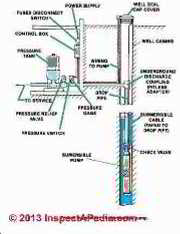
This article describes how to determine how much air should be added to a building water tank in a building water supply system where a private well is the water source and the well tank is not a bladder type or "captive air" tank.
InspectAPedia tolerates no conflicts of interest. We have no relationship with advertisers, products, or services discussed at this website.
HOW MUCH AIR TO ADD - How Much Air is needed in the water pressure tank?
These comments only apply to Methods 1 and 2 for adding air to a water pressure tank.
Method 1: USING AN AIR VOLUME CONTROL and
Method 2: USING AN AIR VALVE for adding air to a water tank
Method 3: DRAINING WATER OUT OF THE TANK to restore the air charge to a water pressure tank is so simple, you just don't care about this question.
Here we are discussing adding air into a water tank, up to some starting pressure (the pump is turned off during this procedure) so that the water pump itself doesn't have to work too hard. Don't confuse the air pressures we discuss here with the water pressures we discuss
at WATER PRESSURE CONTROL SWITCH ADJUSTMENTS
Some basic concepts about water tank air pressure:
if the air pressure in the water tank is higher than the pump pressure control cut-in pressure, in a captive-air water tank the pump can't turn on.
In a "glass lined" bladderless water tank this problem will self-correct - when a nearby faucet is opened excess air will simply gush out of the faucet at the end of the drawdown cycle.
If the air pressure in the water tank (when the tank is empty) is much below the pump pressure switch cut-in pressure, the volume of water that can be drawn out of the water tank will be reduced and the system will not perform properly.
- Just to prevent short water pump cycling:
You want enough air in the tank that the pump stops short-cycling. Don't worry, you can't put in too much air - as long as there is a pressure relief valve on the tank bottom you cannot damage the tank by trying to put in excessive air pressure.
See SHORT CYCLING WATER PUMP. - Don't put too much air into a captive-air bladder-type water tank:
we have had a number of reports of ruptured bladders in water tanks.
If you put too much air into one of these tanks (the air is in the tank but outside of the bladder) the water pump won't be able to push much water into the bladder and you'll get a short draw-down cycle.
Conversely, if you set the pump pressure too high on one of these systems, you might cause the water bladder to rupture inside the tank.
In general, bladder type water tank manufacturers recommend that the tank be empty of water when you set the air pressure in the tank to the specified psi. If you set the air pressure to the specified psi while there is water in the tank, the air volume will be incorrect (too small) and the water tank will not perform properly.
See WATER TANK BLADDERS & CAPTIVE AIR
and
also WATER TANK BLADDER PRESSURE ADJUSTMENT where we describe adjusting air pressure in a bladder type water tank to factory specs.
We discuss water pump pressure control adjustments
at WATER PRESSURE CONTROL SWITCH ADJUSTMENTS.
Also see AIR DISCHARGE at FAUCETS, FIXTURES. - Don't blow up the water tank:
If the tank does not have a PRESSURE RELIEF VALVE intended for water tanks installed on the tank bottom or nearby to protect the tank from over pressure you should have one installed. Especially with systems using a submersible pump capable of pumping to high pressure, this is an important safety device. - For a 20 psi CUT-IN setting on the pressure switch, 18 psi should be ok at the tank
For a 30 psi CUT-IN setting, 28 psi should be OK
Wet the water pressure tank's air pre-charge pressure to 2-3 psi below the pressure control switch CUT-IN pressure.
Watch out: Be sure the tank is empty of water when you are setting its pre-charge pressure.
If you are uncertain about whether or not the tank is protected from overpressure, you are safe pumping the starting air pressure inside your water tank up to 18 psi if your water pump is operating in the 20-40 psi pressure range.
You can try starting at 28 psi before re-starting the pump if your water pump is set to operate in the 30-50 psi range. Some plumbers and well tank manufacturers instruct installers add air pressure to the water tank until air pressure in an empty tank is set to 2 psi below the preset water pump cut-in pressure. We discuss how to set the water pump cut in and cut out pressures
at WATER PRESSURE CONTROL SWITCH ADJUSTMENTS. - At least 30 seconds of water draw-down time
is a reasonable minimum target: that is, with other water system pump and tank components operating normally, we want to be able to run at least 30 seconds of water at a nearby kitchen tap before the pump has to turn on. Longer draw-down cycles are better, up to the point of an excessive air charge.
Even without emptying water from a non-bladder type water tank we can often get things working satisfactorily by simply adding air until the tank drawdown cycle is sufficient. - Excess air will just be discharged:
Provided that your water tank is one that does not use an internal bladder to keep water separate from air, if you have put more air into the pressure tank than necessary, the excess air will simply squirt out of various faucets the next time you run water and then the problem will go away.
See AIR DISCHARGE at FAUCETS, FIXTURES.
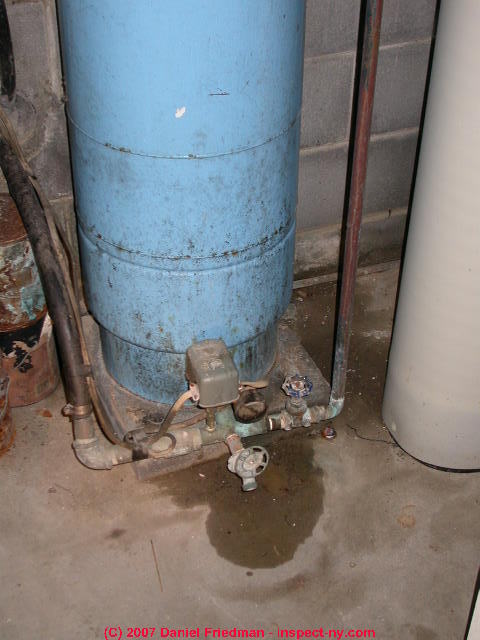
Water tank condensation marks: If you look at an older pressure tank you can usually see a darker or even rusted
color at the bottom portion of the tank.
[Click to enlarge any image]
The top edge of this colored area marks the normal air-water boundary in the tank. (Condensation on the water-filled part of the tank causes this corrosion or darkening.) In this photograph the black mold and debris stains on the lower portion of the water tank probably show the usual levels at which water has been maintained in the tank.
So if you've pumped air into the tank and later you see that the top of the area of tank covered by condensation is about where this line is, you're in business. If you see condensation occurring 2 or 3 inches from the top of the tank you need to add more air.
We used to put in enough air to give a minimum of 30 seconds of water running before the pump came on but this number varies widely depending on pump power and on how fast an individual fixture runs.
So ignore air quantity advice based on time except to watch out for real short-cycling as described earlier.
Readers of this document should also
see WATER TANK BLADDER PRESSURE ADJUSTMENT where we describe adjusting air pressure in a bladder type water tank to factory specs.
Readers of this document should also
See WATER PUMP REPAIR GUIDE for a specific case which offers an example of diagnosis of loss of water pressure, loss of water, and analyzes the actual repair cost.
The illustration at page top is courtesy of Carson Dunlop, Inc. in Toronto.
...
Continue reading at WATER TANK AIR HOW OFTEN TO ADD or select a topic from the closely-related articles below, or see the complete ARTICLE INDEX.
Or see WATER TANK AIR CHARGE QUANTITY FAQs - questions and answers posted originally at this page.
Or see these
Recommended Articles
- WATER TANK AIR, HOW TO ADD
- AIR DISCHARGE at FAUCETS, FIXTURES
- SNIFTER & DRAIN BACK VALVES
- WATER TANK AIR VOLUME CONTROLS
- WATER TANK AIR ADD AT AIR VALVE
- WATER TANK AIR ADD BY DRAINING
- WATER TANK AIR HOW MUCH TO ADD
- WATER TANK AIR HOW OFTEN TO ADD
- WATER TANK AIR INLET VALVE
- WATER TANK AIR LOSS SIGNS
- WATER TANK AIR VALVE REPAIRS
- WATER TANK AIR VOLUME CONTROLS
- WATER TANK BLADDERS & CAPTIVE AIR
- WATER TANK DIAGNOSIS & REPAIR - home
Suggested citation for this web page
WATER TANK AIR HOW MUCH TO ADD at InspectApedia.com - online encyclopedia of building & environmental inspection, testing, diagnosis, repair, & problem prevention advice.
Or see this
INDEX to RELATED ARTICLES: ARTICLE INDEX to WATER SUPPLY, PUMPS TANKS WELLS & SPRINGS
Or use the SEARCH BOX found below to Ask a Question or Search InspectApedia
Ask a Question or Search InspectApedia
Try the search box just below, or if you prefer, post a question or comment in the Comments box below and we will respond promptly.
Search the InspectApedia website
Note: appearance of your Comment below may be delayed: if your comment contains an image, photograph, web link, or text that looks to the software as if it might be a web link, your posting will appear after it has been approved by a moderator. Apologies for the delay.
Only one image can be added per comment but you can post as many comments, and therefore images, as you like.
You will not receive a notification when a response to your question has been posted.
Please bookmark this page to make it easy for you to check back for our response.
Our Comment Box is provided by Countable Web Productions countable.ca
Citations & References
In addition to any citations in the article above, a full list is available on request.
- Life Expectancy of Wells & Water Tanks how long should a water well and its components last?
- Grove Electric, Typical Shallow Well One Line Jet Pump Installation [PDF], Grove Electric, G&G Electric & Plumbing, 1900 NE 78th St., Suite 101, Vancouver WA 98665 www.grovelectric.com - web search -7/15/2010 original source: http://www.groverelectric.com/howto/38_Typical%20Jet%20Pump%20Installation.pdf
- Grove Electric, Typical Deep Well Two Line Jet Pump Installation [PDF], Grove Electric, G&G Electric & Plumbing, 1900 NE 78th St., Suite 101, Vancouver WA 98665 www.grovelectric.com - web search -7/15/2010 original source: http://www.groverelectric.com/howto/38_Typical%20Jet%20Pump%20Installation.pdf
- Our recommended books about building & mechanical systems design, inspection, problem diagnosis, and repair, and about indoor environment and IAQ testing, diagnosis, and cleanup are at the InspectAPedia Bookstore. Also see our Book Reviews - InspectAPedia.
- In addition to citations & references found in this article, see the research citations given at the end of the related articles found at our suggested
CONTINUE READING or RECOMMENDED ARTICLES.
- Carson, Dunlop & Associates Ltd., 120 Carlton Street Suite 407, Toronto ON M5A 4K2. Tel: (416) 964-9415 1-800-268-7070 Email: info@carsondunlop.com. Alan Carson is a past president of ASHI, the American Society of Home Inspectors.
Thanks to Alan Carson and Bob Dunlop, for permission for InspectAPedia to use text excerpts from The HOME REFERENCE BOOK - the Encyclopedia of Homes and to use illustrations from The ILLUSTRATED HOME .
Carson Dunlop Associates provides extensive home inspection education and report writing material. In gratitude we provide links to tsome Carson Dunlop Associates products and services.
 | HOME | ABOUT | ASK a QUESTION | CONTACT | CONTENT USE POLICY | DESCRIPTION | POLICIES | PRIVACY | |
| © 2024 - 1985 Publisher InspectApedia.com - Daniel Friedman | |||||||||