
InspectAPedia® FREE Encyclopedia of Building & Environmental Construction, Diagnosis, Maintenance & Repair |
Question? Just ask us! InspectAPedia
|
 How Frequently to Add Air to a Water Pressure Tank
How often should I need to add air to my water tank?
- POST a QUESTION or COMMENT on how often you should add air to a water pressure tank
Water tank air addition schedule:
This article explains how often to add air to a building water pressure tank, and how to detect and correct air and water leaks in a building water supply system where a private well is the water source.
InspectAPedia tolerates no conflicts of interest. We have no relationship with advertisers, products, or services discussed at this website.
HOW OFTEN TO ADD AIR - How often is the addition of air needed in a water tank?
Frequency of Adding Air to Bladderless Steel or Fiberglass Water Tanks
When your water tank is a conventional older style that does NOT use a "captive-air" type bladder, unless there's a leak at the water tank you shouldn't have to add air again for months or maybe even a year.
The frequency with which you'll need to add air depends mostly on how much water is used.
Eventually air in this older type of tank gets absorbed into the water, losing the cushion effect and generating a need for more air.
Frequency of Adding Air to Captive-air Bladder-type Water Tanks of Steel, Plastic, or Fiberglass
Captive-air or bladder type tanks should never need air added. If you keep having toadd air to a bladder-type tank something is wrong with the system, perhaps a torn or leaky water bladder in the tank or a leak in the steel tank body that is losing air.
The pressure tank's internal rubber bladder contains water, the steel tank body contains the air charge.
Key Water Tank Air Charge or Waterlogged Water Tank Diagnosis & Repair Articles
There are fancier methods than those described below but here are three simple methods, of which the second two work well for easy replacement of air lost from a bladderless or glass-lined steel water storage or pressure tank.
Bladder type or "captive air" water tanks do not normally need to have makeup air added but if you are finding short cycling on a bladder-type water tank system, if the problem is not in the pump control or water piping, the problem may be traced to a failure of the internal bladder itself - a component that may be replaceable. In that case adding air to the bladder type water tank won't correct the problem.
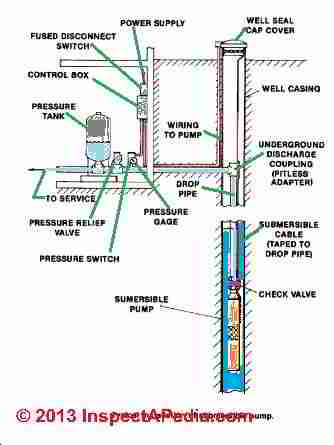
Readers of this document should also see WATER PUMP REPAIR GUIDE an specific case which offers an example of diagnosis of loss of water pressure, loss of water, and analyzes the actual repair cost. The illustration at page top is courtesy of Carson Dunlop, Inc. in Toronto.
...
Continue reading at WATER TANK AIR INLET VALVE or select a topic from the closely-related articles below, or see the complete ARTICLE INDEX.
Suggested citation for this web page
WATER TANK AIR HOW OFTEN TO ADD at InspectApedia.com - online encyclopedia of building & environmental inspection, testing, diagnosis, repair, & problem prevention advice.
Or see this
INDEX to RELATED ARTICLES: ARTICLE INDEX to WATER SUPPLY, PUMPS TANKS WELLS & SPRINGS
Or use the SEARCH BOX found below to Ask a Question or Search InspectApedia
Ask a Question or Search InspectApedia
Questions & answers on how often you should add air to a water pressure tank
Try the search box just below, or if you prefer, post a question or comment in the Comments box below and we will respond promptly.
Search the InspectApedia website
Note: appearance of your Comment below may be delayed: if your comment contains an image, photograph, web link, or text that looks to the software as if it might be a web link, your posting will appear after it has been approved by a moderator. Apologies for the delay.
Only one image can be added per comment but you can post as many comments, and therefore images, as you like.
You will not receive a notification when a response to your question has been posted.
Please bookmark this page to make it easy for you to check back for our response.
Our Comment Box is provided by Countable Web Productions countable.ca
Citations & References
In addition to any citations in the article above, a full list is available on request.
- Flexcon, SMART TANK INSTALLATION INSTRUCTIONS [PDF], Flexcon Industries, 300 Pond St., Randolph MA 02368, www.flexconind.com, Tel: 800-527-0030 - web search 07/24/2010, original source: http://www.flexconind.com/pdf/st_install.pdf
- Grove Electric, Typical Shallow Well One Line Jet Pump Installation [PDF], Grove Electric, G&G Electric & Plumbing, 1900 NE 78th St., Suite 101, Vancouver WA 98665 www.grovelectric.com - web search -7/15/2010 original source: http://www.groverelectric.com/howto/38_Typical%20Jet%20Pump%20Installation.pdf
- Grove Electric, Typical Deep Well Two Line Jet Pump Installation [PDF], Grove Electric, G&G Electric & Plumbing, 1900 NE 78th St., Suite 101, Vancouver WA 98665 www.grovelectric.com - web search -7/15/2010 original source: http://www.groverelectric.com/howto/38_Typical%20Jet%20Pump%20Installation.pdf
- Our recommended books about building & mechanical systems design, inspection, problem diagnosis, and repair, and about indoor environment and IAQ testing, diagnosis, and cleanup are at the InspectAPedia Bookstore. Also see our Book Reviews - InspectAPedia.
- In addition to citations & references found in this article, see the research citations given at the end of the related articles found at our suggested
CONTINUE READING or RECOMMENDED ARTICLES.
- Carson, Dunlop & Associates Ltd., 120 Carlton Street Suite 407, Toronto ON M5A 4K2. Tel: (416) 964-9415 1-800-268-7070 Email: info@carsondunlop.com. Alan Carson is a past president of ASHI, the American Society of Home Inspectors.
Thanks to Alan Carson and Bob Dunlop, for permission for InspectAPedia to use text excerpts from The HOME REFERENCE BOOK - the Encyclopedia of Homes and to use illustrations from The ILLUSTRATED HOME .
Carson Dunlop Associates provides extensive home inspection education and report writing material. In gratitude we provide links to tsome Carson Dunlop Associates products and services.
 | HOME | ABOUT | ASK a QUESTION | CONTACT | CONTENT USE POLICY | DESCRIPTION | POLICIES | PRIVACY | |
| © 2024 - 1985 Publisher InspectApedia.com - Daniel Friedman | |||||||||