
InspectAPedia® FREE Encyclopedia of Building & Environmental Construction, Diagnosis, Maintenance & Repair |
Question? Just ask us! InspectAPedia
|
 Water Storage Tank Safety, Plastic Contaminants, Relief Valves, Installation & Inspection
- POST a QUESTION or COMMENT about water storage tank & water pressure tank safety, features, & controls
This article describes Home Water Tank Safety:
Water Tank Pressure Relief Valves, Water Tank Electrical Switches, how to use them, adjust them, or where they should be installed. We include a water tank safety checklist and a water storage tank installation checklist.
We also discuss PET plastic water tanks.
InspectAPedia tolerates no conflicts of interest. We have no relationship with advertisers, products, or services discussed at this website.
WELL PUMP & WATER TANK SAFETY - Water pump and water pressure tank or water storage tank safety advice
 Water tank pressure relief valves are discussed here. We provide safety tips about
water pressure tank relief valves and electrical safety around water pumps, water pressure tanks, and water storage tanks.
Water tank pressure relief valves are discussed here. We provide safety tips about
water pressure tank relief valves and electrical safety around water pumps, water pressure tanks, and water storage tanks.
Article Contents
Water Pressure Tank Pressure Relief Valve
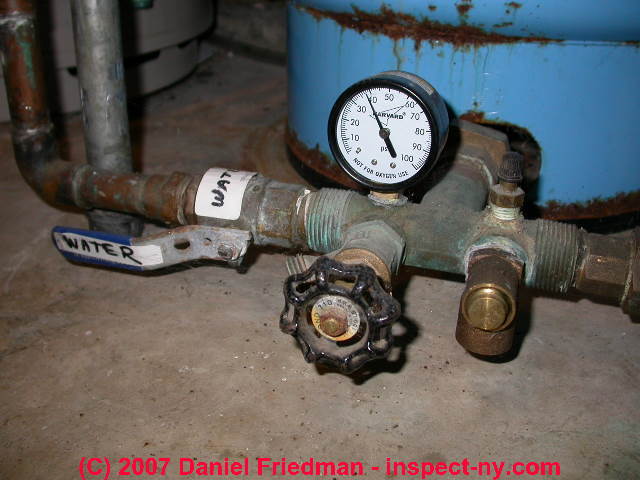
In this photo, the small brass fitting to the right of the black
drain valve is a pressure relief valve needed on any pressurized tank.
On your water system these components may be
located differently.
Tank rupture hazards: can damage equipment or injure someone nearby. Every tank which is
pressurized (such as by water or air) should have a pressure relief valve installed - a safety device
required by building codes in many jurisdictions.
Most water tanks operate at relatively low pressures,
up to perhaps 60 psi. (Higher water pressure in buildings tends to cause leaks at faucets and toilets.)
But in the unlikely event that a pump pressure control is damaged and refuses to turn the pump OFF,
pressures in the system, particularly if a submersible (in-well) pump is installed, can become high
enough to rupture a water tank. This is particularly true if the tank is old, rusted, or otherwise damaged.
Watch out: a ruptured water pressure tank can do more than flood your building, causing expensive damage or mold contamination. A ruptured water tank can also injure or in extreme cases, kill someone, as happened to a New Paltz NY plumber who was leaning over a water pressure tank when it exploded from over-pressure.
At WATER TANK PRESSURE RELIEF VALVE we list some known fatalities from ruptured water pressure tanks.
The water tank pressure relief valve shown in our photo (above) is marked indicating that it will open at water pressure equal to or greater than 75 psi. That pressure is pretty standard and you'll see the 75 psi figure on valves used on water tanks and on some tankless water heaters too.
Check with the manufacturer of your water tank to determine if a different relief valve opening pressure is required.
Details about water storage tank relief valves or water tank pressure relief valves are
If a pressure relief valve is not installed on your water tank ask your plumber to provide one promptly.
Other Water Tank Safety Hazards
- Trip hazards wet floors can cause slips and falls - be careful.
- Electrical shock hazards: can be fatal. Do not touch electrical controls in a building, such as a pump power electrical switch, if you're standing on a wet floor.
- Fatal Electrical Shock Hazard if you remove the cover of the pump pressure control switch you can get access to the
two nuts that adjust the operating pressures of the water pump. But watch out! There are also live electrical contacts exposed in this
area. If you touch them, especially being near water piping, there is a serious risk of death by electrocution.
Watch what you touch, or have a professional plumber or electrician do this job for you.
See details at WATER PRESSURE CONTROL SWITCH ADJUSTMENTS
Water Storage Tank Health, Safety, & Sanitation Advice
 Question:
I've been unable to find on-line information about the safety of using common 1500 gallon plastic water tanks to hold drinking water. Our tank is shaded, but summers are warm and the water often sits in the tank for weeks, especially when we are traveling.
Our tank is 20 years old, but according to web sites now selling drinking water tanks, the plastic is polyethylene terephthalate aka PET.
To my knowledge, we haven't had any problems to date with bacteria growing. I don't taste plastic. We once had a mouse get in and die. Bad smelling water. It cleared up after a few weeks. Probably drank some of it!
Do you have any information or links? - Barbara Stuart
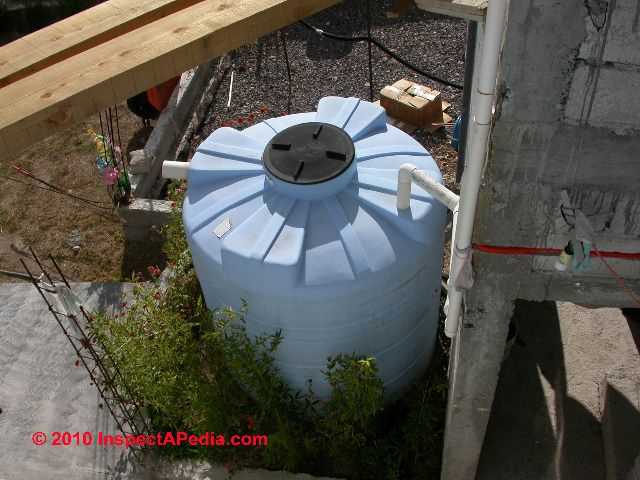
The above-ground water cistern storage tank shown in our photo (above left) is located in San Miguel de Allende, Mexico and is discussed at PASSIVE SOLAR HOME, LOW COST.
Answer:
As Ms. Stuart pointed out, some water storage tanks are made of plastic polyethylene terephthalate aka PET. Polyethylene Terephthalate (PET, PETE or polyester) is commonly used for carbonated beverage and water bottles.
Some water storage tanks have also been constructed of this material.
PET - Polyethylene terephthalate (PETE, PETP, PET-P) is a thermoplastic polymer polyester plastic resin. plastic water tanks may be a health risk to consumers: Commentary published in Environmental Health Perspectives in April 2010 suggested that PET might yield endocrine disruptors under conditions of common use and recommended research on this topic.
Proposed mechanisms include leaching of phthalates as well as leaching of antimony. Other authors have published evidence indicating that it is quite unlikely that PET yields endocrine disruptors. - Web search 6/27/2010 Wikipedia. PET
Sorting Through the Confusion of Opinions vs. Studies About Plastic Container Materials, Names, Hazards
Researching the health hazards of plastic containers and asking which plastics are safe can give conflicting and confusing results.
Some sources such as the "green" website Care2.com assert that PET or PETE polyethylene terephthalate and HDPE high density polyethylene plastic containers are "GOOD: Not known to leach any chemicals that are suspected of causing cancer or disrupting hormones.".
These same sources may tag LDPE, PP, PS as "OK", and tagging PVC or V and PS as "BAD - PVC - According to the National Institutes of Health, di-2-ethylhexyl phthalate (DEHP), commonly found in PVC, is a suspected human carcinogen., and BAD PS - According to the National Institutes of Health, di-2-ethylhexyl phthalate (DEHP), commonly found in PVC, is a suspected human carcinogen." - Web search 07/24/2010 care2.com.
There is also confusion about "polyethylene plastic" bottles and tanks. Don't confuse HDPE plastic (high density polyethylene) with PET - Polyethylene terephthalate (PETE, PETP, PET-P) -
see WHAT PLASTIC WAS USED to Make My Water Tank (or water bottle)?
Looking at more expert researchers commenting on PET plastic containers:
But recently researchers have raised serious questions about potential health and environmental concerns for PET or PETE plastics.
At Reviewers & References (at the end of this page) see Sax L 2010, López-Carrillo L, et als 2010, Koike E, 2010, for examples.
In April 2010 Environmental Health Perspectives, a peer-reviewed open access journal published by the National Institute of Environmental Health Sciences, Saxreported that
Polyethylene terephthalate (PET) is widely used to make clear plastic bottles for bottled water and containers for other beverages, condiments, and cosmetic products.
There is concern that estrogenic chemicals such as phthalates may leach into the contents from bottles made from PET, although PET is not a phthalate derivative. Sax (p. 445) describes several studies suggesting that water from PET bottles can have estrogenic activity in some bioassays and that phthalates might leach from PET bottles. The author notes the difficulties in evaluating these studies, especially in cases where there may have been prior contamination of the water or the containers with estrogenic agents or phthalates.
Sax suggests that the phthalate content of PET bottles, if present, might vary as a function of the acidity of the product and the temperature and duration of storage. Sax also makes the observation that other nonphthalate chemicals such as antimony, which is used as a catalyst in the polycondensation of PET, might also contribute to the endocrine-disrupting activity of products stored in PET containers. The widespread use of PET plastic for a variety of applications suggests that additional research is needed.
The contents of the PET bottle, and the temperature at which it is stored, both appear to influence the rate and magnitude of leaching. Endocrine disruptors other than phthalates, specifically antimony, may also contribute to the endocrine-disrupting effect of water from PET containers.
Conclusions: More research is needed in order to clarify the mechanisms whereby beverages and condiments in PET containers may be contaminated by endocrine-disrupting chemicals.
If your water storage tank is made from Polyethylene terephthalate (PET), and is exposed to high temperatures such as exposure to direct sun and/or in a hot climate, the health risk may be increased. AtReferences or Citations , below, we include citations of several recent articles discussing health risks from Phthalates and PET containers.
List of Types of Plastics Used for Containers & Tanks
Please see PLASTIC RECYCLING CODES, TANKS, TYPES for our complete article on this topic.
- HDPE - High Density Polyethylene - the most widely used material for plastic bottles, HDPE is supplied in FDA-approved food-grade products. It does not withstand temperatures over 160 degF.
- K-SBC - K-Resin SBC plastic containers, a styrene derivative, used for containers but not for oils or solvents.
- LDPE - Low Density Polyethylene - similar to HDPE, less rigid, more translucent, more costly, not used for water storage tanks.
- PCR - Post-Consumer Resin, reclaimed plastic HDPE storage containers.
- Polycarbonate plastic containers made with biphenyl-A (a hormone disruptor)(baby bottles, microwave ovenware, eating utensils)
- PET - Polyethylene terephthalate (PETE, PETP, PET-P) is a thermoplastic polymer polyester plastic resin. plastic water tanks may be a health risk to consumers
- PP - Polypropylene plastic storage containers, used for foods, tolerates higher temperatures.
- PS - Polystyrene plastic storage containers, used with dry products, not for water storage.
- PVC - Polyvinyl Chloride plastic bottles or storage tanks, used for bottled oils and soaps, like HDPE it does not withstand high temperatures over 160 degF.
Sources of Plastic Water Storage Tanks
Some currently-marketed plastic water storage tanks include water tanks for RVs and home or commercial use, constructed of [web search 07/24/2010]
- "Virgin polyethylene" plastic water storage tanks - e.g. Non Pressurized 165 Gallon Polyethylene Water Storage Tank $689.00 new - affordablewater.us and 500-gallon polyethylene storage tanks at gemplers.com.
- "Plastic water tanks" 25-10,000 gallon water storage including rainwater storage tanks, aboveground, by Freeman, Chem-Tainer .
- Chem-Tainer Industries is a producer of a very wide range of plastic storage tanks
- Books on building or repairing ferrocement, steel, and plastic water tanks are below at Reviewers & References.
So What Plastic Was Used to Make My Water Tank (or water bottle)?
How do you identify what kind of plastic was used to make your water or other storage tank or even your plastic water bottle or food container?
Use the simple guide to plastic recycling codes and other plastic tank type identification suggstions
at PLASTIC RECYCLING CODES, TANKS, TYPES for our complete article on this topic, and look for the recycling indicator or label on your plastic container.
Water Storage Tank Safety Checklist
Watch out: be sure that any storage tank is not an attractive nuisance to children or teens, and that the tank is protected from entry - a child or animal falling into a tank could perish.
Chem-Tainer provides these Water Tank Safety Checklists and Advice
- Confirm chemical compatibility of product being stored with that of the polyethylene tank and fittings.
- Tanks are to be used at atmospheric pressure only. Make sure tanks are vented as required to prevent pressure or vacuum from developing.
- Prevent excessive heat near or inside the tank. Polyethylene tanks are designed for a maximum continuous temperature of 70° F.*
- Have and use Material Safety Data Sheets (MSDS) for the product being stored.
- Regard tanks as confined spaces.
- Follow proper entry procedures.
- Do not stand on tank domes as the surface is flexible and slippery.
- Do not move tanks while holding liquid and never allow personnel under a tank when it is being lifted!
Watch out: * EXTREME CAUTION: Consult Customer Service on any applications where continuous use is above 70° F.
Water Storage Tank Installation Checklist
- Locate the tank wisely.
- Protect personnel from chemical danger in the event of a leak and protect the tank from traffic damage and excessive heat.
- Tanks are designed for above ground use only.
- Utilize adequate secondary containment according to particular chemical danger and governmental and industry requirements.
- Fully support the entire bottom of the tank on a clean, smooth concrete foundation.
- Failure to provide proper foundation and support constitutes a misuse of the tank and will void your warranty.
- Fill the usable capacity of the tank with water and hydro test up to a minimum of 5 hours after installation and before product is introduced to ensure tank and fitting integrity.
- Install labels for chemical warning that complies with all local, federal and OSHA requirements.
Water Storage Tank Operating Parameters
- Temperature - Tank specific gravity ratings based on product temperature of 70° F.
- Pressure - Atmospheric pressure must be maintained in tank at all times; vacuum must = 0.
- Make sure tank is properly vented for the type of material and flow rates expected.
- Plumbing - Flexible connections REQUIRED to preserve warranty.
Water Storage Tank Maintenance Guidelines
- Water tanks should be inspected on a routine basis.
- Clean the exterior and interior of the tank.You cannot properly inspect a dirty tank.
See CLEANING & DINSINFECTING WATER CISTERNS AFTER FLOODS & HEAVY RAINS [PDF] U.S. CDC - Inspect the exterior and the interior of the tank for cracking and brittle appearance. Pay particular attention to areas around fittings and where different planes of the tank radius into one another.
- A bright light source should be used to inspect the interior from the man way opening to avoid a confined space entry.
- Inspect fittings and exterior gaskets for leaks and signs of general corrosion and deterioration.
Chem-Tainer Industries - original source http://www.chemtainer.com
...
Continue reading at WATER PRESSURE TOO HIGH: DANGERS or select a topic from the closely-related articles below, or see the complete ARTICLE INDEX.
Or see these
Other Water Tank Safety Topics
- BLEVE EXPLOSIONS
- CISTERNS, WATER STORAGE - types of water storage tanks and cisterns
- ENDOCRINE DISRUPTERS at BUILDINGS
- PLASTIC RECYCLING CODES, TANKS, TYPES
- ROOFTOP WATER TANKS
- SPRINGS for WATER SUPPLY - what are they, can they be sanitary and safe?
- WATER PRESSURE TOO HIGH: DANGERS
- WATER PUMP WONT STOP RUNNING - things that can cause a pump to run continuously
- WATER TANK AIR PRESSURE ADJUSTMENT
- WATER TANK PRESSURE CALCULATIONS
- WATER TANK PRESSURE RELIEF VALVE - pressure relief valves for water storage tanks or water pressure tank
- WATER TANK SAFETY
Suggested citation for this web page
WATER TANK SAFETY at InspectApedia.com - online encyclopedia of building & environmental inspection, testing, diagnosis, repair, & problem prevention advice.
Or see this
INDEX to RELATED ARTICLES: ARTICLE INDEX to WATER SUPPLY, PUMPS TANKS WELLS
Or use the SEARCH BOX found below to Ask a Question or Search InspectApedia
Ask a Question or Search InspectApedia
Try the search box just below, or if you prefer, post a question or comment in the Comments box below and we will respond promptly.
Search the InspectApedia website
Note: appearance of your Comment below may be delayed: if your comment contains an image, photograph, web link, or text that looks to the software as if it might be a web link, your posting will appear after it has been approved by a moderator. Apologies for the delay.
Only one image can be added per comment but you can post as many comments, and therefore images, as you like.
You will not receive a notification when a response to your question has been posted.
Please bookmark this page to make it easy for you to check back for our response.
Our Comment Box is provided by Countable Web Productions countable.ca
Citations & References
In addition to any citations in the article above, a full list is available on request.
- Thanks to reader Barbara Stuart for discussing water storage tank sanitation and concerns for PET plastic water storage tanks - June 2010.
- Barrett JR 2010. Attention-Worthy Association: Prenatal Phthalate Exposure and Later Child Behavior. Environ Health Perspect 118:a172-a172. doi:10.1289/ehp.118-a172b, Online: 01 April 2010 - Polybrominated Diphenyl Ethers Induce Developmental Neurotoxicity in a Human in Vitro Model: Evidence for Endocrine Disruption
Web search 07/24/2010, original source: http://ehp03.niehs.nih.gov/article/fetchArticle.action?
articleURI=info%3Adoi%2F10.1289%2Fehp.118-a172b
Quoting:
Human exposure to phthalates is ubiquitous due to widespread commercial use. Although the compounds are reported to be rapidly metabolized, concentrations in the body appear to remain fairly stable due to ongoing exposure. The United States and Europe have banned some phthalates from consumer products primarily on the basis of reproductive toxicity data. However, not all phthalates are regulated; meanwhile, research indicates toxicity may extend to other endocrine targets such as the thyroid gland, which is critical for proper neurodevelopment. A new study now reports an association between prenatal exposure to certain phthalates and adverse effects on test scores used to evaluate children’s behavior and executive functioning [EHP 118:565–571; Engel et al.]. - Chem-Tainer Industries, 361 Neptune Avenue, West Babylon, NY 11704, Phone: (631) 661-8300, Toll Free: 1-800-ASK-CHEM, Chem-Tainer Representatives are available 8 AM - 8 PM Eastern Time Fax: (631) 661-8209800-275-2436, Email: sales@chemtainer.com - Web Search 07/24/2010, original source: http://www.chemtainer.com/watertanks/vertical.aspx
- Sax L 2010. Polyethylene Terephthalate May Yield Endocrine Disruptors. Environ Health Perspect 118:445-448. doi:10.1289/ehp.0901253, Web Search 07/24/2010 original source: http://ehp03.niehs.nih.gov/article/fetchArticle.action?article
URI=info%3Adoi%2F10.1289%2Fehp.0901253
Polyethylene terephthalate (PET) is widely used to make clear plastic bottles for bottled water and containers for other beverages, condiments, and cosmetic products. There is concern that estrogenic chemicals such as phthalates may leach into the contents from bottles made from PET, although PET is not a phthalate derivative. Sax (p. 445) describes several studies suggesting that water from PET bottles can have estrogenic activity in some bioassays and that phthalates might leach from PET bottles. The author notes the difficulties in evaluating these studies, especially in cases where there may have been prior contamination of the water or the containers with estrogenic agents or phthalates. Sax suggests that the phthalate content of PET bottles, if present, might vary as a function of the acidity of the product and the temperature and duration of storage. Sax also makes the observation that other nonphthalate chemicals such as antimony, which is used as a catalyst in the polycondensation of PET, might also contribute to the endocrine-disrupting activity of products stored in PET containers. The widespread use of PET plastic for a variety of applications suggests that additional research is needed. - López-Carrillo L, Hernández-Ramírez RU, Calafat AM, Torres-Sánchez L, Galván-Portillo M, Needham LL, et al. 2010. Exposure to Phthalates and Breast Cancer Risk in Northern Mexico. Environ Health Perspect 118:539-544. doi:10.1289/ehp.0901091
Web Search 07/24/2010, original source: http://ehp03.niehs.nih.gov/article/fetchArticle.action?articleURI=info%3Adoi%2F10.1289%2Fehp.0901091
Keywords: breast cancer, case–control study, endocrine disruptors, environment, Mexico, phthalates, risk assessment, urinary metabolites.
Quoting:
Conclusions: We show for the first time that exposure to diethyl phthalate, the parent compound of MEP, may be associated with increased risk of BC [breast cancer], whereas exposure to the parent phthalates of MBzP and MCPP might be negatively associated. These findings require confirmation.
Quoting the Editor's Summary:
Phthalates are ubiquitous environmental pollutants used primarily as plasticizers of polyvinyl chloride and as additives in consumer and personal care products. Research has shown that phthalates can have effects on reproductive health and development. Few studies have investigated potential adverse effects of phthalates in women. In a population-based case–control study, López-Carrillo et al. (p. 539) examined the association between urinary concentrations of nine phthalate metabolites and breast cancer. Phthalate metabolites were detected in urine samples in at least 82% of women. The geometric mean concentrations of monoethyl phthalate (MEP) were higher in cases than controls, whereas controls had significantly higher concentrations of mono-n-butyl phthalate, mono(2-ethyl-5-oxohexyl) phthalate, and mono(3-carboxypropyl) phthalate (MCPP) than cases. After adjusting for risk factors and other phthalates, urinary concentrations of MEP were positively associated with breast cancer, and the association w as stronger among premenopausal women. In contrast, there were significant negative associations between monobenzyl phthalate (MBzP) or MCPP and breast cancer. - Koike E, Yanagisawa R, Sadakane K, Inoue K-i, Ichinose T, Takano H 2010. Effects of Diisononyl Phthalate on Atopic Dermatitis in Vivo and Immunologic Responses in Vitro. Environ Health Perspect 118:472-478. doi:10.1289/ehp.0901255 - Web Search 07/24/2010, original source: http://ehp03.niehs.nih.gov/article/fetchArticle.action?articleURI=info%3Adoi%2F10.1289%2Fehp.0901255
Diisononyl phthalate (DINP), a principal plasticizer in many polyvinyl chloride products, has been shown to have an adjuvant effect on immunoglobulin (Ig) production in mice. However, the effects of DINP on allergic diseases have not been fully elucidated.
Conclusions: DINP can aggravate AD-like skin lesions related to Dp. The mechanisms of the aggravation might be mediated, at least partly, through the TSLP-related activation of dendritic cells and by direct or indirect activation of the immune cells.
Quoting Editor's Summary
Epidemiologic studies have suggested that exposure to phthalate esters such as di-isononyl phthalate (DINP) may be associated with the development of asthma, wheezing, and allergic symptoms. Koike et al. (p. 472) investigated the effects of DINP on the development of another allergic disease, atopic dermatitis. These investigators induced atopic dermatitis experimentally in laboratory animals and then exposed the mice systemically to various doses of DINP for up to 16 days. Clinical scores, histology, protein level of cytokines and chemokines in ear tissue supernatants, and levels of immunoglobulin and histamine in serum were measured at the end of DINP exposure. The effects of DINP on immunologic responses of bone-marrow–derived dendritic cells (BMDCs) or splenocytes were also measured in vitro. DINP exacerbated atopic dermatitis–like skin lesions in a manner consistent with eosinophilic inflammation, mast cell degranulation, and thymic stromal lymphpoeitin expression. DINP also enhanced expression o f cell surface activation markers on BMDCs and affected systemic immune responses on splenocytes in vitro. The authors conclude that DINP can aggravate atopic dermatitis–like skin lesions in an animal model and that the effects may be mediated, as least in part, through the thymic stromal lymphopoeitin-related activation of dendritic cells and direct or indirect activation of immune cells. These studies provide biological plausibility for other observations in humans, which suggests that exposure to plasticizers such as DINP might be associated with allergic diseases such as atopic dermatitis. - Watts Corporation, Series 53 Pressure Relief Valves, for commercial and residential applications, publication ES-53 1010, Watts Corporation, 815 Chestnut St., No. Andover, MA 01845-6098; www.watts.com and Watts Corporation in Canada: 5435 North Service Rd., Burlington, ONT. L7L 5H7; www.wattscanada.ca.
Web search 03/24/2011, original source: http://media.wattswater.com/ES-53.pdf and also http://media.wattswater.com/1910868.pdf
Note: The Watts products shown on the first cited product page are small type relief valves. Construction of these products does not meet the (ANSI Z21.22) nationally recognized applicable standard.
- ...
- Our recommended books about building & mechanical systems design, inspection, problem diagnosis, and repair, and about indoor environment and IAQ testing, diagnosis, and cleanup are at the InspectAPedia Bookstore. Also see our Book Reviews - InspectAPedia.
- In addition to citations & references found in this article, see the research citations given at the end of the related articles found at our suggested
CONTINUE READING or RECOMMENDED ARTICLES.
- Carson, Dunlop & Associates Ltd., 120 Carlton Street Suite 407, Toronto ON M5A 4K2. Tel: (416) 964-9415 1-800-268-7070 Email: info@carsondunlop.com. Alan Carson is a past president of ASHI, the American Society of Home Inspectors.
Thanks to Alan Carson and Bob Dunlop, for permission for InspectAPedia to use text excerpts from The HOME REFERENCE BOOK - the Encyclopedia of Homes and to use illustrations from The ILLUSTRATED HOME .
Carson Dunlop Associates provides extensive home inspection education and report writing material. In gratitude we provide links to tsome Carson Dunlop Associates products and services.
 | HOME | ABOUT | ASK a QUESTION | CONTACT | CONTENT USE POLICY | DESCRIPTION | POLICIES | PRIVACY | |
| © 2024 - 1985 Publisher InspectApedia.com - Daniel Friedman | |||||||||