
InspectAPedia® FREE Encyclopedia of Building & Environmental Construction, Diagnosis, Maintenance & Repair |
Question? Just ask us! InspectAPedia
|
 Water Tank Size, Volume, & Requirements

- POST a QUESTION or COMMENT about the size of water tanks in buildings: what size do we need, what are "equivalent" water tank sizes in gallons or liters and what does that mean?
Water tank sizing charts, formulas, advice:
This article explains Water Tank Size - how much water is in the water pressure tank? We address the question of how much water volume we need to avoid short cycling the water pump?
This article series answers just about any question you may have about pumps, wells, and drinking water.
InspectAPedia tolerates no conflicts of interest. We have no relationship with advertisers, products, or services discussed at this website.
How Much Water is in the Water Tank? How big a tank is needed?

How to calculate the volume of water in a water tank
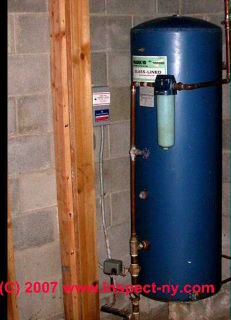
IF we just wanted to calculate the volume of water inside of a round water tank (photo at left), for simplicity ignoring a concave or convex (domed) water tank top and maybe bottom, we can use the formula to calculate the volume of a cylinder. Just measure the height and circumference of the water tank.
[Click to enlarge any image]
Reader Craig Revill send us this photograph [above] of a large water storage tank in an 80 to 100 year old home, along with the tank dimensions: 36" in diameter and 99" in length. You can use the following formula to calculate the number of gallons of water (or any other liquid) in a storage tank:
pi * radius2 * height (pi is 3.1416)
Gallons of water in a tank: one gallon = 231 cu. in.
Reader Roger Davis reminded us to make clear that in the formula above, the radius (which is half of the tank diameter) should be squared. That is, divide the diameter in half to obtain the radius, and multiply r x r to obtain r2.
For the 36" diameter x 99" long water tank above, we calculated the water tank volume as follows:
[3.1416 x (18")2 x 99" = 100,782 cu .in.] / 231 = 436 gallons in this water tank.
That's a big tank storing a lot of water, probably indicating a well with a very low flow rate at the home where this water tank was installed. Or someone was planning to survive a long dry period. The small control connection shown at the 11 o'clock position on the end of this water tank was
Domed water tank volume: If we needed to be precise and if the bottom and top of a water tank are domed at the top and convex at the bottom (usually) we can measure these areas and calculate their volume using the formula for the volume of a sphere (or part of one).
But we suggest skipping this detail. Probably the spherical volume lost from the convex tank bottom is about equal to the spherical volume of the tank top, so it's a wash and we can just use the tank's overall height and diameter.
A 30 gallon water tank does not give you 30 gallons before the pump turns on
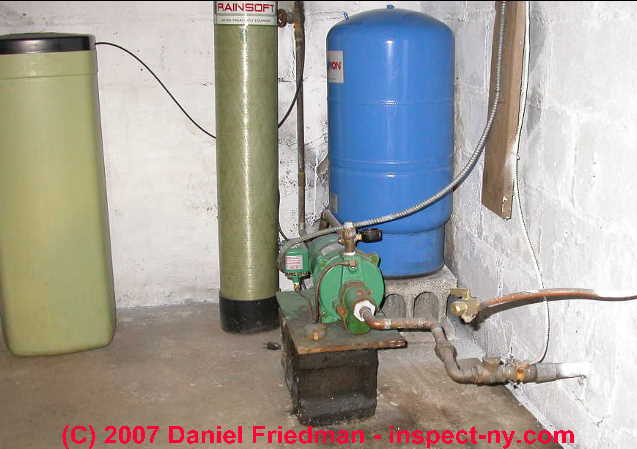
How much water the tank holds or the physical volume of the water tank that is useful to know but iIt's how much water we can get out of the water tank before the pump has to turn on that is important when sizing or adjusting water supply systems and pumps.
This is the "draw down" volume, which we can measure or calculate, or we can focus instead on how long (in time) we can run the water before the pump has to turn on.
If your water pump turns on and off to frequently it can overheat or damage the pump or its controls. Usually this short cycling of the pump is not because the water tank is too small, it's because the tank has lost its air charge. See our discussion of "short cycling" water pumps
at WATER PUMP SHORT CYCLING - home . If your pump is short cycling you want to fix it, as we explain in that article.
The photograph shows a one-line jet pump, the water pressure tank, and a water softener. We know from the fact that this is a single line jet well pump that the well is a shallow one, probably less than 27' deep.
Well depth may have implications for water quantity and quality and vulnerability to surface water contamination.
Remember that a "30 gallon water tank" used to control water pressure and pump cycling in a building does not hold 30 gallons of water, but something less than that (say 20 gallons of water max and 10 gallons of air at the point of pump cut-off).
Then as you draw water out (and the in-tank pressure falls down to the pump cut-on point) the pump is going to come on before all of the water leaves the tank.
So the maximum actual water you get out of the tank is less than the tank size, maybe 15 to 20 gallons max. The bladder-type pressure tank manufacturers cite an "equivalent" draw-down water volume as that provided by the older bladderless tanks.
How to measure the draw-down water volume provided by a water tank
- After the water pump has just shut off at full cut-out pressure (the water tank is now as full as it's going to get), put a 5 gallon bucket under a bath tub spout or other convenient faucet or hose.
- Then turn on the water and let it run into your test bucket.
- Listen for when the pump cuts on, or if your pump is submersible (and you can't hear the pump) station an assistant next to the pump control and have them listen for the click that indicates that the pump relay has turned on - they'll also see the pump pressure gauge start to move back up.
- When the assistant sees or hears that condition, turn OFF the water at your test fixture.
- Measure the volume of water in your bucket.
- That's the draw down volume.
What are some typical water tank draw down volumes?
A 10 gallon water pressure tank that starts fully empty and is pumped up to about 50 psi will contain about 3 gallons of air and 7 gallons of water. The water tank in normal operation does not draw down to 0 gauge pressure before the pump comes on.
The water tank provides out flowing water down to 20 psi (on a 20-40 psi system or down to 30 at a 30-50 psi system) when the pump comes on.
A water pressure tank with a total volume of 10 gallons and operating between 20 psi and 50 psi of pressure will have a draw down water volume of just 4.35 gallons of water.
A typical kitchen water faucet runs between 3 gpm and 5 gpm (varying as the water pressure in the system varies as the water pump cycles on and off), so we can expect to run the water at the tap for about a minute before the pump will come on with this theoretical water tank.
Because the pressure drops as the water tank empties and then increases as the water pump comes back on, the water pressure at a faucet or other plumbing fixture will vary between the pump cut-in pressure (typically 20 psi or 30 psi) and the pump cut out cycle (typically 40 psi to 50 psi). quoting
from WATER TANK PRESSURE CALCULATIONS
The above-cited article, which we admit is a bit unnecessarily complex (I was answering someone else's query) has the math you need to calculate the actual draw-down volume of water you get with a given sized tank, with a given in-tank water volume when the pump has reached its shutoff point.
Relationship of Water Tank Rated Size to Actual Water Draw-down Volume?
Question: what is the relationship of water tank rated size to actual water draw-down volume?
How much water should be in the water pressure tank internal bladder? The water tanks are rated as 85 gallons. When the system cut-out water pressure is reached there is only about 5gal in tanks? - Stephen
Reply: Table of Water Tank Draw-Down vs Rated Size
Modern internal bladder type water pressure tanks give an "equivalent draw down" cycle to the actual "gallons" number on the equipment, but the actual physical volume of water may be significantly less.
5 Gallons does not sound reasonable. Typically on an "85 gallon" sized water tank, the actual water draw-down volume will be about 25 gallons. Below we include a table of rough estimates of actual water draw down volumes for different internal bladder water pressure tanks.
Check your water pressure tank air pre-charge. When the water tank is completely empty the air pre-charge should be 2 psi below the pump control's cut-in pressure. If the pre-charge pressure is too high that will reduce the volume of water held in your water tank.
Table of Typical Water Tank Draw-Down vs Rated Size |
|
| Water Tank Rated-Size (approximate gallons) | Actual Volume of Water Draw Down (approximate gallons) |
Notes to the water tank draw-down volume table above:
- The "actual draw down" is the physical volume of water that is drawn from the water pressure tank before we expect the pressure drop in the water supply system to reach the well pump cut-in pressure.
- The exact water tank size and expected draw-down water volume will vary by manufacturer and tank model, so our data above is only approximate.
- The significance of the "draw-down" volume of water is that it determines the frequency with which the water pump has to cycle on and off which in turn affects equipment life.
Detailed Chart of Water Pressure Tank Sizing, Water Tank Volume, Water Drawdown Volume in Gallons |
|||||||||
| Well-Rite Water Tank Model | Total Water Tank Volume | Equivalent Bladderless Water Tank Size |
Drawdown Water Volume at Various Pressure Control Settings | ||||||
|---|---|---|---|---|---|---|---|---|---|
| Gals | Liters | Gallons | Gals | Liters | Gals | Liters | Gals | Liters | |
| WR45 | 14 | 60 | 30 Gal | 5.2 | 19.68 | 4.3 | 16.28 | 3.8 | 14.38 |
| WR60 | 20 | 80 | 43 Gal | 7.4 | 28 | 6.2 | 23.47 | 5.4 | 20.41 |
| WR80 | 26 | 100 | 82 Gal | 9.6 | 36.34 | 8.1 | 30.66 | 7 | 26.5 |
| WR100 | 32 | 120 | 82 Gal | 11.8 | 44.66 | 9.9 | 37.47 | 8.6 | 32.55 |
| WR120 | 33 | 130 | 82 Gal | 12.3 | 46.56 | 10.3 | 38.99 | 9 | 34.06 |
| WR140 | 44 | 170 | 120 Gal | 16.3 | 61.7 | 13.6 | 51.48 | 11.9 | 45.04 |
| WR200 | 62 | 240 | 220 Gal | 22.9 | 86.68 | 19.2 | 72.67 | 16.7 | 63.21 |
| WR240 | 81 | 310 | 220 Gal | 30 | 113.55 | 25.1 | 95 | 21.9 | 82.89 |
| WR260 | 85 | 325 | 220 Gal | 31.5 | 119.23 | 26.4 | 99.92 | 23 | 87.05 |
| WR360 | 119 | 450 | 450 Gal | 43.6 | 165.03 | 36.8 | 139.29 | 32.1 | 121.5 |
Notes to the Wel-Rite Water Tank Sizing Chart
Data based on a Well-Rite® water pressure tank [1]
When choosing an internal-bladder type water pressure tank, take note of the operating pressure range of your well pump equipment. You will see in the table above that the higher you set the water pressure cut-in and cut-out, the smaller will be the draw-down volume provided by a particular water pressure tank.
Inspect Your Water Supply System to See What's Installed
Even before performing water quantity, quality, equipment function tests, there is an enormous amount we can determine about a building's water supply just by looking at the equipment. Articles here provide details on water pumps, tanks, controls, and wells and water supply inspection, diagnosis, and repair.
Finding the location of your well and inspecting the condition of the well piping and equipment are an important first step to assure a functional and potable drinking water supply - that is, having enough water supply and having water that is safe to drink. The articles listed below provide detailed advice on diagnosing and repairing problems with water pumps, water tanks, wells, and other water supply equipment.
...
Continue reading at LARGE CAPACITY WATER STORAGE TANKS or select a topic from the closely-related articles below, or see the complete ARTICLE INDEX.
Or see WATER TANK SIZE & VOLUME FAQs - questions and answers about choosing the right size water tank, posted originally on this page
Or see these
Recommended Articles
- EXPANSION TANK SIZING GUIDE - tank sizing tables for expansion tanks used on hot water heating systems
- ROOFTOP WATER TANKS
- PLASTIC RECYCLING CODES, TANKS, TYPES where we describe health and other concerns involving plastic tanks and other containers used for water storage.
- SEPTIC TANK SIZE - formulas for calculating the volume and size of tanks of various sizes & shapes
- WATER QUANTITY IMPROVEMENT
- WATER TANK RELATION to WATER PRESSURE
- WELL YIELD IMPROVEMENT
- WATER TANK CLEANING CODES STANDARDS
- WATER TANK DIAGNOSIS & REPAIR - home or see WATER TANK REPAIR PROCEDURES
Suggested citation for this web page
WATER TANK SIZE & VOLUME at InspectApedia.com - online encyclopedia of building & environmental inspection, testing, diagnosis, repair, & problem prevention advice.
Or see this
INDEX to RELATED ARTICLES: ARTICLE INDEX to WATER SUPPLY, PUMPS TANKS WELLS & SPRINGS
Or use the SEARCH BOX found below to Ask a Question or Search InspectApedia
Ask a Question or Search InspectApedia
Try the search box just below, or if you prefer, post a question or comment in the Comments box below and we will respond promptly.
Search the InspectApedia website
Note: appearance of your Comment below may be delayed: if your comment contains an image, photograph, web link, or text that looks to the software as if it might be a web link, your posting will appear after it has been approved by a moderator. Apologies for the delay.
Only one image can be added per comment but you can post as many comments, and therefore images, as you like.
You will not receive a notification when a response to your question has been posted.
Please bookmark this page to make it easy for you to check back for our response.
Our Comment Box is provided by Countable Web Productions countable.ca
Citations & References
In addition to any citations in the article above, a full list is available on request.
- In addition to citations & references found in this article, see the research citations given at the end of the related articles found at our suggested
CONTINUE READING or RECOMMENDED ARTICLES.
- Carson, Dunlop & Associates Ltd., 120 Carlton Street Suite 407, Toronto ON M5A 4K2. Tel: (416) 964-9415 1-800-268-7070 Email: info@carsondunlop.com. Alan Carson is a past president of ASHI, the American Society of Home Inspectors.
Thanks to Alan Carson and Bob Dunlop, for permission for InspectAPedia to use text excerpts from The HOME REFERENCE BOOK - the Encyclopedia of Homes and to use illustrations from The ILLUSTRATED HOME .
Carson Dunlop Associates provides extensive home inspection education and report writing material. In gratitude we provide links to tsome Carson Dunlop Associates products and services.
 | HOME | ABOUT | ASK a QUESTION | CONTACT | CONTENT USE POLICY | DESCRIPTION | POLICIES | PRIVACY | |
| © 2024 - 1985 Publisher InspectApedia.com - Daniel Friedman | |||||||||