
InspectAPedia® FREE Encyclopedia of Building & Environmental Construction, Diagnosis, Maintenance & Repair |
Question? Just ask us! InspectAPedia
|
 Cure Sulphur Smells or Odors in Drinking Water
What causes that rotten egg stink in our water?
- POST a QUESTION or COMMENT about the causes & cures of odors or smells in water supplies
Water odor diagnosis & cure:
This article discusses how to identify, diagnose, and cure rotten egg or sulphur odors in drinking water.
We also discuss which of these odors may warn of unsanitary conditions. Edits, content addition, & web page design
InspectAPedia tolerates no conflicts of interest. We have no relationship with advertisers, products, or services discussed at this website.
Diagnosing and Correcting Sulphur Odors in Water
I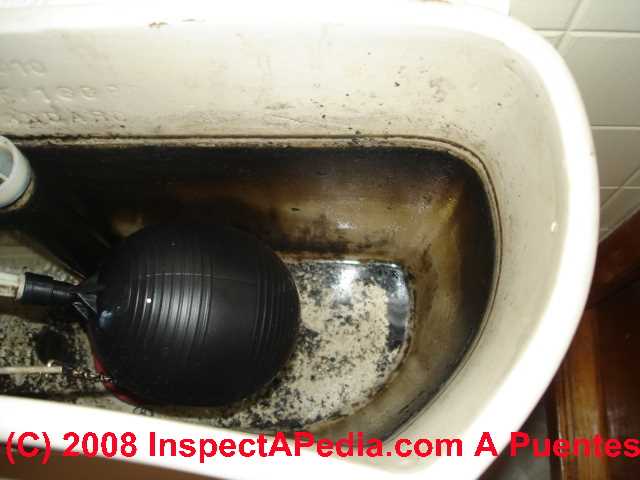 f your source water runs through an area where naturally occurring sulfur is
present, some sulfur may dissolve into the water. We provide a diagnostic procedure to track down the source of sulphur smells in water just below.
f your source water runs through an area where naturally occurring sulfur is
present, some sulfur may dissolve into the water. We provide a diagnostic procedure to track down the source of sulphur smells in water just below.
Some of this dissolved sulfur turns to the gas, hydrogen sulfide, and this can give the water a rotten egg type smelly odor.
Sulphur odors can also be caused by a failing hot water heater component, or by certain bacteria in the building plumbing system, conditions we also discuss below.
Sulphur smells in water can also occur in rivers, lakes, streams, ponds, and can be caused by anoxia and algae which in turn may be caused by high nitrogen from agricultural runoff - a condition we discuss
at WELL WATER CONTAMINANT SOURCES.
- Sulphur or "rotten egg" odors in water throughout a home:
if your water source is picking up sulphur, either seasonally (such as when water tables drop) or all year, you have a persistent sulphur source and the odor will be present at all plumbing fixtures in the home, possibly appearing stronger when water has not been run for some time - but see other versions of that clue which we discus below.
Our photograph at above left, courtesy of Arlene Puentes, shows black sulphur bacteria and debris in a toilet tank in a home served by a well which was very high in sulphur.
Since the toilet is supplied with cold water we knew this was a sulfur problem in the water supply, not simply a water heater anode problem.
We provide a detailed list of sewer and sulphur gas odor sources
at ODORS, SULPHUR SMELL SOURCES.
Also CHINESE DRYWALL HAZARDS discusses Chinese drywall odors, sulphur smells, and corrosive outgassing hazards in buildings. Major costs to remove this product, repair or replace electrical wiring, plumbing, and HVAC components may be involved, and there may be immediate safety hazards due to damaged smoke detectors or carbon monoxide detectors in buildings where Chinese drywall outgassing has caused damage.
- Sulphur odors only at certain fixtures:
I
n certain instances, someone in the household may complain of a sulfur odor in one part of the home, but not any other. This is usually explained because of the presence of sulfur reducing bacteria in a "dead leg" in the plumbing system. These bacteria are not typically pathogenic, or disease-causing, and one common type would be Desulfovibriole.
If there is a portion of plumbing that has been cut and then capped off, creating a small area of non-circulating water, or a "dead-leg", then these bacteria can get a foothold and metabolize the available sulfur in your water - creating a strong odor from one particular sink or tap. - Sulphur odors from water heaters:
A frequent source of a sulphur-like odor in home water systems, regardless of whether your water is from a private well or from a municipal supply source, is a deteriorated sacrificial anode on the water heater tank.
This anode, usually inserted into the water tank from its top, is intended to reduce water tank corrosion. Sacrificial anodes on water tanks can be replaced. If the odor is present only in your hot water, ask your plumber to try replacing the anode. We discuss the hot water tank sacrificial anode and dip tube in more detail at
ANODES & DIP TUBES on WATER HEATERS
Watch out: as we explain
at HYDROGEN SULFIDE GAS, hydrogen sulfide gas is dangerous and can explode or catch fire. Sewer gases also probably contain hydrogen sulfide gas (H2S) In addition some writers opine that there are possible health hazards from sewer gas exposure, such as a bacterial infection of the sinuses (which can occur due to any sinus irritation). Hydrogen is extremely flammable (easily set fire or explodes). - Hydrogen sulfide release from hot water:
Another source of sulphur odors in water the energy which water heaters add to water in the form of heat. Increasing the temperature of water will also facilitate the release of hydrogen sulfide. In addition, the simple act of running water at a shower or faucet will cause a release of this sulfurous odor because of the agitation of the water being released from the tap. - Manganese or Iron,
and Gallianella bacteria as a water odor source: If your source water is high in iron and or manganese, then you may have odors that emanate from bacteria like Gallianella. These naturally occurring bacteria can feed from the available stream of iron and manganese in a water supply, creating foul odors and sometimes plugging, or bio fouling water filters and well.
Odors from iron or manganese-loving bacteria may resemble diesel fuel, heating oil, cucumbers, or sewage.
A BART, or Biological Activity Reaction Test can determine if this type of bacteria is present in your water supply. You probably can't get rid of them because they are normal flora, (naturally occurring bacteria), but annual chlorination of your well will help keep them in check.
See WATER STAINING CONTAMINANTS for more about manganese or iron in water.
An ultraviolet disinfection system
can disinfect the water as it comes into distribution to remove bacteria within the system. Chlorination may also be used, but is not a great choice if there is a lot of iron and manganese, as the chlorine will precipitate the metals out of solution and discolor the water. - Water Softeners as a source of rotten egg smells in water:
if your source water from an outside spigot of un-treated water at your building does not smell, but if all of the water in your building, both hot and cold, smells like rotten eggs or sulphur, and if you have a water softener installed, it may be that you need to sanitize your water softener equipment. This problem is more likely to occur if the water softener has been shut down for a week or more, such as when you are restoring a winterized building to service.
See WATER SOFTENER ADJUSTMENT & CONTROLS for the procedure to follow for sanitizing a water softener. - Other sources of sulphur odors: Does your water smell when you return from vacation? Non-use of a regular water line can also create the same condition of sulphur odors.
- We provide a detailed list of sewer and sulphur gas odor sources
at SOURCES of SULPHUR ODORS in BUILDINGFS.
Watch out: methane odors in a building water supply can be explosive -
see METHANE GAS SOURCES
Watch out: Sulphur smells, rotten egg smells, or sewer gas smells can be caused by a variety of problems that we describe here.
The sulphurous odor may be due to sulphur in the building water supply, bacteria in water, deteriorating water heater electrodes, dangerous sewer gas leaks, hydrogen sulfide gas forming in the water heater itself, even contaminated drywall or perhaps human or animal flatulence. Some of these gases and the implications of their source can be very dangerous, as we describe here and in related articles.
What if the Sulphur Odor is Not Traced to the Water Supply?
If the source of rotten egg smells or sulphur in your building is not traced to a water supply problem, see these related articles
- METHANE GAS SOURCES
- ODOR DIAGNOSIS CHECKLIST, PROCEDURE
- ODORS, SEPTIC or SEWER
- ODORS, SULPHUR SMELL SOURCES
Health Effects of High Levels of Hydrogen Sulfide in Water
H2S in water range from none to very low (0.5 ppm) to "rotten egg smell" (1-2 ppm), to typically about 10 ppm in many water wells. In some water wells H2S may be detected at much higher levels in the 50-75 ppm range.
In the U.S. the U.S. Environmental protection agency does not regulate the level of sulphur in primary or secondary drinking water. Why? In concept, a concentration of sulphur or hydrogen sulfide in water high enough to be a health concern makes the water so nasty smelling that it is considered un-palatable: people won't drink it.
Even very low concentratoins of hydrogen sulfide in water, in the 0.05 ppm range, can be detected as an odor by most people. Low levels of H2S (hydrogen sulfide) in water impart a musty odor that some sources describe as "swampy" smelling water.
Watch out: for corrosive effects of high levels of H2S in water. Higher levels of H2S in the 1-2 ppm range will impart the "rotten egg" smell that most people use to describe the odor.
If your water supply smells like rotten eggs and if the odor is in the water source (not from other causes such as bacterial contamination or a problem in a dirty water softener or water heater), then the water is also highly corrosive to plumbing.
...
Reader Comments, Questions & Answers About The Article Above
Below you will find questions and answers previously posted on this page at its page bottom reader comment box.
Reader Q&A - also see RECOMMENDED ARTICLES & FAQs
Question: Kinetico water softener backflushing to reduce water odors
(July 25, 2016 Re-posting from private email
A few years ago I had a Kinetico water softner system installed at my house by a reputable company. Tremendous improvement over the older system. I was advised by the installer to backflush the resin tank once a month with a gallon of professional grade peroxcide.
Then spin it back and flush with a gallon of pool chlorine and run the water until clear. Naturally, changing the filter also
I've been doing this for years with good results. I change the carbon bed every 1 1/2-2 years.
My water never has an odor until now, a month to the day from the last cleaning. Am I missing something?
Here in Florida we have recently had heavy rains and stifling humidty. Thanks - E.G.
Reply:
E.G. If the new odors are in your incoming water supply that might mean we need to amend the whole water treatment system.
If the odors are not in the incoming water supply but only occur in water passing through the water softener, the carbon bed may be contaminated and need replacement.
On 2017-10-13 by Marianne Loukas - don't use a filter for high sulphur content problems
Hi. I have a ground water well in Florida. 2.5 years ago installed new hot water heater and small diameter while house filter system and used carbon filters changing monthly and at times bimonthly as needed due to clogging and low pressure. It worked great at removing horrid sulfur odors and minerals until 6 months ago.
We thought we had gotten a bad batch of filters strong odor but never reduced pressure.
We bought more filters of a different brand...same thing. I thought maybe somehow the actual filter housing had malfunction.
So replaced with 10" diameter filter system. It stopped the odor for 2 weeks without any reduction of pressure. I don't use that much water in a 2 adult household. Any clues or budget conscious possible solutions would be appreciated. Thanks
On 2017-10-13 - by (mod) -
Marianne,
For high sulfur water you will not have great success using filters: short life, high cost, frequent clogging. A treatment system to remove sulphur is probably what's needed.
On 2017-06-07 by Shelly - How to get rid of sewer smell in kitchen
How to get rid of sewer smell in kitchen
On 2017-06-07 - by (mod) -
If the odor is coming from your sink I suspect that there is a problem with venting. If nothing has changed in the piping system and you don't hear drain noises or see slow drains I would start with thorough cleaning under the sink and around the sink and also cleaning any nearby garbage containers
Question: upstairs water smells bad
(Nov 9, 2012) tom said:
the supply of water to my daughter's house is perfect at the first tap.
it is then routed upstairs through a tank and around the house.the water is
undrinkable in the kithen because of the smell.she can also smell it in the shower.
can you suggest anything
thank you
Reply:
Tom, try shocking or sterilizing the water tank and piping as we describe at
How to shock or chlorinate a well.
Bacteria in a water tank, water heater, or piping could be the culprit.
Question: how to fix an egg smell out of a drinking water tank
Mar 29, 2013) jim carter said:
we nedd some help finding out the anwser for how to u fix a egg smell out of a drinking water tank
Reply:
Sure Jim,
At the top of this article click on
SULPHUR & SEWER GAS SMELL SOURCES
that link explains just what you need.
Question: iron bacteria in new well - can we shock the well to cure this problem?
Oct 30, 2014) Anonymous said:
We just had a new drilled well that they had to go 305 feet. At first it was leaving rust colored stains, probably iron and a fowl smell. Now after we shocked it with bleach the rust colored stains aren't as bad but water is still discolored grayish and still smells.
We had a water test done for bacteria and it failed to coliform bacteria. We don't know what to do as we spent ALOT of money we had not anticipated on and now have all these water problems (should have stuck with our shallow well). What to do any suggestions?
Reply:
Anon
Unfortunately shocking a well, a sterilization procedure, won't correct a problem with iron in the water source. Worse, since you found bacteria after shocking the well, either the sterilization was not effective or there is a persistent bacteria source.
Some water softeners (if one is otherwise needed for hard water) can also remove modest amounts of iron.
I suggest a more careful and comprehensive water test for bacteria (get a count not just presence/absence as a count is more diagnostic), iron, and (after asking the lab) other contaminants that are common in your area. You might try a more proper well shock procedure; then if the bacteria persists you'll need to install appropriate water treatment equipment.
Question: how do I shock the well properly if it smells bad?
(Oct 31, 2014) Anonymous said:
Anon what is a "more proper" well shock procedure?
The only one I was told was the bleach.
Reply:
Anon:
In the ARTICLE INDEX found at the More Reading links just above see the article titled
WELL CHLORINATION SHOCKING PROCEDURE
we describe a proper well shocking or "sterilization" procedure. It's not just the choice of disinfectant that is critical; also critical are the disinfectant concentration, the duration of the disinfectant in the system, the extent to which pipes and tanks are also disinfected (not just the well), the flush out procedure, and the re-test procedure.
Question: water smells like kerosene (ala Willy Nelson's breath - song)
(Mar 1, 2015) Windy said:
My water smells like kerosene....why?
Reply:
Windy
Could be a kerosene leak, heating oil leak, or a contaminant in the water supply itself - in the aquifer or a leak into your well. Take a sample to your local water test lab.
...
Continue reading at WATER ODOR TREATMENTS, CURES - SULPHUR or select a topic from the closely-related articles below, or see the complete ARTICLE INDEX.
Or see these
Recommended Articles
- WATER SMELLS or ODORS, OTHER
- SULPHUR & SEWER GAS SMELL SOURCES
- WATER STAINING CONTAMINANTS for discussion of water contaminants that result in stains on fabrics, fixtures, etc. and that may also help diagnose some water odors.
Suggested citation for this web page
WATER ODOR DIAGNOSIS - SULPHUR at InspectApedia.com - online encyclopedia of building & environmental inspection, testing, diagnosis, repair, & problem prevention advice.
Or see this
INDEX to RELATED ARTICLES: ARTICLE INDEX to WATER TESTING
Or use the SEARCH BOX found below to Ask a Question or Search InspectApedia
Ask a Question or Search InspectApedia
Try the search box just below, or if you prefer, post a question or comment in the Comments box below and we will respond promptly.
Search the InspectApedia website
Note: appearance of your Comment below may be delayed: if your comment contains an image, photograph, web link, or text that looks to the software as if it might be a web link, your posting will appear after it has been approved by a moderator. Apologies for the delay.
Only one image can be added per comment but you can post as many comments, and therefore images, as you like.
You will not receive a notification when a response to your question has been posted.
Please bookmark this page to make it easy for you to check back for our response.
Our Comment Box is provided by Countable Web Productions countable.ca
Citations & References
In addition to any citations in the article above, a full list is available on request.
- Eric Galow, Galow Homes, Lagrangeville, NY. Mr. Galow can be reached by email: ericgalow@gmail.com or by telephone: 914-474-6613. Mr. Galow specializes in residential construction including both new homes and repairs, renovations, and additions.
- Mark Cramer Inspection Services Mark Cramer, Tampa Florida, Mr. Cramer is a past president of ASHI, the American Society of Home Inspectors and is a Florida home inspector and home inspection educator. Contact Mark Cramer at: 727-595-4211 mark@BestTampaInspector.com 11/06
- In addition to citations & references found in this article, see the research citations given at the end of the related articles found at our suggested
CONTINUE READING or RECOMMENDED ARTICLES.
- Carson, Dunlop & Associates Ltd., 120 Carlton Street Suite 407, Toronto ON M5A 4K2. Tel: (416) 964-9415 1-800-268-7070 Email: info@carsondunlop.com. Alan Carson is a past president of ASHI, the American Society of Home Inspectors.
Thanks to Alan Carson and Bob Dunlop, for permission for InspectAPedia to use text excerpts from The HOME REFERENCE BOOK - the Encyclopedia of Homes and to use illustrations from The ILLUSTRATED HOME .
Carson Dunlop Associates provides extensive home inspection education and report writing material. In gratitude we provide links to tsome Carson Dunlop Associates products and services.
 | HOME | ABOUT | ASK a QUESTION | CONTACT | CONTENT USE POLICY | DESCRIPTION | POLICIES | PRIVACY | |
| © 2024 - 1985 Publisher InspectApedia.com - Daniel Friedman | |||||||||