
InspectAPedia® FREE Encyclopedia of Building & Environmental Construction, Diagnosis, Maintenance & Repair |
Question? Just ask us! InspectAPedia
|
 How to Repair Bad Water Pressure
Improve weak water flow rate at sinks, tubs, showers, or sprinklers or in tall buildings
- POST a QUESTION or COMMENT about how to de-clog or de-scale building water piping
Repair methods for improving poor water pressure traced to clogs, pipe diameter, or clogged water supply piping.
This article describes How to Cure Bad Water Pressure Due to Clogged Water Supply Pipes. The process of diagnosis and the costs of the repair are explained.
What makes us think that a water pressure (really more accurately water-flow-rate) problem is due to clogged piping? A quick diagnosis that suggests that bad water pressure at a fixture or in a building is due to pipe clogging is the observation that when you first turn on the water, in that first instant, pressure is pretty good, but falls off almost immediately to a much slower level.
InspectAPedia tolerates no conflicts of interest. We have no relationship with advertisers, products, or services discussed at this website.
Guide to Repair of Clogged Water Supply Piping and Poor Water Pressure & Flow
 Water pressure falls off very quickly:
[Click to enlarge any image]
When a water supply pipe pressure has been traced to supply pipe clogging there are several repair approaches that we can try. Here are some clogged piping repair attempts along with comments about how likely it is that they’ll help.
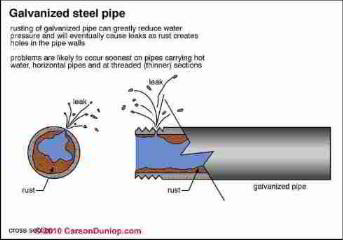
The sketch of rust clogging of galvanized steel pipe shown here, courtesy of Carson Dunlop Associates, shows how the inner diameter of a water supply pipe is reduced by build-up inside the pipe walls. This build-up may be due to rust, mineral deposits, or other debris in the pipe.
The reduction in pipe diameter means a corresponding reduction in the flow rate seen at building plumbing fixtures. When you first turn on a faucet water pressure may be normal or "high" but as soon as water starts to flow the pressure and flow fall off to a noticeably lower level.
This is the classic diagnosis of clogged water piping. But we don't know, yet, how extensive the clogging is - a single elbow, a clogged faucet strainer, or an entire length of clogged water piping can all produce this effect.
The suggestions which follow presume you’ve already followed our diagnostic suggestions to get an idea of the type of water supply flow problem that is present.
That’s important because some water pressure problems are due to water flow problems caused by a water pump, water pump pressure control, water tank, and on municipal water supply systems, flow problems may be due to problems with the water pressure regulator, water supply piping from a municipal supply, or even water meter and main water valve problems.
Watch out: people generally use the term water pressure to talk about the force or volume of water delivered at a faucet or plumbing fixture. Properly this is water flow rate; water pressure in the system is only one factor that determines the water flow rate at fixtures.
Clogged pipes, partly closed valves, length of piping runs, number of ends or elbows are other factors that reduce the actual flow rate or "pressure" observed at a plumbing fixture.
Here we discuss how to correct bad water pressure due to apparent clogs in water supply piping. First we need to do some further diagnosis to determine if the poor water flow problem is at every fixture in the building or just at some of them.
How to Correct Poor Water Pressure & Flow at One or More Plumbing Fixtures When Some Fixtures Flow Well
 Although people commonly speak of "bad water pressure" when referring to weak water flow at the tap, water flow rate is not really the same as "water pressure", though the two are related.
Higher pressure will give us improved water flow rate at a fixture, but other factors such as pipe diameter, pipe length, the number of bends and elbows, and frictional loss as water runs through the system have a big effect on perceived water pressure at the tub, tap or shower.
Carson Dunlop's graph at left reviews the relationship between water pressure and water flow rate for 1/2" diameter and 3/4" diameter water supply piping. You will notice that the pressure drop when using 3/4" diameter piping is significantly less than when using 1/2" piping.
The graph also shows that for a given starting water pressure (static pressure), the water delivery pressure at any plumbing fixture will drop as the flow rate increases at that fixture.
That's why the shower seems to operate at higher pressure than the tub spout: the flow rate through the small perforated openings in the shower head is usually less than through the big-mouthed tub spout.
[Click to enlarge any image]
In discussing the difficulty of explaining pressure and flow Al comments:
It is tricky to understand that flow and pressure at a hose or faucet are inversely proportional. One of the ways I like to explain it is to think of a garden hose with no faucet attached.
When you turn the tap on, the water comes out without much pressure, but it fills a bucket quickly. If you put your thumb over the hose and block most of the opening, the water comes out with much more pressure and you can spray somebody 10 feet away. However, it would take a long time to fill a bucket.
A bathtub is another good example. It takes a long time to fill a bathtub using the shower head. The tub faucet is much faster. On the other hand, the showerhead delivers a lot more pressure and is better for rinsing shampoo out of your hair. - A. Carson to D Friedman, private email, 14 May 2015
How to Diagnose & Fix Individual Clogged Faucet Strainers or Valves
 Static vs. Active or Dynamic Water Pressure
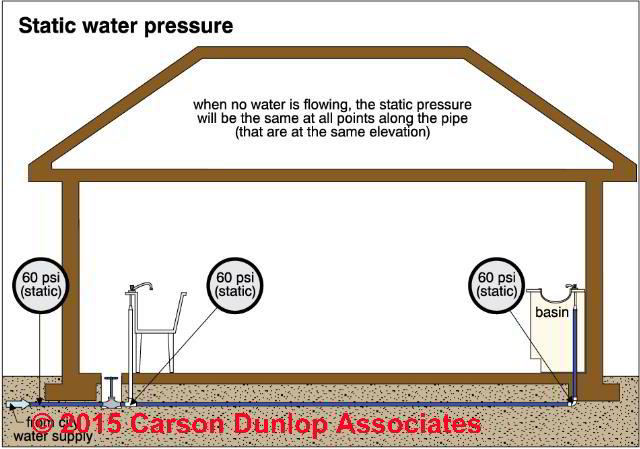
Let's also clear up the idea of what information you are getting when you measure water pressure.
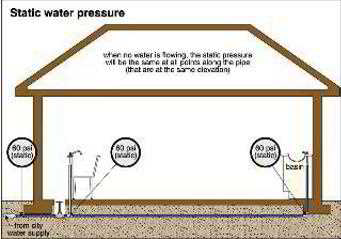
Static water pressure is a pressure measurement obtained (using a pressure gauge) when no water is being run in the plumbing system.
Static water pressure readings give us a starting point in understanding water pressure and flow rate in a building. In vertical pipes the water pressure is approximately 0.43 psi lower for every one foot of elevation.
We use the word dynamic water pressure for pressure readings when water is running though this simplified view gets some flack from some hydraulics engineers who have a more special use of that term.
See WATER PRESSURE MEASUREMENT if you need to measure your building's water pressure.
Carson Dunlop Associates' drawing at above- left explains that when no water is running pressure measured anywhere in the plumbing system will be the same.
That's static water pressure.
Building Height Effects on Water Pressure
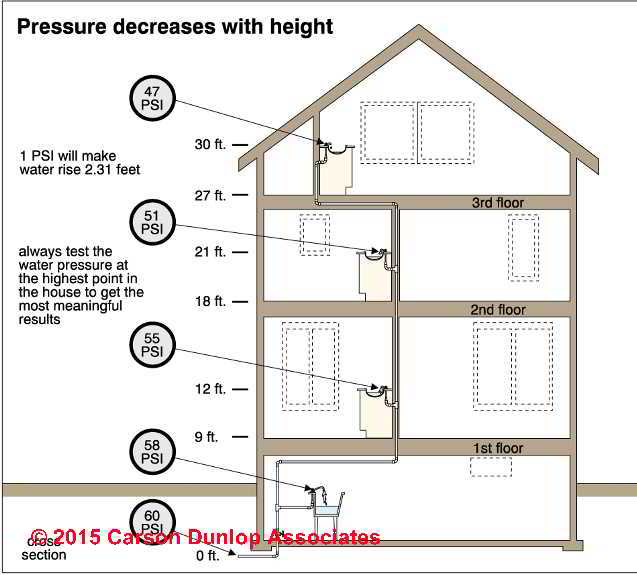 In vertical pipes the water pressure is approximately 0.43 psi lower for every one foot of elevation when no water is flowing, and building height affects water pressure and flow at higher fixtures when water is flowing as well.
So in tall buildings whose water supply is fed from street level or below, the starting water pressure can be quite important. Larger pipes may help improve water flow at fixtures but in buildings over three stories you may need a booster pump system as well.
See WATER PRESSURE BOOSTER PUMP.
Carson Dunlop's sketch at left illustrates a related fact that can help diagnose water pressure problems.
In sum, before looking for specific water pressure problems in the building we need to check the basics:
- What is the static water pressure?
- What is the building height?
- What are the sizes and condition of the water supply piping and what about its length and number of bends.
If poor flow is at just one fixture it’s a good bet that we can trace the flow problem to a local issue that we should be able to repair without more extensive plumbing surgery.
Slow or weak water pressure at the sink - check for debris or mineral clogging of the sink faucet strainer
If the slow fixture is a sink, first check the strainer – debris-clogged strainers can simply be un-screwed. If the pressure is suddenly wonderful you need a new or cleaned strainer, that’s all.
Slow water fill at a toilet - check or replace the toilet tank fill valve
If the slow fixture is a toilet, often the toilet tank fill valve itself becomes clogged with debris; it may be possible to remove, clean, and reinstall the valve but often it’s easier to just install a new one. We sometimes also find clogging at the small shutoff valve or water supply riser to the toilet.
Slow water flow at a shower - check for debris or mineral clogging in the shower head or flow restrictor
If the slow fixture is a shower head, debris or mineral clogging can be diagnosed by removing the shower head and, as with the sink strainer, look for good water flow. If we find that the problem was the shower head, just replace it.
Some shower head models claim to be resistant to mineral clogging by using rubber or other flexible components to form the spray.
Bad plumbing valves or bad fixture supply risers: Plumbing valves or shutoff valves to individual fixtures or valves controlling sections of water supply piping can also become clogged with debris, minerals, or even a broken faucet washer.
Procedure for Fixing Clogged Faucet Strainers or Valves
- Check for clogging at the fixture faucet strainer -
unscrew and clean the strainer, or if the strainer is badly corroded, bring it along to your hardware store and buy a replacement faucet strainer - they are not expensive, but sizes and threads vary a lot so be sure to buy one that fits. - Check for clogging inside the faucet valve itself -
this will require turning off water to the fixture, disassembling the3 valve (usually possible without removing the valve from the fixture), and then slowly turning water back on to flush out debris that may have been accumulating at the valve seat. - Check for clogging at the stop valves
(local shutoff valves) at the fixture using the same procedure.
Clogged Building Water Piping
If you have good water pressure at all fixtures in some building areas but not any fixtures at other building areas,
you may have a clog in building piping (such as due to mineral deposits, rust, or even excessive solder in new work), or mineral and debris clogged strainers at faucets and shower heads (check these first).
Watch out: especially if plumbing fixtures in different building areas are of different ages (say you added a bathroom after the building was built), bad water pressure at all fixtures in a given building area could still be due to clogs at fixture faucet strainers or valves.
But if you check or clean or replace valves and water pressure is still poor in some but not all building areas, we suspect a problem with the piping serving the poor-performing areas: mineral clogs, solder or debris clogs, etc.
See WATER PIPE CLOG DIAGNOSIS - focused on clogged building water supply piping
See WATER PRESSURE LOSS DIAGNOSIS & REPAIR - addressing all causes of inadequate water pressure & flow
See CLOGGED TANKLESS COIL or PIPES, LIME SCALE for methods used to remove scale or lime deposits from piping
How to Improve Hot Water Pressure / Flow
Poor hot water flow but good cold water flow
at one or more plumbing fixtures usually diagnoses either a blockage at the water heating equipment itself or mineral clogging in the water heating system piping.
Heat causes mineral precipitation out of hot flowing water faster than out of cold water, that’s why often mineral clogs appear on hot water components of a plumbing supply system first.
When only hot water supply, pressure, or flow are poor while cold water pressure is good, then we take a different approach, focusing on hot water supply equipment, piping & controls.
Note: Building water pressure that is poor at all fixtures at both hot and cold water taps may be due to clogged building cold water supply piping. Other links at the end of this article provide guides for diagnosis and repair of other causes of bad water pressure throughout a building.
How to Fix Bad Water Pressure Throughout a Building or in Large Areas:
Repairs when ALL Hot Water, all Cold, Water Fixtures, or all Both Hot and Cold Fixtures have Bad Water Pressure & Flow
How to diagnose bad water pressure in the whole building or in large areas
Where an entire building or large building areas have bad water pressure, check to see if there is clogging at a valve, pipe section, or pipe elbow close to the water source. On occasion we’ve found that a building always had bad water pressure after a plumbing “repair” had been performed near the water tank.
The installer had pushed too much solder into a pipe elbow, blocking water passage through that fitting. It was discovered by making successive cuts in the supply piping beginning back near the source to check for good water flow.
Clogged water filters
cause bad water flow throughout a building and can cause water pump problems (if a private well system is installed. Water pump short cycling is discussed further
How to diagnose Bad water pressure in just some areas
Where a single or one or two plumbing fittings are causing poor water pressure, due to poor installation (solder blobs), damage (broken faucet washer or other debris clogging an elbow or valve), the fix is to find and replace the culprits.
Clogged water pipe diagnosis & repair guides
- CLOGGED TANKLESS COIL or PIPES, LIME SCALE
- HOT WATER PRESSURE IMPROVEMENT - if hot water flow is poor but cold water flow is OK
- WATER PIPE CLOG DIAGNOSIS - how to figure out what's wrong - start here
- WATER PIPE CLOG REPAIR (this article on this web page)
- WATER PRESSURE LOSS DIAGNOSIS & REPAIR in building
- MUNICIPAL WATER PRESSURE DIAGNOSIS
- WELL WATER PRESSURE DIAGNOSISwhere we describe the effects of clogged piping on water flow and offer remedies for this problem.
What to Do to Improve Water Pressure Where Long Sections of Piping are Clogged or Too-Small in Diameter
 Clarification: don't confuse "water pressure" with "water flow rate". Most people think "water pressure" in the sense of how forcefully water seems to exit at a faucet or at the end of your garden hose.
What you are seeing is some water flow rate in gallons per minute (gpm). If we can get a flow rate at the outlet of a faucet of 4 gpm when we used to have just 2 gpm, most people call that "better water pressure" but it's really water flow rate.
[Click to enlarge any image]
An accurate measurement of water pressure in a system is taken when no water is running, by hooking a pressure gauge up to any supply point in the system (say the end of your garden hose) and turning on the water.
For homes on a private well you probably have a (possibly reasonably accurate) pressure gauge right at the water tank.
That's what we call "static water pressure" - when nothing is running, since running water somewhere will change both the pressure we measure in the system and the flow rate we'll observe when we open a second faucet.
Local piping clogs can cause bad water pressure in entire sections of hot, cold, or both hot and cold water supply pipes and fixtures in a building. Local water supply clogs due to minerals in the water may clog entire lengths of piping so badly that the only repair is replacement of the water supply pipes.
Note: the most restrictive pipe in the the water supply system determines the maximum flow rate for any water usage fixture downstream from that restriction.
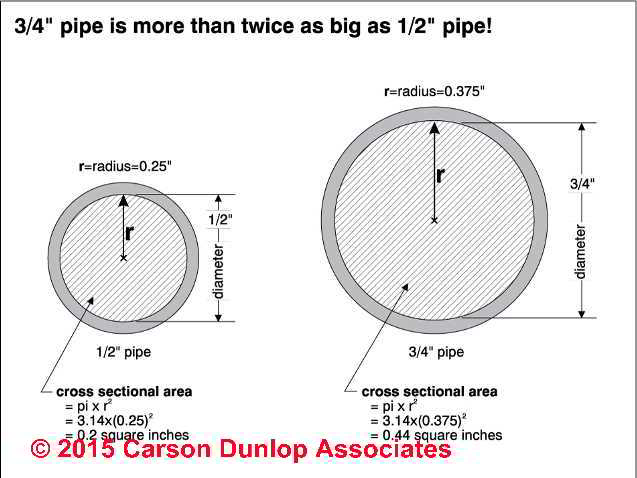
[Click to enlarge any image] In case it's not clear in Carson Dunlop Associates ' illustration at above left, the formula for area of a circle is Area = pi x r2
Certainly if we find that this is what’s needed, there are two approaches that can protect the investment in improved water flow. These can both be done or you may choose just one of them.
- Install a water softener
but remember that clogged water supply piping that has not been repaired using an acid-flush will need to be replaced. Installing a water softener won't "un-clog" mineral-clogged water pipes.
See WATER SOFTENERS & CONDITIONERS to discuss problems with water hardness. - Try clearing clogged water supply piping
using a chemical cleaner or other pipe de-scaling -de-liming methods describef
at CLOGGED TANKLESS COIL or PIPES, LIME SCALE
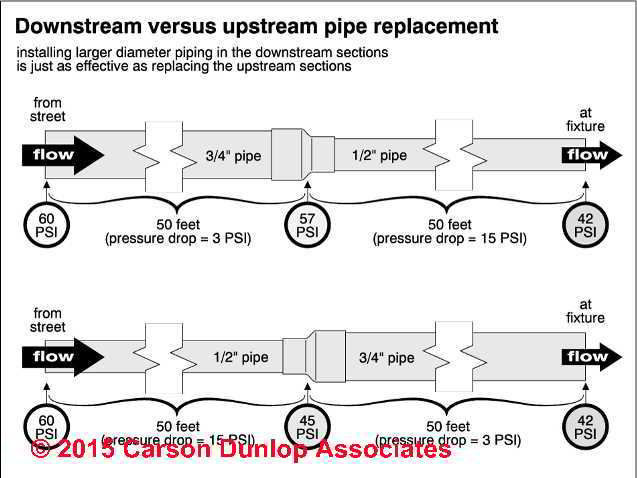
- Install larger diameter water piping
this method will provide piping that will deliver adequate water flow and pressure for a longer time before clogging up due to high mineral content in the water supply.
As you can see in the sketches above and at left, Carson Dunlop Associates point out that increasing a pipe size from standard 1/2" to 3/4" in diameter more than doubles the water flow capacity in the piping! [Speaking just for me I don't understand this but I trust the engineers at CDA.- Ed.]
Image at left provided courtesy of Carson Dunlop Associates, a Toronto home inspection and education company.
Changing any portion of the water supply piping along its length improves overall system pressure/flow at all plumbing fixtures that are downstream from that point. Why?
Moving water loses some of its energy every inch along the way. The smaller the pipe, the higher the friction and the more energy it loses.
Every inch of larger pipe reduces the amount of energy the water loses as it flows through.
We took this second approach on a building where we found that the hot water line clogged with a combination of minerals and iron.
On cutting open the old hot water supply pipe we saw that its interior was blocked to a mere pinhole of remaining water passage. But the cold water line was basically clear. So we replaced the hot water line, including straight runs and all elbows, with a ¾” copper pipe. The repair has continued to function well for nearly 30 years.
Contact us know if you have other questions or repair ideas or if this material leaves you with a question or suggestion.
When Increasing Water Flow Rate or Velocity or GPM, Watch out for Water Hammer & Water Scrubbing Damage
Watch out: as we discuss at WATER HAMMER NOISE DIAGNOSE & CURE, if the velocity of water in your piping system is too fast, when faucets or other controls STOP that water flow you may hear a horrible hammering or banging in the piping system.
Water hammer is more than a horrible noise, it can damage equipment, cause potentially dangerous leaks at temperature/pressure relief valves, and may even cause a divorce.
A second problem with very high water velocity rates through building piping is scrubbing or wearing away of the pipe interior: a problem that occurs at very high water speeds (measured in feet per second) in piping systems.
Generally the maximum safe water velocity or speed in residential water piping systems is 7 feet per second, and for 2-inch or larger pipes you should not exceed 5 feet per second.
Scrubbing is more of a worry in metal piping than in the smoother (less friction) plastic piping systems. Scrubbing and corrosion are common sources of pinhole leaks in water supply piping.
Reader Comments, Questions & Answers About The Article Above
Below you will find questions and answers previously posted on this page at its page bottom reader comment box.
Reader Q&A - also see RECOMMENDED ARTICLES & FAQs
On 2020-10-03 by Anonymous
Drew
Any experienced plumber can address your question, but if your water supply is from private well you might need to ask a bit further to be sure the plumber is familiar with pump and well systems.
On 2020-10-03 by Drew m
Hello I have reduced water flow all over the house, should I be hiring A certain kind of plumbing service for this? And what is a fair rate to diagnose the issue ?
On 2020-08-09 by Ron
I fixed a leak in the main water line out in the yard. It was a muddy mess doing it but I got it done and the meter says it was good, no movement on the dial.
So since I have done this before I went inside to turn faucets on and get air out of the lines plus of course muddy water. Now my problem is everything turns on evenly, especially the bath tubs but after about 3 minutes the pressure cuts in half.
All water faucets reduce pressure. Now if you cut them off and wait about 5 minutes and turn back on same deal and then loses pressure. I't thinking maybe some small debris or granules of Rock or a pebble may have went in there. Where is a good place to start?
On 2020-04-04 by (mod)
Thanks for the comment, Don. Indeed sometimes talk-to-text can produce embarrassing or absurd mistakes. One wonders what the computer was thinking. But, then, they don't actually think, do they.
On 2020-04-04 by Don
This is one of the best talk-to-text errors I've seen!
On 2020-02-11 - by (mod) -
I suspect a clogged control valve or faucet on the hot water side, perhaps from scale. It may be necessary to replace parts but first check the suggestions at
https://inspectapedia.com/plumbing/Hot_Water_Pressure_Improvement.php HOT WATER PRESSURE IMPROVEMENT
Or to be complete you might also see HOT WATER PRESSURE LOSS https://inspectapedia.com/plumbing/Hot_Water_Lost.php
On 2020-02-11 by Smithson
We have low hot water pressure from our bathtub faucet and shower, although the cold water pressure is fine. The bathtub sink hot water flow is fine, so the problem may be in a portion of water line supplying hot water to the tub. What are our options in dealing with this? Thanks.
On 2020-01-04 - by (mod) -
Urinalysis make sense to me. I would be looking for a block elbow or control valve
On 2019-12-28 by Valdo
only one of multiple showers has a low cold water pressure, the faucet is perfect (Moen one knob). After taking it apart the hot water is cumming with great pressure but cold is struggling. In line before the shower is toilet and sink with H/C water and they work perfectly fine.
Is the pipe between toilet and shower clogged?
On 2019-11-17 - by (mod) -
Anthony:
1. If you have good water flow in part of a building and none elsewhere then yes it seems likely that there is a valve that's closed or a valve, elbow, or section of piping that's blocked.
Typically a plumber will go to the first valve or elbow that's downstream from the last point where pipes are successfully supplying water, and will begin exploring valves and if finding nothing there will cut open and examine pipes near the first elbow.
2. Please show me a photo of the "header tank" in the attic.
Is this a water pressure tank that's supposed to be feeding the rest of the home?
If so is it the case that the water in the kitchen tap and outdoor hose spigot are the only outlets on a first floor and all other plumbing is on upper floors?
If so then the problem could be a water delivery pressure issue not a pipe blockage.
If that is the case you may need a water pressure booster pump. (Search InspectApedia.com for that phrase to see details).
On 2019-11-17 by Anthony
I have a problem I have flow to the kitchen tap and garden house at the kitchen window but does not go the rest of the house the entry point for mains is at the kitchen reason why I seem to have flow there.
The water doesn't go to the header tank in the attic. The house had all plastic pipes going to the house it is also plastic too. Is there any way of solving this? Or do I have a blockage?
On 2014-09-24 by rya
To tell you the truth i don't know the names of any of these parts like I said very new to all of this but I can tell you it was a huge chunk of I don't even know what that I think was just shifting back and forth also the water company had just flushed their lines and it occurs to me now that the love they flushed out of their lines went right into mine just out of curiosity how often should a person flush their lines and what can cause im guessing air in the pipes? The sink in my parents house males an awful noise anytime I go there to visit
On 2014-09-21 - by (mod) -
Good going Rya. Can you say exactly where the clog was found?
On 2014-09-21 by Rya
Okay I didn't think anyone way going to answer so I actually did just that and I did find the source of the problem thank you so much for your help
On 2014-09-21 by Anonymous
Rya
Calling the editor at the moment involves a long distanCe call to New Zealand where we are on assignment. Text is thus best.
Basic approach is to find the closest place to th.e blockage where you have full flow, then start disassembling from that point towards the blockage, I prefer to look first at places most likely to clog such as shower heads and valves.
On 2014-09-19 by Rya
Oops lol sorry yes I tried that is it possible at all for someone to email me then I will give my # and they can call? I'm not sure I'm explaining all of this very well I'm very new to all of this.
On 2014-09-19 by Anonymous
Yes I tried that
On 2014-09-19 - by (mod) -
Do you think the work you did moved more debris towards the tub outlet?
Have you tried removing the shower head and flushing the line?
On 2014-09-19 by Rya
Ok I took it apart back there where they all meet and it was pretty nasty but I couldn't see any clogs I cleaned everything up a bit and put it back together but it actually seems worse than it was before what else do I do?
On 2014-09-18 - by (mod) -
Rya I'd look for a local clog such as right at a shower head or if both shower and tub spout are blocked, at a hot or cold water supply elbow or valve or tub control valve.
On 2014-09-17 by Rya
The water pressure pretty suddenly all but disappeared in my shower/tub no problems anywhere else it did this once before but seemed to fix itself before we figured out what was wrong but no such luck this time can someone please help? Ryadutton@outlook.com
...
Continue reading at CLOGGED SUPPLY PIPES, DIAGNOSIS or select a topic from the closely-related articles below, or see the complete ARTICLE INDEX.
Or see CLOGGED SUPPLY PIPES, REPAIR FAQs questions & answers posted originally at this page.
Or see these
Recommended Articles
- CALCULATE WATER FLOW RATES for PIPE DIAMETER, LENGTH, PRESSURE
- CLOGGED SUPPLY PIPES, DIAGNOSIS
- CLOGGED TANKLESS COIL or PIPES, LIME SCALE
- HOT WATER PRESSURE IMPROVEMENT
- WATER HEATER SCALE DE-LIMING PROCEDURE
- WATER PRESSURE BOOSTER PUMP
- WATER PRESSURE MEASUREMENT - what is the dynamic or static water pressure in a water supply system of faucets, fixtures, pipes, tanks, pumps, meters, pressure regulators?
- WATER QUANTITY IMPROVEMENT - steps to increase well yield or other means to improve water flow into the well itself
- WATER SOFTENERS & CONDITIONERS for suggestions about dealing with hard water in buildings.
- WATER SUPPLY PIPE DIAMETER vs FLOW
- WELL FLOW RATE - how much water can we actually get out of a well, at what rate, for how long?
Suggested citation for this web page
CLOGGED SUPPLY PIPES, REPAIR at InspectApedia.com - online encyclopedia of building & environmental inspection, testing, diagnosis, repair, & problem prevention advice.
Or see this
INDEX to RELATED ARTICLES: ARTICLE INDEX to WATER SUPPLY, PUMPS TANKS WELLS
Or use the SEARCH BOX found below to Ask a Question or Search InspectApedia
Ask a Question or Search InspectApedia
Questions & answers or comments about how to de-clog or de-scale building water piping.
Try the search box just below, or if you prefer, post a question or comment in the Comments box below and we will respond promptly.
Search the InspectApedia website
Note: appearance of your Comment below may be delayed: if your comment contains an image, photograph, web link, or text that looks to the software as if it might be a web link, your posting will appear after it has been approved by a moderator. Apologies for the delay.
Only one image can be added per comment but you can post as many comments, and therefore images, as you like.
You will not receive a notification when a response to your question has been posted.
Please bookmark this page to make it easy for you to check back for our response.
Our Comment Box is provided by Countable Web Productions countable.ca
Citations & References
In addition to any citations in the article above, a full list is available on request.
- Lime-A-Way, Jelmar CLR-CL-12 Cleaner, Vanish DRK cleaner, Simple Green Lime Scale Remover, Eco Friendly lime and scale removerand other plumbing de-liming and de-scaling products mentioned in this article are examples of products used to remove calcium, lime, other minerals, and in some cases rust or other clogs or scaling in piping and on plumbing fixtures. Other products are available from your plumbing supplier.
- In addition to citations & references found in this article, see the research citations given at the end of the related articles found at our suggested
CONTINUE READING or RECOMMENDED ARTICLES.
- Carson, Dunlop & Associates Ltd., 120 Carlton Street Suite 407, Toronto ON M5A 4K2. Tel: (416) 964-9415 1-800-268-7070 Email: info@carsondunlop.com. Alan Carson is a past president of ASHI, the American Society of Home Inspectors.
Thanks to Alan Carson and Bob Dunlop, for permission for InspectAPedia to use text excerpts from The HOME REFERENCE BOOK - the Encyclopedia of Homes and to use illustrations from The ILLUSTRATED HOME .
Carson Dunlop Associates provides extensive home inspection education and report writing material. In gratitude we provide links to tsome Carson Dunlop Associates products and services.
 | HOME | ABOUT | ASK a QUESTION | CONTACT | CONTENT USE POLICY | DESCRIPTION | POLICIES | PRIVACY | |
| © 2024 - 1985 Publisher InspectApedia.com - Daniel Friedman | |||||||||