
InspectAPedia®FREE Encyclopedia of Building & Environmental Construction, Diagnosis, Maintenance & Repair |
Question? Just ask us! InspectAPedia
|
 Water Contamination Health Risks
Should We Worry about Well Water Pollution?
- POST a QUESTION or COMMENT about why one should make sure that well water is not contaminated
Reasons to check on the sanitation of your drinking water well:
This article describes & expands on US EPA advice on why homeowners need to worry about well water contamination.
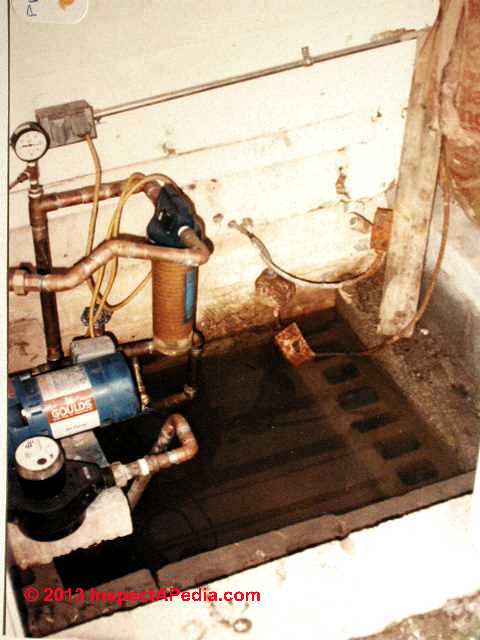
Our page top photo shows a cistern-type open well in a home basement. It is just about impossible for this example-source of drinking water to be consistently sanitary, and the little sediment filter installed will, by itself, not assure that the water is safe to drink.
InspectAPedia tolerates no conflicts of interest. We have no relationship with advertisers, products, or services discussed at this website.
- Daniel Friedman, Publisher/Editor/Author - See WHO ARE WE?
Should we Be Concerned About Water Contamination in a Private Well ?
 This well water contamination article describes types of activities in your area that can create threats to your water supply.
It also describes problems to look for and offers maintenance suggestions. Sources for more information and help are also listed.
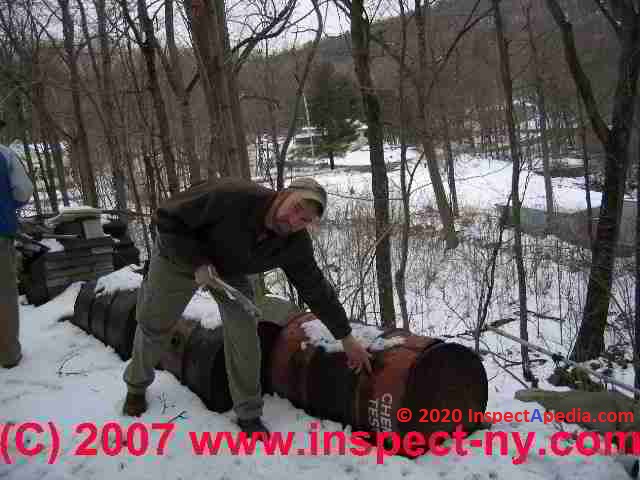
Our photo (left) illustrates chemical drums we found at a property served by a private well, These drums were also less than 10 meters from a nearby stream.
A bit of research was needed to narrow the range of chemical contaminants for which the water well serving this property should be tested.
Note: InspectApedia editors & contributors have edited an original US EPA article for clarity, content, & depth. Throughout this updated version we also include links to additional detail.
For example where the original article cited the role of distance of a well from sources of pollutants, we include a link to our table of WELL CLEARANCE DISTANCES to provide the actual distances involved.
Watch out: You should be aware because the Safe Drinking Water Act does not protect private wells.
EPA's rules only apply to "public drinking water systems" - government or privately run companies supplying water to 25 people or 15 service connections. While most states regulate private household wells, most have limited rules. Individual well owners have primary responsibility for the safety of the water drawn from their wells.
They do not benefit from the government's health protections for water systems serving many families. These must comply with federal and state regulations for frequent analysis, testing, and reporting of results.
Instead, household well owners should rely on help from local health departments. They may help you with yearly testing for bacteria and nitrates.
They may also oversee the placement and construction of new wells to meet state and local regulations. Most have rules about locating drinking water wells near septic tanks, drain fields, and livestock. But remember, the final responsibility for constructing your well correctly, protecting it from pollution, and maintaining it falls on you, the well owner.
Buying a home with a private water well: take a look at
CHEATING ON WATER TESTS : Testing Water for Real Estate Transactions - make sure your water test is valid
How Much Risk of Water Contamination Can we Expect?
 The risk of having problems depends on how good your well is - how well it was built and located, and how well you maintain it.
It also depends on your local environment. That includes the quality of the aquifer from which you draw your water and the human activities going on in your area that can affect your well water.
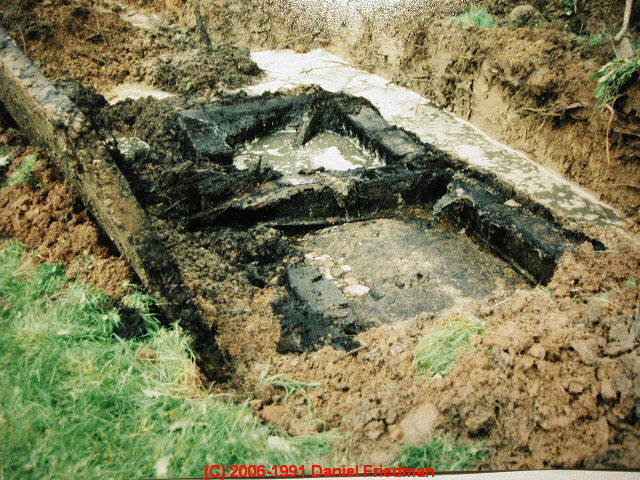
Our photo at left shows a failed septic tank.
Depending on the distance from septic tank or drainfield to the water well, onsite wastewater disposal systems such as this home-made version can be a troublesome source of local well water contamiantion.
Some questions to consider in protecting your drinking water and maintaining your well are:
- Water well type:
the type of water well can make a very large differencein the risk that the well water is contaminatned. For example a water source from a spring subject to surface runoff is difficult to keep sanitary, as are shallow wells and hand dug wells in most areas.
See WELLS CISTERNS & SPRINGSfor descriptions of the different types of drinking water well\s. - Water well clearance distance from sources of pollutants:
what distance should my well be from sources of human wastes such as septic systems? How far should a well be from animal feedlots or manure spreading?
Details are at WELL CLEARANCE DISTANCES - Water well condition,
leaks into a well casing due to cracks, splits, or corrosion.
See WELL CASING LEAK REPAIRS for details. - Water well underlying geology:
what are the types of soil and underlying rocks? Does water flow easily or collect on the surface? More details are
at WELL FLOW RATE and
at WELL FLOW TEST for WATER QUANTITY - Water well depth: how deep must a well be dug to avoid seasonal changes in ground water supply?. More about well depth is
at WELL DEPTH, HOW TO MEASURE - Type of activities near the water well:
What activities in my area (farming, mining, industry) might affect my well? - Well, pump, piping & pargs age:
what is the age of my well, its pump, and other parts?
See WELL LIFE EXPECTANCY. - Well water distribution system sanitation:
leaks into well piping underground can occur durng well pump off cycles and leaks into water piping can also occur in two-line jet pump systems when the pump is operating; also, the water distribution system must be protected from cross connections and backflow problems. Details are
at WELL PIPING LEAK DIAGNOSIS
and at CROSS CONNECTIONS, PLUMBING - Well water treatment system defects:
where a water treatment system has been installed in order to protect building occupants from pollutants in the well water, that equipment must be properly installed and maintained or it is unreliable or worse, can itself be a source of contaminants such as bacterial growth.
Details about water contaminant treatment equipment & methods are
at WATER TREATMENT EQUIPMENT CHOICES - home.
...
...
Continue reading at WELL WATER CONTAMINATION: CAUSES, CURES or select a topic from the closely-related articles below, or see the complete ARTICLE INDEX.
Or see these
Recommended Articles
- BACTERIA LEVELS in WATER, INTERPRETATION - bacteria in well water can be an indicator that other contaminants may be present
- COLIFORM STANDARDS for DRINKING WATER
- CONTAMINANT CLASSES, in WATER
- FAILED WATER TESTS - WHEN to RE-TEST
- SWIMMING WATER TESTS
- WATER CONTAMINANT LEVELS & LIMITS
- WATER POLLUTION - NATURAL SOURCES
- WATER POLLUTANT SOURCES
- WATER POLLUTION - HUMAN SOURCES
- WATER TEST PROCEDURAL ERRORS
- WATER TESTS for CONTAMINANTS - home
- WATER TEST PROCEDURAL ERRORS
- WATER TESTING ADVICE for home buyers
and building owners: water contaminants, water test procedures, well shock procedures, preventing drinking water
contamination,
and CHEATING ON WATER TESTS warns about how people accidentally or on purpose can obtain incorrect water test results.
Suggested citation for this web page
WATER WELL CONTAMINATION HAZARDS at InspectApedia.com - online encyclopedia of building & environmental inspection, testing, diagnosis, repair, & problem prevention advice.
Or see this
INDEX to RELATED ARTICLES: ARTICLE INDEX to WATER TESTING
Or use the SEARCH BOX found below to Ask a Question or Search InspectApedia
Ask a Question or Search InspectApedia
Questions & answers or comments about when to be concerned about possible drinking water well contamination
.
Try the search box just below, or if you prefer, post a question or comment in the Comments box below and we will respond promptly.
Search the InspectApedia website
Note: appearance of your Comment below may be delayed: if your comment contains an image, photograph, web link, or text that looks to the software as if it might be a web link, your posting will appear after it has been approved by a moderator. Apologies for the delay.
Only one image can be added per comment but you can post as many comments, and therefore images, as you like.
You will not receive a notification when a response to your question has been posted.
Please bookmark this page to make it easy for you to check back for our response.
IF above you see "Comment Form is loading comments..." then COMMENT BOX - countable.ca / bawkbox.com IS NOT WORKING.
In any case you are welcome to send an email directly to us at InspectApedia.com at editor@inspectApedia.com
We'll reply to you directly. Please help us help you by noting, in your email, the URL of the InspectApedia page where you wanted to comment.
Citations & References
In addition to any citations in the article above, a full list is available on request.
- [1] U.S. EPA, Drinking Water from Household Wells [PDF] Original source last retrieved 2/13/2013, original source: http://www.epa.gov/privatewells/pdfs/household_wells.pdf
- Access Water Energy, PO Box 2061, Moorabbin, VIC 3189, Australia, Tel: 1300 797 758, email: sales@accesswater.com.au Website: http://www.accesswater.com.au/
Moorabbin Office: Kingston Trade Centre, 100 Cochranes Rd, Moorabbin, VIC 3189
Australian supplier of: Greywater systems, Solar power to grid packages, Edwards solar systems, Vulcan compact solar systems, water & solar system pumps & controls, and a wide rage of above ground & under ground water storage tanks: concrete, steel, plastic, modular, and bladder storage tanks. - Crystal Clear Supply provides portable ceramic water filter purifiers and portable reverse osmosis water treatment equipment - see http://www.crystalclearsupply.com/category_s/7.htm
- Handbook of Disinfectants and Antiseptics, Joseph M. Ascenzi (Editor), CRC, 1995, ISBN-10: 0824795245 ISBN-13: 978-0824795245 "The evaluation of chemical germicides predates the golden age of microbiology..." -
This well-focused, up-to-date reference details the current medical uses of antiseptics and disinfectants -- particularly in the control of hospital-acquired infections -- presenting methods for evaluating products to obtain regulatory approval and examining chemical, physical, and microbiological properties as well as the toxicology of the most widely used commercial chemicals. - Potable Aqua® emergency drinking water germicidal tablets are produced by the Wisconsin Pharmacal Co., Jackson WI 53037. 800-558-6614 pharmacalway.com
- Principles and Practice of Disinfection, Preservation and Sterilization (Hardcover) A. D. Russell (Editor), W. B. Hugo (Editor), G. A. J. Ayliffe (Editor), Blackwell Science, 2004. ISBN-10: 1405101997, ISBN-13: 978-1405101998.
- In addition to citations & references found in this article, see the research citations given at the end of the related articles found at our suggested
CONTINUE READING or RECOMMENDED ARTICLES.
- Carson, Dunlop & Associates Ltd., 120 Carlton Street Suite 407, Toronto ON M5A 4K2. Tel: (416) 964-9415 1-800-268-7070 Email: info@carsondunlop.com. Alan Carson is a past president of ASHI, the American Society of Home Inspectors.
Thanks to Alan Carson and Bob Dunlop, for permission for InspectAPedia to use text excerpts from The HOME REFERENCE BOOK - the Encyclopedia of Homes and to use illustrations from The ILLUSTRATED HOME .
Carson Dunlop Associates provides extensive home inspection education and report writing material. In gratitude we provide links to tsome Carson Dunlop Associates products and services.
 |
HOME | ABOUT | ASK a QUESTION | CONTACT | CONTENT USE POLICY | DESCRIPTION | POLICIES | PRIVACY | |
| © 2026 - 1985 Publisher InspectApedia.com - Daniel Friedman | |||||||||