
InspectAPedia® FREE Encyclopedia of Building & Environmental Construction, Diagnosis, Maintenance & Repair |
Question? Just ask us! InspectAPedia
|
 Well Water Contamination Caused by Humans & Farm Animals
- POST a QUESTION or COMMENT about man-made sources of well water pollution
What human activities are likely to produce contaminants that may enter drinking water wells?
Information is given about drinking water from home wells & types of activities in your area that can create threats to your water supply.
We have added suggested sources of well water contamination and links to in-depth information on most of these.
InspectAPedia tolerates no conflicts of interest. We have no relationship with advertisers, products, or services discussed at this website.
What Human Activities Can Pollute Ground Water?
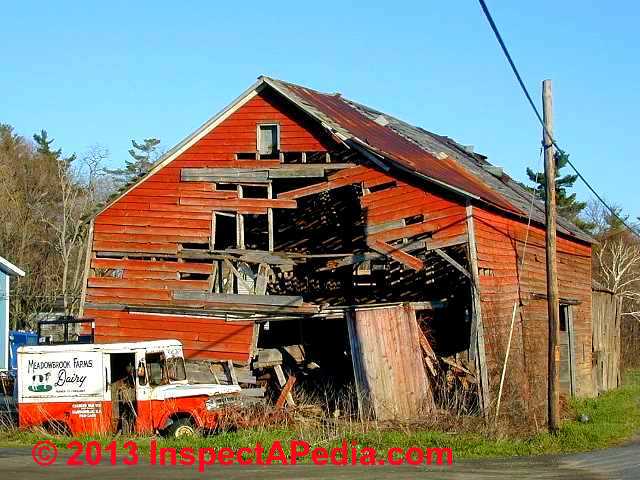
 Bacteria and Nitrates: as Sources of Water Contamination from septic tanks, barns, farm animals
These pollutants are found in human and animal wastes. Septic tanks can cause bacterial and nitrate pollution. So can large numbers of farm animals.
Both septic systems and animal manures must be carefully managed to prevent pollution. Sanitary landfills and garbage dumps are also sources. Children and some adults are at extra risk when exposed to water-born bacteria.
These include the elderly and people whose immune systems are weak due to AIDS or treatments for cancer. Fertilizers can add to nitrate problems. Nitrates cause a health threat in very young infants called "blue baby" syndrome. This condition disrupts oxygen flow in the blood.
More information on water contamiantion caused by humans: see
- SEPTIC SYSTEM INSPECTION & TEST GUIDE - home
- SEPTIC SYSTEM INSPECTION & TEST GUIDE FAQs
- SEWAGE PATHOGENS in SEPTIC SLUDGE
- NEVER FLUSH INTO SEPTICS
- NEVER FLUSH INTO TOILETS - FAQs
- DRUGS INTO the SEPTIC TANK?
Concentrated Animal Feeding Operations (CAFOs): [as Sources of Water Contamination]
The number of CAFOs, often called "factory farms," is growing. On these farms thousands of animals are raised in a small space. The large amounts of animal wastes/manures from these farms can threaten water supplies. Strict and careful manure management is needed to prevent pathogen and nutrient problems. Salts from high levels of manures can also pollute ground water.
Heavy Metals: [as Sources of Water Contamination]
Activities such as mining and construction can release large amounts of heavy metals into nearby ground water sources. Some older fruit orchards may contain high levels of arsenic, once used as a pesticide. At high levels, these metals pose a health risk.
[More information on water contamiantion caused by humans: see
- LEAD POISONING HAZARDS GUIDE - home
-DF]
Fertilizers and Pesticides: [as Sources of Water Contamination]
Farmers use fertilizers and pesticides to promote growth and reduce insect damage. These products are also used on golf courses and suburban lawns and gardens.
The chemicals in these products may end up in ground water. Such pollution depends on the types and amounts of chemicals used and how they are applied. Local environmental conditions (soil types, seasonal snow and rainfall) also affect this pollution. Many fertilizers contain forms of nitrogen that can break down into harmful nitrates.
This could add to other sources of nitrates mentioned above. Some underground agricultural drainage systems collect fertilizers and pesticides. This polluted water can pose problems to ground water and local streams and rivers. In addition, chemicals used to treat buildings and homes for termites or other pests may also pose a threat. Again, the possibility of problems depends on the amount and kind of chemicals.
The types of soil and the amount of water moving through the soil also play a role.
[More information on water contamiantion caused by humans: see
-DF]
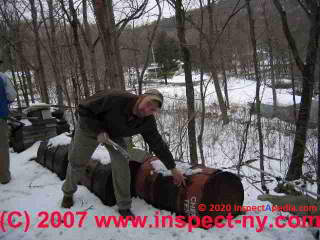 Industrial Products and Wastes: [as Sources of Water Contamination]
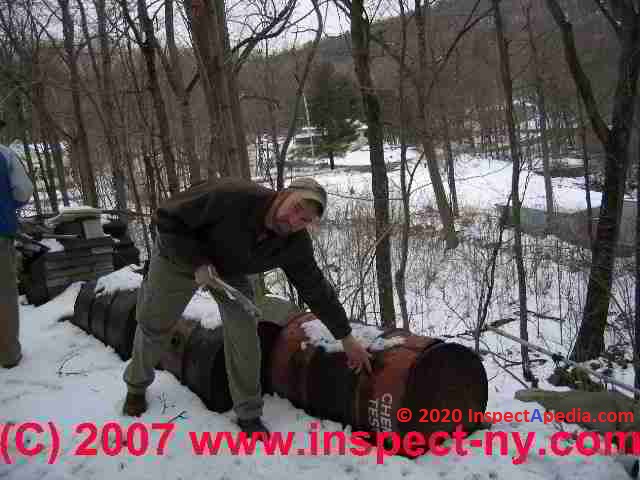
Many harmful chemicals are used widely in local business and industry. These can become drinking water pollutants if not well managed. The most common sources of such problems are:
[Our photo (left) shows chemical waste drums found at a building site. That observation raised a reasonable concern for local contaminant spillage and suggested further environmental testing. - DF]
Local Businesses: [as Sources of Water Contamination]
These include nearby factories, industrial plants, and even small businesses such as gas stations and dry cleaners.
All handle a variety of hazardous chemicals that need careful management. Spills and improper disposal of these chemicals or of industrial wastes can threaten ground water supplies.
Leaking Underground Tanks & Piping: [as Sources of Water Contamination]
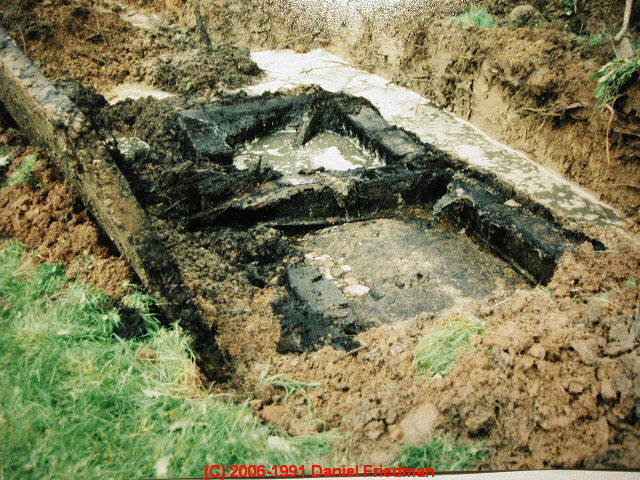
Petroleum products, chemicals, and wastes stored in underground storage tanks and pipes may end up in the ground water. Tanks and piping leak if they are constructed or installed improperly. Steel tanks and piping corrode with age. Tanks are often found on farms. The possibility of leaking tanks is great on old, abandoned farm sites. Farm tanks are exempt from the EPA rules for petroleum and chemical tanks.
[More information on water contamiantion caused by humans: see
-DF]
Landfills and Waste Dumps: [as Sources of Water Contamination]
Modern landfills are designed to contain any leaking liquids. But floods can carry them over the barriers. Older dumpsites may have a wide variety of pollutants that can seep into ground water.
Household Wastes: [as Sources of Water Contamination]
Improper disposal of many common products can pollute ground water. These include cleaning solvents, used motor oil, paints, and paint thinners. Even soaps and detergents can harm drinking water. These are often a problem from faulty septic tanks and septic leaching fields.
[More information on water contamiantion caused by humans: see
-DF]
Lead & Copper: [as Sources of Water Contamination]
Household plumbing materials are the most common source of lead and copper in home drinking water. Corrosive water may cause metals in pipes or soldered joints to leach into your tap water. Your water's acidity or alkalinity (often measured as pH) greatly affects corrosion. Temperature and mineral content also affect how corrosive it is.
They are often used in pipes, solder, or plumbing fixtures. Lead can cause serious damage to the brain, kidneys, nervous system, and red blood cells. The age of plumbing materials - in particular, copper pipes soldered with lead - is also important. Even in relatively low amounts these metals can be harmful. EPA rules under the Safe Drinking Water Act limit lead in drinking water to 15 parts per billion. Since 1988 the Act only allows "lead free" pipe, solder, and flux in drinking water systems. The law covers both new installations and repairs of plumbing.
For more information on avoiding lead in drinking water, visit the EPA's Lead in Drinking Water website.
[More information on water contamiantion caused by humans: see
-DF]
Water Treatment Chemicals: [as Sources of Water Contamination]
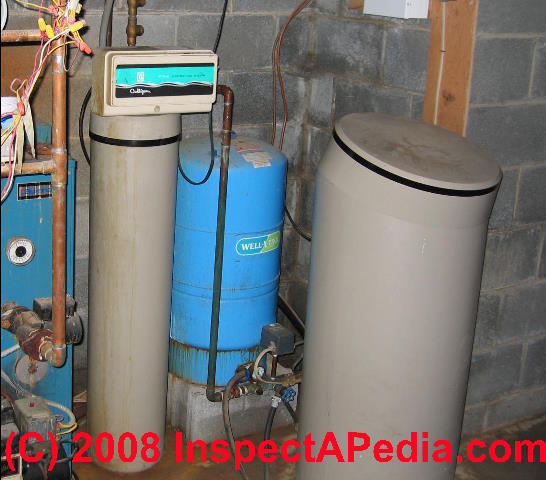
Improper handling or storage of water-well treatment chemicals (disinfectants, corrosion inhibitors, etc.) close to your well can cause problems.
[More information on water contamiantion caused by humans: see
-DF]

Septic tanks are designed to have a "leach field" around them - an area where wastewater flows out of the tank. This wastewater can also move into the ground water.
See The Septic System Information Website - not an EPA website - for in-depth information about inspecting and testing septic systems.
Also see Septic Contamination in Buildings - not
an EPA website - for in-depth information about testing and cleaning-up sewage contamination in buildings.
...
Continue reading at GROUND WATER CONTAMINANTS or select a topic from the closely-related articles below, or see the complete ARTICLE INDEX.
Or see these
Recommended Articles
- EPA GUIDE to WATER QUALITY
- SWIMMING WATER TESTS
- WATER POLLUTION - NATURAL SOURCES
- WATER POLLUTANT SOURCES
- WATER POLLUTION - HUMAN SOURCES
- WELL WATER CONTAMINATION: CAUSES, CURES - home
Suggested citation for this web page
WATER POLLUTION - HUMAN SOURCES at InspectApedia.com - online encyclopedia of building & environmental inspection, testing, diagnosis, repair, & problem prevention advice.
Or see this
INDEX to RELATED ARTICLES: ARTICLE INDEX to WATER TESTING
Or use the SEARCH BOX found below to Ask a Question or Search InspectApedia
Ask a Question or Search InspectApedia
Questions & answers or comments about man-made sources of well water pollution.
Try the search box just below, or if you prefer, post a question or comment in the Comments box below and we will respond promptly.
Search the InspectApedia website
Note: appearance of your Comment below may be delayed: if your comment contains an image, photograph, web link, or text that looks to the software as if it might be a web link, your posting will appear after it has been approved by a moderator. Apologies for the delay.
Only one image can be added per comment but you can post as many comments, and therefore images, as you like.
You will not receive a notification when a response to your question has been posted.
Please bookmark this page to make it easy for you to check back for our response.
Our Comment Box is provided by Countable Web Productions countable.ca
Citations & References
In addition to any citations in the article above, a full list is available on request.
- [1] Drinking Water from Household Wells - PDF, U.S. EPA, Original source last retrieved 2/13/2013, original source: http://www.epa.gov/privatewells/pdfs/household_wells.pdf
- Grove Electric, Typical Shallow Well One Line Jet Pump Installation [PDF], Grove Electric, G&G Electric & Plumbing, 1900 NE 78th St., Suite 101, Vancouver WA 98665 www.grovelectric.com - web search -7/15/2010 original source: http://www.groverelectric.com/howto/38_Typical%20Jet%20Pump%20Installation.pdf
- Grove Electric, Typical Deep Well Two Line Jet Pump Installation [PDF], Grove Electric, G&G Electric & Plumbing, 1900 NE 78th St., Suite 101, Vancouver WA 98665 www.grovelectric.com - web search -7/15/2010 original source: http://www.groverelectric.com/howto/38_Typical%20Jet%20Pump%20Installation.pdf
- Water Tests & Fees this water test fee schedule applies when testing is combined with other onsite building inspection services
- CONTAMINANT CLASSES, in WATER & links to home buyer advice about water testing, drinking water, water supply
- Water Requirements, Home & Outdoor Living
- Our recommended books about building & mechanical systems design, inspection, problem diagnosis, and repair, and about indoor environment and IAQ testing, diagnosis, and cleanup are at the InspectAPedia Bookstore. Also see our Book Reviews - InspectAPedia.
- In addition to citations & references found in this article, see the research citations given at the end of the related articles found at our suggested
CONTINUE READING or RECOMMENDED ARTICLES.
- Carson, Dunlop & Associates Ltd., 120 Carlton Street Suite 407, Toronto ON M5A 4K2. Tel: (416) 964-9415 1-800-268-7070 Email: info@carsondunlop.com. Alan Carson is a past president of ASHI, the American Society of Home Inspectors.
Thanks to Alan Carson and Bob Dunlop, for permission for InspectAPedia to use text excerpts from The HOME REFERENCE BOOK - the Encyclopedia of Homes and to use illustrations from The ILLUSTRATED HOME .
Carson Dunlop Associates provides extensive home inspection education and report writing material. In gratitude we provide links to tsome Carson Dunlop Associates products and services.
 | HOME | ABOUT | ASK a QUESTION | CONTACT | CONTENT USE POLICY | DESCRIPTION | POLICIES | PRIVACY | |
| © 2024 - 1985 Publisher InspectApedia.com - Daniel Friedman | |||||||||