
InspectAPedia® FREE Encyclopedia of Building & Environmental Construction, Diagnosis, Maintenance & Repair |
Question? Just ask us! InspectAPedia
|
 How to Fix Well Water Contamination Immediately
- POST a QUESTION or COMMENT about how to correct contaminated or polluted (unsanitary) well water
Fix unsanitary or contaminated well water: this article gives advice for immediate steps you can take to correct unsanitary or contaminated private well water.
We have edited and expanded original advice on this topic provided by the U.S. EPA.
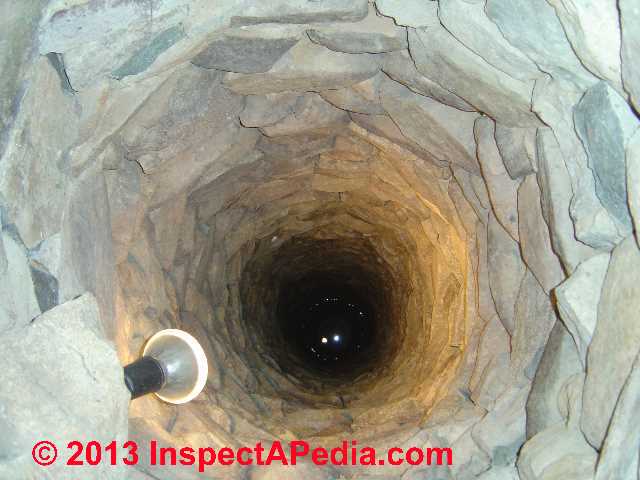
Our page top photo illustrates a dug well lined with stone set in cement; even with this lining a shallow hand dug well can be very difficult to keep in sanitary condition.
InspectAPedia tolerates no conflicts of interest. We have no relationship with advertisers, products, or services discussed at this website.
How to Fix Well Water Contamination Problems Immediately
 If you find that your well water is polluted, fix the problem as soon as possible. You may need to disinfect your water have a new well drilled, re plumb or repair your system. Consider hooking into a nearby community water system (if one is available).
If you have a new well drilled or connect to a community water system, the old well must be closed properly. Consult "local experts" for help.
Procedures for Dealing with Well Contaminants
[See these (non-EPA) step by step guides to correcting problems with well water:
- WATER TEST INTERPRETATION
- COMMON BACTERIA TESTS for DRINKING WATER
- FAILED WATER TESTS - WHAT TO DO
- FAILED WATER TESTS - WHEN to RE-TEST
- WATER POLLUTANT SOURCES
- WATER WELL CONTAMINATION HAZARDS
- FLOOD CONTAMINATED WELL RESTORE & PROTECT
- WELL CASING LEAK REPAIRS
- WELL CASING LEAK REPAIR FAQs
- WELL CONSTRUCTION INFORMATION SOURCES
- WELL DISINFECTION PROCEDURE, POST FLOODING
- WELL SHOCK / CHLORINATION PROCEDURE
The EPA's "disinfect your water" refers not to simply temporary disinfection by "shocking" your well, but more likely to installing equipment to treat the water to assure that it is sanitary.
Dealing with a Persistent Well Contaminant Source
If there is a persistent source of well contamination which you are not able to eliminate (such as by repairing a groundwater leak into a well casing), then the choices are either drill a new well or treat the existing water supply to remove the contaminant. Also see
- INTERPRET WATER TEST RESULTS & CORRECT UNSATISFACTORY DRINKNIG WATER
- ACT on UNSATISFACTORY WATER TEST RESULTS - WHEN TO RE-TEST - Advice for Home Buyers & Home Owners - not an EPA site
You might consider installing a water treatment device to remove impurities. Information about treatment devices can be obtained from the following sources:
- Water Quality Association P.O. Box 606 4151 Naperville Road Lisle, IL 60532 www.wqa.org
- National Sanitation Foundation P.O. Box 130140 789 N Dixboro Road Ann Arbor, MI 48113-0140 (734) 769-8010, (800) NSF-MARK www.nsf.org
- U.S. Environmental Protection Agency (to visit in person) Office of Water Resource Center 1200 Pennsylvania Avenue, NW Ariel Rios Building Washington, DC 20460 Phone: (202) 260-7786 Monday through Friday, except federal holidays, 8:30AM - 4:30PM ET E-mail address: center.water-resource@epa.gov
There are many home water treatment devices. Different types remove different pollutants or impurities. No one device does it all. Also, you must carefully maintain your home treatment device so your water stays safe. For more information, get a copy of EPA's pamphlet, "Home Water Treatment Units" from the U.S. EPA Resource Center or call the Hotline at (800) 426-4791.
The water pollution and testing material in this article series describes types of activities in your area that can create threats to your water supply.
It also describes problems to look for and offers maintenance suggestions. Sources for more information and help are also listed. [Editing for clarity by DF are marked by brackets or italics] Initial Source: EPA 816-K-02-003 January 2002
...
Reader Comments, Questions & Answers About The Article Above
Below you will find questions and answers previously posted on this page at its page bottom reader comment box.
Reader Q&A - also see RECOMMENDED ARTICLES & FAQs
Re-Posting: AUTHOR:Karen (no email)
COMMENT:We recently had a well drilled and while drilling the company experienced trouble with the equipment and hydraulic fluid was leaking around the well. Now we ...
Question: well pump leaked oil into the well bore - water smells
(Feb 5, 2012) hkmp50@yahoo.com said:
I reciently had my well pump go bad, and in the process it leaked all the lubricating oil from the pump into the well.
Basicly the bottom of the pump disintegrated, it has been in service since the 70's Is there any way to fix/repair/remove the contaminate? I replaced the pump but smell oil in the water now, is this a health issue I whould worry about?
Reply:
HKMP
In my OPINION you sure don't want to be drinking oil-contaminated well water. It could take quite some time and waste a lot of water (and contaminate your piping and water tank) to try to flush the oil out just through your new well pump; if you can't get rid of the odor after running water for an hour or so you might try calling a local well driller to see if they have a more powerful pump that can be used to get ahead of the well flow rate into your well - basically pumping the well out completely once or twice.
Check with your local health department and water testing lab to see if they recommend adding a non-toxic (food-grade) oil dispersant that can help remove oil from the well, but
Watch out: common oil dispersants such as Corexit used by the oil industry are themselves highly toxic and should not be inserted into a drinking water source.
See CRUDE OIL & DISPERSANT EXPOSURE
After pump-out is completed, and after you've emptied your water tank and refilled it with clean water, and flushed your system piping, I recommend taking a water sample to your local water test lab to check water potability as well as to check for oil products.
...
Continue reading at CHLORINATION WELL SHOCKING PROCEDURE or select a topic from the closely-related articles below, or see the complete ARTICLE INDEX.
Or see these
Recommended Articles
- CHLORINATION WELL SHOCKING PROCEDURE
- SIX STEPS to WELL WATER SAFETY
- WATER POLLUTANT SOURCES
- WATER TREATMENT EQUIPMENT CHOICES
- WELL WATER CONTAMINATION: CAUSES, CURES - home
Suggested citation for this web page
FIX WATER WELL CONTAMINATION SOURCES at InspectApedia.com - online encyclopedia of building & environmental inspection, testing, diagnosis, repair, & problem prevention advice.
Or see this
INDEX to RELATED ARTICLES: ARTICLE INDEX to WATER TESTING
Or use the SEARCH BOX found below to Ask a Question or Search InspectApedia
Ask a Question or Search InspectApedia
Try the search box just below, or if you prefer, post a question or comment in the Comments box below and we will respond promptly.
Search the InspectApedia website
Note: appearance of your Comment below may be delayed: if your comment contains an image, photograph, web link, or text that looks to the software as if it might be a web link, your posting will appear after it has been approved by a moderator. Apologies for the delay.
Only one image can be added per comment but you can post as many comments, and therefore images, as you like.
You will not receive a notification when a response to your question has been posted.
Please bookmark this page to make it easy for you to check back for our response.
Our Comment Box is provided by Countable Web Productions countable.ca
Citations & References
In addition to any citations in the article above, a full list is available on request.
- [1] Drinking Water from Household Wells - PDF, U.S. EPA, Original source last retrieved 2/13/2013, original source: http://www.epa.gov/privatewells/pdfs/household_wells.pdf
- Crystal Clear Supply provides portable ceramic water filter purifiers and portable reverse osmosis water treatment equipment - see http://www.crystalclearsupply.com/category_s/7.htm
- Handbook of Disinfectants and Antiseptics, Joseph M. Ascenzi (Editor), CRC, 1995, ISBN-10: 0824795245 ISBN-13: 978-0824795245 "The evaluation of chemical germicides predates the golden age of microbiology..." -
This well-focused, up-to-date reference details the current medical uses of antiseptics and disinfectants -- particularly in the control of hospital-acquired infections -- presenting methods for evaluating products to obtain regulatory approval and examining chemical, physical, and microbiological properties as well as the toxicology of the most widely used commercial chemicals. - Principles and Practice of Disinfection, Preservation and Sterilization (Hardcover)
by A. D. Russell (Editor), W. B. Hugo (Editor), G. A. J. Ayliffe (Editor), Blackwell Science, 2004. ISBN-10: 1405101997, ISBN-13: 978-1405101998.
"This superb book is the best of its kind available and one that will undoubtedly be useful, if not essential, to workers in a variety of industries. Thirty-one distinguished specialists deal comprehensively with the subject matter indicated by the title ... The book is produced with care, is very readable with useful selected references at the end of each chapter and an excellent index. It is an essential source book for everyone interested in this field. For pharmacy undergraduates, it will complement the excellent text on pharmaceutical microbiology by two of the present editors."
The Pharmaceutical Journal: "This is an excellent book. It deals comprehensively and authoritatively with its subject with contributions from 31 distinguished specialists. There is a great deal to interest all those involved in hospital infection ... This book is exceptionally well laid out. There are well chosen references for each chapter and an excellent index. It is highly recommended." The Journal of Hospital Infection.: "The editors and authors must be congratulated for this excellent treatise on nonantibiotic antimicrobial measures in hospitals and industry ... The publication is highly recommended to hospital and research personnel, especially to clinical microbiologists, infection-control and environmental-safety specialists, pharmacists, and dieticians."
New England Journal of Medicine: City Hospital, Birmingham, UK. Covers the many methods of the elimination or prevention of microbial growth. Provides an historical overview, descriptions of the types of antimicrobial agents, factors affecting efficacy, evaluation methods, and types of resistance. Features sterilization methods, and more. Previous edition: c1999. DNLM: Sterilization--methods. - When Technology Fails, Matthew Stein, Chelsea Green Publisher, 2008,493 pages. ISBN-10: 1933392452 ISBN-13: 978-1933392455, "... how to find and sterilize water in the face of utility failure, as well as practical information for dealing with water-quality issues even when the public tap water is still flowing". Mr. Stein's website is www.whentechfails.com/
- Our recommended books about building & mechanical systems design, inspection, problem diagnosis, and repair, and about indoor environment and IAQ testing, diagnosis, and cleanup are at the InspectAPedia Bookstore. Also see our Book Reviews - InspectAPedia.
- In addition to citations & references found in this article, see the research citations given at the end of the related articles found at our suggested
CONTINUE READING or RECOMMENDED ARTICLES.
- Carson, Dunlop & Associates Ltd., 120 Carlton Street Suite 407, Toronto ON M5A 4K2. Tel: (416) 964-9415 1-800-268-7070 Email: info@carsondunlop.com. Alan Carson is a past president of ASHI, the American Society of Home Inspectors.
Thanks to Alan Carson and Bob Dunlop, for permission for InspectAPedia to use text excerpts from The HOME REFERENCE BOOK - the Encyclopedia of Homes and to use illustrations from The ILLUSTRATED HOME .
Carson Dunlop Associates provides extensive home inspection education and report writing material. In gratitude we provide links to tsome Carson Dunlop Associates products and services.
 | HOME | ABOUT | ASK a QUESTION | CONTACT | CONTENT USE POLICY | DESCRIPTION | POLICIES | PRIVACY | |
| © 2024 - 1985 Publisher InspectApedia.com - Daniel Friedman | |||||||||