
InspectAPedia® FREE Encyclopedia of Building & Environmental Construction, Diagnosis, Maintenance & Repair |
Question? Just ask us! InspectAPedia
|
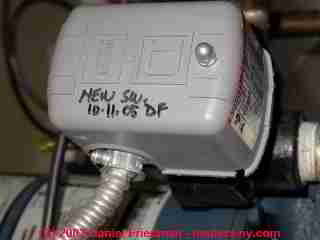 Dropping water pressure
How to Diagnose & Repair Slowly-Dropping Water Pressure
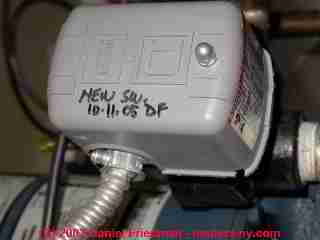
- POST a QUESTION or COMMENT about water pressure that falls off slowly or deteriorates
Troubleshooting deteriorating water pressure in buildings: this article describes how to diagnose slow water pressure loss and erratic well pump behavior.
When water pressure seems to keep dropping after the well pump has stopped, what's wrong? How do we fix it? How to diagnose and fix erratic well pump or pressure control switch behavior.
Here we discuss tracing a water pressure problem to pressure gauge, pressure switch, pump relay, check valve, foot valve, or building water leaks. We explain how to decide if water pump pressure control switch or water pump replacement is needed.
Step by step diagnostic procedure for falling water pressure trouble.
InspectAPedia tolerates no conflicts of interest. We have no relationship with advertisers, products, or services discussed at this website.
Diagnose slow pressure or loss of water pressure in a building after the well pump has cycled off
 Common causes and repairs for erratic well pump or pressure switch behavior
This article discusses water pressure that falls slowly when it should be more steady - diagnosis & cure.
Short cycling of a well pump is also a type of "intermittent lost water pressure" except that water pressure fluctuates between stronger & weaker rapidly, perhaps every few seconds. Short cycling has several different causes, including a partly-clogged sensor on the pressure switch (blocked by debris, water pressure is slow to enter the pump control, and slow to leave it).
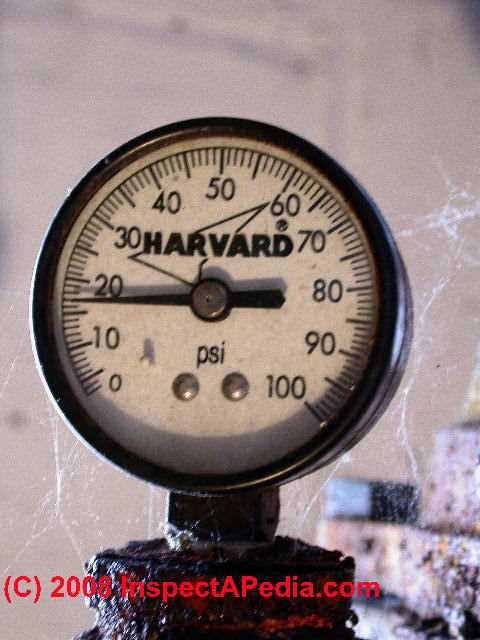
A similar problem can happen at a pressure gauge, making the gauge slow to register an increase and then to bleed down, showing a pressure drop more slowly than the actual water pressure drop.
See details about rapid on-off pump cycling
Meaning of a Slow Responding Well Pump Pressure Switch
A slow response of a well water pump pressure switch
and/or pump relay control to the actual water pressure suggest a blocked pressure switch sensing port - due to debris in the water or hard water. This problem can also cause a delayed-response of the pressure control or gauge to the actual system water pressure.
Note that water pump relay switches are often installed when the well pump is actually down in the well (a submersible pump) while in-building water pumps (1 line or 2-line jet pumps) will not usually require the heavy-duty pump relay control. Instead the in-building pumps are controlled directly by the pressure switch.
Details are at WATER PUMP PRESSURE CONTROL SWITCH
and at this submersible or heavy-duty high-capacyt pump control relay
article WATER PUMP RELAY SWITCH
Meaning of Building Water Pressure Drop to Zero
A building water pressure drop to zero when the well pump is still able to switch on and restore water pressure suggests a bad foot valve or bad check valve that is letting water pressure drain back into the well.
If the accuracy of your water pressure gauge is in doubt,
see WATER PRESSURE GAUGE ACCURACY
If building water pressure is lost entirely and does not immediately recover when the pump turns on,
see WATER PRESSURE LOSS DIAGNOSIS & REPAIR.
When building water pressure appears to drop after the pump is turned off, some causes include
- Water is running in the building, such as a running toilet (usually shows as very slow pressure drop, 10 minutes or more);
if a faucet were on full or a pipe in the building has burst, running water rapidly, you'd probably know it;
In this case water pressure would be expected to drop to the pump cut-in pressure and the pump would come on again (but monitoring this can be confused if the pressure gauge is not working properly, or if the pump pressure control switch is not working properly).
A slow-running toilet, or a slow leak anywhere in the building's piping system, even a small hidden leak at a faucet in a wall cavity can cause a pressure drop noticed when the pump is off and you think that no water is running. - Water leaks in well piping, such as a leak in piping in the well, or a
lost FOOT VALVE
or a bad CHECK VALVE at the building, perhaps at the well pump, can bleed water pressure backwards down into the well when the pump stops. This can drop water pressure to zero or the check valve may leak only at higher pressures.
A bad internal pump seal might water leak-back into the well piping system and into the well itself (depending on check valve locations and conditions). - Water pressure not really dropping (nor rising) exactly as the pressure gauge indicates, can be due to a partly clogged pressure port on the gauge (by debris), slowing its response; but in this case the gauge won't normally drop down to zero.
We discuss gauge problems with air or water pressure gauge readings on water tanks
at HOW TO READ WATER TANK AIR PRESSURE ACCURATELY - Water Pressure Drops then Stops Dropping - If water pressure falls a few psi to perhaps 10 psi when the water pump stops, the problem can be any of several causes discussed
at WATER PRESSURE FALLS BRIEFLY THEN STOPS - pressure drops then stops dropping after pump turns off
Sorting Out the Job of the Pressure Switch vs. the Pump Relay Switch
We were unsure about the "clunk" reported by a reader as an intermittent sound at the pump relay, but a possible explanation would be confusion between what the
little WATER PRESSURE CONTROL SWITCH (also referred to as pump control switch or "pumptrol" or "pressure switch") is doing versus what the heavy duty
PUMP RELAY SWITCH is doing.
Normally, the water pressure at the pressure sensing switch is what turns the pump on and off, either by directly switching the pump on and off in response to sensing the cut-in or cut-out pressure at the pump or water tank, OR indirectly by turning on and off a heavy-duty pump relay switch that is used to turn higher horsepower and thus higher amperage-drawing (submersible) well pumps on and off.
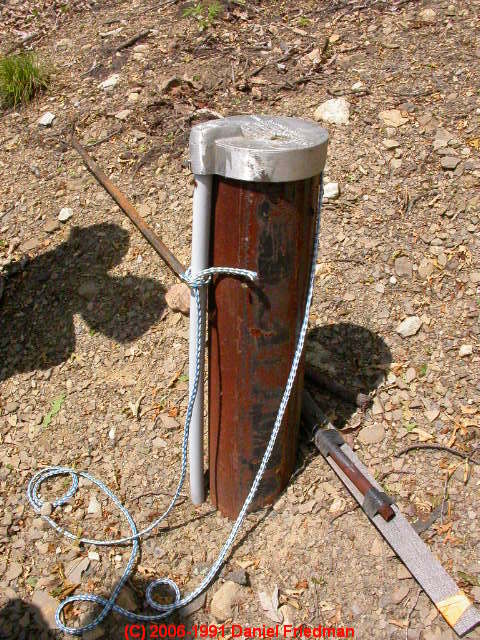 Running a high-amp well pump off of a little pressure control switch will often burn up the switch contacts, or the amperage draw may exceed the rating of the pressure switch itself - that's why the relay switch is used.
So the "duty cycle of the pump" cited by our reader doesn't seem to explain this problem, though some other electrical problem in the pump wiring or controls could be causing the pump to cycle on and off while the pressure switch continues to call for pumping - such as a faulty thermal overload switch.
When a water pump is inside the well, it can be tricky to know when the pump is actually on or off, though usually we hear the pump relay clicking, and some relays have a light that indicates that the relay is telling the pump to run.
The pressure switch calls for pumping by switching a relay in the pump relay, that actually turns the pump on and off. So a secondary potential problem would be in the relay itself, but we would look at the pump pressure control switch first.
List of Diagnostic Steps for Slowly-Falling Building Water Pressure
- Turn off the main building water valve when the well pump has started running, isolating the pressure tank and pump controls from the building.
Now the pump should bring the water tank and controls up to the cutoff pressure and things should stay there. - If water pressure keeps dropping after the pump stops, either your main house valve is leaking and there is water running in the building, or there is a bad check valve or foot valve and water and pressure are returning to the well.
See MAIN WATER SHUTOFF VALVE. - If water pressure drops 1-10 psi then stops falling after the pump stops we suspect one of the conditions discussed
at WATER PRESSURE FALLS BRIEFLY THEN STOPS - Put an independent, working water pressure gauge on the system, say at the pressure tank drain valve, and see what is actually happening to building water pressure;
- Use a neon tester or a VOM to see when the pressure gauge contacts are closed and calling for the pump relay to close and thus turn on the pump; make the same checks at the pump relay.
Watch out: there are electrocution hazards inside of the pump control switch or pump relay. If you don't have the expertise to handle this equipment call a licensed electrician or plumber.
See DMMs VOMs SAFE USE OF.
Reader Question about Dropping Water Pressure
I have a residential well that is about 11 years old. I believe the pump itself is a submersible type located at the end of the pipe at the bottom of the casing in the back yard.
In the house, there is a bladder type pressure tank, a control box on the wall, a pressure switch and guage on the water pipe. After that is the water filter and water softener. Then it branches out to the house.
My Well pump is short cycling. Here's what I see:
Looking at the pipes in the basement where the well attaches to the house water system, I watch the water pressure guage. Its at 60 psi.
I open a facet and run some water until the well pump turns on. The pressure guage is about 40 psi when the pump turns on. I stop running water.
The pressure rises to about 55 psi and the well pump turns off. I watch the pressure guage and it slowly drops a few psi while maybe 10 seconds have passed.
The slow water pressure drop problem and its diagnosis are discussed in this article
The pump turns back on and pumps up to about 58 psi and turns off
I watch the pressure guage and it slowly drops a few psi while about 10 more seconds pass. The pump turns back on and pumps up to 60 psi and now I hear a solid "clunk" noise in the well control (relay) box on the wall and the pump turns off.
This time, there is no drop in pressure and the pump does not turn back on unless I use more water.
I found this information about the "foot valve"
and "well pump pressure" that may help explain the cause but what is the "clunk" noise and why doesn't the clunk happen every time the pump cycles?
Does the clunk only happen when the foot valve is engaged?
Or is the well pump unable to produce 60 psi every time and has its own shut-off at the pump itself?
Well piping foot valve leaks:
In some cases a defective foot valve in the well can cause water to drain back out of the building system into the well, dropping pressure in the water tank and causing the pump to run mysteriously.
The "foot valve" is an anti-siphon device intended to hold water in the pipe that rises up inside the well after the pump has shut off. If the foot valve is damaged you'll need a plumber to pull the well line and replace the valve.
The foot valve itself is an inexpensive part but pulling the well line can be costly. On the author's well
the foot valve lasts typically about 20 years.
See WELL PIPING FOOT VALVES.
Well pump pressure:
Exceeding well pump pressure capability: If you set the cut out (stop pumping) pressure higher than the water pump
is capable of reaching, the pump will just keep running indefinitely until it burns up or blows a fuse or trips a
circuit breaker or overheats.
See WATER PRESSURE CONTROL SWITCH ADJUSTMENTS.
General Tips for Diagnosing Water Pressure Problems
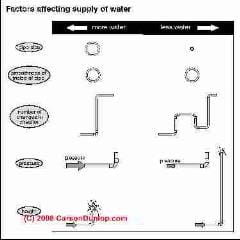
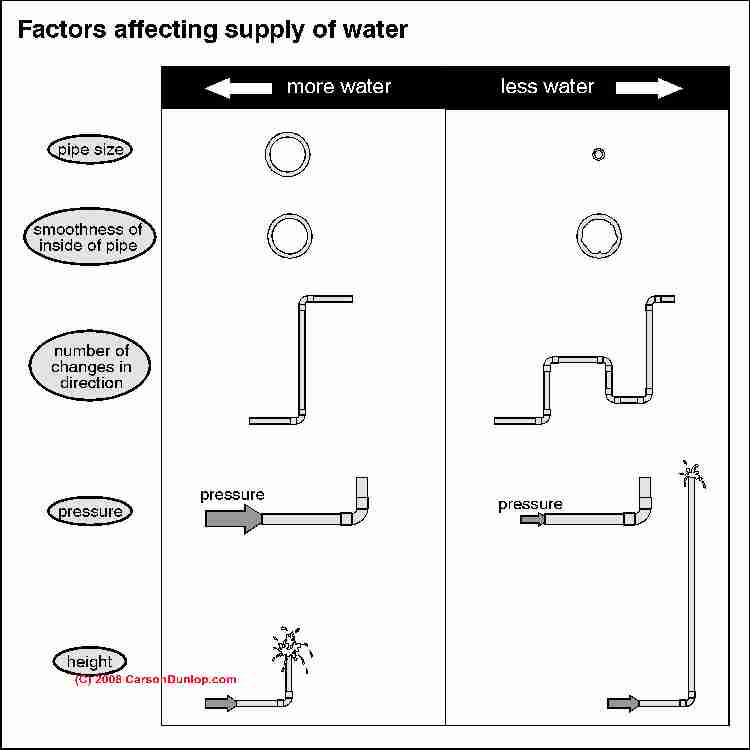 This sketch, courtesy of Carson Dunlop Associates, shows five factors that affect the water pressure and flow in a building. What the sketch has not included are water pressure, quantity, or flow problems that originate at the well, well pump, or water pressure tank. Here is our comprehensive guide to diagnosing bad water pressure.
If you have no water pressure at all, see NO WATER PRESSURE and see the other water pressure diagnostic articles listed just below.
If your water pressure is intermittent, starts and stops, or varies in pressure,
see WATER PRESSURE INTERMITTENT LOSS and see the other water pressure diagnostic articles listed just below.
If there is some water pressure but the pressure and/or flow are poor? See the diagnostic articles listed just below.
Water supply piping problem? See BAD WATER PRESSURE CLOGGED PIPES
and see WATER PIPE CLOG REPAIR.
Keep in mind that if water is running elsewhere in the building (another shower, sink, dishwasher, clothes washer, garden hose, etc) then the water pressure you will observe at your location will usually be reduced.
If you have good water pressure at some fixtures but not at others, you probably have a clog in building piping (such as due to mineral deposits, rust, or even excessive solder in new work), or mineral and debris clogged strainers at faucets and shower heads (check these first). Also
Reader Comments, Questions & Answers About The Article Above
Below you will find questions and answers previously posted on this page at its page bottom reader comment box.
Reader Q&A - also see RECOMMENDED ARTICLES & FAQs
On 2020-12-19 - by (mod) -
Jim
We need to rule out the possibility that water was running somewhere in the building such as a slow running toilet. One way you can do that is to turn off water into the house on the house side of the pressure tank. You should not been see pressure continued to fall.
if you do, it maybe one of the problems listed on the page above.
On 2020-12-19 by Jim
New pump new pressure tank. Adjusted pressure switch 40/60 after ten minutes pressure drops to 50 remains at 50 is that normal.?
On 2020-11-22 - by (mod) -
Dave
Please see the diagnostics at WATER PUMP INTERMITTENT CYCLING https://inspectapedia.com/water/Intermittent-Water-Pump-Cycling.php
On 2020-11-18 by dave Varga
Water pump (Red Jacket submersible) recycles intermittently when not calling for water. No water running, no toilet slowly running, no leaks, supply pipes under floor replaced. Pressure is good as expected on residential well water system. Is this a check valve, regulator or water control at the pressure tank or in the well (located 15' down in casing)? This is a newer 'bladder' pressure tank, pressure gauge has been replaced. Thx, the plumber and myself are stumped.
On 2020-09-23 - by (mod) -
Naveed
With an apology that this is past my expertise, it sounds as if we need to look first at the pump controls and piping for
a leak that's sending water back into the well, such as a bad check valve or piping leak
On 2020-09-23 by Naveed
Hope all's well with you. Well, i've installed 15 hp pump and motor each,for solarization we powered it via 16.5kw solar panel. the power it generates is quite well. What the motor does is the water of pump at the efflux stops and goes start by itself, irrespective of the inverter, which remains on all of the time.
Pump & motor: 15hp each
Solarizated power: 16500watt
Water level: 40feet
Total Head: 100feet (Checked it with 150 feet too, the issue remained the same)
Toltal bore: 330feet
Bore width (Diameter) : 12inches (1 foot)
Diameter of Pipe used for water :4 inches
Can someone please helped me in resolving this issue. to have a non-stop water at the efflux. i will be highly indebted to you for ur help.
P.S: We checked the pump that was okay, had no issue in the pump. The pipes were also well, none else was leaked amidt them.
On 2020-03-19 - by (mod) -
Kevin
A leak in the reverse osmosis system is an interesting thought and not a leak I've encountered. But you're on-track: a slow leak or slow running water anywhere (running toilets can be hard to spot) could be at fault as can be a leaky check valve in well piping.
On 2020-03-19 by Kevin Ilaug
Wel x troll tank builds to 59 psi well pump stops then psi slowly drops to 30 before starting. Might be the check valve in the reverse osmosis?
On 2019-04-06 - by (mod) -
Josh
It sounds to me like the well may have limitrd flow.
On 2019-04-04 by Josh
I have well water. From the well to the house is a long distance so I have a pressure booster in the house. It has started to run a lot. The pressure guage goes to 60 where it is set then drops below setpoint for turning on and runs back up to 60 psi. I’m not sure if it’s the pressure tank, check valve or pressure sensor. We recently had rusty/dirty water for an hour or two then it went away and now the water is perfectly clear again but it’s running the pump so for now I have it turned off. Any suggestions?
...
Continue reading at WATER PRESSURE FALLS BRIEFLY THEN STOPS - after the pump turns off pressure falls a few psi, or select a topic from the closely-related articles below, or see the complete ARTICLE INDEX.
Or see WATER PRESSURE FALLS SLOWLY FAQs - questions & answers posted originally in this article
Or see these
Recommened Articles
- WATER PRESSURE FALLS BRIEFLY THEN STOPS
- WATER PRESSURE FALLS SLOWLY, ERRATIC PUMP
- WATER PRESSURE GAUGE
- WATER PRESSURE TABLE 2: PUMP RUNS, WEAK or NO WATER PRESSURE
- WATER PUMP INTERMITTENT CYCLING
- WELL PIPING CHECK VALVES common source of slow dropping in water pressure and loss of well prime
- WELL PIPING FOOT VALVES common source of slow dropping in water pressure and loss of well prime
- WELL WATER PRESSURE DIAGNOSIS - home
Suggested citation for this web page
WATER PRESSURE FALLS SLOWLY, ERRATIC PUMP at InspectApedia.com - online encyclopedia of building & environmental inspection, testing, diagnosis, repair, & problem prevention advice.
Or see this
INDEX to RELATED ARTICLES: ARTICLE INDEX to WATER SUPPLY, PUMPS TANKS WELLS
Or use the SEARCH BOX found below to Ask a Question or Search InspectApedia
Ask a Question or Search InspectApedia
Questions & answers on intermittent loss of building water pressure: troubleshooting, causes, repairs. .
Try the search box just below, or if you prefer, post a question or comment in the Comments box below and we will respond promptly.
Search the InspectApedia website
Note: appearance of your Comment below may be delayed: if your comment contains an image, photograph, web link, or text that looks to the software as if it might be a web link, your posting will appear after it has been approved by a moderator. Apologies for the delay.
Only one image can be added per comment but you can post as many comments, and therefore images, as you like.
You will not receive a notification when a response to your question has been posted.
Please bookmark this page to make it easy for you to check back for our response.
Our Comment Box is provided by Countable Web Productions countable.ca
Citations & References
In addition to any citations in the article above, a full list is available on request.
- Mark Cramer Inspection Services Mark Cramer, Tampa Florida, Mr. Cramer is a past president of ASHI, the American Society of Home Inspectors and is a Florida home inspector and home inspection educator. Mr. Cramer serves on the ASHI Home Inspection Standards. Contact Mark Cramer at: 727-595-4211 mark@BestTampaInspector.com
- John Cranor [Website: /www.house-whisperer.com ] is an ASHI member and a home inspector (The House Whisperer) is located in Glen Allen, VA 23060. He is also a contributor to InspectApedia.com in several technical areas such as plumbing and appliances (dryer vents). Contact Mr. Cranor at 804-873-8534 or by Email: johncranor@verizon.net
- Thanks to Jeneral Sewer Service - George - 845-297-2285, a New York Hudson Valley drain and sewer cleaning and de-clogging expert for technical details and consulting on drain clog diagnosis and repair, including proper use of the Kinetic Water Ram for drain clearing - 3/14/2009
- Thanks to our reader, Carole Cimitile, 2/17/2009, for reminding us that small problems like faucet o-rings, clogged faucet strainers and similar local plumbing fixture defects can have a big impact on hot water flow, cold water flow, or both hot and cold water flow and pressure problems.
- In addition to citations & references found in this article, see the research citations given at the end of the related articles found at our suggested
CONTINUE READING or RECOMMENDED ARTICLES.
- Carson, Dunlop & Associates Ltd., 120 Carlton Street Suite 407, Toronto ON M5A 4K2. Tel: (416) 964-9415 1-800-268-7070 Email: info@carsondunlop.com. Alan Carson is a past president of ASHI, the American Society of Home Inspectors.
Thanks to Alan Carson and Bob Dunlop, for permission for InspectAPedia to use text excerpts from The HOME REFERENCE BOOK - the Encyclopedia of Homes and to use illustrations from The ILLUSTRATED HOME .
Carson Dunlop Associates provides extensive home inspection education and report writing material. In gratitude we provide links to tsome Carson Dunlop Associates products and services.
 | HOME | ABOUT | ASK a QUESTION | CONTACT | CONTENT USE POLICY | DESCRIPTION | POLICIES | PRIVACY | |
| © 2024 - 1985 Publisher InspectApedia.com - Daniel Friedman | |||||||||